

What do you think?

Inspector Wexford #3
Wolf to the Slaughter
It was better than a hotel, this anonymous room on a secluded side street of a small country town. No register to sign, no questions asked, and for five bucks a man could have three hours of undisturbed, illicit lovemaking.
Then one evening a man with a knife turned the love nest into a death chamber. The carpet was soaked with blood -- but where was the corpse?
Meanwhile, a beautiful, promiscuous woman is missing -- along with the bundle of cash she'd had in her pocket. The truth behind it all will keep even veteran mystery fans guessing through the very last page.
Then one evening a man with a knife turned the love nest into a death chamber. The carpet was soaked with blood -- but where was the corpse?
Meanwhile, a beautiful, promiscuous woman is missing -- along with the bundle of cash she'd had in her pocket. The truth behind it all will keep even veteran mystery fans guessing through the very last page.
226 pages, Kindle Edition
First published January 1, 1967
About the author
Ruth Rendell
490 books1,668 followersA.K.A. Barbara Vine
Ruth Barbara Rendell, Baroness Rendell of Babergh, CBE, who also wrote under the pseudonym Barbara Vine, was an acclaimed English crime writer, known for her many psychological thrillers and murder mysteries and above all for Inspector Wexford.
Ruth Barbara Rendell, Baroness Rendell of Babergh, CBE, who also wrote under the pseudonym Barbara Vine, was an acclaimed English crime writer, known for her many psychological thrillers and murder mysteries and above all for Inspector Wexford.
Ratings & Reviews
Friends & Following
Create a free account to discover what your friends think of this book!
Community Reviews
Displaying 1 - 30 of 253 reviews

November 16, 2025
'Wolf to the Slaughter' is a quite entertaining detectiove story including a commentary on modern (1960-s) morality and if I'm not mistaken, strongly defending high standards of morality. Because the absence of moral principles in the long run leads to crime.

April 2, 2020
This book is the third in the Wexford series and Rendell is still developing the characters of Wexford and his sidekick Burden. Anita Margolis a wealthy young, beautiful and a bit of a swinger who has disappeared after a party. The brother who she lives with in a cottage is an eccentric artist and hopeless about day to day life as well as self obsessed.
A new detective Drayton is assigned also to the case. He falls in love with Linda Grover a pretty dodgy corner shop owner’s daughter. The investigation uncovers a mechanic with strange habits, char women or cleaners that are obsessive in one case and a bit lackadaisical in another.
I was fooled with the red herrings but enjoyed the twist at the end. The clues are there to solve it but I am afraid I am more Pink Panther than Poirot or Holmes. I do like that the stories are set in Sussex where I currently live. Not one of her best stories and set in the swinging 1960s but I still found it entertaining.
A new detective Drayton is assigned also to the case. He falls in love with Linda Grover a pretty dodgy corner shop owner’s daughter. The investigation uncovers a mechanic with strange habits, char women or cleaners that are obsessive in one case and a bit lackadaisical in another.
I was fooled with the red herrings but enjoyed the twist at the end. The clues are there to solve it but I am afraid I am more Pink Panther than Poirot or Holmes. I do like that the stories are set in Sussex where I currently live. Not one of her best stories and set in the swinging 1960s but I still found it entertaining.

October 5, 2019
DAME AGATHA CHRISTIE AND HER PEERS
BOOK 27
CAST - 2 stars: This opens with a "Man In Car with Knife", a "Girl in Car who Doesn't want to Meet Ruby" and a "Bleeding Lady" and they drive past a "Drunk Young Man" and the house of the Cawthornes. Those are my notes. Now, eventually, we find out who is who. That's fine, Rendell does not write 'easy-to-read' novels: you sort of have to work things through. But Rendell keeps adding more and more people. For example, we have Chief Inspector Wexford, Inspector Micheal Burden, Sergeant Comb, Detective Constable Drayton and Detective Sergent Martain. Five investigators? I have no idea why. Eventually, we learn that "Monkey" Matthews is really George Matthews and is staying with Ruby Branch (you know, the Ruby who the "Girl In Car" doesn't want to meet. A Mrs. Adeline Harper has very expensive writing paper and is the only person in town who can afford this particular paper. I could go on and on. Too many people.
ATMOSPHERE - 3: It's the little things that Rendell focuses on: "The coffee was surprisingly good...Someone had been dipping wet spoons in the sugar and at times it had apparently been in contact with a marmalade-covered knife." And about Inspector Burden: "Even so small a thing as answering the telephone seemed to throw him into a state of surly misanthropy." (yea, don't we all have days/times like that...a day of little things build and build...)
PLOT - 2: I'll try for a basic description here. Rupert Margolis, artist, says his sister Ann (pretty, a playgirl) has been missing. Wexford receives a note that Ann has been killed by a 'small, dark, young man' and is driving a black car and goes by the name of Geoff Smith. BUT, I have 8 pages of notes in my attempt to follow it all. That's at least 6 pages too many. Messy.
INVESTIGATION - 2: You'd think, with 5 investigators, things would come to a close fast. Nope. too many people all over the place. Messy, again.
SOLUTION - 1: I was just glad to turn the final page. I think it sorta all made sense. But honestly even after reading my notes, I don't remember a thing. And I have absolutely no interest in reading it again.
SUMMARY: 2.0. All I can say is that 'it was okay' and upon closing the cover, I can't even say who might have been the titular Wolf.
BOOK 27
CAST - 2 stars: This opens with a "Man In Car with Knife", a "Girl in Car who Doesn't want to Meet Ruby" and a "Bleeding Lady" and they drive past a "Drunk Young Man" and the house of the Cawthornes. Those are my notes. Now, eventually, we find out who is who. That's fine, Rendell does not write 'easy-to-read' novels: you sort of have to work things through. But Rendell keeps adding more and more people. For example, we have Chief Inspector Wexford, Inspector Micheal Burden, Sergeant Comb, Detective Constable Drayton and Detective Sergent Martain. Five investigators? I have no idea why. Eventually, we learn that "Monkey" Matthews is really George Matthews and is staying with Ruby Branch (you know, the Ruby who the "Girl In Car" doesn't want to meet. A Mrs. Adeline Harper has very expensive writing paper and is the only person in town who can afford this particular paper. I could go on and on. Too many people.
ATMOSPHERE - 3: It's the little things that Rendell focuses on: "The coffee was surprisingly good...Someone had been dipping wet spoons in the sugar and at times it had apparently been in contact with a marmalade-covered knife." And about Inspector Burden: "Even so small a thing as answering the telephone seemed to throw him into a state of surly misanthropy." (yea, don't we all have days/times like that...a day of little things build and build...)
PLOT - 2: I'll try for a basic description here. Rupert Margolis, artist, says his sister Ann (pretty, a playgirl) has been missing. Wexford receives a note that Ann has been killed by a 'small, dark, young man' and is driving a black car and goes by the name of Geoff Smith. BUT, I have 8 pages of notes in my attempt to follow it all. That's at least 6 pages too many. Messy.
INVESTIGATION - 2: You'd think, with 5 investigators, things would come to a close fast. Nope. too many people all over the place. Messy, again.
SOLUTION - 1: I was just glad to turn the final page. I think it sorta all made sense. But honestly even after reading my notes, I don't remember a thing. And I have absolutely no interest in reading it again.
SUMMARY: 2.0. All I can say is that 'it was okay' and upon closing the cover, I can't even say who might have been the titular Wolf.

May 13, 2015
I can only give this three stars...
The mystery is okay, the interplay of characters, the scattering of clues that an astute reader of mystery should be able to discern, but...
It's the writing. I love Ruth Rendell: the stories, characters, settings, but the way she writes often totally confuses me. An example is when Wexford, the chief inspector, is questioning someone. He will talk; she will talk; it goes back and forth rather nicely, then...
She talks, but in the same paragraph you read, 'Wexford paced,' or 'Wexford set down his mug.' It seems to me that Wexford is talking? But he isn't. Descriptions of him are interspersed in the same paragraph where SHE - the suspect - is talking, and talking, and goes on talking. I don't get why it's written this way. This happens throughout the book and I have to re-read, go back, and once or twice I actually went through the dialogue thinking, okay this is Her, Him, Her, Him - and him again? No, it's her...
It's a stylistic thing, perhaps, and yet being an American reader of mostly American-written books, it tends to flummox me a bit. There's also a tremendous amount of slang, or narration which an English-speaking person might get, but an American has to stop and think about. That's not really such a problem, and I've also learned to keep a dictionary at hand when I read Rendell. I usually learn a few new words every time I read one of her novels. She's not so bad as PD James, but she does throw in a term now and then which makes me go WHAT?
As for the story itself, it revolves around a missing girl who is probably dead somewhere. She left under mysterious circumstances and the police receive a note saying someone killed her. There's the usual in which ordinary people don't like/don't trust the police or only tell the police pieces of information and never the 'whole story.' This book was written in the 1960's, so cultural references are mini-skirts, bell bottoms, 60's pop music and the like. That part is okay. I just read it as a period piece.
But the way the dialogue is presented...blimey.
The mystery is okay, the interplay of characters, the scattering of clues that an astute reader of mystery should be able to discern, but...
It's the writing. I love Ruth Rendell: the stories, characters, settings, but the way she writes often totally confuses me. An example is when Wexford, the chief inspector, is questioning someone. He will talk; she will talk; it goes back and forth rather nicely, then...
She talks, but in the same paragraph you read, 'Wexford paced,' or 'Wexford set down his mug.' It seems to me that Wexford is talking? But he isn't. Descriptions of him are interspersed in the same paragraph where SHE - the suspect - is talking, and talking, and goes on talking. I don't get why it's written this way. This happens throughout the book and I have to re-read, go back, and once or twice I actually went through the dialogue thinking, okay this is Her, Him, Her, Him - and him again? No, it's her...
It's a stylistic thing, perhaps, and yet being an American reader of mostly American-written books, it tends to flummox me a bit. There's also a tremendous amount of slang, or narration which an English-speaking person might get, but an American has to stop and think about. That's not really such a problem, and I've also learned to keep a dictionary at hand when I read Rendell. I usually learn a few new words every time I read one of her novels. She's not so bad as PD James, but she does throw in a term now and then which makes me go WHAT?
As for the story itself, it revolves around a missing girl who is probably dead somewhere. She left under mysterious circumstances and the police receive a note saying someone killed her. There's the usual in which ordinary people don't like/don't trust the police or only tell the police pieces of information and never the 'whole story.' This book was written in the 1960's, so cultural references are mini-skirts, bell bottoms, 60's pop music and the like. That part is okay. I just read it as a period piece.
But the way the dialogue is presented...blimey.

May 10, 2015

Read by............... Robin Bailey
Total Runtime......... 5 Hours 56 Mins
Description: Anita Margolis, young, beautiful, carefree, has vanished into thin air. She left her home to attend a party one wet evening, but has not been seen since. She is reported missing soon after by her brother, whom she shared a flat with, the acclaimed but eccentric artist Rupert Margolis. Inspector Burden quickly forms an impression of a wanton young girl simply gone off somewhere with a boyfriend having neglected to let anyone know. After all, she was that sort of woman, in Burden's opinion. However, Wexford has his doubts, and those doubts will soon be confirmed, and they will soon find themselves enmeshed in a case that will throw every assumption they make into doubt.
3* From Doon With Death (Inspector Wexford, #1)
3* A New Lease of Death (Inspector Wexford, #2)
3* Wolf to the Slaughter (Inspector Wexford, #3)
February 13, 2023
Missing or Murdered?
Review of the Arrow Books/Cornerstone Digital Kindle eBook edition (2009) of the original John Long Ltd. hardcover (1967)
I started a 2023 binge read / re-read of Ruth Rendell (aka Barbara Vine and this is her 5th book and the 3rd of the Chief Inspector Wexford series. As in the previous books, Rendell does not follow a strict plot structure with the cliches of the genre. There is a long subplot where one of Wexford's constables is romancing an apparent witness. His behaviour is stalkerish to a degree and that in itself becomes suspicious, but all is revealed in the twist ending. The significance of the title is also not apparent until the conclusion.
The case begins when an eccentric local artist indirectly reports his sister to be missing. It is indirect because he shows up at the police station asking for where he can hire a charwoman (house cleaner) in the absence of his sister. The front desk sends him away as a nuisance. Soon afterwards though, Wexford receives an anonymous letter:
The missing sister is Anita (called Ann) Margolis and everything seems to be clear, except that the name of the apparent culprit is an alias. Wexford and his assistant Burden have a lot of unravelling to do before all can be explained.
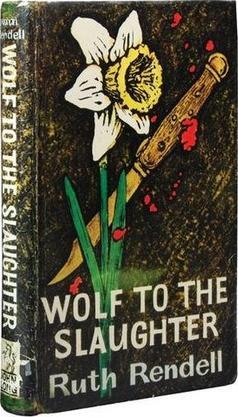
Cover image for the original John Long Ltd. (UK) hardcover edition from 1967. Image sourced from Wikipedia.
This was yet another excellent and unconventional mystery from Ruth Rendell and I am excited to continue this binge read for 2023. I have to try and source some of the non-Wexfords as well as I have never previously read those.
Trivia and Links
Wolf to the Slaughter was adapted as the very first of the Ruth Rendell / Inspector Wexford Mysteries TV series (1987-2000) as Series 1, Episodes 1 to 4 in 1987 with actor George Baker as Inspector Wexford. You can watch the entire 4 episodes on YouTube here.
Read about Five Key Works by Ruth Rendell in The Guardian, May 2, 2015.
Review of the Arrow Books/Cornerstone Digital Kindle eBook edition (2009) of the original John Long Ltd. hardcover (1967)
He had an inventive imagination but he could not visualise the concatenation of happenings that must have been the prerequisite to this letter.
I started a 2023 binge read / re-read of Ruth Rendell (aka Barbara Vine and this is her 5th book and the 3rd of the Chief Inspector Wexford series. As in the previous books, Rendell does not follow a strict plot structure with the cliches of the genre. There is a long subplot where one of Wexford's constables is romancing an apparent witness. His behaviour is stalkerish to a degree and that in itself becomes suspicious, but all is revealed in the twist ending. The significance of the title is also not apparent until the conclusion.
The case begins when an eccentric local artist indirectly reports his sister to be missing. It is indirect because he shows up at the police station asking for where he can hire a charwoman (house cleaner) in the absence of his sister. The front desk sends him away as a nuisance. Soon afterwards though, Wexford receives an anonymous letter:
A girl called Ann was killed in this area between eight and eleven Tuesday night. The man who done it is small and dark and young and he has a black car. Name of Geoff Smith.
The missing sister is Anita (called Ann) Margolis and everything seems to be clear, except that the name of the apparent culprit is an alias. Wexford and his assistant Burden have a lot of unravelling to do before all can be explained.
Cover image for the original John Long Ltd. (UK) hardcover edition from 1967. Image sourced from Wikipedia.
This was yet another excellent and unconventional mystery from Ruth Rendell and I am excited to continue this binge read for 2023. I have to try and source some of the non-Wexfords as well as I have never previously read those.
Trivia and Links
Wolf to the Slaughter was adapted as the very first of the Ruth Rendell / Inspector Wexford Mysteries TV series (1987-2000) as Series 1, Episodes 1 to 4 in 1987 with actor George Baker as Inspector Wexford. You can watch the entire 4 episodes on YouTube here.
Read about Five Key Works by Ruth Rendell in The Guardian, May 2, 2015.

March 1, 2017
It's a special novel that can survive the mistreatment I gave this book by dragging its two hundred pages out across a very busy week, so before anything else: kudos. (I also got the series order wrong and read this directly after From Doon With Death, so the book's competence continues to outweigh mine.)
Past a slightly self-consciously vague opening chapter with a mysterious couple and a knife, Wolf to the Slaughter opens with straightforward Inspector Mike Burden meeting a head-in-the-clouds artist who has wandered into the police station to see if they know where he would find a housekeeper because everything's been disorganized since his sister left, and that oh-what-fools-these-mortals-be bit of seeming local color soon opens up into a complicated and knotty mystery. Anita Margolis, a glamorous and lively party girl with a wad of cash on her, has gone missing, and her disappearance has caused more disorder than just a messy house for her brother. Sordid affairs keep being revealed--and even initiated--all over the place, and the novel becomes a lament of dissatisfaction as much as a mystery, a set of people looking at their lives and asking if that's all there really is.
Wexford and Burden are for the most part happy, and therefore happily exempt, able to walk through the muck without getting bogged down in it, which makes this a clear and coolly delivered take on a lot of hot emotions. Rendell writes a very controlled prose and I can see how someone might bounce off this, but I genuinely love how the Wexford books combine some of the puzzle-box elements of Golden Age mysteries with the sophisticated characterization and depth (and some of the darkness, too) of more recent literary crime novels.
Past a slightly self-consciously vague opening chapter with a mysterious couple and a knife, Wolf to the Slaughter opens with straightforward Inspector Mike Burden meeting a head-in-the-clouds artist who has wandered into the police station to see if they know where he would find a housekeeper because everything's been disorganized since his sister left, and that oh-what-fools-these-mortals-be bit of seeming local color soon opens up into a complicated and knotty mystery. Anita Margolis, a glamorous and lively party girl with a wad of cash on her, has gone missing, and her disappearance has caused more disorder than just a messy house for her brother. Sordid affairs keep being revealed--and even initiated--all over the place, and the novel becomes a lament of dissatisfaction as much as a mystery, a set of people looking at their lives and asking if that's all there really is.
Wexford and Burden are for the most part happy, and therefore happily exempt, able to walk through the muck without getting bogged down in it, which makes this a clear and coolly delivered take on a lot of hot emotions. Rendell writes a very controlled prose and I can see how someone might bounce off this, but I genuinely love how the Wexford books combine some of the puzzle-box elements of Golden Age mysteries with the sophisticated characterization and depth (and some of the darkness, too) of more recent literary crime novels.

April 20, 2011
I tried ten times to get into this, but it just wouldn't work. Rendell wanted to give the investigating team some personality by adding weird personal ambitions, arrogance and romantic lust. But just as I couldn't get interested in the murdered people and the suspects, the plot line of the policemen was even more boring.
To be honest, I couldn't finish the book, so this review isn't representative. The only thing I can say is that I often read pages automatically, only to find out after after a few minutes that I had no idea what I had been reading. It just didn't register. This sometimes happens to me when I am drunk or preoccupied with personal problems. In the case of Wolf to the slaughter, I was neither.
To be honest, I couldn't finish the book, so this review isn't representative. The only thing I can say is that I often read pages automatically, only to find out after after a few minutes that I had no idea what I had been reading. It just didn't register. This sometimes happens to me when I am drunk or preoccupied with personal problems. In the case of Wolf to the slaughter, I was neither.

May 10, 2010
Today Ruth Rendell is well known as a writer of thrillers with a fair amount of psychological tension in them. Wolf to the Slaughter is one of her earlier Inspector Wexford novels, and, while she's a competent writer and Wolf is worth reading, it lacks the edge that characterizes most of her later works. Wolf is police procedural focusing on a suspected murder, but with no body, Wexford and Burden are forced to start with no hard evidence, relying on their intuitions. A wealthy young woman fails to return home one night, and although her brother isn't worried, the police are. What follows is a manhunt for a fellow using the name Smith, who rented a "by the evening" room from a local woman who is, in effect, running a flophouse. It's interesting to watch the inspectors ferret out information, gleaning tiny nuggets of clues from various sources and trying to fit them into a coherent picture. Characters are one of Rendell's strengths, and this book is populated with quirky and lively ones. Much zigging and zagging finally leads to a truly surprising ending. Exciting it's not, but it is fascinating.

July 8, 2015
Difficult to follow this one. Maybe it was just the Kindle version, but it was hard to tell when one section ended and another started. It would be the middle of a conversation between characters it seemed and then it would jump to other characters not in the scene speaking. I found myself rereading paragraphs to try to follow the narrative. The beginning of the novel set up a nice mystery, but then it got bogged down with too many unlikeable characters. It was hard to care whether or not Ann or Anita was dead or alive. I don't think I will read any more of the Inspector Wexford novels. I prefer Ms. Rendell's psychological mysteries.
July 16, 2021
3.5 stars

July 2, 2020
Come join us in English Mysteries Buddy Read of this excellent series.
I just finished my reread after 40 years and would love to talk about it with you.
I just finished my reread after 40 years and would love to talk about it with you.

February 27, 2013
When I am absolutely in the mood to be gripped and entertained, I usually can rely on a mystery by Ruth Rendell or her pseudonym Barbara Vine to do the job.
So I was disappointed by this novel in the Inspector Wexford series. The narrative simply never takes flight. Perhaps one of its flaws is the lack of a dead body in the beginning. This is one of the oldest "contracts" in the mystery genre, and for good reason: a corpse sets the stakes high and charges up your curiosity. Your mind starts to tick over as you examine for evidence everything and everyone that comes into play. Lacking a body, readers don't even know if it's worth our time to follow the clues because--for all we know--the missing young woman may simply be off on a lark.
I found the most compelling bits to be the lustiness of the new cop, who tries but cannot resist the charms of the local shop girl. To his peril.
The problem here is that Inspector Wexford takes a backseat to the other cops in the story for so much of the time that no one is truly in the driver's seat. I usually enjoy the Inspector and would prefer him to orchestrate the action a bit more visibly.
This being Ruth Rendell, the writing is still at a very high level, so fans of this series will probably still enjoy this one.
So I was disappointed by this novel in the Inspector Wexford series. The narrative simply never takes flight. Perhaps one of its flaws is the lack of a dead body in the beginning. This is one of the oldest "contracts" in the mystery genre, and for good reason: a corpse sets the stakes high and charges up your curiosity. Your mind starts to tick over as you examine for evidence everything and everyone that comes into play. Lacking a body, readers don't even know if it's worth our time to follow the clues because--for all we know--the missing young woman may simply be off on a lark.
I found the most compelling bits to be the lustiness of the new cop, who tries but cannot resist the charms of the local shop girl. To his peril.
The problem here is that Inspector Wexford takes a backseat to the other cops in the story for so much of the time that no one is truly in the driver's seat. I usually enjoy the Inspector and would prefer him to orchestrate the action a bit more visibly.
This being Ruth Rendell, the writing is still at a very high level, so fans of this series will probably still enjoy this one.
July 16, 2020
This book was a mixed bag for me.
On the positive side, I liked the way that Wexford’s character is becoming more defined, and so is Burden’s. It’s almost like a father/son relationship in that Burden seems to want to define himself in contrast to Wexford, much as a teenage boy would.
Overall the plot was OK, but there is an element involving a newly introduced member of the police force that I found a bit implausible. And I was disappointed at the lack of women characters with any positive, or even neutral, qualities. Many of the men are unappealing, but I can think of at least one who did no harm!
Oh well, on to the next in our group read. Since I know that I've liked others in the series I'm still very much motivated to continue.
BTW, the narration was just adequate. I don't know if it's the fault of the reader or the editor/producer, but on more than one occasion there was no pause or other indication of a change in action from one character to another, meaning that I occasionally had to rewind to figure out what was happening.
All in all, so-so. Better than lots of crime novels but far from Rendell's best.
On the positive side, I liked the way that Wexford’s character is becoming more defined, and so is Burden’s. It’s almost like a father/son relationship in that Burden seems to want to define himself in contrast to Wexford, much as a teenage boy would.
Overall the plot was OK, but there is an element involving a newly introduced member of the police force that I found a bit implausible. And I was disappointed at the lack of women characters with any positive, or even neutral, qualities. Many of the men are unappealing, but I can think of at least one who did no harm!
Oh well, on to the next in our group read. Since I know that I've liked others in the series I'm still very much motivated to continue.
BTW, the narration was just adequate. I don't know if it's the fault of the reader or the editor/producer, but on more than one occasion there was no pause or other indication of a change in action from one character to another, meaning that I occasionally had to rewind to figure out what was happening.
All in all, so-so. Better than lots of crime novels but far from Rendell's best.

September 21, 2019
Got into the Wexford series backwards when I picked up one of the books from the New Books shelf at my local library several years ago and have finally started trying to read the lot now. My initial experience of Rendell was with her more psychological suspenses so I enjoy the Wexford procedurals (for lack of a better term). They aren’t exactly cozies, not exactly procedurals, and still have that feeling of peeking into people’s brains that gives the slightly eerie factor I enjoy from Rendell.
The joy of this book is that the reader actually witnesses the precursor of death in the very beginning without any understanding. The rest of the story is then sorting out the rather upfront accident from the convoluted facts of so many lives and actions. Having seen the British cold case drama, Unforgotten, I am reminded of how many people can be involved in a murder through the little actions & accidents of fate that we rarely think of and are certainly not aware of in the context of death. Someone dies, and many other lives are disrupted and/or ruined...
The joy of this book is that the reader actually witnesses the precursor of death in the very beginning without any understanding. The rest of the story is then sorting out the rather upfront accident from the convoluted facts of so many lives and actions. Having seen the British cold case drama, Unforgotten, I am reminded of how many people can be involved in a murder through the little actions & accidents of fate that we rarely think of and are certainly not aware of in the context of death. Someone dies, and many other lives are disrupted and/or ruined...
This entire review has been hidden because of spoilers.
September 16, 2013
à chacun son goût
I chanced on this book on my local library's "new books" shelves not long after its publication. It would be an understatement to say I was astonished. "Wolf to the Slaughter" remains my favorite Rendell book to this day, and I own and have re-read every one of them, several more than once. Those looking for traditional police procedurals can try the late Ed McBain's 87th Precinct series. Fans of the-end-justifies-the-means school of law enforcement have Michael Connelly's Harry Bosch novels; for more gruesome crimes and snappier dialog, there are John Sanford's Lucas Davenport books. I have read (and often re-read) every one of them and they are entertaining. But to my taste, there's no author who is so consistently good - and good at exposing the truths of the human heart - as Ruth Rendell.
I chanced on this book on my local library's "new books" shelves not long after its publication. It would be an understatement to say I was astonished. "Wolf to the Slaughter" remains my favorite Rendell book to this day, and I own and have re-read every one of them, several more than once. Those looking for traditional police procedurals can try the late Ed McBain's 87th Precinct series. Fans of the-end-justifies-the-means school of law enforcement have Michael Connelly's Harry Bosch novels; for more gruesome crimes and snappier dialog, there are John Sanford's Lucas Davenport books. I have read (and often re-read) every one of them and they are entertaining. But to my taste, there's no author who is so consistently good - and good at exposing the truths of the human heart - as Ruth Rendell.

October 18, 2016
I’ve always been able to rely on Ruth Rendell in the past when I wanted a good crime yarn on audio; one that wasn’t too complicated that I lost attention on my driving and was rather topical. But its clear that the early novels in the series that feature her ace detective Chief Inspector Wexford and his work in Kingsmarkham area were not as accomplished as the later titles.
Wolf to the Slaughter is the third in the series. I’m so glad that I read many of the later titles before this one because if this had been my first experience of the series, I wouldn’t have gone back for more.
It's about a woman who has vanished. She’s a bit of an odd flighty character living with her avant grade painter brother, both of them forgetful and not much use at domestic activities. Their life revolves around parties. There’s no body and as far as Wexford can discern initially no real crime. But he does have an anonymous letter which is hinting that there is something about this disappearance that warrants his attention. Off he goes with Inspector Burden and a young copper who lets his powers of observation collapse when he falls in love with a young shop girl. There are the inevitable red herrings before Wexford comes up trumps as we know he always will.
It might sound ok but it was really missing the edginess that I’ve found in her later work. This Wexford is a pale imitation of this older self and it shows. I was happy to get to the end.
Wolf to the Slaughter is the third in the series. I’m so glad that I read many of the later titles before this one because if this had been my first experience of the series, I wouldn’t have gone back for more.
It's about a woman who has vanished. She’s a bit of an odd flighty character living with her avant grade painter brother, both of them forgetful and not much use at domestic activities. Their life revolves around parties. There’s no body and as far as Wexford can discern initially no real crime. But he does have an anonymous letter which is hinting that there is something about this disappearance that warrants his attention. Off he goes with Inspector Burden and a young copper who lets his powers of observation collapse when he falls in love with a young shop girl. There are the inevitable red herrings before Wexford comes up trumps as we know he always will.
It might sound ok but it was really missing the edginess that I’ve found in her later work. This Wexford is a pale imitation of this older self and it shows. I was happy to get to the end.

August 16, 2018
This was a great read throughout, but the ending -- which I will not give away here -- notched this rating from a 4.5 to a 5 star.

February 20, 2019
One of the things that is so interesting about this series is that while it’s called the Inspector Wexford series, the stories are not actually told from his point of view. I don’t believe I’ve ever read another series with this feature.
This one is told from the perspective of a young Detective Constable Drayton, who is a relative newcomer to the Kingsmarkham force. The opening chapter shows us the murder scene, but it is opaque, if you will, and we aren’t shown all the details. A vague but genius artist reports his sister is missing, and it is assumed she is the victim.
From that point, we follow the police investigation; simultaneously, we are shown DC Drayton as he falls in love with a local girl, whose father owns a stationery shop.
This one is told from the perspective of a young Detective Constable Drayton, who is a relative newcomer to the Kingsmarkham force. The opening chapter shows us the murder scene, but it is opaque, if you will, and we aren’t shown all the details. A vague but genius artist reports his sister is missing, and it is assumed she is the victim.
From that point, we follow the police investigation; simultaneously, we are shown DC Drayton as he falls in love with a local girl, whose father owns a stationery shop.

March 14, 2020
Good detective story, with some terrific scenes and characters, but a little too spring-loaded so that everything works out at the end. .

March 31, 2025
I am rereading the wonderful Wexford series. Wolf to the Slaughter is the intriguing third book in this series and just what I needed, a British old police procedural mystery.
Rendell honed her craft on this series that went on to be a tv series. There is something for everyone who loves a good police mystery whodunnit.
Crime, murder, mystery, thriller of the old kind is just what is needed to escape for a while.
Rendell honed her craft on this series that went on to be a tv series. There is something for everyone who loves a good police mystery whodunnit.
Crime, murder, mystery, thriller of the old kind is just what is needed to escape for a while.

May 21, 2022
This almost felt like it was from a different series because it lacked the pacing and focus to make this a compelling plot, nor were the characters as interesting to follow as in others in the same series.
August 4, 2020
The ignominious beginnings of the great Wexford mysteries.
Writers used to dream of writing "the great American novel." Now authors have abandoned that in hope of creating a successful mystery series. Get readers hooked on the detective(s) and you're assured of a steady income as long as you crank out new books about Chief Detective Whosis or Private Investigator Whatever. The main characters, their histories, families, friends, and colleagues are carefully planned in advance, right down to the smallest detail.
Ruth Rendell was a reporter when she wrote a book about Inspector Wexford in the fictional town of Kingsmarkam, Sussex. "From Doon to Death" is a superb mystery and the public wanted more, but Rendell was a busy young wife and mother and she was also invested in writing her dark thrillers, some published under the name Barbara Vine. Not having planned to create a series around Wexford, it took a while for Rendell to perfect her characters and their quirks and their families.
In "Doon", Wexford is described as being fifty-two, "thick-set without being fat", and his family is never mentioned. In "Wolf", he's become a fat man who's always been fat and he has a "good-looking, gracious" wife and a seventeen-year-old daughter. "Sins of the Fathers" was published in the same year as "Wolf", but Wexford's daughter is now a married woman and his wife is described as being "plain, but pleasant looking." Definitely NOT planned in advance as a series.
I've read all three and "Doon" is head-and-shoulders above the other two. Could the second two have been books that were written earlier, rejected, and published because of the success of "Doon"? Or were they hurriedly written because Rendell's publisher demanded more Wexford books immediately? Writing is a tough racket and a new author can't afford to be uncooperative.
However it was conceived and written, this book is murkier and less satisfying than than Rendell's best books. Wexford and Burden haven't yet settled down into a comfortable partnership. They're vividly contrasting characters - Wexford bright, flippant, and secretly a softie, while Burden is serious, judgmental, and easily shocked - and that contrast is one of the appeals of the series. However, in later books they've come to respect and like each other. Also, there's little in this book about the families of either men. In later books, both detectives are devoted family men and glimpses into their home lives provides some much needed humor and relieves the darkness of Rendell's writing. That's missing in this book.
The theme is sexual obsession, Rendell's favorite and one of the reason her books created such a stir in the 1960's. An intelligent, happily married woman leaves her loving husband for an uncouth, abusive auto mechanic. An ambitious young policeman becomes a slave to a woman's unearthly beauty, even though he knows the girl isn't as innocent nor as helpless as she appears. A married salesman (a womanizer, but normally discrete) is so jealous of his eccentric, wealthy lover that he threatens to kill her if she leaves him. Why do we fall in love with a face, a body, or a mannerism and lose our common sense? It was a question Rendell never stopped asking.
There are some interesting characters, but no sympathetic ones. All are either self-absorbed or silly or both. And what about the shadowy "wolf" who apparently killed a young woman and disposed of her body without anyone being able to identify him? Murder without profit is the ultimate amateur crime, but could anyone but an experienced professional have covered his tracks so well? One witness says he drove a green car, but where is it?
It's a frustrating case for Wexford and Burden and it's a disappointing read for Rendell's fans who know how good she can be when she's on her game. A pretty good mystery for most writers, but not up to Ruth Rendell's high standards. If you're new to this author, don't start here.
Writers used to dream of writing "the great American novel." Now authors have abandoned that in hope of creating a successful mystery series. Get readers hooked on the detective(s) and you're assured of a steady income as long as you crank out new books about Chief Detective Whosis or Private Investigator Whatever. The main characters, their histories, families, friends, and colleagues are carefully planned in advance, right down to the smallest detail.
Ruth Rendell was a reporter when she wrote a book about Inspector Wexford in the fictional town of Kingsmarkam, Sussex. "From Doon to Death" is a superb mystery and the public wanted more, but Rendell was a busy young wife and mother and she was also invested in writing her dark thrillers, some published under the name Barbara Vine. Not having planned to create a series around Wexford, it took a while for Rendell to perfect her characters and their quirks and their families.
In "Doon", Wexford is described as being fifty-two, "thick-set without being fat", and his family is never mentioned. In "Wolf", he's become a fat man who's always been fat and he has a "good-looking, gracious" wife and a seventeen-year-old daughter. "Sins of the Fathers" was published in the same year as "Wolf", but Wexford's daughter is now a married woman and his wife is described as being "plain, but pleasant looking." Definitely NOT planned in advance as a series.
I've read all three and "Doon" is head-and-shoulders above the other two. Could the second two have been books that were written earlier, rejected, and published because of the success of "Doon"? Or were they hurriedly written because Rendell's publisher demanded more Wexford books immediately? Writing is a tough racket and a new author can't afford to be uncooperative.
However it was conceived and written, this book is murkier and less satisfying than than Rendell's best books. Wexford and Burden haven't yet settled down into a comfortable partnership. They're vividly contrasting characters - Wexford bright, flippant, and secretly a softie, while Burden is serious, judgmental, and easily shocked - and that contrast is one of the appeals of the series. However, in later books they've come to respect and like each other. Also, there's little in this book about the families of either men. In later books, both detectives are devoted family men and glimpses into their home lives provides some much needed humor and relieves the darkness of Rendell's writing. That's missing in this book.
The theme is sexual obsession, Rendell's favorite and one of the reason her books created such a stir in the 1960's. An intelligent, happily married woman leaves her loving husband for an uncouth, abusive auto mechanic. An ambitious young policeman becomes a slave to a woman's unearthly beauty, even though he knows the girl isn't as innocent nor as helpless as she appears. A married salesman (a womanizer, but normally discrete) is so jealous of his eccentric, wealthy lover that he threatens to kill her if she leaves him. Why do we fall in love with a face, a body, or a mannerism and lose our common sense? It was a question Rendell never stopped asking.
There are some interesting characters, but no sympathetic ones. All are either self-absorbed or silly or both. And what about the shadowy "wolf" who apparently killed a young woman and disposed of her body without anyone being able to identify him? Murder without profit is the ultimate amateur crime, but could anyone but an experienced professional have covered his tracks so well? One witness says he drove a green car, but where is it?
It's a frustrating case for Wexford and Burden and it's a disappointing read for Rendell's fans who know how good she can be when she's on her game. A pretty good mystery for most writers, but not up to Ruth Rendell's high standards. If you're new to this author, don't start here.
August 31, 2022
I enjoyed this early Wexford book, but it is certainly not as good as some of the later books.

June 9, 2014
I really think, in the earlier Wexford books, Ruth Rendell may
have been gearing up Inspector Burden to be the pivotal figure
in the Kingsmarkham series. By making him an uptight policeman
she may have hoped, book by book, to humanize him but it didn't
work that way and Wexford, who initially appeared as a grumpy
eccentric, took over. But in this book it is Burden who starts
to put two and two together and drags Wexford out on a cold night
to the Olive and Dove to try to sell him his theory. It is also
Burden who has the sympathetic nature - his treatment of the
pathetic Ruby and his emotion at the shy, gentle woman trying
to sell some rings to an unmoved jeweller is at odds with Wexford's
cynicism. She is to be the pivot to the whole story.
It all starts off with the disappearance of Anita Margolis,
beautiful, promiscuous sister of local artist Rupert - a cryptic
note accusing a Geoff Smith of killing a girl named Ann on the
Tuesday that Anita (who was called Ann) disappeared has Burden and
Wexford on the hunt to find her body. An old cigarette lighter
inscribed "For Ann who lights my life" leads to the killer but not
who they expect.
In an unusual subplot a young policeman, Mark Drayton, has been
taken under Wexford's wing. He likes the fact that Drayton doesn't
have the look of a typical copper - long shaggy hair, "a duffle
coat, I ask you" an exasperated Burden says, but Drayton has
serious emotional issues and when he gets involved with the pretty
girl who works in her father's paper shop his cold and austere
temperament gives in to passion and she may lead him to were there
is no return.
have been gearing up Inspector Burden to be the pivotal figure
in the Kingsmarkham series. By making him an uptight policeman
she may have hoped, book by book, to humanize him but it didn't
work that way and Wexford, who initially appeared as a grumpy
eccentric, took over. But in this book it is Burden who starts
to put two and two together and drags Wexford out on a cold night
to the Olive and Dove to try to sell him his theory. It is also
Burden who has the sympathetic nature - his treatment of the
pathetic Ruby and his emotion at the shy, gentle woman trying
to sell some rings to an unmoved jeweller is at odds with Wexford's
cynicism. She is to be the pivot to the whole story.
It all starts off with the disappearance of Anita Margolis,
beautiful, promiscuous sister of local artist Rupert - a cryptic
note accusing a Geoff Smith of killing a girl named Ann on the
Tuesday that Anita (who was called Ann) disappeared has Burden and
Wexford on the hunt to find her body. An old cigarette lighter
inscribed "For Ann who lights my life" leads to the killer but not
who they expect.
In an unusual subplot a young policeman, Mark Drayton, has been
taken under Wexford's wing. He likes the fact that Drayton doesn't
have the look of a typical copper - long shaggy hair, "a duffle
coat, I ask you" an exasperated Burden says, but Drayton has
serious emotional issues and when he gets involved with the pretty
girl who works in her father's paper shop his cold and austere
temperament gives in to passion and she may lead him to were there
is no return.

July 26, 2014
The start: The start was wonderful. A man and a woman pick up another woman at her house. Something happens in the house and we begin to suspect something went wrong. What that was, we have to wait until the end.
The middle: The book slows down a lot here. Half the time I'm not sure the detectives on the case know what they're doing. Especially when they have no evidence of a murder. I can understand why other readers almost gave up.
The end: The ending (and I mean the end) was exciting. We find out what happens to the missing girl.
The mystery: Was there a mystery? I guess it's the search of a missing person. Could have been a short story.
The characters: I realized that Wexford manages to avoid being in his novels as much as possible. I'm not sure why Rendell includes him at all. I didn't really have any feeling for the other characters.
The middle: The book slows down a lot here. Half the time I'm not sure the detectives on the case know what they're doing. Especially when they have no evidence of a murder. I can understand why other readers almost gave up.
The end: The ending (and I mean the end) was exciting. We find out what happens to the missing girl.
The mystery: Was there a mystery? I guess it's the search of a missing person. Could have been a short story.
The characters: I realized that Wexford manages to avoid being in his novels as much as possible. I'm not sure why Rendell includes him at all. I didn't really have any feeling for the other characters.

December 27, 2009
The sister of artist Rupert Margolis has disappeared, probably with some man or other, it is thought at first. Then a big, unexplained patch of blood is found in a hire-by-the-hour room, after an amorous pair was seen staggering out of the same house. Anita Margolis appears to have been murdered by a Geoff Smith. But the policeman on the case has fallen hard for a young girl near the police station, and his powers of observation have deserted him.
The key to the mystery is identity -- who was doing what? It is not a simple puzzle, and again in this Rendell mystery, the climax is powerful. Rendell doesn't need gore to create a riveting mystery, her characters do it for her.
The key to the mystery is identity -- who was doing what? It is not a simple puzzle, and again in this Rendell mystery, the climax is powerful. Rendell doesn't need gore to create a riveting mystery, her characters do it for her.

December 2, 2011
I found this terribly dated and pedestrian. The plot, characters and dialog were "clunky" and stilted. For me, it was the literary equivalent of those black and white films which the critics sometimes give high ratings but which are almost unwatchable as present-day entertainment.
I had to skip-read the last 50 or so pages, not because I wanted to know what was going to happen, but just because I'd invested a day of reading and I didn't want to consign it to the "abandoned" book shelf.
I didn't even find it interesting as an exemplar of life in 1967. Thank goodness I can move on to something else.
I had to skip-read the last 50 or so pages, not because I wanted to know what was going to happen, but just because I'd invested a day of reading and I didn't want to consign it to the "abandoned" book shelf.
I didn't even find it interesting as an exemplar of life in 1967. Thank goodness I can move on to something else.

January 17, 2019
"Wolf to the Slaughter" has all the nuts and bolts required for a police novel but it's not a gripping mystery. If you haven't read Rendell before, don't start with this. I'd recommend her short fiction, as well as her suspense novels, like "Master of the Moor", "A Judgement in Stone" and "The Killing Doll".
June 11, 2021
I have recently rediscovered Ruth Rendell's writing and am enjoying the experience.
Displaying 1 - 30 of 253 reviews