This volume seeks to expose the hollowness of condemnation divorced from understanding in relation to the Bulger murder trial. People have almost become desensitized to random murder. It is often explained away by madness, sexual fantasy or rejection. One murder in recent times reduced every person to the abduction and beating to death of a helpless infant by two ten-year-old boys. How and why did two innocent boys kill another? Is childhood innocence a myth? And what punishment could fit such a crime, assuming that children are fit to stand trial for murder? Blake Morrison went to the trial in Preston, and discovered a sad ritual of condemnation with two bewildered children at the centre. He looked for possible explanations in the boys' families, their dreary environment, their fantasies, their exposure to violent films. He evokes the worst feats of parents through candid and raw memories of his relations with his own children, and delves into his own childhood to reveal the worst thing he has ever done, to show how easy it is to go along with cruelty. Blake Morrison is the author of two collections of poetry, "Dark Glasses" and "The Ballad of the Yorkshire Ripper", and is co-editor of "The Penguin Book of Contemporary British Poetry". His memoir, "And When Did You Last See Your Father?" won the Waterstone's/Esquire Award for non-fiction and the J.R. Ackerley Prize for Autobiography in 1993.
Blake Morrison was educated at Nottingham University, McMaster University and University College, London. After working for the Times Literary Supplement, he went on to become literary editor of both The Observer and the Independent on Sunday before becoming a full-time writer in 1995.
A Fellow of the Royal Society of Literature, and former Chair of the Poetry Book Society and Vice-Chair of PEN, Blake has written fiction, poetry, journalism, literary criticism and libretti, as well as adapting plays for the stage. His best-known works are probably his two memoirs, "And When Did You Last See Your Father?" and "Things My Mother Never Told Me."
Since 2003, Blake has been Professor of Creative and Life Writing at Goldsmiths College. He lives in south London, with his wife and three children.
QUELLO DI CUI NON POSSIAMO PARLARE LO DOBBIAMO AFFRONTARE CON IL SILENZIO
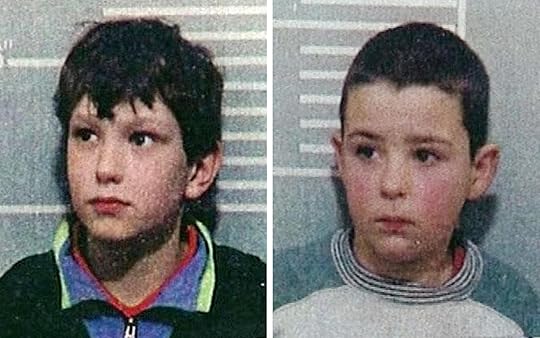
Jon Venables e Robert Thompson.
Un libro molto interessante, inquietante, angosciante.
Blake Morrison, poeta e saggista, s’improvvisa giornalista e lo fa nel modo migliore.
Entrando a far parte di quel genere di folla che non compare nelle foto della stampa, cioè proprio i fotografi, giornalisti, cameraman, reporter, segue il processo James Bulger (Liverpool, 1993), un bambino di quasi 3 anni assassinato da due bambini di poco più di 10 anni, lo racconta, ampia il raggio d'azione, riflette, medita, si pone domande anche imbarazzanti, azzarda risposte, invita a scrutare a fondo, a cercare non solo il dove, il quando, il chi e il come, ma anche il perché.
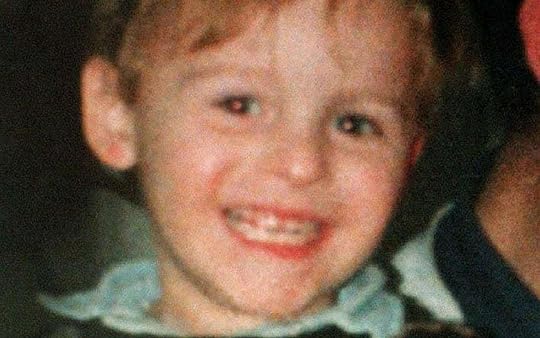
Jamie Bulger, la vittima.
Con la premessa che l'età della ragione, quella che determina la possibilità di essere processati da un 'normale' tribunale o meno, inizia a 8 anni in Scozia, a 10 in Inghilterra, Galles e Irlanda del Nord, a 12 in Canada, 13 in Israele, 15 in Norvegia, 16 a Cuba e 18 in Romania, la prima conclusione è che sono differenze arbitrarie dalle conseguenze enormi.
I due colpevoli avevano 10 anni e 8 mesi all'epoca del delitto ed essendo stati riconosciuti mentalmente in linea con la loro età anagrafica, sono stati giudicati da un tribunale di adulti: non c'era nessuno bambino della loro età nella giuria, la loro condanna non è arrivata da loro pari, come sarebbe giusto e normale aspettarsi.
Senza dubbio i due bambini avevano commesso il delitto. Un delitto brutale. E non ispiravano empatia, sembravano scostanti bugiardi anche arroganti: ma questo non avrebbe dovuto renderli più colpevoli.
Il processo ha individuato due responsabili e li ha condannati: ma non ha certo portato più vicino a capire la ragione per cui il piccolo James fu ucciso, e non ha fornito il perché Robert e Jon hanno fatto quello che hanno fatto.
Questo è quello che quasi sempre succede nei tribunali, ai quali forse i 'perché' non competono.
Ma è giusto che due bambini di quell'età, entrambi provenienti da un ambiente povero, degradato, violento, due bambini che sono stati incredibilmente violenti per qualche minuto (il tempo di uccidere il piccolo James, e forse anche il tempo di rapirlo e portarlo sul luogo della morte...), due bambini che in quei minuti forse ripetevano e rivivevano la violenza respirata vista subita dalla nascita, siano stati condannati al carcere 'normale' per dieci anni?
Blake Morrison lascia intuire che sia un rimborso e una scelta che difende e tranquillizza una parte della società, ma che sia sostanzialmente uno sbaglio, un'ingiustizia, e probabilmente un ulteriore abuso.
PS In un romanzo che ho letto di recente (Isla Berta) si sostiene che bisogna in qualsiasi modo evitare di essere giudicati da chi non conosce la verità. La qual cosa succede sempre sottoponendosi al giudizio di giudici e giuria, persone che non conoscono la verità.
Reading about this notorious case from a distance of 30 years was a strange experience. Having lived through it at the time, the shock, the outrage, the demonisation , the bigger questions, the focus on the individual, the nature of evil comes across in this measured account of a society struggling to come to terms with the brutality of children and what to do with children that kill.
Although I struggle to conceive there is anyone who is unfamiliar with the James Bulger case, it is the story of a toddler just shy of his third birthday who was abducted in a shopping centre by two ten year olds who walked him miles, inflicting casual violence on him en route until they take him to a railway line where they possible sexually abuse him, throw bricks and stones at him and beat him until he is dead at which point they leave his dead body on the tracks to be cut in half by the next oncoming train. The outcry at the murder was visceral and the boys were tried as adults, named and photos of them printed in the papers. There was ongoing debate as to how humane their treatment at the hands of the legal system was and this book covers it all.
Morrison is a journalist and been asked to covert the trial for an American publication and this book is his reflections on the nature of childhood, of children, of parenting and the quest to find out why. He discusses the demonisation of children in films and books around the time citing The Omen, Rosemary’s Baby, The Midwich Cuckoos etc and while I can accept this was a trope these films predate the murderers. In fact I would argue that, in the UK at least, this period saw the switch from the demonisation of children to the vilification of parents. Numerous child abuse scandals, satanic groups of parents sacrificing babies, latchkey children, children abandoned by negligent parents to be abducted or do battle against home invaders (Home Alone). These child killers (in both senses) were at the convergence of both, they were the demon seed but can we blame them or do we look at the inadequate parenting to answer why.
The murder had the hallmark of every issue in society that had been dominating the media for so long. Out of control kids, bad parenting, absent fathers, class (victim and perpetrators were all working class), unemployment (no adult from any family worked), Liverpool (a city plagued by disasters and corruption and mocked as a place of feckless, lazy, unemployed tracksuited inhabitants), procreation as recreation (one of the murderers was one of 8, the victim had nearly 20 aunts and uncles), disinterested schools with useless teachers (the killers regularly truanted, no-one phoned the day of the murder to see why they weren’t in school), watching video nasties. There was no problem in society that wasn’t present in this case. Morrison lists and explores all these factors but concedes that none seem to explain the horrific nature of the killing.
He explores the nature of children, how arguably they are inherently cruel, candidly recounting incidents of crimes against birds and insects. He also makes the confession of being involved in what today may well be classed as gang rape of a 14 year old while he is a teenager. Was it as big a crime then as now? Is it only mores that have changed? He cites previous cases of child on child murders and in light of the nature of children (are they all just repressed Piggy murderers as Lord of the Flies would have us believe?) expresses surprise that it doesn’t happen more frequently.
Morrison, while receiving some criticism for being too sympathetic to the killers, spends a lot of the time during the trial looking at parenthood. About the fears of raising a child when you see potential hazards everywhere, how what happened to the Bulger’s is every parent’s nightmare made manifest. Again he pulls no punches when talking of his own personal experience. He describes undressing his toddler daughter in terms of undressing a lover before making love (a deliberate ploy to discomfort the reader) and of how having her on his lap has caused him to have an erection. It is not done to shock but is a very honest exploration of a parent’s relationship with their child, that there is a physical element to it – we all love a toddler’s pudgy hand in ours, that we go from intense love to feeling you want to smother them in the space of an hour’s trying to get them off to sleep. There, in a nutshell, is the complexity of children – from angels to devils- and parents – from protector to would-be murderer- in the blink of an eye.
When every family experiences these extremes how much more must damaged, struggling ones? Morrison, despite sitting through the trial, never does get an answer to why. Maybe there was no why other than it was just a series of events that happened – which is what I think Morrison finally concludes. Should they have been tried as adults and convicted of murder, been named publicly, their photos everywhere to prompt wonderment that a chubby little baby face could be capable of such cruelty? Again its complicated and Morrison veers between seeing them as children incapable of understanding the enormity of their actions and retracing the events of the abduction and murder and realising how prolonged and calculated and intentional it was.
Like the events of the case the book offers no definitive answers, no whys, no rights and wrongs, no lessons learned. What it does do it bring into focus how hard it is to be a child and to be a parent. How close to disastrous actions we all are more often than we care to imagine. A humane, thoughtful book that brings new perspective to an event one imagined had been exhaustively discussed.
The 2* rating I’ve given AS IF in no way reflects on the excellence of the narrative, which leads one to read compulsively from page to page.
Rather, my rating of this book is to highlight what is mostly forgotten in this book: that a society, which forgets the victims of a crime in its concern for the rights of the perpetrators, is neither liberal nor civilised, but merely sliding from one unhealthy extreme of human nature to another.
Yes, as Morrison so eloquently calls for in the last chapter of AS IF, to be considered civilised, we must move away from a lynch mob mentality, which demands retribution with no thought or consideration of understanding the WHY of a seemingly unpardonable act. But that does not mean society should move to the opposite pole either, where thinking becomes so liberal that no individual, however violent, has to take responsibility for the consequences of his/her actions.
This is what AS IF does. An elegant and intellectual essay exploring the WHY behind the James Bulger murder, AS IF has one fatal, fundamental flaw: the author’s blindness to the fact that, in his strong identification with Thompson and Venables (more about the WHY of *that* later), he forgets to understand the fears and feelings, limitations and troubles of another young child and his family.
Several other reviewers of this book have indicated that Morrison focused too much on his own feelings to the detriment of the book. Although, at times, the prose is too consciously literary, too consciously long-winded (he likes his long lists, he does), it’s so lyrically emotional that this interiority of the well-written prose is what makes it such an interesting read.
However, what is more challenging and thought provoking about this book is the way the author identifies so strongly with the perpetrators and seeks excuses for them in their upbringing. He constantly defends them; in his aching compassion for them he seeks justification and excuses for their act to such a strong degree that he appears to lose sight of "the tiny victim" James Bulger, and his parents. This brought to mind the angry cry in Ralph Bulger’s recent book: “I get so angry that it always seems to be about them and not my baby.” [Pg 98 "My James: The Heartrending Story of James Bulger by His Father" by Ralph Bulger, Rosie Dunn|17269253]]
AS IF does make the Bulger murder case all about the “innocence” of the child murderers and the effect it had on their families and, by doing so, Morrison forgets the ravished innocence of James Bulger and the shattered expectations of his parents.
Given the anguished suffering of Morrison’s search for understanding the WHY behind the perpetrators actions before condemning them, this seeming inability of an otherwise erudite, compassionate and intelligent author to show an equal compassion for the Bulger’s side of the story puzzled me.
Why is his empathy reserved so clearly for the “terrifying experience” of the child murderers to the exclusion of any exploration of the utter terror of what young James must have experienced at the hands of these two perpetrators? Is it because Thompson and Venables are there, alive in court to garner sympathy with their youth and their tears, but James is dead and buried out of sight and, it seems in this book, mostly out of Morrison’s mind as well?
Why the understanding and compassion for the difficulties of Thompson’s mother Ann, and Venables’ parents, Susan and Neil when, even as he sympathises with her, Morrison subtly sneers at Denise Bulger for allowing Hello magazine to tell her story [Pg 58]? The Bulgers come from a similar background to the Venables and the Thompsons – poor, rough and uneducated. Thus, Morrison’s prejudice against them throughout the book [Pg 32; 227-229 & others] is incomprehensible when given his intense search for understanding and the compassion he has for the Thompson and Venables families.
Incomprehensible, that is, until near the end when he reveals – with what appears to be a searing honesty – the WHY of why he identifies so strongly with Thompson & Venables as “innocent” children unfairly judged for a crime they committed without a full understanding of what they were doing.
Morrison’s guilt at his youthful actions [Pg 208 to 214] lies at the heart of his need for society to forgive Thompson and Venables for, if they can find forgiveness, then surely he can too. But the cases are vastly different and Morrison’s arguments and defence of Thompson and Venables fail because of his inability to detach himself from his personal reasons for identifying with them. With that inability, he creates another injustice: he forgets the torment and suffering of the only truly innocent child in this case, young James Bulger.
For, as young as they were Thompson and Venables had a window of opportunity, when – even with a child’s supposedly limited consciousness of the difference between wrong and right – they could have chosen not to murder, and brutally murder at that, a young toddler who, in his innocence, had trusted them. Morrison himself, in justification and understanding of Thompson and Venables extreme abuse of James, quotes statistics that say 80% of abused children become abusers themselves [Pg 200].
Again, Morrison’s reasoning fails him because of his too-strong identification with the perpetrators. Why didn’t he look at this statistic in another way: 20% of abused children do NOT grow up to become abusers. On that long walk from Boodle Strand to the railway line, in all those long minutes that baby James was crying for his mum and his dad, why didn’t Thompson and Venables choose to become part of the 20% who do NOT abuse others and release young James rather than kill him?
Morrison’s closing chapter is a brilliant exposition of what forgiveness means and why it’s necessary for humankind’s evolution. But at what point does forgiveness become a doorway to condone actions that take humanity away from the very path of civilization that it’s supposed to lead us to in our quest to become more humane, rational beings?
Like the Bulger case itself, AS IF by Blake Morrison will raise more questions than it answers. Whichever side of the divide you stand on in this case, AS IF makes an important contribution in that it succeeds in removing much of the “demonization” of Thompson and Venables. One is left wondering whether they are merely lost souls, rather than pure evil. And one can’t help thinking, there but for the grace of God go our children: safe, happy and, hopefully, kind.
This is not so much a true crime book as a meditation on childhood, being a parent, danger, love, sorrow, and a yearning to find out why two ten year old boys deliberately - not accidentally - killed a three year old boy. It was a double nightmare for the whole British nation which happened on 12 February 1993 in the afternoon, in a shopping centre in Bootle, near Liverpool, when the three year old was inveigled away from his mother, whose back was turned, she was at the counter of the butchers buying lamb chops, and when she turned back to her son he was gone.
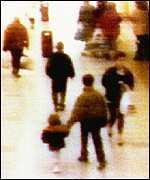
This was the famous CCTV picture of her son being led away :
The first nightmare was - your child vanishes, simply vanishes in the middle of crowded shopping centre. The second nightmare was - it is possible that two ten year old boys conceive the idea of stealing a young child and killing it, and having thought up the idea, could actually go ahead and do it.
So this book tries to think about these issues. Here's Blake on the subject of parental paranoia :
We teach him to stay on the pavement, a safe place until the day a careering joyrider,or police car in pursuit, mounting the kerb…
Time to eat: what shall it be? A fishbone in his gullet, the chip-pan whose handle he reaches for (boiling oil, 80 per cent first-degree burns), or the Brazil nuts (another allergy we didn't know about) swelling his throat? Now he is playing safely in his bedroom, the worst place to be when fire breaks out downstairs or when the giant elm we meant to show the tree surgeon topples on that part of the house.
A drive after lunch? A pity I didn't remember the safety belt or the child-protection lock on the offside rear door; a pity I let him lie on the shelf in the Range Rover, beside the paneless window (broken by thieves last week meant to get it fixed), never thinking that at eighty on the motorway the force, as in an aeroplane, would suck him out.
Holidays now: the wardrobe in the rented villa that topples as he tries to climb inside, the rapids, the windy cliff edge, the bull, the snake, the offshore breeze dragging off his rubber dinghy, the collapsing sand tunnel on the beach. Phew, September again, his eleventh September, he's made it through primary and now it's big school - the magic head injury on the rugby field, the knife-carrying nutter walking in off the street, or the choice of schooltrips: which will it be, the minibus crash, the avalanche while skiing, or the canoes swept out on a hypothermic sea?
But it's all right, he's a teenager now, he graduates from being drowned, set alight or hanged from a tie by schoolmates, the "prank that went horribly wrong". He remembers from last time that the Rottweiler behind the warehouse fence has the jaw, when you get too close to the wire, to scalp you through the mesh. He knows from previous incarnations how quickly a pothole fills with water, how fast fog comes down on the mountain. When policemen tell him there's a bomb alert, will he step this way please, he knows from bitter experience to move quickly and never risk the cordoned-off streets. He is growing up now, he reads the papers, he is coming into new powers as a citizen. At sixteen he can die legally on a motorbike, at seventeen in a car (or under a car: a puncture on the bypass, that cranky old jack I told him never to use), at eighteen from alcohol poisoning. He develops a drug habit, a heroin habit. He's HIV-positive. He commits suicide (from a bridge, off a towerblock, under a tube) just before Finals. He takes up hang-gliding, rock-climbing; a rope snaps, a chute fails to open, we get the call in the middle of the night, the I'm-sorry-to-have-to-tell-you knock at the door. He is in a bar, a bank, a shopping mall, the innocent bystander caught in a robber's crossfire - or maybe he is the robber, the bullet a police bullet. No, he is a shy, unworldly kind of boy, who likes to be helpful about the place, who wants to surprise me by Flymoing the lawn even though the grass is wet, who severs the electric cable, can't grasp why the machine has stopped, stoops down, bemused, picks up the power line...
You see it topples over into a horribly inappropriate gallows humour. I thought the whole book was brilliant.
An utterly uncomfortable read, and not in the way I was expecting.
In 1993, Morrison was tasked with attending, and reporting on, the trial of Thompson and Venables. As any human would, he was desperate to find out the reason why. That, in fact, was the main reason I picked this up, as I imagine would be the incentive for anyone reading this - what could possibly have driven two ten year olds to commit such a deplorable crime?
As I had already subconsciously assumed, no why is provided in Morrison’s commentary; no why ever seems to have been found. Instead, he documented facts of the crime, the trial, and the criminals, and chose to pepper alongside these some anecdotal whims from his own life. I found these largely unnecessary.
The book began well and engaged me, until Morrison’s sympathy for Thompson and Venables shone through more clearly. He makes no secret of this, and puts forth arguments on how both children were hard done by - tried in an adult court, raised in violent or emotionally abusive households, exposed to films targeted to much older people, etc. He argues a lesser verdict, or lesser sentence, would be more appropriate. He suggests we would live in a brighter world should society move from current lynch mob attitudes, to a far more liberal and therapeutic retribution for criminals. When it comes to a beaten two year old, who has been subjected to terrors we cannot even begin to imagine, I beg to bloody differ.
It’s a serious look at both the Thompson and Venables families, casting light on past abuse, sympathising with both sets of parents, and painstakingly making a case for their veneration. Although I can also sympathise with the parents to a degree (how do you come to terms with having a killer as a son?), the sympathy for the Bulger parents was clearly lacking. Coming from the same types of backgrounds as the Thompson and Venables parents, the Bulgers weren’t given the same care. Morrison grotesquely criticised Denise in particular, and at one point made uncomfortable comments on her outfit choices, which almost felt like a fervour of fetish.
For James himself, no remorse was overly apparent. Yes, Morrison had a few dreams about him (how sick I became of reading of his insipid dreams), and mentioned him a few times in an attempt to reestablish some humanity to the essay. But nothing rang true. Morrison’s sympathies lay with the killers, and only the killers, not the little boy who lost his life, not the complete trust he put in two strangers only to have his trust mercilessly broken, and not the guilt and heartbreak of a woman who was only permitted two years with her beautiful son.
Morrison also makes disturbing comparisons between the crime, and children's games, in an attempt to suggest Thompson and Venables were too young to realise what they were doing. In a macabre and unsettling description of himself as a child playing doctors and nurses with friends, he argues children are merely exploring bodies without the prior knowledge of sexuality. Exploring bodies and ending the life of a body are completely different things. This was such a distasteful and harrowing point to even attempt to make.
And, towards the end, we soon discover where Morrison’s sympathies come from. As he admitted to a sordid act he took part in during his own adolescence (similar to doctors and nurses, only far more unacceptable), the bile raised in my throat and it took all of my willpower to reach the last page. Morrison is sympathising with James Bulger’s murderers in a horrific attempt to absolve himself of his own sins.
Call me No-Heart (many have), but if you harm a child, you pay the price. Any attempts to justify will only do greater injustice to those already hurt by the crime. A disgusting attempt to make excuses for two boys who committed one of the most vile atrocities in our lifetime.
I think that the Jamie Bulger case still holds a morbid fascination for most people who lived in the UK at the time of his disappearance, the discovery of his body and the subsequent trial of Robert Thompson and Jon Venables. The whole country shared in the fear at the reports of the disappearance of such a young child, the hope when the CCTV footage of James being led away by two other children was revealed, and the horror and incredulity when it emerged that they had brutally killed him. I hadn't followed every detail of the court case, so the book told me some details that I hadn't been aware of, but in a completely unsensational manner. Blake Morrison was present at the trial of Thompson and Venables, and considers them as victims of their circumstances and the legal system. In fact, he lays himself open to criticism with his descriptions of incidents in his own childhood and youth which could have been misconstrued and lead to conviction if they had not been such a common experience at the time, and undoubtedly since; one person's drunken teenage party exploits could be another's traumatic experience of rape. Likewise, children seem to have an inborn cruelty and a natural curiosity about death. Taken to extremes, this can lead to crimes such as those committed by Bulger's murderers. Poignant and thoughtful, Blake Morrison wonders if the crime was a result of an over-active imaginative game of make-believe (As If), or if it should be viewed as taking the alternative meaning of the phrase 'As If'; "yeah, right, believe that if you want!"
This book is fascinating and balanced and beautifully written, without dwelling too much on the gruesome details; this is no forensic murder mystery. It was written before the more recent conviction of Venables as a paedophile. How could the two perpetrators ever have grown up to be normal boys after such a crime? How could they have been subjected to the ordeal of listening to their previously-recorded testimonies in court, in front of the assembled press and their victim's extended family? How could they have done what they did, been sentenced to spend the rest of their childhoods in prison, separated from their families and normal life, and ever have returned to the normal world? Were they intrinsically evil, or was this one, isolated incident? As if!
"To understand is to forgive" This book was extremely well written and much more than I thought. It isn't a mere telling of facts (hardly), it goes deep into exploring some main issues of childhood and the author is not scared to put himself on the stand as well, reevaluating even his own childhood and I really respect that.
It is very thought-provoking and makes you actually rethink your own childhood actions (and the ones you see around you). I read some reviews complaining that this book focuses too much on the perpetrators' pain than on the victims' one and I don't really understand where they come from; of course it does, the title says it clearly: it is about the trial, the crime, not strictly about the victim! So many people say "it is a horrid crime, they should pay!" It is very easy to say that, to judge others, to elect oneself to bringer of justice and bringer of death especially, and much less easy to empathize, to understand, to go beyond appearences. So few people even try to do that (as I read in some reviews) and that's why the world sucks! Even for governments is much easyer to put someone in jail than to rehabilitate him/her; too much money, too much time. And in this case, also because of the media scandal, the pressure, much easyer even if they were just kids; just children after all, children that were trialed as adults and children that clearly had issues. And how all the facts about their issues were ignored is really unnerving and unjust to me.
Of course, it was a terrible crime, disgusting and I can't even begin to comprehend the pain the parents went through, but it all goes beyond, in my opinion, the pain of one part or the other and more into, as the author says, "a question of childhood".
I wasn’t sure I would enjoy this (enjoy is probably the wrong word) and to begin with I thought that the author was being a little too inappropriately literary for such a devastating subject. By the last chapter, I felt uncomfortably challenged and horribly engrossed.
Morrison was fascinated, appalled and obsessed by the James Bulger case (sometimes to the detriment of familial relations and his own wellbeing), not just for the disturbing nature of the crime itself but because of the public reaction and what this said about our humanity. The author asks more challenging questions about how we define and understood childhood, where personal responsibility begins and ends, what justice is supposed to achieve and our capacity for forgiveness and understanding in the face of a crime beyond ordinary comprehension. This book presents a personal rather than academic view and in turning his focus inward, the author goes to some dark places. I will be thinking about this book for a while.
I've recommended this book to lots of people. It analyses what made Robert Venables and Jon Thompson kill little Jamie Bulger and brings us all frighteningly close to understanding how close we might all come to terrible things if circumstances were different.
A stunning look at the James Bulger murder case. In some sense we are all guilty and Morrison makes the point that we who are without sin should cast the first stone. A horrid crime, a horrid trial, a horrid legacy but a tremendous book.
Way to much Author interference with the story. I read the whole book because I wanted to see how it ended. WASTE OF TIME! This is a horrific crime and did not need the speculation and the added commentary by the Author and his every day life.
A hard one to review because of just how disturbing a story it is. But it is incredibly written and the humanity and nuance on such an emotional subject/story makes this a phenomenal read.
This a a stunning achievement. It's more like a poem than a piece of reportage, but I think it should be on every British person's reading list. We have a problematic culture of punishment which is heavily weighted in terms of retribution. Regardless of your view on the killers of James Bulger, this is a thoughtful account of a freak event and doesn't shy away from the details. It's low key and unsensationalist and completely necessary. Read it.
As I was reading a library copy of this book, I would recommend that you read a copy published after 2011, as the author has written a very important afterword. He reflects on his own writing decisions of what he chose to include. This was a controversial book due, to the sensitive topic, and the inclusion of content about the author's own sexuality. I found it incredibly honest, well written, and very thought-provoking.
This was the first book I found on the Jamie Bulger murder. It was such a frustrating read; it bogged me down time and again with a word-by-word transcript of the evasions and denials of the two murderers. There is a time to summarize and a time to expand. The author does not know which time is which.
A brilliant examination of the James Bolger murder. Morrison writes with great fluency and honesty, following the progression of the trial and examining at own attitudes and experiences of childhood and fatherhood.
The worst by far of Morrison's books: self-absorbed, droning, unconvincing. It says pathetically little about the killing or the people involved but says a lot about Blake Morrison, Blake Morrison’s childhood, and Blake Morrison’s magazine commission. Avoid.
I never leave reviews but I felt I had to explain my (only time ever) 1star rating! I decided to read this after reading James parents books and wanted a deeper insight into the case. I have never read so much drivel in my life! If you want to know all about his family and his mothers house and wardrobe and about watching people in a restaurant and his dreams then your onto a winner! More like a biography than a book on a murder! Then he went into undressing a female, removing her tights and blouse and seeing her nipple and flat stomach etc and I assumed he was referring to his wife……no he was describing his young daughter! And finally I had to stop reading before the end when he admitted getting an erection when he has a child in his lap! Worst book I have ever battled almost to the end with! *updated, I decided I couldn’t give up that close to the end and it just got worse. The man defended both T&V and altho he felt sorry for Poor little James he also felt sorry for them vile murderers! And when you get towards the end you can see why, he has a sick mind himself! This man was the wrong person to write such a delicate subject, may of been ok if he hadn’t turned it into a biography of sickening endings! Don’t waste your money or time with this book!!!
I was recommended this book by one of my writing supervisors, and I found it really thought provoking. It centres around the kidnap of Jamie Bulger and his young killers Venables and Thompson. The author, discusses the psychological reason why the young killers would’ve been drawn to kidnapping a child out of a shopping centre and killing him. There were times in the book when the specific details of Jamie Bulger‘s death was related ad nauseam and that was a little difficult to read. Although the author does pick apart the childhood of both Venables and Thompson, so that we see a pattern of behaviour that led back to their own parents. I found at times, that the author brought too much of his own personal life into the book, and although it was sentimental and emotional at times, it took away from the details of the case he was analysing. I expected from the book, clear-cut, answers as to why these boys offended in the way that they did, but I came away, not really having a final conclusion as to what brought these children to kill in the cold hearted way they did. Nevertheless, a recommended and thought-provoking read.
I struggled with this book at times. The author appeared to be indulging himself by using the topic as a way of maybe cleansing himself from things he had done wrong. But it was also thought provoking and horrific to read at the same time. It raised a view that I have always shared myself, three families were destroyed. The perpetrators were 10 years old, children themselves who did not have consistent appropriate role models, who yes they may have known right from wrong but did they wake up that morning with the idea they were going to kill or did it all get out of hand and they didn’t know how to stop it. I doubt anybody including those boys (now men) will ever know why such a tragic crime happened but I know I for one feel extremely uncomfortable with how the British justice system dealt with this and how the papers got their pound of sensational ten fold
Can't help but feel like large sections of the book are just unnecessary filler. Like one chapter is dedicated to the authors normal routine family life and it has nothing at all in relation to the James Bulger case.
Also thought it was unnecessarily weird/disturbing at points. Examples I can recall- author describing changing his daughter's clothes almost sexually/ getting erections when his kids sit on his knee. I just fail to see what this adds or what the specific intention of including this was, other than to make the reader uncomfortable.
Honestly surprised with the vast majority of positive reviews. My summarising thoughts are that it feels like the author was desperate to offload some taboo thoughts/memories/opinions, and a lot of this book is essentially a memoir under the the guise of a topic that was more likely to be published (a true crime). A very bizarre read.
One of the best true crime books.Morrison dares to confront the disgust and fury evoked by the Bulger case.He broadens the picture and looks into the wider details of the terrible day and events from his own past.When we seek to condemn others as evil, particularly children, it seems only fair that we recall what we were like back then and what misdeeds we did or could have done if things worked out differently. There's a message to bystanders to step in if they have suspicions (several people ..almost stopped the murder).
i liked his prose and it took an interesting perspective. but it was a bit weird...it got semi autobiographical as well as murder-orientated towards the end which was uncomfortable AND then there was a stomach churning bit about having sex with his wife that turned into his children?? it was too much and too ambitious and badly executed at the end (the first three quarters were good).
This entire review has been hidden because of spoilers.
Choose another book if you want to know about the Bulger case
Not what I was expecting. Very little about the case and mostly just a collection of confused ramblings about his childhood and liberal views. Wish I had not wasted my time and money, would have given zero stars if possible!
Do not read! The author made this all about himself and the way he talks about his own kids is perverted. I can't believe this got published, extremely disrespectful and quite frankly freaky! He admitted to getting erections holding his kids and being part of a gang rape! No need for a lot of whats in this and did not really shed light on the case.
I'd give it 3,5 stars - There are parts that I did not really enjoy, as it felt like the author was rambling on about his personal life without relating it directly to the James Bulger case. However, I really liked the last chapter and I think everyone who has an opinion on the case should read it. The amount of things that went wrong in this trial regarding the two boys is shoking.
Honest… maybe too honest at some points, but overall an interesting deep dive into the relative depravity of children and early teenagers. Part memoir and part trial reporting, this book did not disappoint in its detail. At points, Morrison does identify a bit too much with the child-killers, without really digging into how disturbing that is.