This book was converted from its physical edition to the digital format by a community of volunteers. You may find it for free on the web. Purchase of the Kindle edition includes wireless delivery.
Louis Marie-Julien Viaud was a writer, who used the pseudonym Pierre Loti.
Viaud was born in Rochefort, Charente-Maritime, France, to an old Protestant family. His education began in Rochefort, but at the age of seventeen, being destined for the navy, he entered the naval school in Brest and studied on Le Borda. He gradually rose in his profession, attaining the rank of captain in 1906. In January 1910 he went on the reserve list.
His pseudonym has been said to be due to his extreme shyness and reserve in early life, which made his comrades call him after "le Loti", an Indian flower which loves to blush unseen. Other explanations have been put forth by scholars. It is also said that he got the name in Tahiti where he got a sun burn and was called Roti (because he was all red like a local flower), he couldn't pronounce the r well so he stuck with Loti. He was in the habit of claiming that he never read books (when he was received at the Académie française, he said, "Loti ne sait pas lire" ("Loti doesn't know how to read"), but testimony from friends and acquaintances proves otherwise, as does his library, much of which is preserved in his house in Rochefort. In 1876 fellow naval officers persuaded him to turn into a novel passages in his diary dealing with some curious experiences at Istanbul. The result was Aziyadé, a novel which, like so many of Loti's, is part romance, part autobiography, like the work of his admirer, Marcel Proust, after him. (There is a popular cafe in current-day Istanbul dedicated to the time Loti spent in Turkey.) He proceeded to the South Seas as part of his naval training, and several years after leaving Tahiti published the Polynesian idyll originally named Rarahu (1880), which was reprinted as Le Mariage de Loti, the first book to introduce him to the wider public. This was followed by Le Roman d'un spahi (1881), a record of the melancholy adventures of a soldier in Senegambia.
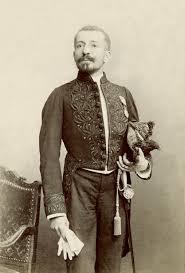
Loti on the day of his reception at the Académie française on 7 April, 1892. In 1882, Loti issued a collection of four shorter pieces, three stories and a travel piece, under the general title of Fleurs d'ennui (Flowers of Boredom).
In 1883 he entered the wider public spotlight. First, he publish the critically acclaimed Mon frere Yves (My Brother Yves), a novel describing the life of a French naval officer (Pierre Loti), and a Breton sailor (Yves Kermadec), described by Edmund Gosse as "one of his most characteristic productions".[1] Second, while taking part as a naval officer in the undeclared hostilities that preceded the outbreak of the Sino-French War (August 1884 to April 1885), Loti wrote an article in the newspaper Le Figaro about atrocities that occurred during the French bombardment of the Thuan An forts that guarded the approaches to Hue (August 1883), and was threatened with suspension from the service, thus gaining wider public notoriety.
In 1886 he published a novel of life among the Breton fisherfolk, called Pêcheur d'Islande (Iceland Fisherman), which Edmund Gosse characterized as "the most popular and finest of all his writings."[1] It shows Loti adapting some of the Impressionist techniques of contemporary painters, especially Monet, to prose, and is a classic of French literature. In 1887 he brought out a volume "of extraordinary merit, which has not received the attention it deserves",[1] Propos d'exil, a series of short studies of exotic places, in his characteristic semi-autobiographic style. The novel of Japanese manners, Madame Chrysanthème— a precursor to Madame Butterfly and Miss Saigon and a work that is a combination of narrative and travelog— was published the same year.
During 1890 he published Au Maroc, the record of a journey to Fez in company with a French embassy, and Le Roman d'un enfant (The Story of a Child), a somewhat fictionalized recollection of Loti's childhood that would greatly influence Marcel Proust. A collection
Not of much renown, but, definitely, a "curious" character, Pierre Loti, a former French naval-officer, and writer, would retire at the age of 60, after a well-travelled life and 40 years of service. He retired to his home in Rochefort, a place full of memorabilia. Later on, a museum was established with several rooms on different époques. In the mean time, he wrote several novels and travelogues. He even got better than Balzac on a certain contest.
This book is about his travels in the Levant area, more specifically in Egypt.
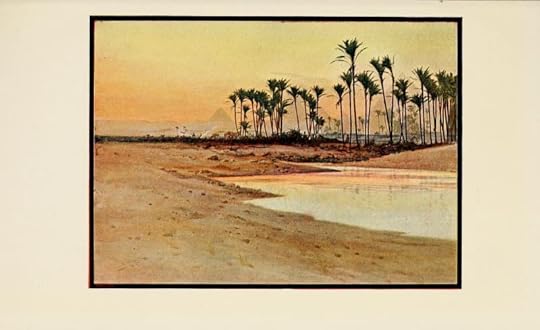
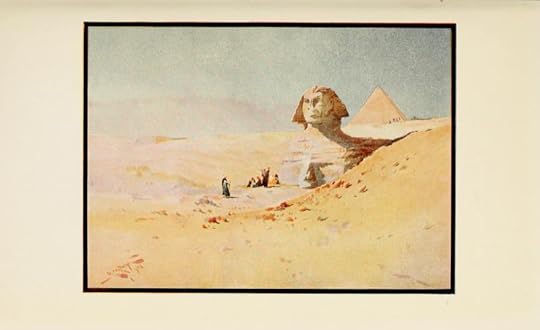
Remarkable to his eye sense was the color of the night (“a color unknown”—to westerners, it’s implied); and, subsequently, the pervasive “rosy...tint”. Several lines are dedicated to the Sphinx, deteriorating. And, of course, throughout the entire trip: to the pyramids.
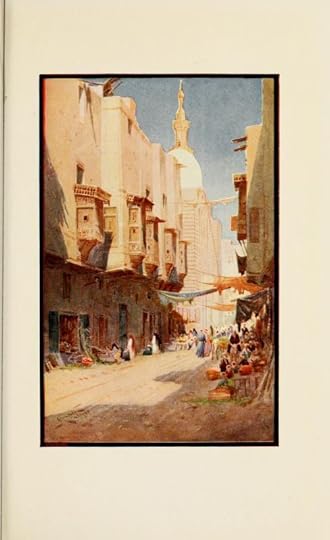
Then, January 1907. The bewilderment of Cairo, the city of the 3,000 mosques. Unlike the ones he was familiarized with, these ones use mosaic. He surely had some penchant on the esoteric (or the tetric?), because he had to pay a visit to the mummies of the museum at night. Traditions say that, overnight, certain “forms” detach from the mummies and other artifacts. It seems, on the departure side, he’d seen a dame…called Nsitanébashrou, alive.
Out of interest and respect, Loti described the many students who attend the “El-Azhar”, a center of Islamic study, to fulfill the imperative of the Prophet: ”seek knowledge” (if need be, go to China). Midst this entire Islamic people, and a lot of “rubbish”, Loti yet takes a sight at the Church of Saint Sergius.
“Pure Egyptians….a race of bronze fellahs”.
Views of the Memphis desert, as well as the black granite of the tombs of the Api and its catacombs are part of the trip.
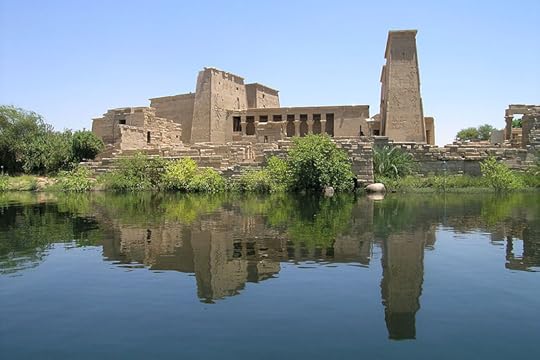
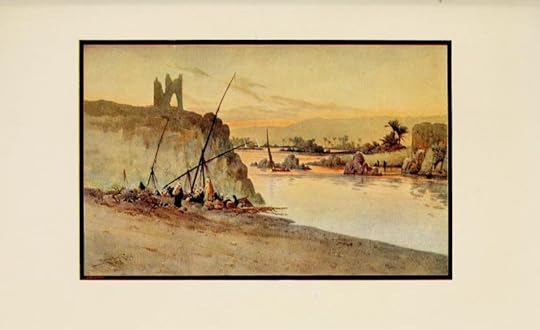
Surely, the Nile. He’ll embark on its ascent heading towards Luxor “colossal Temple” passing by Thebes and into Nubia. The voyage account stops at the cataracts of Aswan. Here it is introduced the theme/title of the book: the Philae, and the plan of the British to elevate the dam over the Nile. The Temple of Isis and most of the ancient temples of Nubia run the risk of being submerged.
(The Temple of Philae on Agilika Island)
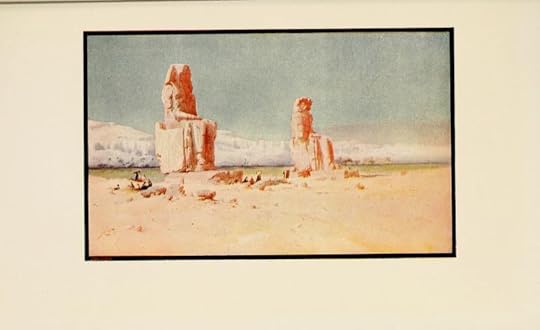
The book had been dedicated to his friend Moustafa Kamel Pacha who died in 1908. I was struck by the beauty of the illustrations.
I read the French version of the book ("La mort de Philae").
Loti’s poetic descriptions of place are beautiful to read, and really portray a vision of the setting as a nuanced place of death, change, and colonialism. As a whole a tough read, but if taken as individual travel essays/memoirs read one a time, very enjoyable and captivating. I could linger on a single paragraph for an hour.