The Eisner and Harvey Award-winning series continues! The time for delay is past. Itto Ogami and Daigoro are headed for Edo, to face Retsudo of the Yagyu once and for all! Stalked by bounty hunters and killers after their reward money, the Lone Wolf now faces deadlier enemies still. Retsudo has called out the nation's most accomplished rifleman, and dispatched a cannon-laden man of war, to intercept the father and son as they navigate treacherous cliffs and the high seas of Japan!
Kazuo Koike (小池一夫, Koike Kazuo) was a prolific Japanese manga writer, novelist and entrepreneur.
Early in Koike's career, he studied under Golgo 13 creator Takao Saito and served as a writer on the series.
Koike, along with artist Goseki Kojima, made the manga Kozure Okami (Lone Wolf and Cub), and Koike also contributed to the scripts for the 1970s film adaptations of the series, which starred famous Japanese actor Tomisaburo Wakayama. Koike and Kojima became known as the "Golden Duo" because of the success of Lone Wolf and Cub.
Another series written by Koike, Crying Freeman, which was illustrated by Ryoichi Ikegami, was adapted into a 1995 live-action film by French director Christophe Gans.
Kazuo Koike started the Gekika Sonjuku, a college course meant to teach people how to be mangaka.
In addition to his more violent, action-oriented manga, Koike, an avid golfer, has also written golf manga.
‘Seasons of Death’: Itto and Daigoro play a small role in this story which centres on the rash actions of a young man who steals his sweetheart just before she is forced to marry the son of a local noble. Holding out in a small shack and threatening to kill both himself and his love if anyone tries to intervene, Itto arrives just in time to stop the local fighting force from overwhelming the young lovers. Interestingly we don’t see any of the bloody action of Itto’s defense, merely witnessing the horrified faces of the other locals as they see the men drop like flies before their eyes. The story’s theme seemed to be “the needs of the few outweigh the needs of the many”, as the young woman had only agreed to marry the noble’s son in order for her poor village to get fishing rights they sorely needed for survival, but as far as the young lover was concerned his desires were more important than that.
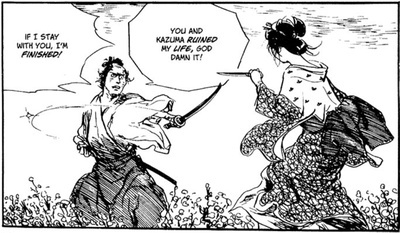
‘Wives and Lovers’: A samurai is on the road helping the wife of a former comrade track down her dead husband’s killer. They have been on the road for years, unable to find the killer and have become lovers (albeit ones that are starting to rub each other the wrong way). Feeling trapped and unable to either complete their mission or simply return home after so long they come across Lone wolf and Cub and initially think they have found the solution to their problem: kill the wanted criminal and return home as heroes regardless of their initial mission. Luckily for them Itto takes it easy on them and uses some tough love to help them to appreciate their true position.
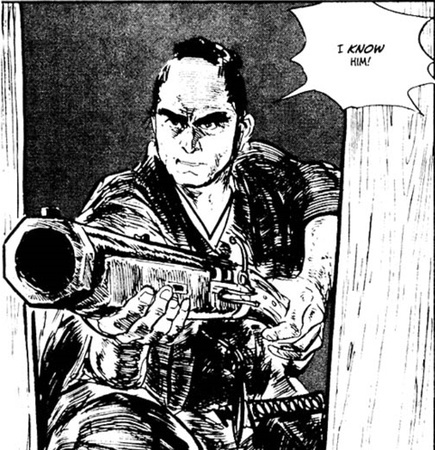
‘The Marksman’: Retsudo literally brings in the big guns to try and finally overcome Lone Wolf and Cub. Witnessing the marksmanship and destructive power of a samurai who has mastered the new technology of the firearm, he sends him out to kill Itto as the latter is climbing a dangerous mountain trail. Unwilling to simply shoot his quarry when he has an easy shot, the samurai instead chooses to take him on face to face…a bad decision as always, this time as much due to Itto’s wiley tricks as his skill with his weapons.
‘A Mother’s Flavor’: A prostitute tired of working under the harsh regime of her Yakuza boss sees Lone Wolf and Cub as they pass by and comes upon a plan: if she simply follows in the trail of the famous killer no one, including her vengeful boss, will dare try and force her back to her old life. She is mostly right, but still suffers from the inevitable fallout of putting herself in the path of the ‘demon’s road’ that Itto and Daigoro follow.
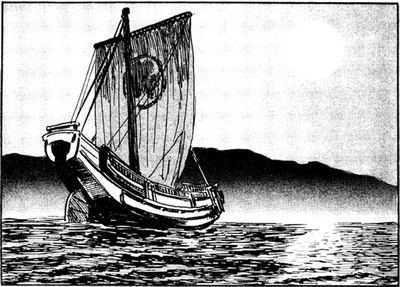
‘The Moon in our Hearts’: As with ‘The Marksman’, Retsudo is getting desperate and looks for more innovative ways to take out the troubelsome assassin who threatens to overthrow the mighty Yagyu clan. This time he dispatches the most powerful warship in the Shogun’s fleet on the chance that Itto will take a chancy sea-path towards Edo. Once again Lone Wolf’s opponent chooses the honourable path in his attack on the assassin and proves that it is definitely not the way to win against him. Itto makes short work of his opponent, though showing respect for his adherence to the true samurai code.
This volume was ok, but none of the stories really stood out for me with perhaps the exception of ‘Wives and Lovers’ with its protagonists whose relationship showed some intriguing complexity even if the ultimate resolution was perhaps a bit trite. It’s also interesting to see how those who choose not to fight dirty and instead be honourable inevitably lose in the end. Itto may respect them as ‘true bushi’, but he has no qualms about exploiting every advantage he can from his foes.
As in the world, so in our lifetimes. Four Seasons of Life. But for this father and son, There was only one season, The lingering season of Death ...
This is a very long series, filled with excellent story-telling and amazing artwork. It is perhaps inevitable that the reader feels the need to compare one volume with another, one new story with the ones that he considered the best from previous volumes and that sometimes the new falls a little short of the high expectations created. Still, even if I felt the current offer merits ‘only’ four stars, there are no stories that truly can be left out of the epic. Each one contributes to the overall monumental tapestry of Japanese society during the Shogunate and two out the five included even deal directly with the main plot. Some of the artwork feels rushed (contracted out?) but then the usual dynamic, detailed and filled with emotion style is back.
>>><<<>>><<<
Four Seasons of Death starts in spring, a season that forces ronin Ogami Itto to take the hardest road towards Edo, in an effort to hide his track from his enemies and from the multitude of bounty hunters set like a pack of wild dogs after him. Itto and his son Daigoro scale the rocky cliffs of the bay that leads to the capital city and, from their high perch, witness a local village drama. A marital cortege is ambushed by a lone, desperate young man who takes refuge with the promised bride in a hut by the beach, threatening to kill both her and himself if anybody tries to come close. Apparently, she was promised to him from childhood, but the village elders decided to give her instead to the son of the local warlord in exchange for fishing rigths that might save the village from famine. The arrival of Lone Wolf puts the fear of death in the retainers who are torturing the young man’s mother in an effort to make him release the bride. The scene serves the main plot by underlining the kind of killing reputation Ogami Itto has gained in the realm, when simply his presence in one place is a guarantee of slaughter for the unwary. The wise ones run out in terror when they see Itto.
Wives and Lovers is the sort of side story used in the series to make a point about bushido, the code of honor of the samurai class. When her husband is killed in a bar room brawl in Edo, his widow vows revenge against the man who killed him and sets out on a lone quest to find him. Her daimyo sends one of his retainers with her to assist in the quest. After four years on the road, the man and the woman become lovers locked in a self-destructive relationship where they blame each other for their ill fortune.
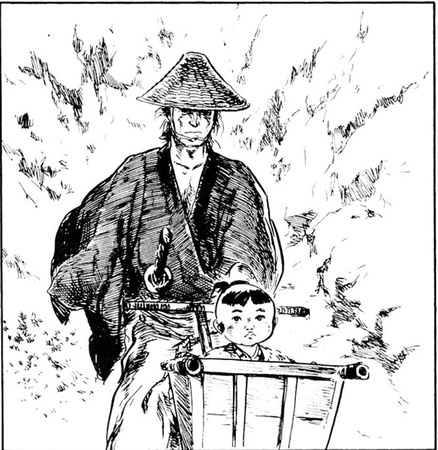
Once again, the entrance of the Lone Wolf, pushing his signature wooden cart carrying Daigoro, serves as a catalyst for a bloody confrontation between himself and the two roving samurai. They egg each other on to attack Itto in order to claim the reward, but Lone Wolf senses their desperation and refuses to engage in a duel. He feels they are not worthy of his anger.
The Marksman is yet another iteration of Retsudo Yagyu’s efforts to find a killer capable of removing Ogami Itto from the game board. This time he hires the Shogun’s most able sharpshooter, a man that has created his own school of martial arts using guns.
Itto and his son continue to use the back roads to Edo, once again almost stumped by the deadly cliffs by the sea. The episode is showcasing the artwork and the interesting perspectives used to convey the danger and the effort needed for rock climbing, while the expected confrontation between samurai sword and rifle will be decided, as always, by the two warriors bowing in obeisance to the bushido – a sort of guarantee of fair play that always puts Ogami Itto in the favorite to win spot. As a side note, maybe of little importance but becoming funny, Itto is making great efforts to make sure he doesn’t lose the wooden cart as he traverses impossible grounds. The gods themselves must intervene to save the signature cart after it is tossed to the waves only to re-appear conveniently on the beach after Itto does his Navarone-style escalade of the cliffs.
A Mother’s Flavor is the needed pause in the quest that relieves the extremes of terror and the gory details of death. That doesn’t mean that this story is less grim and deadly than the previous one, only that the emphasis is on an individual drama and on memories of a different life, lost on the path to Meifumado. A young woman sold in prostitution for a family debt and long abused by her pimp decides on a drunken night to escape. This is not her first attempt to break free and to return to her village, but this time she has noticed Ogami Itto passing by her house of ill repute and she believes the enforcers of the pimp will not dare to confront the Lone Wolf if she travels in his company. Itto tries to persuade her to chose a different path, but he bows to the principle of freedom of the road. At night, as they take refuge in a hovel, the woman notices that Daigoro is eating uncooked rice, and is moved to tears by the memories of the flavour of good white rice cooked by her own mother. She tries to show the young child what home cooking means, but her good intentions are repaid with the death that surrounds everything the Lone Wolf touches.
The Moon In Our Hearts is the the best episode in the album, probably the final desperate effort by the Yagyu to stop Itto before he enters Edo. After he lost all sons and a daughter to Lone Wolf, after he sent to the slaughter several secret organizations of assassins and three country clans, Retsudo now orders the biggest ship in the Shogun’s fleet to go and fire a broadside at the boat father and son are expected to take across the gulf.
The captain of the ship is more honorable than the Yagyu, and refuses to sullen the reputation of his master the Shogun with an act of cowardice under bushido. So he gives Itto a chance at a one-on-one duel, and we all know how that plot twist ends.
The title of the episode is a little more subtle that a sword stroke, and marks a quiet moment of introspection before the final battle, as father and son meditate on an empty beach about existence and predestination while the full moon seems to guarantee a sort of inner peace regardless of the outcome.
Little by little, the sheer number of kills Itto Ogami does in his path towards revenge takes a toll on him. As he draws nearer to Edo where Retsudo resides, The Lone Wolf's heart starts to feel some humanity and remorse. Perhaps he feel it the day he started this mission, but now it manifests outside
The Moon in our Hearts may not be as good as the previous two volumes (17 and 18), yet it advances the plot and takes the father and son closer to their goal. Everything commences for the final showdown between Retsudo and Itto, and I'm assured from what I have seen in this volume that there will be tons of bloodshed along the way. The Yagyu clan will not go down without a fight.
Ooof of bu seri benim yüreğimi dağlıyor. Artık 19. Cilti de bitirmişken bir yandan bitecek diye üzülüyorum, bir yandan araya çok zaman girerse unuturum diye endişeleniyorum. Sağa sola da sordum ama yok, sanırım bu ayarda bir seri daha yok.
Ölümün Dört Mevsimi: Sanki bu ciltte biraz genç aşıklar ve imkansız aşklara odaklanmış gibi geldi. Nadir olacak şekilde kimseyi öldürmeden aşıkların kavuşmasını sağladı Ogami Itto.
Eşler ve Aşıklar: Burada da erkek ve kadın arasında mecburi bir yolculuk, nefret, aşk, mecburiyet ve kınından çıkmadan çözüme kavuşmuş bir sorun.
Keskin Nişancı: Yalnız Kurt ve Yavrusu zaten muhteşem bir tarih yolculuğu. Bu yüzden Keskin Nişancı'yla artık yavaş yavaş ateşli silahlar da devreye giriyor gibi geldi bana.
Anne Yemeği: Çok trajik bir hikayeydi. Fahişenin ışığın altında sokakta yattığı ve Ogami ile Daigoro'cuğumun "gara gara" diye gölgelerden yaklaştığı sahne gerçekten inanılmazdı. Zaten ben renksiz, karakalem nasıl bu kadar muhteşem çizim yapılabiliyor hala aklım almıyor. Bu bölümden aklımda kalan "Çocuklar lezzet farkını annelerinden öğrenir" oldu.
Kalbimizdeki Ay: Daigoro'nun Daigo'su "aydınlanma demekmiş". Kahramanlarımız artık Edo'ya iyice yaklaştı. Yagyu ne kadar hain ve bushiden uzak olsa da denemeye devam ediyor.
Bu seride şunu merak ediyorum eminim ki o dönemde de cesurlar ve korkaklar vardı ama gerçekten insanlar onurları uğruna koca bir ömrü heba ediyorlar mıydı çok merak ediyorum.
Conforme se acerca a Edo, van saliendo quienes trataran de detenerlo, mientras los Yagyu se preparan para el enfrentamiento final, ahí avanza paso a pasito.
3.5 star
Este tomo te hace preguntarte, porqué a veces si ayuda a uno y a otros no, porqué a veces mata a ciudadanos inocentes que no eran ni riesgo ni estorbo, pero otras le perdona la vida a otros que si lo son o lo atacan, no parece haber un patròn o explicación que lo defina, parece más al azar, quizá es así.
Lone Wolf & Cub has entered Edo. It is not the end, but the beginning of the end.
The art is well done & rich in historical detail, the action scenes are kinetic & violent, but that has been true since the first volume. What is amazing is how consistently good the work has been.
A word of warning: though uncommon, the series is interspersed with nudity so if that's an issue, you ought to be aware that there are sex scenes, though they are not pornographic.
Itto Ogami está cada vez más cerca de su enemigo jurado, Retsudo, jefe del clan Yagyu. Sin embargo la locura que ha desatado una persecución que lleva a la tumba a justos y pecadores se ha convertido en una obsesión para el segundo y en una carga para el primero. Itto Ogami sabe que junto con él camina la muerte, que por donde pasa, se desata una carnicería y el camino de Meifumado ya le está pasando factura, pero no puede detenerse, porque de hacerlo, tanta sangra y tanta muerte se volvería inútil. Ya no hay vuelta atrás ni para él ni para el pequeño Daigoro.
The Yagyu are starting to run out of options, and Ogami perseveres. Koike has a surprising amount of situations to put them through, any modern writer would have run out of ideas long ago and started changing the basics a la deus ex machina. The thing I really appreciate about this series is that there are no doppelgangers, no clones, no long-lost family showing up, no identity crisis, no sudden temporary loss of skill, all the cliches and tropes are missing entirely. 19 volumes strong, and on til 28. What an achievement.
Siempre que pienso que la estructura de historias auto contenidas por capítulo se está volviendo cansada o que ya agotó todas las posibilidades el autor, regresa con alguna que otra sorpresa que me devuelve la esperanza en esta serie. Tenemos cinco capítulos, el primero tiene un final desgarrador pero toda la historia te tiene tenso en todo momento. Vemos al lobo y al cachorro ayudar a una anciana que a su vez les ayuda, y cómo sus vidas se conectarán más allá que eso. Tiene una bella reflexión sobre el amor y el cambio de las estaciones y cómo se mueven las estaciones para ellos quienes viven en Meifumado. La segunda historia se siente menos original, un samurai y su amante en búsqueda de venganza. Terminan enfrentándose al lobo y su cachorro y aprenden una gran lección. La tercera historia fue la que menos me gustó, no deja de tener aspectos interesantes pero es la menos original de las tres. La cuarta historia nos presenta a una mujer en un burdel, otra característica que hemos visto antes pero su historia es diferente y termina uniéndose con la del lobo y su cachorro de manera interesante. Al final de esta capítulo las emociones que los autores manejan son intensas, es un capítulo con un final agridulce bastante fuerte. La quinta historia es la mejor de todas. Padre e hijo preparándose para el duelo final contra Yagyu. Comienza con un aprendizaje bastante interesante y evoluciona en una estrategia para entrar a Edo. Al final golpea con intensidad y nos prepara para el enfrentamiento entre ambos rivales. Gran tomo.
Another strong volume that allows an easy return to the series. The landscape of Japan continues to be fleshed out, and this volume in particular strikes a balance between action-filled stories and more intimate, emotional moments. Four Seasons of Death highlights the standard heroics of Ogami, Wives and Lovers is an interesting tale concerning love and relationships, and the rest of the book deals with gunsmithing and a new plot from the Yagyu. The final story, The Moon In Our Hearts, is an entertaining (yet-not-so-unique) story that hints at just how worn down Ogami is from this journey. In rare bouts, this volume and the last few are slowly revealing that he himself is exhausted and ready for the end.
Another superb entry in the series that finds Ogami Itto and his son, Diagora, getting closer to Edo to challenge Yaygu, only to encounter numerous obstacles along the way. What makes this part of the series unique is how Koike continues the separate adventures as they journey, whether dealing with a star-crossed couple or an assassin with a deadly musket. It is matched by Goseki Kojima's gorgeous and crispy realistic art, depicting feudal Japan in both its beauty and brutality, especially in the action. Remains one of the best manga series ever.
A Mother's Flavor - back on the road - a prostitute decides that if she hung out with Lone Wolf and Cub, you could get away with running away. And it works for a time. We are reminded that Lone Wolf and Cub aren't about enjoyment. Brutal as always. But a pretty good quick read.
The Moon in Our Hearts - Lone Wolf and Cub head to the water. With trickery and cooperation. But as is typical lots of honorable people die. And the journey goes on. Another pretty good read, and this one had some memorable bits.
lobo solitario, finalmente te encaminas a la casa de tu enemigo. Al menos eso me quieres dar a entender ya que aún faltan entregas por leer y mira que estoy esperando el final de la serie aunque hay que admitir una cosa. De no ser por tus enemigos jurados, tu historia se movería a paso lento. Quizas, sólo quizás, estas entregas que faltan me digan lo contrario
Ogami Itto continues to journey towards Edo. On the way he encounters a couple who want to defy an arranged marriage, another dysfunctional couple who want to collect the bounty on Lone Wolf and Cub, a gunman with too much honor for his own good, and a woman who wants Itto's protection. Then in a final battle, Ogami Itto enters Edo in dramatic fashion.
It's a mark of skill that Goseki Kojima makes it easy to distinguish between faces even with such a simplistic art style, just through lines and shading.
More tension building, although it's not unbearable and the journey is enjoyable.
"Four Seasons of Death" Itto Ogamis Ruf ist ihm nun vorausgeeilt - bereits sein Anblick lässt die Leute verzweifeln und vor Angst schlotternd davonlaufen. Dies setzt er ein, um einer alten Frau zu helfen, ihren Sohn zu retten.
"Wives and Lovers" Ein Samurai begleitet eine junge Frau auf ihrer Suche nach Rache. Doch ihre Suche dauert schon lange erfolglos an, und als der einsame Wolf ihren Weg kreuzt, sehen sie ihre Chance, ihren Ruf wiederherzustellen. Die Leichen, über die sie stolpern, lassen sie ihren Plan nochmals überdenken.
"The Marksman" Schusswaffen wurden schon des öfteren benutzt, um den Wolf zur Strecke zu bringen - nie hat es funktioniert. Doch wie sieht es aus, wenn der beste Schütze Japans angeheuert wird?
"A Mother's Flavor" Wie schon in der ersten Geschichte wird hier der Ruf des Gejagten eingesetzt. Aber hilft dieser Ruf auch gegen eine ganze Bande Yakuza, die eine entlaufene Prostituierte zurückholen wollen?
"The Moon in Our Hearts" Diese Geschichte hebt den Band hervor: Der einsame Wolf im philosophischen Gespräch mit seinem Frischling. Graphisch wieder einmal überraschend sind die beeindruckenden Schiffsszenen. Auch dass, wie bereits in "Wives and Lovers", die Kämpfe nicht mehr explizit gezeigt werden, sondern nur noch die Leichen, über die Itto Ogami hinwegsteigt, finde ich eine interessante erzählerische Wandlung.
Nachdem Itto in den letzten Bänden wie ein Tier gejagt wurde, dreht sich nun die Sache - der Gejagte wird zum Jäger. Keiner mehr hat wirklich große Lust, für das monumentale Kopfgeld sein Leben aufs Spiel zu setzen. Ich bin gespannt, wie das langsam unausweichliche Aufeinandertreffen zwischen Yagyu Retsudo und Itto Ogami ausfallen wird.
The stories of these volume weren't very important for the story as a whole, although we know that something VERY BIG is coming.
Particulary I loved the climbing chapter (note that that mountain gave more bruises on Ogami more than any other adversary), also the boat chapter is filled with honor, making the lone wolf cry a little.
La sola presencia del lobo que lleva a su cachorro es intimidatoria. La luna alumbra el camino de Itto y Daigoro. Edo está cada vez más cerca. La sangre se sigue derramando.
"La venganza únicamente se alcanza desechando emociones como el amor, la obligación, el resentimiento, la alegría, el enojo, la pena y quedándose únicamente con el odio".
Both amazing stories AND amazing silliness. Lone Wolf scales unclimbable cliff in straw sandals. Lone Wolf gets soaked in the ocean and his clothes look the same wet or dry.