Jump to ratings and reviews
Rate this book

Shame and the Captives: The Tom Keneally Collection

Rate this book
Alternate cover for this ASIN can be found here

Based on true events, this beautifully rendered novel from the author of Schindler's List and The Daughters of Mars brilliantly explores a World War II prison camp, where Japanese prisoners resolve to take drastic action to wipe away their shame.

Alice is a young woman living on her father-in-law's farm on the edge of an Australian country town, while her husband is held prisoner in Europe. When Giancarlo, an Italian anarchist at the prisoner-of-war camp down the road, is assigned to work on the farm, she hopes that being kind to him will somehow influence her husband's treatment. What she doesn't anticipate is how dramatically Giancarlo will expand her outlook and self-knowledge.

But what most challenges Alice and her fellow townspeople is the utter foreignness of the thousand-plus Japanese inmates and their culture, which the camp commanders fatally misread. Mortified by being taken alive in battle and preferring a violent death to the shame of living, they plan an outbreak, to shattering and far-reaching effects on all the citizens around them.

252 pages, Kindle Edition

First published January 1, 2013

99 people are currently reading
1339 people want to read

About the author

Tom Keneally

33 books72 followers
See Thomas Keneally

Thomas Keneally was born in 1935 and his first novel was published in 1964. Since then he has written a considerable number of novels and non-fiction works. His novels include The Chant of Jimmie Blacksmith, Schindler's List and The People's Train. He has won the Miles Franklin Award, the Booker Prize, the Los Angeles Times Prize, the Mondello International Prize and has been made a Literary Lion of the New York Public Library, a Fellow of the American Academy, recipient of the University of California gold medal, and is now the subject of a 55 cent Australian stamp.

He has held various academic posts in the United States, but lives in Sydney.

Ratings & Reviews

What do you think?
Rate this book

Friends & Following

Create a free account to discover what your friends think of this book!

Community Reviews

5 stars
64 (9%)
4 stars
217 (33%)
3 stars
254 (39%)
2 stars
89 (13%)
1 star
25 (3%)
Displaying 1 - 30 of 143 reviews
Profile Image for Michael.
1,094 reviews1,968 followers
March 11, 2015
Marvelous storytelling and character development that shines a light for me on the relativism of morality in the time of war. The tale brings to life the odd historical event of a massive prison break by Japanese POWs at a small town in New South Wales in 1944. We get a window on the lives of the British and Australians running the camp, the program of work in the community set up for trustworthy prisoners, and the accommodation of local farmers and the town to the camp and prisoners they encounter. All are flawed in their distorted understanding of each other, and all struggle under our judging vision to show us some kind of honor on the home front while the madness of war rages elsewhere.

In the first scenes, we get the perspective of young Alice Herman working at her father-in-law’s farm, worried about the fate of her husband who is in a German prison camp somewhere. She kindly serves lemonade to Japanese prisoners who are laboring on shoveling rocks on the roadway. Her action is like a prayer that somewhere someone will be similarly kind to her husband. But the prisoners appear sullen and reticent to accept such special comfort and seem dangerous because of their close supervision by armed soldiers. As one of the sergeants at the camp diagnosed, “They would not let themselves be accused of doing anything to improve he fabric of their captive’s world.”

The prison is run humanely, managed by two army officers who wish they were somewhere else. Colonel Abercare is a career British soldier too old and ineffectual to attain a battlefield command. Major Suttor is an Australian reservist, who despises the imperial pomposity of the Brits and from his experience writing for a radio show equivalent of a soap opera feels he feels he is attuned to common man. Their interplay was very engaging to me. They are at odds on how to handle the implacable Japanese prisoners, who resist any form of cooperation or even human communication. They are kept separate from the Italian POWs, in the grim Compound C. Our representative jailers, who daily face the smoldering resentment of their charges, are highly motivated to keep things under civilized control: Abercare from his ambitions to advance in rank and to keep in good graces with his estranged, aristocratic wife; Suttor to satisfy the watchful eyes of the Red Cross inspectors so that his own son will not be mistreated as a Japanese POW.

Thus, we are set up for a tragedy, with the elusiveness of power and control as a trickster and shame as a hidden force. Through the perspectives of two Japanese characters, one a young elite fighter pilot (Tengan) and the other an older infantry sergeant (Aoki), I finally got a glimmer of understanding of a mindset that has baffled me after a wide diversity of readings. How to understand the kamikaze pilots, the bushido samurai spirit of honor in fighting to the last man, or the thousands of Japanese soldiers who would leap off cliffs at Saipan rather than surrender? My digestion of this alien perspective isn’t helped much by the previous histories and novels I’ve read, which would have me conceive of the Japanese soldiers almost as people brainwashed into oneness with their god emperor. Instead, we get here a much more comprehensible perspective of individual variations in personality and loyalty to the larger cause. The honor of resistance to death or suicide is recognized by Aoki as “a positive hunger for ultimate elimination” in Tengan in comparison to “his own more regretful acceptance of it as a mere duty”.

The coming resolution of this tale in violence is put in contrast by the situation of an Italian prisoner from the camp who is assigned to work on the Herman’s farm. As Alice gets to know this Giancarlo while teaching him English, she is relieved to learn he was not a Fascist. He explains that he is an anarchist, which she has trouble comprehending:
States make war. Therefore, no states, no war. Absolute rubbish. Yet it was somehow a decorative credo in Giancarlo’s case and made him larger in her imagination.

As Alice’s memory of brief marriage fades, she entertains secret longings for this exotic worker close at hand. This interest is very dangerous for Giancarlo, and her selfish attempts to exert power over him makes for a fascinating analog for corrupted humanity as a collateral damage of this war. How the outbreak of the Japanese comes to intersect their moral wrestling makes for a surprising and moving resolution to the drama of this story.

I don’t expect we will get more books out of Keneally, who is now 80 and can rest on the laurels of over 30 novels. I have only read one (“Woman of an Inner Sea”), but I enjoyed a lot two movies based on his books, “The Chant of Jimmie Blacksmith” and “Schindler’s List.” I appreciate a lot the moral dimensions he explores with his sets of characters and do not mind his rather pedestrian prose and tendency to diffuse his focus with multiple perspectives. I don’t like book plots spoiled by movies, so I will need some help selecting what best to read among the many choices I face.

This book was provided by the publisher through the Netgalley program.
Profile Image for Kim.
426 reviews540 followers
March 30, 2015

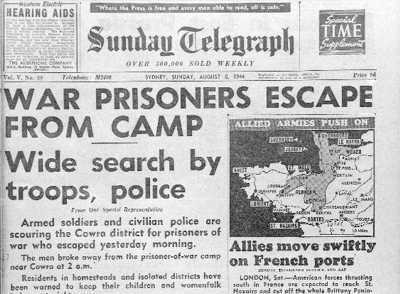
Most Australians of a certain age have heard of the Cowra Breakout. Early in the morning of 5 August 1944, over a thousand Japanese prisoners of war attempted to escape from a POW / internment camp located near Cowra, a small town in a farming community some 300 km west of Sydney. This was the largest prison escape of World War II. During the escape and the manhunt that followed, 231 Japanese soldiers and four Australian soldiers were killed. Many of the Japanese soldiers who died were either killed by other prisoners or committed suicide. All of the surviving escapees were captured and imprisoned. There were no civilian casualites, the escapees having been ordered by their leaders not to harm Australian civilians.

In fictionalising the Cowra Breakout story, Keneally doesn't stray far from history, even though Cowra becomes Gawell and the names of the main players are changed. The narrative focuses on the camp commandant, the officer in charge of that part of the camp from which the escape occurred, a young married woman whose husband is a prisoner of war in Europe, an Italian prisoner and several of the Japanese prisoners.

Keneally is at his best when exploring the motivation of the Japanese escapees. These are men for whom captivity equals shame and who are convinced that the only way in which they can achieve honour is through death. In effect, the escape was a group suicide attempt. However, a real strength of the novel is that Keneally doesn't generalise: the Japanese soldiers are as individual as the other characters.

The most signficant weakness of the work is its pace. The set up, with its introduction to the various characters is reasonably slow and the middle of the novel drags somewhat. However, the build up and aftermath of the escape are worth the wait. Overall, this is an interesting work illustrating a favourite theme of Keneally's: cultural misunderstanding in all its forms.

A couple of years ago I read and enjoyed Keneally's World War I novel, The Daughters of Mars. This work is both more conventional and less moving than that novel. As far as the writing is concerned, Richard Flanagan's powerful and poetic The Narrow Road to the Deep North is much more impressive. However, this is still a novel worth reading. 3.5 stars
Profile Image for Bettie.
9,980 reviews5 followers
April 20, 2015


Read by Paul English and Heather Bolton
Description: Based on true events, this beautifully rendered novel from the author of Schindler’s List and The Daughters of Mars brilliantly explores a World War II prison camp, where Japanese prisoners resolve to take drastic action to wipe away their shame.

Alice is a young woman living on her father-in-law’s farm on the edge of an Australian country town, while her husband is held prisoner in Europe. When Giancarlo, an Italian anarchist at the prisoner-of-war camp down the road, is assigned to work on the farm, she hopes that being kind to him will somehow influence her husband’s treatment. What she doesn’t anticipate is how dramatically Giancarlo will expand her outlook and self-knowledge.

But what most challenges Alice and her fellow townspeople is the utter foreignness of the thousand-plus Japanese inmates and their culture, which the camp commanders fatally misread. Mortified by being taken alive in battle and preferring a violent death to the shame of living, they plan an outbreak, to shattering and far-reaching effects on all the citizens around them.

In a career spanning half a century, Thomas Keneally has proved a master at exploring ordinary lives caught up in extraordinary events. With this profoundly gripping and thought-provoking novel, inspired by a notorious incident in New South Wales in 1944, he once again shows why he is celebrated as a writer who “looks into the heart of the human condition with a piercing intelligence that few can match.”


Do big names phone-it-in? Sure felt as if Keneally did just that with this one. Shame and the Captives lacked both spark and enthusiasm, however I did learn a lot by engaging with this book as it sent me scurrying to the interwebz to look up the gen.
□ □ □ □ □ □ □

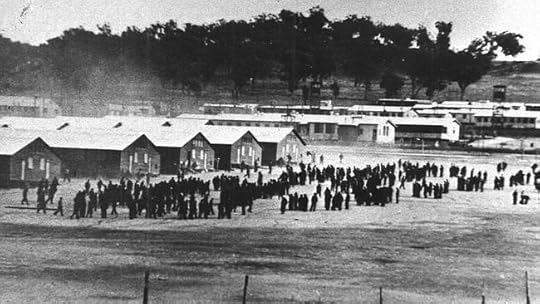
the prisoner of war camp at Cowra, NSW, where hundreds of Japanese were killed in a mass breakout in 1944.

Profile Image for Angela M .
1,453 reviews2,116 followers
March 17, 2015
I had never heard of the Cowra Breakout , the escape of Japanese POW's from a prison camp in Australia in 1944 before I decided to read this book . I wanted to read this because I loved other books by this author most notably Schindler's List and most recently The Daughters of Mars . I was taken by the author's notes , writing and thoughts at the beginning.

"Yet I hope there's a truth in this fiction, in its imagining of motives, and in the actions of these characters - that they do represent in feeling what happened in those times . Fiction has always tried to tell the truth by telling lies , by fabrication."

Multiple perspectives are presented - two of the men in charge , the Japanese prisoners, and Alice Herman wife of a an Australian soldier who is a POW on the other side . There are also Italian POW's but their story is not the center of the novel and we see only bit of the Italian perspective in the character of Giancarlo who works on Duncan's ( Alice's father in law ) farm as part of the program that sends prisoners to work for farmers in the area

The next chapters telling of the capture of two of the prisoners gives the cultural perspective on honor and what it meant to be captured . They preferred death to capture and death rather than bringing dishonor to their families . While these chapters shed light on what happens later, and give understanding to the seminal event of the novel , it was slow paced in parts and I found my interest waning . I felt bogged down at times by too many points of view - Aiko, Tengan , Goda to name a few , but then when the narrative would get back to Alice's story and to Abercare the British colonel 's story my interest picked up again . In addition to depicting the Breakout , Keneally has embedded some other story lines that show the impact of the war , not just on the prisoners. .

Having read the intro and been so taken with the author's thoughts on fiction and telling the story of what happened, I moved on with it since I was curious to see how this historic event would play out . I'm glad I stuck with it because I think that the characters invoke "the feeling of what happened in those times ." Having said that , I can't give it more than three stars , as the middle was a struggle for me to push through . I would recommend it those interested in all aspects of WWII since I would think that this event is little known , except perhaps in Australia and Japan .


Thanks to Atria Books and NetGalley .
Profile Image for Chrissie.
2,811 reviews1,421 followers
June 13, 2015
I feel darn brutal giving this book only one star, but I did not like it.

It is a book of historical fiction which parallels the Cowra Breakout. In August 1944 over a thousand Japanese prisoners of war escaped from an internment camp located near Cowra, a small farming community in New South Wales, about 300 km west of Sydney. There is an adequate epilogue that explains what is fact and what is fiction. So if you are curious about the event maybe you want to read this book.

Some events described are violent. Just a word of warning.

Doesn’t everybody know how the Japanese feel about the shame of surviving war? This is a central topic of the book. Another theme concerns how people may feel obligated to treat prisoners of war justly so that their own prisoners of war will be treated well too. This I found terribly far-fetched, at least how it is presented in this book.

Along with the events of the breakout are fictional love relationships which in my mind are told crudely. They feel as padding to the main story. And so predictable.

The breakout is “exciting” but the lead up takes forever. Remember that padding – it doesn’t draw you in.

I don't like the author's choice of words. This is the central problem I had with the book. Over and over again I thought what a strange way the author had of expressing the events – both what happens and the individuals' thoughts. Too complicated. Strange words used when what is to be said could have been so simply stated.

OK, here is one insignificant example: "She opened the oven and was inspecting the lamb and probing it with a fork when the telephone rang. Fork in rigid hand, she immediately suspended her inquiry into the condition of the meat......" What is it with “suspended her inquiry”? I mean you could more simply say: she poked the meat, and then the telephone rang. Strange language! Not All the lines are strange but so many that you take note. It drove me crazy.

The audiobook is narrated by a man and a woman Heather Bolton and Paul English. This is because the story flips back and forth between a woman on a farm and the internment camp. The narration is good.


Why do you read historical fiction? To teach history by folding the events into an entertaining, engrossing story. Well I didn't get that here.
Profile Image for Elyse Walters.
4,010 reviews11.9k followers
February 10, 2015
3.5 This story is about a prison camp of WW11

It takes place on a farm near Cowra, Australia during 1944-1945.
Japanese POW's plan a 'break out' ...(Italians and Koreans were also in the camp)
Two hundred and thirty-four of the prisoners and four Australian soldiers died. These missing escapees were recaptured.

The novel is inspired by true events (the author was a young boy himself and remembers the shocking tragedy--everyone in his nearby community was sick by the news).

At the start of the book we meet Alice. She is living on the farm. Her father-in-law, Duncan Herman owns it. Her husband, Neville is a prisoner of the Germans in Austria. Alice had met her husband at a dance --did not know him long before she married.
Alice is now stuck living with her Father-in-law --who has lost his own wife.

Duncan --we learn --'slowly' is actually a very 'aware' -wise- man -- He may have lost his wife --(have no interest in woman) --run a 'tight' ship as 'boss' on his farm, but he knows when to speak --and when to keep quiet --(nothing goes by him that he does not see)

Alice --(without child) -- becomes interested in the POW's --(truckloads). Japanese men arrive on the farm to work ---(to fill in potholes). Duncan will manage them.

Alice offers 'lemonade' to the men --wanting to treat the prisoners well --hoping (cosmic energy) --her husband is also being treated well. Later --we will see Alice kill one of the men she serves lemonade to.
Alice will also get close to one of the Italian captives. (Giancarlo Molisano)....Pronounced as "John Carlo". She teaches Giancarlo English --brings him food and drink--while he works on the farm. She soon brings 'herself' to him --(to his bedroom) --A love affair develops. We know her father in law, Duncan, knows. Alice is often wondering 'why' he says nothing --
but remember ...Duncan is a wise man.

We will meet Aoki (Japanese Prisoner -head of a tent, one of the older veteran of the camp). He had already been shot in the leg before he arrived --so walks with a limp).
Aoki is a roll model in ways to other prisoners. He's clear about his religious and cultural suffering by being a captive. He could never let his wife know -for example -- that he is a 'prisoner'....for the SHAME of it. Goda is the other 'senior' prisoner, (runs another tent).

We meet Major Suttor: an efficient but dispassionate officer. He also has a son in a Japanese prisoner of war camp. Suttor writes for a radio show --reflecting about everyday family life in Australia.

Other characters: English Colonel Ewan Abercare: He tries to keep the prisoners happy --give them dignity. He will die a hero at the end of the war -- (rather than be SHAMED) ...

The entire purpose of 'The breakout' is to Preserve Dignity. In Japanese thinking --they are suffering from religious SHAME by being captive.

Tengan --(a former pilot) --is one of the younger Japanese men amongst the compound. Spunky energy. One of my favorite scenes is when he rejects baseball --then later finds himself in a very embarrassing wresting match.

We meet many other characters --Even a Swiss doctor -and a sexy dancer

At the start of this book --the author says....."Fiction has always tried to tell the truth by telling lies, by fabrication".
I thought about this sentence often.
Possibly the 'fabrication' was too much.
If this same story was 100 pages less --I could have felt the 'power' - THE TRUTH - the horrific tragedy - of this war deeper. I've said it before, WAR is WAR is WAR! A tragedy-period!

I needed to concentrate diligently with this novel.
We need details and blemishing to round out our interest with our storytelling,
--"The native woman did coat themselves with pig fat", he had seen it on the hillsides behind the beaches",
....yet this was a challenging read for me. --[even with several enjoyable fabricated scenes]
At times, I didn't know if I was in compound B or C --or if if mattered.

Am I glad I read it? YES! I gained value! (just hard work for my brain)

I would be interested know more about (or hear the author speak about), is HIS experience as a child around this war. What he remembers? How he felt? Things he heard adults speak about? How it stayed with him? Shaped him?

Thank you to Netgalley, the publishing company -- and Thomas Keneally


Profile Image for Esil.
1,118 reviews1,488 followers
March 8, 2015
Thank you to Netgalley and the publisher for an opportunity to read this book. I would give it 2.5 stars if half stars were available. I agree with other GR reviewers who described Shame and the Captives as a missed opportunity. I recently read a couple of novels which touched on refugee camps in Australia during WWII, making me realize that I know essentially nothing about what Australia was up to during WWII. So when I saw that this book took place in a POW camp in Australia during WWII and that it was written by Keneally, I thought this should be interesting and a good read. And it has all the ingredients to be a good historical novel. It's based on an actual break out by Japanese prisoners. It delves into the deep cultural differences between the way in which the Japanese prisoners experienced the shame of their imprisonment and the somewhat hapless efforts of the Australian captors to meet their obligations under the Geneva conventions and to treat the prisoners with some decency. And it is portrayed from different perspectives, including the prisoners, their captors and some local Australians. But unfortunately -- despite all of these excellent ingredients -- the way in which Keneally puts this story together came across as a flat recitation and was somewhat disjointed. And the fictional characters he created were not particularly engaging and were a bit hard to keep track of (and I swear that I am rarely one to complain about too many characters or a complicated plot). Altogether, unfortunately this made for somewhat of a tedious reading experience. Again, this seems like a missed opportunity. I would say "maybe it's just me", but other readers seem to have had similar experiences. I will have to look for other opportunities to read about what Australia was up to during WWII.
Profile Image for Shelleyrae at Book'd Out.
2,609 reviews556 followers
November 4, 2013

I was eager to read Shame and the Captives, not only because I haven't read anything by Keneally since highschool, which seemed remiss of me given his status in Australian literature, but primarly because I was particularly intrigued by the premise.

It was only a few months ago I learned (thanks to Hannah and Emil) that during World War 2 Australia interred thousands of residents of 'enemy blood' . For some reason, I didn't consider that Australia would also have hosted Prisoners of War, largely I suppose because of the relative distances between the main fighting fronts and our country, excepting the attempted Japanese incursions in the north.

The story of Shame and The Captives closely follows the events of the Cowra Breakout in 1944. Camp B of No. 12 Prisoner of War Compound (Cowra) was the scene of a bloody skirmish when many of the 1,104 Japanese prisoners of war tuned on their captors and attempted to escape. While Keneally clearly states in a foreword titled "Where the Tale Comes From" that the Shame and The Captives is, "a parallel account, or a tale provoked by the events that unfolded in Cowra" and further that his characters "are not designed to reflect any virtues, sins, follies, fevers and acts of courage evident in any of the real actors in the Cowra outbreak", this novel is a blend of fact and fiction.

Keneally's representation of the events and the people involved may be fictional but it seems an entirely plausible account, with the histories, personalities and motives the author ascribes to the characters seemingly authentic in light of what we know of history. Delving not only into the lives of the men in the camp, the Japanese prisoners like Tengan and Aoki, the camp commander, Colonel Abercare and his subordinate Suttor, Shame and the Captives extends beyond the camps boundaries into the community, represented primarily by Alice and her father-in-law Duncan.

Exploring the themes of shame, honour, belief, loyalty, cultural disparity, compassion and respect, Keneally provides context for the Cowra Breakout and Australian society in the period of war.

One of the interesting ideas Keneally explores is Australia's trust that if they treated their prisoners with care (according to the Geneva Convention), their soldiers in the custody of enemy nations would be treated with equal fairness. Suttor and Alice, whose respective son and husband are POW's, cling to this ideal. Unfortunately the Japanese mostly despised the Australians for their compassion, since their honour code insisted that death was preferable to imprisonment. The Breakout then, was essentially a mass suicide attempt, a means for the Japanese to die with the honour their beliefs demanded of them.

While I was utterly fascinated by the story of the Shame and The Captives, unfortunately I found the writing, with very little dialogue, often dry and dispassionate. I was in some ways reminded of a school history lesson worksheet where an attempt is made to enliven the learning of facts by couching them in a story. Had I not been so intrigued by this period of history, Keneally's prose may have resulted me in abandoning it.

Nevertheless, I consider Shame and the Captives to be a compelling and thought provoking novel, one I particularly would recommend to Australians interested in our country's history.

Profile Image for Chet.
60 reviews7 followers
April 12, 2015
Disclaimer: I received this book through Goodreads First Reads Program.

Thomas Keneally is, without a doubt, an excellent writer. He can paint a beautiful picture in your mind and you can actually see in your mind the beauty of Australia and the thoughts and fears of the characters. Honestly, when I read the synopsis for this one, I thought that there is no way it could be bad. The plot is interesting as well as the backdrop for the story. The problem, though, is that Keneally just made this one too complicated and, as a result, the book feels disjointed. There are so many characters that you never get a chance to get interested in the them. By the time you start to feel yourself falling for each person's story, the chapter ends and it's three or four more chapters before you see them again. Keneally just tries to cram too much into 380 pages. Personally, I think this would have worked much better as a short story or as a much longer book (which I'm glad it wasn't because a lot of this was just, quite frankly, boring). I don't have any problem with a complicated story, but this one just didn't work. It's honestly a one star read for me, but I gave an extra one because of the writing. Really, that's a disappointment, because I keep thinking about what might have been.
Profile Image for Roman Clodia.
2,883 reviews4,627 followers
June 26, 2016
“He surrendered his crimes up to the gods, under whose aegis he had not extended pity”

Opening a book by Thomas Keneally, we know we will be led into a complex world where humanity itself will be placed under a compassionate but unflinching eye. This fictionalised account of a historical prison breakout by over 500 Japanese POWs from a camp in New South Wales in 1944 is another example of Keneally’s expansive storytelling.

Almost documentary in its approach, this moves between the personal and the political, weaving deep back-stories with present conflicts. At its heart, is the disjunction between the Japanese prisoners and their mostly Australian captors: for the Japanese, to be captive and alive degrades their warrior status, and the breakout itself is more an attempt to die with honour than to escape.

The scenes set in the prison alternate with the home life of Alice in the nearby town, whose husband is in a German POW camp; her relationship with an Italian prisoner whose own philosophy is so markedly different from the Japanese one; and the sometimes tragic lives of the camp commanders.

Keneally writes elegantly and weaves his research seamlessly into the story he is telling so that what we have is an organic whole. He breaks that supposedly cardinal rule of novel writing – show, don’t tell – and proves that ‘telling’, in the hand of a master, works superbly.

This is such a dense and intense book that any review can only give a taste of what it offers, and each reader will find their own way into the book and take different things from it. So not a simple or necessarily an easy book, but one which is richly rewarding.
194 reviews7 followers
February 20, 2015
During the Second World War thousands of Axis prisoners of war were interned Australia and this book was inspired by an incident that took place when the author was a nine-year-old boy living in Sydney, feeling his family’s fear of the enemy within. In August 1944 more than 1,000 Japanese prisoners tried to break out from the Cowra camp in New South Wales with nearly a quarter of them being killed in the attempt against the death of a four Australian soldiers. In this gripping fictionalised version Keneally has written a parallel account of the events of that dramatic night in an attempt to explain the drastic action taken by the Japanese soldiers who felt humiliated by captivity and many of whom would rather face certain death than repatriation at the end of the war. Keneally has peopled his novel with convincing characters caught up in their own world of petty fears and disappointments against the backdrop of a much greater conflict.
Profile Image for Joanne.
847 reviews95 followers
August 27, 2019
On August 5, 1944 1,104 Japanese prisoners of war attempted to escape from a prison camp in New South Wales, Australia. This is a fictional story based on this event.

Tom Keneally sets the scene outside the prison: the surrounding farms and their occupants. Among those on the farms is a young woman, Alice, living with her father-in-law. Barely married, her husband was sent off to war and is now himself a prisoner in a German Camp. An Italian prisoner is sent to the farm as a laborer and the relationship that develops between Giancarlo, Alice and her father-in-law Duncan is a quiet study in what war can do to those left at home. I will readily admit, I was quite bored with their story in the beginning. Silently cursing that I had picked another DNF. However, his writing is so engrossing,( I can't say beautiful-this is not a beautiful story)-he slowly pulled me in and totally won me over.

The prison, the camp the soldiers and guards, all come into play slowly and methodically. The men left to facilitate at these training camps and prisons were, of course, the men who could not fight due to age or illness or injury. They have no clear understanding of who they hold and why they all want to die. The Japanese solider was taught to be captured is to be shamed. They believed that their burial rites, already carried out by their families, were not reversible. Dying was not just an option, it was their duty.

This is a raw, brutal story that some may find offensive. I do think that fans of Literary Fiction would gobble this one up. I found it by pure luck, just searching my library's catalog for a book based in Australia. It gave me a clear, unblemished picture of Australia during War II-something I never even thought about. So many books on WWII are based in Central Europe, and we forget it was a World War. This book brings that home in spades.
Profile Image for Will.
113 reviews8 followers
December 9, 2021
My least favourite of all the Keneally books I've read so far, I found this a chore by the end.

Shame and the Captives has, like all Keneally plots, a good story at its heart. It concerns an outbreak of Japanese prisoners of war in rural Australia during the Second World War. Yet the outbreak itself takes up approximately 50 pages in this almost 400-page book.

There are too many characters who do far too little to be memorable or moving. Some characters appear twice almost 200 pages apart, so as a reader I was hardly invested in their fates.

The love story (I don't know whether to call it the subplot or the main plot) dominates the book, yet it felt like padding. For an effective depiction of a relationship between enemies in war, readers could do worse than read Captain Corelli's Mandolin, a vastly superior creative endeavour.

Keneally does manage to contrast the Australians' startlingly laid back attitude with the Japanese all-consuming approach to war. But this is something which even school children know about the Japanese military culture. So there never seemed to be a broader theme or – dare I say – any point.

Sadly, I found this a rare flop from one of my favourite living authors.
Profile Image for Angela.
82 reviews9 followers
September 18, 2024
Postscript: I decided to read this book again immediately after finishing it. I felt there had been a lot to absorb and that a second reading would provide a better understanding, especially of the events of World War II. I am so glad I did, there are always things you miss in a first read, characters are like strangers you meet for the first time, and key connections can be overlooked. The account of the Cowra Breakout is quite gripping. I appreciated the WWII history I have learned from this novel, the narrative so rich in its content, for which I am raising my rating from 3 stars to 4 stars, and it is indeed a keeper for my bookshelf.

An interesting book to read, a part of Australia’s history which took place during 1944, the latter part of World War II. To give some background, the story revolves around a prisoner of war camp in Cowra, New South Wales. The Cowra Prisoner of War Camp was constructed in 1941-42 to house Italian POWs captured by Allied Forces during World War II. Between January 1943 and August 1944, over one thousand Japanese POWs and internees arrived. By the end of June 1944, the camp was already overcrowded beyond its intended capacity. At 2 am on 5 August 1944 the Japanese prisoners staged an outbreak, during which over 300 escaped outright (most were recaptured over the next nine days). 18 buildings were burnt to the ground. 234 Japanese and five Australians died. This action has remained significant in popular memory as the first time the War was fought on home soil and as the largest revolt of its kind in Australia's history.

Author, Tom Keneally, creates his novel around this camp and outbreak with a multitude of characters who bring ethnic diversity, morals, shame, power struggles, and feelings of loneliness to the novel.

The title ‘Shame and the Captives’ does not refer to Australia’s shame regarding the treatment of the prisoners of war, as I had first thought. On the contrary, it refers to the shame and humiliation incurred by the Japanese prisoners who were caught and imprisoned by the enemy. The Japanese soldiers are well-known for their pride and stoic allegiance to their country. So much so, that they would rather be fatally shot, stabbed to death or commit suicide rather than suffer the humiliation of capture and being taken prisoner. By the end of 1943, Japanese morale in the Camp was low. For the Japanese soldier, the reality of capture was a violation of traditional and ethical codes. Japanese soldiers had a code “Do not take the shame of capture in life”.

Sergeant Hajime Toyoshima was the first Japanese prisoner of war (POW) in Australia. Toyoshima was the pilot of a Japanese Mitsubishi Zero aircraft, from the Japanese Imperial Navy, who participated in the first air raid on Darwin. He is portrayed as Tengan in the novel and was the prisoner who sounded the bugle to commence the Cowra Breakout. His identifying POW number, 42001 (1942 – the year of his capture, 001 – the first prisoner).

I did like the term “horsefeathers”, U.S. slang referring to a load of nonsense. ‘Horsefeathers was the title of a 1932 Marx Brothers movie. I’ve never heard of the word “hoosegow” either, a slang word for a gaol or prison. Ah, how worldly one becomes from reading!

The story is rich in its content and certainly keeps the reader engaged. What I struggled with at times was understanding the actual meaning in some of the lengthy sentences. This is not a book for a light holiday read, in my opinion, as I would call it complicated at times and requiring utmost concentration. This is why I gave it 3 of 5 stars, although it is a strong 3.

I have included the following two excerpts from the novel to demonstrate Tom Keneally’s wordcraft, how beautifully he brings the words and spirituality together.

“Lying as a mere insect on the earth he was grateful to feel a strange serenity and resolve grow in him. This was his most solitary moment since his capture a year-and-a-half past. A memory of his wife was like a visitation at that dismal hour. It was a visit of God’s own redeemed flower. Her soul had been cultivated and generous and her presence endowed him, at this huge distance of space from her grave, with acceptance.”

“One thing he knew as a soldier – there was rarely arrogance after the bullet had gone in. There was the humility of terror, the reduction of the soul to childhood fears and the realisation that monsters exist, and then the reflex cry for the mother who was not there to succour or give rebirth.”

The Cowra Prisoner of War Camp site is listed as one of the top Heritage sites in NSW. The camp site has fostered and inspired artistic work in Australia and Japan. In 1964 a Japanese cemetery was established at Cowra, by agreement with the Japanese government. It was designed by well-known Tokyo Architect Shigeru Yura. In 1965 Cowra, and the Lachlan Valley in which it sits, held the first of a series of annual festivals of international understanding. In 1979 the town's Japanese garden was opened, designed by the renowned Tokyo Landscape Architect Ken Nakajima in a style pioneered in the 17th century. In 1992 Cowra received Australia's world peace bell. Cowra has attracted numerous official and unofficial Japanese visits; a student exchange program between Cowra and Japan established in 1970. In 1991 Cherry Tree Avenue was extended across the perimeter of the camp on its western side to link the War Cemetery and Japanese Gardens.

I visited the Cowra Prisoner of War Site Camp and Japanese Garden in 2023. It is well worth the visit and is testament to how relationships between two countries who were once enemies can work together in reconciliation and friendship in the aftermath of tragedy.

https://www.cowracouncil.com.au/Facil...
Profile Image for J.S. Dunn.
Author 6 books61 followers
August 11, 2017
4.5
Fascinating, sensitive portrayal of his native Australia during WWII from the unusual perspective of POWs held in a camp and the locals who guarded them or had them labor on farms. Though the finale is known in general terms from the onset, the subtleties the author introduces from the varied viewpoints make nothing certain. One is reluctant to reach the final page but well aware that the story did not end there.

Keneally's sure style, his smooth prose, are ever a joy. He is wonderfully unafraid to use multiple adjectives, or vivid adverbs, or words that must be looked up ( eg, hetacomb, obloquy, exegesis ). No dumbing-down here, rather a love of words by a master wordsmith.
243 reviews
February 17, 2024
Read this on a long haul flight, would probably have given up otherwise. The central story line, the Japanese breakout from a prison in NSW is interesting, the motivation and cultural pressures to commit suicide by the Japanese are an interesting window into a very different culture. However after that I found the book slow, poorly developed characters, weak use of an interesting landscape. I really should have felt sympathy to both the Japanese and Australian leaders, also the love interest between Alice and an Italian prisoner was bereft of emotion in my opinion. Disappointing for a well respected Australian writer.
Profile Image for Amanda.
354 reviews5 followers
December 20, 2021
In the context of the breakout of Japanese prisoners of war from a fictional POW camp (but based on Cowra in the central west of NSW), Thomas Keneally examines the meaning of 'shame'. The prisoners carry the shame of being denied a glorious death and decide to take matters into their own hands with devastating results. But there is also shame being dealt with by other individuals including their camp commander and citizens of the community.

It is a very readable book which shines a light on a little known part of history with an interesting sub-text.
Profile Image for Lisa the Tech.
173 reviews16 followers
August 15, 2020
Giving it 3.5 out of 5 but Bookreads does not allow for halves. A pretty good book.
Profile Image for Jennifer (JC-S).
3,517 reviews286 followers
December 21, 2013
‘The madness had been contained within the wire walls of Gawell, but it had by its force and insistence broken the bounds, and stained the bush with its dangerous expectations.’

On 5 August 1944, a frosty moonlit night, some hundreds of Japanese prisoners of war escaped from a prisoner-of-war compound near Nowra, NSW. Two hundred and thirty four of the prisoners, and four Australian soldiers died. Others were injured; all were recaptured.

In this novel, Tom Keneally takes the events surrounding the Cowra break-out and presents a picture of people - residents and prisoners - and the cultural differences which make the break-out (and the high death rate amongst the escaped prisoners) easier to understand.

In Tom Keneally's fictional town of Gawell in 1943, Alice Herman lives with her father-in-law Duncan on the family farm. Alice's husband Neville, who fought and was captured in Greece, is a prisoner of the Germans in Austria. There is a prisoner-of-war camp nearby which houses European (mainly Italian), Korean and Japanese captives. A truckload of Japanese prisoners arrives on the road outside the farm. Under the supervision of a handful of Australians, these men are filling in potholes. Alice offers the entire group lemonade. She hopes that by treating these prisoners as human beings, Neville will also be treated well. Giancarlo, an Italian prisoner of war at the Gawell camp, is assigned to Duncan Herman as a farm labourer. His presence both enhances and disrupts Alice's world.

`It was hard to maintain a martial soul when the enemy refused to present himself.'

But it is the telling of the stories of the Japanese that, for me at least, was the real story in the novel. Much of the shame referenced in the title is a cultural and religious consequence of being alive and captive. To their families, these men are honourably dead and are mourned. For many (but not all) of the Japanese, to die in what can only be seen as a suicidal breakout is more honourable than living and being repatriated at the end of the war. The consequences of the breakout, for the soldiers guarding the camp and for the wider community, are nowhere near as clear. The shame is not only confined to the Japanese: most of the other characters have cause for shame as well.

And after the break-out, what will normal life look like? Will the survivors come to terms with these events, or will shame continue to hold them captive?

I found this novel thought-provoking. Because the novel is based on the events of Nowra, but is told in a fictional town with different people, I found it easier to focus on the story being told rather than the history. At the end, though, my focus changed from the fiction back to the history. I can leave behind the people that Tom Keneally created to tell this story, but I find myself wanting to know more about the real people who were part of it. How did they feel? How did they survive?

`.. murmuring at the business of tea and cake - tannin and sugar as stiflers of grief.'

Jennifer Cameron-Smith
Profile Image for John.
50 reviews5 followers
December 14, 2013
A major cultural misunderstanding
This is an interesting and challenging book about one of the three main events where WWII impacted directly on the Australian people. Most people know about the bombing of Darwin and the mini-submarine attack on Sydney Harbour, but how many know about the bloody escape by Japanese POW's from a camp near Cowra, NSW?

During WWII Australian troops captured many prisoners of war on all battlefronts. While some of them were sent to POW camps near where they were captured, by August 1944 there were nearly 20,000 POW's in Australia. Most of them were Italians, but just over two thousand were Japanese most of whom resented the fact that they had not been killed - "The Japanese soldier never permits himself to be taken".

Keneally weaves a fictional story based on the Cowra POW breakout which shows the conflicting culture and emotions of the local people, the camp administration and the different prisoner nationalities. In a fictional town of Gawell, on the tablelands of NSW and far from the battlefronts, a POW camp is built close to a farming community to house European (mostly Italian), Korean and Japanese prisoners. The camp is split into 4 compounds, 2 for the Europeans, 1 solely for Japanese (Compound C) and the fourth for captured Japanese merchants, and Koreans and Taiwanese.

The camp commanders have little understanding of the cultural stresses Japanese prisoners are facing with the disgrace of their capture. Many Japanese give false names, knowing that their families would have been told of their death because they are missing. Many look to death as the only way out of their incarceration and do not understand the compassion and respect given to them by their captors.

Keneally weaves a gentle story of the local community and the integration of trusted Italian prisoners, and the camp commanders and their naive feelings that they should run the camp humanely within the Geneva Convention in the hope that Australian prisoners will also be treated humanely by the other combatants. The camp is lightly guarded because a breakout is considered unlikely. The camp is commanded by officers who are in general mostly too old or injured to fight overseas. What surprised me most by this fictional re-enactment of the breakout was the inept, almost Dad's Army reaction, of the guards and the local training camp to the escape of hundreds of Japanese prisoners from Compound C searching for death.

This is an interesting and sensitive tale based on an important incident in Australia's WWII history. I have recently read Keneally's splendid WWI saga "Daughters of Mars" and in comparison found the writing style of this book to be much dryer and less inspiring than his previous book.
2,197 reviews
July 10, 2016
It's a terrible story, based on an actual uprising and prison break in New South Wales in 1944. A group of Japanese prisoners of war is determined to achieve honor by dying, whether in battle or by suicide, it doesn't matter to them. Their families think that they are already dead heroes, and to be alive and repatriated would bring disgrace on all concerned.

The source of the break is Compound C, where the most recalcitrant Japanese prisoners are held. In the end many are killed in the escape attempt, including the British camp commander Colonel Abercare and a few of his men. Some prisoners commit suicide. Many more are recaptured and returned to camp.

The cast of characters is large - there is Tengan the downed pilot and implacable leader, and Aoki, his older second in command. The British colonel is a bit of a bumbler with marital issues; his Aussie major writes radio dramas and has a son in a Japanese POW camp. He hopes in some magical way that if he treats his prisoners well, the Japanese will treat his son well too. It's a huge prison. There are the Koreans and Formosans, reluctant conscripts of Japan who hate their former masters, and Italians, many of whom were never true believers, whose army has surrendered and who are mainly happy to be away from it all.

Then there are the locals, particularly Alice Herman and her farmer father-in-law Duncan. Alice's husband is in a European POW camp, their marriage is new and brief, and the memory of it and him is fading day by day even as she hopes for his return. They are offered the services of an Italian POW to help with the farm work and Giancarlo, an attractive and intelligent young man arrives to change Alice's life.

It's well done, of course, and the cultural contrasts between the naïve locals and the driven Japanese are stunning. But I found it was difficult to be emotionally engaged with the characters - any of them.
Profile Image for Lisa.
3,774 reviews489 followers
September 6, 2016
I read somewhere recently that Keneally’s oeuvre is akin to Honoré de Balzac’s La Comédie Humaine (Human Comedy). I think this is an apt description. While he does not recycle his characters as Balzac does, linking them together across time and place in 19th century France, Keneally’s sturdy realism depicts Australian life across the turbulent 20th century, exploring human frailty that is indeed reminiscent of La Comédie Humaine. While the French Revolution and its chaotic political, economic and social aftermath lies at the heart of Balzac’s concerns, Keneally takes the broad sweep of Australia’s 20th century, especially its wars.

Excluding the frontier conflicts that characterise Australia’s Black History, the Cowra breakout was one of the few occasions when blood was shed on Australian soil during wartime. We fight our wars overseas, and with the exception of the 1942 Japanese midget submarines entering Sydney Harbour; the air raids on Darwin and Broome and attacks on coastal shipping, Australia’s casualties died in overseas theatres of war. The Cowra Breakout was remarkable for being so unexpected, and for its shocking loss of life: four Australian and 231 Japanese soldiers. Keneally brings this story to life with his trademark realism though in his introduction he is at pains to stress that the characters are genuine works of fiction, and he renames the town Gawell. (If you pronounce it ‘gawl’ as in ‘galling’, this apparently clumsy name seems very apt).

To read the rest of my review please visit http://anzlitlovers.com/2014/01/06/sh...
Profile Image for Julie.
868 reviews79 followers
April 1, 2014
I have bad book guilt. I'm not saying this was a bad book, it is just that I feel guilty when I reject a book and make it a wallflower, standing on the verges never to be read by me again. I love looking in bookstores, online and in the library, I have close to 3000 on my goodreads to be read folder, I love books that much and the pile beside my bed is teetering with the 7 books that I have to read in the next couple of weeks.

So, I was looking forward to reading Shame and the Captives, a novel by Tom Keneally (of Schindlers List fame). With a prisoner of war camp built in rural New South Wales, it tells the story of European, Korean and Japanese prisoners, and the locals in the surrounding community. I got through forty pages, but for me it was too much of a struggle to read as I was fighting the words too much, so I put it aside.
Profile Image for Banafsheh Serov.
Author 3 books83 followers
March 15, 2014
Considering my interest in the subject matter, I have mixed feelings for this book - possibly because I'm reading it straight after having read Flanagan's 'Narrow Road To The Deep North'.
Kennelly's writing style is dry, indulgent with a reluctance for dialogue. Half way through the book, my empathy for the characters & patience with the pace starts to grow thin. So I skip forward 100 pages to the faithful night of the breakout which proves a wise choice as the book finally comes alive. The Japanese mindset makes for a fascinating read as they struggle with the shame of being taken captive & their quest to redeem their honour.
Profile Image for Linda.
263 reviews
December 30, 2013
Tom Keneally at the top of his game. A fascinating story about recent Australian history.
This tells a fictionalized account of prisoners of war in Australia, and of the Corowa breakout. He does a great job of telling the story from several points of view, the local farmers, the soldiers and the prisoners, both Japanese and Italian. A piece of history I didn't know much about wonderfully illuminated.
Profile Image for Alex Rogers.
1,245 reviews9 followers
January 2, 2017
I didn't finish it - an interesting premise but the story left me cold, didn't get involved with the characters, and eventually gave up, bored.
342 reviews4 followers
March 9, 2021
This is a fictionalised account of the infamous Cowra incident when over one thousand Japanese POWs, held in Australia during World War II, attempted to break out of their POW camp.
By writing a fiction account of the story Keneally focuses in on the motivations and emotions of POWs, civilians and Army personnel. The prisoners had been given notice that they were to be split up and plotted a suicidal mission to restore their fervent national pride and in atonement for their shame in being captured.
The story looks at the event from the various perspectives of; Alice, a newly wed living on her father-in-law Duncan's farm while her husband is a POW in Europe; Giancarlo, an Italian POW working on the farm; Tengen, the first Japanese prisoner in the camp; Aoki and Goda, POW hut leaders; Gawell camp commanders Colonel Aberware and Major Suttor; and a host of other characters who come and go to flesh out the story.
I enjoyed the story but was disconcerted by the author's preoccupation with the sexual proclivities of the characters. I don't understand what the marital infidelity of Aberware, the unusual living arrangements of one of the machine gunners or the defeat 'ritual' of Tengen in a wrestling match added to the narrative. If anything they distracted from the story. It appeared the author felt we couldn't get a full picture of a character unless we joined them in their bedroom? I could understand the narrative tension created by the lonely housewife Alice's affair with Giancarlo but in a strange way that fizzled out without being properly resolved as though it had just been inserted to flesh out the story, pun intended.
If it hadn't been for the unnecessary romping and the slightly unsatisfactory conclusion I would have given it a higher score.
Profile Image for Vivienne Shannon.
Author 5 books16 followers
June 21, 2018
A really interesting read which tells the story of a group of Japanese POWs held in Australia during WWll. This novel explores the tragically different cultural expectations of the Japanese and the Australians. The Japanese are determined to die with honour at any cost - the shame of being taken prisoner outweighing all other considerations, whereas the Australians take it for granted that the decently-treated prisoners, knowing that even if they escape from their camp, they will not survive in the inhospitable landscape - will merely count their blessings and wait for their eventual release.

Entwinede with the stories of the various Japanese escapees is that of Alice, whose husband is himself a POW, and her affair with an Italian POW who comes to work on the family farm. There is such a sense of atmosphere here that I felt I was almost in the landscape myself, and there is some stunning imagery. I loved this novel with its sense of cultural 'otherness', its evocation of the landscape, and its contrast between the two ways of thinking and it was very interesting to gain some insight into the way in which the older Japanese soldiers were so utterly imbued with this overweening sense of honour.
Displaying 1 - 30 of 143 reviews

Can't find what you're looking for?

Get help and learn more about the design.