Most of us know bits and pieces of our history but would like to be more sure of how it all fits together. The trick is to find a history that is so absorbing you will want to read it from beginning to end. With this book, Desmond Morton, one of Canada’s most noted and highly respected historians, shows how the choices we can make at the dawn of the 21st century have been shaped by history.
Morton is keenly aware of the links connecting our present, our past, and our future, and in one compact and engrossing volume he pulls off the remarkable feat of bringing it all together – from the First Nations before the arrival of the Europeans to the failure of the Charlottetown accord and Jean Chretien’s third term as prime minister. His acute observations on the Diefenbaker era, the effects of the post-war influx of immigrants, the flag debate, the baby boom, the Trudeau years and the constitutional crisis, the Quebec referendum, and the rise of the Canadian Alliance all provide an invaluable background to understanding the way Canada works today.
In 1957, when just a little tyke, I met my Great-Uncle Clark Gamble for the first time, when my parents went back to balmy (by our Eastern standards!) British Columbia. Uncle Clark was getting old, but he STILL had many stories under his belt...
You see, back at the turn of the twentieth century, he had been a bridge builder. A Professional Engineer in the days when qualifying for the suffix P.E. to your name was no mean feat. He designed many of the bridges that now spanned the turbulent rivers of his home province.
One of the Makers of Canada!
My hat’s off to you still, Uncle Clark, more than fifty years since you left this cynical planet for Glory. A mere rock of granite spinning in space - home now to facetious masses who see tradition as merely an artifact of stupidity.
Ten years later, while working for the Greater Victoria Water District, my aunt Wilhelmina said to me quietly one night, “Why don’t you walk over to Uncle Clark’s place, to say goodbye? This is probably the last time you’ll see him!”
She was right.
And I’m glad I did!
Does anyone remember such brave souls now? Dr. Desmond does! And he made a living outta it...
I admit, I have a real soft spot for this book.
It is one of my go-to reads for cozy winter nights when I feel a need to wrap myself in the warm blanket of a book of history in which the historian feels no pressing need to be contentious!
But I have a real beef to air about it.
You know, Canada came out on the world stage in 1967 with the Montreal Expo (remember the geodesic dome?) as a shy debutante. And since Canada's political genes originated in Europe, if she were to flirt with socialism she will possibly be forgiven.
But when she married her first beau - Pierre Elliott Trudeau - shortly after, she became an acknowledged player on that stage.
That’s where my gripe comes in.
Poor Desmond, bless him, seems stuck in the pre-flower power sixties in spite of all that! Let’s call them the Stodgy Sixties, for purposes of distinction - for to the kids that’s exactly what they were.
But for him, there were still plenty of Bigger Guys around the Global Neighbourhood to be impressed with.
Get with the program, Desmond! The world was changing. BIGTIME!
“But you know he is, after all, a CANADIAN historian...;And as such his little history will show international GR readers that the word colonialism refers not just to third world countries... Colonialism is still, in so many ways, US.”
But why the massive inferiority complex, guys?
“Well, we have a small army. We ain’t got no nukes. We most often make peace, not war. We behave like a pretty FRIENDLY world presence.”
But all that, at least for me, makes us A-OK! Isn’t that what our TRIGGER-HAPPY world NEEDS?
This book gets a bit of a bad rep, probably because most people read it thinking that it's about a short history of Canada when in fact it's really a short political history of Canada. However it does a good job at covering those details from the early origins of Canada to the fall of Paul Martin in 2006. It's a relatively easy read and I have to say I learned a lot as I didn't have a great understanding of Canadian history despite being an avid fan of history.
Despite being the #1 trading partner of the United States, and also being its next door neighbor, Canada occupies very little concern or interest in the U.S., let alone the rest of the world. While it was the scene of territorial disputes between France and Britain in the 18th century, and later between the U.S. and Britain in the 19th century, Canada is often seen by the U.S. as a bleak, very cold, vast landmass whose people are about as frosty as the weather. Canada receives very little attention from other parts of the world as it is not considered one of the major powers, nor does it pretend to be or aspire to be. By consequence, not many people know much - if anything - about the country, which is so much more than just hockey and snow. Perhaps that is the reason behind Morton's book: to provide anyone with an interest in knowing a little about Canada, its history and its culture.
Morton traces Canada's history back to the many Native American tribes that inhabited the vast prairies, the far northern areas near the Arctic, and the maritime areas along the east coast. Much like in the U.S., the Native Americans were pushed further and further west or north, being forced off of the good land that they lived on. Canada was not much friendlier to Asians either, and one very sad thing that Morton noted was the forced relocation of Japanese-Canadian citizens away from British Columbia in WWII. Just as it was in the U.S., this was a shameful thing to do and one that you hope will never be repeated.
A common theme that runs throughout the book is that of the chasm between the needs of the maritime provinces with those of Quebec, with those of Ontario, and then all the way to the Pacific Ocean. Canada is such a large country that what is important or affects someone in Nova Scotia may not be even a tiny cloud on the horizon in the Yukon Territory. This forced Canada's politicians to try to decide who it was that they must cater to so as to have the best chance of remaining in office.
This strain is exacerbated in the matter of Quebec and the continuing cries for independence. Morton shows how, since its founding, it has retained a distinctly French character, although there have been times where that has ebbed and flowed. Much of this has to do with the language, but also some of it has to do with the French Canadians not wanting to be dictated to by Ottawa. Many Quebecois seem to want to be split off from Canada, and many Canadians probably would be fine with that as well, but so far they have all held together.
Because Morton covers the entire span of Canadian history in less than 400 pages, things obviously move at a rapid pace. Too rapid. The constant procession of Prime Ministers, combined with Premiers in the provinces, different political parties, different social movements, and just the sweep of time itself makes it difficult for the reader to follow along and keep abreast of who is coming and going. Only certain heavyweight Prime Ministers such as William Mackenzie King and Pierre Trudeau seem to stand out on their own. Morton moves so quickly that he seems to be just skimming the surface, or barely giving the reader enough information on a topic before swiftly moving on. By the end of the book, the Canadian culture still seemed unclear and somewhat vague. Of course, Morton did include the word "Short" in the title of the book, so he is not pretending to be writing a tome. Still, more context on people and events would have been welcome.
My heavens, what a slog. If the short history is this dull, I'd hate to read the long history! Ho Ho! Actually, this book did not need to be so boring. This should really be called a POLITICAL history of Canada, because that is all it is. Endless history of Ottawa and parliamentary elections and which party had the majority and how they managed to placate the Quebecois and on and on and on. There is nothing in here at all about cultural history. Not one thing. Nothing. Nothing about food or drink. Nothing about sports. No music, or theater. Nothing really about what was going on in the individual cities and provinces, except how it relates to which party wins elections. And it's not like there are a ton of cities to discuss. They mention immigration a few times, but never get into it in any detail. It's pretty weird that you can have a three hundred page history of Canada and never mention hockey, for example. Not one mention. Not one! Now I'm not saying that all there is to Canada is hockey, but since it was invented there and it's the national game and all, you'd think it would merit at least a passing mention. But by all means, if you are dying to recap the intricacies of liberal vs. conservative elections of the late 19th century, or you just must explore the reasons behind Pierre Trudeau's loss of support in the mid-eighties, read away.
I figure it's good to brush up on history every so often, particularly of one's own country, and this book seemed like a good choice. The blurb and all the endorsements were unanimous in their declarations that this guy writes an engaging history, in a compelling narrative style that makes you want to keep reading.
They all lied.
I've read compelling history. This wasn't it, and I got so tired of the choppy, not remotely compelling style that I've decided to ditch it well before my usual halfway cut-off point. Not only does it not flow with any good storytelling flair, but he can barely keep one paragraph flowing nicely with itself. Furthermore, I know that all short histories have to, by nature, gloss over a lot of things, but I feel like his choices of what to gloss over may not be the best. For example, he allotted barely a sentence to the Acadian expulsion, which was kind of a big deal, and I feel like he barely touched on the early European-Native conflicts and relationships. While at the same time, I feel like he's loaded me down with minutiae. I'm really not quite sure how he can simultaneously give me too many details and leave out what seem like really important things, but he's managed, and I've had enough.
I am still interested in the subject, though, so if anyone knows of a good Canadian history that actually fulfils the promises made by the cover of this book, I'd love your recommendations.
Even though I read this book cover to cover I found it far more descriptive of Canadian politics than a 'short history of Canada'. I was disappointed but it did improve my political understanding and as an immigrant (from Australia) I certainly learned a few things. Very difficult to read, very 'choppy', and lots of the book required you to have an understanding and prior knowledge of Canadian politics.
Well considering the nonsense that is happening down here I thought it might be a good idea to learn more about our neighbors to the North. Fortunately, I learned that they are very open to accepting refugees from conflict torn countries which may include us if things don't change soon. The book isn't a page turner but it is quite informative. It appears Canadian history is not that different from our own except it doesn't have the cruelty and violence so common in U.S. history. They have a primary difference in their population along language lines instead of race. Actually without all the rancor and violence of our history Canadian history is like reading a soap opera about a feud between two families, one English and one French. The two families have a variety of branches scattered across a wide geographic area and each branch of the family has their own idea of what's best for the whole family. Of course agreements are difficult to impossible to achieve so in-family fights accompany the inter-family feud which makes accomplishing anything even more difficult. Doesn't that all sound familiar? It sure did to me. In short this history is primarily about trying to keep the provinces united into either an workable confederation or as a unified federation while trying to manage an economy as well as the social, international, and financial issues along with the resulting politics inherent in all of this. So an American refugee would probably not have much trouble adapting except for all the political parties involved in Canadian politics. I though having two feuding parties that don't understand who they are supposed to be working for was bad but Canada has multiple parties to irritate and infuriate the voters. Like I said it's an informative book but probably not very entertaining. Enjoy.
My edition is from the 1980s, don't know if it was ever updated. A good, easy to read overview of Canada by one of the foremost 20th Century historians. It's dated in places but an improvement over the Euro- centric histories of the earlier part of the century. It gives short shrift to the First Nations (still called 'Indians') but it does cover a lot of ground and gives short shrift to everything. At least it acknowledges their long habitation and contributions to modern Canada ( the birch bark canoe gets a special mention). Still way better than what came before.
Even with the dating I'd recommend it as an introduction.
While I certainly got the sense that Canadian history is an interesting business, this book leapt almost immediately into the somewhat convoluted realms of Canuckian political wranglings with alacrity. Sadly my attention didn't follow suit. Said mire continued for pretty much the entire last two thirds of the text - other things were happening, as far as I could tell, but it all seemed to be at the edges of an Ottawa-skewed lens. Also, as one reviewer mentioned, no mention of hockey, the arts, or much about culture in general, and kind of a swift hop over First Nations matters as well.
I grew up in Michigan and visited Canada regularly. I knew a little of its history, but not that much. After a second Trudeau became Prime Minister, it brought back my memories of his father, and I decided it was time to learn more. This book was a good first start. It's mostly political history, and it sometimes got a little hard to keep all the names straight, but it's a good overall survey from the Europeans' arrival to the early 21st century.
The span of time and scope of history is vast. It must, of necessity, contain many sweeping conclusions. These elicit reflexive skepticism, but the book lacks the detail which might either persuade the reader or equip her to disagree. This will either drive you to further inquiry or, perhaps, disappoint you. Disappointment would be a mistake - it delivers on its promise, and it would be hard to expect more in this compact package.
As other reviewers have noted, this is more of a political history of Canada. At times the names and parties can be overwhelming, and its a bit too Ottowa-centric, but it gets the job done. Reminds me of the US History books I read as a child that focused almost entirely on presidential elections and wars.
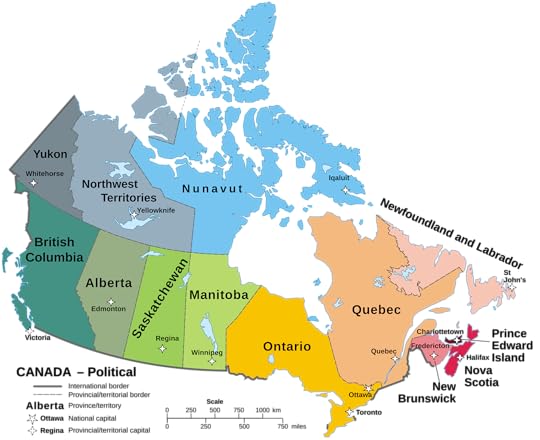
Nevertheless, I knew very little about the subject and appreciated the coverage. It also improved my knowledge of Canadian geography (only 2 maps in the book, however). I would have liked a little more on the provinces and territories and less on the seats won by the parties in each election but it was worth reading.
This is one of the weakest history books I’ve ever read. Even putting aside a total lack of sourcing, it somehow manages to both be too specific and too shallow, glossing over wide swathes of history in the name of accessibility while lacking the context to make what it does talk about have any meaning to anybody other than those already familiar with the history at hand. It fails at being an entry-level approach to Canadian history; it fails at being interesting or useful to those who want to explore new angles or deeper connections.
2 stars feels generous but I did learn a couple things so that's maybe worth the additional star.
This was a slog to get through and I resent the blurb on the back of the book that says this book is "absorbing." The blurb also implies that this book makes Canadian history not dull, and I don't know what book the reviewers read, but my GOD was this dull.
To start, this is a political history, and if you don't already understand how Canadian government works, good luck understanding half of what is going on. The way Morton condenses history is somehow full of details and yet absolutely opaque at putting together a big picture narrative of how the country was formed.
It probably doesn't help that it took me 7 months to read this book, but I honestly feel like I'm no closer to understanding the history of Canada than I was before I read this book. I need to find history books that dive into specific areas instead of trying to get an overview. If you want an overview, just read Wikipedia. It gives a clearer summary of historical events than whatever this book was trying to do.
Large land mass, surrounded by Ocean. Canada has lot of unused land, it's not livable in northern most parts. In many parts of Canada, there are no roads, small towns exist like Iqaluit, Nunavut. The Inuits stay in Nunvat.
Alexander Graham Bell is the greatest Canadian in my perception.
Canada is the land of immigrants.
1. Stories relating to Canada
Growing up in South-India, the perception of Canada was peaceful. Almost everyone around, who I met had a positive view of Canada. Well, we never had any historical lesson on Canada from Tamil Nadu.
At present, I notice, lot of Tamils escape to Brampton, Mississauga, suburbs of Toronto in Ontario. I earnestly wish, they'd try to learn good things from the new land, integrate, contribute, be inclusive, friends with all. From the 1980s, there's a large number of Srilankan Tamils around Toronto, who escaped from War and settled.
But, Why even hear or go through basic History of Canada?
From South-India's perspective, you can notice from almost nothing, a country being formed and prosperous. Not only that, the challenges, issues the country faced, yet they pulled ahead. Integrating British, French descendants, First Nations together as one multi-cultural country.
The last time, I came across Canada was in Sir Visvesvaraya's Resconstruction of India (1920). He spoke highly of Canada, wanting Indians to absorb the operations of statehood functions and industrialization.
These days, Canadians are from all parts of the world, it's truly a multicultural society. In terms of demographics of Indian-Canadians -- Punjabi-Canadians are the majority. Majority of the population live on the borders of US-Canada, as further north is much colder.
In my readings of Canadian history, I found the Sikhs immigrated long back into the provinces. Some Sikhs arrived as part of British military contingents for events like Queen Victoria's Jubilee in 1897, with the first settlers arriving in the early 1900s. They worked in Lumber Mills of Victoria.
I also remember, reading this challenging story of an immigrant from Punjab. He arrived to Canada with nothing, along with his wife. He struggled throughout his life in Canada. He wrote about cold struggles, not able to get a white collar job.
He felt so happy, when his grandson made it to MIT. He described all the challenges he faced building his life, as his english skills were poorer. He could not advance much to managerial roles, such stories, I believe needed to be shared among High-schoolers.
2. What about the economy of Canada?
A reader from South-India might wonder about Canada and US. So this should help him, to get a picture of Canada.
Firstly, in terms of performance, America's economy is ahead of Canada. US GDP in 2023: $27.72 trillion Canada's GDP in 2023: $2.89 trillion. US has larger population and about 10 times more larger economy.
US real GDP per capita stands at approximately $66,300 (2024) Canada's GDP per capita stands at approximately $44,400 (2024) US is on its way to produce 50 percent more than an average Canadian. Massive productivity difference and brain drain of Canadians to US.
Canada has lost lot of workforce in its history to US.
2.a Economy & Jobs
As always, when I meet someone new from a new province. I wonder about the demographics, jobs of the town, as usually people settle where the jobs are around. For many Tamils, Indians, Canada easier to immigrate was before 2017.
I met a family who grew up in Alberta, Canada. It was captivating hearing their upbringing, grand-parents fleeing from India-Pakistan's border settlement, and then, finally settling in Alberta. Now the family is in America, hearing their story made me realize about respecting states, provinces, welcoming immigrants.
2.b Canadian Province by average economic output per person
Alberta - $96,544 Saskatchewan - $90,425 Newfoundland and Labrador - $77,201 British Columbia - $75,662 Ontario - $74,143 Quebec - $68,565 Manitoba - $64,421 Prince Edward Island - $60,592 Nova Scotia - $60,343 New Brunswick - $56,277
2. c Type of Jobs:
Alberta is the wealthiest province -- oil and gas jobs, agriculture jobs. Saskatchewan -- mining powerhouse and ag-processing jobs Newfoundland and Labrador -- Offshore oil, Fishing related jobs. British Columbia -- Tech jobs, film/TV production, ports/logistics, forestry, mining, and tourism. Ontario -- Ranges from all type of jobs, manufacturing, finance/insurance/professional services, engineering
Quebec - advanced manufacturing, aerospace related jobs, hydro-power plant related jobs, precision manufacturing. Manitoba - Agriculture, Logistics related Prince Edward Island - Agriculture, Fishing related processing units Nova Scotia - Agriculture, Defense & Aerospace, IT jobs, Tourism, Fishing jobs collapsed in 1992, due to overfishing of Cod New Brunswick - Agriculture, Forestry, Mining, Fishing jobs
3. How Canada was formed? The country of Canada was formally established on July 1, 1867.
Military threat There was constant threat, American Military especially during the Civil War might look northward next, the war displayed how American military was stronger. The belief of manifest destiny, that America was destined to rule entire North America.
Economy unity Railway lines to link entire Canada, no single colony could afford afford alone. Americans announced that the Reciprocity Agreement would end in 1866, i.e end of free trade.
Political Instability Between 1861 and 1864, two elections, four governments, and three dangerous years, lot of political instability.
Being United together means, the internal divisions between French Canadians and Canadians of British origin could end.
Americans lost Quebec war: The American Revolutionary War (1775–1783), When Americans invaded Quebec in 1775, they were eventually driven away, partly after their troops began to raid livestock and food supplies. This conflict resulted in Britain losing the Thirteen Colonies but retaining "the cold, unprofitable remnants of the continent. Americans lost The War of 1812 as Canadian Major-General Isaac Brock helped secure victory.
4. Canada in 1900s
Canada significantly helped Britain during World War I. Canada sent over 600,000 soldiers to fight alongside Britain, suffering heavy casualties (67,000 dead) and gaining international recognition for battles like Vimy Ridge.
The Second World War transformed Canada into a major industrial power, doubling its gross national product and creating industries that enriched the post-war economy
5. After 1940s:
In the post-war world, Canada gained an independent voice and status as a "middle power," deeply involved in international bodies like the UN and NATO. This period was characterized by unprecedented prosperity, which funded the establishment of the welfare state with programs like unemployment insurance and early health planning. Newfoundland’s entry in 1949 completed Confederation.
After the World Wars, Canada emerged as its role as a "middle power" on the world stage, particularly through its involvement in Cold War conflicts and alliances. Canada participated in the Korean War (1950–1953), contributing destroyers and an infantry brigade to the UN force. This conflict spurred NATO rearmament, leading Canada to commit forces and a major defense budget. The Suez Crisis in 1956 saw Canadian diplomat Lester Pearson orchestrate the deployment of the UN’s first peacekeeping force, earning him the Nobel Peace Prize. From 1960-1980s, Canada experience prosperity boom.
Well-written, engaging, and at least attempting to be balanced. The first part of this book--the more ancient and early histories of Canada, from the First Nations to early colonial days--is dry and a bit of a struggle to get through, seemingly less interesting to the author than more recent stuff.
But from 1865 onward, the book tells a story of Canada. It also fills in a lot of gaps that I, as an immigrant, had--and revealed a lot of interesting falsehoods I had believed after picking them up as sort of modern folk history.
At its most depressing, the book points out the repeated patterns Canada and its governments find themselves engaged in--no problem we face now is new, but is part of a pattern going back and repeating itself over and over for hundreds of years. At its most hopeful, the book highlights what progress we've made as a society and how far we've come, even if constantly reminding how far we still have to go.
This book is a concise history of Canada dealing mostly with from the times of European settlement until the date of its writing. It focuses mostly on the political history, bringing up names of important politicians along with laws and other documents that have shaped the Canadian story. The coverage of such a long history in such a short book requires that matter be quickly dealt with. Perhaps a more modern Canadian history (my copy goes to 1987) would include more information about First Nations. I do recommend this for readers searching for a quick overview of Canadian political history.
Other reviewers have already made the point: this is almost exclusively a political, economic, and military history of Canada. No mentions of hockey, and almost nothing about Canada's cultural or social changes.
This is the typical Canadian history you probably learned in school. Not many new insights to be found here, I'm afraid.
Readable, sure. Short, not exactly. I refuse to believe that Canadian history can't be made more interesting than this book would make it seem.
First, I take issue with the title. 405 pages does not make this a particularly long book by itself, but it is so full of names, places, and events that it made for slow reading, and thus made it seem long for me. Still, it was very interesting, and I learned a great deal.
I have two particular ties to Canada.
One is the trip our family took to Montreal in 1967 for the World's Fair known as Expo '67. It remains a wonderful memory, although the author of this book was not as enchanted. He says, "For a city with crowded slums and without proper sewage treatment, it was a gross extravagance." However, a few pages later he concedes, "In a suffusing glow of pride, Canadians realized that they had sponsored an artistic and innovative success." On that same family trip, we stopped at Stratford, Ontario and saw "Richard III", and we also visited Ottawa, Canada's capital, on July 1, 1967, Canada's 100th anniversary of independence.
The other tie is the ancestry on my father's side. My great-great-grandparents, John and Grace Addison, moved from Scotland to Canada, where their son, Robert Walter Addison, was born in Montreal in 1848. The family later moved to Hamilton, Ontario, where John was a well-known contractor and builder. "Grandpa Robert" served in the Canadian military and fought against the Fenians, resulting in the award of 160 acres of land, which has remained in the family until very recently. Robert moved to Cleveland, Ohio in the US, then his son, John Walter, moved to Gary, Indiana, where his son, Robert John Addison (my father) was born. In 2009, I drove to Hamilton to do some family research and visit the cemetery where John and Grace are buried. You can find it all here in a book I put together called The Addisons in Canada.
But back to this book. Canada is a very large country, so there are lots of areas to describe. Of all the subjects in this book, I think the relationship between the French-speaking "Quebeckers" and the English-speaking Ottawans is the most interesting. The feud has yet to be satisfactorily resolved, although they have lived together in peace for over 150 years now.
All in all, a very good book, if you can spend the time reading it.
Concise and dense, this little history book does a decent job going over the major trends and trials that Canada dealt with over its several hundred years in the making. It wasn’t too difficult to get through, and for the information, it was well-detailed without bogging down too much in areas where the slog of parliamentary processings bore me to tears.
Is Canada’s history boring? When it comes to government, yes, absolutely. Is Canada’s diversity underrepresented? Most definitely. The sheer fact that America is such a disastrous southern neighbor when it comes to social reform, natives’ rights, and basic human decency only highlights how even the barest of recognition and conciliation can be seen as “socialist” to our American politicians.
My Canadian acquaintance I made when visiting compared Canadian nationalism to ours by saying unlike America, Canada is proud to put itself as second best or even the next best thing, but never the absolute best. America’s “We are the best” mentality is shrouded in the conceding “At least we’re not like them” mentality that Canada views itself with, which can come off as both snobbish and hypocritical.
I definitely need to follow up on the Quebec stuff though, because wow I knew the friction there was unusual, but had no idea it had basically always been strange and strained.
Nice overview for those wanting a crash course on Canada.
Desmond Morton wrote a nice little book of mostly political history, bolstered by enough economic and social history to give it some background. He tells us about the prime ministers and most important premiers, their accomplishments and failures, and what they argued about.
The book is mostly descriptive, but there is enough opinion in it to make it interesting. I often agreed with Morton. For example, Egerton Ryerson’s most important accomplishment was surely building Ontario’s public education system, while his contribution to the indigenous residential schools was negligible. On the other hand, when he included indigenous creation myths in his account of the population of North America, I think his time would have been better spent on discussing things that actually happened.
Morton was a military historian, so pay special attention when he analyzes Canada’s contributions in its various wars. We did not always do well, but sometimes we did great.
This book is good for anyone who wants to know more about Canadian history. If you are a beginner, you will learn a lot. If you are an expert, you will find narratives synthesized into a comprehensive whole that you can debate as you read.
Succinct and useful. Not boring, as many Canadians think, and sometimes quite fascinating.
Although the book is over 400 pages long, it is a little too short, especially in the early chapters prior to Confederation in 1867. The book focuses primarily on political and economic developments with a small amount of social and cultural history, including some bleak depictions of pioneer life on the frozen frontier. The strongest chapters discuss how Canada's economy changed over time as well as the different visions of Canada by successive Prime Ministers. There are a few mentions of royal tours but the impact of the constitutional monarchy and Canadian responses to this system of government receive little attention. The book would benefit from the inclusion of a bibliography and further reading suggestions considering how quickly major historical developments are summarized in the text. Well written and readable but too short, even for a short history, considering the breadth of the material.
As a history it failed on a number of respects. Morton does not seem to have a good grasp of what to mention in passing what to dwell on. Too many times I felt that the big central moments in Canadian history, which demand discussion and description are brushed over far too much. Morton also fails to establish themes or put events into understandable, overarching narratives. Especially towards the end of the novel, he also abandons everything beyond describing the political happenings from one election to the next. Condensing the history of a nation into one book is difficult but I do feel it can be done better. However, the worst offense here is the near total absence of indigenous politics and events. The residential schools for instance are only mentioned quickly as are other things which demand more attention. A starting point perhaps but far from definitive. 4/10
I found it hard to find a good "History of Canada" book but this one seems to be fairly comprehensive, but it's pretty light on indigenous issues basically mentioning things like residential schools in passing. This would probably be better titled "A Short Political History of Canada" as it is basically all about what political party is in power and what they did while in power. It skips over big Canadian events or mentions them quickly, sticking to politics. I will give Morton credit though, he does present a fairly unbiased political. It was a little dry and I found jumping forward and backward in time to make for a bit of a confusing read at times, but overall it was pretty good.
If looking for a political history of Canada this is worth a read.
Felt the need to post review of this one. Truly unique and bizarre view of Canadians History. First off entire narrative is based on who is in power , who Is running and then some events ( as is there is direct connection), and on to next election. I get politics is some of it but does not define a country’s entire history. In addition, certainly reads like author positions Canada as emerging country coming into its own until 1970 and positions everything after as a step backwards in Canada and paints a image of a unhappy population post 1970. Had to question where I’ve been living because as a lifetime resident who grew up during this timeframe I had never felt nor lived this narrative. Overall much better Canadian history books out there without this nonsensical narrative.
I simply could not follow this book. The author kept mentioning concepts like broad cultural shifts or specific legislation and emphasizing how incredibly important these concepts are to Canadian history, but he literally never explained what those concepts were. For example, he continuously emphasized the crucial importance of The Quebec Act of 1774, but I have no clue what the act really did. So imagine my surprise when Canadian history would take a dramatic and seemingly unpredictable turn, and the author would point to The Quebec Act as the obvious cause.
Other complaints include the author’s dull writing style and his clear objective to use this history book to push his own clear idea of what Canada should be.
This entire review has been hidden because of spoilers.
Excellent book. Of course, there were places where the author had to skim for lack of space, but all in all, this is a very good book for a summary and a starting point for relearning about Canadian history. This book was also very good in the fact that I found it mostly unbiased - the parts with a bit of bashing of Trudeau Sr. and Harper were fun to read, hahaha. The only disappointing part of the book was the last five pages, where I found out, unfortunately, that Morton is a Trudeau Jr. lover (calling him "eloquent" and an "idealist"). Besides that, this book was enjoyable to read and very informative. Definitely recommend.