Nicholas Mosley's Whitbread Award-winning novel "Hopeful Monsters" dealt with the suggestion that if human nature could not be improved by scientific manipulation, perhaps a suitable environment or soil might nonetheless be prepared into which an appropriate seed for change might fall, and not be smothered by weeds. In "Metamorphosis," a humanitarian worker and a journalist in a vast refugee camp in East Africa come across a newborn child who for some inexplicable reason gives them the impression that it might be just such a seed. But why? And what to do about it?
Nicholas Mosley was educated at Eton and Oxford. He served in Italy during World War II, and published his first novel, Spaces of the Dark, in 1951. His book Hopeful Monsters won the 1990 Whitbread Award.
Mosley was the author of several works of nonfiction, most notably the autobiography Efforts at Truth and a biography of his father, Sir Oswald Mosley, entitled Rules of the Game/Beyond the Pale.
I had been writing this in Ireland with my table set up in a corner of the walked back garden with the branch of an apple tree hanging over from the untended land outside. My computer was behaving impeccably but my writing was becoming lost...
And lost I felt throughout this book. Lost and disappointed. It’s hard to believe that this upcoming novel is written by the same Mosley who amazed me with his amazing Impossible Object. That was a book which read like a dream but here I felt like reading a cryptic and boring reality. Metamorphosis starts on a familiar note with familiar settings – a couple in Ireland with their kids and few ‘others’ who’re capable of complicating an already complicated family with a writer writing about his writing, a journalist musing about Israeli-Palestine conflict, a scriptwriter recalling his time in Jerusalem, a father writing about his kids, a man writing about the women in his life, a friend writing about his well...friend and Neuroscience.
It all seems fascinating and indicate the depth of this little book but it didn’t work for me against my high and excited expectations. I mean what do I know about Neuroscience but again what do I know about Nietzsche either who had his ample presence in Impossible Object. I tried to stick with at least one element here which would carry me towards a rewarding end but somehow Mosley didn’t let me touch the surface of any of his ideas; forget about having an adventurous deep diving. I simply felt like a confused, lonely onlooker from a high cliff who couldn’t make out whether the creature jumping out of the ocean is a dolphin or a shark.
I’ve been reading that book you lent me...it seems to be saying that we can make our own reality if we pay attention to what’s around us.
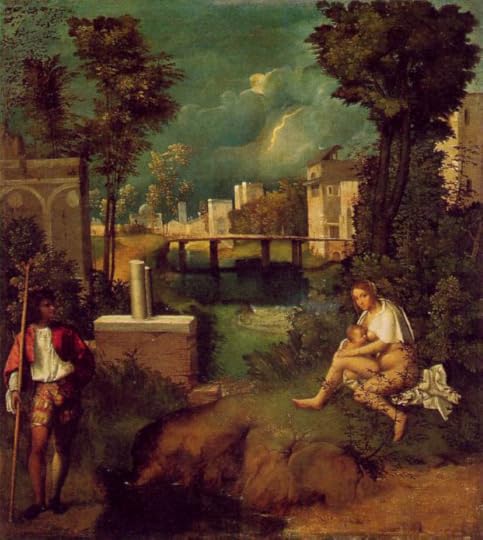
I received such revelatory hints with open arms. He even mentioned Tempest several times, a painting which can have millions of interpretations and tried to form an epiphanic connection from it but whatever I reflected along with few mildly impressive moments in the story rendered nothing but little satisfaction to me. This work is very much close to the present happenings around us. With the observations about God Particle and political tensions prevailing everywhere, Mosley has probably tried to form a kind of allegorical tale signifying the need of a high time change that is required in our society but I feel that under the garb of an ambiguous narrative, the thought of communicating with the readers suffered a great deal and the ‘Metamorphosis’ I kept waiting for never happened. Still, acknowledging my ineptness in deciphering this text and thereby giving a benefit of doubt to a writer I hold in high regard, this book stands at 2.5 stars for me.
I got some worthy epiphanies from this philosophical novella, but I can’t recommend it widely. Most readers seek more in the way of plot and character development, or in play of language and structure, than can be found in its reading. It satisfies my interest in making personal sense out of discoveries of modern physics. However, the focus here is more on the sizzle than the steak. In other words, it’s more about the urge to align everyday existence with concepts from science, however poorly we understand them as they impinge on us through the media, than a serious model for such relations. I found the story to serve as an interesting parable that extends C.P. Snow’s warning over 50 years about the siloes that exist between the sciences and the humanities. People from the sciences need folks from humanities to make meaning of their discoveries, and the latter need the former to provide some kind of objective grounding for their creations. The upshot appears to be that attempts at a collaborative understanding largely fail.
The unnamed first-person narrator, a journalist, is on a holiday at the shore in Ireland with his family. His perceptions of ordinary events and human actions are infused with much ambiguity. Most people muddle through, but he seems to strain a lot to make the right inferences from incomplete knowledge. For example, he sees a dark shape on the beach from the cliff top, and almost slips off trying to discern what it is (a dead whale). He hears a gunshot and somehow suppresses the urge to hide, comes to assume someone may be hunting rabbits, and later, upon finding an immobile man in a hole with a gun, wonders if he may have committed suicide. When it turns out he injured his ankle, the narrator is much relieved, but he still seeks clues in the man’s singing to his daughter about whether he might be involved in reviving in some renewed conflict between Protestants and Catholics. It turns out his journalistic career has involved coverage of nationalistic conflicts such as the Israeli-Palestinian struggle and the brutal chaos within Somalia. We begin to understand how Peter has good reasons to mistrust the world and to struggle with accurate perceptions.
To help deal with these troubles, the narrator draws on his history of ongoing dialog with his friend Johnny, who is a physicist moving into the field of artificial intelligence. The enterprise to simulate the human brain on computers has both of them excited about the prospect of useful insights into human consciousness, but his attempts to gain from Johnny some revelations about free will appear fruitless. The evidence that 90% of the universe is comprised of mysterious dark matter and dark energy and the proof of the “God” particle” (i.e. the Higgs boson) are also areas the narrator yearns to digest through their discussions, though to little avail. It’s sad for all of us riders on this planet that even with serious spoonfeeding by the likes of Tyson, we are doomed to the use of hopelessly inadequate metaphors to make such momentous discoveries relevant to ordinary life. I empathize with the narrator, who was a English major, who gets baffled, but oh so intrigued by a media report: “Cosmologists are now saying that the universe is a hologram of processes on the surface of a two-dimensional sphere.”
Johnny’s explanations of quantum physics with the paradox of Schrodinger’s Cat has more traction for the narrator. This thought experiment from the 30’s was used as a means to reveal deficiencies in the standard theory of particle-wave duality of matter when applied to macroscopic objects. If taken literally, one is left with the concept that until the observer opens the box to see if a radioactive decay has triggered the release of cyanide the cat exists in a state of being alive and dead at the same time. His step-son Peter (and Johnny’s biological son) leaps on the idea of the power of free will in the choice of the observer to open the box and thereby affect reality. The narrator (along with many writers and artists in the 20th century) also feels compelled apply some lessons from the “truth” in physics to conundrums in the world. On one level he seems to be aware of the absurdities that result, but his need drives him on anyway:
I went to Jerusalem to work on a story about the Israeli-Palestinian conflict of the present day. I wrote to Johnny—We are in Schrodinger’s Cat territory here: both sides have equally valid contentions about life and/or death, and it is as if we are waiting for a big Hollywood money-man to open the box and look in.
He keeps stretching to glean something that will help with the mess that humans are in: For was it not now claimed scientifically that the observer affected that which was observed? And might not this represent, and be used as, the freedom that humans felt and understood that they had got; but now sometimes seemed to sense they might have lost? That is—a freedom depending on some partnership not with groups of other humans, but with the world or universe?
On the other side of things, Johnny’s interest in talking with his literary friend seems to represent the struggle of scientists to glean something pragmatic out of the cultural enterprises of the humanities. For example, he is fascinated with the idea that art joins together the subjective and objective, the inside and outside worlds. And significant works can be a cultural touchstone of meaning for individuals over history. The narrator perpetually makes connections between uncertainties in his life and elements present in a famous Renaissance painting by the Venetian Giorgione, called “The Tempest.” As seen below, it depicts a nude woman breast-feeding a baby on one side of a stream and a soldier with a spear on the other, while a storm brews in the distance. For centuries, viewers have been struck by the mysteries in the scene, such as the connection between the two figures and the import of impending threat from nature. The woman’s gaze appears to reach out of the frame to engage the viewer.
The confusion and frustration experienced by the narrator gets transferred to the reader. This is not the same kind of experience you get from reading about the family at the shore in “To the Lighthouse”, whose members also seem to be struggling with ambiguities about reality. We don’t have Woolf’s heroic effort of using language to emulate the flow between perception and thought. Still, Mosley does succeed in epitomizing important aspects of living in the modern world with so much scientific knowledge that is inadequate to solve problems in either the personal or political spheres. Personally, I find recourse in the realms of science fiction, where I get human stories with some illusion of meaning in all the wild theories and discoveries from science. Some of the tales are hopeful and many are dark apocalyptic visions. This novella takes a bit of a turn toward science fiction on the hopeful side. In Mosley’s story characters representing science and humanities in some sense become parents of a new form of human with an extra capacity to deal with unknowns. It’s not quite up to my pleasure standards for speculative fiction, but it’s a fair way to allegorically put the reader out of the misery of an infertile marriage of the two cultures.
This book was provided as an e-book loan from the Netgalley program.
I’ve really no idea what this book was about. I stuck with it hoping it might all become clear, but it didn’t. There’s a family on holiday in Ireland. The man is a journalist who once rescued a child from Africa and now it seems that the child is very significant for some sort of future evolution of mankind. Or something. Beats me.
If this is minor Mosley then I'm extremely excited for the rest of his bibliography because I absolutely loved this. There are some interesting ideas explored here in terms of the interplay between scientific discovery and its impact on everyday life, but I really connected with this from a stylistic point of view. Mosley is a remarkably playful writer even when exploring darker topics. He seems completely uninterested in letting plot constraints or reasonable character behaviour come in the way of his fluidity as an author; it really feels like he's allowing himself to take things wherever feels natural, and you can really tell where a less confident author might have reigned themselves in and how unique this feels as a result. I was most reminded of Nicola Barker, who has a somewhat similar semi-surreality to her writing, but again the idea I keep coming back to is playfulness, and this feels on another level in that regard, at least compared to what I've read from her writing. I can definitely understand why some might bounce off of this — it's pretty rare for a 130 book to feel appropriately described as shaggy — but Mosley's voice here was an absolute delight for me.
Almost quintessentially Mosley. He takes a couple of ideas and worries them half to death across this novella, stating and then restating them in slightly different formulations, whilst fracturing the narrative. Not wholly sucessful but a nice short diversion.
I didn't like this one a single bit. The whole thing feels like a short story that didn't want to die. Philosophical ruminations on the free will, the brain and the computer, ending with an appearance of something that is the next step in the human evolution - the whole thing just feels like sci-fi for the poor (the one you get to watch on TV during the day).
I love the way Mosely writes: he has discovered and developed a way of recording the internal life of his characters, which I find refreshing, true and moving. I also find fascinating his idea that the observer unavoidably affects the observed. The reader is required to engage, and will be rewarded, but this is not especially easy reading.






#mediaviewer/File:Giorgione_019.jpg)