

What do you think?

The Egg Tree
One Easter morning, Katy and Carl went on an Easter egg hunt through Grandmom's house. Katy couldn't find anything until she went up to the attic. And there she discovered a very special set of eggs...
Grandmom had painted them when she was a little girl. And now, she hung them from the branches of a tiny tree -an egg tree! So began a very special Easter tradition.
Grandmom had painted them when she was a little girl. And now, she hung them from the branches of a tiny tree -an egg tree! So began a very special Easter tradition.
32 pages, Paperback
First published January 1, 1950
Ratings & Reviews
Friends & Following
Create a free account to discover what your friends think of this book!
Community Reviews
Displaying 1 - 30 of 217 reviews

July 2, 2018
There are 3 colors for the illustrations and they are like pastels. It is not a bright book with sharp colors. The art was a let down here. The story was fine. A family goes on an Easter Egg hunt and one girl finds some fancy painted eggs the grandmother had forgotten about. They take the fancy eggs and make an Egg Tree.
It turns into 'Field of Dreams' with the whole, 'you build it and they will come' thing. We made an egg tree once when I was a kid. I don't think it's as exciting as a Christmas tree. Once was enough for us.
The nephew thought this was story was too long with too many words on the pages. He kept telling me to skip to the end.
It turns into 'Field of Dreams' with the whole, 'you build it and they will come' thing. We made an egg tree once when I was a kid. I don't think it's as exciting as a Christmas tree. Once was enough for us.
The nephew thought this was story was too long with too many words on the pages. He kept telling me to skip to the end.

March 19, 2010
Updated review 2024: I enjoyed this much more this time around, reading it with my children. The illustrations are so full of warmth and character and the story also brims with warmth, the joy of the Easter season, the arrival of spring, shared family traditions across generations. It resonated with me this time. I'm glad to see it was popular in our library district -- sadly there was only one copy but it had so many holds that I didn't get it until late April and I promptly returned it because four patrons are still on the wait list!
Original review 2014: A pleasant story, and a nice change from today's busy and bright Easter fare, but it didn't especially stay with me. The illustrations, while pleasant, really are more of a nod to the Pennsylvania Dutch folk art rather than an accurate representation of it. It seemed too pastel, watercolor-y to me. And I wanted more information about the meaning of each of the designs. I think it is called "Hex Art"? You can find some gorgeous examples online.
Original review 2014: A pleasant story, and a nice change from today's busy and bright Easter fare, but it didn't especially stay with me. The illustrations, while pleasant, really are more of a nod to the Pennsylvania Dutch folk art rather than an accurate representation of it. It seemed too pastel, watercolor-y to me. And I wanted more information about the meaning of each of the designs. I think it is called "Hex Art"? You can find some gorgeous examples online.

April 4, 2021
Spending their first Easter at Grandmom's farm in the country, Katy and Carl join in the Easter Egg Hunt with their cousins, but find that they're not very successful at tracking down those brightly colored treats. Then Katy finds her way to the attic, where she discovers an old hatbox full of gorgeously decorated eggs, made by Grandmom when she was a little girl. Painted in traditional folk styles, these eggs are so lovely that the children ask to be taught how to create them themselves, and when they have learned the skill, create enough to make a gorgeous egg-tree...
Originally published in 1950, and awarded the Caldecott Medal in 1951, The Egg Tree is a lovely book, one which pairs an engaging story of Pennsylvania Dutch (German-American) Easter traditions with beautiful folk-art illustrations. Before picking the book up, I was unaware of the German Ostereierbaum (Easter Egg Tree) tradition, but apparently it is many centuries old, and was brought by German immigrants to the United States. Although I have some German ancestry on my father's side, this tradition is unknown in my family, so I was happy to learn of it. Apparently, the most well-known example of an Ostereierbaum is the one in Saalfeld, Thuringia, which is decorated every year with thousands of eggs:
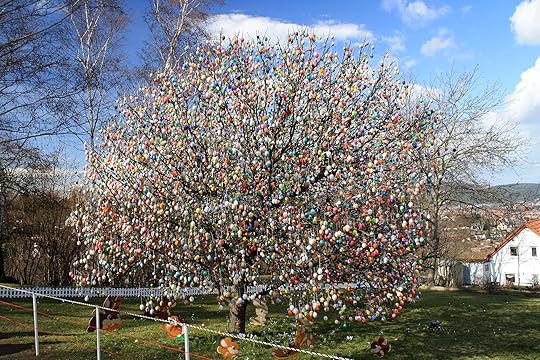
In any case, I found the story here sweetly appealing, enjoyed learning about a new-to-me Easter tradition, and found the folk-style artwork beautiful. Recommended to picture-book readers looking for Easter stories, or for tales with a Pennsylvania Dutch cultural backdrop.
Originally published in 1950, and awarded the Caldecott Medal in 1951, The Egg Tree is a lovely book, one which pairs an engaging story of Pennsylvania Dutch (German-American) Easter traditions with beautiful folk-art illustrations. Before picking the book up, I was unaware of the German Ostereierbaum (Easter Egg Tree) tradition, but apparently it is many centuries old, and was brought by German immigrants to the United States. Although I have some German ancestry on my father's side, this tradition is unknown in my family, so I was happy to learn of it. Apparently, the most well-known example of an Ostereierbaum is the one in Saalfeld, Thuringia, which is decorated every year with thousands of eggs:
In any case, I found the story here sweetly appealing, enjoyed learning about a new-to-me Easter tradition, and found the folk-style artwork beautiful. Recommended to picture-book readers looking for Easter stories, or for tales with a Pennsylvania Dutch cultural backdrop.

August 27, 2026
A wordy and dull picture book about an Easter tradition in Pennsylvania Dutch Country.
During an Easter egg hunt a little girl finds a collection of decorated eggs in the attic, which reminds her grandmother that they used to have a tradition of hanging them on a small tree. So they do that. Yup.
This is a Caldecott medal winner, but I find the pictures just okay. Nothing special.
During an Easter egg hunt a little girl finds a collection of decorated eggs in the attic, which reminds her grandmother that they used to have a tradition of hanging them on a small tree. So they do that. Yup.
This is a Caldecott medal winner, but I find the pictures just okay. Nothing special.

April 2, 2010
I have a lot of regard for the traditions of the Pennsylvania Dutch, having ties to them on both sides of my family. This book does a fantastic job of evoking the simpleness of Pennsylvania Dutch life, and introducing the concept of the egg tree to many younger readers who have probably never even heard of it. That group would include me, as I was completely unfamiliar with the idea before I read The Egg Tree.
Katy and Carl, a brother and sister visiting their Grandmom's house for Easter, embark on a traditional egg hunt with all of their cousins. Katy doesn't have much luck searching for the appointed eggs, but when she stumbles upstairs to the attic, she finds six beautifully colored intact eggshells that have nothing to do with the current day's hunt. Their Grandmom had designed these eggs years ago to hang on a miniature egg tree, but then forgotten about the little works of art that remained in her attic.
Grandmom puts the old painted eggshells onto an Easter egg tree and shows the kids how to design such colorful eggs of their own, and before long a bigger tree is needed. The concept of the egg tree spreads beyond the four walls of Grandmom's house, and by next year's Easter people are coming from all around to observe this Pennsylvania Dutch tradition of decorating an egg tree with bright, colorful eggs. Because Katy had chanced upon her Grandmom's eggs the previous Easter, many people can now enjoy the egg tree to which they all have artistically contributed.
For a Caldecott Medal winner, I personally thought that this book was better than average. I would recommend it, either as a foray into the old-time traditions of Pennsylvania Dutch culture or simply as a nice book to read.
Katy and Carl, a brother and sister visiting their Grandmom's house for Easter, embark on a traditional egg hunt with all of their cousins. Katy doesn't have much luck searching for the appointed eggs, but when she stumbles upstairs to the attic, she finds six beautifully colored intact eggshells that have nothing to do with the current day's hunt. Their Grandmom had designed these eggs years ago to hang on a miniature egg tree, but then forgotten about the little works of art that remained in her attic.
Grandmom puts the old painted eggshells onto an Easter egg tree and shows the kids how to design such colorful eggs of their own, and before long a bigger tree is needed. The concept of the egg tree spreads beyond the four walls of Grandmom's house, and by next year's Easter people are coming from all around to observe this Pennsylvania Dutch tradition of decorating an egg tree with bright, colorful eggs. Because Katy had chanced upon her Grandmom's eggs the previous Easter, many people can now enjoy the egg tree to which they all have artistically contributed.
For a Caldecott Medal winner, I personally thought that this book was better than average. I would recommend it, either as a foray into the old-time traditions of Pennsylvania Dutch culture or simply as a nice book to read.

February 23, 2018
Written in 1950, this book possesses the old-fashioned charm you'd expect. Each page has detailed illustrations in the Dutch style, and the story follows some children hunting for eggs on a farm to the clever idea their Grandmom comes up with.
Ages: 6 - 10
Cleanliness: the words "stupid" and "Land's sakes" are used.
**Like my reviews? Then you should follow me! Because I have hundreds more just like this one. With each review, I provide a Cleanliness Report, mentioning any objectionable content I come across so that parents and/or conscientious readers (like me) can determine beforehand whether they want to read a book or not. Content surprises are super annoying, especially when you’re 100+ pages in, so here’s my attempt to help you avoid that!
So Follow or Friend me here on GoodReads! And be sure to check out my bio page to learn a little about me and the Picture Book/Chapter Book Calendars I sell on Etsy!
Ages: 6 - 10
Cleanliness: the words "stupid" and "Land's sakes" are used.
**Like my reviews? Then you should follow me! Because I have hundreds more just like this one. With each review, I provide a Cleanliness Report, mentioning any objectionable content I come across so that parents and/or conscientious readers (like me) can determine beforehand whether they want to read a book or not. Content surprises are super annoying, especially when you’re 100+ pages in, so here’s my attempt to help you avoid that!
So Follow or Friend me here on GoodReads! And be sure to check out my bio page to learn a little about me and the Picture Book/Chapter Book Calendars I sell on Etsy!

January 16, 2013
My mother had an Easter tree when I was a kid, and this book brought back memories of watching her hollow out eggs so I could take them to school and decorate them, then bring them back home to hang on the tree. The dialogue in this book, and the behavior of the kids, seemed very contemporary, despite the book's age, and I think only the style of dress in the illustrations gives away that the setting is actually Pennsylvania Dutch Country. I was kind of disappointed by how dull the colors are in the images, but I did like the two-page spreads showing the kids hunting for eggs and later painting them.

April 9, 2012
This is a lovely story of a Pennsylvania Dutch family. The children are waiting for the Easter bunny to come, then hunting for eggs. Katy is sad because she can not find any of the eggs...until she goes to the attic and discovers eggs her granmom painted years before. The cousins all paint eggs and create an egg tree...a beautiful egg tree that the community wants to see. This would be a great read aloud to tie into an art project of painting wooden eggs. It would be fun to decorate an egg tree each year.

July 10, 2014
Rating: 2 stars
I try not to be harsh when it comes to my reviews, because each book is someone's baby and I'm sensitive to the fact that each one is precious. However, as a writer and an illustrator reading this book, I feel as if I'm missing something. Why was this book a winner?
It is a very ordinary story about kids who search for eggs during Easter, one of them discovers old eggs in the attic, and their grandmother shows them how to make The Egg Tree. The word spreads and next year even people from the Big City come to see the enormous egg tree the children have created.
I found the separation of text mid sentence with a two-page spread in between irritating. I want to stop and look at the illustrations, but I have to flip the page to complete my sentence first.
I'm also not a fan of this type of illustration. Illustrations in the book are very wooden, and the colours are all over the place--some illustrations literally hurt my eyes. I understand that the 50s were the period of expressionism and moving away from classical illustrations, but I would take Beatrice Potter and Arthur Racham's work over this any day. Maybe it is because of the WWII that they could not afford to spend more money on printing full colour illustrations? I do not know. I am not an expert. However, I am not a fan. I realise Milhous was trying to copy the "Pennsylvania Dutch", but it does not feel or look quite right. Terrible sense of colour throughout the whole book. Monochromatic illustrations are the only ones I can stand to look at. Maybe this is just the case with my book?
This book did not resonate with me at all. The one thing I did like about it is discovering that you could "blow" an egg, and then paint the shell to keep it forever. I have never heard of this before.
The last sentence makes no sense, because the eggs Kathy found were painted by her grandmother and not by the Easter Rabbit.
I'm sorry, but 2 stars is the best that I can give.
I try not to be harsh when it comes to my reviews, because each book is someone's baby and I'm sensitive to the fact that each one is precious. However, as a writer and an illustrator reading this book, I feel as if I'm missing something. Why was this book a winner?
It is a very ordinary story about kids who search for eggs during Easter, one of them discovers old eggs in the attic, and their grandmother shows them how to make The Egg Tree. The word spreads and next year even people from the Big City come to see the enormous egg tree the children have created.
I found the separation of text mid sentence with a two-page spread in between irritating. I want to stop and look at the illustrations, but I have to flip the page to complete my sentence first.
I'm also not a fan of this type of illustration. Illustrations in the book are very wooden, and the colours are all over the place--some illustrations literally hurt my eyes. I understand that the 50s were the period of expressionism and moving away from classical illustrations, but I would take Beatrice Potter and Arthur Racham's work over this any day. Maybe it is because of the WWII that they could not afford to spend more money on printing full colour illustrations? I do not know. I am not an expert. However, I am not a fan. I realise Milhous was trying to copy the "Pennsylvania Dutch", but it does not feel or look quite right. Terrible sense of colour throughout the whole book. Monochromatic illustrations are the only ones I can stand to look at. Maybe this is just the case with my book?
This book did not resonate with me at all. The one thing I did like about it is discovering that you could "blow" an egg, and then paint the shell to keep it forever. I have never heard of this before.
The last sentence makes no sense, because the eggs Kathy found were painted by her grandmother and not by the Easter Rabbit.
I'm sorry, but 2 stars is the best that I can give.

December 22, 2017
• 1951 Caldecott Winner •
I’ve seen this in the library so many times, but I’ve never picked it because I really didn’t like the colors on the cover and the rooster looks like it’s choking on the horn. So I finally read it for my Caldecott challenge. This is beautifully written - a great story for Easter. The art and colors are still not to my taste and look rather dated. But the story held my interest.
Materials used: unlisted
Typeface used: unlisted
I’ve seen this in the library so many times, but I’ve never picked it because I really didn’t like the colors on the cover and the rooster looks like it’s choking on the horn. So I finally read it for my Caldecott challenge. This is beautifully written - a great story for Easter. The art and colors are still not to my taste and look rather dated. But the story held my interest.
Materials used: unlisted
Typeface used: unlisted

August 4, 2017
A beautiful Easter book. I was fortunate to grow up with it, but wasn't sure how my grandsons would take it. They loved it! The pictures are so amazing, the three year old has spent days pouring over them. I wish I could put this book in the hands of everyone, regardless of age. It's truly a work of art and glorious salute to spring. :)

November 25, 2017
Milhous tells a story of a long ago Easter, when the children spend time at their grandparents’ Pennsylvania farm. Along with their cousins Katy and Carl hunt for Easter eggs, but Katy isn’t having much luck, until she heads for the attic and finds a treasure trove of beautifully decorated eggs in a hatbox.
This was a delightful story that tells of a long-time family tradition. I like how the children become interested and then eager to participate in this tradition that had fallen by the wayside. The book shows the family working together to decorate the eggs, and even bringing in other people from the area.
I was somewhat disappointed in the illustrations. Given the topic, and knowing that Milhous won the Caldecott Medal for this book, I was expecting more vibrant coloring. Instead, she uses a rather muted palette. Still, I do like the expressions on the faces of the people (adults and children, alike), as well as the detailed drawings of some of the traditional egg designs.
This was a delightful story that tells of a long-time family tradition. I like how the children become interested and then eager to participate in this tradition that had fallen by the wayside. The book shows the family working together to decorate the eggs, and even bringing in other people from the area.
I was somewhat disappointed in the illustrations. Given the topic, and knowing that Milhous won the Caldecott Medal for this book, I was expecting more vibrant coloring. Instead, she uses a rather muted palette. Still, I do like the expressions on the faces of the people (adults and children, alike), as well as the detailed drawings of some of the traditional egg designs.

July 30, 2018
This book would never get published by a modern publishing house, at least, not without serious editing and formatting changes.
It is really a lot of fun to look at these old Caldecott's and compare them to modern picture books. Every once in awhile I see some comment to the tune of books not being as good as they were in the 'good old days'. I beg to differ!
The illustrations are nice, but dated. The story though is a bit of a train wreck. It's just so wordy! The formatting is strange for a picture book with sentences and paragraphs split between pages. Granted, some picture books do this for suspense, but, this one just does it because they've run out of room on the page. Yikes.
This book makes me want to review the competition and see if there were better options and perhaps this just one because of the holiday and gratitude themes.
This book is really just for those reading the Caldecott's.
It is really a lot of fun to look at these old Caldecott's and compare them to modern picture books. Every once in awhile I see some comment to the tune of books not being as good as they were in the 'good old days'. I beg to differ!
The illustrations are nice, but dated. The story though is a bit of a train wreck. It's just so wordy! The formatting is strange for a picture book with sentences and paragraphs split between pages. Granted, some picture books do this for suspense, but, this one just does it because they've run out of room on the page. Yikes.
This book makes me want to review the competition and see if there were better options and perhaps this just one because of the holiday and gratitude themes.
This book is really just for those reading the Caldecott's.
September 5, 2014
The Egg Tree story is educational,and purposeful.This story is realistic the story portrays and simple life.The cover illustration is related to the type of story,but not it is content.The author used narrative and dialogue,and his/her is simple.The book itself is quality the story's message is directed toward children in terms that they can easily grasp and apply.It discusses competition,encouragement,and polience.The author shows us a small family,which has a grandmom,brother and sister.The characters success depended on their confidence,patience,and unified struggle ,and afterward,the children reflect on the fruits of their efforts,learning the moral of the story for themselves.The readers can easily apply this moral to their own lives:they will be encouraged to prize a big dream,and follow it through to fulfillment

February 19, 2012
Caldecott Winner 1951
I think I really liked it because I remember hunting for Easter eggs with my cousins on a farm. It brings back memories. I have also decorated an egg tree with my own children so I find the book sweet. For today's children, this may only rate a 3, but I am glad that I was taken back down memory lane.
I think I really liked it because I remember hunting for Easter eggs with my cousins on a farm. It brings back memories. I have also decorated an egg tree with my own children so I find the book sweet. For today's children, this may only rate a 3, but I am glad that I was taken back down memory lane.

March 9, 2013
I probably enjoyed this story more than most, but the pictures were fun and the story was touching for me, as it was about a grandmother who teaches her grandkids to paint eggs. It doesn't mention the Pysanky tradition, but it reminded me of my mother, who was a beautiful pysanky egg artist

January 24, 2010
I'm spoiled and don't usually care for the two-or-three-colored picture books of the 1950s, but this book, full of folk art, was great.

September 3, 2019
——-Caldecott Winner: 1951——
When I first saw the title of this book, I thought it was quite odd. But while I was reading it, it all made sense! This book is all about decorating a tree for Easter with painted eggs! My boys enjoyed this 1950’s simple story of the joy that children receive as they decorate their tree with painted eggs.
When I first saw the title of this book, I thought it was quite odd. But while I was reading it, it all made sense! This book is all about decorating a tree for Easter with painted eggs! My boys enjoyed this 1950’s simple story of the joy that children receive as they decorate their tree with painted eggs.

April 22, 2022
This was an overall disappointment. The illustrations were very classical, almost Pennsylvania Dutch style, but for the springtime tale, the color palette didn't seem to fit.
The story was lacking in every sense.
If your family has the tradition of making an Easter egg tree, that's the only context in which I would recommend this book to you.
The story was lacking in every sense.
If your family has the tradition of making an Easter egg tree, that's the only context in which I would recommend this book to you.

March 31, 2021
Expected more
February 20, 2022
1951 Caldecott winner
3.5⭐️
This was a very sweet story about a grandmother and her grandkids having an Easter egg hunt. Super sweet!
3.5⭐️
This was a very sweet story about a grandmother and her grandkids having an Easter egg hunt. Super sweet!

April 21, 2019
What a lovely story. The illustrations are gorgeous.
October 22, 2025
The Egg Tree by Katherine Milhous won the Caldecott Medal in 1951 for its picture book illustrations.
It follows a group of kids, specifically Katy and Carl, going egg hunting for Easter at their Grandma's house. They don't have any luck like their cousins until they find some special eggs that their Grandma made when she was little. They hung their beautifully decorated eggs on a tree and asked Grandma to show them how to decorate eggs themselves. They made so many eggs, they had to get a bigger tree. It became so popular that people from nearby towns and cities came to the little red house and their Egg Tree.
The illustrations are in a Pennsylvania Dutch folk art style, using bright colors and symbolic meanings from their heritage. Because of the number of words in this book, I would recommend it for 2nd-4th grade age groups because it's closer to a mid-elementary reading level. This would be a good book to use during the Easter season, and even dye eggs with the class or create a design based on the art style and colors.
It follows a group of kids, specifically Katy and Carl, going egg hunting for Easter at their Grandma's house. They don't have any luck like their cousins until they find some special eggs that their Grandma made when she was little. They hung their beautifully decorated eggs on a tree and asked Grandma to show them how to decorate eggs themselves. They made so many eggs, they had to get a bigger tree. It became so popular that people from nearby towns and cities came to the little red house and their Egg Tree.
The illustrations are in a Pennsylvania Dutch folk art style, using bright colors and symbolic meanings from their heritage. Because of the number of words in this book, I would recommend it for 2nd-4th grade age groups because it's closer to a mid-elementary reading level. This would be a good book to use during the Easter season, and even dye eggs with the class or create a design based on the art style and colors.

September 4, 2014
Six grandchildren are participating in an Easter Egg Hunt, two for the very first time. One of the girls despairs that she isn't very good at this egg hunt, but then she finds six marvelous eggs in the attic. The eggs in the attic aren't hard-boiled like the others, these are empty shells that Grandmom painted long ago. The children beg Grandmom to let them make painted eggs too, so they do and use them to decorate a little tree. The next year they start earlier with their painted eggs and decorate a bigger tree and most of the village comes to see. Soon, scads and scads of people are coming each Easter to see the decorated tree.
I'm sure I read this sometime in my childhood but it didn't really stick with me, and after I've read it, probably for good reason. This seems to be one of those Caldecott winners that doesn't translate as effortlessly for modern kids. I think this book would spark more questions than enchantments. First of all, I'm sure young readers will find it hard to believe a child could be bad at finding Easter eggs. Secondly, I think modern readers are going to be puzzled when the book says the children eat the eggs. (I'm assuming they are hard-boiled based on the time period, but modern kids are first going to think of plastic eggs so will need some explanation. And kids are likely to feel sorry for poor children who only get boiled eggs and a cookie instead of candy.) Thirdly, I'm pretty sure based on some of the illustrations that the main characters are all Pennsylvania Dutch (Amish), but it doesn't clearly say that so time period setting is likely to be confusing. And that led me to do some research on Egg tree traditions. It seems it is a German tradition, not strictly Amish (and my research also said Amish don't involve the Easter bunny in their celebrations), so I guess to round out the confusion these are "fancy Amish" who stretch the rules a little.
The illustration style was interesting, and for the time period, pretty colorful, but not really my favorite.
I'm sure I read this sometime in my childhood but it didn't really stick with me, and after I've read it, probably for good reason. This seems to be one of those Caldecott winners that doesn't translate as effortlessly for modern kids. I think this book would spark more questions than enchantments. First of all, I'm sure young readers will find it hard to believe a child could be bad at finding Easter eggs. Secondly, I think modern readers are going to be puzzled when the book says the children eat the eggs. (I'm assuming they are hard-boiled based on the time period, but modern kids are first going to think of plastic eggs so will need some explanation. And kids are likely to feel sorry for poor children who only get boiled eggs and a cookie instead of candy.) Thirdly, I'm pretty sure based on some of the illustrations that the main characters are all Pennsylvania Dutch (Amish), but it doesn't clearly say that so time period setting is likely to be confusing. And that led me to do some research on Egg tree traditions. It seems it is a German tradition, not strictly Amish (and my research also said Amish don't involve the Easter bunny in their celebrations), so I guess to round out the confusion these are "fancy Amish" who stretch the rules a little.
The illustration style was interesting, and for the time period, pretty colorful, but not really my favorite.
February 15, 2017
I. The Egg Tree by Katherine Milhous tells the story of Katy and Carl who are staying with their grandmother over Easter along with their little cousins. Katy and Carl wake up excited to see the eggs the Easter bunny hid. After, doing a bit of egg hunting Katy gets discouraged because she isn’t able to find any eggs like the rest of her cousins. She ventures up to the attic where she finds some beautiful painted eggs hidden in a hat box. Her grandmother explains to her that she painted the eggs many years ago as part of a Dutch tradition. Katy wants to keep that tradition going so they all decide to paint their own eggs and hang them on an egg tree, like a Christmas tree, and every year after they add more to it until its basically a celebration unto itself.
II. The theme of this book is tradition. It talks about something that a family does throughout the generations and that is celebrated in a grand scale every year. It represents a family’s own unique culture and gives a message that its something to be proud of and continue on. It’s a very uplifting book that really captures the spirit of an intimated theme in a holiday.
III. 3 Stars
IV. What really stood out for me in this story was the illustrations. They were beautifully done and detailed in watercolor. The colors were also bright and I thought it supplemented the Easter holiday well. I do wish it talked more about the culture and tradition of painting eggs. I also wish it went into more detail about the paintings on the eggs the grandmother painted. Overall, it was a great story I just wish there was a little bit more to it as it seems like kind of a folk story that would be interesting to read/learn about.
V. I would recommend this book in more of an individual rather than a classroom setting. It’s a great entertaining story with beyond beautiful illustration I just can’t see it being used in the classroom.
II. The theme of this book is tradition. It talks about something that a family does throughout the generations and that is celebrated in a grand scale every year. It represents a family’s own unique culture and gives a message that its something to be proud of and continue on. It’s a very uplifting book that really captures the spirit of an intimated theme in a holiday.
III. 3 Stars
IV. What really stood out for me in this story was the illustrations. They were beautifully done and detailed in watercolor. The colors were also bright and I thought it supplemented the Easter holiday well. I do wish it talked more about the culture and tradition of painting eggs. I also wish it went into more detail about the paintings on the eggs the grandmother painted. Overall, it was a great story I just wish there was a little bit more to it as it seems like kind of a folk story that would be interesting to read/learn about.
V. I would recommend this book in more of an individual rather than a classroom setting. It’s a great entertaining story with beyond beautiful illustration I just can’t see it being used in the classroom.

April 3, 2015
Although this 1950 Caldecott Medal Winner contains a great deal of text that might make it unsuitable for a readaloud, it still is perfect for sharing with youngsters in small bits--or even having them read it on their own. Carl and Katy are spending Easter with their grandmother and going on their very first Easter egg hunt. Katy is unsuccessful in finding any of the eggs hidden all over the farm and intimidated by the success of her more-experienced cousins. But she ends up finding the real treasure when she wanders into the attic--six hand painted hollow eggs her grandmother forgot about hiding there many years ago. She threads the eggs, and the children display them on an Easter Egg Tree. This is another picture book I remember from my childhood. I can still recall pestering my own mother to let me make a tree filled with my eggs just like this one that attracted so much attention from the neighbors. The back of the jacket explains how to do just that. Inside the book, though, are all sorts of visual treasures as the illustrator has replicated many folk art designs on the book's borders and within the illustrations as she pays tribute to the Pennsylvania Dutch with their own particular traditions. Although the illustrations may seem drab by today's standards and the story may seem to be a bit too long, it certainly captures forever a time, place, and culture. This is a quiet book, meant to be savored, even while celebrating those beautiful eggs. There is a sentimental quality about the book, too, that insures it will be enjoyed by adults as well as children as they recollect their own growing up days, hunting for eggs in the most unlikely places, and trying to find their own long-forgotten treasures.
February 4, 2016
This book is about 6 children on Easter. Two of the children have never been to their grandma's house for the easter egg hunt before so they're up before everyone else waiting to see the rabbit. Carl and Katy are the only two up and Carl whistles in order for the Easter bunny to come and eventually it does so they go and wake up the rest of the kids to start the easter egg hunt. Carl and Katy are starting off having trouble finding eggs like the other kids but eventually Carl starts to find some. Katy is about ready to give up and goes in the attick to check one last place and ends up finding a box full of 6 eggs. Everyone brings there eggs to the kitchen and they find out that katy found grandmas eggs that she painted a long time ago. Grandma goes and gets a little tree and has them hang their fake painted eggs on the tree, they then want to make more. Grandma teaches them and people come to see their egg tree. The next year they make a bigger egg tree and people from around the world come to see it. Katy feels important.
I think that this was a good picture book but not an exceptional one. The pictures go well with the text and are very colorful so that is something that I was impressed with. The one thing that isn't great is the lengthy text in this book. I think that it is a great book to read to your child but not a great one for them to read. I think also that in this book there are some words that children may not know and that could make them frustrated. Overall the thing that I was most impressed by was the pictures and the amount of detail with color in the pictures. I would recommend this book as something for parents to read to their children but not an easy one for the children to read.
I think that this was a good picture book but not an exceptional one. The pictures go well with the text and are very colorful so that is something that I was impressed with. The one thing that isn't great is the lengthy text in this book. I think that it is a great book to read to your child but not a great one for them to read. I think also that in this book there are some words that children may not know and that could make them frustrated. Overall the thing that I was most impressed by was the pictures and the amount of detail with color in the pictures. I would recommend this book as something for parents to read to their children but not an easy one for the children to read.

January 11, 2017
The Egg Tree is an Easter Egg hunt book. I didn't realize that, because I didn't know that there was a tradition of hanging the eggs on a tree - a good one too, one that I hope my son doesn't remember come Easter. So, this is that book. Two kids at their grandparents participate in their first egg hunt, and while all the other kids get the regular eggs, Kathy doesn't. But she does find some beautiful painted eggs in the dusty attic, which her grandmother once painted and forgot about. She brings it back and granny hangs it on a little tree on the tabletop. And they do the same the next day, with a bigger tree and the next year with an even bigger one. They get visitors to see their egg tree who bring them presents. Pretty illustrations and a good enough story, but this isn't earth shattering.
Even though there's over 3 months to go for Easter, the supermarkets are already carrying Easter candy, and just yesterday, I bought my son a candy bag of mini-eggs with the strict condition that he would get one egg a day. I'm sorry to say he was most excited to read this book, only so he could petition for more candy. It's a little long for a read-along, but he was interested enough, even though he had a disappointment at the start of the book - when the children are waiting for the Easter bunny, they hear some noise. They think it's the bunny, but it turns out to be the cat. This cat isn't shown. My son perked up at the mention of the cat and didn't stop searching for one until the end, but sadly no cat appeared.
Even though there's over 3 months to go for Easter, the supermarkets are already carrying Easter candy, and just yesterday, I bought my son a candy bag of mini-eggs with the strict condition that he would get one egg a day. I'm sorry to say he was most excited to read this book, only so he could petition for more candy. It's a little long for a read-along, but he was interested enough, even though he had a disappointment at the start of the book - when the children are waiting for the Easter bunny, they hear some noise. They think it's the bunny, but it turns out to be the cat. This cat isn't shown. My son perked up at the mention of the cat and didn't stop searching for one until the end, but sadly no cat appeared.

February 24, 2015
The Egg Tree is about Easter and finding eggs on this special holiday. The main character Katy finds beautiful eggs that her grandmother had decorated years before. They decorate eggs as a family and make an Easter egg tree. The reading level for this book is grades 3-5.
Comments/observations: This books genre's include realistic fiction and multicultural and the reading level is grades 1-4. It demonstrates cultural writing because it is based on a family tradition and a classic Pennsylvania Dutch story. My comments on this book are that it is for younger children but it is hard to read because the pages are filled with long paragraphs that in my opinion don't do a good enough job of keeping the readers attention. my emotional readers response to this book was that to me it was boring but the pictures kept me engaged.
How I would use this in my classroom: I would use this book to talk about family traditions and even cultural traditions. We as a class could discuss some family traditions that students have and even choose to write about them after going home and asking their family and friends. Also since this book is inspired by the Pennsylvania Dutch tradition we could also learn about other cultures and their traditions where I would bring in other books that demonstrate cultural traditions.
Milhous, C. (1950). The egg tree. New York, NY: Charles Scribner’s Sons.
Comments/observations: This books genre's include realistic fiction and multicultural and the reading level is grades 1-4. It demonstrates cultural writing because it is based on a family tradition and a classic Pennsylvania Dutch story. My comments on this book are that it is for younger children but it is hard to read because the pages are filled with long paragraphs that in my opinion don't do a good enough job of keeping the readers attention. my emotional readers response to this book was that to me it was boring but the pictures kept me engaged.
How I would use this in my classroom: I would use this book to talk about family traditions and even cultural traditions. We as a class could discuss some family traditions that students have and even choose to write about them after going home and asking their family and friends. Also since this book is inspired by the Pennsylvania Dutch tradition we could also learn about other cultures and their traditions where I would bring in other books that demonstrate cultural traditions.
Milhous, C. (1950). The egg tree. New York, NY: Charles Scribner’s Sons.
December 8, 2015
Little kids are on a hunt for Easter eggs in the beginning and Katy comes across some colorful eggs in the attic, which her grandmother tells her not to eat because she made them when she was a little girl herself. The children wish to know how to dye Easter eggs just like their grandmother so they can hang them on the egg tree. They end up dying more and more eggs so they can make the egg tree even bigger and the following year the egg tree is so big that tons of people show up to see it. There’s very simple color on the pages but the pages are bordered with patterns that look like Easter eggs. At first I didn’t really like this children’s book because it seemed rather boring to me and I couldn’t imagine myself reading it to little kids. However, after looking through it again I started liking it better because I appreciated the little details in it. I like that the grandma was shown to be an important member in the children’s’ lives because not every family is close with their grandparents. It shows the importance of respecting your elders which is something I really appreciate. I could see myself reading this book in the classroom when talking about different traditions. It would be a great way to get creative with your students and see what kinds of traditions their own family holds. This way you can get to know your students better and make them feel more welcome in the classroom.
Displaying 1 - 30 of 217 reviews