What if you met the love of your life - in a different world? In a quiet English town in 1811, there lives a clergyman’s daughter. Kind-hearted but impoverished, lively but plain, Miss Sophy Landon faces a future with few prospects. In the neighbouring realm of Aylfenhame, there lives Aubranael. Disfigured among the beauteous fae, his ruined face condemns him to a life lived alone. Their meeting changes everything. For Sophy will cross the border, and find a glimmer of a future beyond. Might there be a life, and a love, for her in the realm of the fae? For Aubranael, a chance encounter with Miss Landon turns his world upside down. Armed with the temporary gift of beauty, can he hope to win her heart? Pride and Prejudice meets Beauty and the Beast in this heart-warming tale of love, hope and magic.
English both by name and nationality, Charlotte hasn’t permitted emigration to the Netherlands to change her essential Britishness. She writes colourful fantasy novels over copious quantities of tea, and rarely misses an opportunity to apologise for something. Spanning the spectrum from light to dark, her works include the Draykon Series, Modern Magick, The Malykant Mysteries and the Tales of Aylfenhame.
Described as “A historical Regency romance blended with fantasy and fairytale.”, I went into this story not quite knowing what to expect. Miss Landon and Aubranael was light on the romance and heavy on the fantasy and fairytale.
I loved it!!!
I’ll start out by saying that the beautiful book cover was what caught my interest when deciding which book I would read next. From there I got swept into the captivating tale of Miss Landon, of an ordinary station in life with unappealing looks and Aubranael, a disfigured man from another realm. It started off seemingly straightforward, but with the enjoyable storytelling I didn’t care. Part way in, though, there were surprising plot twists and intrigue into what would happen next.
Miss Landon and Aubranael is a delightfully charming book. The characters and their relationships are well-written and the plot works a lot like a fairy tale. I think this story can be enjoyed at most ages - the female protagonist is 29 years old but the romance is very sweet and definitely PG, not at all what I expected but it worked with the overall narrative.
The story is set in an alternate England around 1800 where people are aware of faries and fae creatures. Most households have a helping brownie or two, the bridge troll claims secrets in lieu of the usual toll.. most humans might not fully trust supernatural beings but Miss Sophy Landon does, and she even is friends with some of them. The main plot revolves around the consequences of a chance meeting between our impoverished but kind Sophy and Aubranael, a fae with a magically ruined face. Both feel a connection during their brief encounter in the fairy world, but as Sophy returns to England proper, it is Aubranael who enteres a pact with a witch to see this young lady again. This turns out a little bit like Cinderella crossed with The Little Mermaid - Aubranael gets a makeover as a proper Englishman and sets out to meet Sophy again. The problem is that he looks nothing like his old self and time is ticking, as the glamour spell is only set to last a month and he has to make Sophy's acquaintance all over again. Thing is, meeting a gentlewoman of poor social standing is not as easy as he imagined, even with the help of this new friend the mysterious Mr. Green, who is most definitely also pretending to be somebody else.
I definitely enjoyed reading this book, I just wished the actual romance had gotten a bit more time to shine. Still, this was lovely and I also enjoyed the unusual narrator, Balligumph the bridge troll. The book reminds me a lot of Ghibli movies (magic! curses! cats! magical creatures! women getting things done!), especially the studio's fantastic adaption of Howl's Moving Castle.
This is the first book in the Tales of Aylfenhame series and it seems to be permanently free on Amazon.
Sophy Landon lives in the little village Tilby.where her father is the reverend.He spends most of the time since her mother died eating and only occassionally remembering he has a daughter.
The opinion of the villagers is that he is slowly eating himself to a bad end,along with whats left of his money. Its not like his daughter will recieve any proposals of marriage when things are as they are.
Shes plain and quite bad at housekeeping and cooking and with no fortune to speak of its likely she will remain a spinster. But Sophy does has a something she is good at - her needlework is excellent and she uses this talent to make nice things for her friends be they fey or human.
Her friend the bridge troll Balli decides its not right a fine woman like Sophy should be without suitors and hatches a scheme to send her and her brownie friend Thundigle off to the faerie realm and the Town of Greenlow.
She is amazed by everything she sees there and when she is suddenly bumped into a wall by a man chasing a large cat she rushes after the two of them wanting an excuse but also because she is curious.
The man is an Ayilry (elf I guess) who introduces himself as Aubranael and is a bit peculiar but charming so she accepts his excuse with pleasure.But she recieves a shock when the cat knocks off the large obscuring hat he wears and reveals his face wich is heavily scarred.
This temporarily catches her off guard and Aubranael is ashamed.
His expression changed as hers did. All his sunny merriment drained away, and he looked stricken.
‘Apologies,’ he said quietly, bowing his head to hide his face, once more, behind his hair. ‘I should not have asked; now I have made you uncomfortable.’ He spoke without a trace of bitterness or resentment, or even self-pity, and he made no attempt to chastise the cat.
His apology seemed sincere, and Sophy cursed herself for her reaction. What could it possibly matter, when he was such congenial company? ‘In England,’ she said, summoning back her smile, ‘it is considered
impolite to withdraw an invitation once given, especially to a lady. Here I had taken you for a gentleman!’ Aubranael studied her for a moment, perhaps weighing the sincerity of her words. At last, his smile returned; faint, but growing stronger. ‘And you, Miss Landon of Tilby, are every inch a lady, I am sure,’ he said. He offered her his arm,
So they go off and have a pleasant time together but in the she has to leave even if she secretly wish she could stay just a little bit longer.Likewise Aubranael cant stop thinking of her but how could anyone want someone with a face like his. There is a prejudice in the faerie world against ugliness
Dejected he wanders around with Felebere the Purple cat
She leads him through the forest until they come to the home of Hidenory who first appears as an old crone but turns into a Young Beautiful woman. She tells him her speciality is in glamours.
He strikes a deal with Hidenory who gives him a beautiful unscarred face and sends him off to the mortal World to her associate Grunewald or as he is known there -Frederick Green and after a makeover Aubranael is renamed Aubrey Stanton and the two set off for Tilby.
He will have one month to Court Sopy in his magical disguise as Mr Stanton but with his new persona he finds that his marked attentions to her drives her away and people ridicule his interest in her.
‘I have never seen a woman so absolutely without countenance!’ he declared. ‘And not a penny to her name, either! I must say, you do have the most extraordinary taste.’
But nothing go as planned.
While reading this book I found myself smiling several times throughout.
The setting is regency era but an alternative one where there are brownies in every house and no one is suprised to see a bridge troll. Scared maybe but certainly not surprised.
A book like this could have come across as overly cutesy but I would describe the story as sweet, not saccharine and with just enough of the ugliness of the world in it to make it interesting.There was also some subtle humor in the writing style wich I appreciated very much.
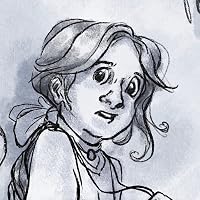
This book further has charming illustrations but with a different style from the cover.
I found Aubranael in Aylfenham a delight it was a bit diminished when he was pretending to be Mr Stanton in Tilby probably because he was pretending to be someone else than he truly was.
When he is not pretending Aubranael is bit naive and earnest while Sophy is more levelheaded. I found myself thinking that this books Sophy was a little bit like Sophy from Howls moving castle.
Aubranael and Sophy doesnt spend much significant time together romantically but you dont find it hard to believe that do have a chance at love with each other in the end.
It is like a fairytale,you dont question the why and hows of a fairytale. It is just so.
Mix together the regency era,elves,Howls moving castle and Alice in wonderland what you get is "Miss Landon and Aubranael"
Its author promises there will be more tales from Aylfenham in the future and I know I want more. Its the perfect read for a day when you need cheering up. :)
Well I made it about 25% and well, it's me I guess. Just not my cuppa. I did skim quite a bit to see if it got better... Wanted to like it, but after trying to read it for several weeks, well time to call it quits. The idea was interesting, but the romance was not.
I couldn't connect with the author's style of writing. Too many added after-thoughts, asides, etc. Everyone was so OVERLY polite that I just wanted to toss a cow-pie at someone to get an honest reaction! But the author would probably write, "that was kind of you to suggest that I needed some excrement in my tea. I shall have to endevour to try it again in future..."
It's kinda Alice in wonderland meets Tolkein But without the clever layering of intent and reaction. In fact it was pretty predictable after about 11%. The author tends to 'jump the shark' instead of creating intrigue. The romance fell flat for me. Unless you like an h that gets sh*t on all the time and then politely acts like it's to be expected... with a smile on her face even. Not my cuppa. The H was sweet but a total limp biscuit. But wait... Big spoiler and safety
A gently-rolling mix of regency romance and fairy tale. And I mean “fairy” in a very literal sense, as the narrator is a troll, Mr. Balligumph, and one of the MCs is Fae. At least half the characters are fairy folk as well: brownies, goblins, not to mention Felebre the purple cat. Interspersed illustrations punctuate the whimsy of the story. There aren't big surprises here, but it's a sweet and unique tale. And 100% clean.
Regency romance meets fairy tale. Sweet but cleaves too hard to Regency romance tropes (read: "uptight mores and customs of the period) and as a consequence the romance is poorly developed.
Miss Sophia Landon lives in the quaint village of Tilby. It's 1811, and Sophia, just shy of reaching thirty, has pretty much abandoned the idea of ever getting married. Fortunately, Sophia's version of Regency England comes with household brownies (like house elves, but with less slavery) and bridge trolls. Point of fact, one of her best friends is the local troll Balligumph. One day Balligumph takes pity on Sophia and sends her on a brief adventure to the land of fairy. While there, she meets a kind, but horribly disfigured young elf.
For Aubraneal, the elf, it's love at first sight. After Sophia returns to Tilby, he arranges a magical disguise which will allow him, for one short month, to look like a handsome human. Transformed, he visits Tilby and attempts to court Sophia.
Conceptual, the idea is charming, though predictable. Obviously, at some point, the magic will fail, and even if Aubranael is successful in his courting, it will be under false pretenses. Nevertheless, this could potentially be a story full of the "feels."
But as I noted in the first paragraph, instead of taking liberties with the mores and social conventions of the time, the narrative sticks to the tedious Jane Austen mating rituals of the time. This is England with brownies, goblins, and trolls, so why not shake up social convention? But...no. Instead, Aubranael spends several weeks in Tilby trying to find a way to have a simple conversation with Sophia. Because he can't just chat her up without a "formal" introduction. *Yawn.* And then, when a ball is organized and the couple finally meet, Sophia decides that she can't dance with him more than once because...reasons. I think the sum total of interactions between Aubranael (in his handsome human form) and Sophia amount to the dance and a convenient encounter while she's out walking.
This might work for fans of Austen, but, honestly, I think it's a wonder the English middle and upper classes didn't go extinct during this time period. My expectations with this novel were for an interesting heroine who broke convention and for a slow unfolding of genuine friends-to-lovers that comes from a boat load of interactions between hero and heroine.
Sophia is pleasant and sweet, but that's the sum total of her personality. Aubranael is similarly lacking in any distinguishing character traits. The most interesting character is a witch who briefly serves as an antagonist. Given the poorly developed relationship between Aubranael and Sophia, the eventual revelation of his mendacity lacks any emotional impact. In short, it doesn't feel like a betrayal, because she hardly knows him.
On the upside, the writing is quite good, with a delightful fairy tale lyricism. The high quality of writing suggests that Miss Landon and Aubranael's flaws are a function of first-book-itis, and that subsequent novels could be much stronger.
Miss Landon and Aubranael fell through the cracks, and I regret that. I read it – quite a while ago, in fact – and I enjoyed it – very much, in fact. But somehow I never wrote a word of a review, despite the fact that I received it through LibraryThing's Member Giveaway.
It takes place in a really lovely fairy tale-esque world, in which Miss Landon (Sophy) is the only one who can see her friends Balligumph the Troll and Thundigle the Brownie. She has been having a difficult time, and an attempt to cheer her up by Balligumph goes a little off-kilter when she finds herself (to her surprise) in Faerie, which has hazards she had never anticipated. And there she meets Aubraneal, and Felebre his feline(ish) companion, and while it's not quite love at first sight it's pretty darn close. But she has to return to her own Austen-esque place … and when Aubraneal takes an opportunity to follow her there in disguise, lessons are learned and love is earned.
It's a charming story, with a different flavor of elfland and of a place like Regency era England but not quite. I loved it – and I really am sorry it took this long to find and post a review.
A quote I saved: She felt that she had been deluding herself for years; hiding from the truths she did not wish to think about, setting them aside in favour of finding some little enjoyment, some small piece of comfort in her life; setting herself up, in short, for the terrible predicament in which she now found herself. But it had not been in her power to do very much more than she had.
Miss Landon and Aubranael is a delightful story mixing romance and fairytales and the author wonderfully writes these characters who are endearing to say the least. A simple story told with gusto and a truly vibrant cover made this book a worthy read. Plus as a reader who generally doesn’t get hooked by Regency romance plots, this book had me chuckling along and enjoying myself with its flair and pace.
I am conflicted in my review of this. I expected something a lot different than what I read. I feel the two main characters hardly spent any time in each other's company so it was hard to believe any romance especially with the epilogue that I don't think should have been an epilogue. It just felt very thin it's relationship building for these characters by the end that I would have liked to see a lot more of them actually bonding with each other as themselves rather than how things actually played out. Big plots came in a bit too late for me and felt disconnected from what the vibe of the book was in the beginning. Honestly I shipped Ballingumph and Sophy more than I did her and Aubranael since Ballingumph actually knows her and takes care of her. I just was disappointed and had much higher hopes. Still, it has good too it, I know that all sounds like I hated the book. It's enjoyable and quick and if you're not thinking too hard about it all you can have a fun time but I think I might be putting my editor hat on a bit too tightly when reading this because it could have added 100 pages to satisfy all the holes I kept finding.
My finger wavered back and forth between 3 and 4 stars, and I finally settled on 4 because it is a charming little book and nothing is so very wrong in its construction as to knock it down relative to its other reviews. Really, I'd say 3.5 stars.
Where it succeeds: -sheer charm, a sometimes underrated quality in fairy tale fiction -it does a pretty good job balancing the tone and plot between fairy tale and Regency comedy of manners -a cute romance that actually isn't all love and marriages after a handful of days, and also doesn't set off major red flags of power imbalances or flagrant manipulation or even, as could have been easily done, making the fae character actually hundreds or thousands of years old -yay for on-the-shelf spinster characters who mostly embrace that role
Why I knocked off some stars: -Aubranael's backstory, to me, came a little too late in the book. Like, nothing is really spoiled or off-kilter because of this, other than it does explain his face, which hovers at the forefront of his thoughts and motivations. -The meet-cute moment is kind of lackluster, and looking back on it from the tail-end of the book just seems weird to me. He's merrily playing chase his feline companion through the market/city? Okay. He never again seems that whimsical. -Tying the above together, I feel like a lot of set-up could been a little more polished, especially WRT Aubranael. Re: his backstory:
In England itself, faeries are known to be real and it's common for people to at least have brownies. Ultimately it seems like a slightly-truer-than-real-life world...except people have empirical evidence of those brownies, and troll bridges are common...and that's it. Where's the treaties between England and fairy land (Alf...mumblemumble) to govern trade and immigration? Where's all the rest of the fae folk? The other real life superstitions about them say they like to screw with mortals, but I guess this fairyland mostly likes to keep itself to itself. Anyhoo, just seems like this aspect could have been pushed harder.
-I mentioned that this tied fairy tale and Regency together pretty nicely, but some things felt a little derivative. E.g. The eternal tea party felt like a drop of Alice in Wonderland in the middle of things. Oh wait, mysterious purple cat! Maybe more deliberate than just one of many possible homages. Hmm. Hmm.
-The plot was a little unfocused. Okay, basic premise is a fantastic Little Mermaid type proper romance, but then there's all these hinted build ups to major intrigue...though not that intriguing of intrigue, because the epilogue, a year later, still has nothing-doing.
I actually bought this for my mother thinking it was a historical sort of harlequin romance. Guess I should read a synopsis better! 😅 I loved the fantasy aspect of it. I loved the characters and I LOVED the mad hatter/Alice in Wonderland style tea party! I can't wait to check out more from this author!
Well, I did not expect this ! I honestly thought that it would just be a cute, predictable romance but it was not really. It still had a lot of good elements : the premise was very nice and I did love the fantasy parts, the descriptions of the faerie realm, Aylfenhame, the secondary faerie characters... It was a nice enough cosy fantasy, with more twists and turns than I would have imagined. But I was quite disappointed that there were not more interactions between Sophy and Aubranael.
I really liked both characters, and I actually liked most of the characters beside of course Hidenory. Sophy has qualified the character of Hidenory the witch as "predatory" and I indeed felt her predatory nature since her first appearance when she bargained Aubranael's first kiss because she liked her own glamour spell a bit too much. And just like Sophy I did not particularly understand her big change toward the end, it really did clash with what the reader had seen of her lack of morals and consideration...
I would say that, disliking the character of Hidenory, I was surprised and unsettled to see that there was actually more developpment, romance and interactions between her and Aubranael than between Aubranael and Sophy ! It almost felt like Hidenory was the third main character !
In conclusion, it is not a bad book and I can see how it could make a pleasant read, but I did not feel fully statisfied by it.
There are some things about Miss Landon and Aubranael that I really loved. The author generally does a great job of replicating Regency-era speech (or at least, the kind of Regency-era speech that's been set down by writers like Jane Austen). She also has a real sense of fairy tales and magic. There were some scenes in this book that were delightful and magical and made me think I was reading something right out of an Andrew Lang Fairy Book.
The overall concept is also really cool: Aubranael, a resident of Aylfenhame, a faerie world, whose face has been damaged by a curse, falls in love with Miss Landon, an Englishwoman who happens to be visiting his town for a short while. When she leaves, he pines after her and decides to follow her to her world. But because he's ashamed of his appearance, he makes a bargain with a witch and her mysterious cohort so that he'll be made handsome for a month with a glamour.
And so, I was hoping for a fish out of water story of a magical being navigating Regency England (as well as his own complexes about his looks), but this wasn't quite that. Scenes where the author could have gone into more detail were generally glossed over (though at least there is a ball scene, something any Regency romance worth its salt should probably include). For me, the best, most showstopping moments took place in Aylfenhame.
The biggest issue I had with this book is that it often felt to me like a very advanced rough draft that could have benefitted from beta readers. There are so many things that are polished, especially the last quarter or so of it, but so much of the rest of it involves characters inexplicably sort of disappearing from the scene (and not by magic); telling and not showing; a lot of general inconsistencies; glossing over important but not main characters like Miss Landon's father; and a choice of narration style that would work in a film or TV series but felt unnecessary and gimmicky and threw off this book. Some chapters (but not all, which was one of the most annoying of those aforementioned inconsistencies) start out by being narrated by a bridge troll, who has a folksy tone. But then they quickly shift into a third person omniscent narrator, with a Regency English-tinged tone. This shift didn't seem necessary and often felt a bit clunky or clumsy.
So, too, are the illustrations randomly peppered through the book. They didn't seem necessary, especially in a novel for adults. Maybe if they had been extraordinary or unusual, or had fit the plot in some way (Say, if one of the characters was a portraitist or sketch artist, or there were posters of the characters in the story or something), they would have made sense. But the author does a fine job describing the characters, making the illustrations unnecessary, and the style is such a generic-looking one that it doesn't even feel like it does her descriptions justice. Many of the magical creatures look vaguely the same.
There's no Author's Note or any other end material to this book, so I can't be sure, but I suspect that English didn't have any beta readers. Some books/authors don't need them, but in this case, I think this novel very much would have benefitted from them. They might have inspired English to tighten up some slower parts and answer some questions the book leaves. There's nothing wrong with the questions raised with the build-up to the next book in the series, of course; I'm talking about things like why we never get to see Sophy (the titular Miss Landon) interact with her father, who's a pretty important figure in terms of her life and the plot, or why Thundigle doesn't go with her to Aylfenhame the second time, and actually seems to sort of forgotten for a while.
Overall, Miss Landon and Aubranael had its charming moments, and I did like that the love story was based on a meeting of minds rather than instant physical attraction. But I think beta readers would have said something about the narration choice and other inconsistencies, and really could have helped make this book feel like a polished, finished product, rather than a gem that still needs a bit of a shine.
What if you met the love of your life - in a different world?
In a quiet English town in 1811, there lives a clergyman’s daughter. Kind-hearted but impoverished, lively but plain, Miss Sophy Landon faces a future with few prospects.
In the neighbouring realm of Aylfenhame, there lives Aubranael. Disfigured among the beauteous fae, his ruined face condemns him to a life lived alone.
Their meeting changes everything.
For Sophy will cross the border, and find a glimmer of a future beyond. Might there be a life, and a love, for her in the realm of the fae?
For Aubranael, a chance encounter with Miss Landon turns his world upside down. Armed with the temporary gift of beauty, can he hope to win her heart?
Pride and Prejudice meets Beauty and the Beast in this heart-warming tale of love, hope and magic.
This enchanting story appeals to the child within. All while using fae characters as a backdrop the author weaves her tale.
It is often difficult and clumsy to use a narrator to carry the gaps and slow spots in the action, but the other characters distract from this and it all seems to work. I enjoyed reading the story, and couldn't help but notice the ending was open ended. I would expect a follow up work.
Set in Regency England, this fantasy is as much about a romance as it is about magic, trolls, goblins and witches. I like the way the author incorporates a realistic portrayal of England with the fae world of Aylfenhame. Many of the English customs and protocol reminded me of Pride and Prejudice, but with ‘brownies’ (tiny house servants), and a significantly different approach to romance between Sophy and the mysterious Aubraneal. As we learn more about the Aylfenhame world, the novel begins to take on a fairy tale feel that one could read to children.
29-year-old protagonist Sophy Landon is without assets and therefore considered no longer marriageable. She’s a kind, highly principled woman, but her romantic conquest Aubraneal is less so. This again reminds me of Pride and Prejudice, but as it’s one of my favorite novels of all time, I didn’t mind. For readers in search of a gentle fantasy that doesn’t have earth-shaking, graphically violent, scary scenes, this book would be a good choice.
I think, now that I have finished this book and read some other reviews to gather my thoughts, that the best way to describe this book is ”fairytale by way of Georgette Heyer.”
The problem is, I don’t care for Georgette Heyer.
Of the couple of Heyers I have read, my chief complaint is that, while funny and full of situations, they aren’t romances. The characters billed as the romance pairing are on page together the least out of anyone in the book. And that is the case here, too. The whole second half of the book, the protagonists are separated, and before that, she thinks he’s somebody else.
And for someone from Aylfenhame, Aubranael is the most naive character of the book.
I did like all the fairytale bits, I liked the backstory that arrived halfway through and gave the story a whole lot more thrust and underpinnings. I was just hoping for ROMANCE, and tbh I expected Aubranael’s character to be entirely different than what we got. However, if you just want a Regency fairytale book (or if you DO Like Georgette Heyer), this might be for you.
This was a sweet and engaging fantasy romance. There were a couple of typos in the text and I'm not overly a fan of the style of the occasional illustrations, but I will definitely be reading more of the series.
I don't even know where to start. I haven't read a fantasy book (that wasn't by Tolkien or Lewis) this original since Elizabeth Goudge's A Little White Horse. The blend of Regency England perfectly melds with the elven/faery realm.
All the characters were enthralling. Charlottle E. English has mastered the surprisingly difficult art of writing people. She made her cast and crew believable, intriguing, complicated but human. (or maybe it's the human aspect which makes us complicated)
These characters don't just act and react. They think, reflect, scheme, and give up. They're overwhelmed, deceived, and don't leap to make heroic choices at the drop of a hat.
There are several moments when a character is faced with their actions and they see that the choice they made was the wrong one, or the choice they made wasn't the best choice but they were so backed into a corner they still can't see that another choice was to be made.
The world building was incredible and perilously cozy. Perilous and cozy, that is, not 'so cozy it's perilous'.
Best of all? There's an underlying mystery and plot happening, threading through the happenings of the main characters, just out of sight and out of reach. Something from the past with consequences for the future, but at this point, who knows what really happened that night?
Something about this just did not work for me. And I have read other works of this author. A plain young woman with no prospects and an uncaring father, is always nice to the magical people. One, in return for a gift from Sophy, gives her a wisp that leads her over the wall and into the fae land of Aylfenhame where she meets a man with a ruined face.
I just kept saying to myself, but why would they do that?
The Aylfenhame series is Charlotte English at her best. It is light-hearted and fun to read but also serious moral fiction. We meet strong young women and the denizens of Aylfenhame they meet along the way, their stories told by the kindest and most elegant bridge troll in all of England. Superb.
I read the beta version of this while it was in progress and the full version as soon as it came out. Having just read books 2 and 3, I must go back and book 1 again.
Good books are like that. --------- I went back and reread the entire series, staying up way too late at least a couple times in the process.
The writing style in this was kind of weird to me - it felt stiff and I didn't think the jokes quite landed. I wasn't super convinced by their chemistry, but they seemed lovely?
In any case, I was more interested in the world English had set the romance in - the story was a bit weak, so the world-building really propped it up.
I'm all for illustrations in books, but man, I wasn't digging the art style at all in this book. Was really sad about that. Also, it took me out of what I imagined, in particular, what Aubranael looked like - just didn't mesh well.
This was a beautiful story (which is why I gave it 2 stars) that was unfortunately poorly executed. It was too long and too short in all the wrong areas and the ending was extremely dissatisfying. After all that she wasn’t even sure, no confessions of love no romantic or cute moment just.. a kiss and bam done. What.. WHAT. I wanted to read the rest of this series but if this is how they’re going to be I have to pass..
This was the best book I've read lately. Written in such a warm warm way. A wonderful tale written in a fantastic setting. Absolutely wonderful. Thank you for lifting my spirit s.
3.5 - nearly 4 Stars. (1= dnf/What was that?; 2= Nope, not for me; 3= Yes, NICE/SWEET; 4= I LIKED IT A LOT!; 5= A favorite, it was great!)
TALES OF MISS LANDON AND AUBRANAEL is bk #1 in the TALES OF AYLFENHAME by Charlotte English. TOMLAA is a CLEAN novel, a fairy tale or fantasy adventure, actually, with subtle nods regarding personal significance and integrity; forgiveness and acceptance deftly woven into the sweet story. I enjoyed TALES OF MISS LANDON AND AUBRANAEL and found it entertaining.
TALES OF MISS LANDON AND AUBRANAEL is the tale of a place and a time, long ago, in England where the fabric between human and fairy realm ran parallel and occasionally overlapped. Under the insistence of a friend, one fine morning, Miss (Sophy) Landon, a somewhat plain and unfashionable 29yr old village parson’s daughter, wanders unknowingly out of her ordinary human world into the previously hidden land of fairies (Aylfenhame). During Sophie’s brief visit to Aylfenhame, Sophy meets a kindhearted but sadly scarred person named Aubranael, 29/30yrs. They hit a rapport and a friendly connection is made but Sophy is compelled to return home to her ailing father. After a week or so Aubranael begins to miss the acquaintance of Miss Sophy wishing they had had more time together, and so he makes an effort to locate her in her own world in England. Aubranael returns to England (the human world) and under the disguise of an attractive and wealthy man (granted to him through magic) where Aubranael hopes to refresh and build his acquaintance with Sophy. Aubranael soon discovers that the customs, privileges, prejudices and more (in the human world) combine to separate various types of persons much more so than in his own world, Aylfenhame. Aubranael desires more than anything to build a lasting relationship with Sophy, in either world, but soon wonders if such a future is even possible with so many differences and barriers standing between them?
THE TALES OF MISS LANDON AND AUBRANAEL reminds me of a fairy tale, one that might be enjoyed by YAs through adults. It contains adventure, unusual creatures, and a touch of magic with a sweet, delayed HEA. I caught myself pondering issues of personal integrity, significance, and other values as I read. There are 4 titles currently in the TALES OF AYLFENHAME series. Previously, I read #3, Bessie Bell and the Goblin King, and adored it. I recommend these tales to readers who enjoy light fantasy, adventures and fairy tales; historical romances; and sweet HEAs. Each story could be read as standalone titles but the characters overlap slightly in each book and I intend to read them all. A set of the first 3 books is available in a combined set.
READER CAUTIONS - this is a CLEAN novel suitable, IMO, for all ages. VIOLENCE - None. PROFANITY - None. SEXUAL SITUATIONS - None. Simple kisses.
A charming Fae regency romance story, but read like a children's book.
In regency England, the Fae and humans have found harmony, in that smaller fey creatures work for humans, and the higher live in their own realm. Sophy Landon, a penniless and unremarkable girl, takes an unexpected trip to Aylefenhame where she meets Aubranael, a disfigured Ayliri and they become fast friends. In order to pursue Sophy, Aubranael makes a deal with a witch for glamour, and spends a month upsetting Sophy's small little town to discover he didn't need a ruse all along.
Here's what I didn't like: While an utterly charming tale, the interjections from Balligrumph in the chapters, and the little doodles made me feel more and more like I was reading a child's tale than a romance. The Felebre and Hidenory relationship seemed flawed—almost like a plot hole—at the end when it was "revealed" who Felebre was or might be. The relationship between Sophy and Aubranael from *Sophy's* perspective is forced. The tea party chick states Sophy has a true love, yet she has no idea who it could be, though it's heavily hinted it's Aubranael, but at that moment, Sophy merely believes she's only met him once and thinks of him as a dear friend. While I get this is supposed to be nuanced and such because he's Stanton, she doesn't know that, only the reader does. I wish there had been more world building around the Fae. You can feel there's a huge and complex lore and world there, but you don't get to know it.
Here's what I liked: It's utterly charming. I loved the Aylfenhame and the market, and basically the tiny hint of anything fae in the book. The style reminds me of Georgette Heyer, and had everything you'd expect from a Regency romance, but kinda... lacked in the romance bit. Well written and edited, had a polished and finished feel.
Overall, I'm having trouble on what to rate this. It took me far longer to read considering I should've adored this book, and I have with ones like it in the past, but the pacing was dreadfully slow. I began skimming toward the end. Add that to it feeling like I was reading a children's book and it left me wanting something that this book wouldn't be able to deliver.
This is quite a mild Regency romance combined with fairy tale, though it's not a retelling of any one tale in particular. The influence of Beauty and the Beast is there, and so is Alice in Wonderland in the mad tea party, but it's its own thing. It sits in a slightly odd place age-wise; the main character is 29, but it has the simplicity and the general feel of YA or even younger. Nothing steamier than an extended kiss occurs.
This is the second book I've read by the author, and as with the other one, the writing fault I noticed most is that she frequently uses "may" instead of "might" in past tense narration. She also confuses "principle" with "principal" a couple of times, and there are a good few simple typos of the kind that spellcheck doesn't catch but any reasonably alert reader should (such as "pull" for "full," "day" for "say," "about" for "out," "dead" for "head"). There's the odd missing or misplaced word, too, and a couple of excess coordinate commas between non-coordinate adjectives, but the punctuation is generally good.
The characters are pleasant enough, but don't have much depth to them, especially the secondaries. I did like the main pair and wanted them to succeed (not that I was ever in the slightest doubt that they would). The plot is straightforward, and, like the setting, is mostly assembled from prefabricated parts of Regency romance and fairy tale.
I appreciated that the female main character, while she is rescued by her friends at one point, then takes decisive action that makes a difference; she's not passive or helpless. She's clumsy, except for her one strong skill (sewing), which is a bit of a cliche for a heroine.
All in all, it's pleasant but bland; nothing (apart from the editing, and I've seen plenty worse) is badly done, but nothing is amazing either. I enjoyed it enough to let it keep its fourth star, though not enough that I'd bother with a sequel or seek out other works by the author.
Regency-fantasy. Sign me up. Parts of this get 5 stars, but there were several large flaws in the book as a whole. It starts out a little shaky as it is narrated by a third party, but the story soon starts in earnest with a pleasing mix of faerie and Austen world-building. But then the book takes a turn and enters squarely in the regency romance genre. Fine, I can live with that. Except that magic is almost completely left behind, and it smacks of a Disney fanfic. But there are some sweet moments and fun historical courtship so read on. Now the plot thickens and the conventional writer's devices take over. A little formulaic but tolerable. Magic is introduced back into the mix. Wonderful. But once again, the book dodges my expectations—this time with a high fly ball to left field. The heroine plunges into a faerie world so complex in such a haphazard manner that I wonder if this rambling narrative went through any kind of developmental edit. And the hero. Where is he? Clinging to the threads of the unique and intriguing, I read on. and on. and on. Additional characters, subplots, layers, and backstory pile up in what felt to this reader like the climb to the finale. Instead it is chapters and chapters, leading to a rather unsatisfactory ending. Not because the hero or heroine don't get what you are hoping (trying not to include spoilers) but—in an ending that feels like an epilogue—the characters come to an arrangement which feels neither conclusive nor hopeful nor even basis for a cliff-hanger. Not what I had hoped. Do I still recommend it? Yeah. But be warned. Maybe plan to read it in short installments like a web story and give it the same graces. I bought the whole series. I will read the next volume(someday), but when I see the titular character is someone who only appeared briefly in book one, I can pretty much guarantee I am not going to find satisfaction for the "Miss Landon/Aubranael" saga. Get a good editor, and this writer would be golden.