Jump to ratings and reviews
Rate this book

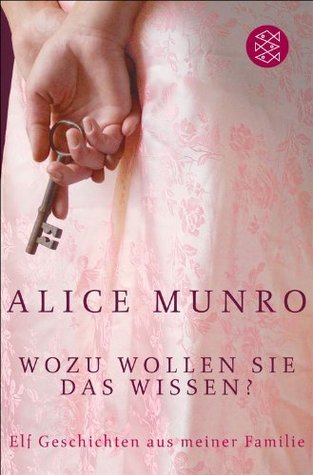
Wozu wollen Sie das wissen?: Elf Geschichten aus meiner Familie

Rate this book
Nobelpreis für Literatur 2013


»Wozu wollen Sie das wissen?« Alice Munros Spurensuche in der eigenen Familiengeschichte und Erinnerung führt in die reizvolle Wirklichkeit von Dichtung und Wahrheit: elf neue Erzählungen der großen kanadischen Autorin, in denen sie Historie und Imagination auf faszinierende Weise miteinander verquickt.

545 pages, Kindle Edition

First published January 1, 2006

450 people are currently reading
5412 people want to read

About the author

Alice Munro

239 books6,588 followers
Collections of short stories of noted Canadian writer Alice Munro of life in rural Ontario include Dance of the Happy Shades (1968) and Moons of Jupiter (1982); for these and vivid novels, she won the Nobel Prize of 2013 for literature.

People widely consider her premier fiction of the world. Munro thrice received governor general's award. She focuses on human relationships through the lens of daily life. People thus refer to this "the Canadian Chekhov."

(Arabic: أليس مونرو)
(Persian: آلیس مانرو)
(Russian Cyrillic: Элис Манро)
(Ukrainian Cyrillic: Еліс Манро)
(Bulgarian Cyrillic: Алис Мънро)
(Slovak: Alice Munroová)
(Serbian: Alis Manro)

Ratings & Reviews

What do you think?
Rate this book

Friends & Following

Create a free account to discover what your friends think of this book!

Community Reviews

5 stars
1,184 (21%)
4 stars
2,128 (38%)
3 stars
1,649 (29%)
2 stars
464 (8%)
1 star
140 (2%)
Displaying 1 - 30 of 737 reviews
Profile Image for Connie  G.
2,140 reviews704 followers
January 28, 2021
Title Story Only

"America. . . There is where every man is sitting in the midst of his own properties and even the beggers is riding around in carriages. So there you are, my lad, and God grant that one day you will see it closer, and I will myself, if I live."

"The View From Castle Rock" shows the excitement and hardship of a family leaving their home in Scotland to search for better opportunities in Canada, and fulfill a father's dream. Eventually, the family crossed the Atlantic to Nova Scotia. The father, James, was homesick for Scotland, and spent the whole trip telling tales about his home in Ettrick to the other passengers.

Alice Munro imagines how her ancestors reacted to the Atlantic crossing. The story is partly about new life as baby Isabel was born at sea, and the pending deaths of other passengers on the ship. Andrew was a family man who intended to farm in Canada, and his brother was looking for adventure. There was a sense of excitement mixed with apprehension as the ship approached Nova Scotia. I enjoyed this immigration story, and was left wanting to follow the family's journey into Canada.
Profile Image for Anna.
274 reviews99 followers
July 22, 2017
Dull.
And disappointingly so.
If you went to college or have read any book reviews in the last 20 years, then you KNOW Alice Munro's work is one of the canons of modern literature (because all your big-brained English teachers say so)....these stories jut fall flat, never ripening into the colorful, fully fledged narratives that one might expect from someone who's won every lit prize known to man.
The stories in "Castle Rock" are based on Munro's own ancestors in Scotland and their journey to America, but instead of people who have depth and energy, we end up with lackluster, paper doll-like figures whose feelings are ever so subtly hinted at but never fleshed out.
I'd read the title story years ago in college or another collection -- can't remember which now -- and I had this on my shelves for years ever since looking forward to finally sitting down to read the entire collection, but I actually feel like I'm in college again -- reading "important" work by "important" writers and trying to figure out why they're considered this way.
I'll still read Munro's other work, but this felt like one of those late-career books published by one of the greats -- and not edited much -- because they knew her name on the dust jacket would sell.
Profile Image for Chrissie.
2,811 reviews1,421 followers
July 22, 2018
Free online link to the one short story The View from Castle Rock:
https://www.newyorker.com/magazine/20...

The emigration voyage of one family over the sea from Scotland to Nova Scotia, Canada. The year is 1918. A husband and pregnant wife, their young son, an elderly father and a brother and sister. It is the trip itself that is the focal point. The emotions and thoughts of each come through well. Fears, hopes and expectations are palpable. Use of the Scottish brogue makes the telling feel authentic

We learn also of how their lives will play out in the new land.

This was a good story. I liked it.
Profile Image for Caroline.
558 reviews719 followers
May 21, 2015
This was my first Alice Munro book, and I approached through a fog of reviews that were running out of accolades "the best fiction writer now working in North America" "a sculptor of the human condition: nothing more and nothing less than an artist." "One of the great storytellers of our time, descended from a line going back to Chekhov and Katherine Mansfield....."

Oh dear. Obviously due to my own ineptitude, I was unable to grasp much of this at all. For the most part I found this book boring, boring, boring.

It was based on the history of Munro's own family, going right back to William Laidlaw, (Laidlaw was Munro's family name) born at the end of the 17th century....and it continued up to modern times. Munro makes it clear that these tales are stories though, and not simply biographical.

In fact I did enjoy a couple of them - based on her family history during the 19th century - Illinois and The Wilds of Morris Township. In the first there was a unexpected and gripping storyline,and I enjoyed the subtle quirkiness of the characters, in the second I was intrigued by the harsh demands of frontier life, beautifully described by Munro.

But for the most part I couldn't wait to finish the book. I felt that an author of her stature should be read from beginning to end, so I did stick it out, but I didn't find it enjoyable. I am wondering if my education were better I might have enjoyed it more....but I suspect not. I think I need a bit of Sturm and Drang in my fiction, and hooks that are probably found more in books for the mass market. (Oh woe is plebby me....)

One thing was really good, and that was a review I found of the book written by someone here at Goodreads who had enjoyed it. I found it fascinating to read about the ways in which the book had been attractive to her, plus it is just a great review. Highly recommended for anyone thinking of reading the book.

http://www.goodreads.com/review/show/...

Profile Image for Fatma Al Zahraa Yehia.
602 reviews970 followers
Read
July 1, 2024
It wasn't easy reading this book for me from the beginning. So as it is a story collection, I flipped through it looking for something that might grab my attention. Having almost read all that Munro wrote, I found this collection the least I was interested to read.

So, I will highlight the three stories that I liked.

1) The hired girl
Munro explores how a seventeen years old girl dealt alone with a world that is superior to her. As degradation of her financial status, the narrator had to work as a maid. Brilliantly, Munro shows and doesn't tell the girl's trials to keep herself on an equal footing with the family that she working at.

2) the ticket
Before her wedding, The narrator is given a ticket by her grandmother as a plan B in case she changes her mind. Through the stories of her grandmothers and her own parents' marriages, the narrator starts to have some doubts about her upcoming marriage.

3) Home
The narrator comes back to her home for an unusually long stay. She notices the change that her stepmother brought to that home and to her father's life. She comes to a moment when we question ourselves if should go back to a life that we long deserted, or should keep on moving in life that doesn't add a lot to us.
Profile Image for Sepideh Zandifar.
3 reviews9 followers
November 8, 2015
آلیس مونرو –نویسنده ی کانادایی- از بهترین نویسندگان داستانهای کوتاه است.داستانهای او بر شرایط و روابط روزمره ی زندگی انسانی متمرکز است.او علاوه بر پرداختن به مفاهیم کلی,به جزئیات رفتارهای متقابل بین شخصیتهای داستان را نیز بصورت قابل تعمق و هنرمندانه می پردازد.طرح داستان برای مونرو در درجه ی دوم اهمیت قرار دارد و رویدادهای داستان اندک هستند.آنچه برای او مهم است,موقعیتهای احساسی آنی شخصیتهای داستانهایش هستند و هم از این نظر و هم از نظر شخصیت پردازی کم نظیرش در مورد هر یک از شخصیتهای داستان ,به "آنتون چخوف " شبیه است.
Profile Image for diario_de_um_leitor_pjv .
777 reviews135 followers
October 17, 2023
Um conjunto de contos que resultam da busca da escritora pelas sua raízes familiares que emergem da Escócia rural.
Um conjunto de textos simples que numa narrativa cuidada que confirmou que Alice Munro é escritora a ler atentamente.
Profile Image for George Ilsley.
Author 12 books316 followers
November 30, 2022
My interest in this book was stronger in the first half, but petered out a little. The closing stories are personal, and sweet, and offer a glimpse into the mind and world of Alice Munro (which is certainly a priceless gift), but they do not measure up to the compression and depth in her best work of pure fiction.

Fans of Alice Munro will love this book, because Alice is easy to love, but fans of her short fiction might not be universally impressed.
Profile Image for Sofia.
1,031 reviews129 followers
November 8, 2018
Descobri este livro acidentalmente numa das bibliotecas públicas que frequento e confesso que foi o aspecto da capa que me fascinou primeiro (aqui a foto não é apelativa, mas garanto que ao vivo e a cores o efeito é diferente). A autora recordou-me o Nobel e outra colectânea de contos que li dela anteriormente e decidi arriscar.
The view from Castle Rock é seguramente a minha colectânea preferida de contos de Alice Munro.
Embora algumas histórias sejam mais empolgantes que outras (recordo em particular "The ticket" mas regra geral a segunda parte do livro fascinou-me mais), todo o conjunto justifica que a autora seja reconhecida como a rainha das short stories.
É sem dúvida uma contadora de histórias nata, com uma escrita clara mas não simples.
O meu género de literatura. 5 estrelas numa pontuação muito (se calhar demasiado) pessoal.
Profile Image for Marica.
410 reviews211 followers
May 20, 2020
Alice Munro scrive un libro sulle origini della sua famiglia e sulla sua giovinezza, evitando di coinvolgere i congiunti viventi, cosa condivisibile. Mi è capitato di leggere scritti autobiografici di qualche autore, mi sono chiesta cosa li spingesse a farlo. Doris Lessing dice di averlo fatto per dissuadere gli inventori di fandonie dalla loro impresa già iniziata. Per gli altri, forse,il desiderio di allontanare qualcosa da sè nell'atto di renderlo pubblico (Amos OZ). Perchè lo fa Munro? Non più giovane, sembra voler rimpicciolire l'importanza delle sue vicende personali collocandosi nel palco di rami del suo albero genealogico, dalla Scozia alla Nova Scotia, fra gente formata nel culto presbiteriano che educa alla sobrietà e alla lettura e discussione dei testi sacri. Piuttosto spassose le conseguenze: il popolo (anche le donne, nota dell'autrice), istruito, dava filo da torcere ai pastori sollevando questioni teologiche. Di Walter, il ragazzo che durante la navigazione per l'America scrive "quello che accade", descrive i pensieri in margine a un ragazzo morto che viene sepolto in mare. Immagina che i pesci lo mangino a bocconcini e se lo figura nei dettagli: usa questa tecnica "per ridurre l'impatto". Io ritrovo molto la Munro in questa frase: mi sembra una affabulatrice perfetta e precisa e che usi questa sua dote per stemperare la violenza delle emozioni che si accompagnano agli eventi della vita e controllarle.
Profile Image for Berit Lundqvist.
696 reviews25 followers
December 31, 2018
Alice Munro follows her ancestors from Scotland, the old country, to North America. The stories she tells are partly true, partly made up. Munro has studied old documents, both in Scotland, and in Canada. From the persons she found in them, she has cut out the paper-doll figures she wanted her ancestors to be.

The last part of the book is about Alice Munro herself. How she grew up on a fox farm (!) in Ontario, restricted by the unwritten rules of the countryside. Know your place. Don't waste your life on books.

I like Alice Munro's writing. She is there, she identifies with her characters, at the same she keeps her distance. And she is respectful. Always,
Profile Image for Frank.
313 reviews
June 7, 2009
I think this is my new favorite Alice Munro collection. Usually in her collections--in all collections of stories--there's a clunker or two, stories that seem to be there merely to fill out the book. Not so in this one. It's solid all the way through.

This book reminds me a bit of Munro's book The Beggar Maid, which is pretty close to a novel in that it follows a single character's life through a series of stories, from childhood to middle age. This one extends the reach of the narratives on either end, encompassing tales of the narrator's Scottish ancestors, beginning in 1695, and extending all the way through the narrator's old age and even a foretaste of death. Munro notes in the foreword that the stories are fictionalized, but are also closer to her own experience than any she's published before.

The first half of the book is focused on the narrator's family--legendary tales of ancestors who are close to folk heroes, an imagined Atlantic crossing by a group of family members, struggles to establish homes out of the bush, and finally her own father and mother's faltering attempts to make a living. The stories in the second half zero in on the narrator's own experiences of family, passion, work and class distinctions, marriage (though the narrator's own marriage is addressed only out of the corner of her eye), landscape and change, and, in the penultimate story, history.

The Canadian title of The Beggar Maid is Who Do You Think You Are?, which I think is far superior. Likewise, I think a better title for this book might be the title of the penultimate story, "What Do You Want to Know For?" The title comes up while the narrator is investigating a mysterious unmarked burial mound that she and her husband have discovered off a rural road in Huron County. She's poking around in the library, aware that such researches may seem strange. In fact, such investigations are what the book is all about--a probing of one's past, both the distant family past and more proximate personal past--for whatever it might yield as an answer to the mysteries of existence.

"It happens mostly in our old age," Munro writes of this urge in her Epilogue, "when our personal futures close down and we cannot imagine--sometimes cannot believe in--the futures of our children's children. We can't resist this rifling around in the past, sifting the untrustworthy evidence, linking stray names and questionable dates and anecdotes together, hanging on to threads, insisting on being joined to dead people and therefore to life."

Of course, Munro has been engaged in this activity, this rifling through untrustworthy evidence, this tying together of threads, throughout her career. It's no wonder that, in pursuing the activity that captures the imagination of so many people in their latter years, Munro has produced a work of such fascinating range and depth.

Profile Image for Seemita.
196 reviews1,775 followers
March 31, 2015
There is a picture on the wall,
Dipped in a colorful pall,
Drop of smoke drips about
And the canvas speaks aloud.

Bunch of heads, small and big,
Bodies, bountiful and frail;
Walk into the others' world
Lighting up a shiny trail.

Days lived in the sunny cavern,
Nights held in the dreams, forlorn,
Flossed emotions in the heart,
Family that grows never apart;

Strangers sparkle at the eyes’ edge,
Enlivening the mighty illusions,
Which is the bliss of nostalgia
And the unformed reunions.

All words that explain the walk,
Get fused into the grave at last,
And the picture on the wall
Turns silent at one life, past.
Profile Image for Lori  Keeton.
684 reviews201 followers
February 7, 2021
This review is for the title story only.
The View from Castle Rock is a short story by Alice Munro. In the early part of the 19th century, a family boards a ship for the very first time. They spend 6 weeks aboard and each person’s personality and desires come to life. This family is making their way to a new life in Nova Scotia from Scotland. Old James has dreamed of this opportunity without realizing what he will actually miss from his Scottish home. He spends the entire trip telling everyone he meets story after story about his homeland. He has brought his family with him, two sons and a daughter. Mary is the oldest and takes on the care and protection of her brother Andrew’s 2 year old son, young James. She is an eccentric type, unmarried and really only connects with her little nephew. Agnes is Andrew’s pregnant wife who gives birth on board. Walter befriends a smart and curious young girl named Nettie who has been sick on the journey. They spend time getting to know one another while he sits in the upper deck writing a journal of this adventure. We get a true sense of coming to the New World as an adventure for this family who looks forward to a simple farming life in their new home.
Profile Image for GloriaGloom.
185 reviews1 follower
November 18, 2010
ho acquistato questo libro in un megastore feltrinelli poco prima di Natale, non riuscivo a trovarlo in mezzo a tutte quelle agendine e quei calendari con i gatti, allora spazientito ho chiesto aiuto a un commesso, lui, con modi gentili, mi ha domandato se dovevo regalarlo a una donna, dato che -a parere del commesso o dell'ufficio marketing della Feltrinelli non so- è il libro di un'autrice indicata per una donna. Signori dell'accademia delle lettere di stoccolma o come diavolo si chiama, se proprio non volete dare il Nobel alla Munro almeno datelo ai commessi della Feltrinelli.
Profile Image for Stela.
1,071 reviews435 followers
October 6, 2015

Marin Preda, a great Romanian author, declared once in an interview, speaking of his most famous character: “Ilie Moromete, who really existed, was my father.” I’ve always used this quote as an example for my students of how writers like to maintain a deliberate confusion between fiction and reality.

In her Foreword of The View from Castle Rock, Alice Munro is even more ambiguous. After informing the reader that there is an historical truth behind her stories, she emphasizes the word stories as though putting it in opposition with the concept of real events, only to suggest immediately afterwards that reality and fiction are impossible to be told apart, that you can read them, without being wrong, either as the biography of a family or as a narrative inspired by this biography:

These are stories.
You could say that such stories pay more attention to the truth of life than fiction usually does. But not enough to swear on. And the part of this book that might be called family history has expanded into fiction, but always within the outline of a true narrative. With these developments the two streams came close enough together that they seemed to me meant to flow in one channel, as they do in this book.


And you become tired soon enough if you go in search of the truth, that is if you try to separate reality from fiction, the narrator voice from the auctorial voice and the auctorial voice from the real one. For the masterstroke of The View from Castle Rock, which, besides, ensures the unity of the text, is the perfect blend of those voices, so much so that some critics named the narrator Alice, in spite of her complete silence regarding her name. This is the first writer’s privilege Alice Munro makes use of: to challenge the reader not only to redefine reality (or fiction, if you wish), but also to become comfortable in this hybrid universe.

The second privilege is to redefine genre. It has already been said that Alice Munro does not need to write novels, for her stories are often enough novels in nuce. However, this book looks suspiciously like a novel, moreover, like a saga with, it’s true, many pages ripped out. And just as the broken parts of the slate tablets could not prevent human imagination to restore Gilgamesh tale, the broken links between the stories can easily be filled in to retrace a line that, as beautifully said Elizabeth Hay in her Introduction “is not just the line of blood, but of ink”. To keep the reader in hesitant balance between the two genres, the writer uses some narrative hooks that unite and divide at the same time the stories. The steadiest is the narrative voice, whose reliability is uncertain even when provides documents to support her story, like the letter of her ancestor Old James which, like the other events she talks about, could or could not have existed (and does she not, with a subtle irony, urges us to believe only in James Hogg’s, her fellow writer, words?):

“…I belive that Hogg and Walter Scott has got more money for Lieing than old Boston and the Erskins got for all the Sermons ever they Wrote…”

and I am surely one of the liars the old man talks about, in what I have written about the voyage. Except for Walter’s journal, and the letters, the story is full of my inventions.
The sighting of Fife from Castle Rock is related by Hogg, so it must be true.


Another hook is the leitmotiv of the journey, or journeys, for are many: the narrator’s from Canada to Scotland in search of her ancestors and from Ontario to Vancouver in search of herself; James Laidlaw’s from Scotland to Canada to fulfil a dream dreamt on the top of Castle Rock from where he pretended to see the American Coast; William Laidlaw’s from Scotland to United States to break with family; Andrew’s from upper Canada to Illinois to bring back with him William’s widow and her children; and one last travel of the narrator to Illinois to find William’s grave.

In fact it is with the image of a grave that the book symmetrically opens and closes, in the same game of decanting reality until it becomes imaginary: a real gravestone, discovered in Scotland, of her direct ancestor, the first William Laidlaw, whose life had had “something of the radiance of myth” for he was the last to see fairies and ghosts; and an imaginary one, since it was never discovered, of the other William Laidlaw, dead of cholera in Illinois.

In my opinion, though, the most impressive tale the book talks about is the initiatory journey the narrator takes, in which she looks not only for the ancestors that could define her past but for the origin of her gift, of her own need to express herself in writing, to arrive at a proud acknowledgment of a hereditary talent that, like a messenger from the past, gave her the power to reshape reality by flooding timeframe, distance, reality:

And in one of these houses – I can’t remember whose – a magic doorstop, a big mother-of-pearl seashell that I recognized as a messenger from near and far, because I could hold it to my ear – when nobody was there to stop me – and discover the tremendous pounding of my own blood, and of the sea.

798 reviews123 followers
June 18, 2018
Billed as a collection of stories, spanning the centuries, connecting storytellers to writers, The View from Castle Rock is, as one reviewer stated, "a delightful fraud." It's a memoir, fleshed out with fiction but based heavily on Alice Munro's family stories, starting with Will O'Phaup, star of rumor and myth and proceeding with his descendents as a character study of all the family members who came across the ocean. Those Laidlaws and O'Phaups who wrote and were written about. The Ettick Valley from whence her Scots ancestors came is described it with the ease of those who did live there, as though all these things are as familiar to her as the bush at the back of her family's farm. Though she has been there, walking the wet midlands while it rained on and off, she maintains that these are all just stories. The emphasis of her Forward is more on the flow of these tales from an original source which is never obscured with her liberties.

I read slowly at first, dubiously seeing the connections of past leading to stories she may have heard at the fireplace. Themes and hand-me-downs began to quietly appear, family lines branched, yet always returned to Huron County, and to point toward Munro's own life. Once I reached my last possible return date for this library book, I began to rip through it, and found the effect not at all negative. Nearing the last half of the book the stories become even more personal, dealing with people that Munro has observed in her own life, briefly, like her grandparents, or more closely, like her own parents. This does not mean she does not illustrate their lives as she did with Will O'Phaup, or the little-known-of William Laidlaw, in fact she may be more willing to illuminate them since she can better see what would or could have been.
But I had meant, didn't he think of himself, of the boy who had trapped along the Blyth Creek, and who went into the store and asked for Signs Snow Paper, didn't he struggle for his own self? I meant, was his life now something only other people had a use for? (p166)
She takes advantage of knowing these people and conjuring bits of fancy to tie to her memories, the details of her childhood impressions filling in the gaps of old memories; reflective commentary solidifies them.
It must have meant something, though, that at this turn of my life I grabbed up a book. Because it was in books that I would find, for the next few years, my lovers. They were men, not boys. They were self-possessed and sardonic, with a ferocious streak in them, reserves of gloom. Not Edgar Linton, not Ashley Wilkes. Not one of them companionable or kind. (p226)
My favorite thing about The View from Castle Rock was being reminded that this was a collection of people who could be traced from generation to generation, and Munro's reception of this legacy; her family's affection for books, for reading, for writing, for storytelling. It's thrilling to read about readers and writers because it's a bond that we and the author share implicitly, and perhaps connects us in a way books about no other occupation can. With this, the symbols and connections come with almost no effort, occurring to me in a pleasant and gentle manner. I liked finding myself and the things I know easily reflected in several moments across the years, on both sides of the ocean.

Read my review on 'aurora lector.'
Profile Image for Biron Paşa.
144 reviews290 followers
October 10, 2017
Roza Hakmen çevirisi Alice Munro hikâyeleri; görünce insanın ağzı sulanıyor. Bittiğinde de en başta uyandırdığı heyecanın hakkını veriyor.

En baştan not düşeyim: Bence bu kitap Alice Munro'ya başlama kitabı değil. Evet, Alice Munro'nun kendi kökenini, hayatını anlattığı bir kitap, ama kitaba ilgi duyabilmek için Alice Munro'ya ilgi duyabilmek gerekiyor.

Kitaba gelirsek, Alice Munro benim en beğendiğim 5-6 yazardan biri diyebilirim. Ölmeden önce yazdığı her şeyi okumak istediğim az sayıda yazardan biri. Sevgili Hayat'tın son bölümlerinde de kendi hayatıyla ilgili öyküleri vardı ve çok beğenmiştim. Bu kitabın ikinci yarısının da o hikâyelere benzediğini söyleyebilirim. İlk bölümü ise Alice Munro'nun 1800-1900'lerde yaşayan akrabalarını araştırıp hikâyeleştirmesi şeklinde. Ben oradaki hikâyeleri de çok beğendim. Bilhassa gemi yolculuğunun olduğu hikâye en beğendiğim hikâye oldu.

Alice Munro'nun yazdığı şeylerin tartışılacak pek bir tarafı yok gibi geliyor bana. Sadece anlayamadığım bir şey var: Bu kadar sakin, bu kadar arabesk olmaktan uzak anlatırken, nasıl bu kadar hüzünlü hikâyeler anlatmayı beceriyor?
Profile Image for Moshe Mikanovsky.
Author 1 book25 followers
September 14, 2018
Disappointing. Not what you would expect from the queen of short stories. If this is the first Munro you pick up, do yourself a favour and put it down. Pick another.
Profile Image for Ginny_1807.
375 reviews158 followers
May 24, 2013
Fulgente armonia
Con “La vista da Castle Rock” Alice Munro ci consegna un’opera alquanto singolare: una serie di racconti legati tra loro da un fil rouge che li rende quasi un romanzo e, dal punto di vista tematico, una storia familiare che si evolve in memoir.
La prima parte del libro ricostruisce, attraverso documenti storici e testimonianze private, le vicende del ramo paterno della famiglia dell’autrice (i Laidlaw) a partire dal 18° secolo, con il racconto del viaggio per mare dalla miseria della Scozia alla promessa di una vita migliore nella Nova Scotia; la seconda parte invece è autobiografica e ripercorre episodi della vita dell’autrice dall’infanzia all’attuale maturità.
Nell’insieme, inoltre, vengono sviluppati i temi più disparati: un vivido ritratto della Scozia degli antenati; la nascita del Canada come nazione e le sue trasformazioni; l’allevamento delle volpi da pelliccia e le alterne fortune del commercio di questi prodotti; e poi resoconti di viaggio, visite a persone, biblioteche e cimiteri, descrizioni naturali talora di rigore scientifico e molto altro ancora.
Tutti questi elementi, all’apparenza così eterogenei, si fondono incredibilmente in un ibrido di rara armonia grazie alla meravigliosa vena interpretativa di questa impareggiabile scrittrice.
Nelle sue mani anche l’episodio più comune e quotidiano o il più arido e oggettivo documento d’archivio si animano di vita , si colmano di significati intensi e segreti e si trasformano in arte narrativa pura.
La Munro scava implacabile nel materiale a sua disposizione, lo amalgama con innata perizia e lo popola di personaggi reali e palpitanti, per i quali reinventa stralci di vissuto, dialoghi e stati d’animo laddove la sua fantasia deve intervenire per colmare i vuoti lasciati dallo scorrere del tempo e dall’assenza di testimonianze esaustive.
Il ritmo narrativo è, al solito, piano e privo di scosse, ma mai banale o prevedibile: vi si intuiscono infatti una tensione creativa sempre feconda, una acutissima sensibilità al particolare e a tutto ciò che è più propriamente ‘umano’ e la magia dell’invenzione letteraria più munifica e fulgente.
Profile Image for Tubi(Sera McFly).
376 reviews60 followers
August 11, 2016
Öykülerinde sevdiğim yaklaşımı kendi geçmişine ve ailesine yaptığı bu yolculuğunda bulamadım. Kurguyla iç içe ailesine ilişkin yaptığı araştırmalardan yola çıkarak yazdığı bazı öyküleri yazmasa da olurmuş (Veya okumasam da olurdu).
İlk bölümde atalarının İskoçya'dan Kanada'ya yaptığı yolculuk ve orada hayat kurma çabaları anlatılırken, ikinci bölümde kendine odaklanıyor. Daha doğrusu kendi gençliğinden kimi enstantanelere yer verirken kendini anlatmaktan biraz fazla kaçınıyor. Beklediğim Jeanette Winterson'ın keskin ve samimi otobiyografisindeki gibi bir yaklaşım olmasa da, yazarın kurgu öykülerinde kalakaldığım anları düşünüyorum ve bu anı kitabını nerede konumlandıracağıma karar veremiyorum. Bu kadar betimlemeye harcadığı zamanı kişilerin iç dünyalarını vurgulamak için harcasaydı fikrim değişebilirdi.
Profile Image for S©aP.
407 reviews72 followers
June 19, 2012
Tecnicamente non lo si può definire un pastiche, ma ne richiama il tono. Una raccolta di scritti in cui si mischiano appunti documentali, ricerche, diario e invenzione narrativa. Racconto. Il passo levigato della Munro carpisce la lettura. Avvolge. Accompagna nella Storia. Lo fa senza creare sussulti, né ansia cronologica, restituendo il piacere dell'ascolto sereno; dell'evasione. Si salta indietro; s'incontrano personaggi; si torna a un presente prossimo, o appena trascorso. Chiuso il libro, alla fine, si ha un quadro di umanità; si trattiene il tempo in archi più lunghi. Si respira l'intuizione di quell'ignoto che accomuna, rendendo incerta e stupefacente ogni vita. Il discorso intimo dell'autore è un telaio invisibile, su cui inconsciamente riposare.
Profile Image for KL Dilley.
19 reviews14 followers
July 29, 2008
I haven't read Alice Munro in years, so am really happy to have stumbled across this book at the library. I've just started it but it has a really different structure then her usual writing. She is incredible at turning what seems to be an ordinary scenario onto its head. She is dark, and sincere and wonderfully observant. It has a feeling of being consistently pulled deeper in, she lets you glide along and then pulls, then repeats.

OK I finished this book now, the library wanted it back. I have to say this wasn't one of my favorite books of hers, but it reminded me how much I love the way she uses language.
Profile Image for Philip Zyg.
66 reviews
December 18, 2011
A fascinating experiment, comparing your personal life with that of your ancestors who first set foot on the American soil: this is what Ms Munro does in this book and the result is excellent. She doesn't risk unnecessary parallelisms between the XVIIIth century and the XXth, she just puts the two "histories" side by side to see what comes out. The reader is free to draw any conclusions (if any are to be drawn) or simply enjoy the narrations. No, says Munro, the past doesn't always explain the present, but it's worth knowing where you come from.
This is my first Munro and certainly not the last!
Profile Image for José Miguel Tomasena.
Author 18 books542 followers
June 26, 2021
Increíble. Como siempre. Son cuentos escritos a partir de su historia personal y familiar. La primera parte cuenta relatos de la migración de sus antepasados escoceses a Canadá y sobre el proceso de colonización. La segunda, historias más próximas, sobre su juventud.
"El plan" fue el cuento que más me gustó. Sutil y terrible. Sobre el matrimonio.
Profile Image for Teresa.
Author 9 books1,028 followers
September 28, 2008
Interesting, semi-fictional account of Munro's ancestors and of Munro herself (or her narrator-persona). Many of the stories (chapters?) are as good as anything I've read by her.
Profile Image for El.
1,355 reviews491 followers
August 17, 2018
Is it possible that this is my first Alice Munro? Yes, I believe that it is. In fact, though I've known the name for a long time, when her name came up in conversation a couple months ago as someone I should read, I first wrote it down in my notebook as "Alice Monroe" because it didn't click initially for me. Stellar.

This book was primarily recommended because Family History. It's technically fiction, but my mentor thought it would be good for me to read it and see how someone writes about family history stuff. It's not that easy, especially when you don't know that much about the part of your family about which you are trying to write, especially when you are writing nonfiction. So it was difficult for me to read this and keep in mind that it's fiction, short stories based on her family stories which is similar to something I tried to do in my undergrad years before some less-than-helpful professors tried to take it in a different direction and it turned into something I didn't care much about.

Munro is clearly a talented writer. I know people love her and she is one of those Canadian goddesses that more people should read. But I will be real - the writing often left me feeling cold. I was surprised by that. I loved the words on the page, the way the sentences rolled, but by the end of each story I found myself uncertain about how I felt about it as a whole. That's sort of strange to experience, especially by someone so many have told me they adore.

Flipping through the book now, I wonder if a lot of it has to do with the short sentences. I don't normally mind that sort of thing, and sometimes it works really well for an author, but maybe it didn't really work for me in this context. Family histories are complex, yes, but can be rife with salacious or juicy details. It's sad when they come across as dry at times.
Their Christmas tree was in the corner. The front room had only one window and if they had put the tree there it would have blocked off all the light. It was not a big or well-shaped tree, but it was smothered in tinsel and gold and silver beads and beautiful intricate ornaments. In another corner of the room was a parlor stove, a woodstove, in which the fire seemed just recently to have been lighted. The air was still cold and heavy, with the forest smell of the tree.
(p187)
And also, because I have so much going on, the collection of stories was often difficult for me to read. That's my fault, not Munro's. I'm in such a nonfiction place, filled to brim with essays and memoirs, that when I read these stories, I found myself confused when Munro wrote in the first perspective. She wrote about herself, yes, but she also wrote about "I" in the context of family members/characters in the 19th century. This was discombobulating for me, disorienting. So when it was really Munro's personal thoughts or part of the story, I wasn't sure if it was really her voice or not. Again, I blame only myself.

I want to and will read more by Munro. I hoped to learn something more from this than I was able, but it's just my place in time right now that prevented it from all coming together.

Also, spoiler alert, this has nothing to do with the Hulu show Castle Rock.
Profile Image for Lucas Sierra.
Author 3 books602 followers
December 16, 2021
Un autorretrato (Reseña, 2021)

(También disponible en: https://cuadernosdeunbibliofago.wordp... )

“Como si entonces se viera más, aunque ahora se vea más lejos” (346)

Por encima de la línea quebrada que dibujan las almenas del castillo, el hombre señala en la distancia una vaga sombra que contrasta apenas con el azul del mar. “América” dice, y los otros que lo acompañan, como él borrachos, asienten sin decirle, ya por ignorancia o porque es más entretenido seguirle el error, que esa es Inglaterra, y que América está mucho más allá, cruzando un mar sin nada más que mar alrededor, invisible a la mirada.

El dedo de ese hombre borracho en la cima de una torre en ruinas marcará el camino de la inmigración de una familia que luego de las olas y las fiebres y los árboles y los arados aprenderá a criar y vender zorros, y a lidiar con la soledad y la enfermedad, y eventualmente a escribir su historia desde las manos de una de las hijas de las hijas de los hijos de las hijas, quien por algún motivo considerará necesario recorrer la trama de la memoria. La vista desde Castle Rock es un libro de cuentos de carácter biográfico donde Alice Munro compone un retrato de su familia y de sí misma, donde busca en la memoria para construir la íntima y hogareña mitología de su historia familiar.

Hay dos momentos en el libro, y ambos pueden distinguirse de acuerdo con las fuentes que sirven como sustrato a la escritura. El primero es aquel donde la memoria juega con el archivo, y compone los relatos más antiguos, esos cuyos protagonistas son nombres en los registros de inmigrantes, en las tumbas de viejos pueblos, en las crónicas de las bibliotecas que conservan ajados ejemplares de periódico. El segundo hace de la memoria anécdota, y se fía de la mirada niña y adolescente y joven adulta de la autora para contar el carácter de la familia más cercana, y trazar la propia identidad partiendo de los límites y las esperanzas que ese círculo inmediato configura. De alguna manera, entre el borracho soñador que embarcará a su progenie para ir al nuevo mundo, y la mujer que recorre las carreteras buscando un túmulo funerario mientras espera el diagnóstico de un tumor que se descubrió, está contado lo que Munro considera que la moldeó como autora.

Porque si bien la clave biográfica incluye eventos sobre el amor, la muerte, y la economía doméstica, el centro es la insistencia en pertenecer a una estirpe que podía nombrar cosas. Desde los lejanísimos familiares que llevaban a bordo del barco un diario secreto, hasta la más reciente fabulación con que mamá vendía pieles de zorro a huéspedes de los hoteles. La palabra está aquí como una herencia, como un aprendizaje. Algunos de los relatos hacen explícito el aprendizaje del oficio de escritura. El mejor de los cuentos, “Ayuda doméstica”, concluye con la escena brillante de una adolescente que lee y descubre los Nueve cuentos góticos de Dinesen.

Una frase de Margarite Duras dice algo así como que escribimos para saber de qué escribiríamos si escribiéramos. Este libro de Munro es una extensión de esa frase. Escribe para saber por qué escribe, para entender de qué escribir. Este es su autorretrato, y lo logra con belleza y pulcritud, y aunque no ha sido mi libro favorito entre los suyos, siento que en términos de obra funciona como un eje de gravedad. Leerla no será lo mismo luego de Castle Rock. Algo he aprendido aquí, algo ha quedado insinuado, que dará un aliento de lejanía y cansancio, de reverencia y misterio, al resto de su obra, que espero, claro está, seguir descubriendo, poco a poco.
Displaying 1 - 30 of 737 reviews

Can't find what you're looking for?

Get help and learn more about the design.