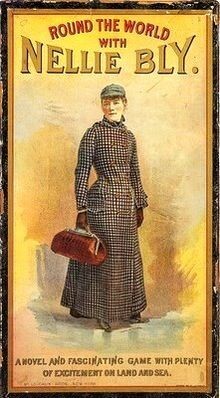
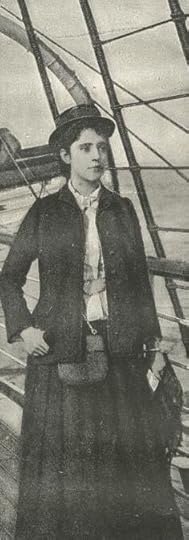
On November 14, 1889, Nellie Bly, the crusading young female reporter for Joseph Pulitzer’s World newspaper, left New York City by steamship on a quest to break the record for the fastest trip around the world. Also departing from New York that day—and heading in the opposite direction by train—was a young journalist from The Cosmopolitan magazine, Elizabeth Bisland. Each woman was determined to outdo Jules Verne’s fictional hero Phileas Fogg and circle the globe in less than eighty days. The dramatic race that ensued would span twenty-eight thousand miles, captivate the nation, and change both competitors’ lives forever.
The two women were a study in contrasts. Nellie Bly was a scrappy, hard-driving, ambitious reporter from Pennsylvania coal country who sought out the most sensational news stories, often going undercover to expose social injustice. Genteel and elegant, Elizabeth Bisland had been born into an aristocratic Southern family, preferred novels and poetry to newspapers, and was widely referred to as the most beautiful woman in metropolitan journalism. Both women, though, were talented writers who had carved out successful careers in the hypercompetitive, male-dominated world of big-city newspapers. Eighty Days brings these trailblazing women to life as they race against time and each other, unaided and alone, ever aware that the slightest delay could mean the difference between victory and defeat.
A vivid real-life re-creation of the race and its aftermath, from its frenzied start to the nail-biting dash at its finish, Eighty Days is history with the heart of a great adventure novel. Here’s the journey that takes us behind the walls of Jules Verne’s Amiens estate, into the back alleys of Hong Kong, onto the grounds of a Ceylon tea plantation, through storm-tossed ocean crossings and mountains blocked by snowdrifts twenty feet deep, and to many more unexpected and exotic locales from London to Yokohama. Along the way, we are treated to fascinating glimpses of everyday life in the late nineteenth century—an era of unprecedented technological advances, newly remade in the image of the steamship, the railroad, and the telegraph. For Nellie Bly and Elizabeth Bisland—two women ahead of their time in every sense of the word—were not only racing around the world. They were also racing through the very heart of the Victorian age.
Look for special features inside. Join the Random House Reader’s Circle for author chats and more. “What a story! What an extraordinary historical adventure!”—Amanda Foreman, author of A World on Fire “A fun, fast, page-turning action-adventure . . . the exhilarating journey of two pioneering women, Nellie Bly and Elizabeth Bisland, as they race around the globe.”—Karen Abbott, author of American Rose “[A] marvelous tale of adventure . . . The story of these two pioneering women unfolds amid the excitement, setbacks, crises, missed opportunities and a global trek unlike any other in its time. . . . Why would you want to miss out on the incredible journey that takes you to the finish line page after nail-biting page?”—Chicago Sun-Times (Best Books of the Year) “In a stunning feat of narrative nonfiction, Matthew Goodman brings the nineteenth century to life, tracing the history of two intrepid journalists as they tackled two male-dominated fields—world travel and journalism—in an era of incredible momentum.”—Minneapolis Star Tribune
Matthew Goodman is the bestselling author of three books of non-fiction.
His essays, articles, short stories, and reviews have appeared in The American Scholar, Harvard Review, Salon, the Village Voice, the Forward, Bon Appetit, and many other publications, and have been cited for Special Mention in the Pushcart Prize and Best American Short Story anthologies.
Matthew has taught creative writing and literature at Vermont College, Tufts University, Emerson College, and at writers’ conferences including the Antioch Writers Workshop and the Chautauqua Institution. He has received fellowships from the MacDowell Colony (twice) and the Corporation of Yaddo.
He lives in Brooklyn, New York, with his wife and two children.
It was very hard for me to give this only 2 stars because I really WANTED to like it more. The story itself was interesting. It's not surprising that it's not something we learn about in school, basically we get 5 minute sound bites on most historical moments that aren't wars. But I feel this was a significant point in women showing they can do the same jobs men can do...sometimes even better.
No, it wasn't the story. It was the writing. This book could have easily been half the size if Matthew Goodman could have just kept all the little tangents and offshoots to himself. Although I just stated the writing is what kept this book down, I blame the editor more than the author. It's obvious Goodman did his research, he needed help to know which tidbits added to the story and which just weighed it all down. Honestly, if this wasn't being read for my book club I most likely wouldn't have finished it - and I never just abandon a book. Especially one I paid for!
The story of Elizabeth Bisland and Nellie Bly is really amazing and worth learning about. Just know ahead of time that the tangents the author goes off on are NOT pertinent to the story and you can skim over them. It will make it much easier to get through. It honestly has nothing to do with the projection of the story for you to know how the Thomas Cook Travel Agency got its start or the exact address of every person in the book. Some of the information is interesting, but they info pulls you out of the story and just doesn't flow.
What a wonderful book about a topic most of us know little about, heck few even know or remember the name Nellie Bly. Bly was an intrepid journalist for the NY World and had an idea for a round the world journey to try and outdo the fictional record of 80, as written by Jules Verne. Her idea in 1888 was pushed aside, but by 1889 the World's circulation started to decline and out of the blue the newspaper decided it would be a great idea and so on 2 days notice Bly was sent on the journey in November. She traveled on an East to West course, with her first leg being on a steamer from New York to England. Not to be outdone, the editor of Cosmopolitan magazine had feature writer Elizabeth Bisland hustled to their offices and told her she had to now race around the world against Bly and beat her back to New York, but Bisland was going to go West to East and her trek began with a train trip across America - but she only had 8.5 hours to prepare and catch the train! This book is a story of the two ladies, their differing upbringing, differing writing styles, and their competition to get around the world faster than the other. Bisland knew she was racing Bly, but Bly did not find out about Bisland until she was in Hong Kong. Lots of good stories and descriptions of the trip, author Matthew Goodman does a great job in contrasting the women, their highlights and dilemmas, as well as their returns to New York and lives after the trek. A great non-fiction look at travel in the later 19th century, as well as the emergence of female journalists. This is a book any reader, no matter their sex, will enjoy immensely!
Impressed doesn't cover the half of it. Eighty Days: Nellie Bly and Elizabeth Bisland's History- Making Race Around the World is one romp of an adventure. A fan of vicarious thrills, this book gave me more than my money's worth. Who could not love the intrepid spirit of both these women and what they accomplished?
Of course I had heard the name Nellie Bly but truly knew little about her. Born Elizabeth Jane Cochran I was surprised to read what lengths she would go to for a good news story for New York's The World. From buying a baby to expose the slave trade, to feigning insanity to report on the mistreatment of women in Blackwell Island Insane Asylum there was little Bly wouldn't do for an expose. None though would bring her the acclaim and fame of her proposal to beat Jules Vern's 80 day around the world trip. With just a single grip to carry her needs and "dressed in a snugly fitted two-piece garment of dark blue broadcloth trimmed with camel's hair", she sets out on the journey of a life-time. Little did she realize rival magazine, The Cosmopolitan headed by John Brisben Walker, would pit his own candidate, Elizabeth Bisland, against her to circumnavigate the world in less than 80 days. Bly sets out in New York heading across the Atlantic, whereas Bisland's route takes her west across, 8 1/2 hours behind Nellie.
The race was enough to keep my interest but there's so much more for the reader to appreciate. A memoir not only of the women, Bly and Bisland but a period piece of New York and journalism. Nellie Bly's determination and fearless nature help to build a strong foundation for the right for women to hold leadership roles in the workplace.
Riveting narrative non-ficiton. Put it on your list.
Note - These comments are in regards to an e-galley edition provided by the publisher. I have been waiting for publication to post my thoughts.
What a blast! Tracing the around-the-world race between two female journalists in 1889, Matthew Goodman brings a dash of thrill and wonder to the event which makes it read as though it happened today. Jules Verne's famous story inspired the idea and two New York newspapers made it happen much to the delight of their absorbed readers.
...one could drift out on dreams that bring what life has failed to give...
The latter part of the nineteenth century brought forth a slew of new technologies which dazzled the world. Steam replaced sail, making ocean travel faster and a bit safer. Railroads criss-crossed countries and telegraph wires revolutionized communications. Rudyard Kipling noted, "They have killed their father Time". Travelling suddenly became easier and the news could be delivered in five minutes from thousands of miles away. As Paul Simon might say, it was the age of miracle and wonder.
Nellie Bly and Elizabeth Bisland were the two participants in the worldwide race, although Bly didn't know there was a competitor until the race was almost at the halfway mark. The two women were both journalists, but different in lifestyle and in writing style. While they both started in New York, Bly went eastward, taking a ship across the Atlantic, while Bisland began her trip on a westward-bound train. Their adventures brought them out of the secluded United States and into worlds of which they had only previously dreamed. This was still the time of empire and throughout their respective sojourns, the British sun never set.
Elizabeth Bisland
Matthew Goodman makes this race a pure pleasure. With each vehicle of transport, with each new land reached, he has meticulous research at the ready (the selected bibliography is pages long), sprinkled with quotes from famous writers and explorers. His own words are not bad themselves.
Describing a New Orleans market, he notes pomegranates...like rubies in a bed of cotton. In the South China Sea, one can watch the sea quiver under the blinding sky. The post-Civil War American Southerners are described as marinated in the vinegar of defeat. And the magnificent paragraph on Japan, filled with colours and sparkles has wooden temples silvery with age.
There's not much wrong with this page-turner. I cheered both women on, then started picking my own winner. I selected a time of finish, hoping I was somewhere near the final result. I was there on the decks of ships, sick as the lurches on stormy waves brought me to the sides. Apart from the misspelling of a name on page 321, everything else was meticulous. I must read more from this author.
This delightful popular history subtitled Nellie Bly and Elizabeth Bisland’s History-Making Race Around the World is a fascinating account of the lives of two young female reporters in New York at the end of the nineteenth century. The story has much to recommend it: it could be read as a cautionary tale on the fleeting nature of celebrity, or a meditation on the twisting course of a life, or a history of women’s rights. It would be a great addition to the reading lists of teens since I feel sure that many students, both male and female, would be immediately captured with the concept of a race around the world.
While many of us have heard of Nellie Bly, my guess is few of us could say why. This book explains that a young Pennsylvanian took the pen name Nellie Bly from a popular song of the time, and managed to talk her way into a job as an investigative reporter in Philadelphia first and then New York. She convinced her newspaper, owned by Joseph Pulitzer, into arranging a round-the-world trip to beat the record set by the fictional character Phileas Fogg of the wildly bestselling science fiction novel, Around the World in Eighty Days by Jules Verne.
The idea of the race is galvanizing, but Goodman does a good job with the history as well, taking many opportunities to divert the story to highlight ill-remembered people, places, and practices of the time, the expansion of the railroads, the truth of ocean travel, the beauty and strangeness of Japan and China in the late nineteenth century. Nellie Bly became a sensation around the world, but certainly in the United States where news of her progress was charted by her newspaper, and estimates of her expected “time of touchdown” back in New York were gambled upon.
Elizabeth Bisland, Nellie’s competitor for the fastest time, was less promoted than Nellie certainly, but also sought the limelight less. The story of her journey, around the world and in life, is no less instructive and adds immeasurably to the work as a history of the period. The photos added a great deal to the text, and I am grateful the publisher agreed to print them.
Matthew Goodman found a good story and wrote another. Just as the story riveted readers of the newspaper The World in the 1880s, so the revived story interests us now. I would not be surprised to learn that this book leads budding historians to seek out the original documents that came of this novel adventure. Likewise I would not be surprised to find aspiring writers divining new subjects in the historical record worthy of our interest again.
I feel like Eighty Days had a completely promising starting point and through most of it was very enjoyable, but about 3/4 of the way through I almost couldn't take anymore. It felt like the author wanted the book to be one thing but didn't have enough material to get him there. A big part of my disappointment came every time he introduced a new person, method of travel, etc. He would go on for sometimes a full page about that new thing then go back into the story. The other issue I had was that I think the author wanted everyone to fall in love with these two women but just kept giving me reasons to not like them or not make them as likeable. Nelly Bly is unquestionably the hero of the authors story but by the end I didn't actually like her very much she seemed to be self centered, while Elisabeth Bisland seemed at first to be a little snotty but in the end she came off as the most open minded and just nice.
All in all it was interesting but just not quite interesting enough.
I love this type of narrative fiction, easy to read, and about a time period where it was very unusual for two such different women to undertake a challenge such as this. I have read many books abut Nellie Bly, when I was 14 or so I wanted to be just like her, unstoppable, curious and able to investigate many different things and than write about them. Elizabeth Bisland I know less about so it was interesting reading that another woman actually undertook this challenge as well. Although Elizabeth actually followed society's unwritten rules, much more so than Nellie, this was still a very unusual and bold thing for a young woman to be doing during an age when woman were expected to not stress their brains. Anyway it was very nice to revisit an old friend, and nice to read about another fearless woman. Loved that the author included pictures, really helped set the scenes and loved all the information about the places the woman visited. Very readable and will definitely recommend.
I initially read about Nellie Bly and Elizabeth Bisland's race around the world in "Rejected Princesses" by Jason Porath (shameless plug - read that!!). It was my first introduction to Bisland; I knew that Nellie Bly was a journalist who sometimes went undercover, but I had really only heard about her insane asylum exposé. After listening to the History Chicks' podcast episode on Nellie Bly (shameless plug - listen to them!!), Nellie Bly's badassery intrigued me. I went to look for a biography of her at my local library, and lo and behold I find this one, "Eighty Days", all about the race I had enjoyed reading about in "Rejected Princesses"! I was eager to start.
The book itself is a really great biography: it spotlights the two women equally, and gives a lot of factual nuggets and details without coming across as dry. Matthew Goodman includes relevant pictures throughout the chapters, which helps with dropping yourself into history. At times the dates and travel methods and miles etc. can seem repetitive, but this is a book all about travel after all, and Goodman's descriptions of the various locations and countries visited make up for any tedium on the journeys there. It wasn't quite perfect enough for me to give it the full 5 stars but it is definitely engaging and interesting, and I'd still recommend it.
I found, interestingly, that although I started the book for Nellie Bly, I actually preferred Elizabeth Bisland by the end. While I quite admire Bly's hard-scrabble pluckiness and her go-get-'em drive, I found that pleasant, well-read, charismatic Bisland is someone I identified with more. Bly was more in the race for the fame and glory that winning would give her - it was her own idea to go around the world in less than the 80 days popularized by the famous fictional Jules Verne novel, whereas Bisland was basically forced to do so as well by her editor, just to give Bly some competition. Because of this, Bisland cared less about the winning the race aspect and seemingly ended up being much more immersed in the beauty she saw and the places she went than Bly was. Bisland's writings of her adventures are awestruck and wondrous of the sights and other cultures. Bly almost hostilely barreled around the world, writing that she was disappointed with and inconvenienced by a lot of the sights proclaimed to be so interesting about foreign countries, and broadcasted the opinion that America is the best country and the American way of life is superior - basically the epitome of the "uncouth American tourist" stereotype that purportedly everyone from other countries hates. That attitude turned me off quite a bit. While I am an American by birth, I have so much curiosity and appreciation for the older countries in Europe and Asia and their unique cultures, and I definitely would not say Americans are superior to anyone else (**coughcough especially with our recent choice of "leadership" coughcough**). To each their own opinion I suppose, but at least in this book, Elizabeth Bisland was much less maddening for me to read about than Nellie Bly because she was classier in the face of unfamiliar ports of call, and chose to make her mark on history caring more about the "world" part than the "race" part.
Such a clever book in many ways. Matthew Goodman recreates the 1889-1890 race between Nellie Bly, a muckraking journalist for the New York World, and Elizabeth Bisland, a writer and editor for Cosmopolitan, to circle the globe in less than the 80 days it took Jules Verne's fictional Phileas Fogg. Switching back and forth between and within chapters, Goodman lets readers get what is a largely sympathetic view of Bisland and a not so favorable depiction of Nellie Bly. Nellie Bly, of course, won the race. But Goodman goes to some lengths to demonstrate the cost of her doing so, while highlighting the post race successes of Bisland. Bly we are told was a hypocrite, a gold digger, a liar, attention seeker, cheat, and even a racist. All of which is true to an extent--at least as presented from the evidence in Goodman's popular history. Meanwhile, Bisland is beautiful, demure, honest, intellectual, and loyal.
Or was she? Goodman spends some time focusing on the mysterious Thomas Cook agent who supposedly gave Bisland false information when she was preparing to change trains outside Paris and travel to a waiting ocean liner. Instead of taking her planned route, she was deceived into undertaking a trip over the English Channel, across England and the Irish Sea, and to another much slower passenger ship, which languished in a winter storm in the North Atlantic. Bisland, says Goodman, did not get the name of the Thomas Cook agent or even a strong description, and there is no record such an agent was dispatched. The implication is that the agent was actually acting on behalf of Nellie Bly's backers who had resorted to sabotaging Bisland. All reinforced, when Goodman later quotes Bly as saying when money is involved in a race such as hers, anything was allowable. Bad, Nellie! Bad!
But I wonder. Goodman also spends a lot of time describing Bisland's dislike of publicity, reluctance to go on the trip in the first place, and her rejection of her participation in it during the following decades of her life. Perhaps the Thomas Cook agent never really existed. Might Bisland have made him up, in order to sabotage her own trip and avoid the notoriety she would have been forced to endure?
Otherwise, this is an enjoyable work of popular history. Goodman not only creates tension and suspense for an outcome we know the result of beforehand. He also provides valuable descriptions of the inventions, significant public figures, political movements, and events of the last decades of the nineteenth century. He creates context that helps flesh out the world Bly and Bisland lived in.
For all Goodman's intent to rope readers into the Bisland side of the race, I ended up more sympathetic towards Bly at the end. The main reason? The unsavory Anglophilia Bisland displays--and Goodman seems to endorse. Bly, says Goodman, disliked (hated is probably a better word) the British and their empire. Bisland gloried in it. She and her husband even built a mock Tudor mansion on Long Island and outfitted it with reproductions of British museum pieces. It's just the sort of thing you would expect of a certain type of American traveler who feels the need to gush over in order to separate themselves from the hoi polloi around them. Bisland, after all, only hobnobbed with the upper class and elites of British society. Bisland also tried to ape British literature in her own writing. I've read some of Bisland's essays. They are cloying and over descriptive. Essentially, Bisland was a sort of down market Henry James.
Wonderful. I always Nellie Bly was a fictional person. What a delightful, energetic person she clearly was. And how focused she was to help the poor. Her motto - "help first, analyze later".
This is not a terribly interesting book about what appears, actually, to have been not a terribly interesting event.
Bly and Bisland raced around the world in 1889 essentially as publicity stunts for rival newspapers. They were effective publicity stunts. People in 1889 thought it was totally cool. That's about it. Both trips appear to have been almost completely uneventful, cushioned by money and someone else doing a lot of the logistics.
Maybe the interesting take-away is that it was possible, even in 1889, to go around the globe as westerner with only the most cursory and touristic contact with anyone except other white people, mostly by hopscotching with ships from one colonial British enclave to another.
Goodman makes some effort to sketch in historical background on things like the newspaper industry, the role of women in it, fairly extensive biographies of both women and any number of other people, and a little about the history of the ships and trains and things, but it doesn't add that much to the book. He also writes the actual race in a very novelistic style, which is not terribly good either, rife with cliched landscape descriptions and "she must have..." and "surely". The afterword claims all feelings, reflections, internal monologues and what-not are taken from sources, but those are never mentioned in the text itself, so it's a bit of a mystery what belongs to which imagination.
Not particularly recommended unless you have a real burning passion for late 19th c. woman reporters.
Nellie Bly is a woman that takes chances. She sees the difficulties of being a woman in the 19th century, so she determines to carve a niche for herself. Nellie begins writing for The World newspaper as a journalist. At the time, journalism was considered a man's world far too crude for a woman to be a part of. But Bly proves her worth and is quite a success.
Nellie proposes to her editor that she be allowed to travel around the world alone. She claims she can do it in less than 80 days. And so begins the real story.
The book follows not only Bly's departure and journey from New York, but also Elizabeth Bisland's journey from San Francisco. Bisland works for a competitor's paper and her editor sends her off on a "race" against Bly.
As the women journey around the world, we are given interesting tidbits of history, both American and world, and have a better understanding of gender, race and politics.
Some parts are slow, but a great piece of women's history.
I was familiar with the name, Nellie Bly, but I did not know the reason for her celebrity. I do not want to discourage someone from reading this book as I thought the book showed an informative snapshot of the life and times around 1890 in New York, the United States, and various parts of the world. But they should be aware that the book is loaded with details and research into related and unrelated people, events, and topics. I thought the description of life in China is not to be missed. Now I know where the saying “death by 1000 cuts” comes from – shocking! The research in the book was in-depth and exhausting, as demonstrated by 70 pages of references. The book actually ends at 78% on my kindle. I’m glad I read it, but I wouldn’t want to read it again!
Onvan : Eighty Days: Nellie Bly and Elizabeth Bisland's History-Making Race Around the World - Nevisande : Matthew Goodman - ISBN : 345527267 - ISBN13 : 9780345527264 - Dar 453 Safhe - Saal e Chap : 2013
Inhalt: Im Jahr 1889 liefern sich zwei Journalistinnen ein Rennen um die Welt. Inspiriert durch Jules Vernes 'In 80 Tagen um die Welt', wollen sie Philas Foggs Rekord um fünf Tage unterbieten. Nellie Bly startet Richtung Osten auf einem Schiff und ihre Rivalin Elizabeth Bisland beginnt ihre Reise mit dem Zug in westlicher Richtung.
Art des Buches: Non-Fiction
Wie fand ich das Buch? Das Buch hat mich sofort für sich einnehmen können. Im Mittelpunkt steht das Rennen um die Welt, aber auch das Zeitgeschehen und die Lebensgeschichten von Nellie Bly und Elizabeth Bisland. Zwei Frauen, die völlig unterschiedlich waren und die doch einiges verband. Besonders gut hat es mir gefallen, sehr viel Hintergrundwissen zu bekommen, ob es über Joseph Pullitzer, Schiffe, Bahnen und die Gesellschaft dieser Zeit war. Ich habe mich nicht informiert, wer von den beiden Damen das Rennen gewann und konnte so ein wenig mitfiebern. Das Buch ist sehr flüssig geschrieben und ich mochte es auch, dass gewisse Punkte, die für die Story wichtig waren, ganz kurz dem Leser noch mal ins Gedächtnis gerufen wurden.
3 passende Wörter zum Buch? Weltreise - Wettkampf - Journalismus
Wem empfehlen? Wer das Buch von Jules Verne liebt oder sich für Geschichte und starke Frauen interessiert, wird mit diesem Buch viel Freude haben.
A detailed telling of the life, times, and adventures of the two women reporters who raced around the world. A very thorough work and provided numerous points of interest.
Content Considerations: d*mn was used once. Mentioned in passing a few affairs or potential affairs. Mentioned a little drinking, smoking, opium etc.
In the 1890s Jules Vernes' novel Around the World in Eight Days was popular. An ambitious young woman reporter for The World newspaper in New York suddenly thought she could possibly beat that record in real life, alone. She studied timetables and planned before approaching her boss and talking him into the journey. She would set out by ship from Hoboken, NJ and finish there in less than 80 days.
News of her race against time spread quickly. It inspired the editor of Cosmopolitan (which was a totally different publication pre-Helen Gurley Brown) to send one of his columnists in the opposite direction in hopes of beating the World reporter.
So Nelly Bly, reporter extraordinaire, and Elizabeth Bisland, beautiful, sophisticated literary type set out on their race. Nelly Bly was a pseudonym taken from a popular song of the day. She didn't know about Bisland's attempt until they practically crossed paths in the Far East.
This is a long book of nearly 400 pages but my interest in it never flagged. One ad I saw compared Goodman's handling of the story to Erik Larson and I agree. There are pictures of the people and places and modes of transport to help the reader feel part of the exciting trip. Complications abounded for both women as weather, miscommunications, and mechanical problems with ships and steamers conspired to slow them down.
One funny part of Nelly Bly's story is that she was suddenly approached by several young men, one at a time, who seemed eager to marry her. Rumor had it that she was an heiress who was traveling to mend a broken heart. Her sudden suitors were looking for someone wealthy to support them, and at least one didn't mind saying so. Finally she told one young man that it was all an act; actually she was quite poor and a friend had paid for her trip. That was the end of the suitors.
I won't ruin the story by telling you who won the race but even afterward the story of the two women and the rest of their life is fascinating. In retrospect, I suppose I could have predicted their fate, but then again maybe not.
"Is it possible for us to struggle and overcome fate?" Bly asked in that column, the very last words she would ever publish. "Or are we merely being swept along a course which all our efforts fail to alter or change?"
Ever since I purchased an ex-library copy of Around the World at a book sale years ago, I've been fascinated with the story of Nellie Bly, the reporter who sought to beat Phileas Fogg's record of circling the world in 80 days. I've always meant to read a more detailed book about her, so I was very much looking forward to this audiobook - and it did not disappoint.
While I initially just wanted further information on Nellie Bly's race around the world, this book delves into the life of the woman who was hired to beat her in her goal - Elizabeth Bisland. And we are taken to their lives both before and after that historical journey.
I greatly enjoyed the in-depth look at both women's histories. However, my rating is dropped ever so slightly because of the book's tangents. Multiple times, Matthew Goodman will mention a small historical detail somewhat related to Bly and Bisland and then spend paragraphs talking at length about said detail. I read this via audiobook, but I'm sure I would've had a harder time reading these meanderings in a physical edition.
Humanity, it seemed, always found a way to bear what had previously seemed unbearable.
"Eighty Days" borrows its title from the Jules Verne classic, which in 1890 inspired a young female journalist to persuade her editors at Pulitzer's "The World" to send her around the globe in an attempt to beat the fictional Fogg's record set in "Around the World in Eighty Days." This is one of those marvelous and engrossing books that opens your eyes to historical events which electrified the world at the time of their occurrence, but of which we now remember nothing. I love reading books that teach me things; I enjoy even more reading books that teach me things I feel I should know, but don't; I especially appreciate books that teach me what I should know and constantly surprise me in the process. "Eighty Days" was one of those books.
I happened to read "Eighty Days" several months after reading Paul Collins' "The Murder of the Century: the Gilded Age Crime that Scandalized a City and Sparked the Tabloid Wars," and I'm glad I read that book first, since it provides a robust history of the NY newspaper wars that constitute the perfect backdrop for appreciating "Eighty Days." So, I would recommend reading Collins' book first, since much of what Goodman writes about in his book will make much more sense if you know the history of Pulitzer's newspaper--for which the heroine of "Eighty Days," Nellie Bly, worked as a pioneer female journalist.
"Eighty Days" bounces back and forth between an account of Nellie Bly's history-making race around the world, and a parallel account of another, very different female journalist--Elizabeth Bisland, who wrote for "The Cosmopolitan" and was pressured by her editors to attempt at the same time a similar journey around the world, but in the opposite direction. The book progresses from a biographical introduction to the two young women, to a blow-by-blow chronicle of their respective journeys, to an epilogue of sorts that briefly traces out their lives after the headline-grabbing race that made them famous. From start to finish the book was riveting.
My only two complaints about "Eighty Dats" are, first, that the back-and-forth nature of the account bounced me out of one woman's story just when I got thoroughly involved in it, and second, that it read less like history than historical fiction. I know the fictionalized approach to non-fiction is all the rage at the moment, but I too often found myself wondering where the line had been drawn between truth and imagination, and Goodman's ersatz notes at the end (keyed to pages, but lacking note numbers in the text itself) often didn't provide enough information to answer that question. What I particularly liked about the book was the follow-up story of the two women's lives after their race. They were both fascinating characters, but I found Elizabeth Bisland especially intriguing.
The bits and pieces of Bisland's prose that found their way into Goodman's history I found beautifully expressive, and often profound. But one excerpt from her later essays I thought particularly eloquent. So In the hope that whoever reads this review might find her writing as tantalizing as I have, I'll end with this evocative passage, in which Bisland is lamenting the discomforts of old age: "One suffers from being forced to dwell in a house steadily falling to decay; a trial to the housekeeper, arousing a sense of some innate incompetence that the beams of the building should sag, doors open with difficulty, windows dim with the dust of time, the outer complexion of the house grow streaked and grey with the weathering of many seasons. There is a certain desperation in the realization that no repairs are possible. . . . one braces one's self to accept courageously the wrongs of time; to wear the lichens and mosses with silent gallantry." How can one read such prose and not want to know its author? So in addition to a wonderful read, I have Matthew Goodman to thank for introducing me to Elizabeth Bisland, who has now been added to my short list of people I plan to track down after this life if it turns out that we indeed have souls that make eternal conversations and friendships more than the stuff of literary fantasy.
Once more I am surprised at the history I missed in school. But why should I be? In the epilogue to this wonderfully written historical account, Elisabeth Bisland is quoted as follows: “The record of the race, hitherto accepted as truth about ourselves, has been the story of facts and conditions as the male saw them – or wished to see them…No secret has been so well-kept as the secret of what women have thought about life” (Goodman, 2013, p. 364). Not to mention that even famous women and their achievements are often forgotten. I am thankful that one man chose to investigate these two women and their journeys.
I would like to point out that if all history were written in such an engaging manner, it would be much less onerous to students. As I was reading, I kept wondering how much of the story was fictionalized. I was pleased to read in the notes that Mr. Goodman (2013) created all of the dialogue in the book from written sources, such as memoirs, letters, or newspaper articles (p. 381). This comes through in the personalities of the two women, both of whom are complex and at times likeable and unlikeable. Not only are the women interesting, but their travels around the world and the lessons that they each learned, or perhaps did not learn, are valuable windows into the past and human nature. There is more to the story than a race and who won, and this book could as easily serve in a psychology or philosophy class as in history or English.
For those who don’t know the outcome, and I would guess that is a lot of people, I won’t spoil the story for you. Instead, I am going to dwell a bit on what the story’s central theme was for me; time. I was struck by several passages related to time:
“New York, of course, had moved no closer to Philadelphia, but a trip that had once taken seven days now required less than seven hours. The country seemed to be growing ever smaller, more tightly knit: everywhere seemed closer than before.” (p. 106)
“People will have to marry by railroad time, and die by railroad time. Ministers will be required to preach by railroad time, banks will open and close by railroad time; in fact the Railroad Commission has taken charge of the time business, and the people may well set about adjusting their affairs in accordance with its decree.” (p. 107)
“We do not ride on the railroad, it rides upon us” – Henry David Thoreau in Walden (p. 108)
“Like the best magician, it [the telegraph], produced extraordinary effects by means that few people understood, and indeed, it seemed to have performed the greatest trick of all: making time disappear.” (p. 193)
Samuel Morse was toasted for having “annihilated both space and time in the transmission of intelligence.” (p. 194)
Wow! Reading these lines I was reminded of Stephen King’s Dark Tower series, Time Travel in Einstein’s Universe by J. Richard Gott, and About Time: Einstein’s Unfinished Revolution by Paul Davies; all of which I recommend, both on their own and as food for additional thought on this story. Just take the quotes above and substitute airplanes, rockets, and the internet and we are still living with the compression of space and time.
I am always fond of books that lead me to new reading and this book does not disappoint in this area. I will now have to move on to read or re-read Rudyard Kipling’s The Deep Sea Cables, Elizabeth Bisland’s The Truth About Men and Other Matters, Walt Whitman’s To a Locomotive in Winter, Henry David Thoreau’s Walden, and Jules Verne’s Around the World in Eighty Days, among others.
Eighty Days is more than a true story, it takes the reader back in time and around the world in both directions. Don’t miss this trip!
Works Cited Goodman, M. (2013). Eighty Days: Nellie Bly and Elizabeth Bisland's History-Making Race Around the World (First bed.). New York, NY, USA: Ballantine Books.
I was excited to get an audio copy of this book so quickly from the library. I was eager to learn more about a race around the world in 1889-1890 that had the public riveted at the time, but is little known today. This fascinating book focused on much more than the race around the world between Nellie Bly and Elizabeth Bisland, two female journalists who set off to beat the fictional Phileas Fogg's 80 days in Jules Verne's classic book.
Nellie Bly was a spunky newspaper reporter from western Pennsylvania who talked her way into a job at Joseph Pulitzer's newspaper, The World, in New York City. Many of her pieces for the paper were expository where she went undercover or somehow worked her way into the situations she was covering to experience and report on them first-hand. She had been pitching this "race" to The World for a year to no avail. The decision was made to fund her idea of going around the world - on publicly scheduled transportation only - in less than 80 days because The World was losing circulation in the highly competitive NYC newspaper business. She set off, after only 2 days notice, from New York on November 14, 1889, crossing the Atlantic to go from west to east in her trip.
The editor of Cosmopolitan magazine (nothing like today's) saw an article in The World about Bly's trip the very morning she took off and was immediately inspired. He decided they would fund a trip going east to west, to be made by Elizabeth Bisland, their literary journalist, starting that day. At this time, Bisland knew nothing of the trip or that her life would soon be turned on its head. Between having the flash of inspiration and when Bisland left later that day on a train bound west, he convinced her and contracted with Thomas Cook travel agency to map out her trip. Bisland was a southern belle from a prominent plantation family who had lost their fortune as many had after the end of slavery. She had educated herself and made her way to NYC to make a career in journalism. She initially balked at taking the trip, but ended up consenting ... and the rest is little known history!
The author, Matthew Goodman, does an excellent job of going back and forth in the book between the two women's experiences. He highlights how different these women were and how differently they approached the trip. He builds momentum and excitement throughout the book illustrating how riveted the public were by this race, even though for the early parts of the trip, Nelly Bly thought she was only racing with the fictional Phileas Fogg.
I was surprised by how the race was not always the focus of the book. Goodman not only tells the story of the race, but he diverts to all kinds of topics relevant to the culture and technologies at the time. We learned a lot about these other topics of the day, such as late 19th century communications, railroads, how our current time zones were created, the newspaper business, women's rights, travel, Joseph Pulitzer, Asian culture, etc., etc. Occasionally these diversions irritated me (many were long passages of the book), but they were always interesting and educational. All in all, it's a minor complaint about the book.
The story doesn't end with the end of the race; Goodman follows these women throughout their lives. Their individual life paths were fascinating and not necessarily predictable given how they started out.
(I listened to this book, but have a hard copy on order at the library in order to see the pictures. I thought the narrator did a good job, although at times I felt her voice was rather provocative given the subject. I looked her up and saw that she's narrated a lot of erotica - aha!)
As any history nerd would tell you, the adage that history is written by the victors is boring. Sometimes, the people who lost or ignored or forgotten by history are just as, or very often, more interesting than the figures we celebrate. Unfortunately, this not the case in this book.
There was a Tumblr post recently going around about Elizabeth Cochrane aka Nellie Bly, detailing her life and exploits as an investigative journalist, and a lot of the commentators mentioned that they had never heard of Nellie Bly before. (One good thing about growing up in Western Pennsylvania; we champion our rich history because nearly everyone ignores us.) And this book should have been a great exploration of her life and her famous trip. Especially when Elizabeth Bisland comes in. I had never heard of Bisland, and never knew that there was a full-fledged race between the two women. And there are some really good descriptions of the two’s travels around the world and the sites they respectively encounter. (I love the meeting between Nellie Bly and Jules Verne. Verne asks Bly why she’s skipping on a town in India that’s prominently featured in Around the World in 80 Days. Bly responds, “I don’t have time to rescue a young widow.” Verne’s wife rightfully points out that she quite likes the young lady.)
However, here is the biggest problem of the book: Goodman tries to build up Bisland as a heroic figure worthy of being on the same level as Bly. Except that there’s a reason why Nellie Bly was written into history books (if she’s mentioned at all). Nellie Bly began her career in investigative journalism, starting with getting thrown out of Mexico when she investigated their politics; this was followed by her breakthrough assignment of going undercover at the insane asylum at Bellevue. Goodman mentions at the end that Bly’s career was only defined by the first 27 years of her life, ending with the trip around the world; and let’s be honest, not a lot of people have accomplished as much as Bly did in that time. And this is not to knock Elizabeth Bisland, but she was a society and literature writer, which was acceptable for a woman reporter at the time. The sole reason Bisland went on her journey was at the behest of her editor, in a grab to do competition with the World. It also doesn’t help that part of Goodman’s attempt to build up Bisland in the reader’s eyes is by knocking Bly’s character—he criticizes Bly for not being conventionally beautiful, or that she’s superstitious or that she lies about her age. They’re not malicious, but Bisland doesn’t get as much of a critical eye.
I’m all for championing lesser-known figures of history, especially minority figures, but this book goes about it in the wrong way. I understand what Goodman was doing, but I don’t like the fact that he goes out of his way to lessen an incredibly and deservedly inspirational woman all in the name of “Well, someone else did it.”
If you ever stop in the town of Jerome, AZ, you will likely wander into the wonderful and curious kaleidoscope shop called "The Nellie Bly." Supposedly it is the "worlds largest" of such venues, and even features a handpained sign of the once-famous "world girdler" wearing with her signature checked coat and gripsack. I had heard of Bly mainly from her expose of a New York Psychiatric hospital, which was published by the World newspaper in 1887, and had wondered about her connection to a quaint, if remote, part of the desert southwest. After reading this book, I'm 95% sure she at least passed through it on her trip around the world.
This book is an intriguing portrait of two very different--and yet, surprisingly similar--women who caught up in what I like to think of as the Victorian Age "Steampunk" Effect. With this sudden surge of new technology, suddenly barriers were being broken, humanity is pushing itself faster, further, closer, louder, and becoming more efficient. Social barriers began to crack along with the physical restraints on speed and distance. Women could be reporters? Travel around the world? With fewer than seventeen trunks? No, with ZERO trunks?! What science fiction!
Nellie Bly is still relatively well known today, but I had never heard of Elizabeth Bisland, Bly's rival "world girdler," and I'd be remiss in not mentioning her. She was also a writer, but instead of Nellie's dare-devil stunt-girl journalism, Bisland was an introvert, an idealist, and Poe-reading romantic. Both dealt with their respective celebrity in different ways, and both changed for life by their respective journeys, for good and ill. I can't help but admire both of them, even if I have the feeling they didn't care for one another (though it's not clear to me if they ever actually met).
Overall I found the book perhaps a tad long and somewhat repetitive in places, yet was also surprised by some of the unexpected action sequences, my personal favorite being the crazy engineer who careens his train--and Miss Bisland--down the back of the Wasatch Mountains for a record-breaking speed run, with the locomotive careening up on two wheels around the curves. As both a dual-memoir of some boundary-breaking ladies and as a send-up to the late 19th Century and the emergence of the modern world, I heartily recommend it.
Eighty Days was a fascinating account of two women's race around the world, that of Nellie Bly and Elizabeth Bisland.
The race was not intended to be a race at all. The idea was to outdo the fictional character Phileas Fogg's eighty day journey around the world, an idea that Bly had been pressing to the World, the paper in which she worked. She was finally given the ok, and preparations had been set. However, The Cosmopolitan caught wind of this and decided to send one of their own, Elisabeth Bisland, to race Bly. Bly set out east, and Bisland set out west.
There's no doubt that Bly's quest was the most reported on. I honestly did not know about Bisland until I came across this book. I knew all about Bly's trip around the world, but was flabbergasted that there was another woman doing the very same thing at the very same time.
The book chronicles both women's trips around the world, the ups and downs, and the unexpected road blocks. It also gives insights to the places and people both women encountered.
Both women completed their journeys, with Bly beating Bisland by a few days. Bly had become a celebrity, while Bisland gained only a little fanfare.
However, one thing they both accomplished was what they did for other women, especially in the field of journalism. More women were hired in the aftermath of the race, and the 'new American woman' was established.
One thing that bogged the book down was the endless detail. The text would sometime veer off into pages and pages about the city either women was visiting. It was nice and all, but it felt like way too much. I skipped much of this, honestly. It seemed as though there was not enough to write about either woman's trip to make a whole book, hence all the unnecessary detail.
Still, this was an informative book, and like me, you can always skip the stuff I did.
The older I get, the more fascinated I become with the ways other people have lived their lives -- in foreign lands, through other political and cultural epochs, and through the ever-reaching telescope of history. As I mature, perhaps I'm taking greater ownership of my world, and a woman in 1880's New York City is not just a stock character, but a woman like me, a woman with ambitions and desires and opinions, who must also battle with corsets and marriage expectations, rather than high-heeled business attire and...marriage expectations. In Eighty Days, we're given the opportunity to know two women who vary in their disposition, their background, and their social mobility, but both challenged with the same task and facing the same social constraints. The task is covered engagingly in the first 2/3 of the book, but the last 1/3 was the most poignant for me, as we learn how the experience shapes each woman's future. This book is many things at once, and might appeal to many different tastes for its exposure to Industrial Age America, women's suffrage, steam technology, history of journalism, British Empire, NYC social hierarchy, early-contemporary fantasy literature, American advertising, etc, etc. I loved all of it. The research librarian in me reveled in all the primary-source material the author unearthed to provide us with such a rich, full picture of the era. But what was even more impressive was the emotional investment I had in the character study of both women. Regardless of the times, these women responded to celebrity and career expectations in ways relevant to any woman's struggle. I'm grateful to the author for making the experiences of Nellie Bly and Elizabeth Bisland fresh and accessible to today's audience, and not just their ballyhoo-ed race, but the life they led afterward.
This is the story of two pioneering women journalists who refused to be pigeon-holed covering fashion and society teas, which is all many editors were willing to assign women, if they hired them at all. Nellie Bly (real name: Elizabeth Cochrane) and Elizabeth Bisland had established their reporting credentials by the time they raced each other around the world in opposite directions the winter of 1889-90. They aimed to break the record set by the fictional Phileas Fogg in Jules Verne's novel, "Around the World in 80 Days." The "New York World" which employed Bly, used her trip to boost circulation, and not just in reporting her adventures. It collected some 600,000 plus entries (each one of which required the purchase of a newspaper) in a contest to guess the exact amount of time her trip would take.
I really enjoyed reading about Bly and Bisland and the trajectories of their lives. To me the parts that weren't about the race around the world were more interesting. Goodman presents a ton of information about life in that era, particularly about newspapers, ship travel and railroads. Probably because I had a career in journalism myself, I really enjoyed reading the parts about the newspapers, but not so much the parts about steamships and trains.
Bly became famous as a result of her trip, but I give Goodman credit for not romanticizing her. He is critical of her for lying about her age, exaggerating perils she faced and not doing enough reporting while on her journey. What she really cared about getting to the destination as quickly as possible, not about understanding the cultures she visited or even noticing the workers and poor travelers who shared her trains and ships but not her first-class status.
I'd never heard of Elizabeth Bisland before I read this book, so I was pleased to learn about her.
This book about a newspaper stunt that captivated America in 1889-1890 excels at giving a sense of people, time, and place, evoking the sights, sounds, technology, and culture of the era in vivid and fascinating detail. When the Suez Canal opened creating a water route from Europe to Asia at about the same time that the transcontinental railroad was completed in the U.S., people, including Jules Verne, began to speculate about how fast a trip around the world could be. Jules Verne’s fictional hero managed it in 80 days, but reporter Nellie Bly and her editor thought she could do it faster, and sell a lot of newspapers in the attempt, so with almost no time to prepare she was off--heading east on a ship over the Atlantic. Later that day and with even less preparation Elizabeth Bisland working for an early incarnation of Cosmopolitan Magazine started off in the other direction.
The two women make interesting and appealing book subjects. They were very different--Nellie who did undercover reporting was scrappy while Elizabeth more interested in books and conversation was more cultured, but both came from impoverished backgrounds and had to work hard to be part of the mostly male world of journalism. The chapters alternate between the women as they venture around the world in opposite directions, often reacting very differently to what they encountered. I found myself hoping that somehow both women in this highly enjoyable book could win their globe spanning race.
Damn, this book is good. The topic -- two female newspaper reporters (a rarity at the end of the 19th century) racing around the world against each other and against Jules Verne's fictional 80 day standard -- was enough to attract me. The careful research and fabulous writing make it one that I will highly recommend.
Goodman didn't fictionalize any of this. If it wasn't in Bly's or Bisland's memoirs or other original sources, it didn't go in the book. Using just the fact, he paints a vivid picture of these two very different young women, the world of journalism, New York City and other American points of interest, trains, steamships, and the many locations visited by Bly & Bisland during the height of British colonialism. There's a lot going on, but he blends it all seamlessly into a narrative that only lags for the tiniest occasional moments.
I was fascinated to the end of the epilogue. How differently these women perceived the world they'd never seen before, and how this experience affected each of them, was a story in itself.
Reread to my boys, 2021, after reading Around the World in Eighty Days. They really enjoyed it, too, although they felt like it went on too long after the end of the race.
Meticulously researched, vividly written, Goodman's book evokes a whole forgotten world -- 1889 America - as he tells this sweeping tale of the great race around the world to beat Phileas Fogg's fictional 80 day circumlocution -- and incidentally to build the New York World's circulation to over a million. Nellie was a huge pop star for a moment in time, then forgotten, as has been her genteel competitor, Elisabeth Bisland, sponsored by Cosmopolitan Magazine. I enjoyed this truly thrilling piece of American pop history, and I savored each moment I could return to their world. Hats off to a Matthew Goodman, a great popularizer of forgotten history and a brillinat writer.
In an age when most people had yet to see a horseless carriage, two young women working for rival New York newspapers raced around the world in opposite directions as a publicity stunt. It worked. By the time they returned, largely unaware of the attention they had gathered, millions of people knew their names: Nelly Bly and Elizabeth Bishland.
Matthew Goodman's well written and well researched book lets you relive the adventure, eager to find out who won. This is a great summer read, especially if your looking for a book to take on the road.