

What do you think?

Flowers of the Sea
Flowers of the Sea
Thirteen Stories and Two Novellas
by
Reggie Oliver
This sixth collection of ‘strange stories’ by Reggie Oliver follows the award winning Mrs Midnight (2011). Oliver’s variety of subject matter, wit, characterisation and stylistic elegance are on display, as is his gift for telling a good story.
The rivalry between two former MI5 members in a seaside town escalates into something deeply sinister and mysterious. . . . The one-time assistant to a musical genius is dying in early nineteenth-century Vienna and cannot escape his obsession with their last collaboration. . . . In Weimar Germany a mass murderer is awaiting his execution with perplexing eagerness. . . .
There are two novellas in this collec-tion. ‘Lord of the Fleas’ is a study of a sinister eighteenth-century architect, told through various documents, including an unpublished fragment of Boswell’s Life of Dr Johnson, and a series of increasingly desperate letters from a young woman to her cousin in the style of the epistolary novels of Fanny Burney. The other novella, ‘A Child’s Problem’, inspired by a painting in the Tate Gallery by Richard Dadd, was nominated for ‘best novella’ in the Shirley Jackson Awards of 2012.
Reggie Oliver is an English playwright, biographer and writer of ghost stories. His work has appeared in a number of anthologies, including the Year’s Best Fantasy and Horror and The Mammoth Book of Best New Horror.
Flowers of the Sea contains: ‘Introduction’ by Michael Dirda, ‘A Child’s Problem’, ‘Striding Edge’, ‘Hand to Mouth’, ‘Singing Blood’, ‘Flowers of the Sea’, ‘Lord of the Fleas’, ‘Didman’s Corner’, ‘The Posthumous Messiah’, ‘Charm’, ‘Between Four Yews’, ‘The Spooks of Shellborough’, ‘Süssmayr’s Requiem’, ‘Come Into My Parlour’, ‘Lightning’, ‘Waving to the Boats’, ‘Author’s Note’.
Flowers of the Sea is a sewn hardback book of 388 + x pages with decorated boards, silk ribbon marker, head and tailbands, and d/w.
Also available as an ebook.
Thirteen Stories and Two Novellas
by
Reggie Oliver
This sixth collection of ‘strange stories’ by Reggie Oliver follows the award winning Mrs Midnight (2011). Oliver’s variety of subject matter, wit, characterisation and stylistic elegance are on display, as is his gift for telling a good story.
The rivalry between two former MI5 members in a seaside town escalates into something deeply sinister and mysterious. . . . The one-time assistant to a musical genius is dying in early nineteenth-century Vienna and cannot escape his obsession with their last collaboration. . . . In Weimar Germany a mass murderer is awaiting his execution with perplexing eagerness. . . .
There are two novellas in this collec-tion. ‘Lord of the Fleas’ is a study of a sinister eighteenth-century architect, told through various documents, including an unpublished fragment of Boswell’s Life of Dr Johnson, and a series of increasingly desperate letters from a young woman to her cousin in the style of the epistolary novels of Fanny Burney. The other novella, ‘A Child’s Problem’, inspired by a painting in the Tate Gallery by Richard Dadd, was nominated for ‘best novella’ in the Shirley Jackson Awards of 2012.
Reggie Oliver is an English playwright, biographer and writer of ghost stories. His work has appeared in a number of anthologies, including the Year’s Best Fantasy and Horror and The Mammoth Book of Best New Horror.
Flowers of the Sea contains: ‘Introduction’ by Michael Dirda, ‘A Child’s Problem’, ‘Striding Edge’, ‘Hand to Mouth’, ‘Singing Blood’, ‘Flowers of the Sea’, ‘Lord of the Fleas’, ‘Didman’s Corner’, ‘The Posthumous Messiah’, ‘Charm’, ‘Between Four Yews’, ‘The Spooks of Shellborough’, ‘Süssmayr’s Requiem’, ‘Come Into My Parlour’, ‘Lightning’, ‘Waving to the Boats’, ‘Author’s Note’.
Flowers of the Sea is a sewn hardback book of 388 + x pages with decorated boards, silk ribbon marker, head and tailbands, and d/w.
Also available as an ebook.
407 pages, Kindle Edition
First published November 1, 2013
About the author
Reggie Oliver
168 books130 followersReggie Oliver is a stage actor and playwright. His biography of Stella Gibbons was praised as “a triumph” by Hilary Spurling in the Daily Telegraph, his play Winner Takes All, was described as “the funniest evening in London”, by Michael Billington in The Guardian, and his adaptation of Hennequin and Delacour’s Once Bitten opened at the Orange Tree Theatre in London in December 2010.
He is the author of four highly-praised volumes of short fiction: The Dreams of Cardinal Vittorini (Haunted River 2003), The Complete Symphonies of Adolf Hitler (Haunted River 2005), Masques of Satan (Ash Tree 2007), and Madder Mysteries (Ex Occidente 2009). His stories have appeared in over 25 anthologies and, for the third year running, one of his stories appears in The Mammoth Book of Best New Horror, the most widely read and popular of contemporary horror anthologies.
He is the author of four highly-praised volumes of short fiction: The Dreams of Cardinal Vittorini (Haunted River 2003), The Complete Symphonies of Adolf Hitler (Haunted River 2005), Masques of Satan (Ash Tree 2007), and Madder Mysteries (Ex Occidente 2009). His stories have appeared in over 25 anthologies and, for the third year running, one of his stories appears in The Mammoth Book of Best New Horror, the most widely read and popular of contemporary horror anthologies.
Ratings & Reviews
Friends & Following
Create a free account to discover what your friends think of this book!
Community Reviews
Displaying 1 - 21 of 21 reviews

April 5, 2019
Without a doubt, Reggie Oliver is overstuffed with talent. His craftsmanship is top quality; the prose is superb. But there is something sadly missing. An ability to create resonance? Mastery of tone? Subtlety? A good editor? One can only guess. A number of the pieces in this collection suffer from pretension ("Süssmayr's Requiem" is the biggest offender), obviousness, or an unsuccessful striving for deeper meaning (in particular the title story). It appears the author went to the school of Robert Aickman; however, those stories that attempt to be the most Aickman-esque lack the headmaster's realistic depiction of the prosaic everyday in their beginnings and the unnerving ambiguity of Aickman's endings, and so fail to graduate with much more than average marks. I did notice an ongoing focus on aging and grappling with mortality, but the message delivered in those stories can usually be translated as It sucks to get old because then you will discover that life has no meaning. Which is not the deepest or most interesting of conclusions. My overall impression is that these tales were written by a skilled craftsman, but maybe not an artist with vision. A dabbler?
There is one glorious exception: the novella "A Child's Problem", which starts the collection (and which I happily saved for last). This smashing tale concerns a smug young boy left to fend for himself at his decrepit and clearly quite evil uncle's gothic estate. Oliver made a great decision in withholding sympathetic qualities from the entitled lad. The battle of wills - involving chess, vengeful ghosts, murder, and scavenger hunts - was a riveting and layered experience. When you have intriguing characters, a strong, resonant narrative, and fascinating themes, sophisticated prose can only make what is strong even stronger.
However, when lacking those first three precious things, you have the remainder of this collection.
And so 4 stars for one fabulous novella and 2 stars for the rest; in sum, a generous 3 stars.
pithy synopses:
"Striding Edge" - where did that young man disappear to? don't ask the Greenwood Folk!
"Hand to Mouth" - why does a baby cry in an abandoned château? don't question the Dowager!
"Singing Blood" - what is the nature of true evil? don't query the old cleric!
"Flowers of the Sea" - does life actually have meaning? don't consult the book of pressed flowers!
"Lord of the Fleas" - will a blood sacrifice in fact extend life? don't investigate that secret passage!
"Didman's Corner" - why must everything be draped in black? don't visit the old woman's cottage!
"The Posthumous Messiah" - is there death after life? don't take counsel from the widow!
"Charm" - what happens when charm inevitably fades? don't party with Sir Roddy!
"Between Four Yews" - how much does revenge cost? don't make a partner of a djinn!
"The Spooks of Shellborough" - what does a spy do in retirement? don't contemplate past misdeeds!
"Süssmayr's Requiem" - are we all born to die? don't look for meaning in a Requiem!
"Come Into My Parlour" - what did the spider do to the fly? don't cross a spinster!
"Lightning" - can you indeed 'make your own luck'? don't reminisce with an elderly actor!
"Waving at Boats" - what to do about the meaninglessness of existence? don't rage against the machine!
There is one glorious exception: the novella "A Child's Problem", which starts the collection (and which I happily saved for last). This smashing tale concerns a smug young boy left to fend for himself at his decrepit and clearly quite evil uncle's gothic estate. Oliver made a great decision in withholding sympathetic qualities from the entitled lad. The battle of wills - involving chess, vengeful ghosts, murder, and scavenger hunts - was a riveting and layered experience. When you have intriguing characters, a strong, resonant narrative, and fascinating themes, sophisticated prose can only make what is strong even stronger.
However, when lacking those first three precious things, you have the remainder of this collection.
And so 4 stars for one fabulous novella and 2 stars for the rest; in sum, a generous 3 stars.
pithy synopses:
"Striding Edge" - where did that young man disappear to? don't ask the Greenwood Folk!
"Hand to Mouth" - why does a baby cry in an abandoned château? don't question the Dowager!
"Singing Blood" - what is the nature of true evil? don't query the old cleric!
"Flowers of the Sea" - does life actually have meaning? don't consult the book of pressed flowers!
"Lord of the Fleas" - will a blood sacrifice in fact extend life? don't investigate that secret passage!
"Didman's Corner" - why must everything be draped in black? don't visit the old woman's cottage!
"The Posthumous Messiah" - is there death after life? don't take counsel from the widow!
"Charm" - what happens when charm inevitably fades? don't party with Sir Roddy!
"Between Four Yews" - how much does revenge cost? don't make a partner of a djinn!
"The Spooks of Shellborough" - what does a spy do in retirement? don't contemplate past misdeeds!
"Süssmayr's Requiem" - are we all born to die? don't look for meaning in a Requiem!
"Come Into My Parlour" - what did the spider do to the fly? don't cross a spinster!
"Lightning" - can you indeed 'make your own luck'? don't reminisce with an elderly actor!
"Waving at Boats" - what to do about the meaninglessness of existence? don't rage against the machine!

February 12, 2021
I'm normally not one for complaining about not having the ability to assign half stars on Goodreads, but if I'm being honest with myself, I'd have this collection squarely at 3.5 out of 5 stars. I know, shocking for me, since I have absolutely loved Oliver's work in the past, and, well, Tartarus Books - need I say more? There were some outstanding stories in this collection, I mean some really amazing stories. But there were a few clunkers. "This is normal," you say, "it's a short story collection. They all have some clunkers in them." True. However, I expect more from Oliver (and Tartarus). But I don't think I can lay the blame solely on the author or the publisher. Every author writes clunkers and some of them get published (I can name a few of my early published stories that I'd rather have a "do over" on), and publishers all run the tightrope of trying to be commercially feasible while staying true to their art. Sometimes publishers come to trust an author so much that they are not so rigorous in collecting later works as they might have been early on - if they've seen success selling books from this author, why should they rock the boat? Again, I can tell stories about myself (and a couple of my stories) that I'm not proud of, in this regard.
But, again, I have a hard time laying the blame at the feet of the obvious potential culprits. Okay, everyone is complicit to some degree or another. But would it be terribly socialist of me to say that "the market" has something to do with it? And here, I mean the book market's seeming need for profit on a large scale: "the machine," if you will.
The machine needs to make money. That's what keeps writers, editors, marketers, bookstore owners and employees, and distributors all eating. Without money, nothing (or at least next to nothing) gets done. Unfortunate, but true. So the element of profitability enters the equation. Don't even get me started on the element of greed, or you'll see one angry Socialist in this boy.
What the market seems to have found is: big sells. Big series and big, thick books are what keeps the machine running and puts dollars on the table of those who produce the books. I remember back in the '70s and '80s that books, generally were much thinner than they are today, at least the ones on the mainstream bookshelves. I recall science fiction books that had two novel(la)s between front and back cover by two different authors. Thick books were there, yes, but they were a rarity, possibly having to do with binding glues on paperbacks in those decades, I'm guessing.
Then, along came Stephen King. I would love to see a study about how books "grew" in page count after King's The Stand came out. Perhaps that was not the watershed moment, but it's when I first recall thinking "jimminy Christmas, that is a BIG book!". Then, BIG books started sprouting up all over the place. And long series. Yes, you had series fiction before the '90s (I think of the Xanth novels or Terry Pratchett's Discworld, for instance), but the book market seemed to make a swift shift from K-Reproducers to r-Reproducers at about the same time as the sound of King's behemoth thumping down on reading desks resounded around the world.
This might be a direct product of the generation in which I was raised (Gen-Z, if you're wondering - no, I'm not a Boomer, okay?). Reagonomics made it not only okay to deregulate trade and open the door to "free" trade, it veritably blew the doors off the hinges. Not only was it permissible to feed the greed, it became a sin not to do so, as God seemingly rewarded the ambitious with untold wealth. You're poor? Well, God must hate you then. You obviously did something wrong!
And we all bought into this. Or the vast majority of society did, at least.
But as I've gotten older (at half of a hundred, I'm finally willing to admit that I am "middle aged"), I've found that fulfilling all those childhood dreams of collecting all the Star Wars toys I ever wanted and all the comic books I never had as a (middle-middle-class white) kid and getting to eat out at fancy restaurants almost as often as I want to (I wish) . . . was empty. I'm in the process of discovering (because old habits and attitudes are hard to break and clearing the scales from one's eyes requires time and habituation) that less really is more. Less property, less digitalism, less social media. Yes, even (here I'm going to be crucified) fewer books.
Regarding the latter, this is the point I've been coming to with all this rambling. Some books, especially short story collections, could do with fewer stories - screw the machine! The invisible hand of the market needs a sharp slap!
And what am I doing about it? Well, first off, I find myself, more and more, buying slimmer books. I've always been a huge fan of novellas, which I've expressed before and will continue to espouse. Heck, my two most recently published books, The Varvaros Ascensions and The Simulacra, are novellas (the first is actually two novellas in one book). Secondly, I'm buying slimmer books. I have found that some of the best literature "out there" is hiding in chapbooks and small, limited run editions of small press books. They tend to be expensive (i.e., less "bang for your buck" than traditionally-published books), but I know that this money, by and large, is going to smaller operations. My order of operations for ordering such books are: 1) contact the author and buy direct, if possible, 2) buy direct from the publisher, if possible, 3) buy from Ziesings or a local bookshop, 4) buy on E-bay, 5) buy from you-know-who (but only as a last resort). I like feeding the smaller machines, rather than the juggernauts, if at all possible, so I'm often willing to pay a little more (and in some cases a lot more) for books that are way smaller than their gigantic, less-expensive competitors. I like underdogs.
Now, how does all this relate to the book at hand, Reggie Oliver's collection Flowers of the Sea? Well, to be honest, this book could stand to be shorter. Like about 5 of 13 stories shorter. Or at least 3 of 13 shorter. You'll see why in my comments on each story below. Many of these tales were mind-blowingly good, including the first novella (also the first story in the book). A couple were good, but not quite great, and, well, there were clunkers. Shave those clunkers out and even a couple of the good stories, and you have a gem of a collection here. So, without further ado, here are my notes on each story. I think these notes are mostly spoiler-free, but if you're going to read the collection, read it first, then read my review (and tell me that I'm wrong):
"A Child's Problem" starts off rather stodgy. Right from the get-go, I could see that little George was going to learn some discipline. Things got ugly quick, as one might predict from the mix of characters in the house. It's easy to see why "A Child's Problem" was a Shirley Jackson Award nominee. The novella is near-perfect, a ghost story in Jamesian fashion wherein the main protagonist, the child George, grows from his pains and sorrows. Even the "evil uncle" trope can be forgiven because Oliver leans into the stereotype so strongly that the reader willingly accepts it. I could see BBC making this into television drama easily. Five stars and Christopher Lee as the uncle, please!
"Striding Edge," a tale of the capriciousness of nature and the intent of those who immerse themselves in it, doesn't end with a sudden, sharp twist, like some supernatural tales do, but it meanders, like a group taking a hike up a steep mountain ridge . . . until it plunges off into the abyss. I loved the "soft shock" of the unveiling (or, rather, the veiling) at the end. Five stars.
"Hand to Mouth" was just plain terrifying. I normally don't get shivers while reading works of horror, but this one chilled me (as the narrator is, quite literally, chilled). This went beyond my desire for a creepy story and skipped awe for pure fear. This could give me nightmares, a thing that I normally don't take from reading. Five stars like the five fingers of a cold, dead, wriggling infant exploring your body in the darkness. Ewwwww! Ew! Ew! Ew!
While suitably gruesome, "Singing Blood" felt a bit academic, as fiction modelled after the style of, say, Nabakov, can sometimes be. Not that Nabakov was dry or boring - far from it - but a pastiche of Nabakov, which this felt like to me, is a bit pedestrian. Unfortunate, as I usually love Oliver's work, but this one only gets three stars from me.
The titular story is a musical piece of grief, loss, and finally, abject horror. What happens as those we love "lose" themselves and we see the inevitability, after having been subjected to such pain, of losing ourselves. An unhealthy diet of existential dread is served here, which leads to the decay of all that is beautiful into something ugly, something . . . else. Chaos looms. Five stars.
"Lord of the Fleas" is a tale that Oliver admits was written reluctantly when he was asked to write a zombie story. It is an epistolary novel written in a strong Dickensian voice, both aspects of which make this a very unusual zombie story, pulpish yet "proper". I liked it well enough, but was about as thrilled to read a zombie story as Oliver was to write one - not very. Still, good enough for four stars, more for the stylistic panache of the writing itself than anything else.
I finished the story "Didman's Corner" and thought "that really reads like an Aickman story," only to find that Oliver admits he was trying to do an Aickmanesque story. Well, he succeeded, and in spades. And, what can I say? I'm a sucker for Aickman. The climax of this story is a soft, fluffy, stifling, and terrifying thing. And the denouement classic quiet, yet unfeeling despair. Five stars.
"the Posthumous Messiah" was likeable until the very end and the denouement. Endings are hard to pull off - I know I've flubbed a few here and there in my own stories. But this was really a let-down. There are moments when the story "sparkled" with promise (strange for a story that depicts almost everything as drab and grey, I know), but I didn't feel the promise was ever kept. Three stars.
"Charm" is a squeamishly uncomfortable story about a type that everyone knows: that party-animal playboy who is far, far past his prime and becomes an embarrassment for everyone to be around. This fall from charming to awkward is a long one, and the erstwhile player can't weasel his way out of this one. A cringeworthy, then terrifying (but sort of bordering on ridiculous, in the end) tale. Alas, only three stars.
"Between Four Yews" was written as a "prequel" story to M.R. James' "A School Story". Only James' setting is reflected in the story, and Oliver's tale is something quite apart from James'. It is a well-told tale of revenge (on multiple accounts) but without many of the typical tropes. The ending is a fantastic subversion of James' stories and quite effective, on reflection. Five stars.
Another case of liking a story up until the very end. "The Spooks of Shellborough" has compelling characterization (Oliver's characters are usually believable and familiar), an extremely compelling backstory, and a great set up . . . for what could have been a spectacular, eerie end. But the literal revealing of the "monster's" face just felt cheap. Four stars, but could easily have been three. Or five.
I'm usually not fond of stories in which the main character is dying throughout. But from start to finish, "Süssmayr's Requiem" held me in it's grasp, like the composer's own visions of blood and death, which are woven throughout the work. As you would expect, it's a solemn piece, and Oliver sustains the mood throughout, without making it drag, just like a great requiem should be! Five stars.
"Come into my Parlour" is a riff from the (in)famous poem "The Spider and the Fly". It was quite predictable, outside of one small twist near the end that proves inconsequential to the tale. Three stars.
Oliver is at his absolute best when he writes about acting, and "Lightning" is no exception. He captures all the pettiness that happens behind the curtain, the politics and personalities, with perfect clarity. It is clear that Oliver knows the stage. It would be very interesting to see this work staged as a play about a play. I loved this story, whose horror comes absolutely unexpectedly. Incredible. Five stars!
"Waving to the Boats" was an appropriate story to end the collection. Quiet and grey, with a morose bit of humor at the end. And while the subject matter and setting were languid, the story didn't have to be. Only three stars for this last tale, the collection ending with a whimper, rather than a bang. Then again, I think the author intended it this way. Still, a bit of a let down. The story "Flowers of the Sea" already hit a similar sort of theme as this story (at least peripherally) and did it much more effectively.
In all, a good collection, but not his best. I liked Mrs. Midnight and Other Stories and The Complete Symphonies of Adolf Hitler and Other Stories much better. One thing that Oliver does as well or better than many other writers currently writing is creating characters that are, well, characters. They are unique and he reveals them, usually, in the most clever ways possible. Unfortunately, in the case of this collection, there is an over-reliance on a pithy last phrase in many stories that just does not tie out well. I'm going to hate myself for doing this, but I'm going to give it three stars and redirect you to his other outstanding collections.
But, again, I have a hard time laying the blame at the feet of the obvious potential culprits. Okay, everyone is complicit to some degree or another. But would it be terribly socialist of me to say that "the market" has something to do with it? And here, I mean the book market's seeming need for profit on a large scale: "the machine," if you will.
The machine needs to make money. That's what keeps writers, editors, marketers, bookstore owners and employees, and distributors all eating. Without money, nothing (or at least next to nothing) gets done. Unfortunate, but true. So the element of profitability enters the equation. Don't even get me started on the element of greed, or you'll see one angry Socialist in this boy.
What the market seems to have found is: big sells. Big series and big, thick books are what keeps the machine running and puts dollars on the table of those who produce the books. I remember back in the '70s and '80s that books, generally were much thinner than they are today, at least the ones on the mainstream bookshelves. I recall science fiction books that had two novel(la)s between front and back cover by two different authors. Thick books were there, yes, but they were a rarity, possibly having to do with binding glues on paperbacks in those decades, I'm guessing.
Then, along came Stephen King. I would love to see a study about how books "grew" in page count after King's The Stand came out. Perhaps that was not the watershed moment, but it's when I first recall thinking "jimminy Christmas, that is a BIG book!". Then, BIG books started sprouting up all over the place. And long series. Yes, you had series fiction before the '90s (I think of the Xanth novels or Terry Pratchett's Discworld, for instance), but the book market seemed to make a swift shift from K-Reproducers to r-Reproducers at about the same time as the sound of King's behemoth thumping down on reading desks resounded around the world.
This might be a direct product of the generation in which I was raised (Gen-Z, if you're wondering - no, I'm not a Boomer, okay?). Reagonomics made it not only okay to deregulate trade and open the door to "free" trade, it veritably blew the doors off the hinges. Not only was it permissible to feed the greed, it became a sin not to do so, as God seemingly rewarded the ambitious with untold wealth. You're poor? Well, God must hate you then. You obviously did something wrong!
And we all bought into this. Or the vast majority of society did, at least.
But as I've gotten older (at half of a hundred, I'm finally willing to admit that I am "middle aged"), I've found that fulfilling all those childhood dreams of collecting all the Star Wars toys I ever wanted and all the comic books I never had as a (middle-middle-class white) kid and getting to eat out at fancy restaurants almost as often as I want to (I wish) . . . was empty. I'm in the process of discovering (because old habits and attitudes are hard to break and clearing the scales from one's eyes requires time and habituation) that less really is more. Less property, less digitalism, less social media. Yes, even (here I'm going to be crucified) fewer books.
Regarding the latter, this is the point I've been coming to with all this rambling. Some books, especially short story collections, could do with fewer stories - screw the machine! The invisible hand of the market needs a sharp slap!
And what am I doing about it? Well, first off, I find myself, more and more, buying slimmer books. I've always been a huge fan of novellas, which I've expressed before and will continue to espouse. Heck, my two most recently published books, The Varvaros Ascensions and The Simulacra, are novellas (the first is actually two novellas in one book). Secondly, I'm buying slimmer books. I have found that some of the best literature "out there" is hiding in chapbooks and small, limited run editions of small press books. They tend to be expensive (i.e., less "bang for your buck" than traditionally-published books), but I know that this money, by and large, is going to smaller operations. My order of operations for ordering such books are: 1) contact the author and buy direct, if possible, 2) buy direct from the publisher, if possible, 3) buy from Ziesings or a local bookshop, 4) buy on E-bay, 5) buy from you-know-who (but only as a last resort). I like feeding the smaller machines, rather than the juggernauts, if at all possible, so I'm often willing to pay a little more (and in some cases a lot more) for books that are way smaller than their gigantic, less-expensive competitors. I like underdogs.
Now, how does all this relate to the book at hand, Reggie Oliver's collection Flowers of the Sea? Well, to be honest, this book could stand to be shorter. Like about 5 of 13 stories shorter. Or at least 3 of 13 shorter. You'll see why in my comments on each story below. Many of these tales were mind-blowingly good, including the first novella (also the first story in the book). A couple were good, but not quite great, and, well, there were clunkers. Shave those clunkers out and even a couple of the good stories, and you have a gem of a collection here. So, without further ado, here are my notes on each story. I think these notes are mostly spoiler-free, but if you're going to read the collection, read it first, then read my review (and tell me that I'm wrong):
"A Child's Problem" starts off rather stodgy. Right from the get-go, I could see that little George was going to learn some discipline. Things got ugly quick, as one might predict from the mix of characters in the house. It's easy to see why "A Child's Problem" was a Shirley Jackson Award nominee. The novella is near-perfect, a ghost story in Jamesian fashion wherein the main protagonist, the child George, grows from his pains and sorrows. Even the "evil uncle" trope can be forgiven because Oliver leans into the stereotype so strongly that the reader willingly accepts it. I could see BBC making this into television drama easily. Five stars and Christopher Lee as the uncle, please!
"Striding Edge," a tale of the capriciousness of nature and the intent of those who immerse themselves in it, doesn't end with a sudden, sharp twist, like some supernatural tales do, but it meanders, like a group taking a hike up a steep mountain ridge . . . until it plunges off into the abyss. I loved the "soft shock" of the unveiling (or, rather, the veiling) at the end. Five stars.
"Hand to Mouth" was just plain terrifying. I normally don't get shivers while reading works of horror, but this one chilled me (as the narrator is, quite literally, chilled). This went beyond my desire for a creepy story and skipped awe for pure fear. This could give me nightmares, a thing that I normally don't take from reading. Five stars like the five fingers of a cold, dead, wriggling infant exploring your body in the darkness. Ewwwww! Ew! Ew! Ew!
While suitably gruesome, "Singing Blood" felt a bit academic, as fiction modelled after the style of, say, Nabakov, can sometimes be. Not that Nabakov was dry or boring - far from it - but a pastiche of Nabakov, which this felt like to me, is a bit pedestrian. Unfortunate, as I usually love Oliver's work, but this one only gets three stars from me.
The titular story is a musical piece of grief, loss, and finally, abject horror. What happens as those we love "lose" themselves and we see the inevitability, after having been subjected to such pain, of losing ourselves. An unhealthy diet of existential dread is served here, which leads to the decay of all that is beautiful into something ugly, something . . . else. Chaos looms. Five stars.
"Lord of the Fleas" is a tale that Oliver admits was written reluctantly when he was asked to write a zombie story. It is an epistolary novel written in a strong Dickensian voice, both aspects of which make this a very unusual zombie story, pulpish yet "proper". I liked it well enough, but was about as thrilled to read a zombie story as Oliver was to write one - not very. Still, good enough for four stars, more for the stylistic panache of the writing itself than anything else.
I finished the story "Didman's Corner" and thought "that really reads like an Aickman story," only to find that Oliver admits he was trying to do an Aickmanesque story. Well, he succeeded, and in spades. And, what can I say? I'm a sucker for Aickman. The climax of this story is a soft, fluffy, stifling, and terrifying thing. And the denouement classic quiet, yet unfeeling despair. Five stars.
"the Posthumous Messiah" was likeable until the very end and the denouement. Endings are hard to pull off - I know I've flubbed a few here and there in my own stories. But this was really a let-down. There are moments when the story "sparkled" with promise (strange for a story that depicts almost everything as drab and grey, I know), but I didn't feel the promise was ever kept. Three stars.
"Charm" is a squeamishly uncomfortable story about a type that everyone knows: that party-animal playboy who is far, far past his prime and becomes an embarrassment for everyone to be around. This fall from charming to awkward is a long one, and the erstwhile player can't weasel his way out of this one. A cringeworthy, then terrifying (but sort of bordering on ridiculous, in the end) tale. Alas, only three stars.
"Between Four Yews" was written as a "prequel" story to M.R. James' "A School Story". Only James' setting is reflected in the story, and Oliver's tale is something quite apart from James'. It is a well-told tale of revenge (on multiple accounts) but without many of the typical tropes. The ending is a fantastic subversion of James' stories and quite effective, on reflection. Five stars.
Another case of liking a story up until the very end. "The Spooks of Shellborough" has compelling characterization (Oliver's characters are usually believable and familiar), an extremely compelling backstory, and a great set up . . . for what could have been a spectacular, eerie end. But the literal revealing of the "monster's" face just felt cheap. Four stars, but could easily have been three. Or five.
I'm usually not fond of stories in which the main character is dying throughout. But from start to finish, "Süssmayr's Requiem" held me in it's grasp, like the composer's own visions of blood and death, which are woven throughout the work. As you would expect, it's a solemn piece, and Oliver sustains the mood throughout, without making it drag, just like a great requiem should be! Five stars.
"Come into my Parlour" is a riff from the (in)famous poem "The Spider and the Fly". It was quite predictable, outside of one small twist near the end that proves inconsequential to the tale. Three stars.
Oliver is at his absolute best when he writes about acting, and "Lightning" is no exception. He captures all the pettiness that happens behind the curtain, the politics and personalities, with perfect clarity. It is clear that Oliver knows the stage. It would be very interesting to see this work staged as a play about a play. I loved this story, whose horror comes absolutely unexpectedly. Incredible. Five stars!
"Waving to the Boats" was an appropriate story to end the collection. Quiet and grey, with a morose bit of humor at the end. And while the subject matter and setting were languid, the story didn't have to be. Only three stars for this last tale, the collection ending with a whimper, rather than a bang. Then again, I think the author intended it this way. Still, a bit of a let down. The story "Flowers of the Sea" already hit a similar sort of theme as this story (at least peripherally) and did it much more effectively.
In all, a good collection, but not his best. I liked Mrs. Midnight and Other Stories and The Complete Symphonies of Adolf Hitler and Other Stories much better. One thing that Oliver does as well or better than many other writers currently writing is creating characters that are, well, characters. They are unique and he reveals them, usually, in the most clever ways possible. Unfortunately, in the case of this collection, there is an over-reliance on a pithy last phrase in many stories that just does not tie out well. I'm going to hate myself for doing this, but I'm going to give it three stars and redirect you to his other outstanding collections.

May 10, 2021
Reggie Oliver is one of those authors like Algernon Blackwood and Arthur Machen, who is master of a few key aspects of horror, terror, suspense, and description. Yet, he is not a perfect writer. His stories are immersive, antiquated, and charming. Reading his work feels like sliding into another time, being confronted with images that refuse to vacate the mind, and sinking into the narrative flow effortlessly, until you are left breathless on the shore of some imaginative ocean. However, more than a few times in this collection, he bungles the ending, leans too heavily into his wry, aristocratic language, and grinds the tension to a halt with an unnecessary comment or four. None of these issues prevent this collection of stories from being a delight to read.
"A Child's Problem" - a super-old-fashioned horror story from the perspective of a precocious child. Old mansions, jump scares, extremely slow-paced. Reminded me of The Haunting of Bly Manor. Overall effective, well-written, but very long. Could easily have been written by Blackwood. Liked the chess references, the authenticity. Verisimilitudes of classic frightful tales resplendent in the mossy setting.
"Striding Edge" - a consummately readable parable about a hiker with friends in a mysterious cult. A silly ending, but plenty of good imagery. Excellent atmosphere.
"Hand to Mouth", "Singing Blood" - decent stories with the same fear-inducing atmosphere.
"Flowers of the Sea" - one of my faves from this author. I find the concept of dementia to be the most frightening thing on this earth. Try watching the short film Mémorable - you will never be the same. This story had a similar, powerful effect on me. Utterly chilling, heartbreaking. The ending was a strange choice, twisting the tone unexpectedly.
"Lord of the Fleas" - a compelling story with a pre-historic style. Features Samuel Johnson (somewhat unnecessarily). Quite good overall.
several more similar stories ensue. One can grow weary of the strained cragginess of the upper-upper-upper crust British snootiness. When he's not funny, he's NOT funny. But once in a while a joke comes out of nowhere and gets me chuckling.
The collection is quite long. When I got to "Sussmayr's Requiem," I took a short break. This story features one of Mozart's peers and is a prototypical tale of an artist suffering under the shadow of a genius.
"Come into my Parlor" - A farcical story from the child's perspective. He portrays the childish mentality well, hearkening back to writers like Lewis Carrol or C. S. Lewis. His writing is comparable - but the ending is just bad.
"Lightning" - A tale about actors and a frightening performance. Well-told, lame ending.
You can detect a pattern in my criticism, but don't think these tales are missable. He is a tremendous writer, who captures unforgettable moments. His style is rare nowadays, and his storytelling powerful. I will be reading all of his collections.
"A Child's Problem" - a super-old-fashioned horror story from the perspective of a precocious child. Old mansions, jump scares, extremely slow-paced. Reminded me of The Haunting of Bly Manor. Overall effective, well-written, but very long. Could easily have been written by Blackwood. Liked the chess references, the authenticity. Verisimilitudes of classic frightful tales resplendent in the mossy setting.
"Striding Edge" - a consummately readable parable about a hiker with friends in a mysterious cult. A silly ending, but plenty of good imagery. Excellent atmosphere.
"Hand to Mouth", "Singing Blood" - decent stories with the same fear-inducing atmosphere.
"Flowers of the Sea" - one of my faves from this author. I find the concept of dementia to be the most frightening thing on this earth. Try watching the short film Mémorable - you will never be the same. This story had a similar, powerful effect on me. Utterly chilling, heartbreaking. The ending was a strange choice, twisting the tone unexpectedly.
"Lord of the Fleas" - a compelling story with a pre-historic style. Features Samuel Johnson (somewhat unnecessarily). Quite good overall.
several more similar stories ensue. One can grow weary of the strained cragginess of the upper-upper-upper crust British snootiness. When he's not funny, he's NOT funny. But once in a while a joke comes out of nowhere and gets me chuckling.
The collection is quite long. When I got to "Sussmayr's Requiem," I took a short break. This story features one of Mozart's peers and is a prototypical tale of an artist suffering under the shadow of a genius.
"Come into my Parlor" - A farcical story from the child's perspective. He portrays the childish mentality well, hearkening back to writers like Lewis Carrol or C. S. Lewis. His writing is comparable - but the ending is just bad.
"Lightning" - A tale about actors and a frightening performance. Well-told, lame ending.
You can detect a pattern in my criticism, but don't think these tales are missable. He is a tremendous writer, who captures unforgettable moments. His style is rare nowadays, and his storytelling powerful. I will be reading all of his collections.

October 30, 2014
If there exists a more deft and elegant stylist currently writing tales of the strange and supernatural, I don't know of them. Over the last fortnight I've read two of the recent short story collections by Reggie Oliver, MRS MIDNIGHT AND OTHER STORIES, and FLOWERS OF THE SEA (Thirteen Stories and Two Novellas). The latter becoming my favourite of the five Oliver collections I have read to date, and I'd say it is also one of my favourite collections, thus far read, in the horror/weird tale field - I think the balance of dark humour and the supernormal was pitch perfect.
The beautifully considered prose is reason enough to read this writer, but the insights, enigma and turn of phrase elevates the work into something special. The observations so often have the precision, brevity, and resonance of Saki, while the tone can effortlessly slip from the wry - when concerning the petty, cruel and absurd - to the dreadful. I am also often startled by what I find in Reggie Oliver's stories, and I like being startled.
Fans of the atmospheric revenant tale should be rubbing their hands in anticipation of reading these books, as the author is often a practitioner of the supernatural story of which M R James is the recognised master. For Aickman readers, the same curious spirit of that later master often makes welcome appearances. In fact, the author has the ability to encompass much in the varied wheelhouse of horror, the weird and the fantastic - Lord of the Fleas, for example, is a welcome innovation in the undead sub-genre.
For me the author's command of such a distinctive near Edwardian voice is essential to the success of the tales and half of their appeal (they cry out for audio versions read by the author - Reginald Oliver), and to my taste, it's actually difficult to pick favourites from these two works, as favourites became numerous by the time I finished Flowers of the Sea. A Child's Story and The Dancer of the Dark are superb. The title story of the second collection, Flowers of the Sea, is as powerful as it is frightening and tragic. And then I reached Come Into My Parlour, which, for me, reached horror perfection (a memorable echo of Seaton's Aunt therein). So, highly recommended, and essential, for lovers of quality in the strange and supernatural tale. Curious riches await the uninitiated
The beautifully considered prose is reason enough to read this writer, but the insights, enigma and turn of phrase elevates the work into something special. The observations so often have the precision, brevity, and resonance of Saki, while the tone can effortlessly slip from the wry - when concerning the petty, cruel and absurd - to the dreadful. I am also often startled by what I find in Reggie Oliver's stories, and I like being startled.
Fans of the atmospheric revenant tale should be rubbing their hands in anticipation of reading these books, as the author is often a practitioner of the supernatural story of which M R James is the recognised master. For Aickman readers, the same curious spirit of that later master often makes welcome appearances. In fact, the author has the ability to encompass much in the varied wheelhouse of horror, the weird and the fantastic - Lord of the Fleas, for example, is a welcome innovation in the undead sub-genre.
For me the author's command of such a distinctive near Edwardian voice is essential to the success of the tales and half of their appeal (they cry out for audio versions read by the author - Reginald Oliver), and to my taste, it's actually difficult to pick favourites from these two works, as favourites became numerous by the time I finished Flowers of the Sea. A Child's Story and The Dancer of the Dark are superb. The title story of the second collection, Flowers of the Sea, is as powerful as it is frightening and tragic. And then I reached Come Into My Parlour, which, for me, reached horror perfection (a memorable echo of Seaton's Aunt therein). So, highly recommended, and essential, for lovers of quality in the strange and supernatural tale. Curious riches await the uninitiated

September 16, 2021
In the Author's Note at the end of this volume, Reggie Oliver says the following:
"Anyone looking for a diet of 'raw head and bloody bones,' mutilation, torture, sexual abuse and the like in my work should apply elsewhere."
That's one reason I enjoy reading his work -- I have no stomach for gore and viscera splatted all over the page, and personally I prefer my horror-ish reading to have meaning and as Oliver also says, a "metaphysical dimension;" I also prefer stories that aren't so clearly cut and dried that offer food for thought. The other reason I enjoy reading his work so very much is that it's highly intelligent.
My complete thoughts coming soon. for now I loved this book; this time there were only two stories that were just not to my personal taste -- "Charm" and "The Spooks of Shellborough" -- but they were still very well written, as were all of the tales found within. Your mileage may vary.
more to come -- very highly recommended.
"Anyone looking for a diet of 'raw head and bloody bones,' mutilation, torture, sexual abuse and the like in my work should apply elsewhere."
That's one reason I enjoy reading his work -- I have no stomach for gore and viscera splatted all over the page, and personally I prefer my horror-ish reading to have meaning and as Oliver also says, a "metaphysical dimension;" I also prefer stories that aren't so clearly cut and dried that offer food for thought. The other reason I enjoy reading his work so very much is that it's highly intelligent.
My complete thoughts coming soon. for now I loved this book; this time there were only two stories that were just not to my personal taste -- "Charm" and "The Spooks of Shellborough" -- but they were still very well written, as were all of the tales found within. Your mileage may vary.
more to come -- very highly recommended.
June 18, 2015
I haven't read all that much of Mr. Oliver's work. Indeed, prior to finishing this one the only other collection of his that I've read was "The Complete Symphonies of Adolph Hitler." I think some of the reasons why I've been slowly exploring his work is because, first of all, he's somewhat prolific (I believe this is his sixth short story collection), and also because his collections can kind of run on the longish side: it seems many of them come close to the 400 page mark, "Flowers of the Sea" being no exception. It's funny, I generally have no problem reading very long novels, but when it comes to short story collections I'm of the opinion that the shorter, the better. Still, I like how Mr. Oliver takes his time with his stories, letting them proceed at their own stately pace. And it's hard not to be impressed by the man's erudition: he's obviously (as they say) "well-read," and I find his work to be generally most effective when set in the past: he seems to enjoy setting stories in the 19th century, and there are usually a number of historical flourishes and period details that proves that he's certainly done his homework. Generally speaking, a reader who has encountered his work in the past should know what to expect: ghost stories revolving around middle-aged/elderly narrators or main characters (more often than not male), said narrators tending to be either antiquarians, retired professors, or involved in the theater industry, and usually somewhat irritable (it seems cliché or shopworn phrases in particular raise their ire).
My favorite story in this collection is probably the one that gave it its name. I also greatly enjoyed the novella "Lord of the Fleas." From what little interviews of his I've read I've gotten the impression that Mr. Oliver isn't nearly as in thrall to Lovecraft as many other horror writers are, but this novella seems very Lovecraftian to me, and reminded me a bit of his "Charles Dexter Ward" novel: perhaps because it deals with a necromancer (identified as a "Great One") artificially enhancing his lifeline, or the references to "essential salts," or the fact that his minions are grotesque subhuman specimens... there's even a forbidden grimoire (though it must be pointed out that the novella also makes reference to M.R. James' "Count Magnus"). "The Spooks of Shellborough" is a fun supernatural story dealing with retired MI6 agents in a small seaside town.
One thing I've noticed with this book is that the homosexual characters are almost uniformly horrible and unpleasant people, be they pedophiliac Peter Kurten-style serial killers (see "Singing Blood"), sadistic gangsters who fuck other men to death (as in "Charm"), or alcoholic/nihilistic cowards ("Lightning," the penultimate story). One could point out that some of the other stories (such as "A Child's Problem" and "Lord of the Fleas") deal with equally unpleasant heterosexual antagonists, but I think this is balanced by the fact that there are at least a few narrators/main characters who we're meant to see as somewhat sympathetic: by contrast I think the only gay character who comes off well in this book is Alex in "Lightning," though he only appears on one page and even then one must make the assumption that he's gay. Ah well, not all gay people are good (obviously), and I suppose I shouldn't complain too much as the antagonistic characters noted above are still more interesting to read about than many of the (it must be said) stuffy and overly well-mannered/respectable narrators.
My favorite story in this collection is probably the one that gave it its name. I also greatly enjoyed the novella "Lord of the Fleas." From what little interviews of his I've read I've gotten the impression that Mr. Oliver isn't nearly as in thrall to Lovecraft as many other horror writers are, but this novella seems very Lovecraftian to me, and reminded me a bit of his "Charles Dexter Ward" novel: perhaps because it deals with a necromancer (identified as a "Great One") artificially enhancing his lifeline, or the references to "essential salts," or the fact that his minions are grotesque subhuman specimens... there's even a forbidden grimoire (though it must be pointed out that the novella also makes reference to M.R. James' "Count Magnus"). "The Spooks of Shellborough" is a fun supernatural story dealing with retired MI6 agents in a small seaside town.
One thing I've noticed with this book is that the homosexual characters are almost uniformly horrible and unpleasant people, be they pedophiliac Peter Kurten-style serial killers (see "Singing Blood"), sadistic gangsters who fuck other men to death (as in "Charm"), or alcoholic/nihilistic cowards ("Lightning," the penultimate story). One could point out that some of the other stories (such as "A Child's Problem" and "Lord of the Fleas") deal with equally unpleasant heterosexual antagonists, but I think this is balanced by the fact that there are at least a few narrators/main characters who we're meant to see as somewhat sympathetic: by contrast I think the only gay character who comes off well in this book is Alex in "Lightning," though he only appears on one page and even then one must make the assumption that he's gay. Ah well, not all gay people are good (obviously), and I suppose I shouldn't complain too much as the antagonistic characters noted above are still more interesting to read about than many of the (it must be said) stuffy and overly well-mannered/respectable narrators.

November 11, 2013
Reggie Oliver is a living legend among aficionados of horror and ‘classical’ or ‘traditional’ (by which a near-total banishment of gore & teenage-sex is implied) ghost-stories. This book, his latest collection that has been brought out by Tartarus Press as per their exceptional standards, should keep that status intact. Some of the stories were missed by me (I found them too experimental, or, using the loaded word, too ‘Aickmanesque’), some came very close, and several hit the target squarely. There were at least 5 stories/novellas in this 15-story collection to which I would be returning on dark & stormy nights.
Trying to give a story-by-story analysis in terms of them being ‘hit-or-miss’ would be wrong, and I would encourage every reader to pick up their hard-earned copies to undertake that sojourn to find out the story that they would like to re-read, again & again. Nevertheless, my personal thoughts with respect to a few favourites are: -
• A Child’s Problem: The best novella of this collection.
• Striding Edge: A tight & chilling tale.
• Hand to Mouth: The core piece had been there in ‘The Dracula Papers I: The Scholar’s Tale’, but the way in which it had been brought ‘to life’ in modern circumstances is blood-curdling and utterly gruesome.
• Between Four Yews: Many of us had encountered this brilliant prelude-cum-sequel to M.R. James’ “A School Story” in the superlative anthology brought out by Sarob Press under the watchful eyes of Rosemary Pardoe, and it is one of the high points of this collection as well.
• The Spooks of Shellborough: A grim chapter of the modern history of UK gets revisited in this story, but the ghost story told against that backdrop is even grimmer.
• Lightning: The horror in this story is subtle, but breath-taking.
• Waving to the Boats: This story had reminded me of “Three Miles Up” from the very beginning, and can be read as a tribute to Elizabeth Jane Howard’s brilliant story in its entirety.
Overall, an extremely satisfactory collection, and if you haven’t got it yet, I recommend you to visit the websites of Tartarus Press (if not the hardback then the paperback reprint which might be in the offing), Cold Tonnage Press or Fantastic Literature, and to get hold of this book. Recommended.
Trying to give a story-by-story analysis in terms of them being ‘hit-or-miss’ would be wrong, and I would encourage every reader to pick up their hard-earned copies to undertake that sojourn to find out the story that they would like to re-read, again & again. Nevertheless, my personal thoughts with respect to a few favourites are: -
• A Child’s Problem: The best novella of this collection.
• Striding Edge: A tight & chilling tale.
• Hand to Mouth: The core piece had been there in ‘The Dracula Papers I: The Scholar’s Tale’, but the way in which it had been brought ‘to life’ in modern circumstances is blood-curdling and utterly gruesome.
• Between Four Yews: Many of us had encountered this brilliant prelude-cum-sequel to M.R. James’ “A School Story” in the superlative anthology brought out by Sarob Press under the watchful eyes of Rosemary Pardoe, and it is one of the high points of this collection as well.
• The Spooks of Shellborough: A grim chapter of the modern history of UK gets revisited in this story, but the ghost story told against that backdrop is even grimmer.
• Lightning: The horror in this story is subtle, but breath-taking.
• Waving to the Boats: This story had reminded me of “Three Miles Up” from the very beginning, and can be read as a tribute to Elizabeth Jane Howard’s brilliant story in its entirety.
Overall, an extremely satisfactory collection, and if you haven’t got it yet, I recommend you to visit the websites of Tartarus Press (if not the hardback then the paperback reprint which might be in the offing), Cold Tonnage Press or Fantastic Literature, and to get hold of this book. Recommended.

April 14, 2019
So far this is enjoyable and not surprising, given my experience with The Complete Symphonies of Adolph Hitler. There's maybe more of an M.R. James flavor (rather than Aickman) in the pieces I've read. The longer stories leave more room for character sketching; I'm also enjoying the social sparring and power plays (between the boy and his uncle in "A Child's Problem", the narrator and his obnoxious old classmate in "Striding Edge", and the brief exchange between the narrator and his cousin at the end of "Hand To Mouth"). There's also a hint of this involving the shopkeeper in the title story, though it's somewhat peripheral to the main narrative. I often have trouble with stories that hinge on descriptions of visual arts, but this worked for me; somehow Oliver was able to pull off the tricky ending.
Update...
I have to admit, I often pick up an Oliver story in the hopes of discovering more Aickman, but that's really not a fair starting point. My reactions to "The Spooks of Shellborough" are typical of my thoughts on Oliver's work that I've read so far. As usual, there are vivid and sympathetic (and not so sympathetic) characters, often with intriguing back stories. (My favorite Aickman stories tend to have minimally but effectively sketched characters.) In "Spooks", I find myself enjoying Martin (?) and Wentworth's company, and didn't mind the somewhat creaky theatrical machinery to learn more about their respective contexts. But I consider the ending a miscalculation; I would have stepped back further and not filled in so many details. I'd much prefer a more open-ended final sequence, instead of the blowout.
Update...
I have to admit, I often pick up an Oliver story in the hopes of discovering more Aickman, but that's really not a fair starting point. My reactions to "The Spooks of Shellborough" are typical of my thoughts on Oliver's work that I've read so far. As usual, there are vivid and sympathetic (and not so sympathetic) characters, often with intriguing back stories. (My favorite Aickman stories tend to have minimally but effectively sketched characters.) In "Spooks", I find myself enjoying Martin (?) and Wentworth's company, and didn't mind the somewhat creaky theatrical machinery to learn more about their respective contexts. But I consider the ending a miscalculation; I would have stepped back further and not filled in so many details. I'd much prefer a more open-ended final sequence, instead of the blowout.

December 3, 2013
Reggie Oliver is a great writer. These stories are wonderful. A joy to read. The book itself is another grand production from Tartarus Press - Other publishers should take note of the high quality of these books.

January 24, 2014
As I said in my review of Ramsey Campbell's Holes for Faces there were a small handful of short story collections of which I read a little or a lot late last year and now I am trying to go back and finish them up. Wrapping up the year, I wrote a basic review of some of them. Here is the one, edited and appropriately reworded to fit in more fully here, for Flowers of the Sea:
That mostly still stands. The book is dark at the appropriate time, erudite where it needs to be, fanciful as required, and covers a wide patch of settings, though most are middle- to upper-class establishments with a sense of isolation where it was once busy and a hint of social decay. See It is never about pulse-pounding terror, and might skew a bit towards a sense of comeuppance, but it is well written, well timed, and covers all of its themes and settings with aplomb. The stories occasionally repeat small sections, which might be on purpose. To see all of these things in one story, "The Spooks of Shellborough" is probably a good example of the various ups and downs of the styles. A couple of quick follow-up notes to specific stories (that I haven't already mentioned):
* "Didman's Corner": The mystery seems obvious to me, and this makes me wonder if I am simply overguessing, especially since this story was marked as being inspired initially by Aickman.
* "Between Four Yews": A story that attempts to explain the mystery of M.R. James's "A School Story". It makes for an almost meaty story on its own, but feels a bit wrong-minded to explain the Jamesian tale [which is as much about the act of telling ghost stories as it is a particular one], and a little too boxed in by it's progenitor.
* Speaking of Aickman, I was convinced that I was missing something big and Aickmanesque in "Lightening", one of my favorites, until I read the author's notes and saw that it is meant to be about horror in a different way.
* "Waving to the Boats" seems to fit so well in with Campbell's Holes for Faces that I wonder if this is somehow on purpose.
There you go. Recommended for those who like a blend of older style horror stories with newer invention. Perhaps not for those who think horror needs to be visceral in order to be effective.
It is a fascinating collection, both in its dogged insistence to embrace a slightly older style of storytelling and its blend of story themes that are close to the same but not the same. And it would be uncouth for me to not praise Oliver for the the even hand which he crafts his stories, a vital aspect to his fine tales. Even when he descends into nastiness, such as "Lord of the Fleas"—a tale almost Lovecraftian—or "Hand to Mouth", Oliver still maintains a degree of gentle charm. See also "A Child's Problem", which is a blend of slow ghost horror and boyhood adventure, and "Flowers of the Sea", a poetic take on personal losses that touches upon the strange.
That mostly still stands. The book is dark at the appropriate time, erudite where it needs to be, fanciful as required, and covers a wide patch of settings, though most are middle- to upper-class establishments with a sense of isolation where it was once busy and a hint of social decay. See It is never about pulse-pounding terror, and might skew a bit towards a sense of comeuppance, but it is well written, well timed, and covers all of its themes and settings with aplomb. The stories occasionally repeat small sections, which might be on purpose. To see all of these things in one story, "The Spooks of Shellborough" is probably a good example of the various ups and downs of the styles. A couple of quick follow-up notes to specific stories (that I haven't already mentioned):
* "Didman's Corner": The mystery seems obvious to me, and this makes me wonder if I am simply overguessing, especially since this story was marked as being inspired initially by Aickman.
* "Between Four Yews": A story that attempts to explain the mystery of M.R. James's "A School Story". It makes for an almost meaty story on its own, but feels a bit wrong-minded to explain the Jamesian tale [which is as much about the act of telling ghost stories as it is a particular one], and a little too boxed in by it's progenitor.
* Speaking of Aickman, I was convinced that I was missing something big and Aickmanesque in "Lightening", one of my favorites, until I read the author's notes and saw that it is meant to be about horror in a different way.
* "Waving to the Boats" seems to fit so well in with Campbell's Holes for Faces that I wonder if this is somehow on purpose.
There you go. Recommended for those who like a blend of older style horror stories with newer invention. Perhaps not for those who think horror needs to be visceral in order to be effective.

February 2, 2015
Brutal. The English ghost story fashioned into a bludgeon.

October 5, 2022
Reggie Oliver nos ofrece historias extrañas y oscuras, escritas muchas veces con un estilo antiguo, erudito, que ya no se ve. Se caracteriza por una prosa elegante y unas tramas intrigantes, atmosféricas. Está cercano a Robert Aickman, M.R. James y Arthur Machen, entre otros.

March 10, 2014
_Flowers of the Sea_ was the February book read for the goodreads group Literary Horror.
Tartarus Press is a small publisher of weird/supernatural fiction. Their hardcover books are usually printed in limited editions, exhibit high production quality, but are pricey. Sometimes though, ebook editions are also available, at highly affordable prices. This book, for example, I got for my Kindle for $5.50. What a great value!
The goodreads page for this book shows the table of contents. The fiction I though highly of:
"A Child's Problem" A supernatural, Gothic novella which was nominated for Best Novella Of 2011 in the Shirley Jackson Awards. A boy is staying with an elderly relative, and gradually learns of his relative's disturbing past.
"Flowers of the Sea" In this story, which has supernatural elements, the narrator's wife comes down with dementia.
"Lord of the Fleas" A story told in a documentary style--that is, in the form of letters, newspaper accounts, research notes, etc. I liked this story a lot--I was amused by some parts, chilled by other parts, felt sad at other times.
"Between Four Yews" According to the story notes section of this book, this story was written in response by Rosemary Pardoe for a book of "prequels or sequels" to stories by M.R. James. "Between Four Yews" is related to the M.R. James story "A School Story." I haven't read the M.R. James story (yet), but Oliver's story stands on its own terms and is pretty good.
"The Spooks of Shellborough" The word 'spooks' is used in more than one sense here. The story is about the conflict between two retired spies, and a ghost.
"Come Into My Parlour" The story is about the interactions between a boy and a creepy aunt who is staying with his family.
Tartarus Press is a small publisher of weird/supernatural fiction. Their hardcover books are usually printed in limited editions, exhibit high production quality, but are pricey. Sometimes though, ebook editions are also available, at highly affordable prices. This book, for example, I got for my Kindle for $5.50. What a great value!
The goodreads page for this book shows the table of contents. The fiction I though highly of:
"A Child's Problem" A supernatural, Gothic novella which was nominated for Best Novella Of 2011 in the Shirley Jackson Awards. A boy is staying with an elderly relative, and gradually learns of his relative's disturbing past.
"Flowers of the Sea" In this story, which has supernatural elements, the narrator's wife comes down with dementia.
"Lord of the Fleas" A story told in a documentary style--that is, in the form of letters, newspaper accounts, research notes, etc. I liked this story a lot--I was amused by some parts, chilled by other parts, felt sad at other times.
"Between Four Yews" According to the story notes section of this book, this story was written in response by Rosemary Pardoe for a book of "prequels or sequels" to stories by M.R. James. "Between Four Yews" is related to the M.R. James story "A School Story." I haven't read the M.R. James story (yet), but Oliver's story stands on its own terms and is pretty good.
"The Spooks of Shellborough" The word 'spooks' is used in more than one sense here. The story is about the conflict between two retired spies, and a ghost.
"Come Into My Parlour" The story is about the interactions between a boy and a creepy aunt who is staying with his family.

November 18, 2015
What a wonderful discovery. Reggie Oliver had somehow slipped under my radar, and judging by the amount of GR reviews he is somewhat unknown. It's a pity - he should be raved about. Flowers of the Sea is a near perfect short story collection. There are some very chilling moments of pure horror, and Oliver doesn't shy away from monstrosities, but on the whole these stories are much more than horror. Elegant and thoughtful, they remind me a little of Robert Aickman's "strange stories", but Oliver has more compassion with his characters.
Tartarus Press has published several of his short story collections, and they're available on Kindle as well. I'll be reading all of them, with gusto. I'm not a very good writer of reviews, especially when I'm this enthusiastic about something, so I'll just leave you with the picture by Richard Dadd that was the inspiration for one of my favorite stories, A Child's Problem. Look at that and tell me you don't need to read this story IMMEDIATELY.
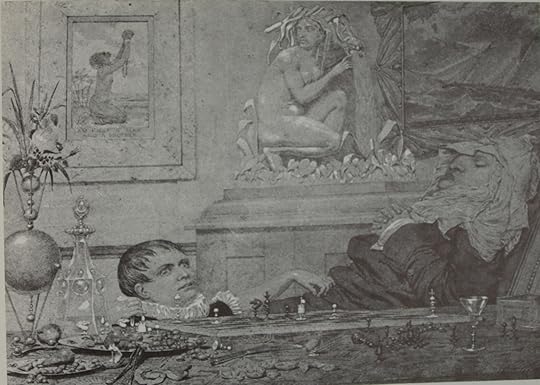
Tartarus Press has published several of his short story collections, and they're available on Kindle as well. I'll be reading all of them, with gusto. I'm not a very good writer of reviews, especially when I'm this enthusiastic about something, so I'll just leave you with the picture by Richard Dadd that was the inspiration for one of my favorite stories, A Child's Problem. Look at that and tell me you don't need to read this story IMMEDIATELY.

January 8, 2021
I am a sucker for Requiems: Cherubini, Mozart, Dvorak, Fauré, Verdi, Britten, Penderecki and now (and then) Süssmayr’s own. This is what I mean by a Reggie Oliver classic story, one that it is a privilege to read and I am personally pleased to imagine the massed and marshalled audience of this book applauding as it comes to the close of its visionary pattern on the stiff, luxurious paper of the page. It tells of an Englishman who rents a room in Vienna under the room of a bereft Süssmayr who is in turn tainted with a Salieri type bitterness after helping a dying Mozart complete his own Requiem, and seemingly haunted by Mozart’s widow. The English protagonist is as Eric Fenby to Delius who by the end returns to the ‘stone music’ of the Morchester cathedral, which I imagine to be like Lichfield’s.
This story, for me, completes the book’s earlier astrological chart (in ‘Lord of the Fleas’) but inspirationally of death as well as of birth, the precise Epochal moment of each of these two events by charting between them a changing river of astrologically literary harmonics to represent the pattern of the Requiem, a Jungian synchronicity, transcribing a chart-intrinsic series of Blakean passages (not purple so much as golden) fluted through with that ‘riparian spate’, that idea of a river never being the same river twice, borne along by the oxymorons of humanity, philosophy, science, religion etc that were first adumbrated by ‘Singing Blood’. And riven by the spirit and music of Mann’s Magic Mountain.
A story that needs to be read and read and read till it gives up all its secrets. Never be impatient with literary works like this one!
The detailed review of this book posted elsewhere under my name is too long to post here.
Above is one of its observations.
CAVEAT: I originally published the title story of this collection.
This story, for me, completes the book’s earlier astrological chart (in ‘Lord of the Fleas’) but inspirationally of death as well as of birth, the precise Epochal moment of each of these two events by charting between them a changing river of astrologically literary harmonics to represent the pattern of the Requiem, a Jungian synchronicity, transcribing a chart-intrinsic series of Blakean passages (not purple so much as golden) fluted through with that ‘riparian spate’, that idea of a river never being the same river twice, borne along by the oxymorons of humanity, philosophy, science, religion etc that were first adumbrated by ‘Singing Blood’. And riven by the spirit and music of Mann’s Magic Mountain.
A story that needs to be read and read and read till it gives up all its secrets. Never be impatient with literary works like this one!
The detailed review of this book posted elsewhere under my name is too long to post here.
Above is one of its observations.
CAVEAT: I originally published the title story of this collection.

November 14, 2013
✭✭✭½
“A Child's Problem” (2011) ✭✭✭
“Striding Edge” (2011) ✭✭✭✭
“Hand to Mouth” (2011) ✭✭✭✭
“Singing Blood” (2011) ✭✭✭
“Flowers of the Sea” (2011) ✭✭✭✭½
“Lord of the Fleas” (2012) ✭✭✭½
“Didman’s Corner” (2012) ✭✭✭✭½
“The Posthumous Messiah” (2012) ✭✭✭
“Charm” (2012) ✭✭✭✭
“Between Four Yews” (2012) ✭✭✭✭
“The Spooks of Shellborough” (2012) ✭✭✭✭
“Süssmayr's Requiem” (2013) ✭✭½
“Come into My Parlour” (2013) ✭✭✭✭½
“Lightning” (2013) ✭✭✭
“Waving to the Boats” (2013) ✭✭✭✭
“A Child's Problem” (2011) ✭✭✭
“Striding Edge” (2011) ✭✭✭✭
“Hand to Mouth” (2011) ✭✭✭✭
“Singing Blood” (2011) ✭✭✭
“Flowers of the Sea” (2011) ✭✭✭✭½
“Lord of the Fleas” (2012) ✭✭✭½
“Didman’s Corner” (2012) ✭✭✭✭½
“The Posthumous Messiah” (2012) ✭✭✭
“Charm” (2012) ✭✭✭✭
“Between Four Yews” (2012) ✭✭✭✭
“The Spooks of Shellborough” (2012) ✭✭✭✭
“Süssmayr's Requiem” (2013) ✭✭½
“Come into My Parlour” (2013) ✭✭✭✭½
“Lightning” (2013) ✭✭✭
“Waving to the Boats” (2013) ✭✭✭✭

August 18, 2020
Flowers of the Sea is a wonderfully subdued, elegiac collection from Reggie Oliver. The stories here are quiet and Aickman-esque with a classical quality that reminds one of turn of the century ghost stories.
Oliver's prose is clean and vibrant and his ability to quickly build characters out of thin air is enviable. Even when it seems like nothing is happening, it's the vividness of his actors that make for an engaging read. I could imagine Flowers of the Sea pairing well with a rainy day and a suitably lethargic mood.
Oliver's stories are like quicksand, in that you just can't help but sink into them.
Oliver's prose is clean and vibrant and his ability to quickly build characters out of thin air is enviable. Even when it seems like nothing is happening, it's the vividness of his actors that make for an engaging read. I could imagine Flowers of the Sea pairing well with a rainy day and a suitably lethargic mood.
Oliver's stories are like quicksand, in that you just can't help but sink into them.
August 11, 2014
I'd not read any Reggie Oliver before, and after this I will be reading more of him. I'm predisposed to enjoy mystery/dark tales/arcana, and though I am not well read in the genre, 'Flowers of the Sea' fits what I had expected.
Oliver's strength for me was his ability to fit the tradition of the contemporary narrator into the 20th and 21st centuries without losing the occasional excursion into a more distant past. His style is modern and easily accessible: the potentially tiresome periodic sentence is rare, but the well turned phrase is not, and he delights in the use of an unusual word, often architectural, without its being out of character with the narrative voice. Some of the stories sent me scurrying to see if some of the obscure bookish references were genuine: I liked the photocopy of the Greek Lexicon illustrating the origin of Dr Johnson's alleged imprecation against fleas - 'oak, oak' - for example. This technique certainly helps establish the credibility of the narrator.
My only quibble is that, also in the tradition of the genre, for me some stories ended unsatisfactorily suggesting either indecision about how to conclude or not providing quite enough information to allow me to fathom how the preceding events might have come about. So why, given this kind of misgiving about the genre, do I continue to read in it? - because the bulk of the pleasure is in the telling of and the gradual unfolding of the mystery, in the style and in the anticipation of a shudder or two.
A very enjoyable collection.
Oliver's strength for me was his ability to fit the tradition of the contemporary narrator into the 20th and 21st centuries without losing the occasional excursion into a more distant past. His style is modern and easily accessible: the potentially tiresome periodic sentence is rare, but the well turned phrase is not, and he delights in the use of an unusual word, often architectural, without its being out of character with the narrative voice. Some of the stories sent me scurrying to see if some of the obscure bookish references were genuine: I liked the photocopy of the Greek Lexicon illustrating the origin of Dr Johnson's alleged imprecation against fleas - 'oak, oak' - for example. This technique certainly helps establish the credibility of the narrator.
My only quibble is that, also in the tradition of the genre, for me some stories ended unsatisfactorily suggesting either indecision about how to conclude or not providing quite enough information to allow me to fathom how the preceding events might have come about. So why, given this kind of misgiving about the genre, do I continue to read in it? - because the bulk of the pleasure is in the telling of and the gradual unfolding of the mystery, in the style and in the anticipation of a shudder or two.
A very enjoyable collection.

January 26, 2014
If I weren't so insanely busy these days I'd give this more of the review that it deserves, because this guy is awesome. I kept getting weirded out every time something modern was mentioned, like email or mobile phones, because the writing style here is purely old school Poe/M.R. James, with a little splash of bloody gore thrown in here and there. Overall, this guy focuses on atmosphere, I think, but I wouldn't put it in that annoying "quiet" horror category that irks the shit out of me. No way, this dude is still full on.
What really freaks me out is apparently he's primarily and actor, I think, and into the theatre most of all. It just seems like talent overkill for him to also be so good at horror literature. I'm sure to be reading everything this guy does.
What really freaks me out is apparently he's primarily and actor, I think, and into the theatre most of all. It just seems like talent overkill for him to also be so good at horror literature. I'm sure to be reading everything this guy does.

May 23, 2019
This is my first Reggie Oliver book and the second book from Tartarus Press that i own. I am about to start reading the 4th story "Didman's Corner" ( not in order of appearance ) and i'm in love with both this collection and this author. I knew he was good, i didn't know he was this good. Saturday first thing in the morning, i'll go to the Tartarus page and i'll order everything available by Reggie Oliver. All in.

August 14, 2016
Definitely feels similar to M R James, though still different enough.
Displaying 1 - 21 of 21 reviews