Strange things begin to happen the minute young Kay Harker boards the train to go home for Christmas and finds himself under observation by two very shifty-looking characters. Arriving at his destination, the boy is immediately accosted by a bright-eyed old man with a mysterious message: “The wolves are running.” Soon danger is everywhere, as a gang of criminals headed by the notorious wizard Abner Brown and his witch wife Sylvia Daisy Pouncer gets to work. What does Abner Brown want? The magic box that the old man has entrusted to Kay, which allows him to travel freely not only in space but in time, too. The gang will stop at nothing to carry out their plan, even kidnapping Kay’s friend, the tough little Maria Jones, and threatening to cancel Christmas celebrations altogether. But with the help of his allies, including an intrepid mouse, a squadron of Roman soldiers, the legendary Herne the Hunter, and the inventor of the Box of Delights himself, Kay just may be able rescue his friend, foil Abner Brown’s plot, and save Christmas, too.
At once a thriller, a romp, and a spellbinding fantasy, The Box of Delights is a great English children’s book and a perfect Christmas treat.
Masefield was born in Ledbury, a rural area in England to George Masefield, a solicitor and Caroline. His mother died giving birth to his sister when Masefield was only 6 and he went to live with his aunt. His father died soon after. After an unhappy education at the King's School in Warwick (now known as Warwick School), where he was a boarder between 1888 and 1891, he left to board the HMS Conway, both to train for a life at sea, and to break his addiction to reading, of which his Aunt thought little. He spent several years aboard this ship and found that he could spend much of his time reading and writing. It was aboard the Conway that Masefield’s love for story-telling grew.
In 1894, Masefield boarded the Gilcruix, destined for Chile. He recorded his experiences while sailing through the extreme weather. Upon reaching Chile, Masefield suffered from sunstroke and was hospitalized. He eventually returned home to England as a passenger aboard a steam ship.
In 1895, Masefield returned to sea on a windjammer destined for New York City. However, the urge to become a writer and the hopelessness of life as a sailor overtook him, and in New York, he deserted ship. He lived as a vagrant for several months, before returning to New York City, where he was able to find work as an assistant to a bar keeper.
For the next two years, Masefield was employed in a carpet factory, where long hours were expected and conditions were far from ideal. He purchased up to 20 books a week, and devoured both modern and classical literature. His interests at this time were diverse and his reading included works by Trilby, Dumas, Thomas Browne, Hazlitt, Dickens, Kipling, and R. L. Stevenson. Chaucer also became very important to him during this time, as well as poetry by Keats and Shelley.
When Masefield was 23, he met his future wife, Constance Crommelin, who was 35. Educated in classics and English Literature, and a mathematics teacher, Constance was a perfect match for Masefield despite the difference in age. The couple had two children (Judith, born in 1904, and Lewis, in 1910).
In 1930, due to the death of Robert Bridges, a new Poet Laureate was needed. King George V appointed Masefield, who remained in office until his death in 1967. Masefield took his appointment seriously and produced a large quantity of verse. Poems composed in his official capacity were sent to The Times. Masefield’s humility was shown by his inclusion of a stamped envelope with each submission so that his composition could be returned if it were found unacceptable for publication.
On 12 May 1967, John Masefield died, after having suffered through a spread of gangrene up his leg. According to his wishes, he was cremated and his ashes placed in Poets’ Corner in Westminster Abbey. Later, the following verse was discovered, written by Masefield, addressed to his ‘Heirs, Administrators, and Assigns’:
Let no religious rite be done or read In any place for me when I am dead, But burn my body into ash, and scatter The ash in secret into running water, Or on the windy down, and let none see; And then thank God that there’s an end of me.
Today in What the Hell Did I Just Read? we bring you . . . this book.
Highly recommended, considered a classic, a "Christmas story for the ages," according to sources I used to trust. And beautifully reprinted by the NYPL with the original illustrations, this bookworm's crack. How, how, HOW could I go wrong in reading this to my kids the week following Christmas?
Well, for starters, I had to stop every page and explain what the heck was going on. Aside from the old fashioned language and British terms, there are also references to the Roman occupation of Britain, the Bronze Age, King Arthur and various of his knights, classic Punch and Judy shows, Herne the Hunter, Anglican church administrative procedure, great alchemists of the past, Alexander the Great, and the fall of Troy. All things that the modern child is just so totally familiar with, that there is no need for any sort of explanation! Our young hero Kay would wake up to find himself helping people with flint spears defend themselves against wild animals, being kidnapped from the last hours of Troy by 18th century pirates, or traveling through a magic wood with the Wild Hunt, all using excessively poetic language, thus leading me to have to stop and explain parts of Roman fortifications, geographic formations, and pre-steel weaponry.
Further confusion arose from the fact that this is apparently the second book about Kay and Co., and so the big reveal of the villain left us baffled, as did references to their previous adventure. Young Maria Jones, Kay's friend who is about ten years old, is armed with actual pistols that she took from the villains in the previous book. Yes, that's right, there is an armed child who is considered "spunky" for literally threatening to shoot everyone who irritates her. She's kidnapped, by the way, and they all just sort of go, well, what a pity she didn't have her pistols with her, but I'm sure she'll be fine. Various other people are kidnapped, with the same lack of reaction from almost everyone.
Then there's Kay. People offer Kay money, mysterious and fabulous gifts, opportunities to time travel and experience magical events, and speak of him and to him as though he is the King of England. No reason is given for this. He does not appear to be nobility, particularly smart, or particularly good looking. He lives in a manor house, has an endless supply of funds, and his only guardian is "the beautiful Caroline Louisa." Where are his parents? Who is Caroline Louisa? At first I thought she was his sister, but she's more like a nanny, I guess. He's apparently so wonderful that all he needs in the way of guardianship is a beautiful young woman to cater to his every whim.
Basically, the entire book was bizarre. I feel like the author just sort of chucked a bunch of ideas and scenes onto the page and decided to run with it whether they made sense of not. Many of the scenes are funny, or dramatic, and quite fascinating, but then they'll just end, or segue into a completely different scene. Many of the scenes are simply baffling. (For instance, there's an extended sequence when, trying to hide from some villains, Kay and his friends shrink themselves down and hide in a mouse hole, which is cool and makes sense. But most of the chapter involves the mouse giving them a detailed tour of his hollow tree and its various rooms, like some sort of overeager realtor. When the tour is done, the bad guys are gone, and they walk home without incident.) I suspect that at one point Masefield's editor just said, "I can't figure out if this is an actual rat who talks, or a man named Rat, so screw it." Then he went to lunch and never came back.
My kids and I were eager to finish, not because they cared at all about the ending, but because they wanted it to be over with. My daughter (age 8) was also convinced that the epilogue would tie it all together and it would suddenly make sense. When we got to the final line, she yelled out, "Are you kidding me?"
John Masefield, poet laureate of the U.K. from 1930 till his death in 1967, is perhaps best known for his poem “Sea Fever” (“I must go down to the seas again, to the lonely sea and the sky”). He was also, however, one of the finest and most influential writers of children’s books. I first read The Box of Delights in Kenya, when I was about ten. When I went to the States for college, I was horrified to find that no one had heard of it, and that the only available edition had been butchered by an abridger (who had somehow managed to trim out all the most marvelous and magical parts). Happily, New York Review Books recently came out with unabridged versions of both The Box of Delights and its precursor, The Midnight Folk. It now seems to be finding some sort of readership in the U.S.
The Box of Delights was first published in 1935, and achieved immediate success in Britain, where it is viewed with the same reverence as A Christmas Carol. It follows the adventures of Kay, who meets Cole Hawlings, a traveling Punch and Judy man, at a train station. Hawlings has a magical box, which is coveted by a gang of criminals disguised as clergy. Knowing he’ll soon be “scrobbled” by the gang, Hawling gives the box to Kay, who gets into adventures.
Among the supporting cast of characters, Maria, Kay’s gun-toting cousin, stands out (“I shall shoot and I shall shock, as long as my name’s Maria”), as does Sylvia Daisy Pouncer, Kay’s former governess. The novel is delightfully illustrated by Masefield.
Three years after The Box of Delights came out, T.H. White published The Sword in the Stone, which was to become the foundation of The Once and Future King. Certain sections of White’s book owe much to Masefield’s, including the parts where the Wart turns into various animals. In 1948, C.S. Lewis published the first of the Narnia books. Lewis revered The Box of Delights – “The beauties, all the ‘delights’ that keep on emerging from the box – are so exquisite, and quite unlike anything I have seen elsewhere” – and The Lion, the Witch and the Wardrobe, in particular, has a similar feel: snow, wolves, magic, Christmas. Two of the children are even named Peter and Susan. Several sections of The Magician’s Nephew are also indebted to The Box of Delights. But the book that pays the most overt homage is probably Susan Cooper’s The Dark Is Rising. The Christmas theme, a boy meeting strange people with bright eyes who wear unusual rings, and the scenes with Herne the Hunter are all heavily inspired by the earlier novel.
If the novels by White, Lewis, and Cooper had come out today, there would probably be a media furor and lawsuits once people realized the similarities with The Box of Delights. So the book is also a lovely reminder of a more innocent time, when writers were free to be inspired, and free to purloin scenes and characters and turn them to their own uses, in trying to recreate a bit of magic.
'Tis the night before Christmas and the wolves are running!
'Tis the night before Christmas and the children have been stolen!
'Tis the night before Christmas and the guardian has been stolen!
'Tis the night before Christmas and the clergy have all been stolen too!
'Tis the night before Christmas and Herne the Hunter and the Lady of the Ring and the King & Queen of Fairies will all come a'calling!
'Tis the night before Christmas and little Kay shall become as small and as fast as a bird! and he shall encounter wolves & wizards & witches & thieves! and he shall visit strange places and he shall enter the past and he shall protect his precious Box of Delights and he shall visit a friendly mouse! and he will deal with all of this with a certain nonchalance because it's not like he hasn't done this sort of thing before!
'Tis the night before Christmas and the author is having an adventure too, with language and history and legends and dreamscapes and so much more, and all of this done with a certain nonchalance because it's not like he hasn't done this sort of thing before!
'Twas the night before Christmas, and all through the house All the creatures were stirring, including a mouse. Would the villains be hung by their necks in their lair? So hoped little Kay, with a bloodthirsty glare. The children weren't nestled nor snug in their beds; Their visions of vengeance danced in their heads. And I heard them exclaim as they ran through the night: "Happy Christmas to all who change wrong into right!"
We love this book and would rate it one of the best childrens books of all time. Written in beautiful and poetic language it evokes a magic rarely found. I feel the first seven chapters are excellent, after this there are some bits that feel a slog and there are some discussions between Abner and his staff that go on to the extent that now we have read it so many times I leave some bits out. Obviously a publisher these days would also point out that the ending should be changed ! This aside there are some chapters that really stand out. The scene were Cole escapes through a painting and the description of the amazing christmas party are wonderful and could be read independently from the story. We love the 1930s language and how Kay comes back from school for the holidays having picked up some awful slang such as asking his guardian to lend him some tin as he doesn't have a tosser to his kick ! Interesting that given it was written in the 30s the author describes a plane that could take of vertically and we wonder what parallels the author might draw if he were alive today, between the box of delights and a modern machine such as a tablet or 3DS ! We have a 1968 edition not pictured on goodreads, that has a beautiful cover in a very 60s style in dusky pink, yellow and olive green,unfortunately this last read was too much for the book and the cover fell off, but we have framed it in honour of this book ! Lovely to escape to a more magical time, the perfect Christmas read.
A wonderful book. What a vivid imagination. The text is a little bit dated in places, but still a very enjoyable read. The BBC adaptation of the book is very faithful to what the author set down, and well worth watching, if you ever get the opportunity. (It features a very young-looking James Grout (Superintendent Strange from the Inspector Morse television series).
The Box of Delights (1935) by John Masefield is a miracle and a masterpiece of magical literature. I admit to getting lost in the narrative. I was completely absorbed in Kay Harker’s adventures. The actual box of delights allows the holder to travel quick or small or both – the depiction of magical and enchanted journeys held me enthralled. We encounter Herne the Hunter, the Lady of the Oak Tree, lions, unicorns and talking animals. There are kidnappings, chases, robberies and great escapes. I set the book aside reluctantly and came back to it with great anticipation. The evil Abner Brown and his henchmen were indeed creepy and sinister – really quite scary. The final chapter had me in tears – I just wanted to be there literally experiencing the joy and wonder. Now I must read The Midnight Folk by the same author.
That phrase was the best part of this book for me. It stated immediate evil and drew me in, plus it kept me going when nothing else made sense. This John Masefield tale is a Christmas favourite for many and seems to have influenced the Narnia saga. I would also dare to say that it has some elements that may have influenced the Harry Potter stories as well such as the young hero, railway stations, snow-filled villages, hot drinks, and magic.
Alas, when it was first read to me as a child in an Aussie school, I just didn't get it. But then, I didn't like listening to the C.S. Lewis stories either, so maybe I was one of those Wolves. To give Mr. Masefield the full benefit of the doubt, I purchased the nicely bound New York Review edition, hoping for more illumination. But, while I gained a little bit more appreciation, I remain under-whelmed by it all.
Young Kay still drove me crazy and I never knew when he was speaking to others or muttering to himself. This edition thankfully explains some of those issues by explaining that Masefield's original manuscript had never been corrected until now, which explains my original childhood bias. Long story short, the first publication of this book left several passages out, which the NYR edition fixes.
Time and Tide and Buttered Eggs wait for no man.
Summation of my personal view:
STARFALL - Loss of one star for driving me crazy (how did Peter suddenly appear at the end), lack of structure, and the sudden ending.
STAR-RISE - Addition of one star for imagination (just as a child would think), pagan memories, and untouched slang of the 1930s.
It's that time of year when John Masefield makes an appearance for me.
The Box of Delights reminds me of being little and watching the 80's BBC production on TV in fascination. I absolutely loved the series and remember knowing it was near Christmas when it was on.
I splashed out for the Folio Society version of this book some years ago as it is beautifully bound and illustrated. I try to read it each year just before Christmas.
Every time I read I discover something new about the writing. This time I realised how grown up the book is for a children's book. Some of the historical background is quite complicated for children. Conversely, I love the imagination within the story, the conjuring of ethereal "other" worlds where we can speak to animals, shrink to tiny proportions and fly through time and space. It is my kind of magical.
I love the use of old words that have fallen out of favour, words like scrobbled (kidnapped/bungled), scraunched (crunched/crushed/ground like gravel noisily) and fantod (a state or attack of uneasiness, gives me the fantods!)
Honestly this book takes me right back to being a little girl, lying on my stomach in the living room with my mum behind me in her special "mum chair", watching The Box of Delights and looking forward to Christmas. Any book that is able to evoke such a strong, potent and happy memory deserves all the stars, particularly when you're late 40's and you lost your mum just on a year ago.
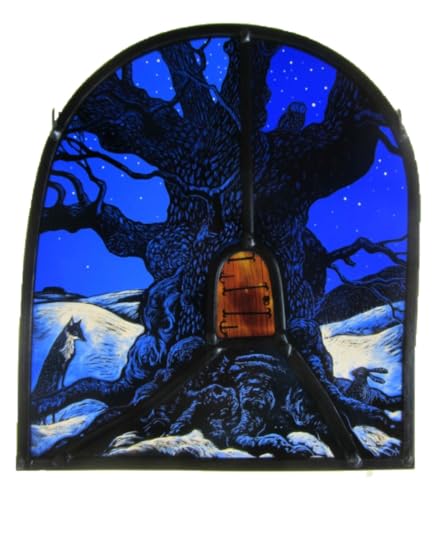
Poet John Masefield's 1935 British Empire-era fantasy finds twelve-year-old Kay Harker home from his boarding school just in time to help a magical old Punch and Judy showman. At least, that seems to be what happens. The plot's pretty convoluted. But the images Masefield conjures up are gorgeous. UK stained glass artist Tamsin Abbott's gorgeous panel of Masefield's She-Oak Tree
Adventures include getting tiny to tour a mouse tribe's amazing multi-level tree home, riding magical horses, and dodging sinister silent airplanes. Guest appearances by strong-minded girl cousins, Herne the Hunter, cathedral bell-ringers, and Reverend Stalwart, a former heavyweight boxer.
Eleven-year-old me would have been enchanted with all the period detail & would have giddily given it four stars. Old-old me says, eh, it's a three.
p.s. This is book 2 of Masefield's decent-chap rich-orphan Kay Harker two-volume series. I skipped book 1 because it was too Lemony Snickety for me. YMMV.
Sample quote: "In the busy market-place there were open-air booths selling all manner of matters for Christmas; chiefly woollen mufflers, nailed boots, cloth caps, hedger’s gloves and the twenty-eight-pound cheeses, known as Tatchester Double Stones."
Imagine a child whose parents have separately died in tragic circumstances; a child who up to the age of ten is home-schooled, living with guardians who limit his reading so that he largely has recourse to just his own imagination; a child who has returned from his first term among strangers at boarding school, able to retreat back into that fantasy world of his own making.
Then imagine that child several decades later, successful in what he really wanted to do -- to use his imagination in creative ways -- looking back to that childhood. How would he recapture that wonder, the sense of play and the closet anxieties without turning his writing into autobiography?
Perhaps the way forward for John Masefield -- given the accolade of Poet Laureate in 1930 -- was to turn his past history on its head and make the dreamworld he'd conjured up more real than reality. This he appeared to have done in 1927 with The Midnight Folk, and this too is what he may have also done in 1935 with The Box of Delights.
Kay Harker, Masefield's alter ego, has no siblings (unlike his creator) but does have playmates in the shape of the four Jones children, particularly the stolid Peter and Peter's more rumbustious sister Maria. In place of of the pompous male guardian and sinister governess of The Midnight Folk Kay now has the sympathetic Caroline Louisa, a mother figure who bears the same name as Masefield's own mother and who will suddenly disappear, as the author's own mother did (though for Kay it won't be as permanent).
But before all this comes about, Kay is to meet several strangers, starting with rather dubious clergymen on a train, then a travelling Punch & Judy man, a shape-shifting horseman, a mysterious woman, and bloodthirsty pirates. And he will also re-encounter some old foes in the form of the sinister magician Abner Brown, the witch who was his governess Miss Pouncer, and the untrustworthy Rat.
The Box of Delights is too rich and complex a tale to summarise adequately, for it works at several different levels. Superficially it is a fantasy, with magic manifested in a painted landscape one can enter, a hillfort and Roman camp, flying cars, supernatural familiars and, of course, the Box of the book's title, which allows the possessor to both 'go swift' and 'go small'. With this small container, and the book within it, Kay becomes the hero of his own adventure -- a spy, a sorcerer's apprentice, a rescuer of kidnapped individuals, and a sea captain saving a marooned man.
On a deeper level there is manifested Masefield's poetic sensibility, his love of nature, his awareness of the numinosity of old places. And below all that there is an understanding of a solitary child's psychology, how deep loss may be masked by irrepressible curiosity and imaginative play, how fears may be signified and addressed by means of symbolism.
Add to all this the expectations aroused by the season: small wonder then that all the nostalgia of Christmas decorations, toys, lights, the comfort of church services, bells and carols and so on may be threatened by bitter cold and those of evil intent, all encapsulated by the chilling phrase 'The Wolves are Running.'
Is the magic real or is just a dream? Or is reality what we think we've perceived or experienced? Masefield's novel allows one to suspend disbelief by taking us back to a time when, seemingly powerless in an irrational adult world, we children were only able to effect change for the better in the safety of our imaginations.
Kay is able to retire behind the valance surrounding the table in his room. In a world gone mad it is tempting to find shelter and comfort, if not behind a curtain, then at least in a book like this.
It seems that many other reviewers had not read 'The Midnight Folk' first, yet jumped into this, its sequel. They seemed confused, and seem to think that it is because they are reading a sequel.
I can tell you it is not because you are reading a sequel (Midnight Folk has virtually no back story on this, except a recycled villain.), but simply because the book is quite confusing.
There is SO much in this book that I'm surprised editors didn't catch and go, 'hang on a minute...', etc.
Sometimes something is mentioned, such as a window being open, and in the next sentence we'll be told again that, yes, the window is indeed open. Also, it will talk about a character standing up, and I'll search the last few pages trying to find when it was they actually sat down! ...and they'll be no mention. Annoying things like that. Things they could have easily fixed with some proper editing.
I do like that Abner Brown was brought up again, however. He's a good villain, not like the watered down versions, he's the real thing. He's not afraid, and in fact enjoys, dispersing with human life (including children), yet is disillusioned and thinks that some of what he does may come to the good use of humanity. The scene in the vault where he monologues is probably one of my favourites in the book. I thought it well-thought out on the authour's part. Also, his use of black magic gave me chills just as much, if not more, as C.S.Lewis' Narnia writings of it did.
It's a charming book, but one I probably won't be reading again.
The characters only spoke when it was necessary for them to move the disjointed plot along (although, one could argue that this was because of the ending), yet it seems Masefield had fun with word play, making the Police Captain and Maria go on longer than needed just for fun.
It got my imagination going, and that's why I loved 'Midnight Folk', but it was a bit disappointing... thus the three stars.
Not the easiest book to get through. It's over 300 pages and the chapters (only 12) are very long. The transitions within the chapters are often blurred, making it harder to grasp what is going on where and when. Were this published today, I think separating the action into shorter chapters would have been done. Some bits are a little too convenient - deus ex machina.
This is a curious mixture of reality and fantasy: we have gangsters, magic, time travel. At times it was difficult to know just what was imagery and what was fantasy. It was interesting that, unlike in a lot of books, here we get children operating both on their own and with adults. I enjoyed the old-style British reality, such as the interactions with the police. I also liked the integration of religion into the essence of the book.
Many of the characters seem underdeveloped. It seems that only Kay, Cole, and Abner get enough. Jemima, Peter, and Susan are nearly superfluous. However, I dearly love Maria Jones, who is quite unusual for the time - she seems several decades ahead of most children's fiction: "I shall shoot and I shall shock as long as my name's Maria." I wish she had more time. I hadn't read The Midnight Folk, but that didn't seem to hinder anything in understanding what's happening. I think I will, though.
I only managed to get halfway through this one and found it to be okay but not something I'd recommend for today's children who would probably find it excruciatingly boring. It's a slow read, which is not a bad thing, but I am not finding the characters captivating (or even passably interesting, come to think of it). There is a set pattern to the plotting, as well, that is picked up early on and becomes very dull after so many repeats. To grasp the story at all, it is necessary to have a rather deep knowledge of English history and folklore, which most children nowadays do not possess, and so would feel utterly confused. They could, I suppose, hold the book in one hand and Google furiously with the other, but that is tedious.
I might finish it next Christmastime but in the high heat of Australian summer, I am feeling especially disconnected from the deep snows of the English countryside in its 1930s' holiday splendour and I don't really care what happens to Kay and his lot.
3.5; the shifts in tone are somewhat jarring (the book starts off as a light fantasy precursor to the likes of The Dark is Rising series, The Wolves of Willoughby Close, and John Gordon's Giant Under the Snow and sporadically digresses into a Wind in the Willows/Alice in Wonderland-type mode), and contemporary readers might find the antiquated 'I Say Jolly Good gung-ho' tone crossing over from whimsy into insufferable tweeness at times, but despite all that Masefield possesses a seemingly effortlessly ability in conjuring up a genuine sense of the numinous and otherworldly, and it is for that reason he is worth seeking out.
Although there are beautiful magical scenes in this sequel to The Midnight Folk, and I continue to be a big fan of John Masefield, I felt it was less tightly edited than its predecessor, and confess to feeling a bit frustrated at times by what felt like long tangential diversions from the plot.
Have to agree with another reviewer though that Maria is a wonderful character. What a shame Mr Masefield didn't give her a book of her own!
It happens a lot doesn't it - that second read which brings far more to the table than that first encounter; in consequence it is upped from 3* to 4*. Very Taliesin, mythologically speaking, wouldn't you say?
I don’t know how I feel about this one, and it may be too soon to tell, as I literally just finished it. Started this as a Christmas Read-Aloud with my kids - I thought it had so much potential - and they DNF’d it. To them it was confusing, and they couldn’t tell what was real and what was not. It seemed like characters went from A to C without telling how they got there or what happened to B. And because they couldn’t tell where it was going and get that invested in the characters, they just weren’t interested. Plus the chapters were long and it didn’t seem Christmas-y at all. So I finished it myself - and did finally find it sort of coming together and making more sense, and even get a little more interesting. And the final 3 pages or so did have some strong Christmas vibes. But I shouldn’t have to get two-thirds of the way through a book to get to the point where I care. Maybe if I’d’ve known in the beginning that it was all a dream, I could’ve sold it to the kids that way - because it sure sounded a lot like the crazy, rambling dreams they sometimes describe to me.
This entire review has been hidden because of spoilers.
"Strange things begin to happen the minute young Kay Harker boards the train to go home for Christmas and finds himself under observation by two very shifty-looking characters. Arriving at his destination, the boy is immediately accosted by a bright-eyed old man with a mysterious message: “The wolves are running.” Soon danger is everywhere, as a gang of criminals headed by the notorious wizard Abner Brown and his witch wife Sylvia Daisy Pouncer gets to work. What does Abner Brown want? The magic box that the old man has entrusted to Kay, which allows him to travel freely not only in space but in time, too. The gang will stop at nothing to carry out their plan, even kidnapping Kay’s friend, the tough little Maria Jones, and threatening to cancel Christmas celebrations altogether. But with the help of his allies, including an intrepid mouse, a squadron of Roman soldiers, the legendary Herne the Hunter, and the inventor of the Box of Delights himself, Kay just may be able rescue his friend, foil Abner Brown’s plot, and save Christmas, too."
From Wikipedia: "The Box of Delights is a children's fantasy novel by John Masefield. It is a sequel to The Midnight Folk, and was first published in 1935. The central character is Kay Harker who, on returning from boarding school, finds himself mixed up in a battle to possess a magical box, which allows the owner to go small (shrink) and go swift (fly), experience magical wonders contained within the box and go into the past.
The owner of the box is an old Punch and Judy man called Cole Hawlins, whom Kay meets on a railway station. They have an instant rapport, and this leads Cole to confide that he is being chased by a man called Abner Brown and his gang. For safety, Cole entrusts the box to Kay, who then goes on to have many adventures."
Other reviews: “The book that always had the magic of a snowy English Christmas…. It’s still a lovely book, magical and funny, to be read by anybody of any age.” —The Horn Book
"This classic of English children's literature, sadly overlooked by most on this side of the Atlantic, has just been reissued in a beautiful edition by the New York Review Children's Collection...Although The Box of Delights was first published in 1935, Masefield's intoxicating prose has lost none of its pull...in this wonderful tale of bravery and intrigue that deserves to become another staple of the holidays." --The San Francisco Chronicle
"This uniquely imaginative tale would be a delight for fans of old-fashioned, English Literature and could be compared to the likes of A Christmas Carol and the Lion the Witch and the Wardrobe." --CLEAR Reviews
“Masefield's novel, a plum pudding of strange adventures, English legend, and spiritual feeling, should be more widely appreciated” –The Washington Post
“This book is a writer’s oft-raided treasure trove…the world’s best ‘crossover book’…It does time-travel better than Narnia…The story floats on brilliant, eccentric dialogue and…never loses its snowy-Christmas, Nutcracker enchantment…” –The Independent (UK)
Normally I don't look at reviews when I'm reviewing a book. But in this case, I knew that this book is considered a classic of chilren's literature and is also cherished by grown ups. I do like children's literature! I'm passionately in love with Arthur Ransome's Swallows & Amazons series, I absolutely adore Wind in the Willows and reread it or watch any of the movies every time I get the chance to, I cut my teeth on Thornton Burgess' Mother West Wind series, etc.
But I just couldn't get into this book. Perhaps because I haven't read The Midnight Folk, thus coming in mid-story, as it were. But the plot seemed convoluted and disjointed, the characters seemed stilted, and the battle of good vs. evil (the staple of every really good children's books) seemed confused -- I never could sort out why the Wolves wanted to win or what they thought they might gain by winning.
I'm disappointed - I'd hoped to add another delicious children's tale to my collection of treasures.
At the train station on his way home from school for the Christmas holiday, Kay Harker, the main character of The Box of Delights, encounters a mysterious Punch and Judy man named Cole Hawlings. The two hit if off so well that when Hawlings needs someone to hide and guard his box of delights he entrusts it to Kay. As Kay enjoys the powers given to him by the box - to move swiftly, to shrink, to travel through time - he also becomes aware of a strange series of disappearances around town. Not only have several local clergyman been "scrobbled" but some of Kay's houseguests, Kay's guardian Caroline Louisa, and Cole Hawlings himself have gone missing as well. Kay realizes all of these kidnappings must be attempts to gain access to the box of delights and in trying to protect it, he has a variety of thrilling adventures.
I had a difficult time reading this book. While I could appreciate the appeal of its atmospheric setting, fanciful use of magic, and adventurous spirit, I spent much of the story feeling like I had no idea what was going on. I found it confusing that the characters never seemed surprised by anything that happened to them, and that they took in stride everything from shrinking to the size of a rodent to witnessing kidnappings. I was also frustrated by the lack of character development. There are quite a few characters, but very little in the way of details about personalities, looks, or interests. It is always hard for me to get into fantasy novels, but it is especially hard without a strong character to latch onto, and I didn't really find Kay to be that strong, well-developed protagonist. I also didn't like that the magic of the box of delights didn't have very many limits and that magic often saved the day in a very deus ex machina kind of way.
Because I was reading them simultaneously, I couldn't resist making numerous comparisons between The Box of Delights and The Dark is Rising by Susan Cooper. In many ways, the books are similar, right down to the involvement of folk hero Herne the Hunter in both stories, and the midwinter setting. But I felt much more comfortable in the world of The Dark is Rising. Even when I didn't fully understand an allusion, I still knew exactly what was happening and how each event contributed to the overall story arc. There were times in The Box of Delights when I had to re-read passages to be sure I had even a vague sense of what was going on, and in general, it just felt very slow to me, even though lots of things were happening.
The Box of Delights is a sequel to a book I have not read, The Midnight Folk (1927), in which Kay Harker is apparently also the main character. There don't seem to be any direct references in the second book to the events of the first, but I do wonder if Kays's matter-of-factness in the face of supernatural happenings might have made more sense if I'd read the books in order. I'm not sure I personally enjoyed this book enough to want to read the first book any time soon, but I won't rule it out. I do think The Box of Delights is worth reading, however, even if I struggled to enjoy it, and I'll gladly have my girls read it during the Christmas season in some future year.
This is probably the 5th or 6th time I've read this through. I usually either read this or A Christmas Carol every year at Christmas. This is definitely the book that I love the most that the fewest other people have read, and it would definitely be on my desert island top 10.
Like all of my favorites, doing a review sort of takes away from it's aura, and really, if I did a real review, it would be really long and detailed, so I'll just keep it brief for now.
This all started with my sister and I watching the 1984 BBC mini-series version of this every year at Christmas, provided we could find it when it came on (remember those days?). It was beautiful and haunting, and now having read the book several times, I can say it does an incredible job of capturing the excellence of the book version. BBC folks in those days were really on to something (thinking also of the 4 Narnia series)--the music is wonderful, and judging by twitter, many others besides my sister and I are still charmed by this Christmas classic, even 35 years later.
Then, about 15 years ago or so, my sister found the book version for me and got it as a gift for me. This is still one of the best gifts I've ever received, because I didn't even know the book version existed. Thank you Colleen! Shame on me for not knowing, but I just never looked around.
Now, the book itself is a magical story about how a group of children, most notably protagonist Kay Harker, save the 1000th Christmas Eve service at the local cathedral from the clutches of the evil Abner Brown. There are many unforgettable and unique characters, the setting makes me want to go back in time to rural inter-war England, and the plot (with many a whimsical side-track) leaves you rooting for the good guys on every page.
But what I want to consider more is what this book has done for my own sense of aesthetics and what I most treasure in life. What I am often left wondering, and I think this is probably true for any of us about the things that we most love in life, is did I love these things so much before the Box of Delights, which made me love it so much, or did Box of Delights so entrance me that it taught me to love those things and transformed those things into my favorites? Or is it a little of both?
I'm referring to things like cathedrals, snow, British history, a blending of legend and history, and poetry. I think above all else, what I love about this book is how it blends the feel of Christmas with that lovely sense of never quite knowing whether what is happening is real or not. My wife can kind of find this maddening in a story--too dreamlike and magic without clear rules--and while I am certainly sympathetic to that, this book never takes itself too seriously; therefore, I think it is easier to just accept and fall in love with its whimsies.
John Masefield, thank you for writing this book. I am very much looking forward to sharing it with my children once they are old enough.
Bizarre and beautiful and brilliant. This was everything I was hoping to find in Joan Aiken's Wolves of Willoughby Chase but didn't. Come to find out Aiken was directly influenced by John Masefield's work. As was C.S. Lewis and many others. (I have to wonder if Elizabeth Goudge and Ian Fleming were among them).
This is far from a perfect book. It doesn't need to be. The demands a contemporary audience has with fantasy--a clear system to the magic, consistent plotting, psychologically realistic characters--aren't present here. But it's almost a relief to step away from those kind of tight, closed-in, well-explained novels. This thing is a like a wild beast or better a live flame to which other writers can bring the kindling of their own imagination to be rewarded by its light.
Much more fantastical, bordering on the bizarre, than I prefer to read, but I enjoyed both boat scenes and it was fun to read a book important to J's childhood.
3.5* I'd wanted to read this for a number of years - and finally got my hands on a copy, at just the right time, it seems - this is a perfect December read, lots of snow and carolers and such within!
(I do wish I had read Midnight Folk first.)
This was a funny read, funny as in there is more kinds of magic in this book than any other I've read - Masefield seems to have done a sort of tossed salad of time travel, talking animals, a box that gives special powers to it's bearer(powers that are unplumbed, it might do a lot more than what is mentioned) - which makes for a colorful jumble of a book. At times it seemed totally haphazard, but not in an unpleasant way. I suspect that it gets better and more beloved after a rereading, both for it's quirks and because one knows what to expect and can appreciate the details.
I wanted to like it more than I did, but at the same time, I found it quite unique and interesting and have to give Masefield credit for that. His characters are surprisingly unemotional, which I found amusing. And there was food for thought - I've always tried to have my 3 wishes ready in case a genie should jump out of a lamp - and this book made me think - what would I want to see if I could see anything I wanted? Kay was asked that remarkable question. So now I've got that to think about. I wouldn't mind seeing the path the whales take as they migrate...or, or...
Anyway! I will read Midnight Folk, and look forward to reading this to Squirt when he's old enough.
I vaguely remember this being on tv at Christmas far back in my youth so thought it would be a nice festive read... frankly though I was confused... I couldn't figure how old the characters were,why nobody seemed concerned when people went missing for days on end and why they weren't astonished by magic. admittedly this is a sequel...maybe all those points are addressed in first book.... a little catch up might have been nice. the idea of the magic box that goes swift and goes small and the menace of the pretend clerics could have been a better story...maybe it just hasn't stood the test of time.
I read this book most years at Christmas, it's something of a ritual. If I get the chance I watch the BBC adaptation as well. There is something so thrilling about the warning issued to Kay, the young hero: The wolves are running. Yet Kay is wonderfully matter-of-fact about his adventure, taking encounters with mysterious missionaries, scrobbled clergy, murderous pirates and Herne the Hunter in his stride. He's aided by visiting friends, including the intrepid Maria, but they do have a way of getting scrobbled themselves. It is a magical book, pure joy.
Whew! This is an action-packed story that kids who like adventure will enjoy. Danger, magic, talking animals, battles against evil, time travel, ... it's all here. Melodramatic. Quite a bit of history. And amazingly, the youthful characters take everything in stride, even nonchalantly.
All the British words and phrases (and even some made-up ones?) give the text a decided 'flavor.' ('Scrobbled' is used at least 100 times. And it doesn't refer to anything that has to do with the internet.)
What frustrated me while reading, made sense by the end.



 hedger's gloves were thick leather mittens