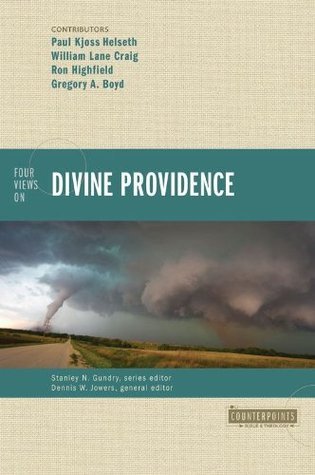
This book guides students, pastors, and lay learners to consider and evaluate various ways of understanding God's involvement in the world, especially in relation to views on predestination and the extent of the atonement. Four different scholars present their positions in point-counterpoint style, and the editor's introduction and conclusion frame the discussion.
William Lane Craig is Research Professor of Philosophy at Talbot School of Theology in La Mirada, California. He and his wife Jan have two grown children.
At the age of sixteen as a junior in high school, he first heard the message of the Christian gospel and yielded his life to Christ. Dr. Craig pursued his undergraduate studies at Wheaton College (B.A. 1971) and graduate studies at Trinity Evangelical Divinity School (M.A. 1974; M.A. 1975), the University of Birmingham (England) (Ph.D. 1977), and the University of Munich (Germany) (D.Theol. 1984). From 1980-86 he taught Philosophy of Religion at Trinity, during which time he and Jan started their family. In 1987 they moved to Brussels, Belgium, where Dr. Craig pursued research at the University of Louvain until assuming his position at Talbot in 1994.
He has authored or edited over thirty books, including The Kalam Cosmological Argument; Assessing the New Testament Evidence for the Historicity of the Resurrection of Jesus; Divine Foreknowledge and Human Freedom; Theism, Atheism and Big Bang Cosmology; and God, Time and Eternity, as well as over a hundred articles in professional journals of philosophy and theology, including The Journal of Philosophy, New Testament Studies, Journal for the Study of the New Testament, American Philosophical Quarterly, Philosophical Studies, Philosophy, and British Journal for Philosophy of Science.
This was a very enlightening read that helped confirm what I already suspected was true. Paul Kjoss Helseth depicted are grotesque picture of God as an omni-derigent all-causing control freak who is responsible for all human action... yet then tried to claim human being still have moral responsibility. Ron Highfield was not much better, although he denied the sort of omni-causality that Helseth proposes. However, his solution to resolving divine foreknowledge and human free will was to resort to mysticism and claiming that we can never know. It's a divine mystery that we have to accept on faith. Gregory Boyd's defence of Open Theism, whilst making a good critique of Calvinism, likewise fell flat on its face. He tried claiming that God knows all "might" counterfactuals, but not all "would/will" counterfactuals, not realising that might counterfactuals have no actual truth values, they are just indeterminate statements based on lack of knowledge. William Lane Craig's defence of Molinism, by contrast, sketched a view of divine foreknowledge and providence that was both consistent with the Bible and with human free will. Indeed, the only arguments made against his case was that he dared put philosophy and theology "ahead of what the Bible clearly says." Oh really? The Bible clearly says that Calvinism is true? What absurd nonsense! Gregory Boyd's criticisms of molinism simply amounted to his not understanding that might counterfactuals have no truth values. All in all, Molinism remains for me the most obviously true view.
Every essay Ron Highfield writes in this book is charitable, Bible-based and Christocentric. I had never heard of him but it was a delight to encounter his work. However, most interactions in the book seemed to devolve into what-aboutism accompanied by an inability to enter into the conceptual world of the other writer. For example, Greg Boyd derides Highfield for claiming evil is merely privative and has no ontological being. Boyd pejoratively notes that evil “is manifest to me and quite simply has being, whatever that means.” But what Boyd evidently fails to notice — something Highfield explicitly mentions in his section, no less — is that Christian theologians of all stripes have held that belief for thousands of years.
Surprisingly, the two I disagreed with most ardently (Craig and Boyd) had the best dialogue because they shared the most terminological and conceptual ideas. Nevertheless, this is what you get when you throw a bible scholar, a philosopher-theologian, an apologist, and a Westminister divine into a blender and see what comes out.
I've always found William Lane Craig to be impressive. He introduced me to Molinism, and I'm more and more convinced of it. Craig offers the best argument of the four views represented here.
Notes:
1) God "concurs" with all secondary causes (41)
2) Craig's objection against universal, divine, causal determinism: (1) cannot offer a coherent Interpretation of Scripture (2) Determinism is self-defeating. You're either determined to accept it or you're not (3) makes God the author of sin and denies human responsibility (4) Nullifies human agency (5) makes reality into a farce (60)
3) Open theism has insuperable problems, but Boyd offers a damning critique of deterministic theodicies (297)
5) Craig, "libertarian freedom is not the possibility of choosing otherwise but rather the absence of causal constraints outside oneself that determines how one chooses" (226)
As other reviewers (and contributor William Lane Craig) have said, this book actually offers three views instead of four, because the editor for some reason decided to give us a double dose of Calvinism. (And, neither of those doses are particularly compelling or convincing.)
Craig’s case for Molinism is the strongest, I think, though I could see a possible world where I end up in Boyd’s open theism camp. Both Craig and Boyd offer up biblically consistent, philosophically satisfying views that explain how we make sense of evil, suffering and human free will in light of God’s perfect love, goodness, omniscience and omnipotence. The Calvinists, meanwhile, to quote Craig, present the world as a “farcical charade” in which “God makes people sin and then punishes them for it.”
Four stars for Craig and Boyd’s essays and interactions. 1.5 to the Calvinists.
The Counterpoints format serves a topic like the one dealt with in this book very well indeed. Each of the four authors is given the opportunity to set forth and develop his view of Divine Providence, followed by short contributions by the other three authors after each main essay which offer responses to each view.
Overall, the debate felt well balanced - Helseth, Craig, Highfield and Boyd are excellent scholars who handle their subject with care and precision. They are, on the whole, respectful in their critiques of one another's views while at the same not pulling any punches when it comes to theological/philosophical disagreements.
Of the four authors, I found Helseth's contribution the most frustrating, his (over)extensive use of quotations making for extremely difficult reading. Moreover, his chapter responding to Boyd's open theism view does not do so much as engage with Boyd's chapter, but rather quotes extensively from Boyd's other work (in particular, his book Satan and the Problem of Evil) and critiques that instead.
Finally, as many others have commented on in this thread, Helseth and Highfield's views are essentially the same, making the title 'Four Views' somewhat misleading - this is a discussion between a molinist, an open theist, and two Calvinists - and so we really have only three views, not four.
In his introduction and concluding remarks, Jowers does a good job introducing the views, highlighting points of agreement/disagreement, and setting the debate in its wider theological context.
All in all, this is a good read that I would highly recommend.
I agree with Craig's criticism of this book; what we have here is really three views, since Highfield and Helseth are really promoting a similar type of determinism. Nevertheless each view is adequately argued for and criticisms are presented well. There was little discussion as to how Diving Providence relates to salvation, but I suppose that is a different doctrine?
I don't know where I would come down on this argument. I think that in the end it has to be a mystery, in which case I would go with Molinism. The only strong criticism of Molinism I can see is the grounding objection, where are free choices grounded in if not in God's nature? Does Molinism require a second eternal reality from which God creates the universe, like Plato's Demiurge (Highfield's criticism)? Maybe, but I think it's fair enough to say that the particulars of how free choices can be grounded in God's nature can remain a mystery while accepting the Molinist account for how God predestined free creatures. The main reason for accepting Molinism over open Theism or Omnicausality are the disturbing conclusions of both of those doctrines. In the former, any particular predestined event becomes problematic. In the latter, the predestination of evil presents just as much a problem. I'd like to keep hold of the free will defence to the problem of evil please!
This book felt like a pretty good starting point for exploring the issues at play in differing views on divine providence, although I don't think it would serve as a comprehensive view of any of these four views. As I was reading each author's presentation I would feel like "oh yeah that makes sense!" But then I would read the responses from the other authors and then fee like "ah hmm okay... maybe not." Quite a rollercoaster.
This book also primarily focuses on philosophical concerns. Where scripture is referenced, it is only in short quotes of verses that are then claimed to support this or that view. No attempt is made to perform large scale exegesis or to create a historical reconstruction of what the authors of the bible would have thought of these issues. Because of this I found myself feeling like the most this book could achieve was some sort of secondary level of confidence. Even if any of these viewpoints had airtight philosophical arguments, it would still take probably another book to argue that that viewpoint was actually one that was adopted by the authors of the bible (or if not, to provide hermenteutical justification for holding that viewpoint today).
In any case, this book was an interesting read and made me want to dig more into these issues.
I found this to be a very challenging but rewarding read that brought me to a better understanding of the four viewpoints contained within. It was Calvinism that I was seeking a better understanding off, mostly because I find the five-point variant to be morally repugnant. I’m still not attracted to Calvinism, but have been convinced that I need to understand it better. I am now moving on to the books, For Calvinism and Against Calvinism. I need to do a mass of reading before I settle on a position that flows naturally from the idea of a loving god.
Excellent dialogue. Worth the read. Helseth's critique of Boyd's essay is actually better than his essay arguing in favor of his position, and also Craig's essay is really well articulated as well. Great stuff in here. Albeit I hold to a deterministic scheme a la the Reformed confessions, this discussion was both encouraging and fruitful, and helped me honestly understand both Molinism and Open theism better than I had hitherto.
We have here three authors asserting that God immutably decreed at creation that I would, in error, disagree with them on this point, versus one arguing that he did not. I simply cannot make myself believe that absolutely everything that happens is God's will (and that's the contention of a settled view of the future, even if you try to play games with the word "will"), and so I am an open theist.
Which isn't to say that the case for open theism presented here is totally airtight. The other contributors have some good criticisms. I think we need a new conception of freedom (and of possibility) different from the "compatibilist" and "libertarian" notions that applies equally to God and to the independent (someone's going to take issue with my use of that word) spiritual beings (including humans) he has created. We are free in the same sense that God is free, whatever that sense may be, because that's how God chose to make us. Of course, the God-given power that we freely exercise is limited, and we exercise it based on limited knowledge, but we exercise it in the same way that God exercises his unlimited, underived power. Such a proper formulation of freedom should sidestep the responses (especially Craig's) to Boyd without even requiring specific counter-refutations, which one might call shifting the goalposts. But that's only a legitimate criticism if the goalposts were correctly positioned in the first place.
Universalism and open theism are much easier to defend together than separately, which makes sense, since the whole truth answers more questions than the partial truth. But then, see Kierkegaard on defense of Christianity in general constituting stupidity…
A general weakness of the "Counterpoints" format is on display here: it's useful in introducing conflicting opinions and pointing out objections to each from the perspective of each other, but it leaves it to the reader to identify precise points of disagreement over basic axioms that must usually be chosen without justification based on personal experience. In some ways, an interactive dialogue might be more useful, wherein one author starts explaining his position till another disagrees, at which point the objector takes over, and so on, but that format has its own obvious weaknesses, especially not allowing any given perspective to be fully and coherently articulated.
I could say lots more, but it would just demonstrate my inability to disagree politely, and no one cares, anyway.
This was the first "Four Views" book I've read, so I'm not sure how it compares to others in this series, but on its own, this book holds its own. The book shows four different views on God's providence: how God concerns Himself with the affairs of this world and causes His will to be done through those affairs. Calvinism, Molinism, and Open Theism each have their own section. The fourth viewpoint (actually third in sequence; the Open Theism section comes last) comes from a Church of Christ scholar who attempts to construct a model of providence almost exclusively from Scripture and not from a theological framework. His view can be summarized in saying that God controls the world by liberating His people from sin through salvation. I liked the format of the book. I ultimately found myself sharpshooting all four authors for arguments that I found lacking, particularly Helseth (the Calvinist) and Boyd (the Open Theist). William Lane Craig (whose viewpoint I very much agree with) in particular seemed to not quite answer the question in his section, giving a rousing defense of Molinism but not quite tying Molinism to providence. In the end, this book has made me think a lot about why I agreed or disagreed with various parts of each argument, and for that, this book is a success.
Each chapter is one of the four views followed by the other three contributors critiquing that view. It ends with the editor critiquing and summarizing all four views. All four believe there is free will and that God is sovereign but they explain it differently. I wasn't really convinced by any of their arguments and thought all of them were confusing at times and not well defended. The two Calvinist views were very similar, in fact Craig argues they are basically saying the same thing and they both say they agree with most of the other. Highfield I felt had the weaker argument of the two and at times almost sounded heretical or at the very least very poorly worded. He had a lot of very odd views. Helseth I felt was more consistently Calvinistic and what I would have expected of his view. Boyd was just completely heretical, denying and misinterpreting very basic Scriptural doctrines, the clearest of which is God's being able to know the future. Craig was the closest to my view but relied too heavily on philosophy and was very difficult to follow. The summary at the end was helpful and it was helpful to read the views and the critiques though not nearly as clear or convincing as I would have liked.
First, I’ve never been a big fan of the multiple views style of book. They often become very repetitive, as well as are unhelpful in that the initial author does not have a chance to respond to critiques.
Second, this work in particular is quite difficult not only in subject matter but in the argumentations. Quite a lot is simply not well written and becomes a rambling mess.
Third, the classic Reformed view presented as well as Ron Highfield’s view are particularly indistinguishable, which is acknowledge by those critiquing Highfield.
It is helpful to get an overview of different views of providence, but as a whole quite easy to become lost in the extremely philosophical argumentation and bantering.
This book suffers from two obvious problems: the inclusion of only three views instead of four, and essays that are often too technical to be enlightening to the interested layman. On the other hand, this book boasts William Lane Craig and Greg Boyd, both leaders of their respective views, as contributing authors. The big name authors and the free-for-all debate style (each author gets and essay, followed by a short response by the others) certainly give this book some entertainment value along with high level discussion, so this book might be worth a read if you can get past its deficiencies.
The first problem is simple. Helseth and Highfield have the same view, which is divine causal determinism. Why some sort of 'simple foreknowledge' view wasn't included (shared in various flavors by Arminians, Catholics, and the Eastern and other Orthodox churches) is beyond me. There's no excuse for not including the view held by the absolutely overwhelming majority of Christendom in a volume like this one.
The latter problem is more difficult to pin down, but no less apparent as one tries to wade through the text. This book features a 'compare and contrast' approach suited for an introductory book, where beginners can read each view, read the responses, and then make up their mind. The problem is that this book is way too advanced to be intelligible by a beginner. Helseth's essay is the first, and arguably the most difficult to read for a beginner due to his use of niche theological vocabulary, which he doesn't define for the reader. Craig and Boyd contribute essays which are probably slightly too philosophically technical for a beginner, although to be fair, that's difficult to avoid due to the inherent philosophical nature of the views they espouse. Craig and Boyd's responses are another story. Expect a lot of highly technical philosophical bickering. Highfield's writing is by far the easiest to read. The heart of the issue here is that each author has two goals which are very difficult to reconcile: writing a clear and persuasive essay aimed at beginners, and writing a rigorous and technical essay to withstand scrutiny from the other authors. The latter goal almost always won out.
If you're still reading this review you've probably gotten over the two big hurdles, so this book might be worth a read for you. When I first read this book I was already fairly familiar with the views and vocabulary, ruling out the second hurdle, and I took the title at its word, ruling out the first. The second read-through many months later, I wanted to make sure I understood what was going on and relive the fireworks, and I decided it was worth the cost of reading the Calvinist view twice with Helseth and Highfield slapping each other on the back in their responses. Here are my thoughts:
Helseth's essay was ok, but could have been more readable while still retaining rigor. I thought Helseth could have more clearly distinguished his view from Craig's Molinism (Craig calls him out on this in his response), and Helseth's decision to declare the mechanism behind compatibilism as 'inscrutable' and leave it at that was extremely puzzling. Since Helseth is arguing from the wider Reformed tradition anyway, why not include a page or two on compatibilistic free will? The responses were mainly just standard anti-Calvinist objections, namely that human freedom is obliterated and that God's character is impugned.
I thought Craig's essay was surprisingly weak. His introduction to Molinism is alright; the problem is that he spends an astounding amount of his essay preemptively defending against open-theist objections. Everyone knew going into this book that Craig and Boyd would be the stars of this format, so perhaps Craig wanted to gain as much ground on his main rival as he could in his essay. Curiously, Craig barely mentioned the grounding objection to middle knowledge, and was hammered on that in the responses. Craig did have a section addressing the Reformed view, but it was limited to one particular objection and all of that objection's implications. I thought it was strange that he didn't give a more general defense.
I really do appreciate Ron Highfield, but he stuck out like a sore thumb in this book. His essay, while reverent, was lacking a fair amount in logical consistency and a bit in persuasiveness, and he was predictably shredded by Craig and Boyd in the responses. His view is basically the same as Helseth's, but with a different (and far more subjective, in my opinion) methodology used to arrive there.
Boyd did a remarkable job considering what is, in my opinion, the fatal weakness of his position, but his essay was ultimately unconvincing. He paints a very different picture of the biblical narrative than the other authors, but parts of Boyd's view are wholly unconvincing (see his 'character hardening' thesis, which get demolished by Helseth and Craig). It's a valiant effort, undone by fatally flawed view.
All things considered I suppose this review isn't too rosy, but the responses were better than the essays almost across the board. Craig and Boyd in particular get into it, and their back-and-forth is interesting if you can figure out what they're talking about. Those familiar with this topic and interested in what some influential evangelical voices have to say in an unusually candid format should give this a read. Readers who want a clear introduction to this debate should look elsewhere.
I like the book. However, I think the non-inclusion of a simple foreknowledge w/ free will (which is how I understand most Armenians, Catholics, Eastern Orthodox) was a substantial deficit. This is particularly true given the 2 nearly identical views that represented a more Calvinist understanding that were included.
Honestly really enjoyed this. Had to read it for my Systematic Theology class. However, there were lots of big boy words I had to look up. I loved how there were responses to each view from each contributor. It was a great primer on 4 major views of God’s Providence. However, it was pretty boring pretty often, so it gets 3 stars from me.
I will sit with the contents of this book for years and still recognize I cannot fit Providence into a nice little box and make it make “sense”. Found myself captivated by pieces of multiple views presented and frustrated by straw mans that most authors presented to destroy the views of others.
I read this as I was working on a paper for seminary. It gave a helpful surgery of the four views. Although I disagree with their views, I found Boyd and Craig’s sections to be the most well written. I was a bit disappointed with Paul Helseth’s portion and how addressed the problems of evil and human freedom within the reformed view.
Good introduction to the positions. Found out in real time that the Arminian/Calvin debate is not settled within Stone-Cambellism. Very interesting to see two guys come to the same conclusion from different starting points (Highfield & Helseth).
Always helpful to hear theological positions from actual proponents of those positions. Recommended to have on hand, especially when considering Molinism and Open Theism.
Two authors, Highfield and Helseth, present their view that God controls all things. Though their views differ slightly(?), neither suggests that God is evil. Both maintain that God wills all human sin. The problem of evil is resolved by denying the reality and permanence of evil. What seems to us to be evil now will, in the end, actually be seen as good.
Craig presents his version of Molinism. The idea is that prior to creation God considered all of the possible and feasible worlds inhabited by creatures who exercise libertarian freedom. He then actualized the best of all feasible worlds. Though there is evil in the world, God did not ordain it -- free creatures freely choose it. God knew how he would deal with all of it before creation.
Boyd presents his version of Open Theism. God is fighting against evil through wisdom and love. He never wills evil. God gave humans libertarian freedom. Since future decisions are not yet made, the future is partly unknowable. The problem of evil is resolved by claiming that God is currently doing his best and will ultimately be victorious in the battle against evil.
This is a great book that gives four potential theological stances in regards to divine providence. The four views presented are:
"God Causes All Things" by Paul Kjoss Helseth "God Directs All Things" by William Lane Craig "God Controls By Liberating" by Ron Highfield "God Limits His Control" by Gregory A. Boyd
For each viewpoint, an expert holding that belief describes all the reasons that he feels this is the best theological point of view. Then the other three theologians/scholars take time to respond and critique that viewpoint.
For clarity purposes, here is the structure of each section: 1.) Viewpoint on divine providence presented by an expert 2.) A critique of that viewpoint by an expert believing in a different type of theology 3.) A critique of that viewpoint by an expert believing in a different type of theology 4.) A critique of that viewpoint by an expert believing in a different type of theology
The conclusion of this book encapsulates where the four experts' thoughts overlap and where there is division in their thinking.
Excellent overview of the issue along with strong interaction between the contributors. To echo something Dr. Craig said in a podcast, I wish that they would have had a contributor who defended something of a mystery view, something to the effect of "God is sovereign, man is free, and how these things work together is just a mystery we have to live with!" Such a contributor would have been a more helpful addition than Ron Highfield, who along with espousing almost the same view as Paul Helseth, lacked the clarity and intellectual rigor of Helseth. He brought nothing original and frankly did nothing for the book. Had the book only had Boyd, Craig, and Helseth, I would have been just fine with that. Other than that, excellent work. Recommended to those interested in the issue/
Excellent overview of the issue along with strong interaction between the contributors. To echo something Dr. Craig said in a podcast, I wish that they would have had a contributor who defended something of a mystery view, something to the effect of "God is sovereign, man is free, and how these things work together is just a mystery we have to live with!" Such a contributor would have been a more helpful addition than Ron Highfield, who along with espousing almost the same view as Paul Helseth, lacked the clarity and intellectual rigor of Helseth. He brought nothing original and frankly did nothing for the book. Had the book only had Boyd, Craig, and Helseth, I would have been just fine with that. Other than that, excellent work. Recommended to those interested in the issue/
...Not deeply enough Scriptural. This is not to say that the philosophies contained here-in are not important in their own right, but only that philosophy should be secondary to Scripture-icity where Christian theology is concerned. I did appreciate the depth of thought clearly undergone by the contributors as well as the occasional use of humor in some of the rebuttals. In the end, most readers (including myself) will probably either need to work through the material slowly in order to even grasp some of the contentions in it, or content themselves with a surface level integration of it. I went through the book quickly and thus settled for the latter option.
Very good presentation and intro in to the constructs of Molinist and open theism. I tend towards the feeling that Boyd's and Craig's writings and responses are the most entertaining, fulfilling, challenging and provoking of the book. They happen to represent open theism. The other two are much less so, which might be a downfall for a book that is supposed to represent dialogue between the two sides. I found Helseth's critiques even less intriguing than his actual presentation, even as his presentation remained effectively narrow. But for Boyd and Craig, highly worthwhile.
I have about had it now with the point and counter point series... that said... this one had some great pastoral insights... for all my disagreements with Boyd... I found some of his pastoral concerns actually worthy of considering... Again, I do NOT agree with his solutions... but as to the questions that need to be answered (given how this whole topic has played out in the abstract and ethereal) I think we need to at least listen to what he is saying.