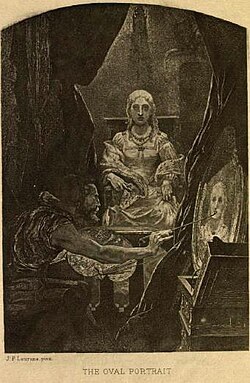
Il capolavoro del maestro del terrore con audiolibro e illustrazioni animate
"Il ritratto ovale", uno dei grandi capolavori di Edgar Allan Poe, rivive in una nuovissima edizione illustrata. Il racconto può essere letto o ascoltato in versione audiolibro ed è accompagnato da splendide illustrazioni originali animate e sonorizzate. Un modo nuovo e innovativo per rivivere l'esperienza di un grande classico del maestro del terrore.
. Riduzione, traduzione e adattamento: Simone Buttazzi . Illustrazioni animate: Giacomo Venturelli . Voce narrante dell'audiolibro: Alice De Toma
In collaborazione con gli studenti del corso di illustrazione dello IED – Visual Communication di Milano
The name Poe brings to mind images of murderers and madmen, premature burials, and mysterious women who return from the dead. His works have been in print since 1827 and include such literary classics as The Tell-Tale Heart, The Raven, and The Fall of the House of Usher. This versatile writer’s oeuvre includes short stories, poetry, a novel, a textbook, a book of scientific theory, and hundreds of essays and book reviews. He is widely acknowledged as the inventor of the modern detective story and an innovator in the science fiction genre, but he made his living as America’s first great literary critic and theoretician. Poe’s reputation today rests primarily on his tales of terror as well as on his haunting lyric poetry.
Just as the bizarre characters in Poe’s stories have captured the public imagination so too has Poe himself. He is seen as a morbid, mysterious figure lurking in the shadows of moonlit cemeteries or crumbling castles. This is the Poe of legend. But much of what we know about Poe is wrong, the product of a biography written by one of his enemies in an attempt to defame the author’s name.
The real Poe was born to traveling actors in Boston on January 19, 1809. Edgar was the second of three children. His other brother William Henry Leonard Poe would also become a poet before his early death, and Poe’s sister Rosalie Poe would grow up to teach penmanship at a Richmond girls’ school. Within three years of Poe’s birth both of his parents had died, and he was taken in by the wealthy tobacco merchant John Allan and his wife Frances Valentine Allan in Richmond, Virginia while Poe’s siblings went to live with other families. Mr. Allan would rear Poe to be a businessman and a Virginia gentleman, but Poe had dreams of being a writer in emulation of his childhood hero the British poet Lord Byron. Early poetic verses found written in a young Poe’s handwriting on the backs of Allan’s ledger sheets reveal how little interest Poe had in the tobacco business.
This very short story written by Edgar Allan Poe in 1850, tells of a wounded man who forces entry into an abandoned chateau. He makes himself at home in one it’s bedrooms and becomes fascinated by the abundance of art decorating its walls. One portrait in particular, that of a young girl, seems to bewitch him, and he becomes obsessed, wondering who she is, and what happened to her. Read it and find out! Here is the link for this freebie. https://poestories.com/read/ovalportrait
Often, it is said that true art demands sacrifice since intense and overwhelming artistic expressions require great personal costs. We have witnessed that various artists have produced enigmatic and surreal pieces of artistic expressions through different mediums by surrendering their hours of comfort and leisure. An artist of highest grade requires an powerful and passionate drive that, more often than not, takes us nearly all of a person’s attention, time and energy to create by keeping social norms, their personal well-being or any other set standards at bay. The obsessive drive to create gradually gets ingrained into deep psyche of artists and perhaps affects the wiring of their brain, so much so that it becomes an internalized thing rather than something which is forced. The artist has to transcend the mundanity of life to that nurture that internalized psychic thing for creating the aesthetic art of divinity.
Suddenly, a seemingly innocuous question springs up from dungeons of ignorance and stares straight into our eyes by sending a stir down our spine, and with bated breath, we realize the (perhaps remote for now) possibility that there might be some dangers too arising out of that ‘artistic obsession’. What could be these dangers and how do they affect our lives? On contemplation, it occurs to us that, while the grand artistic obsession may lead to groundbreaking aesthetic unique masterpieces, but it might also render us deep psychological wounds, scars of which may not be assuaged even with the balmy healing of time.
The Oval Portrait is centered around the prominent and famed theme of ‘art and life’ wherein Edgar Allan Poe carefully explores the haunting nature of art in the light of profound and destructive powers of artistic obsession. The treacherous intersection of artistic obsession and life takes us through a chilling account of an artist’s deadly obsession to create a perfect alter ego of his wife on canvas, to extent that the aesthetic beauty oozing out of it, may put even divine beauties to shame. Suddenly, we stare at lethal possibilities of this demonic artistic endeavor, with mouth agape. One of those possibilities throws us off our guard by making us consider the impact and cost of such an infernal artistic endeavor and who has to bear it.
Poe argues that art and life perhaps cannot peacefully coexist since the pursuit of artistic perfection can be of predatory nature and may have catastrophic impact on our lives. The short story takes the theme of ‘art vs life’ beyond the eternal struggle and perhaps towards absolute impossibility as the grandiose desire to create may demand to pay with life itself or relationships. The desire to create something aesthetic and eternal may force us to become blind to the entries and concerns of our loved ones and perhaps the (un)holy indifference could be life-threatening as well.
The short story also shares light on the age-old dilemma of art’s (in) ability to capture the full reality of existence as, no matter how pure and divine an art may be, it is artificial and often fails short of life. However, Poe may argue that sacred boundary between art and life gets often blurred and probably, that is also seen in the artistic movements of twentieth century as the artist moved from passive viewing to active participation, transforming art from a fixed, static object to an ongoing process in which viewers or audience are required to perform.
The short story starts with a minor story wherein the protagonist enters a chateau to find a painting of vignette manner in which the beauty of woman depicted appears to be of divine proportions. The aesthetic beauty of an avant garde art, wherein some details of painting are suffused to the background so that other details come out to foreground of the painting, conjures up an enigmatic spell around the viewer to engulf them in to a spellbinding experience wherein they lose grip over reality. The spell of eerie and mysterious piece of art is such that the protagonist starts questioning his reality as to whether he is hallucinating or really experiencing it. During the process of his curious inquiry about the revered painting and its subject, he satiates his inquisitive proclivity and finds something surprising and climatic.
The Oval Story focusses upon the psychic vampirism, the term though came into existence during 1960s, but Poe is supposed to be its pioneer for depicting the concept in literature; the artist of the story portrays its effect through his wife while consummating his artistic expeditions. The notion of psychic vampirism also sheds light on the issue of subjugation and objectification of women since the wife of the artist has been reduced to just be an object for artistic expression of the artist. We are encountered with a profound moral quandary that is it more of skills of the artist or the devotion and love of the woman who is narrowed down to just be the specimen that is to be personified in the painting. The woman cries from the infernal fire of non-being as if her own being is thrown into hell of nothingness and her existence has been reduced to be just to a commodity for pleasing patriarchal explorations.
The author uses his deft adroitness and artistic finesse to craft the horror short story with economy of language using only 2-3 odd pages to produce such a profound gothic atmosphere. The short story makes a bit uncomfortable, for it quashes the norms you might have devised for your comforts, and compels you to flex your mental muscles for examine whether art is a blessing or curse since the intense emotional and psychological investment it demands coercing the artist to create it, may appear a curse at times to them.
The oval shape of portrait in the story perhaps indicates towards the oppressive and disorienting enclosure of life within the enigmatic space of art which probably acts a focal point for the artistic obsession with aesthetical beauty. The oval shape signifies the cyclical transformative process between the vitality of the object of the painting, the wife and the portrait itself which vitalizes itself through the artistic expedition. We may also further extend our tendency to analyze and commentary to interpret the shape in another one of many probable ways, it may signify an opening of a supernatural, omnipotent eye which stares upon the narrator of the story by paralyzing him through a captivating spell of artistic perfection which might have engulfed vitality of its object.
It is inevitable that the reader’s mind may not wander upon the exploring the eerie similarities between The Picture of Dorian Gray by Oscar Wilde and this little gem by Poe as both these tales poignantly explores the perilous relationship between art, the artist and perhaps its subject as well. However, both tales differ in their treatment of the subject-matter since The Picture of Dorian Gray is more about aestheticism, moral decay and hypocrisy as the painting in Oscar Wilde’s tale gets transformed due to moral sins and aging of the subject. The necessary evil of digression further takes my mind to the probable similarities Poe’s tale might have with Artforum by Cesar Aira since both narratives focus upon the narrative compulsion to possess an idealist representation of reality, though Aira’s more a modern, quirky reflection on consumerism, nature of art creation, obsession of a collector as most of us might be nurturing being bibliophiles.
Edgar Allan Poe makes us, the readers, think about our own unterminated or still germinating creative seeds which may be jumping up and down in our consciousness to take birth in the form of some artistic expressions. But then it reminds us of the famed dilemma, which we explored above, of pouring our entire souls into artistic endeavors vs the cost they incur to us, and sends an eerie and dark reminder that the cost of our artistic pursuits may be overwhelming and daunting for us, shaking us to our cores questioning that are we ready for the epic and bold sacrifice it may demand?
Since there are dozens of reviews already posted here, in the spirit of freshness I will focus on how Edgar Allan Poe uses this tale to convey the power of art and aesthetic experience for both artist and viewer. Below are my observations along with several of the author’s quotes.
The narrator enters a room situated in a remote turret of a Italian mountain chateau, a room filled with tapestry and trophies “together with an unusually great number of very spirited modern paintings, in frames of rich golden arabesque.” This framing of works of art is no accident – by its very nature, art is a world apart; no matter how realistic, what is contained within the frame requires a viewer’s attention and imagination to be seen properly.
“Long – long I read – and devoutly, devoutly I gazed.” The act of devotion traditionally appertains to religion, but, for such art aficionados of the nineteenth century as the narrator, in a very real sense, art took the place of religion. And, similar to religious and mystical experience, his art gazing evaporates the everyday experience of time. He tells us, “Rapidly and gloriously the hours flew by and the deep midnight came.”
The narrator’s experience reflects what many eighteenth and nineteenth century philosophers such as Immanuel Kant, Frederick Schiller and Arthur Schopenhauer refer to as "the disinterested state," a mind-set whereby we transcend the muck and grime of our petty, self-preoccupied day-to-day concerns and soar to the crystal clear psychic sky of universal beauty.
Then the narrator’s attention turns more directly to the oval portrait and he spends an hour riveted on what he sees, such riveted attention moving him to intense emotional and psychological depths. We read, “I had found the spell of the picture in an absolute life-likeliness of expression, which, at first startling, finally confounded, subdued, and appalled me.”
This is the potency one encounters when totally committing to the art object; in his case being, in turn, startled, confounded, subdued and appalled, states made all the more vivid by the rarefied, ethereal air of aesthetic experience; indeed, his senses and neurological pathways are washed clean and opened like floodgates for the expressive force of the lifelike portrait of the artist’s young, beautiful wife. Additionally, the mood set by the candles of the candelabra and the dark night only adds to the piquancy of his astonishing experience.
When the narrator turns to the page discussing this painting and its history, we read along about a “passionate, wild and moody man" taking glory in his work, an artist who painted day and night over many weeks and who “took a fervid and burning pleasure in his task." However, the artist’s obsession in conferring life to his painting has a price: the more alive and vital his painting, the more life is drained from his tender, young wife, a process the artist, in his obsessive fervor, completely fails to register. This transference of energy crescendos with the final brush stroke - the painting springs fully to life at the exact moment of his young wife’s death.
So, what are we to make of this tale? Is the painter an evil man as some reviewers might suggest? Any reader who has been touched by the muse and participates in the creative life of art, music or literature knows there are sacrifices to be made, usually sacrifices made by the creative artist himself or herself but there are times when others are impacted, either willingly or unwillingly.
Where do we draw the line? We certainly don’t want to live in a flat, vapid, humdrum artless world but should such sacrifices be made as in Poe’s tale? How we answer this question is a telling sign of who we are as individuals and who we are collectively as a society.
A man seeks shelter for the night in an abandoned chateau. While he is in bed he notices a painting on the wall of a girl. He is captivated by it, and reads about it in a book, which tells the sad tale of the painting.
This was a short, gripping, and fascinating read. Another interesting story by Poe.
Un pintor que, a medida que se acerca a la perfección al retratar a su esposa, le va arrebatando gradualmente la vida.
Así como aquel personaje indicó en cierto momento: «¡Esta obra es magnífica, tiene todo el espíritu y la vida misma!», eso es algo que calza y describe a la perfección el texto del que forma parte, junto con su temática. Pero no les puedo comentar más al respecto, porque es un relato extremadamente breve y, si revelara el más mínimo detalle adicional —por más insignificante que sea—, sería como contarles todo.
Si bien no tengo quejas, sí mantengo una inquietud que me causa ruido: al principio, el protagonista menciona que su criado lo dejó malherido y que así fue como lo abandonó; después, juntos encuentran una vieja mansión para pasar la noche, donde el personaje principal solo se encuentra en estado febril; posteriormente, el criado descansa y el protagonista evita perturbarle el sueño, mostrando preocupación y hasta cierto afecto por él para que no se despierte en vano.
La verdad, no sé si esto pueda deberse a un error de mi edición, de la traducción o si en realidad esa parte no fue muy cuidada por Poe. Digo esto porque no hay una lógica clara: es como si el criado lo hubiera traicionado y herido para que luego el personaje se preocupe por su descanso como si nada dudoso hubiera sucedido entre ellos. Sea como sea, es algo que comprobaré cuando relea este cuento en otra edición.
También me llama sobremanera la atención que se pueda estructurar una trama tan precisa y bien lograda en tan pocas páginas; de hecho, se acaba de convertir en uno de mis relatos favoritos del autor. Además, plantea un concepto muy original que al parecer inspiró El retrato de Dorian Gray, de Oscar Wilde, lo que algún día comprobaré.
No obstante, tengo que decir que me gustó mucho este cuento y, además del desajuste que indiqué anteriormente —y que desconozco si originalmente fue ideado así, o si es algo de mi edición o traducción—, no tengo más reparos que hacerle a esta obra.
Sin embargo, El retrato ovalado es muy atrapante, a pesar de su abismal simpleza y corta extensión. Tiene lo justo y necesario. Todos los méritos para el autor, quien en tan pocas páginas logró plasmar exactamente lo que quería. Concluye en el momento preciso.
Por lo mismo, mi calificación final es de ★★★★☆. Esta obra merodea el podio de mi top 28 de Poe. Se la recomiendo a todos, sin hacer segmentación alguna entre los lectores.
En la ficción, lo ideal habría sido no terminar el retrato; en la realidad, llegar hasta el final de esta lectura.
Para otras reseñas sobre la obra de Edgar Allan Poe:
The Oval Portrait is a dark and delicious bite from Mr. Poe.
An injured traveler takes refuge for the night in an abandoned chateau. What he discovers when “… the deep midnight came.” will alter his perception of the enchanting beauty in the oval portrait.
“-- in these paintings my incipient delirium, perhaps, had caused me to take deep interest; so that I bade Pedro to close the heavy shutters of the room -- since it was already night -- to light the tongues of a tall candelabrum which stood by the head of my bed -- and to throw open far and wide the fringed curtains of black velvet which enveloped the bed itself.”
This short story can be read in the space of fifteen minutes and can be found for free HERE.
Thank you to Sandra for bringing this quick read to light!
Injured, and fearful of spending a cold night outdoors, an unnamed man of means (our narrator) seeks shelter in an abandoned chateau where a turret room, dark and steeped in faded grandeur, presents itself. Our narrator has his valet light a candelabrum and throw open the fringed curtains surrounding his bed (I could easily imagine a resultant cloud of dust and moth husks, such was the flamboyance of Poe's imagery). He retires to contemplate an array of gilt-framed paintings that hang from the bedroom walls. One, in particular, arrests his gaze; it is a portrait of a young woman ripening into womanhood.
If you are at all interested in a twisty story of life imitating art, then please read on... https://poestories.com/read/ovalportrait (it will take but fifteen minutes of your day).
My thanks to Kimber Silver for the intriguing review that brought me here!
Poe packs a lot of symbolism into this short but engrossing allegorical tale of when passion turns into obsession. I recommend reading this short story at least twice as each re-read and reflection can show an alternate perspective and bring a different understanding of Poe’s underlying themes.
After finishing my vigorous tussle with Faulkner late last night, I thought it time for a palate cleanser.
Enter Edgar Allan Poe’s The Oval Portrait.
Our narrator spends a night in a remote chateau. His lavish room is adorned with magnificent art. One portrait in particular, grabs his attention. It’s a painting of a gorgeous is transfixed by it. Our narrator reads up about the painting and the artist and subject concerned.
The story is chilling.
The major theme for me here (apart from crapping my pants), was the peril of being obsessed with art, rather than real life.
This was a real treat to read just before I closed my eyes to sleep. When I woke up during the night, I made double sure not to stare at various photos around the bedroom. Just in case.
In this haunting nineteenth century work by POE, a wounded man finds shelter in an abandoned room filled with portraits, and upon reading the nearby book of their history, THE OVAL PORTRAIT of a beautiful young woman seems to come alive and mesmerize the man as he learns the dark secret of her existence.
I really liked this story on artistic obsession. A wounded man seeks shelter in an old castle. When lying in bed he becomes aware of an oval portrait of a young lady. What is so special about the portrait? How did the artist paint it and what happened to the lady depicted? Classic Poe with an eerie twist at the end. Recommended!
Este es un relato que cuenta la historia de un hombre que llega a un castillo y se encuentra con un retrato muy particular. Luego encuentra un libro con la historia de cada una de las obras exhibidas allí y, a medida que lee la de ese retrato oval, se da cuenta de la oscuridad y la tragedia que se esconde tras esa bella imagen.
Esta es una historia súper corta y que, en mi opinión, me queda debiendo un cierre más contundente.
- قصة تراجيدية قصيرة، ترتكز على التضحية بشكل عام، التضحية التي قدمها الفنان من اجل فنّه، والتضحية الني قدمتها الزوجة من اجل حبها... بالنتيجة الزوجة ماتت واللوحة قابعة في سرداب... الجميع قد خسروا!!
I wish this short story were a bit longer to show the narrator’s expression as to what he learned at the end of the story, however I love the message that with great art comes a great price. Nice little read!
La verdad me ha dejado más bien fría, no ha logrado transmitirme esa sensación de inquietud que debiera provocar la historia de este retrato maldito. Para mí, definitivamente, no es lo mejor de Poe.
That was interesting! I've always loved Poe and this didn't disappoint as a very short story.
About the plot: A gentleman traveling stops at an aging home to stay the night and is treated to a room full of paintings and a book describing said paintings. He stays up reading about one in particular, the oval painting in the corner that looks remarkably realistic.
Take 15 minutes or so to read about this portrait. The story can be found free here.
Es una delicia ver como Poe maneja los tiempos en este breve cuento:
Una presentación gótica para situarnos en escena y recrear un ambiente de inquietud y desasosiego: el castillo abandonado, la torre, la decoración rica, ajada y vieja, la oscuridad de la noche, el candelabro, las cortinas de terciopelo negro que envuelven la cama.
Después de sumergirnos entre las sombras, viene la luz. Nos descubre algo misterioso que atrae nuestra atención: un retrato misterioso de una mujer.
En ese estado de duermevela, que bien podría ser un sueño o ser real, ya nos mantiene expectantes, solo queda resolver el misterio. Conocer con "temor" la historia del cuadro, donde incorpora los elementos fantásticos sobrenaturales.
Llegado a este punto, solo nos queda descubrir con "horror" esa impactante frase final, el porqué resultaba tan inquietante la visión de ese retrato.
El retrato oval se publicó en 1842, mientras que el retrato de Dorian Gray se publicó en 1890. Perfectamente pudo haberse inspirado en el cuento de Poe y el retrato que absorbió y devoró el alma (la vida) de la modelo.
En este retrato gótico ya se recoge ese vínculo entre la imagen retratada y la persona real, incluso entre la imagen y el alma. Es el amor de la esposa lo que capta el pintor. Un amor que entrega la esposa a su ser amado. Mientras que el pintor embelesado con su obra no es capaz de apreciar los cambios en la modelo, que está devorando su alma. El pintor no ama a su esposa, ama su belleza. La muerte de la esposa representaría el triunfo de esa obsesión por la belleza, de la esencia de la belleza sobre el amor - en las últimas fases, ni siquiera la mira- y del arte sobre la vida. El peligro de quedarse solo con lo superfluo, con la belleza.
En El retrato de Dorian Gray, el retrato purga y refleja los vicios y la perversión de Dorian, manteniéndolo inalterado a él. En este caso es al revés, es la mujer la que sufre, por la obsesión de su marido. Ella no tenía ni culpa ni pecado propio que expiar.
Dicen que Poe pudo haberse inspirado en un retrato de su madre fallecida cuando era niño, que siempre llevaba consigo.
The narrator "takes refuge in an abandoned castle and discovers a room with a series of paintings accompanied by a small book describing them. His attention is attracted by an oval portrait depicting a young woman of rare beauty."
The story is eerie and tragic, and despite its shortness, fully captivates the reader.
The writer of the story is wounded and seeks refuge in an abandoned chateau which is described very vividly and makes the scenario easy to picture. As he reads long into the night when moving his candelabra so he can see better, the light strikes a portrait of a young woman. What does it disturb him so? It rivets him and holds his attention. The short but extremely good story is a tale of obsession which comes at a terrible price.
I had never even heard of this story before. It has similarities to The Picture of Dorian Gray, but I'm not sure which author drew his influence from the other. This is a heart rending story of love, neglect, & death, very sad, but also sweet in a way...
This is a short-short, only two pages, but manages to pack one story inside another &, unfortunately, left me unsatisfied. The ending was too obvious, too early, & lost its impact. It's a cool idea no matter how it is interpreted; They're not mutually exclusive, but could be.
I looked it up on Wikipedia because of something another reviewer mentioned, that it was an inspiration for The Picture of Dorian Gray. The Wiki article agrees & the dates seem to bear it out. Read the story first, though. The Wiki article is a major spoiler. http://en.wikipedia.org/wiki/The_Oval...
You can read this story for free at Project Gutenberg. It's the very last story in Volume 1 of THE WORKS OF EDGAR ALLAN POE IN FIVE VOLUMES, The Raven Edition. If you just want the story itself, it's available here to read online: http://en.wikisource.org/wiki/The_Ova...