In Bali, what you see--sekala--is a colorful world of ceremony, ritual, dance, and drama. What you don't see--niskala--is the doctrine underlying the pageants, the code underlying the rites, and the magic underlying the dance. " Sekala & Niskala" explores both tangibles and intangibles in the realm of Balinese religion, ritual and performing arts. "The best book on Bali for the serious visitor ..." "Has the freshness of personal experience." -- Dr. Hildred Geertz, author of Kinship in Bali and professor of anthropology at Princeton University "The editor can cheerfully recommend this book, which are absolutely crammed with unusual lore and information." -- Dr. Frederick E. deBoer, editor of Bali Arts and Culture News
Bali, like the Discworld, is a place where the primary directions are ‘hubwards’ and ‘rimwards’ – in Balinese, kaja and kelod. The ‘hub’ in this case is the sacred Mt. Agung, in the centre-east of the island, which is seen as the dwelling-place of the Hindu gods.
I was a bit sceptical of the claim in this book that the Balinese still orient themselves this way (it was published nearly thirty years ago), but when, in my best imperial-colonialist style, I grabbed locals and asked them which way kaja was, everyone showed me without hesitation. In practice, it seems that most of southern Bali just treats ‘kaja’ as being equivalent to north, and the kaja-kelod axis as being perpendicular to the east-west axis; at least that was what I found when I asked for directions. (This is reversed if you live in north Bali, but how it works if you live somewhere like Jembrana, which is due west of Mt. Agung, I have no idea.)
Now indulge me for a moment while I brief you on the Balinese calendar, which is of eye-watering complexity. Alongside the familiar Western calendar are two others, the 210-day Pawukon calendar, and, for good measure, the Saka lunar calendar. The Pawukon cycle involves no fewer than ten different week systems, all of which run concurrently. There is a week that is one day long, another of two days, one with three, and so on up to ten. So each given day will have ten different names, one for each of the ten weeks going on simultaneously. The days of some of these weeks are sequential (so the five-day week repeats the sequence of Umanis, Paing, Pon, Wage and Keliwon), but, for added fun, others are not. The days of the two-day week are Menga and Pepet, but the order goes: Menga, Menga, Pepet, Menga, Pepet, Pepet, Pepet… and so on in a 35-day repeating cycle! Special days in the Balinese year occur at important conjunctions of these different week systems, for instance when the last day of the three-day week coincides with the last day of the five-day week (called Kajeng Keliwon; this happens every 15 days). Fantasy novelists deep into their world-building would probably reject this as outlandishly implausible, and that’s before you add on the equally important Saka lunar calendar, which is at least roughly the same length as the Gregorian….
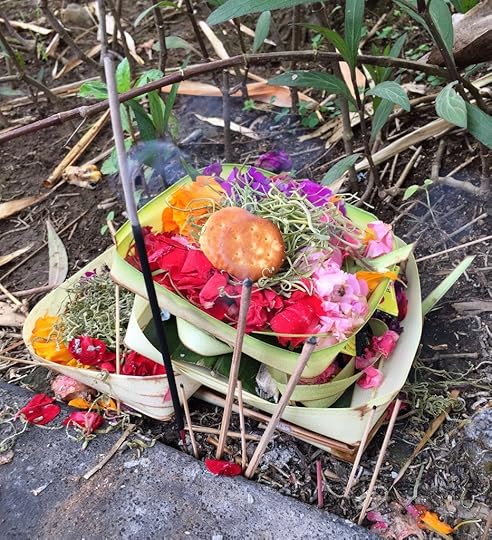
Perhaps because of its status as a Hindu enclave in the world’s most populous Muslim country, Bali is a place where religious tradition seems very prominent in daily life. Family temples and roadside shrines are everywhere; you literally can’t walk ten metres down the street without stumbling over a little coconut-leaf canang filled with coloured petals, a slice of watermelon, perhaps a Ritz cheese cracker, and a smouldering stick of incense. There will also be one of these on the dashboard of most taxis. I learn from this book that it’s considered very rude to step over one, which is good to know because avoiding this is no mean feat given the tiny pavements and insane traffic on Bali.
Canang on a traffic island, Seminyak
Also of use to the interested tourist are the detailed descriptions of shrines, odalan ceremonies, cremations and (if shopping around) of krisses and their manufacture; Eiseman’s wife, a specialist in Balinese dance, contributes several erudite chapters on the legong and other traditional dances. It’s also worth studying the section on castes and clans, so that when your taxi driver introduces himself as Made, you can say, ‘Ah, the second son of a rice-farming family,’ to general amazement. And the chapter on Uluwatu temple is more useful to visitors than anything in the usual guidebooks, and will allow you to stand on the cliffs and gaze knowledgeably at the shrines while the macaques make off with your sun-hat.
I love this book. I have heard of this book for quite some time already, but every library that I came across didn't have a copy of it. So, a couple of months ago, I asked my sister to buy this book for me. This book is divided into four sections; each includes a variety of essays regarding religion, ceremonies, rituals and art in Bali. The essays don't need to be read in a chronological manner. I found every chapter interesting and the occasional illustration wonderful. At first, I was a bit worried that this book might be outdated because it was written in the 70s, but I'm glad to report that much of its content is still valid. I recommend this book to the serious visitor of Bali, who really wants to learn more about the culture and tradition. I'm so happy that I have learned so much, especially regarding the Balinese calendar. Now I finally understand the complex week systems that layer over each other in the Pawukon calendar and how specific ceremonies are held on specific days. Seriously this book left me feeling like a better person.
This has everything I've wanted to read about Balinese culture. Exploring both the seen and unseen elements in their way of life.
Leaving some quotes here I want to save for further reference:
"The Balinese conceive that all things in the universe, living or not, have some connection with each other."
"Sekala means what you can sense - see, hear, smell and touch. Niskala involves that which cannot be sensed directly, but which can only be felt within."
"In Bali, the position of mankind is one between good and evil or, more appropriately stated, in a state of coexistence with them. Mankind's job is not to destroy evil. Nothing in the teachings of Balinese Hinduism requires or even mentions this. Evil is a part of the whole. Neither can exist without the other."
An excellent read for those interested in the complex spirituality of the Balinese Hindus. The author provides a definitive portrayal with terrific detail of religious ceremonies and sacred rites of this extremely rich culture. I have been amazed at the depth of their animistic beliefs and their pursuit of the sacred in their daily lives. Wow.
While Eiseman's depth of knowledge is widely acknowledged, the book can be overwhelming due to its exhaustive detail. At times it reads more like an encyclopedia than a cohesive narrative, making it challenging to engage with fully. For instance, some sections include extensive backstories on individual masks used in performances, which may detract from the overall flow.
At the same time, I can appreciate the wealth of information provided, finding it invaluable as a supplementary resource for understanding Bali beyond surface-level tourism. The book has been recommended as essential reading for serious visitors to Bali who wish to gain deeper insights into its cultural fabric.
"Bali, Sekala and Niskala" stands out as a significant contribution to the study of Balinese culture. Its blend of personal experience and scholarly insight offers readers both an informative and immersive experience. Despite critiques regarding its length and detail, Eiseman's work remains a foundational text for anyone looking to explore the intricate layers of Balinese religion, ritual, and art. The book ultimately serves as both a guide and an invitation to engage with Bali's rich cultural landscape on multiple levels.
This book confirms, or at least tries to explain, many unanswered culture-related questions of me as a local Balinese possessed since forever.
Eiseman tried to utilise a critical western perspective to elaborate his experience living a live like a local, an agency many of the Balinese cannot have.
Haven’t read the 2nd volume but I’d like to further understand: (1) why such this thorough explanation of Bali should first came from the perspective of individuals from external culture trying to understand Bali, not otherwise, (2) why many statements from this book didn’t open sufficient counter explanations and additional discussion; accusing Mayadenawa as a devoted Buddhist opposed by the society and the term ISHWW was adapted from catholic missionary are wild to hear as a local.
I read this book when I was researching on the demons and spirits of Bali for a novel set in a remote Balinese fishing village and - although it can make slightly heavy reading at time - it is so fascinating and so full of surprising (and downright bizarre) material that it is converted into a real page-turner. Since I spend a lot of time in - relatively unspoiled - West Bali I plan to reread it as soon as I can find time.
Beforehand I was afraid that this book, written by a white author, would be another orientalist view of the Balinese culture but I’m positively surprised it’s not. Especially since this book is from the 1980s. The author has a very broad knowledge and did a well job at explaining complex matters
Really great outsider’s insight into the complexity of Balinese Hindu culture — it was maybe too much detail for me personally, but really did the job of recording detailed paragraphs about particular areas of Balinese life, especially religion and belief.
For whatever reason, I have a near obsession with finishing whatever books I start. Most of the time, this isn't a problem, but sometimes it almost kills me. This book was an instance of the latter.
Fred Eiseman has an incredible depth of knowledge about Bali, I will give him that much. What he doesn't have is any self restraint, or at the very least a good editor. At times, this book was just down right painful to read. There was just so much exhaustive detail at times, you couldn't see the forest for the trees. I don't need to know the name and backstory of every individual mask used in a barong show. It's also probably unnecessary to GIVE DIRECTIONS to all of the places and attraction you mention. I almost felt like Eiseman couldn't decide what he wanted his book to be: an encyclopedia on Balinese culture, a travel guide, or a book on Hindu tales and legends.
On the flip side, I did learn a lot, and it was a useful supplement to some of the things I had heard about and seen while I was in Bali. But on the whole, I think this could have been a much more interesting and useful book, if only it had been half its current length and much more tightly written.
Sitting in my villa in Bali, surrounded by rice padis, this was the perfect read for me! Eiseman provides deep and detailed insight into traditional Balinese culture. Definitely recommended reading for those who like to get the most out of their travels! (My only caveat is that occasionally the details are a little overwhelming. Also, I sometimes experienced a bit of discomfort with the semi-insider POV of a convert to Balinese Hinduism speaking of "our" village.)
For serious reader who wish to see Bali beyond its traveling destination. My favorite parts are about the rituals -the dance, trance and even black magic. Also about the religion, where hindu balinese is pretty much similar with budha also in Indonesia, Kejawen
An old book (1990) which is complete described about balinese tradition and religion. Only in English. I'm still searching the 2nd Volume, coz I'd only the 1st Volume.