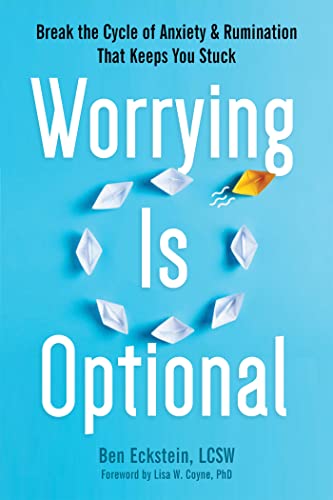
"Worrying Is Optional: Break the Cycle of Anxiety and Rumination That Keeps You Stuck" authored by Ben Eckstein and Lisa W. Coyne is a compelling guide that delves into the pervasive struggle with worry in an increasingly uncertain world. This comprehensive book not only acknowledges the universality of worry as a human experience but also provides invaluable insights into effectively managing it. The authors emphasize that while worry is a natural response, excessive and persistent worrying can have detrimental consequences, impacting our sleep, daily functioning, decision-making, and overall well-being.
The book commences by assuring readers that to some extent, worry is a normal response to life's uncertainties. However, it firmly distinguishes between occasional, functional worrying and the kind of worry that becomes overwhelming and counterproductive. The latter can lead to a relentless cycle of rumination and anxiety, hindering our ability to navigate life's challenges.
At its core, the book conveys an empowering message: worrying is a choice. The authors assert that individuals have the agency to decide whether or not to engage in excessive worry. This perspective forms the bedrock of their strategy for breaking free from the cycle of unhelpful rumination and anxiety.
To facilitate this transformation, the book introduces readers to a plethora of therapeutic approaches and techniques sourced from metacognitive therapy, acceptance and commitment therapy (ACT), and cognitive behavioral therapy (CBT). The authors stress the importance of tailoring these techniques to individual needs, encouraging readers to construct their own personalized toolkit for managing worry.
Readers embark on a comprehensive journey encompassing various facets of worry. This includes gaining insight into the underlying mechanisms of worry, identifying its triggers, and acquiring the skills to set boundaries to prevent it from spiraling out of control. The book also explores tackling perfectionism and embracing uncertainty—two common factors that contribute to excessive worry.