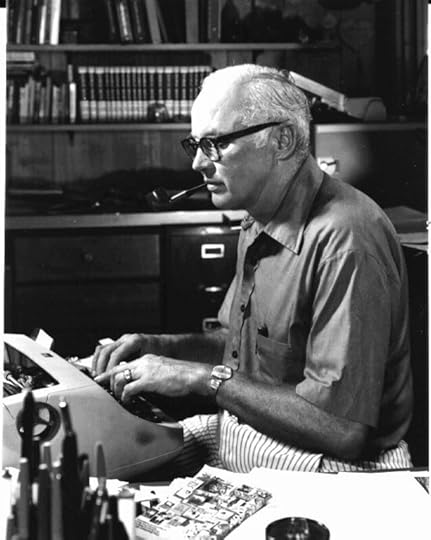
John D. MacDonald was born in Sharon, Pennsylvania, and educated at the Universities of Pennsylvania, Syracuse and Harvard, where he took an MBA in 1939. During WW2, he rose to the rank of Colonel, and while serving in the Army and in the Far East, sent a short story to his wife for sale, successfully. He served in the Office of Strategic Services (O.S.S.) in the China-Burma-India Theater of Operations. After the war, he decided to try writing for a year, to see if he could make a living. Over 500 short stories and 70 novels resulted, including 21 Travis McGee novels.
Following complications of an earlier heart bypass operation, MacDonald slipped into a coma on December 10 and died at age 70, on December 28, 1986, in St. Mary's Hospital in Milwaukee, Wisconsin. He was survived by his wife Dorothy (1911-1989) and a son, Maynard.
In the years since his death MacDonald has been praised by authors as diverse as Stephen King, Spider Robinson, Jimmy Buffett, Kingsley Amis and Kurt Vonnegut, Jr.. Thirty-three years after his passing the Travis McGee novels are still in print.
“Remember, there is a very cold and strange entity that hides inside Howie Brindle. It is the imposter. He is the stage effect.” — Meyer to McGee
It’s early December as this unusual Travis McGee novel begins. Whereas most of the McGee novels have mystery and suspense laced with resonating observations about life and society, with MacDonald casting a cloud on the sunshine of Florida with his insightful pondering of the misled, this one has those observations and insights front and center, with the mystery and suspense the underscore. While it makes this an atypical Travis McGee novel in some ways, it does not make it a bad one. It is in fact, a very good read, with many worthwhile moments. It’s not surprising that it’s one of the books in the series that he dedicated to his wife, Dorothy.
Coming just before the excellent Dreadful Lemon Sky, this was the first Travis McGee published in hardback, however, and just for a moment, perhaps less than a moment, MacDonald blinked. There is no way to give an accurate portrayal of a book so misrepresented at times without getting into great detail, so if you have a problem with basic plot spoilers for a book that’s been around for almost fifty years, you might want to stop reading here.
MacDonald was at heart a pulp writer — elevated so high most don’t recognize it as such, but a pulp writer nonetheless. He realized his readers were paperback readers, and knowing this one would be marketed toward people who might not have read a Travis McGee before, you can almost feel him taking the pulp edges off McGee, softening his hero just a tad to make him a bit more vulnerable — and fallible. The basic plot of a likable, affable sociopath who fools both McGee and Meyer would be used again — and in a more resonating way — in MacDonald’s next to last Travis McGee novel, Cinnamon Skin.
Each entry in any great series has its own atmosphere and value, however, and Turquoise Lament stands alone quite nicely. While Cinnamon Skin is a near masterpiece, The Turquoise Lament is very, very good when you don’t compare the two — or pit it against more stellar entries in the series. At MacDonald’s level, it is a matter of mere degrees between good and memorable. We are, after all, talking about one of the greatest series in American fiction, lauded by one great noteworthy writer after another. Over two decades, Travis McGee became a household name because readers couldn’t wait to get their hands on the next novel. This one is a solid four stars, as opposed to the solid five for Cinnamon Skin. That is all.
It begins in lovely Hawaii during early December. With great economy MacDonald places us there, and we’re soon hip to why taxi fares are so outrageous in Honolulu. McGee has made the trip from Florida at the request of Pidge Brindle, and the Travis McGee devotee can already sense this one is going to be a bit different from the others. McGee remembers how lovely Pidge was at seventeen, stowing aboard his boat to offer herself to him. Not the lech some over the years have misleadingly portrayed MacDonald’s hero as, McGee of course emphatically declines, taking Pidge back to her father, Ted. MacDonald, however, understood the wistfulness of what might have been, that twinge of regret every man feels at perhaps passing up something wonderful — even when it’s the right thing to do. There is nothing harder to resist than someone completely in love with you. Pidge is definitely no longer seventeen, however, and she is just as lovely. But she’s also an emotional mess. Whether the mess is real, or imagined, is for McGee to figure out.
A year ago, Pidge married Howie Brindle, a big, uncomplicated and easygoing giant who may not be the brightest bulb in the cupboard, but works hard and is very likable. Pidge’s almost neurotic story doesn’t jibe with anything he knows about Howie. Nor does it jibe with the evidence, which includes photographs. Though McGee cares about her, he needs to get the lay of the land, to discover if something diabolical is going on, or whether Pidge is having issues. So he talks to Howie and gets his version. With readers’ sympathy firmly in Pidge’s court, in a brilliantly written scene, we meet Howie, and begin to have the same doubts as McGee:
“He let go and spun away. His voice had broken. He started walking slowly back out the jetty toward the Trepid. It was a listless and dejected walk. A big dumpy giant, sad in the Christmas-coming sunshine.” — McGee describing the heartbroken and confused Howie.
But if Howie isn’t trying to kill Pidge, and there wasn’t another woman hiding on the boat while they were at sea — and all evidence suggests he isn’t, and there wasn’t — what’s going on with Pidge? Is she cracking up? So McGee drinks and talks to her, and they drink and talk some more, until finally, Pidge breaks down. Everything is psychologically sound in what transpires next. McGee doesn’t plant ideas, it is Pidge who realizes she doesn’t love Howie, no matter how much she wants to, and she’s created this elaborate ruse to explain why. This of course leads to an intimacy not planned by McGee, but firmly orchestrated by Pidge. As she tells McGee, explaining how it took her three hours to work up courage for her planned seduction: “You never had a chance, McGee.” And she’s right. It’s impossible for McGee to turn her down now, and there’s really no reason to:
“That and other memories of her were strangely merged with the sweet and immediate realities of her, the here-and-nowness of her, so that I seemed to live in the past and the present all at once. — She was a temptation out of the past, served up on some kind of eternal lazy Susan so that it had come by once again, and this time we had taken it.”
Later, Pidge explains:
“It’s too scary. I can’t go through all that again. Not ever. So there’s just one thing that would keep me from going back to him. And we just finished that one thing, and it was really beautiful. I wanted to do it with you a thousand years ago and you wouldn’t. You were pretty stuffy about it.”
Somewhere along the way, however, what might have been becomes what is:
“There may be better ways of spending the middle part of a Friday in Hawaii or anywhere else. If so, I find it very hard to think of any. It made a fine Friday. And Saturday. And Sunday.” — McGee in his thoughts
Much later, after Meyer collapses and is in the hospital, and after a couple of suicides by lonely friends, McGee ponders his future:
“Would I, Travis McGee, bring thee, Linda Lewellen Brindle, aboard this houseboat to live herein and hereon, with me, happily, so long as we shall all remain afloat?”
But before Meyer makes McGee think long and hard about his own mortality, McGee has to tell Howie that Pidge doesn’t want to be with him:
“He looked down. I thought it was a snort of sour laughter, and then realized it was a sob. I saw tears run down his round ruddy cheek. I felt like a coconspirator in a very rotten plan. This was a very simple decent guy. So like a coward, I tiptoed offstage.”
For a while, McGee goes through women, trying to shake off Pidge, but he can’t. Soon McGee realizes that he loves Pidge, then he gets her letter. Here is MacDonald the writer at his absolute best. Written from Pidge’s viewpoint, he perfectly captures her female voice, her thoughts and feelings, her excitement about the future she plans with McGee. It goes on for four pages, and will ring absolutely true to any man who has ever received a love letter. It’s a terrific piece of writing that offsets a later pretentious flourish when MacDonald has McGee interrogate himself during a mock trial. Also offsetting it is an insightful rumination on modern arrogance in regard to ancient civilizations. The mock trial in McGee's head is just a minor blip on the radar.
It’s Meyer who, when he begins recovering, realizes exactly what McGee's running from, and points him in the right direction. As McGee finally admits to his best friend, and one of the great sidekicks in mystery fiction:
“I keep thinking that other people have friends, and they talk about ball games and the weather and laugh a lot. What have I got? Ann Landers.”
Sounds like a great romance, doesn’t it? Well, finally we get to the Travis McGee part of the novel with which we’re more familiar. There is sunken treasure, and a lot of money left to Pidge by her father, Ted. There’s a guy named Collier, some blackmail, and Pidge somewhere out there on the big blue ocean with Howie Brindle, making one last trip to sell a boat before she returns to be McGee’s love. Then McGee has noticed something off in the photos that he needs to have an expert look at. It gives McGee a chill when he realizes he’s read it all wrong. This is the one where McGee almost buries someone alive. But mostly he just backtracks Howie, which reveals a very startling picture:
“Remember, there is a very cold and strange entity that hides inside Howie Brindle. It is the imposter. He is the stage effect.” — “An almost casual impulse. Irritation plus opportunity plus slyness, plus a total absence of human warmth and feeling.” — Meyer
It is also Meyer's belief that Pidge can stay alive longer at sea because of what transpired in Honolulu; simply because she believes she imagined it all the first time out, and Howie will not feel the impulse quite so quickly. With no hope of finding her on the water — MacDonald makes it startlingly clear just how difficult it is to locate a boat on the open sea — all McGee can do is wait for the boat in American Samoa. It gives McGee a chance to make observations about that part of the world which ring very true.
What finally transpires is violent and exciting, and leads to a true reversal of roles, and a bittersweet ending. The mystery and suspense is the underscore here, the soft strings rather than the driving horns. Had a reader never picked up a McGee book, this would seem marvelous. Having read them all many times over the decades, it’s only a good, solid entry where McGee was written a bit softer, the broad shoulders rounded in McGee’s version of a mid-life crisis. A great ending makes up for a lot, but this one is best enjoyed by those who love the ongoing commentary about society and the observations about living, and humanity. A book certainly misunderstood and sometimes misrepresented. A solid four stars as a McGee novel.
“The blackness was there in Howie Brindle, and then it was gone.” — McGee
(This is one of those books that’s a little tricky to review because I have to give up a fair amount of plot to discuss what I found so ridiculous about it, but it's all part of the basic set-up. If you know that you’re reading a crime novel and/or are familiar with Travis McGee it’s pretty obvious how things will play out. Plus, I’m not giving up anything about the ending so I’m not going to spoiler tag the whole review, but if you haven’t read and you don’t want to know too much, you should probably skip this one.)
The old Sea Cock really outdid himself this time….
When Pidge Llewellen was a teenage girl she had a huge crush on Travis McGee and her treasure hunting father once saved his life so he feels more than a little protective of her. After her father was killed in an accident, McGee and his friend Meyer made sure she received the sizable inheritance she was owed as well as vetted her prospective husband Howie Brindle. After their wedding Pidge and Howie set off on a cruise around the world in a small boat.
Months later Travis gets a call from Pidge in Hawaii asking for help. When he arrives Pidge tells him that either she’s crazy or Howie is trying to kill her. She claims several weird incidents happened at sea, but when Travis talks to Howie the big friendly lug is hurt and confused at his wife’s claims and behavior.
Convinced that the man is telling the truth, McGee gets Pidge drunk and to admit that she doesn't love Howie. Travis assures her that all the odd stuff was just her poor little female mind being unable to cope at failing when she picked a mate. Reassured, Pidge bangs McGee for a couple of days to prove his theory right. She then tells Howie that they’ll need to split, but he convinces her to sail the boat to meet a buyer at Poga Poga before they call a divorce lawyer.
Satisfied at his efforts as a marriage counselor and psychologist, McGee returns to Florida where he immediately begins nailing even more women than usual. Whatever could have driven him to this state? Examining his own heart, McGee finds that he has fallen in love with Pidge, and coincidently he gets a letter from her proclaiming her own love and saying that they’ll start a life of bliss together right after she gets done with this risky ocean voyage alone with the husband she recently informed of her wish to divorce and that she once thought might be trying to kill her…..
At first, McGee is ecstatic, but then he belatedly figures out that Howie is a total sociopath involved with a complicated scheme regarding Pidge’s inheritance. With no way to reach Pidge, all McGee can do is investigate Howie’s past and be waiting to see if Pidge is still alive when the boat reaches Poga Poga.
This could have been a great story, maybe even a turning point in the series if it had played up the angle of how badly McGee botched this and left a woman he cares for at the mercy of a killer. Heroes are interesting when they make mistakes and having the star of a series like this completely fail and try to atone for it should make for an entertaining book.
The problem here is that MacDonald makes McGee such a goddamn know-it-all. The off-topic monologues that Travis indulges in are usually one of the charms of the series for me when he was reflecting on life in an increasingly homogenized and corporatized America. However, in this one it seems like ole Trav knows best about everything from boat maintenance to hotel management to the safety records of cable cars. Since his work involves mixing it up with various kinds of shady people, he also frequently points out all the ways that the simple sheep of the world get slaughtered by the wolves and how he’s much too cautious and smart to fall for any of those tricks.
So he looks pretty damn ridiculous because he never once seems to consider the idea that he gave his blessing to a young man he knew little about so that he could marry a wealthy young lady and then sail away with her. After Pidge tells him she’s worried about being murdered including one incident where the husband admitted that he fired a gun in her direction, McGee is so certain that he’s diagnosed and treated (with sex) Pidge’s problem that it never even crosses his mind that Howie might be a bad guy. Even if you believed that there was no possibility that Pidge had been in danger before, it seems odd that McGee doesn’t show the slightest concern that she’d be alone for weeks at sea with the husband she's leaving.
I mean, what the shit? I would expect a cynical student of nature to maybe think that putting a couple with a pending divorce alone in a goddamn boat in the middle of the goddamn ocean wouldn’t be a great idea under the best of circumstances, let alone when either the husband has tried to kill her already or the cheese has slipped off her cracker….
McGee has had some pretty severe character defects through the course of this series, but this is the first time I just thought he was a complete moron from page one.
John D. MacDonald comes forward in time from 1973 to 2021 and tries to pitch his Travis McGee book to publishing executives.
EXEC: So, wow, you’ve been in suspended animation since 1973, how was that?
Mac: Ugh, you don’t want to know, makes me want to drink.
EXEC: Would you care for some mineral water?
Mac: What? No, you know, something with some legs.
EXEC: Right … sparkling water?
Mac: No, just … forget it, what did you think about the draft?
EXEC: Well! Hahahaha, it certainly is - um – colorful, isn’t it? Except there does not seem to be anyone of – color in your work.
Mac: What? There was some Hawaiians and part of it was in Samoa, whaddaya mean?
EXEC: Um – hahahhahha – we can circle back to that, um, also, you seem to describe your protagonist, Travis McGee as being somewhat … oh, shall we say sexist.
Mac: Travis likes the ladies, and they like him, am I right? Whaddaya mean?
EXEC: Maybe he is displaying some toxic masculinity.
Mac: [staring at EXEC]
EXEC: He demonstrates some archaic attitudes about male-female relationships.
Mac: I’m not really following you, the lead woman in the book, Pidge, she’s a sweet girl, had a crush on McGee, he waits til she’s not jail bait to throw her a beach towel, he plays both sides of the street, then he feels weird and gets together with a few chicks back in Florida before he realizes he loves her. What?
EXEC: Eh … right, and also your main character, well quite frankly, he commits several felonies, possible kidnapping, aggravated assault – I’m … just … not sure this is a hero in the present sense.
Mac: [staring again, his jaw has dropped open a quarter inch]
EXEC: I must be honest, I’m a little confused, your work can be exceptional, your narrative asides and socio-cultural observations are transcendent, but then you have as your central figure a misogynistic, chauvinistic, possibly racist, anti-social caveman who beats up other guys and treats women horribly and who does not respect relationship boundaries. See, if it’s a tough guy action hero, we can market that. If you’re going to wax philosophical about social reforms, we can sell that too, but put them together? I don’t think so.
Mac: What? What are you talking about? Travis is a sensitive guy! He misses his friend, when his friend’s daughter calls for help, he goes all the way from Florida to Hawaii to be there for her! Sure, he sleeps with her and other married women, and if I guy needs a smacking, McGee is just the guy to get rough if that’s what the play calls for. Racist? Sexist? Travis is a humanist, he likes everybody, he wants everyone to be able to do whatever they want. He takes up for the little guy, people come to him for help.
And I’m sensitive too! I’m not just a detective story pulp fiction writer, and my readers aren’t one dimensional either. We like action but we also think. I see from the ground level what’s wrong with this world, can see like a freight train coming down the track that we’re turning into a bunch of air-conditioned pansies and I call us out for that and the financial world too for building a society more intent on making money than making friends and that’s the way I write!
EXEC: See, and there’s the problem. No one writes like this anymore.
“Gian Gravina? ‘A bore is a person who deprives you of solitude without providing you with company.’ ” ― John D. MacDonald, The Turquoise Lament: A Travis McGee Novel
I found this book to be..lamentful.
I should start by saying I have never before read a Travis McGee novel. This was my first one. I am not sure if I will read more. Perhaps I will but I sure did enjoy this book.
Travis McGee is a detective who lives on a houseboat. He receives a call from the daughter of an old friend of his who is positive her husband has bad intentions and is trying to kill her.
It is worth noting that this lady always harbored romantic feelings for Travis even though nothing happened.
Travis takes on the case and soon convinces himself that she was overreacting. But once off the case, he has a realization. Could this woman have been right? And is she in danger even now?
SPOILERS:
This book was really good. The lady..whose name is Pidge..and Travis of coarse begin an affair. So now his heart is invested in the outcome too.
I love how the use of the ocean is used so skillfully in the novel., with even the title being an homage to water. Being an ocean lover myself I found that aspect deeply compelling. I was less interested in the mystery and more interested in the romance. The ending and what becomes of the love between these two was not something I expected.
Being that I have never read this series before, I really do think I picked a good one to start with and if anyone is thinking of reading this who, like me, has not read any of the series, this book can be read on it's own and still be very enjoyable.
I do not know if other books in this series have the same mournful plaintive tone but if they do, I think I may need to read them. I was very impressed with just how haunting Turquoise Lament was. Four lovely stars.
The Travis McGee novels were the novels of my teenage years. I collected and read each of them as I found them in swapmeets or used book stores. The color mentioned in each of the titles made each find a part of a themed collection.
In this re-visit of the genre I began to think about why I liked the Travis McGee novels so much all those years ago. The simple answer was that Travis McGee was something of a loner. He also spent a lot of time in his own mind, thinking through things and presenting their meaning. And yet, he listened to others, acted upon a faith in knowledge, and believed in integrity. He lived a life that enjoyed a quiet modest comfort. Travis McGee worked when he needed to (usually resulting in another novel) and enjoyed what he called his incremental retirement between jobs.
After all these years, I now see how Travis McGee shaped my love for the books that took his characteristics to the next level. Writers such as Ernest Hemingway and Graham Greene took Travis McGee to the next level with their characters, but rather than solving mysteries, these writers attempted to solve life itself.
Based on my recollections, The Turquoise Lament is better than most McGee mysteries. The plot is relatively expansive and covers a diverging set of topics and locations. Along the way, the Travis McGee introspective never stops. The topping on this particular donut, in the box of donuts that comprise the McGee novels, seems to have a bit of extra flavor in it.
The one consistent flaw in MacDonald’s writing of the McGee novels is his inability to capture feelings of kindness and love. Yes, he writes them into his novels, but stoicism wins out over deep emotions every time. The noir mood, the philosophical introspective, and the tough guy McGee cannot communicate the full depth of his feelings for people. This dryness in emotion holds The Turquoise Lament, and every other McGee novel, back from being works of literary art.
"A bore is a man who deprives you of solitude without providing you with company." - Gian Vincenzo Gravina, quoted in Turquoise Lament
It wound-up really well, but puttered a bit at the middle, and was predictable at the end. I think my misgivings about this book were structural (no major sexism, racism, or homophobia in this book). It had several fantastic quotes and asides and the treasure hunter/gold digger parallel could really have been magic. In the end, however, the girl-in-peril scenario just didn't really work. She was obnoxious and the whole routine of the chase and rescue was like an over-long aerial tram cable: it begins to sag in the middle.
I've been reading Ian Fleming's Bond series around the same time as MacDonald's McGee novels and I love and hate both series. There is just enough to keep me reading, and I TOTALLY get why they both sold well, but ye gads the 50s - 70s were not the most enlightened period of crime/espionage writing.
Turquoise Lament is a mystery/ adventure novel far different from any other and is even uniquely textured among the Travis McGee novels. Usually, some damsel in distress comes to McGee and tells a tale of woe. The reader follows along as McGee and often good buddy economist Meyer set out to unravel the swindle and outfox the fox. Yes, that's all here. McGee receives a letter from Pidge who many years ago had a teenage crush on him and he jets to Honolulu to help her. Yes, McGee untangles a nefarious plot or scheme. But this story develops differently than Most of the Travis McGee stories. There is a sense of heavy backstory that fills up a lot of the first third of the book and an almost disconnected middle as alarm bells go off in McGee's head and he starts putting it together and then and only then does he go to try and rescue the damsel though too much time may have ticked away.
John MacDonald is in a class of his own when it comes to the Travis McGee series which are literary masterpieces of the first order. And this story is right up there with the best of them invoking every imaginable emotion and slowly inexorably building up to the climax.
Linda Lewellen (nicknamed Pidge from childhood), is the lady in distress this time, but the connection is weighted with a history. Travis and Meyer worked with her father, an academic whose real vocation was serious and very lucrative underwater treasure hunting. Gutsy, impulsive, motherless, and insecure, a 17-year old Pidge stowed away on Travis's boat, the Busted Flush, and attempted a probative seduction. Travis delivered her back to her father, of course, and a year later, Pidge went off to college. Two years later, her father, Professor Ted, died in a motorcycle accident, and Pidge inherited her father's boat, the Trepid, and a sizable trust fund. Mom dead, Dad dead, college boyfriend dumped, it was a difficult time for Pidge. Vulnerable Pidge married stolid Howie Brindle, an engaging deck hand who was helping to maintain the Trepid. It all happened so quickly. The couple embarked on a round the world cruise on the Trepid and now, a year later, Pidge has called Travis from Hawaii. She's troubled. Travis and Meyer both took a paternal interest in Pidge and the memory of the 15-year old innocent he first met is still strong. Moreover, Travis owes a debt to Professor Ted. The professor saved his life in a particularly ugly barroom attack. A vicious drunk went after Travis with a metal studded fishing club.
THE TURQUOISE LAMENT finds Travis in a contemplative mood. Pidge is no longer an adolescent, and when he meets her in Hawaii the realization, though pleasant, is also a reminder that Travis is not getting any younger. Mortality is a persistent presence in this book. Travis has a nightmare about the bully that nearly killed him until Professor Ted intervened – only in the dream he dies. Each new year at Bahia Mar seems to be a woozy remembrance of past faces dimmed over time. The count is increasing of those who have moved on, retired or died – life's passages laid out like a deck of cards, always ending with the ace of spades. The timing is also bad for Travis. Another new year is approaching. He cannot help but notice the age difference between fellow diver Frank Hayes and Hayes' employees at his Seven Seas Ltd. salvage operation. Although it's been only a year since he last saw him, Travis barely recognizes Rine Houk, a veteran boat dealer. Houk is wearing an ill-fitting rug, attempting unsuccessfully to look younger. The effect is embarrassing, and Travis tells him as much. A major event in the story is that Meyer passes out and is rushed by ambulance to the hospital.
Travis is at first skeptical of Pidge's fears, and he persuades her that she is the victim of her own repressed stress. Then, Frank Hayes shows up. Frank had worked on Professor Ted's crew along with Travis and Meyer, and has an interesting story to relate as well as a question that up to then had been overlooked. Travis digs further. He begins to unravel some lies that had been buried in the past.
Of the three Travis McGee books I've read so far, this was my favorite. There's a consistency in the action. Travis wavers between two images, adolescent Pidge and adult 'Lew Ellen'. When the inevitable occurs between Travis and Pidge, Travis's mind fills with a collage of memories: “That and other memories of her were strangely merged with the sweet and immediate realities of her, the here-and-nowness of her, so that I seemed to live in the past and present all at once....She was a temptation out of the past, served up on some kind of eternal lazy Susan so that it had come by once again, and this time we had taken it.” (p.87)
I fell in love with the character of Meyer in THE SCARLET RUSE, and Meyer has a large and active role in this book, providing names of contacts, alternate hypotheses, and quiet erudition to Travis. A typical example is a pithy quote from Gian Gravina: “'A bore is a person who deprives you of solitude without providing you with company.'”(p.179)
The story follows a classic pattern. Untruths are gradually stripped away. Polished manners and wealthy facades dissolve into underlying corruption and greedy self-interest. The plot was totally satisfying, a thriller that begins slowly and gradually accelerates as danger mounts with each tick of the clock.
Numerous supporting characters are introduced. They do more than simply nudge the plot along. They come alive through physical description and mannerisms. One of the most memorable is Gabe Marchman, a retired wartime photographer whose career ended when he stepped on a booby trap. Currently he is a troubleshooter and high-priced consultant.
The customary rants, this time against lawyers and the despoiling of Samoa by big business interests, as always, have a contemporary resonance.
At the time this book was written, MacDonald was already a decade into the Travis McGee series. MacDonald gives no indication of fatigue and his writing and storytelling abilities continue to shine in this book.
As usual with my reviews, please first read the publisher’s blurb/summary of the book. Thank you.
27% Ouch! Something so wrong and out-of-character here for McGee, I almost quit the book. Wow.
There's a good mystery here, and great tension in the final 2/3 of the book. The open ocean sailing descriptions are very good, and the character Pidge is charming and vulnerable.
Meyer has been figuring more and more in McGee's adventures, but mostly doesn’t appear in this book, sadly.
The climax is exciting and satisfying. Too bad about McGee's horrific "slip" in the first part of the book.
This is similar to how I imagine Pidge's ship, but less complicated than this: Full size image here
Quotes:
Big changes for Miss Agnes, after being flipped into the swamp in a previous book:
Now she had the big engine lifted out of a 1 9 72 Mark IV Continental that was totaled. Rebuilding the engine with both stock and custom power assists had meant a new gear train and a new rear end. Then she had more power than the suspension and the brakes could handle. So we installed a suspension out of the biggest Dodge pickup, along with power disc brakes all the way around. Of course I had to change to a twelve-volt system, and put in two heavy-duty batteries and a heavy-duty alternator. After several weird improvisations, we rigged a power steering system that worked well enough. There was enough extra horsepower to borrow some to run a really efficient air-conditioning system. - "Gian Gravina? A bore is a person who deprives you of solitude without providing you with company." - SO TRUE! And that, perhaps, is the vulnerability of the corrupt, the terrible fear of losing the fruits of corruption. - Heavy rain awakened me in the night, and for a half a breath I did not know where I was. Where is a product of who. And identity seems raveled by jet lag. To the tune of "Who Is Sylvia?" we sing "Who is McGeevia?" I was on the wrong side of the world, and my heart was a stone.
Bonus. From the 1970 "Darker Than Amber" movie starring Rod Taylor, pictures of the producers' ideas of McGee's "The Busted Flush":
A slow start but plenty of mystery and suspense once it got going. In this one we find Travis going to the aid of a previous acquaintance who feels like shes losing her mind and hearing voices whilst also chasing down a valuable item missing from her fathers estate.
Pretty good overall but quite a lot of time spent on the backstory of certain events.
Not the usual salvage job for McGee in this one as he sets about helping the daughter of a dead friend who saved his life once upon a time. Some neat backstory here that tells the tale of the time when McGee and Meyer were chasing after sunken treasure, the time when his life was saved, and it is plopped here, an embedded short story, as Chapter Two. McGee duty bound heads out on a rescue mission that turns into a mystery he has to chase down in the usual McGee way that is equal parts social engineering trickery and brazen thuggery. JDM really gave McGee some fun characters to interact with: a war photographer, a bush pilot flying a home made plane, a crusty manager of a trailer park, and the usual assortment of crooked lawyers and businessmen for McGee to shakedown. The teasing out of the mystery keeps the story moving and entertaining. McGee is back in top form busting chops and taking names. The only disappointment here is that there is not the usual 30-40 page climactic sequence to bring the novel to a smashing conclusion. With this one it is a short and sweet battle that is over surprisingly quickly. And it's no spoiler - six books left in the series, after all - to say that McGee lives to fight another day.
I had a few laments myself as I read this book. I've reread all but one of the series (out of order,) and I've noticed that McDonald's characters tend to speak alike unless they're from another country. And what it is, is, many sentences are written in the style of this sentence, no matter who is speaking.
Next lament: I found the beginning of the book boring. I'm sure treasure-hunting is incredibly difficult work, but I don't want to read a for Dummies edition of how it's done. This was all to lead up to how the treasure-hunter saves McGee's life, but I found the whole incident anticlimactic and rather amusing.
Next lament: Mr. McDonald, when McGee falls in love for real, couldn't you have shown us how she's different from the hundreds of short-term encounters he's had?
Last lament-NOT McDonald's fault. I read library books and this one came to me smelling as if it had been wreathed in cigarette smoke for weeks by someone who chain smokes as they read.
Liked the ending and what becomes of the villain, and also what becomes of McGee.
No one writes this way anymore. They couldn’t even try because the thought police would cancel them for saying something inappropriate. This is a very well written mystery from the hard boiled, private investigator genre. This is about a man who does his detecting by going places, talking to people, and observing things. He didn’t have Google or a crime lab to help with research. That required him to develop experience and keen insight in understanding people, reading their motives and how they might do things. This kind of hands on physicality is lacking in many of today’s mysteries. I think sometimes we conflate having seen a picture or a video of a place with knowing what it’s like to actually be there. John D. McDonald had a rare talent for making his scenery feel so real that you could smell the sea air and taste his character’s beverage of choice while reading.
Travis McGee is so perfect, like all those 1960s heroes who are chipped from bronze, who have beautiful women buzzing around their heads like flies, and whose wallets are always filled with the wherewithal to go at a moment's notice to far and exotic places. That's probably why I will probably not read any more John D. MacDonald novels. It's not that they're bad; but I hate measuring myself against so much perfection. God knows I was born with a "go thither" look as far as lissome models are concerned; and money flees from me like a mouse from an owl.
The Turquoise Lament is probably a good read if you're still under that old 1960s black magic. Maybe I'm getting too old for formulaic wish fulfillment novels. So I'll just let the old Busted Flush (McGee's boat) sail off into a perfect sunset while I continue to try to survive in an increasingly perplexing world -- one too perplexing for those kinds of sureties.
Mid 20th Century North American Crime Hook - 2 stars: Travis meets a lovely (troubled, natch) lady he knew when she was much younger. Will there be lovin' on the Busted Flush? Of course! But will Travis save her from a terrible fate? MacDonald takes too much time for things to heat up, especially for this genre. Pace - 2: The middle third is a slog. Too much tech talk about boats. Cast - 3: Travis is always great. Friend Meyer is in hospital. Travis gets it on with a nurse or three. Then there is Pidge, the MAIN love interest. Plot/Crime - 3: Pretty, rich gal married to odd, penniless guy with suspicious past. Will he get all of her money? Atmosphere - 2: A boat sails 3,000 miles from Hawaii to Pago Pago. BUT, we aren't on it at all! I found this very frustrating. But Pago Pago a new place for me. SUMMARY - 2.4 stars. MacDonald/Travis in standard form. But I wanted to be on the boat instead of reading about types of boats, boat repairs, a car conversion, and something about debentures.
While still interesting, this Travis McGee story did not pull me along as well as most of his others. His comments on society, though still insightful and accurate, felt like they were tacked on for no reason rather than adding to the story. His sexual exploits also were too much a part of this tale for me to gloss over as I usually do. I did like that the mystery wasn’t as straight forward this time, and that the lead character showed a good deal of vulnerability. All in all, a mixed bag.
Another very solid entry in the Travis McGee series. There's not really any "recovery" in this story--MacDonald has clearly moved beyond the transactionality of the traditional PI novel. TURQUOISE is also light on the fisticuffs, and instead offers insights into relationships and psychology, including of the sociopathic kind. We get a good dollop of melancholy about getting older and youthful opportunities unrealized, thanks to the return of a young woman's from Trav's past. Of course women rarely enter a Travis McGee novel without having trouble in tow, and Pidge Llewellyn's troubles pull McGee to Hawaii and Pago Pago, while along the way MacDonald gets to share information on recondite areas of interest, including estate law and the onerousness of maintaining a private yacht. Some readers lament all the "digressions," but to my mind MacDonald is a storyteller almost without peer in the crime section of the bookshop--only Westlake, and Block and Leonard when they're really on top of their game, are playing in the same league.
Plus, you get prose like this: "He is a very careful, fussy pilot. They are the best kind. It was such a nice morning he took it right across the peninsula and emerged a little north of Fort Myers. Once over the Gulf, he took it down to a thousand feet and stayed a half mile off the beaches as we went up the coast. Even looking toward the morning brightness, I had a good view of the coast. I hadn’t seen it from that altitude for several years. Boca Grande looked much the same. And so did Manasota Key. But the small city of Venice, and Siesta Key, two keys north of Venice, were shocking. Pale and remarkably ugly high-rises were jammed against the small strip of sand beach, shoulder to shoulder. Blooms of effluent were murking the blue waters. Tiny churchgoing automobiles were stacked up at the lift bridges, winking in the sun, and making a whiskey haze that spoiled the quality of the light."
SPOLIER ALERT: Clearly I have read too many Fleming 007 novels: when MacDonald described a gondola tram in great detail about 2/3rds of the way through the novel, I new exactly where the story's climax would take place.
Published in 1973 and is the 15th book to "star" Travis McGee. Again, great names for some of the characters - Pidge and Howie. Travis is a great character and certainly, on the surface, seems to live a life dreamed by most men. John D MacDonald (1916-1986) . Interestingly. Travis ponders and makes fairly stark warnings on oceanic pollution in this book - ahead of the times? Prone to a bit of down home philsophy, my favourite quote from the book -"Integrity is not a conditional word. It doesn't blow in the wind or change with the weather. It is your inner image of yourself, and if you look in there and see a man who won't cheat, then you know he never will." MacDonald's style seems to me to be sparse and quick paced which helps to move the intricate plots forward with a momentum that just grabs the reader. Loved the series.
I've always heard good things about MacDonald but I think the only thing I ever read by him was a crusty preface to a Dean Koontz book where—in what might be the most backhanded praise to appear in such a place—he refers to "all the hinges working", unlike most books of the day (this was some time in the '80s).
But, damn, if MacDonald writes about a hinge in his book, you're going to know about hinges. How this one is a butterfly where normally a piano hinge would be used, and the particularly alloy which makes it stronger or weaker for the context that the hero is in. In this book there are boats, planes, treasure driving, zip ties (or the '70s equivalent), digital watches, a modified Rolls Royce, all described in such a way as to convince you the author had firsthand experience with all of them and an above-average (even for an author) interest in what made things—everything!—tick.
Well, by this point, JDM was nearly 60 years old, had been an OSS officer in WWII, and he probably had done a lot of that stuff, with enough real world experience to pick up quickly on things he hadn't personally done.
OK, so the wordcraft is good and the verisimilitude is there, what about the story? Well, this is pure hard-boiled detective stuff here, the pulpiest thing this side of fresh-squeezed, and the thing is, this S.O.B. still got me. Allow me to elucidate:
It's a damsel-in-distress scenario, see, and in this case the skirt's gotta thing for our man McGee, and soon enough we realize he's got a thing for her kept in check by the age difference. But we all know how this story plays out: The hero gets the girl, and then the girl dies. Because the hero in real, reciprocated love ceases to have the necessary restlessness and disaffectedness that generally characterizes the protagonists of these kinds of stories.
There are no spoilers coming, I promise.
But, yeah, I'm pretty sure she's gonna die. And yet, I was on the edge of my seat by the end. That's good writing. (I'm not a fan, but I admire Carrie because King tells you the ending while telling the story in such a way that you're hoping for something different than he's already told you is going to happen.) Again, without spoilers, the ending is simultaneously less sensational and more brutally real than I'd imagined I'd find.
If I were going to pull back from a perfect 5, I'd note two things: First, detail can come in two flavors. That which is important to the plot, and that which establishes verisimilitude. (There's also detail that acts purely for aesthetic ornament, but I don't think MacDonald is the kind of writer who tries to impress the reader with that sort of cleverness.) Anyway, there's probably more of the latter than is absolutely necessary.
Second, this is a more-tense-than-suspense book, which makes it feel slightly flat in the middle part. There's a lot of foreshadowing regarding the fate of the love interest, so you spend a good third of the book with something akin to anxiety. Robert Newton Peck advised writers to "Stay in the phone booth with the gorilla" but in this story the hero doesn't realize that there is a gorilla in the phone booth until after he's left his girl alone there. (Wow, that's a tortured sentence.)
MacDonald pulls this off, with a series of interconnected dots that would've done Raymond Chandler proud (except Chandler didn't really care if all the hinges worked, heh) to keep you engaged in the mystery aspects, but it's overall more unsettling than I expected. This probably contributed to the effectiveness of the ending, however.
I'll definitely be reading more from JDM. I've been meaning to read The Executioners for some time anyway.
I am sure I must have read the Travis McGee novels when I was much younger, but I don't remember them. So, I'm re-reading them now. This one seemed to ramble a lot. MacDonald's writing style in the McGee novels was always to have asides of philosophy, often of the pop style. They often rambled on over several paragraphs. But here, they tended to be longer, and go further afield. His asides often gave a strong sense of world-weariness, but these seemed to go further in that direction. I wondered if MacDonald might have been moving into some form pf paranoia (it that's the right term). The plot took a long time to gel. It wasn't clear for some time where it was headed. Eventually, it started to move along better, and by the end, it was moving along at a good pace. Because of all this, I wasn't as enthusiastic about this novel compared with the earlier Travis McGee novels.
Although not one of the best efforts in the series, No.15 gives author John D. MacDonald plenty of opportunity to extend his anti-development, pro-environment rants outside of Florida--to endangered Hawaii and American Samoa. In both idyllic tropical paradises, greedy commercial interests are busy turning pristine beaches into sewers and dumping “unfolding clouds of glop staining the harbor, browning the blue” (p244). I particularly liked this line: “The parking meters at the beach area stood like a small lonely forest of Martian flowers” (p144).
THE TURQUOISE LAMENT is one of the few examples of Travis McGee actually living up to his euphemistic job title as a “marine salvage consultant.” Along with Meyer, he gets involved in an undersea treasure-hunting expedition and, later, in a determined effort to recover Professor Ted Lewellen’s cache of treasure maps and research materials (potentially worth tens of millions). Mostly, McGee gets his arms full of the late Professor Ted’s disturbingly young daughter and heir, the unfortunately nicknamed “Pidge.” The novel involves a great deal of fretting, rumination and knuckle-chewing by the action-oriented McGee as he waits for Meyer to get over an unexpected illness and for Pidge to show up in Pago Pago after a 3,000-mile sailing voyage alone with her chubby hubby, Howie Brindle--who just might be a murderous sociopath eager to become a rich widower. By my count, poor McGee is on the losing end of three different hand-to-hand rumbles. He makes some bad romantic/sexual decisions worthy of a college freshman, and he spends a lot of time feeling like “sitting down on the floor and crying a little” (p90). Although not at 100 percent in THE TURQUOISE LAMENT (he blames it on jet lag), our boat-bum Quixote still has a special gift for knowing “how to open people up as wide as a Baptist Bible” (p211).
It was good to see the reappearance of an interesting character from way back in book No.4 and some concern expressed for a very special house cat from No.10. Another minor biographical tidbit for fans: THE TURQUOISE LAMENT reveals how far tight end Travis McGee got as a football player (p178)!
This novel was not the usual "Travis McGee" adventure. It started very slow where I get to the point of boredness, and just continued hoping the story will alter in a past-paced direction, which it did. The thrill start building up when Travis start looking for Linda's (Pidge)husband Howie Brindle's past.
A sociopath who's planning his wife's demise just to get a bequest left by her father before he met an accident. A coexecutor defrauding his client in connivance with a hostile husband. But Travis McGee was always ahead of the game, and adept at solving the mystery where Pidge needed his help the most.
Solid entry in JDM's Travis McGee series. The knight-errant from The Busted Flush this time helps out an old friend with a loopy husband. Lots of philosophical asides from Travis that fit into the plotline. Good action sequences. Enjoyable read.
2o jun 15 #49 from macdonald for me and the 16th travis mcgee story. if you have not read any of the other stories from macdonald, if all you've read is the travis mcgee stories, you're missing out. you owe it to yourself to read at least some of them. they're good stories. macdonald nails it all down, character, story-line, story. last macdonald read was The Scarlet Ruse...and i took a break in between reading a pile of mcgee stories to read The Greatest Thing Since Sliced Bread, another story that you should read, 5-stars, marked it as a favorite.
onward and upward.
21 jun 15 finished. better than 3-stars, but 3-stars it gets for the manner in which mcgee acts. previous reads, the man made a point of telling his worshipers that he will not have sex with a married woman. his standard, like the standard of our time, changed and is changing. he violated his oath not once, but twice. unfortunately, in our time, anyone with a standard is labeled a "hater"..we've redefined "hate" as well..in our time. what people fail to realize is that any standard that changes to fit our needs of the time can just as swiftly and as easily change to put us in the stew and folk will eat you for lunch. and so it goes.
i wondered as the story began if the character list would pan out as the others have done so...and the lists here do indeed pan out like the others. macdonald makes use of a host of characters large and small, real and imagined. his "bad" guy in this instance is a man with no standards. none. none but the whims of his desire. he does, in fact, eat the stew he makes of people and in the end he got his just dessert. three cheers. and for that, at least, i am satisfied. onward, ever onward.
story begins the place pidge had borrowed was a studio apartment on the eleventh floor of the kaiulani towers on hobron lane, about a hundred yards to the left of ala moana boulevard on the way toward downtown honolulu.
riding in from the airport, i found out why taxis cost so much in hawaii. when you want to know something, ask.
time place scene setting * hawaii, early december, and time passes. before long it is christmas and time continues to move along * miami international airport * 11th floor studio apartment of pidge, kaiulan towers, hebron lane, honolulu * the trepid, a sailing vessel capable of ocean travel * other ships, vessels: whazzit purchased, changed name to the lumpy by pidge's father. the duchess a larger vessel than the previous, revamped, changed name to the trepid * hawaii yacht club * the international market--the outrigger, the surfrider, the moana princess, kaiulani hotel * the busted flush, slip f-18, bahia mar fort lauderdale, florida * locations of likely sunken treasure, one in particular off baja california...this is the past, past story of professor ted lewellen * a jet from florida to l.a., another, continental, l.a. to hawaii * another jet, national returning to florida * a hospital in florida, the i.c.u., a private room #455 * a treatment room where travis meets another married woman for a quickie she was the second heh! well, he did take one in the head this once. brain damage? * the past: club de pescadores, fishing resort and hotel * july 10th, an accident that left ted dead * various locations are mentioned as pidge relates the travels of the trepid with howie and her aboard, the canal, frederiksted on st croix, other places * pitchilingue cove in the bay of la paz in baja california, where a treasure hunt of ted's was launched, travis and meyer assisting * 9th floor of the towers, where travis stays...huh? or was that a continuity error? * the story moves thru time...to christmas, to the last weekend of the year (meanwhile, pidge, howie, and a potential buyer of the intrepid are sailing toward american samoa, while travis is learning more about howie's activity when he was in florida * miss agnes, travis's 30s model rolls royce, converted to a pickup by another...and in this story, there is the first maybe the second time there is a reference to another mcgee story The Long Lavender Look * mansfield hall's office in an older bldg in miami * the miss kitty and then rine houk's place of boat-selling business * brandonton * bayway trailer haven howie spent his teen years living with his grandparents, #108 and t.k lumley's trailer where travis gets informatoin * sarasota-brandonton airport terminal for lunch * brandonton city police station * the hisp house, 10 tangelo way, a house made of seven or eight boxes stacked just so...worked on a number of these while in florida * one of tom collier's places...one on dolphin lane, another the strawberry tort, and another off state road 84, a ranch * with time, we have new year's eve..we have the 5th of january, and travis returning to the islands, this time pago pago, pronounced pahng-o pahng-o, where he awaits the arrival of the intrepid...just howie and pidge aboard a weather-beaten boat * that arrives on or about 12 jan, a couple days shy of the prediction * pago pago international airport tafuna * intercontinental hotel, tutuila * pacific trading company * the cable car from solo hill to the top of mount alava * the communications office travis sends radio messages to the intrepid * the clinic in pago pago or howsomeever it is called tutuila. * various locations on the island...a shop...the pool at the hotel...the bar, various rooms in the hotel. * a tiny island in the banks * corpus christi, texas, via phone, the fahrhowser residence * gabe marchman's ranch west of lauderdale * coop's bd-4, an experimental, kit-built aircraft that flies mcgee to sarasota-brandonton airport
characters major * travis mcgee, our hero, 1st-person eye-narrator, beach bum, salvage operator, 6'4", and in this one travis, never one to shy away from unmarried sex, goes against the grain he established in previous mcgee stories and commits adultery with a married woman...not just one woman, but at least two. piker! i'm wondering what got into macdonald as i sense a difference in this telling...and i think the character list will ultimately reflect that change. * pidge, linda lewellen brindle, married now to howard brindle, in hawaii, stopping there on their way around the world. pidge...to do with her ability to mimic pigeons as a young girl...initially believes either she is losing her mind, or howie is trying to kill her. travis to the rescue. she is one. * d. howie brindle, husband of a year or so to pidge, also called lou ellen * professor ted lewellen, associate of travis..so travis has known pidge since she was a teenager and she had a crush on him so forth so on
minor characters, with name, without a name, setting/scene character * taxi driver, hawaii * a man who had to carry four sets of i.d. papers, advised travis on how to carry money, paper * new people, herd, loners * matty odell, matty odell's widow, who sold the whazzit to ted * best friend of pidge in whose apartment pidge is staying. the best friend is gone to tend to a mother with cancer, alice dorck * a fellow...at the hawaii yacht club...the dockmaster there, another * an old member of club, now dead, travis sniffing information...the 6-member crewed missy iii * big blonde jolly ladies * coaches of howie, who had a brief football career, no drive ambition * meyer, travis's economist friend and neighbor at bahia mar * others from the area: the alabama tiger, johnny dow, chookie & arthur, other bahia mar regulars * five guys on the pitchilingue cover treasure hunt: ted, travis and meyer and: * joe delladio, a mexican electronics engineer, and later, we learn from frank that joe died in a head-on in the mountains of mexico * frank hayes, a construction engineer and scuba expert, and frank appears later in the story, too * minor partners who couldn't overcome their fear of sharks, hence travis and meyer called in * hollanders on the dutchman carrying gold, two made it home * hank...some guy who played with an octopus for film * small herd of sports fishermen...old charlie, pedro (he'p), poor old tom, bunny mills, the boss and an asshat, don benjamin, manuel...was either with the crew of the resort * bartender at the fishing resort * trust officer, mr lawton hisp...who helped with $-issues after the death of ted * two blonde girls, hitchhikers on boats, what a concept...one had an older sister married to a lawyer, joy harris & celia fox. pidge hallucinates that joy is stowed-away by howie, so forth so on. * pilot and panamanian line handles on board the trepid through the canal * a waitress * irregular formations of japanese men * the rapist who attacked pidge's friend alice (past) * man at camera store...pidge took photos of her hallucinations * scott...a young man with whom pidge was okay with before her marriage to howie * a rich lady gave travis a hamilton pulsar watch in lieu of half that didn't seem fair 'cause it was over quick * a national stewardess * and previously, a stewardess on the continental flight * ruthie meehan, a long-time waitress, fort lauderdale, drowned over the christmas time * her sister in new hampshire, who sent for the body * brud silverman borrowed lacey davis's charger and ran it into a tree at 120 mph, same time as ruthie drowned * a fat gentle woman...who helped when meyer toppled over half dead * a tiny blonde nurse * several people * doctor damon kwalty * a gray-headed nurse * an orderly * ella marie morse, rn, private nurse for meyer, she married a wealthy patient who died, left her well off * marian lewandowski, rn, and travis and her diddle in the treatment room, get a life! travis you piker! * marian's husband is a pipeline worker in iran, norman is his name * marian is living with norman's mother, her mother-in-law, who is keeping an eye on her * together marian & norman brought two babies into the world * nita best friend of marian, on vacation, her and a cardiologist do the hump and bump in the treatment room and marian got the word on its availability for such and such * half a dozen casual availables, later, meyer who isn't taking notes, makes a note of them: * two tourist ladies * the new hostess of the beef'n it * one stewardess * one school teacher * one avon lady * and travis adds, and a nurse * deputy lew arnstead, deputy bill cable, cypress county jail, one of the few stories where another story is referenced, The Long Lavender Look * an old man with a walker going along the corridor * dawson, the name of a man who will buy the intrepid from pidge * norman had gone off with a girl to get beer...at a party * joe delladio died with his wife and 2 of 4 kids on the head-on in the mountains * tom j. collier, ted's lawyer, of fall, collier, haspline and butts...and in the end, tom's demise or fate is given small fare...i s'pose after the end of howie, down to the wire as it was, we can accept that tom is treated to a sentence of completion at the end, we are told more or less...more. not shown. but okay. the story had reached its limit of a set number of pages. the credits were rolling and the crowd had already started for the exits. * mansfield hall, a miami lawyer used by tom collier for the shake and bake * a greek once hit frank hayes as hard as travis hit im * blaney, the boss nurse at the florida hospital where meyer is kept * frank's crew of two...presumably pilot, co-pilot of a small fast jet, ted and harry * three hulking youths in a yellow 'bird...past...story of travis traveling north of gainesville on i-75 * mansfield hall's secretary who reminds travis of mrs archie bunker until she speaks * principals and a representative, legalese from mansfield hall for tom collier alone though he don't know what * man of the cloth...a joke mansfield hall tells travis * a girl answered the phone...when travis calls tom collier's office and impersonates mansfield hall * a doctor owned the salamah...and howie worked for the doc and his wife, fred harron, who died diving off his boat, howie working for them at the time * grandparents, who raised howie * lois harron, widow, doc harron's wife * she has a daughter home on christmas break...the daughter is with a bunch of others in the family pool * some young folk in wet suits were trying to find breakers to ride * fat jack hoover...captain of the miss kitty, owned by * a crazy old lady from duluth who comes to florida with * a maid, a cook, 3 poodles, and 3 friends for a slow cruise * rine houk, travis is sent to him by fat jack for info on howie, and he is an old guy, sells boats * jefferson fahrhowser...boat person * susan fahrhowser, daughter of jefferson, knew howie * mark...name of a guy who knows rine houk * mister mertz, guy who shows at rine houk's place of business * bonnie fahrhowser, the griefing widow, big party going on, thank you, howie * jeff junior, son of bonnie and jefferson sr * gabe marchman, combot photographer...and i think he was in other mcgee stories * his chinese-hawaiian wife doris * they have seven kids * pierre jolie couer, rue de la trinite, fort-de-france martinique...guy who developed pidge's film, other film * a whole bright birdlike flock of little marchman girls & friends came whirling & chirping into the garden area * marianne barkley...associate of meyer...had three husbands buried each one, sound of her voice did them in * a psychiatrist friend of fred herron who suggested a cruise, where fred died * herron friends who saw them in spanish wells * coop, a pilot...and i think he was in another story or two, real name pelham whittaker, looks like gary cooper, hence, coop. built an experimental aircraft, a jim bede (real person) aircraft kit, teaches night, flies days * his wife, teaches days so she does not have to fly with coop * an audience of two...for coop, at the airport * a lanky miss behind the hertz counter...who rents travis an auto * two men at the brandonton city police...dave is one...the other is ben durma...they talk football, howie * little brown people up in the chichicatenango clouds * a rookie middle linebacker, dicosola, put an end to travis's glory days of football * ben durma has a wife * dispatcher...calls back stan shay, another cop, who has more info on howie * one guy chashing his old lady naked...what the cops have to deal with * guy name meeker, running guard, drowned, a fisherman wading next to tin can island found his body...meeker crossed howie * some people merely sitting * t.k. lumley...with a wc fields nose, one of the lame, at trailer court, provides travis with information about howie * molly & rick brindle, howie's grandparents, died in trailer explosion, howie was safe, but did get weepy on cue * fitterbee, man who owned trailer before the brindles bought it...he and his wife put in home...she passed, he remarried * married daughter in oregon...of either the brindles or fitterbee i forget * howie was 1 of 3 kids of rick and molly's son and wife...who died, howie got weepy * c. jason barndollar fell off pier and drowned * lucy mcbee...some old tourist * a girl with a scotish accent answered the phone * arn yates red toyota that travis borrows * a round woman in a purple jumpsuit, yellow picture hat & red garden gloves, mrs dockerty neighbor to the hisp place she has a husband * charity hisp, mr hisp's moneyed wife, her maiden name is fall, her grandfather war senior partner in the law firm above * they have four children * jonathan fall is the grandfather of charity * gary lindner a money guy * a floor man * a woman with a booze-blurred voice.part at tom collier's ranch * nancy is tom collier's separated wife, calls tom mr swinger * dockmaster at the atlantic clue, pompano beach * four horses stared over the fence at me this scene is a hoot, a bit of the ole comedic relief * 80-100 guests at tom collier's party * some earnest young men in ranch gear.at party * a six-foot lady.who provides travis with gin * two or three hustlers with the highest going rate * a baroness who sang here and there.still at the party * a couple of girls from the water-ski school * college girls, beach bunnies, store clerks, secretaries.still at the party * men...outnumbered two to one.still at the party * a little blonde gem.on tom collier's arm * eight of us got off (plane that landed at the airport, pago pago) * taxi driver * a man in uniform yawning and scratching his behind * three girls were in busy conversation * samoans selling clothes * a small boy wanted to carry my bundle.another hoot.for 10-cents, comedic relief again * bartender, island hotel bar, henry * wendell revere.travis has a conversation with him in the bar * fishermen from japan, a great horde of squat, dim little subhuman robots * retired admiral and his lady * raoul the cat...that travis worries about...once owned by a lady strangled * samoan fare taker * on the cable car at times: ships' officers, german tourists in hiking boots, some young japanese girls, gigantic indiana schoolteachers, honeymoon couples from nevada, montreal, an italian travel agent, two volcanologists from yugoslavia * proprietor of a store on the island where travis purchased a monocular * japanese couple...attendant * an old man sitting on a key of the floating platform * the inspector...who okays the intrepid for entry * two sturdy young samoans in white...both female, one a doctor * doctor alice alasega * travis's uncle...a story from the past about a bear and cubs * two docs in honolulu...that howie had see pidge * a man * two cabs...2nd driver * nine people...went on cable car * 2 large loud couples got off speaking pure texican * an old tourist hissed at me * the young psychiatrist
famous people/characters, fictionally famous, rich, powerful so forth * god * god and an ignorant angel...in the joke mansfield hall tells travis * john wayne * cromwell...who was a pirate at one time * rilke: a quote: love consists in this, that two solitudes protect and touch and greet each other * santas * eternal lazy susan...makes you wonder the source of the name * lothario * ann landers * captain kidd * castro * mrs archie bunker * archie bunker, on the title page: revenge is the best way to get even. * colonel sanders * arnold palmer * gian gravina: a bore is a person who deprives you of solitude without providing you with company. * gary cooper * elsie the cow...and here macdonald teams up with the elf terrorists and herein lies possibly one of the first suggested methods of local terror advocated by none other than john d macdonald. the shame. * jim bede (aircraft) * hertz...as in the rentals * adam...as in adam's apple * virginia...as in yes virginia there is a button...lower jaw knock a guy out you hit him right. cops know this...others * w.c. fields...as in nose like * julian bream (music) * captain hornblower * harry truman * satchmo...not sure who macdonald means by this...but it is equated with a samoan fare-taker who can't find the right change * spiro agnew (wristwatch) * bausch & lomb (old binoculars) * calvinist (an idea that is repeated in mcgee)
A four-star within its genre (crime fiction) though in this, my second MacDonald novel, I’m finding the structure formulaic, albeit very well done.
Key ingredients:
1) The romantic hook for McGee, a vulnerable, attractive young woman who needs his help. After he gets serious, she will prove inaccessible for some reason;
2) One-off sexual encounters that demonstrate McGee’s appeal to women, while giving him an opportunity to resist and then give in to his desires;
3) A corrupt businessman who needs to be strong-armed into confessing his misdeeds. MacDonald often critiques the inanities of modern American capitalism and this gives him an opportunity to punish one of the worst offenders.
4) A psychopath, young and powerful, who will initially best McGee in combat but then be overcome by the latter’s cunning.
5) McGee’s cast of male buddies, often from the sailing community, who provide emotional support and affirm McGee’s great guy status.
Seems easy to write along these lines, but so many crime novels fail to deliver suspenseful good writing. MacDonald reliably succeeds.