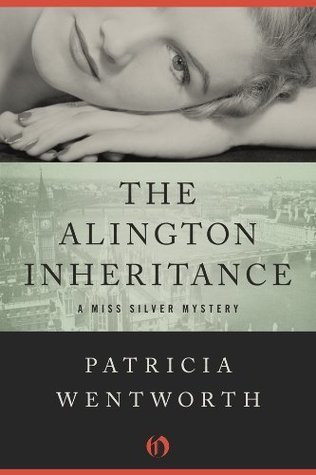
When a question of inheritance turns fatal, Miss Silver searches for the killerJenny has never been one to feel sorry for herself. The illegitimate child of a wealthy man and a statureless woman, she has been an orphan since before she can remember. It is a hard life made bearable only by the kindness of her guardian, an old woman named Miss Garstone, who has always treated Jenny as her own. Struck down by a motorist, “Garsty” dies, whispering to Jenny that her parents were actually married, and she is the rightful heir to the Alington fortune. Miss Garstone was not the only one who knew the secret, and as Jenny grieves, her wealthy cousins work to protect their fortune. When the quiet conflict turns deadly, governess-turned-detective Miss Silver is the only one who can unravel the perplexing family saga.
Patricia Wentworth--born Dora Amy Elles--was a British crime fiction writer.
She was educated privately and at Blackheath High School in London. After the death of her first husband, George F. Dillon, in 1906, she settled in Camberley, Surrey. She married George Oliver Turnbull in 1920 and they had one daughter.
She wrote a series of 32 classic-style whodunnits featuring Miss Silver, the first of which was published in 1928, and the last in 1961, the year of her death.
Miss Silver, a retired governess-turned private detective, is sometimes compared to Jane Marple, the elderly detective created by Agatha Christie. She works closely with Scotland Yard, especially Inspector Frank Abbott and is fond of quoting the poet Tennyson.
Wentworth also wrote 34 books outside of that series.
This was an ok book - but not one of my favourites. The characters were well-written and the plot moved at a steady pace, but there was no mystery involved. Also it took over half the book for Miss Silver to appear. With regard to the mystery, I was expecting a whodunnit - but that was not what this was. You are told right from the get-go who the killer is and why. All you are doing is reading how the situation works out - with no twists or unexpected events. There are better Miss Silver mysteries out there, this is one I can't really recommend.
The Alington Inheritance by Patricia Wentworth JB Lippincott Comapny, 1958 191 pages Mystery; Miss Silver 2.5/5 stars
Source: Library
Summary: Jenny Hill has always been content as Jenny Hill; until she finds out that she is actually the natural daughter of her parents and is entitled to be Jenny Forbes and claim a property. But Mac Forbes, as the current owner of that property who would be supplanted be her, will not let that happen.
Thoughts: I follow Meg Cabot's blog and she recommended the Miss Silver books by Patricia Wentworth for fans of Agatha Christie; well if you skim my archives, you'll see that I am a big fan and I'm currently involved in my own personal challenge to read all of her books so I was interested to give these a try. I went to my library's catalogue and this was the only book they had so I figured I'd give it a try.
This was not the best introduction to Ms. Wentworth's stories, I hope. First the murder does not happen until nearly halfway through the book and the murderer and motive are actually explained at the time of the murder. The only suspense is if the characters will figure it out, which I never doubted they would. So it fails as a mystery.
Then the writing, while enjoyable, is very repetitive. I read every piece of information at least twice although sometimes as many as five times. And it's not as if the words are varied; it is nearly word for word repeated. And it is not as if it happened in the beginning and then was explained at the end again; instead it happens and then is repeated something like two pages later. I ended up having to skim .I hope this is not indicative of Wentworth's other works because I would like to give some of the earlier Miss Silver books a try.
Another problem for me is that it takes place in 1958 and a huge part of the plot is whether someone is illegitimate (and thus not an heir to a piece of property) and the goings on of stereotypical small English villages. The first just seems so stupid to me in a time where it seems like so many people are having children out of wedlock and the latter is gossipy women with no ambitions in life other than to gossip about each other.
The detective Miss Silver seems a bit Marpleish, which is good as I adore Miss Marple but she doesn't appear until almost halfway through the book. Jenny, the main character, is super lame. And most of the other characters don't have much personality. The most irksome part is the way everybody blames the victim of the murder: she deserved it because she had a strong personality and knew what she wanted (ugh, the attitudes about women that are sometimes expressed.)
Overall: Repetitive and without suspense. Not recommended.
Cover: My copy from the library did not have any cover but I like the purple and I find it funny that the author's name and the detective's are bigger than the title and thus more important/recognizable to the audience, presumably.
I meant to mark this four stars, not five. As in, I really liked it, not loved it. Slip of the mouse! Wentworth seems to like to begin in media res, in relationship terms: you're left scratching your head trying to work out what's going on, because clearly these people have some tangled relationship troubles. That's how I like it! It's more interesting to me than the actual mystery.
There isn't quite enough depth and verity in the interactions for me to love it: but I do really really like it.
After Agatha Christie, I happily spend my time with Patricia Wentworth. This one, set around 1959 is mostly about family—all the various ways that families interact and relate (or not) and rely on 9en another. The pace is almost like a cozy mystery and there is actually very little blood or other moistness (other than crying) so it is quite palatable to most readers. Calming read.
I will start off by saying that The Alington Inheritance was not at all what I expected. I have read other books by Patricia Wentworth (The Benevent Treasure being a favorite), but this book did not adhere to expectations.
That's not necessarily a bad thing, just different. The Alington Inheritance was one of the last books published by this author, and I do wonder if she decided to do something a bit unusual and focus on the people rather than the plot. This book does have a murder, but forget about the mystery and forget about unexpected plot twists (and prepare for a deux ex machina or two). In fact, once the murder occurs, write down your own ending in a few sentences. You'll be spot on.
But that is not the charm of this book. This book is a study in character. Many characters, in fact. It takes the stock players of your typical village murder mystery and makes them...real. I daresay there is not one character - even those who appear only in a few scenes - who isn't given a moment of introspection, of color, their soliloquy on the stage. The author shows in this book the true means of success for every good character in any medium: backstory, motivation and human frailties. A plot is vital, but the characters have to come alive. They do in this book, and many grow and change by story's end.
This is the 31st of the 32 Miss Maud Silver series. It is an enjoyable cozy mystery. It doesn't seem to be as loaded with characters to keep straight as in many of others in the series, nor is the mystery particularly puzzling, but the story comes to a satisfactory resolution as I have come to expect from the Patricia Wentworth mysteries. Although this can be read as a stand-alone, the enjoyment of Miss Silver is enhanced by following her cases through the whole series.
I really love Miss Silver mysteries. This was one of the best. I locked into the characters and was stressed in all the right places. Also, angry at the right places and at the right people. It took me a few Miss Silver books to get used to Ms. Wentworth's formula. You get the prequel and then Miss Silver steps in to wrap it up. Everyone loves Miss Silver. Recommend.
Jenny Hill has been brought up by an elderly lady she calls Garsty and who was her mother's governess. Just before her tragic death following a hit and run accident she tells Jenny that there is a letter from her father to her mother showing that they were actually married and that therefore the local big house should actually belong to Jenny.
The letter seems to have gone missing. Jenny is taken in by Mrs Forbes at the big house to look after her two girls. But Jenny overhears a conversation between Mrs Forbes and her eldest son - Mac - with whom Jenny is just a little in love, which shows her that they are aware she should own what they regard as their own house.
Jenny feels she cannot stay in the house any more and runs away that night. Fortunately she meets up with a distant cousin who takes her to his aunt, who takes her in while they decide what it to be done. Then a murder is committed nearby and Jenny herself is in danger. Here is an ideal case for Miss Silver to look into and she does so very efficiently but not before the wrong person is accused and it looks as though the real murderer will never be revealed.
I enjoyed both reading and listening to this well written Golden Age mystery though it was actually first published quite a long time after that Golden Age of British crime fiction. Miss Silver is always clever and percipient and her knowledge of human nature and the minutiae of everyday life is second to none.
The Miss Silver series can be read in any order even though they are part of a series as the only things which mark out the passage of time are the promotions of Frank Abbot and other detectives of Miss Silver's acquaintance and the marriages of her various relatives.
2024: my 2021 review says it all, still a 3 star listen for me.
2021: Repeat late-night listen. I have assiduously avoided revisiting this Miss Silver mystery as the opening chapter is not a captivating beginning for me and I find the teenaged girl/woman in the story unappealing: I coped with Jenny as the lead character a bit better this listen through, perhaps because I was focusing more on other characters around her - Richard’s aunt (lovely woman), and young Meg (she’s a precocious delight) , and, Dickie (a bona fide scamp). The ending for Max was the best outcome for him, and, Jenny, and, little Joyce and Meg.
I haven't read a Miss Silver book in years, though at one time I'd read a lot of them. I picked this one up to fulfill a reading challenge, and found it very, very good. Jenny is only 17 when her beloved guardian dies. She finds out at the same time that she should have inherited Alington House and the family money instead of the woman who lives there now with her four children. How the events unfold is a fascinating story of secrets, gossip and murder. There was a strong atmosphere of danger in this book. Though the reader always knows who the baddies are and what they're doing, I still felt nervous for Jenny until almost the end of the story. 5 stars
I picked this up on sale and I'm really glad I did. It's one of those quaint little books that just kind of fill your heart with knowing that everything works out in the end. A solid 4 star read. I recommend this book to those who like simple kind-hearted stories that have some intrigue and very little violence. BTW, I was unaware that this book is part of a series, when I read it. So, it is fine, standing well, on it's own. JP
Not a whodunit, because not only do we know who done it, we see them plan it and carry it out the murder. This is more about how all the clues are found and the blame comes home to roost with the guilty party.
In the middle part of the 20th century, the expectation was that all young girls were just waiting for a masterful man would show up, say "Darling!" several times, and that was it, love and marriage, even if the girl was a dreadfully wet blanket.
A departure from the author's nirm, in that the reader knows all along who the criminal is and the tension comes from watching the other characters figure out what happened. I particularly enjoyed the characterizations in this one, as well as Wentworth's creatively vivid descriptions.
This was a bit different from most of the other books in this series. Miss Silver didn’t show up until halfway through the book and seemed almost an afterthought. And this time she didn’t solve the crime!
The story was just “ok”. It didn’t help that I didn’t much care for the instant romance between a vulnerable, weepy, naive 17 year old girl and a man of 25… I thought it was a bit skeevy.
All the same, I am in a full-blown panic… there is only one more book in this series. Boo-hoo!
Desperately in need of a good editor. Multiple repetitions of dialogue as well an unresolved (and apparently forgotten) "mystery" of the death of one of the first characters mentioned. I don't know if Wentworth forgot to tie it in with all of her typical tidy endings or if her characters really are that naive/heartless. Miss Silver doesn't do any sleuthing here. She's basically just along for the ride.
The murderer in this case appears normally intelligent, but sets himself up in a fantastically stupid way (thanks, I guess, to his overweening arrogance). He may as well have flipped a coin with regards to what happened with his note.
This is a reread. My original rating was 4 stars, but I've downgraded it to 3 - ok, maybe 3.5 stars, but it definitely isn't one of Wentworth's best.
It is the only one of Wentworth's novels (as far as I am aware) where the murderer is shown committing the murder. The tension in the story comes from wondering if he will be caught before the wrongly accused person will be hanged and before he can kill again. This could have worked really well, but unfortunately, the writing is quite tedious - perhaps Wentworth was getting tired after writing so many Miss Silver novels?
Miss Silver interviews multiple people, and each time we are given their story in full, whereas in other novels, we would get something along the lines of "I have spoken to everyone who was present, and all their statements agree." This makes for a lot of tedious repetition and I found myself skimming over large chunks of text.
My biggest issue with this story is the central romance. Jenny is supposed to be very innocent, but I struggled to believe that any 17-year-old in the late 1950s be so naïve as to be unaware of the dangers of telling a strange man she is running away from home, that no one knows where she is and then asking him for a lift to 'anywhere' in the early hours of the morning.
I also found it stretched credulity to believe that the random motorist was a distant cousin of Jenny's. That they both fell in love with each other at first sight is not surprising, but the way in which Jenny was rushed into an engagement by a man 8 years older than her and his middle aged aunt made me deeply uncomfortable. While I'm sure Wentworth meant it to be romantic, it felt unpleasantly manipulative to me.
Contrary to other reviewers, I didn't find Jenny to be too feeble. It's true that she spends a lot of time crying, but considering that in just a few weeks she has experienced the death of her guardian/mother figure, the loss of her home, the discovery that people she thought loved her were plotting against her, another loss of home, attempted murder...I'm not sure I would have been any braver if I'd had to deal with all that at 17!
Minor irritations: Miss Garstone's death is never properly explained - there is a conversation between two characters that hints one of them may have been responsible, but it's never clearly resolved.
When Jenny runs away, she is supposedly unable to squeeze a change of underclothes into her tiny case, yet finds room for 'half a dozen handkerchiefs' and her mother's Bible. 1950s undies weren't THAT bulky!
On the plus side, this novel has some of my favourite fringe characters, especially the children. But if you're new to Miss Silver mysteries, please don't start with this one!
Jennifer "Jenny" Hill had always considered herself illegitimate until the death bed confession of her governess and guardian who was dying from her hit~and~run injuries. Miss Garstone or Gartsy, her guardian, confessed that Jenny's parents were really married and proof could be found at Somerset House. She withheld the information because Jenny would be taken away from her... and as a result, she had allowed the Fosters to think themselves the heirs to the Alington fortune and estate when in fact Jenny was the true heir being the daughter of the elder son and heir, Richard Alington Forbes who married Jennifer Hill before his plane was shot down in the war. At the Dower House? on the Alington estate, Jennifer gave birth to her daughter then died. After her guardian's funeral, Jenny was taken to the main house to serve as governess to the two youngest girls... then she overheard the Fosters, mother and eldest son, ruthlessly plotting to marry her off to Mac to get their hands on her inheritance given the truth as found out by Mac in Somerset House after removing Richard Foster's last letter to his wife from one of Gartsy's little chest of drawers. So, she bolted. This was full of coincidences as a means of moving the main character from one place to another... plausible with a bit stretch. Still a Good read given the events following Jenny's escape.
Jenny Hill has learned she is the sole heir of Alington estate — land and monies. She was raised in a cottage across the road from it by a maiden lady, while other Alington family members occupied the property. She had never been told of her true parentage, nor was it common knowledge.
Jenny found out by accident one night, by overhearing a conversation between the current mistress of the manor and her oldest son. She also found out deception was their plan to keep her from her inheritance.
In a panic, she ran away from the situation and wound up meeting a young man who was a distant relative, with no vested interest, and who was willing to help her.
When a murder occurs, Miss Silver is asked to come and investigate on the part of the accused. There is a question if there somehow may be a tie to the secrecy of the Alington inheritance situation.
Again, Miss Silver questions all and looks for loops and disparities in peoples’ alibies, tells that let her know someone is lying. In a small village, where she comes from, secrets are hard to keep. It is the same where the crime happened.
I’ve enjoyed a number of books from Patricia Wentworth’s Miss Silver series.
I am wild about Miss Silver and my relative disappointment in this book is that she played such a minor role. Her presence was felt, but she didn't appear until mid-way through the novel, and although her "moral compass" prevailed in bringing justice, she played a relatively minor role in the story.
The Miss Silver chronicles always seem to include a chaste (but satisfying) romance, but in general this was darker than most of Wentworth's books. And, there was no mystery regarding who committed the murder, but the tension centered around whether the man unjustly accused would be freed from the charges.
My favorite element of the book was Miss Silver's influence on a 10 1/2 year old boy who held the key to the story's resolution---Allingham has created a unique character that never fails to impress.
(Not really this ebook version, but the other isn't listed.)
Other reviewers note that this isn't a typical Miss Silver mystery, which is a good thing, because if this is what they're all like, I can't imagine why anyone reads her. A comfortable read, because it's evident that terrible things won't be happening to any of the likeable characters. HOWEVER, details are repeated and repeated and repeated. Miss Silver has to hear every conversation word for word, even if thee reader's already experienced it; and that important letter gets repeated every single time it's mentioned.
Still, I'd like to try another; perhaps this really isn't the best place to start with Wentworth.
What a truly bizarre book. It felt longer than it really was. At times I was ready to rate it 4 stars. It was incredibly inconsistent and just, really really weirdly written.
We start out with Jenny, who is the most USELESS HELPLESS woman in the world, who can't bear to stand up for herself in any way or have even the smallest amount of assertive activity, who literally has to be persuaded for days just to simply write a letter so she can claim her massive inheritance, because gee gosh the people she used to live with until she found out they were her enemies would be put out and inconvenienced and a little socially embarrassed. HUH?? I have never read a character who has less backbone, less spine, less courage, than our protagonist Jenny. The one active thing she did was run away, and other than that, she simply let the plot happen to her (or even try to actively resist it out of fear).
At first I was saying to myself "well we gotta start with a flawed character so she can overcome the flaws by the end right?" but no - someone else steps in and solves the mystery for her and other people bring her back home and even by the end she's relying on her new man and his mom to support her in deflecting mildly awkward social situations because she can't do it herself. You truly get the impression that she learned nothing and experienced no growth at all from this, other than a lucky inheritance and marrying her cousin.
That was also weird - I mean, a distant cousin, sure, but not THAT distant, and the book really amped up the weirdness by stressing how much the guy looked like their great grandfather, to the point of Jenny thinking she was LOOKING at her great grandfather at first because he so accurately matched the portrait of her great grandfather that was in the hallway that she saw every day her whole life.
So basically imagine growing up with a portrait of your grandpa's dad hanging on the wall, when he was a young man, looking dapper I suppose, and then one day when you're 17 you meet a guy who looks JUST LIKE THAT, because you find out he's your cousin (he even has the same name - he's named after him!) and thinking HELL YEAH! WHAT A HOTTIE! "Dang, my great grandpa sure was hot, hope I meet a guy just like him! Maybe someone in the family..."
The book did not get into that aspect of it at all because it was just assumed to be completely normal, and perhaps it was at the time, but reading it now is insane.
The cover of the book says it's a Miss Silver story but Miss Silver does not show up until the book is about 50% done, so that's pretty misleading. Although then she does sort of take over, but at that point you've already fully committed to Jenny as the protagonist, and all of a sudden Jenny gets sidelined. Which, great, she sucks as a protagonist, but also this is just jarring as hell. Not well written, not paced well.
It seems like this book is constantly giving us more and more and MORE side characters too, and telling us about their inner lives and so much unnecessary backstory. We're introduced to one side character, then a side character in THEIR backstory, then a side character in THEIR backstory, and all of a sudden we're hearing about character relationships five levels removed from the main character, for no reason at all.
The random bratty little kid, Dicky, was also so annoying, and his mom was written to be so stupid, for absolutely no reason other than to frustrate the reader I guess since her character played no other part.
I haven't even gotten to the most absurd thing about this book though, and it's really something - spoilers for the ending here.
The villain/murderer, Mac, and his not-quite-as-evil but still very manipulative and cunning and immoral mother, Mrs. Forbes, have this weird mom-son evil partner relationship, although the mom is a little afraid of the son, she is also basically in love with him in a weird obsessive way.
Jenny and Miss Silver find the evidence that will conclusively prove that Mac is the killer. Nice! Jenny, for whatever reason, CALLS MAC ON THE PHONE AND TELLS HIM THIS. Girl he tried to kill you and has been pure evil to you forever why are you giving him time to get away???
Mac hangs up, knows the police are going to close in, but he has time to get away, thinks about escape options, thinks about his life... and then just gets a gun out of a drawer and shoots himself in the head, boom done.
This was lame, it robbed the reader of getting any satisfying ending for the villain, they don't lock him up, they don't tear him down, they don't get to do anything with him - just boom bang dead.
Then his mom, Mrs. Forbes, gets the telegram that her son shot himself. And she cries and cries and ... opens up a drawer and ALSO takes out a revolver and ALSO shoots herself.
WHAT!!!
This is in the space of like two pages and it was one of the most absurd things I've ever read, like, all this build-up, this sociopathic partnership of cunning villains, then they just both commit suicide the end. WHAT! I had to put the book down I actually laughed out loud, I was already dumbfounded at Mac's suicide and then to read the mom's immediately after I felt like I had to be imagining it. What a preposterous stupid ending!!
There WERE some really good parts in this book, some sections and chapters just happened to be written very well, so that's why it's 2 stars instead of 1. I was thinking it was a solid 3 star book until I got to the ending. What an odd, odd story.
World War OK left devastation behind and the characters in this book show that. Jenny, the central character, lives with her former governess after the sudden death of her father in the war and her mother soon thereafter in childbirth. It's assumed that her father died before they could get married so she bears the stigma of illegitimacy too.
It is a good read for me when the good people win. The suspense is sufficient. Those at the fork in the road take the better way. The innocent suffer but stay strong. All the good, old fashioned values we secretly long for . . .
Orphans, busy bodies, a lost heir, precoscious children, gallant young men, and the murder of an unfortunate young woman are the characters that make for a delightful English village mystery.
This book is remarkably old fashioned, as are the characters. And I loved every minute of it. Mac is despicable. His mother is worse. Jenny is one amazing 17 year old. It is hard to even imagine what she has been through.
Patricia Wentworth is the pen name of Dora Amy Elles, who was born in British India in 1877. In all, she wrote sixty-six novels, thirty-two of them in the Miss Silver series. I stumbled into the Miss Silver stories when I read "The Case of William Smith" 1948, which was number thirteen. I liked it well enough to go back to the start of the series and read "Grey Mask" 1928. I've subsequently read all of the books in order--except William Smith--and I've just finished book 31, "The Alington Inheritance" 1958. This review is as much about the series as it is about book 31.
The dates of each story is important in that they are all written contemporaneously. Each story is set in the time in which it was written. However, our protagonist doesn't seem to change at all, although she's obviously aged some thirty years from series beginning to ending. Miss Maud Silver is a former governess and teacher, to which referred as "the scholastic profession." Somewhere during the early inter-war period in southern England, Miss Silver enters a new profession--Private Enquiry Agent. You guessed it, she's a private investigator.
We're never told exactly how she made that remarkable transition, but throughout the series of stories there are several references to the case of the poison caterpillars, but we're never told any details. Unlike some other "P.I.s," Miss Silver has a close working relationship with the police force, including a rural county force and Scotland Yard inspectors. In fact, one young Detective Inspector, Frank Abbott, and she share a strong friendship and deep respect for one another.
Inspector Abbott is back in action in "The Alington Inheritance" when a young woman is murdered in a village just outside of London. Frank has arrested a young man who seems the likely suspect, but Miss Silver in engaged by the suspects father to solve the murder in order to save his son. Miss Silver's normal modus operandi is that she can't prove the innocence of any suspect, but that she will work to find the truth, wherever it takes them.
Miss Silver works the inside of cases, and as such she's often privy to information not available. Once again, this proves invaluable, as she discovers peripheral facts that at first don't seem to be connected to the murder at all. In truth, they're at the heart of the crime.
Our story includes widows and orphans, and cousins and inheritances galore. All of these elements seem to be among Wentworth's favorite factors leading to the crime at the heart of the story. There are deceitful relatives and nosy neighbors around every corner, but Miss Silver is there to sort it all and save the day--of course.
I'm not going to tell you the plot. You'll have to discover it for yourself. What I will tell you is that I enjoyed this story even more than I have most of the others. Wentworth's characters are amazingly well crafted for us, and she's a master of using their dialog to define who they are in the society of the time. Every novel is a balancing act of plot movement or action with the background information and inner emotions of the characters. Wentworth errs a little on the side of too much detail, but the action catches up with it in the end.
Each of the Miss Silver books works as a stand alone story if you choose. Not everybody is as obsessive as I am about binge reading them in order from start to finish. Either way, you'll enjoy coming to know Miss Silver as much as I have. Happy reading.