With over 600 colour illustrations, this book offers an entertaining yet informative guide to Victorian art. Embracing the entire English-speaking world, the book presents a rich panorama of one of art's most fertile periods.
The subject of this cornucopia, this fount of earthly delight, is at once completely simple – paintings made between 1819 and 1901 – and intoxicatingly complex. We flit from the home to the factory to the railway station to the sick-room to the battlefield, from the West End to the Wild West and from the East End to the mysterious East in the company of the young the old, the sick, the poor, the joyful, the suicidal, the drunks, the beggars, the musicians, tailors, stone cutters, jockeys, gamblers, and those that just sit and do nothing in particular. Victorian photography was only in black and white, but these paintings are all in COLOUR, great spouts of it, going everywhere. Reading this book, should I say rather drinking it like a horse at a horse-trough, noisily and ignoring all else, over the past couple of days made me slightly drunk with the plenitude of all these scenes, all this scrupulous presentation of a kind of hyperreal version of what actually was. It’s realism, Jim, but not as we know it. I bet it’s not everyone’s taste but I love a whacking great canvas stuffed with three hundred busy figures all frantically engaged with each other, all getting off or getting on something big, all huffing off to a wedding or down at the country fair watching the freak show. Towards the end of the period, the impressionists came in and gave the big French boot to most of this stuff, they found it, and many have agreed, insufferably sentimental. Okay. You may well be right, you cool ironists of the twentieth century. You’re going to point to pictures like The Doctor (Luke Fildes, 1891) in which a sick child lies sleeping whilst an old doctor stares at her, desperately trying to think of something useful to do. Or A Hopeless Dawn (Frank Bramley 1888) in which the young wife of a fisherman is slumped across the lap of her old granny in the most picturesque of cottage with the dawn’s light breaking in just so – it’s a three handkerchief job, for sure. They liked babies. Well, who doesn’t? But they really liked babies. Here’s Whistler on the subject – he was sorting out paintings to display at the London Academy one year:
You know, the Academy baby by the dozen had been sent in and I got them all in my gallery – and in the centre at one end I placed the birth of the baby – splendid – and at the other end the baby with the mustard pot and opposite that the baby with the puppy and in the centre the baby ill, the doctor holding its pulse, mother weeping. On the other, by the door, the baby dead – the baby’s funeral – babies of all kinds and shapes…
They also liked animals. And they liked to kill them too :
Who does not glory in the death of a fine stag? there is something in the toil and trouble, the wild weather and the savage struggle which makes butchers of us all. (Sir Edwin Landseer)
They had all kinds of odd, uncomfortable, unacceptable views about everything. It’s true, we’re better than they were. A bit more clued up.
The author-editor Lionel Lambourne puts it thus
The work of mid-Victorian artists and novelists confirms the fears of those sensitive to sexism that most male attitudes were deeply chauvinist p 375
(I assume those not sensitive to sexism will have no problem with the mid-Victorians.)
The Victorians weren’t scared to take stuff on, though. You have to give them that. they weren’t timid. They went at things with gusto. They catalogued everything, They invented everything not already invented by the Chinese and the Greeks. Then they painted it all, in meticulous detail. Here are some of the chapters of this book:
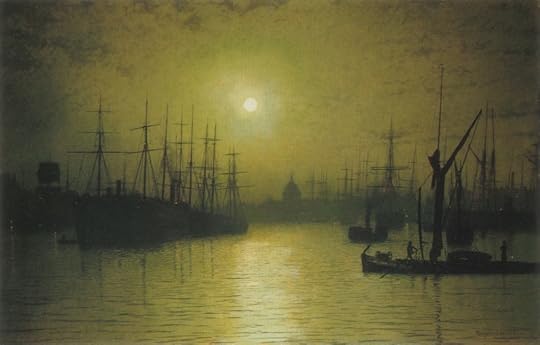
Portraits, landscapes, panoramas (they loved those), genre (narrative) painting, childhood, fairies (Richard Dadd, for instance, who murdered his dad, and painted The Fairy Feller’s master stroke in the madhouse, as great a painting as ever was), sports, animals, pre-Raphaelitism, social pictures, social realism pictures (problems!), emigration (farewell Paddy, shall I never see your blue eyes no more?), the frailer sex, the fallen woman (they loved those, you might say they had an unhealthy interest in the subject), America, the grand colonial adventure, and plenty of nudes. William Etty’s paintings of nudes were so luscious they were called “bottomscapes”. So they were big and brash and masculine – see for example the brilliant celebration of men bashing stuff with big hammers called “Iron and Coal : The Industry of the Tyne” which has the magnificent subtitle “In the Nineteenth Century the Northumbrians Show the World What Can Be Done with Iron And Coal” – and they were quiet and unhurried (“Nightfall Down the Thames” by John Grimshaw – someone steal that one for me, please?).
George Eliot also liked the quiet ones:
I find a source of delicious sympathy in these faithful pictures of a monotonous homely existence, which has been the fate of so many more among my fellow mortals than a life of pomp. I turn without shrinking from cloud-borne angels. from prophets, sibyls and heroic warriors to an old woman bending over her pot, or eating her solitary dinner while the noonday light falls upon her mob-cap and touches the rim of her spinning-wheel
I could rant and ramble on about all this but you get the picture… when you pick up this book (you may need a friend to help you, it’s big) you’re in the thick of it. All human life is here.
A final quote from the Bishop of Carlisle (can we detect just the merest twinkling of his clerical eyes here?)
the case of an Old Master much allowance can be made, but for a living artist to exhibit a life-size almost photographic representation of a beautiful naked woman strikes my inartistic mind as somewhat if not very mischievous
Wow. I didn't realize how much I would love this era of painting (1819-1901 - Queen Victoria's life). I was worried it would be too many portraits. Indeed, the human face was of great interest, but I found most of these painting had multiple-to-many faces. Even the few single-persons, usually had a complicated background or highly ornate dress.
The text is perfectly laid out in this huge 10x12 inch book format. The detailed writing is easy to read, yet richly in-depth. The 626 color plates are placed exactly where they belong in the flow of the writing to let the reader immediately see the painting that is being talked about on that page of text. I sampled some of the readings, but I can tell this will take many readings to extract all the features in here.
Each plate has all the proper details of artist, title, year, size, etc. There were SO many different artists represented in this book. Easily a few hundred.
I am not an artist, but I tend to like the impressionists. Now you can count me as one who like the Victorian artists as well. I either liked or loved every print in this book.
I liked the layout of this book: it's packed with big, full-color images of paintings that correspond with the text, meaning that the image being discussed is on the same page (or thereabouts) as the image itself, which allows the reader to easily move back and forth between image and text. I enjoyed how Lambourne gave a number of contexts for the paintings, ranging from broad sociopolitical factors and artistic traditions to private squabbles between artists and the love affairs they had with their models. (The gossip about the Pre-Raphaelites was familiar, but seeing how it is reflected in the paintings they were producing made it even more titillating.)
The book gives preference to a handful of artists and styles while glossing over others, but it's a good starting place for getting a sense of the period's art and how it changed as the century progressed. The book is loosely organized by genres and themes (i.e., portraits, landscapes, women painters), but at times it felt like the narrative struggled to make connections among the paintings in a given chapter, especially toward the end of the book. I also thought that colonial art should have received more attention than one slim chapter, but overall, the book offers a nice general overview of the period.
Very exhaustive, great photographic research book. Tonnes of great works are covered with plenty of descriptions of the timeframe. Thoroughly recommend.
The art history classes I took in college neglected much of the material presented here. And that's a shame. I'd much rather have studied these artist shown in this book than over-praised Impressionists.
This is a huge, large and beautiful book. There's hundreds of paintings reproduced in color. There's some great chapters and terrific writing.
I got this book from the library and I've decided that I must buy a copy, even though it's quite expensive. I cannot recommend this book highly enough.