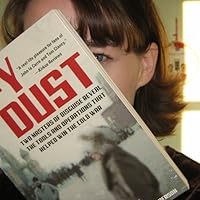
The Mysterious World of Agatha Christie is a 1975 non-fiction analysis of the works of Agatha Christie written by Jeffrey Feinman. An intimate backstage look at the working methods of the greatest puzzle weaver of all time-including a complete bibliography of her work.
This book was published in 1975 just before Agatha Christie's death in January of 1976. It includes a few chapters of biography about Dame Agatha and how she became such a success. There are also chapters about her most famous characters, her theater plays, and movie adaptations of her works. There is an analysis of the components of a good mystery, and whether or not mystery novels can be considered as artistic literature. There is an entire chapter full of quotes from her critics. The last chapter is a Mystery Quiz, where the reader can try to guess which Christie book has some particular factor or item.
I was disappointed in this book. First of all, the author includes several major spoilers for some of her most popular novels, such as the ending of Murder on the Orient Express. I started skipping ahead anytime that I saw the title of one of her books that I haven't read yet, so that I would not get spoiled!
Secondly, the information about Christie's life and background does not look reliable at all. At one point, the author says that "Frederick Miller figures in his daughter's life mostly by his demise, for he passed away while Agatha was still quite small. ... Agatha herself remembers only her mother." However, the truth is that Agatha's father died when she was 11 years old. But this book makes it sound as if Agatha either has no memories from before the age of 11, or as if her father must have died when she was 3 or 4 years old (before a person would normally have long-term memories of childhood). The information in this book makes no sense at all, and it is misleading.
In another place, the author says "The family tree of Mrs. Miller... is generally surmised that she was from an extremely wealthy, multiply-titled family." However, Agatha's mother was quite poor, and her family were certainly not titled. Wikipedia says "Christie's mother Clara was born in Dublin in 1854 to British Army officer Frederick Boehmer and his wife Mary Ann Boehmer née West. Boehmer died in Jersey in 1863, leaving his widow to raise Clara and her brothers on a meagre income." Yes, the author did say that it is "generally surmised", but seriously, a little investigation would have given you the facts. I didn't feel that I could trust anything this author wrote after that.
I did enjoy the quotes from Christie about how much she loves Dickens and Trollope and Jane Austen. I was delighted to find out that her favorite Dickens is Bleak House, which is also one of my favorites!
I also enjoyed the chapter that compares Christie's writing to other famous detective story writers like Dorothy Sayers, Sir Arthur Conan Doyle, G.K. Chesterton, and one of the first mystery writers, Edgar Allan Poe. It was interesting to explore what made all these mysteries so great and so widely loved.
I had high hopes for the chapter about Christie's famous characters, Hercule Poirot and Miss Marple. I was hoping for a deep analysis of the characters, but the chapter was pretty superficial and just talked on and on about how popular the characters are and how they have found a place in literature that makes them memorable. Not what I was hoping for. I'm not really sure what the author's qualifications are as a literary critic or biographer, but this is not very well written.
I very seldom read biographies, and the fact that I read this one speaks well of the topic. It seems better (4 stars) than on-par (3 stars) for the genre, but it is still a biography, which means that it's less enjoyable for me than my usual non-biography reading. If I were an average biography reviewer, I'd probably give it 4 stars, but since I am the one reviewing it, I'll give it 3 stars.
To be honest, the reviewer refrained from my pet peeve for biography, assuming that because something worked well for an individual, that it will work well for the rest of humanity. (From a statistics standpoint, n = 1, which isn't very significant...)
Instead, this biography is one of admiration for Agatha Christie, without encouraging the rest of us to start writing crime fiction, or excelling in whatever fashion.
One of the reasons that I read it is curiosity in what happened to Agatha Christie when she went missing. This book takes the publicly given reason that she truly suffered a nervous breakdown. That may be the case. I don't know. There has been other speculation, as to whether it was a publicity stunt, or some other act. It's the mystery within the mystery writer's own life.
The cover says that this is "An intimate disclosure of the carefully guarded private life" and it's not, really, or at least not beyond what's already been made public. I would hope that the author wouldn't invade Agatha Christie's privacy without permission from either herself or her descendants. She was still living at the time of publication.
Still, it is an enjoyable read, and I learned several things about the author. I didn't know how she most often employs nursery rhymes in her titles, or how people accused her of always having the similar settings of elaborate country houses, or that Christie claims that her daughter Rosalind could always solve her mysteries well before the end.
I had thought before about Agatha Christie breaking some of S. S. Van Dine's rules for fair play for mystery writers. In fact, I think she liked to flaunt them.
I like this description of Agatha Christie's writing: "Agatha Christie writes animated algebra. She dares us to solve a basic equation buried beneath a proliferation of irrelevancies. By the last page, or final curtain, everything should have been eliminated except for the motive and identity of the murderer: the elaborate working-out apparently too complicated to grasp, is suddenly reduced to satisfactory simplicity. The effect is one of comfortable catharsis." - Francis Wyndham
One of my children wrote a high school thesis contrasting Agatha Christie and Sir Arthur Conan Doyle's writings as to which impacts society more. This author agrees with my child that it was Christie, but for a different reason: people relate more to the psychological aspect of it than they did to Holmes' laboratory skills. "But Miss Marple's uncanny ability to read human nature and Poirot's skill at finding the hidden truths in obvious things will always be virtues of human life."
It's interesting to me that mystery fiction isn't considered an art in some circles because the stories have to follow a formula, but that the same isn't said of sonnets, who have their own formula.
Feinman writes, "If anyone should hold it against detective stories that they aim to soothe, let it be remembered that this really the aim of all art; to give us some comfort by helping us to comprehend, to mentally master what we can never get the best of physically. Mystery stories, like chess, are small, self-contained worlds where unique laws obtain. We would never think of faulting chess because it isn't very much like the real world, why should we do so for the murder mystery?"
I vastly prefer Joan Hickson's acting of Miss Marple more than Margaret Rutherford. Hickson's is truer to Agatha Christie's writing, and she also gives the impression that she cares about people. She could be one's kindly old aunt or grandma. Rutherford is more ruthless and arrogant in her attacks. I can't imagine anyone actually liking her Miss Marple if they met her in person, much less confiding in her.
I didn't do as well on the quiz in the back of the book as I should have. I think I rushed over it, because they were cartoons.
I always like to read the writers that inspire my favorite authors to get a glimpse of their inspiration. In this case, I haven't read many of Agatha Christie's favorite authors. I have read Jane Austin and Charles Dickens, but not her favorite Dickens, Bleak House. (My dad didn't like Bleak House, calling it "Bleak.") I haven't read Elizabeth Daly, Michael Gilbert's early works, Margaret Miller, Patricia Highsmith, Hugh Walpole, Elizabeth Bowen, Graham Greene, Muriel Spark.
I have read Alexander Dumas' "The Count of Monte Cristo" with the Abbe Faria character that predates Edgar Allen Poe's detectives in the mystery genre. But Feinman attributes the mystery genre to Poe's "The Murders in the Rue Morgue." I haven't read that one, but I don't like reading Poe very much. The ones I've read of him are not so much a mystery to be solved as the sense of horror.
I do like G. K. Chesterton's Father Brown.
Favorite Quote: "I used it again in Towards Zero, when a girl who has tried suicide is told that any moment before the end might be the important one. This I believe."
I like Feinman's description of why people like to read mysteries:
"The reader 'escapes' into the detective story, where nothing is impossible to solve and where the unfathomable can be explained by logical thinking. In a world whose every tendency is to greater and greater disorder, we are profoundly soothed by this sort of perfect explanation for terrible deeds. The effect is further enhanced, particularly by wry, somewhat detached writers like Agatha Christie, because of the attitude the detective takes toward homicide. To Hercule Poirot or Miss Marple or even Tommy and Tuppence Beresford, murder is so matter-of-fact, so interesting; a fascinating puzzle to be worked out much like a picture puzzle on one's game table in the drawing room. All fears are dispelled and all questions are answered."
In the chapter, "Challengers and Champions; Christie's Critics", I also like Margery Allingham's description of it:
"As it emerges today the detective story proper is a form of entertainment almost entirely cerebral, since it aims to provide a means of escape for those who do not wish for some excellent private reason to take their emotions for a ride with the novelists. In its never-never land where Death is merely a cipher for the most important happening, and the puzzle is the thing, it is perhaps not at all surprising that a charming, shrewd and essentially civilized matron should be high priestess of the cult."
I think the mystery genre has changed since that golden era. Now readers want to feel rather than to think, and most so-called mysteries don't have enough clues before the grand reveal to actually solve them.
I recently discussed the reasons for people to read mysteries in my review of Lorna Barrett's "Bookmarked for Death," because the author gave her own reasons as to why people read them: - - - - - - "Over the years more than one friend or acquaintance had asked Tricia why she was so enamored of the mystery genre. How could she actually enjoy stories that celebrated violent death? They had it all wrong. The books didn't celebrate death but triumph for justice. Too often real-life villains got away with murder, but in fiction, justice was usually assured."
I would've said it's the intricate puzzle solving that's the appeal, but many books today focus more on the excitement and emotions (suspense novels) and less on actual clues (mystery novels) even when classified as mystery.
I do, however, know one person who says she reads mystery novels so that the violence vents her frustration in ways she wouldn't act out in real life. In that, I suppose it's no different than playing violent video games, but I find them both to be unnerving, because they are not working to come to peaceful terms with people.
One of my kids says that mystery readers feel like they are missing out in excitement in real life, which draws them to the genre, and that romance readers feel they are missing out on romance. I'm not sure that's entirely true, but it may be for some people. When I read a romance, it's generally for the character stories, or sometimes, for the acts of kindness, because I feel our society, in general, can be devoid of kindness. I can be happy to read character stories of kindness whether or not they involve romance (my personal definition of a comfort read, or a cozy read.)
Also, some mystery TV shows seem to like to showcase the stranger, bloodier crimes to appeal to people's curiosity or sense of the macabre.
So I think people read mysteries for a variety of reasons. - - - -
Reviewer Kailey pointed out two errors in Feinman's "Agatha Christie":
"The information about Christie's life and background does not look reliable at all. At one point, the author says that "Frederick Miller figures in his daughter's life mostly by his demise, for he passed away while Agatha was still quite small. ... Agatha herself remembers only her mother." However, the truth is that Agatha's father died when she was 11 years old. But this book makes it sound as if Agatha either has no memories from before the age of 11, or as if her father must have died when she was 3 or 4 years old (before a person would normally have long-term memories of childhood). The information in this book makes no sense at all, and it is misleading.
"In another place, the author says "The family tree of Mrs. Miller... is generally surmised that she was from an extremely wealthy, multiply-titled family." However, Agatha's mother was quite poor, and her family were certainly not titled. Wikipedia says "Christie's mother Clara was born in Dublin in 1854 to British Army officer Frederick Boehmer and his wife Mary Ann Boehmer née West. Boehmer died in Jersey in 1863, leaving his widow to raise Clara and her brothers on a meagre income."
"Yes, the author did say that it is "generally surmised", but seriously, a little investigation would have given you the facts. I didn't feel that I could trust anything this author wrote after that."
I thought this was a nice, if dated, collection of tidbits about Agatha!
The only thing that I found off-putting was the author's clear Agatha worship, complete with exclamation points. There were some statements that were a little cringe-worthy. But I chalk that up to excess enthusiasm, and the spirit of the times. Everyone was excited because Curtain had just been released.
The book is split into sections, including a section at the end of criticism, which I thought was maybe not the best way to end. So I read that earlier, and then went back and read the bit about the detectives. I loved all the Poirot details, and wish there had been more details on Miss Marple. She seems kind of glossed over. And I get it, she only has a small number of books, especially compared to Poirot, and this was written right after Curtain. But I do love Jane.
I loved all the quotes from the Dame, and a few factoids which were enlightening, such as how she is both a Lady and a Dame (not being British, I had no idea they were separate, or what they meant or where they came from). Also, I did not realize that she so enjoyed decorating houses, and that at one time she owned 8 homes!
I also agreed with the author's explanation for why these stories have lasting appeal, and his comparisons to other authors who didn't have as much staying power. I especially liked his little bits on why it is comforting. This explains a lot for me, since during 2020 I went through a few months where all I wanted to read was Agatha (summer, after George Floyd was killed).
"In a world whose every tendency is to greater and greater disorder, we are profoundly soothed by this sort of perfect explanation for terrible deeds." "If anyone should hold it against detective stories that they aim to soothe, let it be remembered that this is the aim of all art; to give us some comfort by helping us to comprehend, to mentally master what we can never get the best of physically."
A lovely discussion of the literary merits of detective fiction in this section, too.
I have only just finished my reading of Poirot, all in order (following my reading in order of Miss Marple back in 2019), and I think that is the perfect time to read this little volume. I got it from a bookseller on IG, just because I hadn't seen it before. Very interesting, and a nice addition to my collection (complete with the cigarette ad!).
This is a very dated book, but that’s the least of its problems. Dame Christie didn’t give interviews, so there’s not much about her in this book. The author has instead plumped it up with all sorts of boring filler (lists and plot summaries of all the books), critical reviews, actor information for movies and theatrical productions, etc. And there’s pointless speculation: “Dame Christie’s dissatisfaction has been so great that it is unlikely that many more films will be made from her works. But she’s a lady who wreaks success wherever she goes, so one can imagine that she may be filming and directing her own films any time now.”
It reminded me a lot of a high school research paper.
This book is my mom's. I see it is described as a non-fiction analysis. (I'd thought it would be a biography--and there is a chapter (or two) of that, but there is also additional information as well.
This is a short overview of Christie and her works which was written shortly before her death. The author spoils several of her works, but I doubt anyone would read this who hadn't read her most well-known books. About And Then There Were None, Feinman writes "The title of Mrs. Christie's book demonstrates the isolationism and truly innocent bigotry that was common in the author's girlhood and is totally in appropriate now". Okay, the first half of that sentence is overly generous nonsense since the greatest fault in Christie's writing is that she thinks anyone who is not white and English is inferior. But I liked the end of the sentence. People act like political correctness and cancel culture are new, but even in 1975 people could recognize that times have changed.
More of a Hagiography than a Biography, it still is a useful guide to the works of the 'Duchess of Death', her writing style and a little about her life and times.