Jump to ratings and reviews
Rate this book

A Gentle Creature and Other Stories: White Nights; A Gentle Creature; The Dream of a Ridiculous Man

Rate this book
In the stories in this volume Dostoevsky explores both the figure of the dreamer divorced from reality and also his own ambiguous attitude to utopianism, themes central to many of his great novels.

In White Nights the apparent idyll of the dreamer's romantic fantasies disguises profound loneliness and estrangement from 'living life'. Despite his sentimental friendship with Nastenka, his final withdrawal into the world of the imagination anticipates the retreat into the 'underground' of many of Dostoevsky's later intellectual heroes. A Gentle Creature and The Dream of a Ridiculous Man show how such withdrawal from reality can end in spiritual desolation and moral indifference and how, in Dostoevsky's view, the tragedy of the alienated individual can be resolved only by the rediscovery of a sense of compassion and responsibility towards fellow human beings.

This new translation captures the power and lyricism of Dostoevsky's writing, while the introduction examines the stories in relation to one another and to his novels.

ABOUT THE SERIES: For over 100 years Oxford World's Classics has made available the widest range of literature from around the globe. Each affordable volume reflects Oxford's commitment to scholarship, providing the most accurate text plus a wealth of other valuable features, including expert introductions by leading authorities, helpful notes to clarify the text, up-to-date bibliographies for further study, and much more.

160 pages, Kindle Edition

First published January 1, 1876

248 people are currently reading
3842 people want to read

About the author

Fyodor Dostoevsky

3,250 books72.3k followers
Фёдор Михайлович Достоевский (Russian)

Works, such as the novels Crime and Punishment (1866), The Idiot (1869), and The Brothers Karamazov (1880), of Russian writer Feodor Mikhailovich Dostoyevsky or Dostoevski combine religious mysticism with profound psychological insight.

Very influential writings of Mikhail Mikhailovich Bakhtin included Problems of Dostoyevsky's Works (1929),

Fyodor Mikhailovich Dostoevsky composed short stories, essays, and journals. His literature explores humans in the troubled political, social, and spiritual atmospheres of 19th-century and engages with a variety of philosophies and themes. People most acclaimed his Demons(1872) .

Many literary critics rate him among the greatest authors of world literature and consider multiple books written by him to be highly influential masterpieces. They consider his Notes from Underground of the first existentialist literature. He is also well regarded as a philosopher and theologian.

(Russian: Фёдор Михайлович Достоевский) (see also Fiodor Dostoïevski)

Ratings & Reviews

What do you think?
Rate this book

Friends & Following

Create a free account to discover what your friends think of this book!

Community Reviews

5 stars
722 (33%)
4 stars
970 (44%)
3 stars
411 (19%)
2 stars
40 (1%)
1 star
14 (<1%)
Displaying 1 - 30 of 257 reviews
Profile Image for Baba.
4,070 reviews1,514 followers
December 26, 2023
“I was laughed at by everyone upon every occasion. But no one knew or guessed that if there was a man on this earth who knew better than anyone how ridiculous I was, that man was myself, and that was the thing that I found most exasperating of all, that they did not know it.”
Fyodor Dostoyevsky, A Gentle Creature and Other Stories
A Gentle Creature, White Nights and The Dream of a Ridiculous Man are the three short tales about dreamers divorced from reality collected in this read. 6 out of 12, Three Stars; reading seven Dostoyevsky's back to back in around 50 days was probably not the best way to taste this classic writer and a more relaxed series of rereads of this and his other books would not go amiss for me.
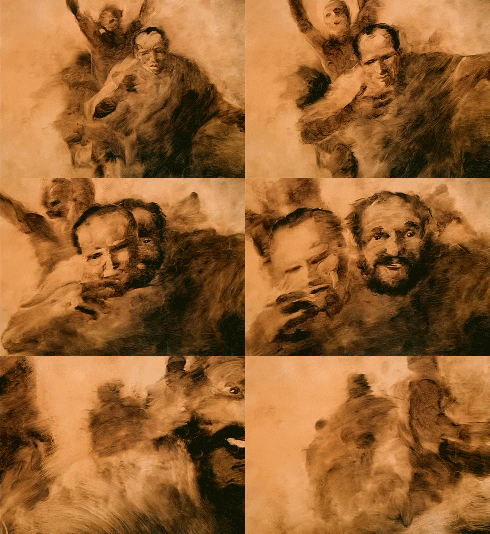
2009 read
Profile Image for Kiran Dellimore.
Author 5 books216 followers
November 10, 2024
This anthology of stories from Fyodor Dostoevsky took me on a literary roller coaster ride from start to finish. Of the three stories in this collection (White Nights, A Gentle Creature and The Dream of a Ridiculous Man) I most enjoyed A Gentle Creature. Perhaps, enjoy is not quite the right word here. I would rather say that this story left the greatest impression upon me. It lingered with me with after I read it for quite some time.

A disclaimer here is that I have previously read White Nights so I was already familiar with the general outline of the plot. Reading this story a second time was nevertheless a treat since I was able to more fully appreciate the great skill of Dostoevsky as a raconteur. He tells this story in a charming, entertaining style which is very buoyant, in quite stark contrast to his heavier novels like Crime and Punishment, Notes from Underground and The Brothers Karamazov.

A Gentle Creature by contrast to White Nights, was a much more morbid affair. This story deals with the death of a poor, young woman, ostensibly the ‘gentle creature,’ who has recently been married to an older man, who is a pawn broker. The seemingly mundane and ordinary life of the pawn broker is turned upside down by the advent of this woman on the scene. Dostoevsky masterfully takes readers into the pawn broker’s mind as he goes down a psychological rabbit hole of increasing entanglement with the woman, as she transitions from a being a pitiful pawn shop customer to his spiteful, recalcitrant spouse. For me this story somehow reminds me of Notes from Underground, in its psychological depth and incisiveness.

The last story, The Dream of a Ridiculous Man, was oddly my least favorite in this anthology. It didn't resonate with me in the same ways as the others. I couldn't connect effectively to the plot which felt overall rather depressing and nihilistic, despite the stories more uplifting ending. Maybe in the future I will reread this one to see if I can glean deeper insights. Overall, The Dream of a Ridiculous Man is a skillfully written story, which showcases Dostoevsky's vivid imagination and creativity as a writer.
Profile Image for Maru Kun.
223 reviews573 followers
May 27, 2015
"If in the first act you have hung a pistol on the wall, then in the following one it should be fired."
Two of the three stories in this well chosen collection prove Chekov decisively wrong. If you have mastered human psychology and looked deep into the human soul like Dostoyevsky then the pistol can appear but its hammer does not need even to be cocked.

All three stories are about dreams and dreamers. Dreams are extremely strange things which, in and of themselves, are only dreams so are neither good nor evil.

The mischief in each story lies in how simple dreams become bound to an ever more complex reality; a reality that, with all its contingencies and uncertainties, is also tied to the dreams of others. The dreams in each story are not rare. They may even be universal: the first a dream of romantic love, then one of absolute power and finally of peace and human brotherhood.

In White Nights the dream is of transcendent love rescuing the dreamer from his solitude and alienation. The hero meets by chance a young lady who waits each night by the Yekaterinsky canal for the return after a year of one she promised herself to in marriage. Her almost overpowering yearning for marriage seems to come from the desire to escape from a stifling life alongside her ageing grandmother. Will her hopes for marriage be met or will she recognise the emotions the hero holds for her, so realising his dream of redemption through pure romantic love?

In a Gentle Creature the dream is of absolute power over the innocent and vulnerable. The protagonist, a forty one year old pawnbroker, marries his desperately poor but proud and beautiful sixteen year old customer. He enters the marriage with the sole desire to break her spirit and control her. His motive is the self-justification of his own inadequacies - his cowardice and loss of social status. But the human spirit is not so easily constrained and his young wife finds what may be the only path that can lead her to freedom.

The last dream is one of human brotherhood. The dream of a paradise uncontaminated by human corruption where people live in harmony with the world and each other unafraid of death. This dream is The Dream of a Ridiculous Man.

Well done to Oxford Classics for putting these three stories into one volume. They complement each other perfectly and distill many of the themes of Dostoyevsky's work.
Profile Image for Anastasia Ts. .
383 reviews
August 2, 2017
Πολύ ωραίο ανάγνωσμα! Δεν θα αναφερθώ σε περιλήψεις των διηγηματων, αυτές υπαρχουν κ στο οπισθόφυλλο. Θα γραψω μονάχα τον λόγο που αξίζει καποιος να διαβασει Fyodor: για να ερθει σε επαφή με την ηθική κ την πραγματικότητα του συγγραφέα. Αριστη σκιαγραφιση των χαρακτηρων, επηρεάζει συναισθηματικά και πνευματικά τον αναγνώστη. Ο Fyodor ενδείκνυται για απαιτητικους αναγνωστες!
Profile Image for Phoenix2.
1,258 reviews116 followers
June 11, 2017
A "lighter" work by Dostoyevsky, that contains three small stories, about love, human relationships, the development of one's character, and the history of human society. The stories are interesting, with fast paced action, few characters, food for thought and unconventional endings. The story "a gentle creature" was a nice one, about the relationship between two spouces who were almost strangers to one another. The way it was presented was interesting, with the main character narrating the story in a future present, trying to make sense of its outcome. Overall, 3 out of 5 stars.
Profile Image for morgan.
171 reviews86 followers
November 29, 2021
White Nights was like looking at the reflection of yourself in a river and finally understanding everything that's pained you for so long.

fyodor, you continue to occupy my heart again and again x
Profile Image for MJ Nicholls.
2,275 reviews4,853 followers
January 26, 2012
A Partial Excuse For My Misanthropy. Part One. 1) I am awestruck when I meet a new person. I babble to overcompensate for the feelings of respect I have for this person who is alive, like me, and who lives a life, like me. 2) I like people! 3) Then something happens. The more I speak to the person I have met who is brilliant, the more I start to realise how profoundly not brilliant they are. How ordinary. How like me. 4) All those wonderful words they used when we first met, like “hello” and “pleased to meet you,” now seem pathetic. This new person will have to fight to earn my respect. 5) No one works hard to earn respect unless there’s money involved. 6) So I dry up in conversation. My childlike enthusiasm to make a new lifelong friend dissipates. 7) People don’t want new friends as adults unless they can give them things. Like money, power or IKEA products. 8) So I fall silent, feeding my interlocutor lines from time to time, looking at my watch. 9) What a disappointment! How dare this person be ordinary? Why wasn’t this person ecstatic to meet me? 10) This is one reason for my misanthropy—I come into every new interaction with enthusiasm. I listen. I am attentive. I am committed to giving this person ears to air their grievances and do their usual speaking thing. 11) Usually, the other person isn’t. 12) People need to be more excited to meet me. I’m not saying hopping up and down. But at least laugh at my shit jokes. At least laugh! 13) You bastards! 14) These stories are fabulous.
Profile Image for Hugo Emanuel.
387 reviews27 followers
September 8, 2014
“A Submissa e Outras Histórias” coleciona uma série de contos de Dostoievski que demonstram, acima de tudo, duas características do autor que julgo serem pouco discutidas e apontadas: a sua versatilidade e o seu humor. São duas características que habitualmente não são atribuídas a Dostoievski, provavelmente devido ao facto de os seus trabalhos mais conhecidos serem obras monumentais e trágicas, com um crítico e temerário olhar sobre as grandes questões sociais, morais e filosóficos da época e onde as interações entre as suas personagens quase invariavelmente conduzem a portentosamente trágicos acontecimentos. O facto é que, apesar de por vezes surgirem laivos de humor nos grandes romances do autor, a atmosfera e temas destes são consideravelmente sombrios e pesados. É acima de tudo ao lermos os contos do autor que adquirimos a perceção do quão divertido e versátil consegue ser Dostoievski e de que a sua obra engloba um considerável número de peças cómicas e fantásticas. A coleção em questão é uma excelente prova de tal facto e evidencia acima de tudo o quão influenciado foi o autor por outro grande vulto da literatura russa, nomeadamente Nikolai Gogol (apesar de este ser de nacionalidade ucraniana, a maior parte do seu trabalho foi escrito quando já vivia na Rússia, sendo São Petersburgo o cenário mais frequente das suas obras).
A coleção abre com o conto “Uma História dos Diabos”, uma hilariante e brilhante sátira algo gogoliana que evidencia a enorme distância existente entre as opiniões progressistas e liberais que certos membros das classes altas proferiam orgulhosamente em voz alta nos salões e jantares referentes a reformas sociais e as suas verdadeiras opiniões e sentimentos em relação a estes temas. Fá-lo relatando na primeira pessoa uma desventura de Ivan Iliitch, conselheiro de estado conhecido por chocar ou causar a admiração dos seus interlocutores com as suas opiniões em relação às reformas liberais, nas quais afirma ter uma considerável simpatia humanista pelos servos e um desagrado pelo sistema de classes sociais. Depois de uma discussão que enceta com dois conhecidos de opiniões contrárias e que sugerem que a sua conversa não passa de “ar quente”, este decide-se a provar-lhes que estão enganados com a decisão de engrandecer e enobrecer o jantar de casamento de um seu subalterno com a sua presença. A sua presença na dita cerimónia (onde está longe de ser bem-vindo) acaba por ser desastrosa e ter consequências que este nunca imaginara para o seu subalterno.
Segue-se “Apontamentos de Inverno sobre Impressões de Verão”, um texto que, segundo o autor, foi produzido na sequência de insistentes pedidos para que este escrevesse uma espécie de “narrativa de viagens” na qual relatasse as impressões que lhe causara os monumentos e cidades que vira durante uma sua viagem pela Europa. Até num texto que sugeriria algo convencional, Dostoievski surpreende. Começa por admitir que não só viu muito pouco de cada cidade europeia que visitou, mas que ainda o fez á pressa e que, por este motivo não se acha apto a descrever minuciosamente tanto o que viu como as impressões que estes o causaram. Em vez disso, o que produz acaba por serem impressões erráticas e considerações variadas sobre os locais que visita que pouco se debruçam sobre o espaço físico de tais locais, envergando em vez disso por tecer reflexões sobre a influência europeia na Rússia, comentar de forma irónica os costumes da França da época de Napoleão III recorrendo par ao efeito á literatura, entre outros. È o segmento da coleção que menos me agradou e, embora tenha o seu interesse, não consegue de todo competir com o resto dos textos presentes nesta coletânea.
“O Crocodilo” é um conto fantástico, também no espirito de Gogol, no qual um funcionário do estado é engolido por um crocodilo. Este, no entanto, em vez de perecer, permanece vivo dentro do crocodilo, de onde comunica com o mundo exterior. Dostoievski aproveita este acontecimento insólito para satirizar as ideologias que começavam a ficar em voga na época, em particular o liberalismo económico e o feroz materialismo que este alimenta. È um excelente e divertido conto, cujo único defeito é terminar algo abruptamente.
“Bobok” trata de um individuo que durante um funeral ouve os diálogos encetados entre si por alguns dos mortos que povoam aquele cemitério, cujas discussões e preocupações parecem, apesar da sua nova condição, não diferirem muito dos que tinham quando vivos. È também um conto divertido e interessante, mas que peca um pouco pela sua brevidade e fim algo abrupto.
“Menino numa Festa de Natal”, “O Mujique Marei “ e “A Centenária” são ensaios artísticos que, não obstante a sua brevidade, atingem um poderosíssimo efeito no leitor. Não me vou debruçar muito sobre este pois fazê-lo implicaria contar demasiado destas breves reflexões do autor.
Segue-se “A Submissa”, um conto absolutamente extraordinário e brilhante, onde estão presentes as habituais preocupações, temas e geniais recursos estilísticos do autor. Trata de um usuário, dono de uma loja de penhores que desposa uma rapariga pobre de natureza gentil e meiga, que não deseja outra coisa que ser amada. No entanto, a frieza, avareza e orgulho com que o usuário trata a sua esposa leva a que esta venha a perder a sua inocência e a sua vida. O texto é constituído pelos pensamentos erráticos e desesperados do usuário que procura justificar o comportamento que adotara em relação á sua esposa. O orgulho do usuário é de tal modo imenso que o torna completamente cego á sua responsabilidade pelo destino final da sua esposa. Este conto é absolutamente genial e considero-o um dos melhores trabalhos do autor.
O último conto desta edição é o também excelente “Sonho de um Homem Ridículo”, no qual um homem que proclama ser ridículo aos olhos dos outros e de si próprio visita em sonhos uma versão alternativa da nossa terra onde a sua presença porá em causa a existência sublime e inocente em que vivem os homens que habitam esta “outra terra”.
“A Submissa e Outra Histórias” é uma excelente edição que, apesar de não ser o melhor ponto de partida para ficar a conhecer o trabalho do autor, é sem dúvida uma leitura altamente recomendada para o leitor já familiarizado com alguns dos seus romances.
Profile Image for Scott Bielinski.
369 reviews44 followers
June 7, 2024
11 years ago, Dostoevsky convinced me that the Christian life is worth living. I'll always be grateful to God (and Dostoevsky!) for that. To this day, Dostoevsky remains, for me, the greatest literary antidote to the nihilism and despair that so often nags at me.

"But how to construct paradise - I don't know, because I can't convey it in words. After the dream, I have lost the words, at least all the chief words, the most necessary. Well, so be it: I am on my way and will keep talking ceaselessly because, after all, I saw with my own eyes, even though I can't convey what I have seen but that's what the scoffers cannot comprehend. They say: 'he's been dreaming, he's rambling, hallucinations.' Well, what of it? And they're so proud of themselves! Dream? What's a dream? Isn't this life of ours a dream?" (127-28)
Profile Image for Annie.
1,151 reviews425 followers
March 24, 2025
This is a book of three short stories/novellas, so will review them each in turn below. There are some plot details so I suppose this could be considered a spoiler review, but does anyone read Dostoyevsky for the plot (rather than the beauty of his language and thought!)? I rest my case. Proceed as you like.

----------White Nights------------

It's Ted. It's Ted from How I Met Your Mother, if Ted were a virgin, and perhaps had a sprinkle of autism.

Our humble protagonist has no name, but let’s call him, oh, Fyodor. Poor Fyodor spends all his days isolated, unable to connect with people in St. Petersburg, unable (so he thinks) to have a normal conversation, especially with girls. All sweet, lovable Fyodor wants is love, and chance circumstances (pretending to be a girl’s boyfriend, when the girl is getting harassed on the street) enable him to meet a nice girl, Nastenka.

They have a grand time and get on well, despite Fyodor’s extreme bashfulness, mostly due to Nastenka’s patient gregariousness. They become immediate friends, with Nastenka warning Fyodor he must not get too attached or see her as anything more than a friend because she’s waiting for a soldier she fell in love with, who she promised to meet here in the city a year ago, though of course he doesn’t show.

Fyodor is genuinely adorable and tries to reassure her the soldier will, no doubt, show up eventually, even offering to go to the man himself to convince him to show up. But eventually Nastenka is forced to give up and accept her lover has forgotten her, and then turns to Fyodor and declares she admires his faithfulness and thinks she could grow to love him when she gets over her heartbreak. Overjoyed - because of course, despite his intentions, Fyodor is head over heels for Nastenka- Fyodor immediately accepts her offer. But as is always the case - the soldier shows up and Nastenka goes off in a whirlwind. Is Fyodor bitter about it? No, Fyodor’s a stand up guy and recommits himself to solitude, wishing them the best from the bottom of his heart, resolved to let his moment of joy with Nastenka be enough to last him a lifetime.

"But that I should feel any resentment against you, Nastenka! That I should cast a dark shadow over your bright, serene happiness! ...That I should crush a single one of those delicate blooms which you will wear in your dark hair when you walk up the aisle to the altar with him! Oh no — never, never! May your sky be always clear, may your dear smile be always bright and happy, and may you be for ever blessed for that moment of bliss and happiness which you gave to another lonely and grateful heart ... Good Lord, only a moment of bliss? Isn't such a moment sufficient for the whole of a man's life?”

It’s a tale as old as time, a song as old as rhyme, and Dostoyevsky captures it beautifully, setting loneliness in the gilded frame of sublime, transcendent love-without-expectation.

----------A Gentle Creature------------

Local 41-year-old pawnbroker marries 16-year-old orphan (who accepts because she lives in rubbish circumstances and has no other options) — then rejects her loving attention and affectionate hugs when he gets home as excessive and unnecessarily effusive, does not allow her to leave the house without him, says things like "women have no originality" — is shocked when she throws herself out a window.

Dostoyevsky uses stream-of-consciousness to reveal the inner thoughts of the pawnbroker in the immediate hours after his wife’s death as he processes how his own neglect, avarice, and contempt have led to the violent, stunning death of this “gentle creature.”

----------The Dream of a Ridiculous Man------------

This was my favourite!

Man who plans to kill himself one night because he is convinced of his own indifference and that nothing, in fact, matters (how painfully Russian nihilist literature of him). However, he doesn't follow through, because after refusing to help an orphaned little girl in distress, he realized he pitied her and felt shame for not helping her — which means he is not, in fact, indifferent yet and will therefore have to put off suicide until attaining perfect indifference.

Only for the man to fall asleep and have a dream about a parallel universe in which envy, greed, prejudice, hatred, anger, etc. do not exist, and people on this parallel earth are able to live in harmony, and greet one another with pure love.

“Ah, it was all exactly as with us, but it seemed that everywhere glowed with a kind of festive air, some great sacred triumph finally achieved. The tender emerald sea lapped quietly against the shores, caressing them with a love which was obvious, palpable, almost conscious. Tall, beautiful trees stood clad in the full luxuriance of their blossom; their numberless leaves, I am convinced, greeted me with a low, caressing murmur, seeming to utter words of love. Flocks of birds flew across the skies, and, quite unafraid of me, perched on my shoulders and hands and gladly fluttered their dear little wings at me. And finally, I saw and recognized the people of this happy earth. The children of the sun, children of their own sun— ah, how beautiful they were! Never on our earth had I seen such beauty in a person. Perhaps only in our children, in their very earliest years, might one have found some distant, feeble reflection of that beauty. The eyes of these happy people sparkled. Their faces radiated intelligence and a kind of consciousness which had attained to the condition of serenity, but these faces were blithe and a childlike gaiety echoed in their words and voices. Ah, at the first sight of their faces, I immediately comprehended everything, everything! They pointed out their trees to me and I could not understand the degree of love with which they looked on them: it was as if they talked of creatures like themselves. Yes, they had discovered their language and I am convinced that the trees understood them. They looked on all nature in this fashion; the animals, who lived peaceably alongside them, never attacked them — indeed loved them, tamed by the love they themselves received. They pointed out the stars to me and spoke of something beyond my comprehension, but I am certain that they were in contact with the celestial stars. They would roam about their beautiful woods and fields as they sang their delightful songs; they ate sparingly of the fruit of their trees, the honey of their forests, and the milk of their affectionate animals. Love was known among them and children were born. They rejoiced at the children who appeared, as at new participants in their bliss. The old people died peacefully, falling asleep as it were, surrounded by people bidding them farewell; they blessed them, smiling and receiving bright smiles in return. I saw no grief or tears during all this, nothing but love mounting to a pitch of ecstasy — a serene fulfilled, contemplative ecstasy. They could barely understand me when I used to ask them about eternal life, but were evidently so instinctively assured of it that it did not constitute a problem for them. They had no shrines but they did have a kind of constant, vital, living communion with the universal whole.”

But from the narrator, these joyful, childlike people inadvertently learn envy and sarcasm and pettiness, and their paradise is spoiled. Upon waking, the narrator is convinced this was no dream at all but a reality that existed, and he is determined to return our world back to the paradise from which he is certain it, too, once was and can be again - so goes about proselytizing of his new knowledge.

“But how to construct paradise — I don’t know because I can’t convey it in words.” So he rambles on to people, who call him crazy, and say it was all a dream. Well, so be it if it is, he says! Isn’t this life of ours a dream? And even if it wasn’t true, even if it was only a dream, it makes no difference, because if everyone chose to become more like those people, we could bring about such a paradise anyway. “If only everyone desired it, it could be all brought about at once.”

The use of language in this one was just exquisite.
Profile Image for Margaret.
1,524 reviews67 followers
April 11, 2017
A Gentle Creature is a collection of three short stories by Dostoyevsky: "White Nights," "A Gentle Creature," and "The Dream of a Ridiculous Man." Taken together, these three stories are representative of many of the themes Dostoyevsky explores in his novels. In "White Nights," the protagonist is a solitary man who has never spoken to a woman, and rarely speaks to anyone at all. One evening on his ritual walk, he encounters a young woman weeping and they form a brief nightly friendship. In "A Gentle Creature," a despotic pawnbroker marries a desperate young woman selling her dead parent's possessions. In "The Dream of a Ridiculous Man"--my favorite of the three--a ridiculous man contemplates suicide and has a dream where he shoots himself in the heart and is transported to a utopian world.

These stories all contain hallmarks of Dostoyevsky's novels--naive protagonists, unreliable narrators, women in dire circumstances with little choice, the angst of unrequited love, spiritual visions. Because of this, it would make an excellent read for anyone unsure whether they want to tackle one of his epic novels. If you like this, than you'll like his novels, and it's a short and easy read. And as always with Dostoyevsky's fiction, I'm impressed by how he can make internalized plots suspenseful.
Profile Image for Alexis Neely.
76 reviews4 followers
December 20, 2024
The first two stories were not good because this reads very incel core and the way the women are written is evil as fuck, the last story was unfortunately good bc there were no women aka he couldn’t fuck it up😸
Profile Image for rita.
61 reviews15 followers
September 8, 2023
A Submissa e Outras Histórias constitui um acervo de contos que representa, em todo o seu esplendor, a versatalidade da obra de Dostoievski. Tendo um conhecimento prévio de algumas obras deste Autor, é impossível não as ver espelhadas em qualquer um destes contos. As temáticas exploradas por Dostoievski, para além de plenamente coerentes nos dias atuais, são transversais a toda a sua obra, o que torna este livro - quiçá - na melhor introdução à obra deste Autor.

Por um lado, temos contos satírico-cómicos (Uma História dos Diabos, O Crocodilo, Bobok) que, explorando situações ridículas e inverosímeis com recurso ao fantástico, detém como pano de fundo incisivas críticas mordazes, como fiel precursor da tradição gogliana. É o mesmo estilo que encontramos mais desenvolvido em A Aldeia de Stepantchikovo e Os Seus Habitantes e Um Sonho do Tio, que mostram o talento de Dostoievski enquanto dramaturgo prosaico.

De outro lado, em Apontamentos de Inverno sobre Impressões de Verão, Dostoievski constrói uma dilacerante reflexão política e filosófica, omnipresente, em maior ou menor escala, em quase todas as suas obras, como sejam Recordações da Casa dos Mortos, Crime e Castigo, O Jogador ou Os Irmãos Karamazov.

Na mesma linha, O Sonho de um Homem Ridículo mostra a importância das temáticas religiosas para Dostoievski, indissociavelmente ligadas com a sua análise da natureza humana. À semelhança de Raskolnikov em Crime e Castigo, o protagonista deste conto aparece-nos como mais um exemplar do homem regenerado dostoievskiano. Alienado da sociedade onde se insere e consumido por um sentimento de indiferença perante a vida, o protagonista decide matar-se. Antes de o fazer, porém, tem um sonho muito peculiar onde lhe é feita (pelo menos, assim o proclama) uma revelação da verdade do pecado original. Através do relato deste sonho, Dostoievski pinta um quadro angustiante, mas esperançoso, sobre a origem do Universo e os vícios da Humanidade. Recusando-se a acreditar que o mal é o estado natural do ser humano, o protagonista proclama nas linhas finais desde conto que vai viver e vai pregar. Tal como Raskolnikov, regenera através da sua recém-encontrada fé e encontra nela o seu propósito de vida.

Em A Submissa, o mestre da complexidade psicológica debruça-se, mais uma vez, sobre os meandros dos comportamentos e motivações humanas. Dostoievski impera na descrição psicológica de toda e cada uma das suas personagens, colocando-as em situações limite e amplificando as suas emoções de uma maneira absolutamente genial e envolvente.

Por último, nos contos mais curtos desta coletânea (O Mujique Marei, A Centenária e O Menino numa Festa de Natal), não menos incisivos que os restantes e com uma escrita igualmente belíssima, Dostoievski pinta retratos crus quer da pobreza das camadas mais baixas da sociedade russa da época, quer da simplicidade da aceitação da morte.

Quer seja escrevendo romances de 800 páginas, quer seja escrevendo contos de 8 páginas, o génio de Dostoievski excedeu todas as expectativas (já altíssimas) que poderia ter e deixou-me, mais uma vez, absolutamente rendida.
Profile Image for Буянхишиг Отгонсэлэнгэ.
104 reviews3 followers
February 13, 2021
Here is the reasons why I chose to read this short stories from Fyodor Dostoyevsky.
1. Being not familiar with the writings of Fyodor Dostoyevsky, and felt daunted to tackle his 600-hundred pages masterpieces,
2. Being not sure if it is right time or if I'm in right mind to read any masterpiece of Fyodor Dostoyevsky.

Thus I believe above reasons justify my picking of his smaller stories.

So here it is after some days later as usual I'm trying to put few words on book from my void-like mind. I envy anyone who can combine three words to make sense. I really do!

The book consists of three small short stories; White Nights, A Gentle Creature, The Dream of Ridiculous Man.

In White Nights, our protagonist is a dreamer who can't shake off the dream state. He meets a young lady by chance. By loving the lady, he tears the shackles of dream. Was it love or strong emotion that leaves him free?

In a Gentle Creature, our protagonist is a forty-one years old pawnbroker who marries his desperately poor sixteen years old customer. By day one of his marriage, he takes the absolute control over his young bride and dictates his marriage life with bitter end. He tries to create a perfect friend in his wife by breaking her spirit as the society did to him. One would say instead of forgiving and moving on with his life, he holds into grudge and shame.

The Dream of a Ridiculous Man, would be the last story in this book. In this book, Fyodor Dostoyevsky dreams the perfect human society. This dream is about society without base human corruptions where people live in harmony with the world and with each other. Thus dream of a ridiculous man.

I believe this book would be the best introductory works of Fyodor Dostoyevsky one can hold into. I'm ready for his masterpieces and as well as short stories after reading this brilliant collection. Highly recommended.
Profile Image for Ema.
816 reviews82 followers
July 14, 2020
4,5*

O meu senão com esta colectânea é o ensaio Apontamentos de Inverno sobre Impressões de Verão, o qual foi penoso ler e passo a explicar. Apesar de algumas reflexões e críticas serem bem interessantes, mesmo ao jeito "Doistoiévkiano", o autor aqui parece estar apenas do contra, nada na sua viagem pela Europa parece agradá-lo, ou seja, em 60 páginas, não há nada de belo nos países e nas cidades que visitou. Não estava à espera disto e foi algo que me irritou.

Por outro lado, talvez a minha história preferida seja O Crocodilo, uma alegoria cómica e, também, cheia de sumo crítico e reflexivo, mas muito mais acutilante e envolvente. A forma como narra e expõe o ridículo do ser humano é de mestre, claro está.

Adorei as memórias, os textos mais filosóficos, as críticas ao seu país e às ideologias com as quais não concorda, o estilo narrativo tão característico e simplesmente delicioso, a doçura fria com que aborda temas delicados e profundamente tristes. É um dos meus autores favoritos e ainda bem que tenho tantos outros textos e calhamaços para me maravilhar. E com os quais aprender.
Profile Image for Μιχάλης Παπαχατζάκης.
373 reviews20 followers
June 15, 2022
Σε μετάφραση του Άρη Αλεξάνδρου, μια συλλογή τριών σπουδαίων διηγημάτων, η οποία ακολουθείται από μια σχετικά ογκώδη ανάλυση της ζωής και των πιστεύω (ειδικά των θρησκευτικών πιστεύω) του μεγάλου της ρωσσικής και παγκόσμιας λογοτεχνίας και πως αυτά αντανακλώνται στο έργο του. Τα τρία διηγήματα είναι βέβαια αυτοτελή, αλλά διαβάζοντάς τα συνεχόμενα παρατηρούμε μια μεγάλη συνάφεια στη θεματολογία: και τα τρια πραγματεύονται μοναχικούς άντρες, και τα τρία μιλάνε για την ματαιότητα των πράξεών τους λόγω της λάθος (εν πολλοίς εγωϊστικής) αυτοτοποθέτησής τους στην κοινωνία. Και τα τρία πραγματεύονται την αυτοκαταστροφή. Σπουδαίο έργο.
Profile Image for nam.
71 reviews
December 20, 2021
the first one was a nice read
the second one horribly uncomfortable
the third one started off strong but gave off midsommar vibes halfway through to the end
Profile Image for John Pistelli.
Author 9 books361 followers
January 5, 2016
This little book, translated by Alan Myers, collects three of Dostoevsky’s short works on the subject of the "dreamer"—one early piece, the classic 1848 novella "White Nights," and two pieces of the 1870s, first published in D.’s Diary of a Writer: "A Gentle Creature" and "The Dream of the Ridiculous Man." This allows a fascinating juxtaposition of the writer’s early and late styles. Spoilers below.

"White Nights." I have been meaning to read this one for a long time, and somehow never got around to it, or was perhaps even avoiding it. I recall a friend’s mentioning it, many years ago, in connection with his sorrow upon the unexpected death of a young man who was a near-stranger, just someone he passed most days on the street. This gave me the sense that "White Nights" would be an unbearably touching tale of urban missed connections, of the city’s deep invitation to and frustration of intimacy with strangers, a filament stretched (or braided with Baudelaire) between Poe’s nightmarish "Man of the Crowd" (Dostoevsky loved Poe) and Joyce’s wistful Ulysses. "White Nights" is only that for its first few pages, though, beautiful pages in which the narrator wanders around Petersburg through the titular midnight sunshine familiarizing himself with strangers and architecture. From there, it develops into a brief romance between the narrator and a young woman that lasts all of four nights. (The novella’s ubiquity as cinematic source material—it has been filmed 11 times!*—makes sense considering this storyline: it calls to mind films such as Breathless, Wings of Desire, and Before Sunset, the lyrical delicacy and evanescence of urban romance being something of a specialty of the movies). Because the romance plot is a familiar one, though no less devastating in the end, contemporary readers will perhaps be most interested in the aforementioned Poe- and Joyce-like elements, the visions of the flâneur in the radiant northern midnight, amid the Enlightened city’s sleep of reason. Another aspect of the novella, emphasized by W. J. Leatherbarrow in this volume’s introduction, is D.’s experiment with a new kind of character: The Dreamer. Our narrator, we learn, has lived almost his entire life in his mind or in books, dwelling in fantasy as reality becomes more and more unbearable. While this is not exactly a new theme even for the middle nineteenth century (think of Cervantes), urban isolation and loneliness give it a new poignance, which has not lost its relevance. If they ever want to film the novella a twelfth time, they should update it so that the narrator is a video-game addict, or perhaps one of the famous hikikomori of Tokyo. I conclude with this passage, prophetic of D.’s later achievements in creating characters who waver between the sublime and the ridiculous; the narrator explains his predicament to the story’s heroine:
"Do you know that I am compelled to celebrate the anniversary of my own sensations, the anniversary of what was formerly so precious to me, but never actually existed—because the anniversary is celebrated in memory of those same silly disembodied dreamings—and do this because even those silly dreams are no more, since I lack the wherewithal to earn them: even dreams have to be earned, haven’t they? Do you realize that on certain dates I enjoy recalling and visiting those places where I was once happy after my own fashion? I enjoy constructing my present in accord with things now irrevocably past and gone, and I often drift like a shadow, morose and sad, without need or purpose, through the streets and alleyways of Petersburg. What memories there are! I recall, for instance, that it was exactly one year ago, here at this precise time, that I wandered along the same pavement as lonely and depressed as I am now. I remember that even then my dreams were sad, and although things were no better back then, there’s still the feeling that that living was somehow easier and more restful, that there wasn’t this black thought which clings to me now; there were none of these pangs of conscience, bleak, and gloom-laden, which give me no peace by day or night. You ask yourself: where are your dreams now? And you shake your head and say how quickly the years flew by! And you ask yourself again: what have you done with your best years, then? Where have you buried the best days of your life? Have you lived or not? Look, you tell yourself, look how cold the world is becoming. The years will pass and after them will come grim loneliness, and old age, quaking on its stick, and after them misery and despair. Your fantasy world will grow pale, your dreams will fade and die, falling away like the yellow leaves from the trees…"
He is nostalgic, not for the past itself but for the fantasies he was able to harbor in the past, before the futility of his idealism became obvious to him, as well as the inevitability of his continued inaction; he is nostalgic not for anything accomplished or experienced, but simply for potential. It would be one thing if accomplishment and experience alone remained elusive, but the true horror is that potential vanishes too, year by year. Nonetheless, the novella’s conclusion provides a hint of the spiritual consolation Dostoevsky will later offer, even as his visions of horror become more drastic: "A whole moment of bliss! Is that not sufficient even for a man’s entire life?" We are defeated by time, but may triumph in eternity, even the eternity mystically represented by a moment. And our moments, needless to say, are what art, more than any other human activity or institution, can preserve—hence modern literature’s (and cinema’s) consecration to the days and nights of the ever-moving, ever-changing city.


"A Gentle Creature." This story, based, like many of D.’s plots, on an event he read about in the newspaper, is about the destruction of a young women through marriage to an older pawnbroker spiritually ruined through his own pride, cowardice, and ressentiment. It is another in the author’s portrait galleries of spiteful men who want to possess and destroy beauty because they do not feel themselves worthy of it or capable of living according to the ideals it inspires. Considered from a strictly literary point of view, the story is notable for its narrative form, which D. claims to have borrowed from Victor Hugo; in a preface to the story, he writes that he considers it "fantastic" in the sense that its narrative implies "a supposed stenographer noting everything down"—in other words, recording the narrator’s fragmentary and non-linear account of himself. We have here an approach toward stream-of-consciousness narration, with an authorial intent of establishing the correct "psychological sequence," as Dostoevsky writes in his preface. The psychology, though, is in service to a religious conception, an answer to the question of what prevents this man from saving his own soul, what causes him to destroy another soul. For all that, the story is a bit overly long for a re-tread of familiar territory, even if ultimately moving. The narrator of "A Gentle Creature" does call himself a "dreamer," like the narrator of "White Nights," but in that earlier story, written before Dostoevsky had developed his later religious convictions, allows more play and ambiguity to the dreams themselves; in this story, the dream of revenge upon society is worth too little in itself to give the story much moral ambiguity.

"The Dream of the Ridiculous Man." I first read this one way back in 2002, in a wonderful class taught by Ilya Vinitsky called “Madness and Madmen in Russian Culture” (we also studied D.’s The Double, Tolstoy’s The Kreutzer Sonata, Pushkin��s "Bronze Horseman" and "Queen of Spades," and a host of great literature [Lermontov, Odoevsky, Gogol, Chekhov, Garshin, Hippius, Bulgakov], visual art [Repin, Vrubel, Filonov], and theater/music/dance [Mussorgsky, Khlebnikov, Stravinsky, Nijinsky, Diaghilev], with extra-Russian contexts provided by Plato, Shakespeare, Bosch, Hogarth, and Foucault—overall, it was more fun than should be allowed in college!) I think it is slight as a story, but its conceit is a brilliant one. Here we have not a figurative dreamer but a literal one: a man who falls asleep just before he is about to commit suicide, and whose subsequent dream takes up most of the tale. Our narrator, another alienated man, has decided that nothing in life means anything; consequently, he resolves to kill himself, just after rebuffing a young girl’s pleas for help in the street. But he falls asleep instead and dreams of an alien planet where human beings exist in a prelapsarian state, perfectly innocent, free and beautiful, without lies or oppression or violence. The narrator has come from earth with his vices, however, and soon corrupts them by introducing lies into social discourse. Soon enough, they fall from lies into exploitation, sensuality, theft, rape, murder, war, and all the rest. Perhaps the story’s best insight arrives when these human aliens turn to "scientific" ideological systems to try to remedy their fallen state: in other words, socialism, anarchism, laissez-faire capitalism, and the like are part of the very problem they intend to solve. This does not prevent the narrator from waking up with the intention to communicate his vision, to spread the word and save the world, even though, as he has just seen, it is not within humanity’s power to do so. The story ends, however, with his resolution to find the little girl whose cries for help he had ignored—this, from D.’s Christian point of view, is presumably the right idea: you cannot save the world (even the desire to do so is imbued with Satanic pride), but you can love your neighbor. The interest of this story for us today—a period in which we are drowning in literary dystopias and utopias—is its relocation of the dystopian/utopian vision in the psyche and its projections.

* I did watch the most famous of these films, Visconti's Le Notti Bianche (1957), but I did not like it much. Visconti and his collaborators removed all characterization from the narrator, made his loneliness merely circumstantial (he has just moved to town), and moreover cast the handsome Marcello Mastroianni (who played the role as a slightly bumbling but confident charmer)—it is a pleasantly lyrical, if rather dull, film, but has little to do with Dostoevsky.
Profile Image for Tiago.
240 reviews19 followers
April 8, 2025
Esta é uma coleção de contos da fase madura de Dostoiévski. As histórias foram escritas entre 1862 e 1877. As temáticas são bem variadas, temos contos muito bem humorados, outros em que Dostoiévski disseca a alma humana como só ele sabe fazer. A minha nota final é 4,5/5 arredondada para baixo. É um bom livro para ser lido aos poucos, ao longo de alguns meses.

Uma História dos Diabos - 4
Foi uma releitura. Há 3 anos li uma edição brasileira, ri muito e também senti vergonha alheia. É uma novela engraçadíssima onde Dostoiévski usa a ida inesperada de um chefe a uma festa de casamento de seu subalterno para descrever as relações sociais na Rússia pós-reformas no início dos anos 1860.

Notas de Inverno sobre Impressões de Verão - 3,5
Dostoiévski visita a França, Inglaterra e Alemanha e produz um relato não convencional. Primeiro começa com uma análise da literatura russa no século XIX (aborrecida e, nas palavras do próprio autor, supérflua). Ele se foca uma análise sociológica russos x europeus. O ponto alto é o “roast” feito aos franceses/Paris e compensa os capítulos iniciais. O conto mais enfadonho da coletânea.

O Crocodilo - 4
Conto bem maluco de Dostoiévski. Um homem vai ao shopping com a sua mulher ver um crocodilo exposto por um alemão e acaba engolido pelo bicho. Só que ele sobrevive e passa a viver (e filosofar) dentro do animal. A naturalidade dos outros personagens lidando com o acontecimento torna a história engraçada. Temos críticas à burocracia e o velho duelo Rússia x Europa. Perde pontos pela ausência de final. Este e o "Uma História dos Diabos" são os contos mais engraçados desta coletânea.

Bobok - 4
Um conto fantástico/satírico em que o protagonista é um personagem que poderia ser muito bem o famoso "homem do subsolo" de Dostoiévski. Após ir a um funeral, ele adormece no cemitério e começa a ouvir um diálogo entre os mortos. O diálogo satiriza bastante com a sociedade russa. Aproveita-se melhor a leitura tendo uma contextualização da época. Bobok é uma resposta de Dostoiévski aos críticos literários.

Menino numa Festa de Natal - 4
Um conto de Natal brutal e demolidor. O título ilude o leitor para o que vem na história: pobreza, indigência, frio. As crianças Dickens são quase felizes em comparação. Digo com toda certeza que este conto NÃO deve ser lido no Natal.

O Mujique Marei - 3,5
Dostoiévski traz duas recordações bem distintas da sua vida: uma do tempo em que esteve preso e outra do tempo em que era uma criança de nove anos. Na prisão, um preso polonês chama todos os russos que estão ali de bandidos. Ao recordar um episódio de infância com o mujique Marei, o patriotismo de Dostoiévski aflora e ele "refuta" o polonês ao mostrar a bondade do homem simples da Rússia.

A Centenária - 3,5
Um conto em que Dostoiévski numa forma bem "dostoievskiana" trata do tema da longevidade e da velhice. O narrador ouve o relato de uma pessoa a respeito de ter encontrado e conversado com uma mulher de 104 anos que estava a caminho da casa dos netos para almoçar. A noite, o narrador então resolve "dar um final" ao relato, escrevendo o que, na sua opinião, seria mais verossímil de ter acontecido.

A Submissa - 5
É um conto absolutamente genial. A estrutura da história com o narrador (dono de uma casa de penhor), tendo diante dele o cadáver da mulher que acabara de cometer suicídio, tenta "racionalizar" e fazer uma retrospectiva sobre a sua vida de casado, é incrível. Em termos de contos de Dostoiévski que lidam com a psicologia, as motivações e as emoções humanas, este é o melhor deles.

Sonho de um homem ridículo - 5
Acho que só Dostoiévski conseguiria escrever uma visão desta sobre o pecado original. Um homem ridículo (autodenominado) está com o suicídio "marcado" tem um sonho onde descobre uma Terra paralela onde a população ainda vive sem o pecado original. O processo de corrupção da população é descrito de forma brilhante e quase profético.
Profile Image for Naomi.
15 reviews
December 30, 2024
A beautifully written collection of stories that delves into the psychological background of three different characters that almost blend together while reflecting Dostoevsky's own spiritual journey in life.

While White Nights was my favourite short story because it shows how dreamers often romanticize people and let themselves down in the process, I also enjoyed how dark the other short stories were as well. I think this could be off-putting for some, but it is one of the reasons that I like Russian literature because it shows the heartbreak and melancholy that haunt people.

Although I found the overall writing style easy to read and the content profound, I am not a fan of how Dostoevsky writes dialogue. I can see how his use of grammar impacts the emotion behind the text, but the way the characters express themselves pulled me out of the story at times because it seemed as though it should have been written as an internal monologue (I can see that Dostoevsky has many thoughts he likes to write down) when there was a whole paragraph dedicated to the character voicing their thoughts to another person. In some cases, it added a point to the story, but this seems to be consistent among all of his works that I've read.

Overall, I highly recommend all three of these stories, but I would definitely start with White Nights, then Dream of a Ridiculous Man, and lastly, A Gentle Creature just because of the themes that many people might have a harder time dealing with.
Profile Image for Andrew  William.
297 reviews5 followers
March 4, 2025
There were some absolute banger lines in this short story collection. I underlined so many passages that just were constructed well or sounded pretty or had interesting thoughts or felt significant to me.
Classics can be hard sometimes bc of the time period, it can be difficult for me to stay engaged, but there was no point where i lost interest.
White nights was probably my favorite of the three. The yearning was so delectable. You think you know yearning? You don't til you've read white nights. And some of it just hit so hard for me ya'know.
The second favorite would probably be the ridiculous man. It had a semi-cyclical nature to it with a little twist on religious imagery the concepts were just /so/ interesting.
A gentle creature was good, it was well written, but the narrator is the most insufferable POS I've ever had to read from and most of my annotations are me calling him gross or an asshole because he IS. But that was the point he was supposed to be an asshole so it was well done, he was just awful lol.
Either way all the stories were well done and it was a very cohesive and quick collection. A very good introduction to dostoyevsky without having to read 600 pages of crime and punishment.
Profile Image for Cody.
196 reviews2 followers
March 23, 2023
i am not a big classics guy (massively sweeping generalization i know!! sorry!) and i am especially intimidated by The Russians so i wanted a more approachable (aka shorter) introduction to dostoevsky. i was very pleasantly surprised by his accessibility and humor! i love the breezy dreamy melodrama in “white nights”, reading it feels very much like doing a big old sigh and swoon onto a little velvet chaise. “a gentle creature” was probably my favorite - the cognitively dissonant stream of consciousness was soooo on the fritz in a very engaging way. the only type of unlikable narrator i really enjoy is a true love-to-hate-this-guy cartoonish capital-h Heel, which fyodor nailed. the last story didn’t do much for me but they can’t all be bangers
Profile Image for Parmin.
21 reviews
December 7, 2024
This was the first masterpiece I read by Dostoyevsky.
I fell in love with this book and welcomed it separately.
I suggest it, one hundred percent.
It was a very interesting book, and it was a little strange.
The main characters in the story were very complicated, but that's what made it a strange story.
I suggest you read this book!!!.
Profile Image for Haleema.
160 reviews10 followers
November 22, 2022
pleasantly surprised … was so scared i wouldn’t like it but I LOVED IT ! writing style - i couldn’t even look away
Profile Image for reem.
124 reviews1 follower
December 31, 2023
My new hobby is walking into a bookstore and picking up any of Dostoyevsky's collections of short stories that I don't currently own (I've only accidentally purchased the same collection ONCE.) That means I will have many copies that contain the same stories, hopefully a different translation, but a new book will always contain at least one new story that I haven't read before. This collection had two. A Gentle Creature and The Dream of a Ridiculous Man. I loved them both very much. The latter read a little like Hesse and I wasn't concerned, nor disappointed. I can't escape Dostoyevsky's grasp on human nature and humanity, and his explicit understanding of the sociopaths in society. His stories and novels are constantly entertaining, delightful and full of profound knowledge and wisdom of the streets and the worlds behind closed doors. This book has prompted me to pick up The Gambler and Other Stories -an edition that contains FIVE stories I haven't read yet. Richard Brautigan was spot on when he described the correct way to end a year when he said: “I drank coffee and read old books and waited for the year to end.” That seems about right to me.
Profile Image for Sour Candy.
46 reviews1 follower
March 12, 2025
I ll add "a gentel creature" to my fav horror books✨️
43 reviews
February 13, 2025
I have genuinely never read a writer who captures the human mind so fully.
White Nights: 5/5
A Gentle Creature: 5/5
The Dream of a Ridiculous Man: 3/5
Profile Image for Courtney Kleefeld.
Author 7 books49 followers
May 1, 2022
There are only three short stories in this collection--White Nights, A Gentle Creature, and the Dream of a Ridiculous Man.
White Nights was one of Dostoyevsky's early short stories, and The Dream of a Ridiculous Man was I believe his last or among the last short stories that he wrote.
A Gentle Creature is deep and well-written but definitely not for everyone because of its dark nature (it's about a woman's suicide), while the other two short stories I would more easily and readily recommend to anyone who is interested in getting into Dostoyevsky's works, though the Dream of a Ridiculous Man is about someone contemplating suicide, but then something happens which I won't say.
Out of the three short stories, The Dream of a Ridiculous Man was my favorite, and I felt like it was the strongest and more concisely written story of the three.
If you're looking for a lighter story about a dreamer, White Nights would be a good story to start with. If you want something profound and life-changing, The Dream of a Ridiculous Man would be great.
If you're looking for a dark psychological dive into a despicable man's mind and can handle the dark, A Gentle Creature is a well-written and interesting story that exposes a character's secret and conscious evil intentions that create unhealthy dynamics in his relationship which lead to disastrous consequences.
Displaying 1 - 30 of 257 reviews

Can't find what you're looking for?

Get help and learn more about the design.