Jump to ratings and reviews
Rate this book

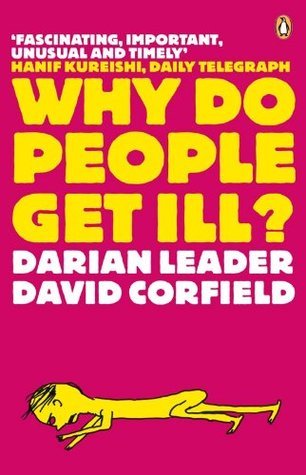
Why Do People Get Ill?: Exploring the Mind-body Connection

Rate this book

Have you ever wondered why we get ill?


Can our thoughts and feelings worsen or even cause conditions like heart disease, cancer or asthma?


And what - if anything - can we do about it?


Why Do People Get Ill? explores the relationship between what's going on in our heads and what happens in our bodies, combining the latest research with neglected findings from medical history. With remarkable case studies and startling new insights into why we fall ill, this intriguing book should be read by anyone who cares about their own health and that of other people.

371 pages, Kindle Edition

First published January 1, 2007

23 people are currently reading
242 people want to read

About the author

Darian Leader

50 books150 followers
Darian Leader is a British psychoanalyst and author. He is a founding member of the Centre for Freudian Analysis and Research (CFAR).

Darian Leader is President of the College of Psychoanalysts, a Trustee of the Freud Museum, and Honorary Visiting Professor in Psychoanalysis at Roehampton University.

From Wikipedia:http://en.wikipedia.org/wiki/Darian_L...

Ratings & Reviews

What do you think?
Rate this book

Friends & Following

Create a free account to discover what your friends think of this book!

Community Reviews

5 stars
28 (20%)
4 stars
37 (26%)
3 stars
49 (35%)
2 stars
16 (11%)
1 star
9 (6%)
Displaying 1 - 14 of 14 reviews
Profile Image for Bernie Gourley.
Author 1 book114 followers
March 24, 2015
This book’s title might suggest that it’s about the germ theory of disease or genetic anomalies, but it’s actually about why some people exposed to germs or carcinogens don’t get ill, while other people become ill at the drop of the hat—even when they have no exposure to the immediate cause of illness. (e.g. A Japanese study found that hypersensitive subjects had skin reactions when exposed to a harmless leaf when they were told that it was from a lacquer tree [i.e. that it was mildly toxic.]) It’s well established that stress plays a role in one’s level of health. Of course, it’s not merely the presence of stress, but the nature of it and how it’s dealt with that matter. Our bodies are supremely skilled at conquering invaders and repairing damage as long as our parasympathetic nervous system is engaged sufficiently for our body to do the work of fighting infection and healing. Leader and Corfield’s core argument is that it’s how we worry rather than what we worry about (or even whether we worry) that influences proclivity to become ill. More specifically, the authors propose that the inability to communicate feelings can play a significant role in one’s propensity for illness.

The authors review many interesting studies from medical literature. For example, rhinovirus may be a necessary condition for a cold, but it’s not a sufficient condition. In other words, many exposed individuals never become symptomatic. The same has been shown for tuberculosis, malaria, and a host of other ailments. (It may be true for all ailments.) Another fascinating study found that sporadic bombing in London’s suburbs correlated with higher ulcer rates than the constant bombardment in the city. This suggested that the predictability of a stressor was important vis-a-vis its health effects—apparently more important than the presence or severity of the stressor. Also, there are the many studies about the correlation between certain times / events and disease onset (the most well-known of these is that the most frequent time of death from heart attack is between 8 and 9 in the morning on a Monday.)

Leader and Corfield make a compelling argument in support of their thesis that’s rooted in an extensive review of the scientific literature on the quirky complexities of illness. I’m not certain that I’m completely convinced that what they believe is most important is what is in reality most important. (To be fair, it’s not a matter of deficiency of approach so much as the complexity of disease onset and the difficulty of establishing a hierarchy of importance.) However, the beautiful part of the scientific approach is that even if one doesn’t buy the authors’ arguments hook-line-and-sinker, the book is still a valuable read because it presents a great deal of research--as well as some interesting food for thought on the present state of the medical establishment. I suspect the authors didn’t win many friends with medical doctors, given the strong critique they present. Leader and Corfield point out, what most of us have long suspected, that the money-makers in healthcare are expensive pharmaceuticals and surgery, and that this has created a dangerous incentive. Of course, the authors’ point is that this has undermined the value that psychological approaches might have, but the same could be said to be true for postural realignment therapies or other neglected approaches to treatment. The last chapter is a searing critique of the state of the medical profession that suggests that doctors are disproportionately ill-conditioned to listen to patients and to get to the root causes of their ailments.

The book’s organization is reasonable, but could have been improved. There’s a great chapter on the immune system, but it’s chapter 11 of 15 chapters. It would have been useful to move that text closer to the front of the book so that readers would have access to this primer as they considered why the solution might be found internally rather than in the medicines and surgeries that they are conditioned to believe are in virtually all cases necessary.

Of course, I understand that the authors’ thrust is on the psychological rather than the biological/physiological front, and this undoubtedly played into the organizational decisions. It may be true that the book isn’t about how a body can knock out ailments, but why it occasionally fails to; however, understanding how we defeat illness is an important part of the backstory.

There are important chapters on heart conditions and cancer. These are important not only because those diseases are major killers, but because these are the nasty diseases that many will be skeptical of the relevance of mind-body factors. In other words, many will accept that our attitude and approach to stress may be relevant in whether one breaks out in hives, catches the flu, or gets an ulcer—but may not except that a force as powerful as cancer can be swayed by one’s mindset and behaviors.

I’d recommend this book for anyone interested in how good health can be fostered.
Profile Image for Jessica.
1,075 reviews44 followers
August 6, 2020
1 Star! ★
This was ridiculous. The book either talked about the patient’s crazy delusions about illness or their stress for all of any medical problems. Giving crazy excuses and banter about theoretical excuses. I could not take it anymore ...dnf

Was not based on any medical studies. I felt like I was reading some average person’s opinions on medicine.
Profile Image for Joel Cuthbert.
228 reviews3 followers
June 14, 2024
Boy did I have high hopes for this one... You must understand, I was diagnosed with a rare, albeit curable, cancer this last year. So this book (which had long been on my to-read list) found its way into my hands during a few waiting room sits. I've been dabbling in more analytic traditions of psychological thought, and who doesn't after receiving a cancer diagnosis, want to understand what psychological implications might affect one's health.

Here's the thing. I really appreciate the book's underlying premise and philosophical assumptions, but it really quickly becomes a rather long-winded series of "This person's mother died and then their arm started hurting!" stories. I kinda wish we could have maybe cut out a good 100-200 pages of this and focus on making some clearer argument. It got really bogged down in dense (though somewhat repeating) passages.

This is my second book by Darian Leader, and if I recall the other one was also a bit disappointing. I'm on the lookout for another book that might tackle this thesis without just telling me a bunch of anecdotes about folks who clearly had their physical health impacted by their emotional and psychological experiences.

Close, but ... not quite ideal. The first few chapters kinda give you what you need.
Profile Image for Debra.
97 reviews5 followers
July 5, 2015
This book asks more questions than it answers, which makes it both refreshingly different from most books about health and also quite frustrating. Running through what feels like a lot of case studies and a bunch of Lacanian theory, it ultimately concludes that what makes people ill is mind body separation, which is by no accounts a new or exciting finding.

The case studies are sometimes fascinating and sometimes tedious (I find the emphasis on language in Lacan to be a bit of a stretch when it comes to actual psychology, as opposed to art criticism, where Lacan is pretty much ace). At points, the presentation of the case studies made me think of some of my own experiences differently, and that was quite interesting. But, there weren't enough thought provoking moments to justify the length of the book, which definitely dragged in places, particularly as many of the chapters ended with the conclusion of: 'well it might be this, but then again, it might not'. I mean, I guess psychoanalysis is complicated, but these sorts of conclusions made me wonder: how does it ever get anywhere at all?

Although the book made me want to take out a bank loan and then go hire a psychoanalyst (which I imagine was the intention of the authors), I found the emphasis on psychoanalysis as a mode of medical treatment frustrating. It's exactly this sort of focus on results-oriented approaches to medicine that the book's authors rail against, but the reality is that in a world of finite resources resource intensive treatments that don't always work will never be favoured by the medical establishment. Even the authors seem to realize that, as they advocate for group therapy sessions at the book's end.

Yes, trauma, beliefs, and emotions (repressed and otherwise) can have an impact on your health - the book is certainly convincing there. I'm just not convinced that the authors present a solution to medical problems linked to emotions that is both widely accessible and achievable. And that's too bad, because I completely agree with the authors that the lack of mental health care of physically ill patients in mainstream medical treatment is absolutely a wasted opportunity to improve the quality of people's lives while potentially reducing costs - and maybe even curing certain illnesses.
Profile Image for M.
39 reviews
May 6, 2020
I was prescribed antibiotics back in 1992 for a very mild case of strep. Not sure I even bothered taking them since I felt fine. Haven't had any medication since aside from some kick aß Chinese medicine for a mild cold. I always know why and how I get a cold and it's exactly how it's described in this book. I've had the flu once in my life but it could have been food poisoning. My colds, which are rare, occurs usually because I've flown to Europe so I'm tired and then I take insanely long walks, freeze a little don't eat enough or right, and then I can get a mild cold. The pollution is also a factor. I can no longer visit Paris or I can't breathe at all. The pollution hits me too hard in Paris which is incredibly sad.
Obviously this book is prescient. I found it in the medical section at the bookstore next to the University of London along with their textbooks and stethoscopes which is pretty cool that they put books out in addition to their textbooks. I've had it for a few years and only recently opened due to this new era of medieval thinking when it comes to medicine/health/immune system. I'm still in shock at the stupidity that surrounds me at the moment. Disney selling children's masks. The Chicago's mayor selling t-shirts, both exploiting an illness and the dead. Banks are making billions on fees and scientists from Stanford are sounding the alarm yet no one listens, they are glued to the drama of it all. Fear lowers the immune system. As much as these masks freak me the F out because they are essentially creating a Petri dish on your face and then you touch your face I have to find solace in the fact that I'm not neurotic enough to think they will help nor do I clean my fruit with Clorox bleach wipes nor do I think I will catch the bat flu outside in the sun on the wind. We have good bacteria and killing it by being neurotic will only lower your immunity. The reason the police aren't wearing masks is because they know that they increase your risk of infection. My father is a cop. Good luck out there. Oh and my Doctor told me ten years ago that I have such a good immune system because I was exposed to a ton of different germs growing due to babysitting and teaching a bunch of grade schoolers music while I was still in high school. So yeah, let's isolate ourselves and lower our exposure to one another so we lower our immune systems even more. Sounds like a big money making scam. And do not compare us to Italy or Europe in general I lived in a small Italian village and the media hyped that up and lied. Their older generation is ten years older. Their doctors smoke in the hospitals. It's a big mess. Keep calm, carry on.
Profile Image for Mai-ana.
366 reviews
May 8, 2020
OK did not finish! I was interested in the idea that certain people seem to get sick more often. However felt like for the most part they were stating the obvious of what most of us know. We all know that if we are stressed we tend to get sicker. That is something we nearly all know. However they seemed to keep repeating it every chapter particularly about the same cases. There wasn't really any evidence to back up what they were saying. Oh and saying that someone getting diabetes at the same time as when their father left is concidence not causation!
Liked Freud too much for me as well.
Profile Image for Brea.
50 reviews
December 2, 2019
A very interesting read, if a bit presumptuous. I had never thought of concepts such as guilt being so deeply ingrained in physical sickness. Definitely worth checking out.
Profile Image for Joji.
83 reviews
Read
December 21, 2020
Most of the illness can have a direct correlation between the incidents in life and it is important to find that and proceed to treating the same than doing treatment in the clinical manner.
Profile Image for Daniela.
102 reviews
October 17, 2018
Just a few thoughts and observations:

-The authors seem to be extremely fascinated with Freud. They also take great liberty in throwing around interpretations in relation to the numerous "case studies" they bring up.

-Too many "case studies" without any real facts or actual investigation. Just incidents with lots of speculation by the authors.

-The book feels like an antithesis to all reason after having read Bad Science by Ben Goldacre quite recently. Anecdotes do not equal generalizable explanations.

-I have a hard time coping when it’s implied that doctors don’t care for their patients / don’t want them to get well.
Profile Image for Heather Shaw.
Author 33 books6 followers
November 4, 2008
Several interesting health items have been made public recently by the BBC:

Stressed out parents make both themselves and their kids sick.

Caring for children with developmental illnesses, like Down’s or autism, weakens parents’ immune systems.

People who own cats have a forty percent lower risk of fatal heart attack.

What do these points have in common? According to authors Leader and Corfield, the former a psychoanalyst and the latter a philosopher, it’s the mind. “[A] symptom may be a way of identifying with someone else,” they write. And even more intriguing, “certain physical symptoms may even be made from words.”

What does that mean? It means that language is central to human subjectivity. Both Leader and Corfield studied Lacanian psychoanalysis in Paris, and for Freudian and mid-20th century psychoanalyst Lacan, language is the key to the subconscious—more than that, it is the subconscious. “Since Paris, we’ve always had a dialogue about psychoanalysis,” Leader said last year in an interview in the Independent. “We were interested in discovering this psychosomatic research of the ’30s, ’40s, and ’50s. It just seemed, compared to stuff today, so sophisticated…Now it’s all statistics and fashion-driven consensus and views.”

Not that there isn’t a certain fashion these days for finding the mind over matter. But if fashion pushes doctors to spend less time covering symptoms with pharmacopeia and more time listening to patient, it couldn’t hurt. In the introduction to their book, Leader and Corfield state that “between twenty-five and fifty percent of GP visits are for medically inexplicable complaints, and the most common diagnosis in general-practice medicine today is non-illness.” Meaning, it’s all in your head. And according to the authors, it is. Arthritis is a “symptom” of unresolved anger; Cancer, a “symptom” of unresolved grief.

What to do? Listen. Leader and Darian say that illnesses are like stories, and if doctors listened more, they’d discover that people who have trouble narrating change into the stories of their lives—whether it be birth, death, job loss, promotions—are the ones who get seriously sick. And, while drugs can mask symptoms, create a sense of elation, or burn away cancer, these illness will only return in different forms until the underlying cause is uncovered and addressed.

Why People Get Sick is highly recommended for the health shelves of libraries and bookstores. The book’s readability makes it an excellent choice for book clubs. The last chapter, on the fetishes of doctors, is enough to keep people talking for…well forever.
Profile Image for PMP.
251 reviews21 followers
October 5, 2007
Reads a little like a middle school attempt at a litcrit essay, with coaching from an elder brother who's a premed. But, wow, I haven't read anyone taking Freud so seriously in a while, which lends the book some nostalgic charm.
Profile Image for Lynn O'Neill.
18 reviews
April 24, 2009
To ask more questions! The mind-body association theory is of great interest to me. This book gives lots of case study examples on its workings. The authors, I felt, didn't push any of their opinions. They posed lots of great questions - some great food for thought.
162 reviews
July 28, 2011
Fantastic. It is great to hear from the sience professionals that stress is the main reason of many illnesses.
Displaying 1 - 14 of 14 reviews

Can't find what you're looking for?

Get help and learn more about the design.