The Conquest of Space is a 1949 speculative science book illustrated by Chesley Bonestell and written by Willy Ley. The book contains a portfolio of paintings by Bonestell depicting the possible future exploration of the solar system with explanatory text by Ley.
Willy Ley (sometimes credited as Willie Ley) was a German-American science writer and space advocate who helped popularize rocketry and spaceflight in both Germany and the United States. The crater Ley on the far side of the Moon is named in his honor.
Update 03/09/22 - The review below dates from 2019, but at that time I didn't know how to include pictures in my reviews. I don't normally edit my reviews, but in this case the art of Chesley Bonestell really adds to the book, so I've added pics of some of the art included in the book.
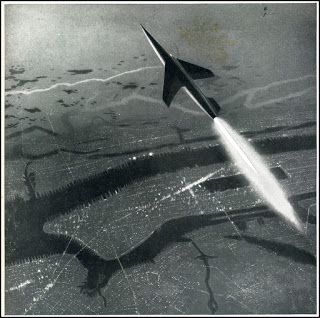
My rather battered copy of this book was obtained during the 1970s, via what used to be known in the UK as a "jumble sale". It was dated even at that time - having been published in 1949 it envisaged future lunar missions which of course had already taken place by the time I read it. However the appeal of the book was less in the text but instead in the fantastic illustrations by Chesley Bonestell, who places the reader in a rocket ship, looking down on NYC;
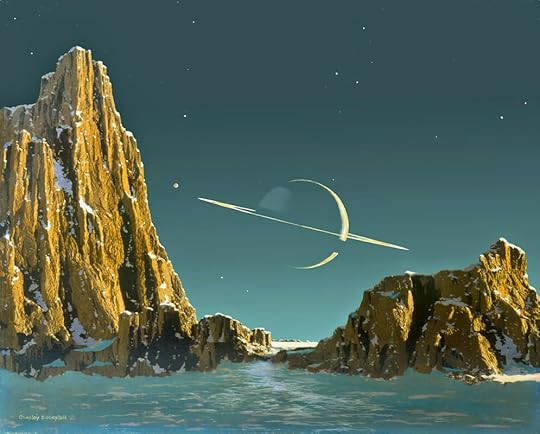
standing on one of the moons of Saturn looking up at a view of that glorious world;
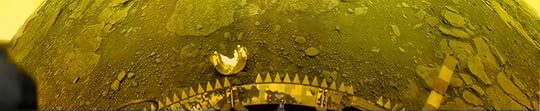
or imagining the surface of Venus as a dust bowl.
Actually, the pictures sent back in the 1980s by the Soviet Venera 14 probe suggests Bonestell's vision might not have been too wide of the mark, particularly in how Venera captured a little bit of Venusian sky.
The 3 paintings by Bonestell are just a few of those from the book. All this was more than enough to set the imagination of a nerdy teenager soaring. I still enjoy looking at the illustrations today. It's also quite fun to see what was hoped for 1949, for example "...we are justified in believing in life on Mars - hardy plant life."
Sadly that was not to be, but some scientists still hold out hope of discovering microbial life beneath the Martian surface. Maybe one day people will shake their heads that we ever hoped even for that.
A dimly remembered love from a childhood school library; recently I found a copy to revisit, and it lives up to the reputation. One can scarcely believe that the book was written in 1949. Of course the main draw of the book is the many outstanding illustrations by Chesley Bonestell -- the book was essentially written around the illustrations by Willy Ley. And equally of course, much of the astronomical knowledge is rather dated. None of which detracts from my enjoyment in seeing it again -- the intellectual effort to make the very best use of the knowledge of the day, to communicate it to the reader, and to convey the truth, undimmed by time, that the Universe is a beautiful place which we can only learn so much about without visiting, shines through.
We can only learn more by going.
And we can go.
And there are strange and beautiful things to be seen.
And that's all just as true today as it was in 1949.
Bonestell serves up a Henry VIII-style feast for your eyeballs and Ley, heroically, matches him in witty captions and explanatory text. This book is a resort for the mind to be experienced again and again.
I scooped up this 1949 book at an estate sale because I knew its history. A collaboration of a rocket scientist and the premiere illustrator of outer space, it served to introduce the public to the early promise of space travel by rocket. It inspired a lot of people who subsequently went into science and engineering, and science fiction.
In the first part Willy Ley explains some of the basic elements of rocketry, and Chesley Bonestell provides illustrations of an imagined rocket-plane journey from Long Island to the West Coast. From there we move into speculation about travel to the Moon and other worlds. Most of the rest of the book describes the Solar System's bodies as they understood them to be at the time, with speculative illustrations by Bonestell.
It's fun to see how much they got right, and what they got wrong. (They were still holding out hope for canals on Mars.) The illustrations included winged rockets as in the early science fiction magazines, which ultimately turned out to be not feasible.
Bonestell is probably the best known renderer of space scenes, and in this book his scenes include the Moon and Mars, plus views of Saturn from its various moons (both near and far). They are so good as to have a photographic quality.
A fun book. The scientific details are horribly out of date, but the book shows the optimism of the post-war environment where flying cars were just around the corner (although not mentioned here), and the Moon was only the first stop to the rest of the Solar System.
A look at American aspirations aiming skyward in the postwar era. The predictions and prognostications are quaint. The science, where it was speculative, is now largely known. But the illustrations are breathtaking and remarkably precise given they originate from the artist's study, imagination, and fine motor coordination, rather than scientific or computational instrumentation. A valuable relic of scientific history.