Jump to ratings and reviews
Rate this book

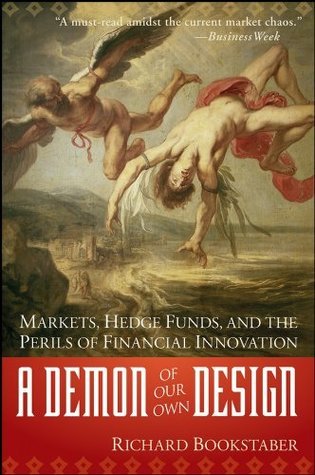
A Demon of Our Own Design: Markets, Hedge Funds, and the Perils of Financial Innovation

Rate this book
Inside markets, innovation, and risk

Why do markets keep crashing and why are financial crises greater than ever before? As the risk manager to some of the leading firms on Wall Street–from Morgan Stanley to Salomon and Citigroup–and a member of some of the world’s largest hedge funds, from Moore Capital to Ziff Brothers and FrontPoint Partners, Rick Bookstaber has seen the ghost inside the machine and vividly shows us a world that is even riskier than we think. The very things done to make markets safer, have, in fact, created a world that is far more dangerous. From the 1987 crash to Citigroup closing the Salomon Arb unit, from staggering losses at UBS to the demise of Long-Term Capital Management, Bookstaber gives readers a front row seat to the management decisions made by some of the most powerful financial figures in the world that led to catastrophe, and describes the impact of his own activities on markets and market crashes. Much of the innovation of the last 30 years has wreaked havoc on the markets and cost trillions of dollars. A Demon of Our Own Design tells the story of man’s attempt to manage market risk and what it has wrought. In the process of showing what we have done, Bookstaber shines a light on what the future holds for a world where capital and power have moved from Wall Street institutions to elite and highly leveraged hedge funds.

293 pages, Kindle Edition

First published January 1, 2007

73 people are currently reading
2155 people want to read

About the author

Richard Bookstaber

6 books26 followers
Richard Bookstaber is the author of A Demon Of Our Own Design, a book highlighting the fragility of the financial system that occurs from tight coupling and complexity. The book is noted for its foreshadowing of the financial crisis of 2007–08.

Ratings & Reviews

What do you think?
Rate this book

Friends & Following

Create a free account to discover what your friends think of this book!

Community Reviews

5 stars
340 (31%)
4 stars
409 (37%)
3 stars
270 (24%)
2 stars
59 (5%)
1 star
13 (1%)
Displaying 1 - 30 of 69 reviews
Profile Image for Ross T.
6 reviews5 followers
August 3, 2012
Marvellous read. Bookstaber gives the reader an interesting and unorthodox theory of why financial crises occur, as well as an in-depth account of some of the scandals and failures that have been associated with financial innovation in the past few decades.

The most valuable chapter of the book is on the nature of accidents and their origins in complexity. The enabling cause of crises may be exogenous, such as through new information, but the fundamental cause is endogenous within the structure of markets themselves. Markets are vulnerable to crises because they consist of many interlinking parts which change quickly and uncontrollably. In such systems, small changes can lead to large effects.

In finance, the product of a complex and coupled market is liquidity. Liquidity has many benefits, not least facilitating the allocation of capital across the financial sector. However, liquidity also enables higher leverage and can therefore increase the vulnerability of the financial sector. For a highly levered firm doesn't require a large (exogenous) push to knock it over. A trivial exogenous shock could lead to the collapse of a highly levered firm, through a heightened demand for liquidity and a downward spiral of mark-to-market losses. In the context of the recent financial crisis, subprime was the straw that broke the camel's back. The exogenous causes are not a sufficient source of explanation; there was an endogenous vulnerability in the financial sector.

The downside of the book is that there are not many prescribed solutions other than applying the brakes on financial innovation every now and then and reducing leverage. Perhaps these broad guidelines follow from believing in a chaotic view of markets which makes targeted regulation ineffective (and counterproductive). Nevertheless, it doesn't make for a very satisfying conclusion.

But I am strongly persuaded to believe that Bookstaber's view of markets is right. And even if it isn't, then the book is worth reading for the fascinating insights on the structure of financial markets which you be unlikely to find in popular economics books.
Profile Image for Jeffrey.
10 reviews5 followers
January 25, 2009
This is not an easy book to understand if you are not a trader or involved with financial engineering on an everyday basis. Upon first read however, I sensed that Bookstaber's overall argument is spot-on for the historic financial crisis of 2008. For example, he explained how a liquidity crisis could be precipitated, ironically, by a demand for liquidity itself.

Once we move away from many of the technical nomenclatures in Bookstaber's book, the underlying backbone of this book argues that the financial markets, derivatives, liquidity options and other tightly-coupled financial mechanism--literally and all the products of human design--are extremely risky because they are too complex and their interdependent dynamic interactions are beyond what we can ordinarily perceive and react to.

To make this argument, Bookstaber must have relied on Chuck Perrow's seminal "Normal Accidents" (1984) and Dietrich Dorner's "The Logic of Failure" (1989; Deutsch), neither of which he explicitly gave credit to. While Perrow argued that complex technologies inevitably fail, Dorner argued that human cognition tends to short-change our decision making process especially when faced with non-linear interactions.

In short, this is a valuable book with great insights (even though I do not understand much of it) despite Bookstaber's implicit denial that he must have stood on the shoulders of Giants to construct his thesis. Particularly relevant for the Financial Crisis, this book at least does a better job in explaining the demise of LTCM technically than N.Taleb's terrible "went bust" in the 'Black Swan'.
Profile Image for John.
293 reviews23 followers
November 9, 2017
This book will pop your eyes and drop your jaw. This is a report from inside the front lines emanating from a veteran financial trader who ran with the pack Back in The Day, who observed the carnage from a front row seat in 1989, 1997-99 and 2007 before all hell broke loose the next year.
Bookstaber is a very smart man, well-versed in mathematics and derivatives; however, this book translates the complex financial engineering into plain English. Having read other tales of excess and debauchery on Wall Street, this account is more down to earth, focusing on the trading plays, key players and wild markets. I put this book up there with two other masterpieces and must-reads.
Roger Lowenstein's "When Genius Failed" about the meltdown of Long Term Capital Management in 1999 (which is covered extensively in this book) and Joseph Stiglitz's book "The Roaring 90's" which provided an insightful academic perspective on the market upheavals (although it stopped at the millennium and was disposed to favor Clinton/Greenspan/Summers/Rubin on policies). Bookstaber updates it and provides a view from the trenches. You get a taste for the egos and politics inside big banks. He sounds the warnings about financial derivatives, complexity and coupling and hints that we are sowing the seeds of our demise. This book came out in 2007. Like many of the doomsayers and Cassandras who sounded the alarms in advance - Nuriel Roubhini, Ragharam Rajan, Mohammed El-Erian, Brooksley Born and Nassem Nicholas Taleb - Bookstaber was ignored... and ultimately vindicated.
Profile Image for Jim.
56 reviews
April 14, 2009
This book helps explain why the financial markets collapsed. Basically, when complex systems (like space shuttles, suspension bridges and nuclear power plants) fail, they fail catastrophically (meaning it happens fast and they stay broke). This physical principle seems as reasonable to the civil engineer as to the financial engineer.

It also helped me understand the mindset of the financial engineers (who prefer to call themselves quants) who use their particular cleverness with mathematical modeling to send our financial system in search of a "RESET" button from the government (the bailout). Using modeling skills and manipulating Black-Scholes to ever-risker and thinner margins requiring billions of dollars to "make" millions, they upset a cardinal rule of real engineers - Use a Factor of Safety!

The author is unapologetic and smug, but lays out the facts and does little to hide from the reality of what they did. The real take-away for me is this aspect of the approach. What they did and how it happened makes sense in retrospect in a way it did not it real time. Adjustments to policy by regulators are approached in the same manner - as after-the-fact Monday morning quarterbacking.

The real question we should be asking is - is there a way to align the inevitable actions of the margin-seeking reality of the financial engineer with the needs of the real economy? And when it comes to "money" - what is real?
Profile Image for James.
301 reviews71 followers
May 13, 2011
This book was written in 2007, just before the recent crisis,
the author doesn't predict it,
but the book has a lot of interesting ideas, individually well presented.

Some like the authors belief that the markets move because of a demand for liquidity,
I don't accept, I think fear & greed move the markets.

But I'm open to new ways of looking at things and there's a lot of good material in the book.

From the cover you'd think it was about the evils of hedge funds,
but the author thinks they are a positive for the markets,
and little in the book is about hedge funds.

Quite a variety of topics tossed in one book.

Could have been organized a bit better,
but much better than almost all the other finance books I've read this last year.
Profile Image for Ernst.
33 reviews2 followers
July 28, 2012
I read this book before the financial crisis hit its peak, and it was astounding. Even for a non-finance person like me, the explanation of the workings of the financial markets and structured products was easily understandable, and the predictions of the market reaction to over-leveraging due to structured products, combined with a lack of liquidity proved prescient.
If you want to learn about the workings of the financial markets and how structured products work, and how both can fail, this book is for you, whether you are an expert in the field or not.
Profile Image for John.
120 reviews48 followers
March 19, 2016
The author, a former hedge fund risk manager, describes how the nature of our financial system makes it prone to behaving unpredictably and pathologically in times of crises due to tight coupling and systematic complexity. He predicts that attempting to overlay profligate safety regulations onto these tightly coupled, complex markets may magnify, rather than reduce risk of future crashes.

The Deeply Connected Downward Spiral
The book delivers two major points about risk in modern financial systems: 1. the interconnectedness of actors + positions in the face of abnormal market conditions can causes cascading, self-worsening failures when "the shit hits the fan", and 2. well-intentioned safety measures applied to overly complex, tightly-coupled systems can increase rather than decrease danger. The author uses the examples of complex mechanical system failures including the ValuJet crash, the Chernobyl meltdown, and Three-Mile Island, to show how, rather than hedge funds, it's the highly interconnected nature of markets and the complexity of highly leveraged asset strategies that causes crashes.

Attention is paid to the way market crises are often triggered by cascading liquidity demands triggered by margin calls in the face of positions declining in value, the sale of which further depress prices when funds go into fire sale mode to meet the margin calls, further depressing prices. Of equal interest is the author's case for "coarse" (generalized) survival mechanisms in species rather than highly specialized defenses because generalized adaptations provide more durability against unexpected future crises (explored via an explanation of the survival characteristics of arthropods and African fish). The debunking of the Efficient Markets Hypothesis and "perfect markets is especially welcome.

The Poor, Ill-Defined Hedge Fund
Bookstaber explains at length how the mainstream media and others unfairly blame hedge funds for risk-taking and precipitating crashes without understanding the real nature of hedge funds, which, in his view do not have a definable nature. He takes pains to indemnify hedge funds as a category for culpability because his view is that the category "hedge funds" is too inclusive and general. He considers hedge funds and "alternative investments" to be such a broad category as to be meaningless in the aggregate. However, the author's insider role in leveraged, algorithmic finance suggest that he may be a bit biased. Even with prior knowledge of his hedge fund insider status, the book feels a bit heavy on defending hedge funds as an elite class of professionals whose notoriety is undeserved. This position ("stop blaiming hedge funds, they don't cause crashes... and by the way, there's no such thing as a hedge fund!!") seems not particularly useful in a solutions-focused approach of reducing crash propensity.

Short on Conclusions
Bookstaber's prescription for reducing frequency and severity of financial crashes are confined to the final few sentences of the text, and consist of nothing more than an airy suggestion to somehow decrease complexity and liquidity in financial markets. Beyond not inventing new, more complicated structured finance products, how one might do this is left as an exercise for the reader.

Four stars, made me think, made me curious, and made me angry

As an addendum to the book, I highly recommend reading the author's senate banking committee testimony, which is quite short and gives a clear explanation of why additional risk controls in the face of market crises can be difficult if not downright dangerously counterproductive.
Profile Image for Glenn.
232 reviews15 followers
July 6, 2009
Bookstaber is has a Ph.D. in econ from MIT and years of risk management experience on Wall Street during the 80s and 90s to add delightful anecdotes to his risk-philosophizing. Less heady than Taleb and more detailed than most finance-style books, Bookstaber describes positions which earned billions and/or blew up. The writing is a little disorganized, and sometimes the direction is unclear. Many of the stories are familiar as they are the epic disasters which defined Wall Street in this era. Finally, for all the wisdom Bookstaber writes out, the book predates the 2008 financial crisis, though eerily suggests the "tightly coupled" and "complex" derivatives could lead to no good. To his credit, Bookstaber offers some solutions to risk management AND effective regulation - usually between jabs at inept policy makers.

A thoughtful read, if you're into this type of thing.
Profile Image for Zbyszek Sokolowski.
299 reviews16 followers
May 23, 2013
Book is good, it describes that not only small investors make very simple mistakes but also people even who have won noble prize in finances. Author shows also that any try to regulate market will eventually fail. And way is to make it simpler and less prone to break down it means that leverage of positions should be confined. Greed causes to introduce new financial instruments because they until they become more popular are source of easy money due to market ineffectiveness but this strategy end in even more complicated market which is more likely to fail
Profile Image for Joseph.
211 reviews5 followers
April 5, 2010
This book alternated between fascinating and boring page to page. I love his analogies and he had some great ideas and points but at times became overly technical and repetitive. Glad I read it for the commentary about financial regulation. He gave some great ideas about the need and dangers of more regulation of financial markets.
Profile Image for Alicja.
112 reviews26 followers
not-finished
August 26, 2018
Nie dałam rady. Książka jest napisana dla ludzi z branży finansowej. Niestety moje zrozumienie haseł stricte finansowych z poziomu instrumentów pochodnych okazało się niewystarczające. Szkoda, ponieważ miałam wrażenie, że książka jest napisana sensownie.
78 reviews1 follower
May 10, 2009
Good account of the financial crises earlier this decade and some pretty interesting ideas on why modern finance is going to continue to be struck by these crises.
345 reviews3,088 followers
August 20, 2018
Why did I wait 10 years to read this book? It is a joy to read. Richard Bookstaber has had a long career in the financial markets. Today he is the Chief Risk Officer at the pension fund University of California Board of Regents and a senior advisor at the US Treasury’s Financial Stability Oversight Council. When he wrote this book he was a hedge fund portfolio manager and prior to that he was in charge of risk management at both Morgan Stanley and Salomon that later turned into Citigroup. The reason for not picking the book out of the bookshelf was that the subtitle “Markets, Hedge Funds, and the Perils of Financial Innovation” gave me the impression that it was a sensationalist, hedge fund-bashing book written by an outsider. This is obviously completely wrong. Few are more qualified than the author to discuss financial risk.

There are three parts to this book although they aren’t presented chronologically. There is one extremely interesting theoretical part comprising of chapter 1, 8 and the conclusion; there is a brilliant autobiographical part covering Bookstaber’s Wall Street career (chapter 2-7) and then chapters 9 through 11 present a somewhat less vivid, semi-theoretical, discussion around hedge funds and much more. For me the chapter on the 1987 crisis was a revelation. Why are researchers still debating what triggered the downturn? Here it’s written out in black and white from someone who had the benefit of both a front row seat and the oversight and understanding to make sense of the event. In short it was a combination of investor psychology, a mismatch in liquidity between the futures market and the cash equities market to act as a trigger and the widespread usage of portfolio insurance that created a self-enforcing negative loop of selling.

In the Wall Street section the author describes the full palette of financial mishaps that he experienced at the investment banks - including the debacle of LTCM, which was closely affiliated to Salomon. In general too many think that only what has recently happened is likely to happen next or that things that seldom happen, will not happen – at least not on their watch. Combine this with the non-linear effects of a constant stream of newly invented derivatives plus complex organizations with plenty of politics and you have an accident waiting to happen. Time after time new financial products are launched without the understanding of unintended consequences. Sometimes the risks are even deliberately ignored as the gains will fall to the banks’ personnel but they will not face the losses.

The theoretical part and especially the chapter “Complexity, Tight Coupling, and Normal Accidents” should be required reading to be eligible for employment at financial regulators. A combination of complexity and tight coupling creates unforeseen events that often cascade through the financial system as a crisis. The complexity arises as the agents in the system change their behavior depending on others behavior and events are often triggered by the use of derivatives – and this is written before the 2007/08 crash. Due to the constant need for liquidity when using derivatives - and the often high leverage - agents in the financial system are critically interdependent and the speed of the market gives little room for error or time for adjustment when things go wrong. That accidents occur in such a system is according to the author to be expected – they are so-called normal accidents that arise by the design. The need for liquidity, not new information, is the main driver of short-term price movements. Less leverage and an incubation period for financial innovation is suggested to tame the system.

The text is colorful, quick-witted and written with a self-irony that adds to the readability. Bookstaber is a quant with a splendid way with words! At this point the book merits a 5-star rating. Unfortunately the hedge fund part isn’t fully up to par. It’s untidy, a bit defensive about hedge funds, searching, and the author doesn’t seem to have fully completed his thoughts. In contrast to earlier parts, no colorful interior from the hedge fund world is offered - pity. In all, if you are to understand financial calamities you should have read this book.
181 reviews6 followers
February 7, 2021
One of the better financial and trading books that I have read in a while - Bookstaber provides an excellent book that is a bit biography, financial history and also theoretical exposition. Written by an experienced market participant, there is something for everyone here.

A Demon of Our Own Design framed roughly around Bookstaber's own career - he uses his experiences trading around various financial panics (Black Monday, LCTM, the dotcom bubble, etc) to provide insight. Generally after providing some context, Bookstaber will then return to provide his explanation of the mechanisms that caused the bubbles - the depth of his analysis is never in question, even taking us on a history lesson to the Dutch tulip mania. It helps that Bookstaber was close to the action, with his time at Salmon Brothers yielding some fantastic anecdotes - you can't beat his recollection of Munger saying: "A spread trade is like a stick with shit on both ends."

The last sections of the book are dedicated to giving some different ways to think about markets and risk. Gone is the textbook view of markets as being conveyors of information, rather the price action is a reflection of liquidity demands by different participants. But the greatest strength comes in Bookstaber's exposition of risk - rather than being obscure and impenetrable, Bookstaber draws of different analogies and other disasters that make his arguments accessible. In short, he berates the complexity of financial markets, they are like the furu fish - highly adapted to a specific context, but outside this do we really know how they will respond or will they be resilient. The answer is likely no - hence the constant repeats of financial crises. Indeed the only useful analogy from physics may be: “Just as high-energy physics creates a state that is no more differentiable than to say that is is matter, so the high energy in financial markets created a world where securities were no more differentiable than that they contained risk. ... As the market moves into crisis, the absolute value of the correlation of assets approaches one. The problem is you cannot always predict ahead of time if the correlation will be positive or negative.”

Instead Bookstaber argues perhaps markets should draw more from biology, taking the humble cockroach as an example - its resilience (in contrast to the furu fish) comes from the fact that it is not overly specialised - instead its simple rule to move away from the wind gust has allowed it to survive over many periods and in many environments. Bookstaber here is a proponent of more coarse behaviour - simpler behaviour that is more robust and would provide the system with more slack. Drawing from Brazilian Jiu Jitsu, he provides yet another fantastic analogy: "What became over time was that having a firm understanding of the actual application of a set of controlled techniques through live training and real fights was superior to having a quiver filled with techniques that were powerful in theory but could not be tried and refined until an actual fight occurred." Innovation for innovation's sake is not necessarily good for society: "Just because you can turn some cash flow into a tradable asset doesn't mean you should..."

In short, anyone reading A Demon of Our Own Design will definitely have something to learn, while being entertained. It's not often that can be said about books about markets.
Profile Image for Arjun Pathy.
52 reviews
September 23, 2025
Bookstaber manages to bridge biology, psychology, and his deep financial experience to create a truly fascinating text. He argues that it is humans coarse thinking that has allowed us to survive (like cockroaches) but also dooms us to irrationality and market failures. Financial markets in the end lead back to human brains. The time horizon of a financial innovation is a couple of years, and inefficiencies are transient, especially as markets get more efficient. It is at this frontier, where banks are constantly trying to dream up new, more complicated products that most of the issues occur. Ironically, this fits in with the efficient market hypothesis, as ideally there is a product to match every possible risk. However, in practice, this leads to malfunctions such as ‘87. In the end, the Achilles heel of most markets is liquidity. It all comes back to liquidity, whether you look at LTCM or Amaranth. Liquidity is especially dangerous when paired with leverage. With all this being said, Bookstaber was highly technical, and didn’t try to make the book accessible to a non-professional. I was too lazy to look up every term, so I inevitably missed some context. Generally, a great book that is highly interdisciplinary.
Profile Image for Monzenn.
878 reviews1 follower
March 2, 2023
Chock-full of tidbits and information about trading and markets, especially from a risk management perspective. Hedge funds are maybe a little less than half of the book. The recommendations about simplifying transactions and reducing leverage also make sense.

What knocks this down by a star is that weird and unrelated section about complete knowledge being impossible - which is true, but then he pooh-poohs the efforts of those who tried it. In mathematical lore those who tried to build a complete world of knowledge are just as praised as those who proved it impossible, because both went through the proper mathematical process. The author just decides to say "oh well those ones are wrong," which is perhaps a product of his results-first work experience but is a disservice to mathematics. Left a lasting bad taste in my mouth.

Otherwise, the rest of the information can act as a risk management reference book. Just cut off that section, perhaps.
Profile Image for Ian Robertson.
89 reviews42 followers
February 13, 2013
With its publication predating by a year the financial meltdown of 2008, this well written book about “the perils of financial innovation” promises an insider’s view of what ailed the system; neither a postmortem nor a prediction, but rather a detailed diagnosis of the corpus financius. For the most part, Bookstaber, a former trader and head of risk management at several major Wall Street firms, delivers a very entertaining thirty year history of financial innovation and folly. Over time, risk is sliced or packaged in ever more innovative ways, leading to profits for traders and firms, and ultimately and inevitably outsized losses for shareholders when a bet turns bad.

Bookstaber writes about the stock market crash of 1987 (outlining both the cause and his role), the rise and fall of bond giant Solomon Brothers, the financial colossus that was Citigroup, and the rise of hedge funds. He includes many interesting anecdotes, at one point describing an innovative product developed by UBS which readers will recognize as index-linked CDs (in Canada GICs) offered a few years later by many retail bank branches, as well as some historical detours that provide context or an introduction to the issue at hand.

Readers shouldn’t worry about the seeming complexity of the subject matter, as Bookstaber explains complex ideas and market mechanics very well, without jargon or condescension. Along the way he takes the accounting profession to task (echoing former SEC chair Arthur Levitt’s critique of a few years earlier), provides an explanation of efficient markets and the mathematical underpinnings of economics, and offers an excellent introduction to hedge funds by outlining different trading strategies and the importance of liquidity.

Bookstaber writes with wonderful turns of phrase, and more than once I found myself smiling at his witty but understated delivery. Describing the new market hotshots called risk arbitrageurs, he writes, “During the takeover boom of the 1980s, they were voracious, sharks that preyed on other sharks. They bet on who would take over whom. The most prominent names in this business included Ivan Boesky, who would later be arrested, and Robert Rubin, who would later be Secretary of the Treasury.” As we know now, Rubin would later preside over Citigroup’s risk mismanagement and its financial collapse. It seems the only shark with its reputation unsullied is the Long Island resident introduced to us a few years earlier by Peter Benchley.

Despite the excellent content and storytelling, I have a few small quibbles. First, and an issue which applies equally to the stock market reports on our daily news as it does to Bookstaber’s book; references to stock market point drops are meaningless unless readers know the starting index level (and it’s different for each of the Dow Jones, S&P500 and NASDAQ). All market movements should be reported in percentages. Second, history has proved some comments inaccurate. For example, Bookstaber’s comment that “mortgages have little in the way of default risk” may have been true historically, but of course has been proved disastrously wrong since. Third, his defense of hedge funds and their beneficial role in markets too seems biased, perhaps owing to his previous employment at a hedge fund. Hedge funds may well provide market liquidity, but their benefits and costs to the financial system are much more complex than Bookstaber pretends. Read for example the ongoing debate about today’s high frequency trading and its impact on the transparency and stability of markets; liquidity run amok, and to whose benefit?

Two larger issues, unfortunately, prevent the book from being truly outstanding: its divergent focus and its weak conclusion. Bookstaber may have been aiming to demonstrate our financial demon by recounting his involvement in various events, but unfortunately the high level of detail about the people involved gives it the feel at times of a memoir rather than a book with important lessons. Readers can skim much of the personal detail without losing any of the terrific content, but the lack of focus does detract from the overall effect. Bookstaber could have taken a lesson from Peter Bernstein’s landmark book Against the Gods: The Remarkable Story of Risk in how to retain only the important details and remain both engaging and on message.

Curiously, despite his chronicles of others’ bets gone bad, he remains confident that his own trades - shut down by senior management - would have paid off handsomely. Bookstaber’s hubris ultimately limits the book’s full potential, and after an excellent description of the symptoms, he unfortunately concludes with an unreflective diagnosis and an uncritical prescription. His prescription is for simpler financial products and less leverage. Prescient given the incredibly leveraged financial system and undecipherable mortgage based securities at the root of the following year’s crisis, but vague and unhelpful. He is on firmer ground in his caution to regulators (is he talking directly to Alan Greenspan here?) that “it may be dangerous to assume that institutions behave rationally,” and more solid ground still when, after introducing the notion of uncertainty and the impact of observation on the outcome (Heisenberg’s Uncertainty Principle), he cautions that increased regulation may be counterproductive as it could have large, unforeseen and unintended consequences on the market.

Bookstaber is an expert on risk, an insightful and edifying guide, and a first rate storyteller who has delivered an entertaining and educational and tour of the risk of markets. Despite the criticism noted above, A Demon of our Own Design is a worthwhile read and a welcome addition to our understanding of risk in capital markets.
Profile Image for David.
573 reviews9 followers
June 6, 2017
well..it is another great book focusing mainly on LTCM blow out, Russian default and mainly from the background story of Citigroup failure: Weil, Prince, etc..although towards the end of the book, author did mention all of the so called natural self protection mechanism, and the rules of the nature and all...slowly guide us to the direction that hedging, investment, arbitrages are no safe bet...HFT was mentioned in one short paragraph..also mentioned hedge funds are not making profit coincide with the book Hedge Fund Mirage...but after-all, this is another book about author's experiences rather than a remorse about his past participations in partying with the major financial crime mobs of the century..
270 reviews10 followers
September 7, 2017
Bookstabber has been on the ground floor (and or partially responsible) for all of the terrific market crashes we've seen in our time. He writes about them and tells great first hand stories of things like Charlie Munger castigating Salomon mgmt at a BoD meeting or Dimon aggressively demanding a zeroing out of Russia exposure (ahead of the default!).
The author does a great job with his analogies and tells wonderful historic anecdotes that he then ties into modern day finance.
He makes some effort to explain things but this book is written as an appeal to financial market professionals (eg. he just assumes it makes sense to you when he says an option arb hedge fund's primary risk is gamma).


169 reviews6 followers
February 12, 2021
Five-star content, four-star writing.


The question posed by this book is: why can’t the financial markets seem to get their act right? Why, in spite of reduced risk in the underlying economy, in spite of the march of innovation and the contributions of financial engineering, do we not enjoy reductions in financial risk that we find in other areas of our lives? Why are markers actually becoming more crisis-prone?

One answer is the effects of innovation. The positive effects of innovation comes at a price. Innovation increases complexity. Many innovative instruments are in the form of derivatives with conditional and nonlinear payoffs. When a maker dislocation arises, it is difficult to know how the prices of these instruments will react. Markets have also become more interconnected and more liquid, making it easier to take on leverage because liquid and readily priced securities make for good collateral.

Financial risk is also higher because the markets increasingly assume a mathematically precise rationality, as opposed to the way we actually do, or indeed really should, behave.

Market crises are not born from nature. The machinery of the market itself can take a small event and distort it. The more closely we try to follow the ideal, thereby adding complexity and tight coupling to the market, the more frequently crisis will occur. Attempts at that point to add safety features, to layer on regulations and safeguards, will only add to the complexity of the system and make the accidents more frequent.


After 9/11 the market recovered in 3 weeks.

Despite more volatile markets, economy has become more stable.

When price drops, does it signal a demand for liquidity or a change of the fundamentals? If liquidity demander targets a shorter time frame than the liquidity provider, price can over drop. The key is the difference in the time frame. If sellers could have waited longer for the liquidity they demanded, the buyers would have had time to react and the market would have cleared at a higher price. Any model that depends on instantaneous execution cannot wait.

Accounting has failed us as investors and managers. Accounting should be about generating sufficient statistics to assess the state of a firm.

For financial markets, the tight coupling born of liquidity feeds right back to the source of complexity. Liquidity is the lifeblood of derivatives; unlike the underlying securities, derivatives are created on the assumption that they can be hedged on an ongoing basis, and so make continuous demands on liquidity. Without liquidity, derivative markets die.

The principal reason that prices vary, especially in the short term, is liquidity demand. That is, far more than acting as a conveyor of information, the objective of markets is to provide liquidity.

Liquidity demanders must move the market to meet their needs. Liquidity suppliers try to profit from the moves; they strive to meet the liquidity demand for a price. The first line of liquidity providers is the market makers; next line includes hedge funds and other speculators; and then, working a longer time frame, investors. Liquidity providers serve a valuable economic function. They keep capital readily available for investment and apply their expertise in risk management and market judgement. They take risk, use their talents, and absorb the opportunity cost of maintaining ready capital. In getting ahead of the curve, anticipating demand and putting in an early order to get in-demand inventory the liquify provider is not just making a profit; she has made the economy more efficient.

Liquidity allows capital to migrate to greater opportunities. Liquidity enables collateralized loan - credit.

More transparency does not make the market more stable: it exposes liquidity providers because their goal is offload their risk quickly - if their position is published they wouldn’t take that much risk; increasing transparency may also change participants behavior.

Because we cannot measure without error, for many dynamic systems our forecast error will grow to the point that even an approximation will be out of our hands. We can run a purely mechanical system that is designed with well-defined and apparently well-behaved equations, and it will move over time in ways that cannot be predicted and, indeed, that appear to be random.

While the academics continues to be on making economics look more and more like physics, economic behavior may be better explained by biology.

The coarse response, although suboptimal for any one environment, is more than satisfactory for a wide range of unforeseeable ones. In contrast, an animal that has found a well-defined and unvarying niche may follow a specialized rule that depends critically on that animal’s narrow perception of its world. Perhaps we have been wired to behave in a coarse manner. We run our lives ignoring some information and reacting less than fully to our circumstances. Hedge funds and other investors make money in spite of a world which fill information because people do not act based on full information. That market inefficiencies occur speaks to the fact that there is more to life than financial markets and financial risks. Our coarse behavior literally leaves money for the taking. It may well be that this is not a failing, but rather an insignificant cost for the genetic structure that allows us to better survive as a species.

Each financial innovation added complexity to the market for the simple reason that complexity was what sold and what made the most money. A large segment of the firms in the hedge fund/alternative investment world employ opportunistic strategies that feed off the inefficiencies born of this complexity.
14 reviews
August 31, 2025
Really enjoyed this one. It makes a pretty complicated subject (hedge funds, derivatives, financial “innovation") more understandable than I expected. In a refreshing change, we have a book written by someone with an actual background in economics, not just a journalist who couldn't pass econ 101, because they never mastered calculus.

Bookstaber was on the inside, so the stories feel authentic and not just theory, and he shows how a lot of the fancy financial tools actually made markets less safe, not more. Some of it is technical, but he explains things clearly. Honestly, it’s a bit scary how relevant it still feels years later. If you’re curious about how Wall Street really works and why crises keep happening, this is a smart and surprisingly readable book.
Profile Image for Arup.
236 reviews14 followers
August 1, 2020
Another insider take into Salomon, LTCM, 90s' Wall St. Fun stories. Book ends with concluding that "normal accidents" are unavoidable in complex systems that are also tightly coupled. To break the chain of recurring financial crises we have to forgo our desire to invent new securities and everyone's favorite - reduce leverage. Slowing the speed of transaction (a la bank holidays of the good old bank-run days) is also recommended - anything that reduces the "liquidity" of investments and the leverage that mushrooms out of this liquidity.
Profile Image for Greg.
74 reviews3 followers
February 27, 2019
So much I didn't know about economics. The systems approach to his explanations of both complexity and liquidity are something an ex-engineer could appreciate. Also makes me realize how little hope there is for regular players (read: people with full time jobs doing things other than finance) to reliably hope to achieve better than average in the market. I'm much more happy now making average returns on the markets!
Profile Image for Sayak.
41 reviews
March 22, 2024
It would have been a 4 but Mr. Bookstaber lost me in the last 50-60 pages with his evolutionary comparisons against cockroaches and somewhat incomprehensible defense of hedge funds. It may just be me but it was hard to connect the dots. Rest of the book is a well-written narrative with technical details which may only be appreciated by the right audience.
Profile Image for Nam KK.
111 reviews9 followers
January 14, 2025
I've never read a worse finance book in the last decade. The author seems confused about the purpose of the book. Is it supposed to be a memoir of a risk manager? Not quite. A history of financial markets? Hardly. A theory on market approaches? He barely scratches the surface. Reading this felt like a complete waste of time.
Profile Image for Lawrence FitzGerald.
491 reviews39 followers
November 22, 2018
A quick read with some useful insights.

The supply and demand for liquidity in markets is a useful insight.

Complexity is a necessary condition for chaos.

I don't think either originates with Bookstaber, but I carried it away none-the-less.
11 reviews
April 10, 2020
as relevant now as in the GFC
identified and reasoned, contextual examples from history of finance
demystifying the BS
demonstrating the limits of statistical predictions, and a warning against over complicating market structure and backward looking regulation
Displaying 1 - 30 of 69 reviews

Can't find what you're looking for?

Get help and learn more about the design.