In 1508, Pope Julius II commissioned Michelangelo to paint the ceiling of the Sistine Chapel. The thirty-three-year-old Michelangelo had very little experience of the physically and technically taxing art of fresco; and, at twelve thousand square feet, the ceiling represented one of the largest such projects ever attempted.
Nevertheless, for the next four years he and a hand-picked team of assistants laboured over the vast ceiling, making thousands of drawings and spending back-breaking hours on a scaffold fifty feet above the floor. The result was one of the greatest masterpieces of all time. This fascinating book tells the story of those four extraordinary years and paints a magnificent picture of day-to-day life on the Sistine scaffolding - and outside, in the upheaval of early sixteenth-century Rome.
There are some works of art that are so transcendent, so seemingly divinely inspired, that you almost don’t want to look too closely at the individual(s) responsible for creating such magnificent beauty lest they turn out to be total douche bags. It’s a little bit like seeing how the sausage is made. “Man, this sausage is delicious…I can’t wait to see how you guys do—wait…oh…oh, no…hold on…is that pig anus you’re putting in there?! Seriously? Like, the anus of a pig? I’m eating a pig’s ass? Why is it so delicious? WHY, GOD, WHY?!”
Hmm. This review is not getting off to a very good start. Let’s try that again.
Michaelangelo is the ninja turtle who loves to party. He also loves pizza—well, I mean, they all love pizza, but Mikey especially loves pizza, and he sure comes up with some crazy toppings. This one time he…
What? Wrong Michelangelo? F$@& me!
All right. Let’s try this one more time.
It’s pretty universally agreed, and I’d wholeheartedly include myself amongst the group of agreers, that the ceiling of Sistine Chapel is one of the most amazing works of art ever created (and it’s unquestionably one of the most influential). The artist most responsible for that work (I say “most responsible” because, like any Renaissance fresco-er, he had help from a team of assistants), was Michelangelo Buonarroti, and the story of how he came to paint that magnificent work—and the challenges he encountered while doing it—is a fascinating one, ably recounted by Mr. King.
In retrospect, it seems almost impossible that we can admire Michelangelo’s work today. The passage of time alone could have, and nearly has on multiple occasions, destroyed it (only a combination of luck, genius craftsmanship at the outset, and dedicated conservation efforts have managed to preserve it), but the fact that it exists in the first place is almost inexplicable.
Michelangelo shot to fame on the strength of a number of works, but primarily because of a 17-foot-tall naked dude by the name of David (like Madonna or Beavis, he needs only one name, though I’ve heard Beavis is more well-endowed). He considered himself a sculptor first and foremost and had never executed a fresco before (though he had been commissioned to do one); in fact, the primary reason he ended up getting offered the commission to paint the Sistine Chapel ceiling was because a rival talked the pope into it in the hopes that Michelangelo would either decline (and be disgraced) or utterly fail (and be disgraced).
Despite his relative inexperience, the logistical difficulties of painting something so absurdly high (contrary to popular belief, Michelangelo did not paint lying on his back, though rumor has it that he did once eat a plate of pasta in that position, which, in and of itself, should be recognized as one of history’s most daring and difficult feats, because gravity…am I right?), the sheer amount of square footage involved (it took Michelangelo more than 4 years to complete), and the near-constant turmoil that resulted from then-Pope Julius’s warmongering ways (side note: my alma mater, Ohio Wesleyan University, features the seemingly inexplicable Battling Bishop as its mascot; that concept makes a lot more sense after reading about the exploits of the vainglorious Julius), Michelangelo produced a masterpiece of form and aesthetics that continues to inspire people today.
I should preface the following remarks by noting that I am, in the technical sense, a heathen, having never been baptized. I was raised nominally as a Christian, but with no particular guiding doctrine nor any family devotion to, well, devotion. So, when I visited the Sistine Chapel a few years ago, I did so primarily with historical and artistic interests in mind, not religious ones. We had the good fortune to be part of a tour group that was able to gain access to the Chapel before it opened for the day to the general public, which means that there were only about 50 or 60 people milling about when I was there—it might as well have been empty.
Craning my neck to see the full splendor of Michelangelo’s work, I was dumbstruck. (Well, really, I was awestruck, but since when you adjust for my lack of intellectual horsepower, it was the functional equivalent of being dumbstruck.) Despite having nary a religious bone in his body, I can only call it a religious, or, at least, cathartic, experience. The sheer power and awesome majesty of Michelangelo’s (and his conspirators’) work was so unbelievable that it seemed hard to believe that human hands could have crafted it…
…which brings us back to the thorny issue of not wanting to look too closely at the person responsible for such divine glory lest he turn out to be a large-nosed curmudgeon who thought smiles were comparisons using “like” or “as” rather than facial expressions intended to convey that inexplicable feeling known as “happiness.” Which, in this case, he was. And, yet, the story of the Sistine Chapel’s painting, of Michelangelo’s strange relationship with Pope Julius, of his rivalry with Raphael, of his odd family dynamics, of his insane and obsessive work ethic, is fascinating in and of itself. If it doesn’t reach the dramatic heights of his artistic achievements, it does not in any way diminish them, and King’s account adds flesh and bone to the ethereal images that have continued to speak to us across the ages.
Well worth a read for art or Renaissance aficionados.
(On an unrelated note: do we think Splinter was being intentionally ironic when he named the most happy-go-lucky ninja turtle after the grouchiest of his quartet of Renaissance artist-inspired names? I hope so; otherwise, it just makes him look ignorant, and there are few things I hate more than an ignorant mutant rat who holds himself out as a wise sensei. I just don’t truck with those shenanigans.)
What a treat. This book felt like the best read I've had in a long time. This may seem unfair to some of the great books I've read recently, but this one was at the same time instructive and of very easy access. It covered everything from the technical aspects of painting frescos to the artistic concerns that went into the vault of the Sistine Chapel, to the geo-political landscape of Italy at the beginning of the 16th Century.
The books starts with Michelangelo's early career and how he landed the commission to fresco the vault of the Sistine Chapel. It was very interesting to see the life of a tradesman in those days. The author goes over Michelangelo's character and his relationships with various figures of the days. As the book follows the progress on the vault, we are made privy to the ever changing political landscape and the ongoing competition with Raphael, as each one pushes the boundaries of art.
I have read quite a bit about the Papacy during the Middle-Ages and this was a very nice refresher of the events in Northern Italy at the time. The book is as much about Pope Julius II as it is about Michelangelo. But the real focus of the book is the fresco and its numerous panels and figures. The author walks us over all the difficulties, tribulations, and inventions that continually happened throughout the project.
The book has many illustrations and nice color plates of the entire vault. But for some reason, it is missing the two pendentives from the altar wall that were considered by Michelangelo's contemporaries as his best work. There are also other works, notably by Raphael, that are not depicted and I had to go to the Internet in order to see them. But it was still a very enjoyable read that gave me a new prespective on this cornerstone of Western culture.
Russ King’s bestseller describes the painting of the Sistine Chapel under the reign of Pope Julius II, a notorious tyrant of a pope. The book details the technical challenges of the painting of the Sistine Chapel (ranging from paint issues to scaffolding issues to design issues), the life of Michelangelo leading up to the commission, the historical events during the reign of Julius and how they intersect with the chapel painting, and other such details. Overall, I had a hard time getting through this book. While the technical challenges of the painting were interesting, and the pictures of the Sistine Chapel make a man stare in slackjawed amazement at the mural’s beauty, the flow of the book didn’t hold my attention. One problem was the continuous mention of obscure Italian after obscure Italian (probably not obscure if you were an art history major). After awhile, the names began to run together and I couldn’t keep track of the various figures involved in the mural’s painting. Secondly, King includes far too many details of every historic event even remotely related to the completion of this great work, and the tangential details ruin the pacing. There were many sections in the book I felt could have been left out, and the book would have fared the better for it. Lastly, King seems to have written the book for art buffs. As he describes works created by Michelangelo or other artists, he often compared aspects of the work to aspects of other existing works that may have inspired said work (i.e. this particular arm pose from one statue is reminiscent of the arm pose from this other statue). But unless one were also familiar with the other works, the points are less effective. I wish King had included far more illustrations throughout so that non-art fans could better follow his analyses. Overall, a recommendation only for fans of the Sistine Chapel, or for European or Art History majors.
Another fine volume of art history from Ross King. This covers most closely Michelangelo's early years in Rome, from 1505 when he got the commission for Pope Julius II's tomb, through 1512, when he finally finished the ceiling of the Sistine Chapel. The notoriously grumpy genius was immortalized twice (at least) by artists working at the Vatican in those years - by himself as the prophet Jeremiah, and by Raphael as the notoriously grumpy genius Heraclitus in his "The Academy of Athens."
By the end of it, I was envisioning Michelangelo as muttering "Damn it, Pope Julius, I'm a sculptor, not a painter!" and "Damn it, Pope Paul III, I'm a sculptor, not an architect!"
I remember myself standing in Sistine Chapel. I was standing there speechless, throwing my head back, absolutely dazzled by what I was experiencing. Later I thought, though, what other people had felt standing there. Did they know the story behind Pope's ceiling in question? Did they understand the narrative of each scene they saw? Did they try to imagine what creating such a masterpiece required? Or were they simply standing there thinking why on Earth THIS is considered to be one of the greatest things humanity has ever created? Did they read something on the subject? Did anyone tell them?
There’re plenty of scholars who regularly publish their researches full of complicated terms and relatively new ideas which they usually don’t offer to a broader audience. There’re plenty of guides who tell one and the same story every day in Sistine Chapel, or in the Louvre (insert the museum that you like most) and don’t even try to make it fun to listen. There’re plenty of tourists who whould never understand why they have paid their money to see Mona Lisa or Pietà and what all the fuss is about. Don’t get me wrong, I love scholars and respect what they do, I certainly know that being a guide day by day is exhausting, and I don’t think that every individual is obliged to be in awe standing in front of the work of art. But I do believe that art, history and, hence, art history as well could (and should for that matter) be both informative and entertaining. Moreover, I believe art history may be appealing for a huge audience once the person who tells the story makes it relatable.
Ross King certainly knows how this things works. I wouldn’t dare to compare Ross King with any serious scholar though, but I love his approach both to Leonardo (I’ve been in team Leonardo since I remember myself being interested in art in general) and to Michelangelo. He may simplify facts or omit something overcomplicated, but he always invites his readers to learn more. Both in Leonardo and the Last Supper and in Michelangelo and the Pope's Ceiling he gives impressive, broad context for the period of creation of the masterpiece in question, trying to describe what surrounded the artist and his work. Sometimes King gets carried away, but mostly it does no damage to the book. It may even hook a reader and make him or her search for additional information.
This book does not make art seem boring or a privilege of the elite. It tells the fascinating story of a man who sometimes was unsure and afraid, made his mistakes, lost his temper, and, above all, created the grandiose chef-d'œuvre. It tells the story of the time when ugly deeds were adjoined with grand gestures and visions. And I hope that this book works the way it should.
Having immensely enjoyed reading Brunelleschi's Dome by the same author, I knew this bestseller about Michelangelo would not disappoint. Through thorough research, Ross King exposes truths that rectify many prevailing myths, particularly those promulgated by cinema. Indeed, Michelangelo did not lie flat on his back to paint painstakingly the frescoed scenes on the curved Sistine Chapel ceiling. The artist, in fact, wrote to his father describing how he had to stand on raised scaffolding in an uncomfortable stance with his head tilted back. Unlike the Michelangelo portrayed by Charlton Heston, the real Michelangelo was not the only artist responsible for decorating this ceiling. Michelangelo employed numerous assistants to help with all phases of the work, since sculpture in stone rather than fresco painting was his medium of choice.
King renders both the artist and the pope as formidable personalities. Michelangelo never hestiated to ask for compensation that he felt was due him. He even followed the warrior pope to the battleground to ask for money. Although respectful, Michelangelo never cowered before Pope Julius II, and was probably highly admired and respected in return.
The Sistine chapel ceiling that took more than four years to complete has become synonymous with Michelangelo's name. King points out numerous details that illuminate the life and work of an artist whose portfolio seems inexhaustible. Well-researched and readable, I highly recommend this accounting of Michelangelo's life.
"They make a sword or helmet from a chalice and sell the blood of Christ here by the load, And cross and thorn become a shield, a blade.” - Michelangelo about Rome under the rule of Pope Julius II
A comprehensive look into Michelangelo's work on the Sistine Chapel's ceiling, the war that raged behind the scenes, and the ever-present disdain he had towards society, Raphael, and Pope Julius II. Shout out to Michelangelo for being one of the most famous introverts ever.
I am not the ideal reader for this book, and picked it up for idiosyncratic reasons. Art history has never much interested me, nor does Renaissance painting in particular, and I’ve never seen the Sistine Chapel. However, I am working on a challenge to read a book primarily set in each country in the world, featuring people from that country and ideally written by an author who is too, although this last is flexible. Microstates, as you can imagine, are a challenge, and none more so than Vatican City, which holds sovereign status despite being an administrative center rather than a proper country. It’s hard to find books from a place that boasts only 109 acres (about 0.17 square miles) of territory and no native population! After deciding against multiple poorly-received thrillers entitled “Conclave,” I settled on this, which as it focuses on art created within the Vatican, seems to more or less fit. Maybe later I will find something else that fits better.
At any rate, this is a perfectly readable history that will likely appeal much more to people who do love art history and/or Michelangelo’s work. It’s a narrative of both the Sistine Chapel ceiling project and the events surrounding it—namely Pope Julius II’s wars against everybody who pissed him off, although there’s also an awful lot about Raphael and the art he was working on at the time, which never impacts Michelangelo’s work to the extent I was expecting from these sections’ prominent billing. The sections on other subjects certainly put the Sistine Chapel frescos in context, and it’s impressive just how much information we have about these early 16th century people; the facts appear to be well-sourced.
There’s also a lot about fresco techniques, where Michelangelo got his colors, lots of name-dropping of various other Italian artists at the time, etc., from which I learned a bit but which also proved more than I wanted to know. The author has his focus, and that’s the art and the politics; he doesn’t even much discuss Michelangelo’s life outside of the Sistine Chapel years, though enough of his letters and others’ impressions of him survive to paint him as a perpetually dissatisfied, self-pitying diva (or, stated less judgmentally, a depressive and eccentric introvert). There were a few asides I definitely wanted more information on—like the bit where Michelangelo had to wait for a statue to be raised until the day deemed most auspicious by the papal astrologers. Papal astrologers? What? I remain unenlightened on this point, as Ross King apparently finds it unremarkable, or at least is far more interested in the techniques of fresco.
I certainly learned a lot about the Sistine Chapel frescoes though, as King puts them in context and points out aspects I might not have noticed otherwise: for instance, half the ceiling features much smaller and more numerous figures in its central images than the other half. This is because Michelangelo and his assistants, standing (no, not lying down or suspended) on a scaffold that covered the entire ceiling, couldn’t see their work from the floor until the first half was unveiled, years into the project. At that point, he realized larger figures worked much better, and painted the rest accordingly.
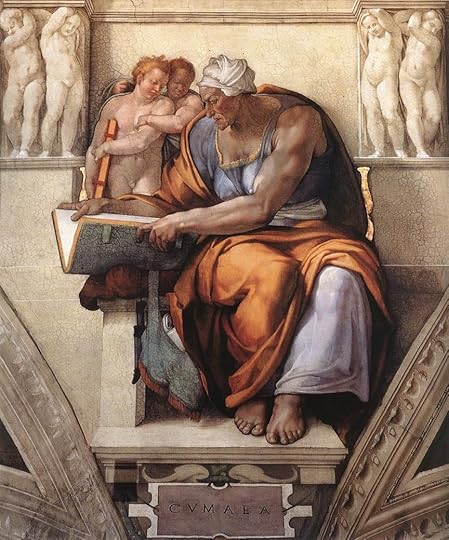
The extent to which the author’s own art criticism revolves around calling women ugly and old is striking, though. Take a look at this figure, per King a “grotesque behemoth” and “hideous crone”:
Cumaean Sibyl
First glance: that’s a bodybuilder, and he looks fine. Second glance: okay, this figure does indeed have breasts, and the Cumaean sibyl is supposed to be female. (Michelangelo used only male models regardless of the figures he was painting, but most of his women are still recognizable as such, if at times conspicuously muscular in the arms and shoulders.) However, while to Michelangelo a masculine-looking, dark-skinned woman might have been “grotesque” or even “hideous,” this is King’s judgment, published in 2003 and unfortunate today. And I’m still not convinced by “crone”: what elderly person has that physique? If one did, perhaps the better descriptor is “awe-inspiring.”
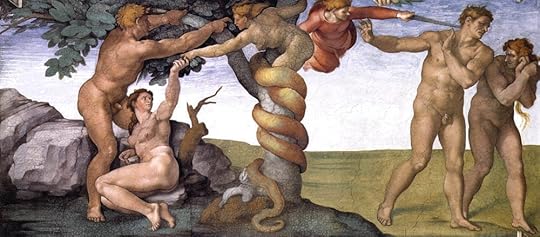
Meanwhile Eve, in the expulsion from Eden, comes in for similarly harsh criticism: per King, she’s “a hideously ugly old crone with tangled hair, wrinkled skin and a hunched back.” Here she is:
Temptation and Expulsion
She doesn’t have a hunched back, she’s cowering behind Adam as an angel menaces them with a sword. The long red hair again indicates relative youth. And she’s definitely wearing a rictus of anguish, which can indeed make people look older and uglier, but from context, well, who wouldn’t be? Focusing on her appearance rather than her emotions is telling.
King has also thoroughly reviewed the literature on who has called which of the child figures holding up nameplates “hideous,” “vile,” “morose, stunted, grimacing,” “dwarfish, brutal,” and “unspeakably repulsive”—just so you know. I had no idea art criticism revolved so much about judging the subjects’ beauty and gender conformity. But, first art history book.
Don’t let me discourage you if this is your thing, though. As I said, it’s readable, and you’ll certainly learn a fair bit about the Sistine Chapel ceiling frescos and the circumstances surrounding their painting. May be well worth the read for those who love art history and those planning to visit the chapel—which, by the way, both looks like a fortress and was designed with that dual purpose in mind! Nothing like pouring boiling oil on people from the ceiling of your church, after all.
Once again, I find myself surprised at the remarkable amount of detailed knowledge that survived for Michelangelo Buonarroti after 500 years. “Michelangelo and the Pope’s Ceiling” presents the detailed story of Michelangelo’s efforts to paint the ceiling of the Sistine Chapel. As implied by the title, this book presents a lot of perspective on Pope Julius II, including his focus on making the Sistine Chapel beautiful, his papacy, and his relationship with Michelangelo.
Michelangelo’s family kept their correspondent with their artisan son, and author King Ross made excellent use of it to help paint a clear picture of the mercurial artist. Michelangelo had a knack for insults and put downs that I enjoyed.
During the years that Michelangelo worked on the chapel, the artist Rafael was also becoming famous. Though Rafael did not work on the chapel he performed many projects for the pope and others in Rome. In some ways Rafael seemed slightly off topic, but including his story helped highlight the enormous personality differences between the two men. King Ross makes a case that Rafael never matched the amazing artistry of Michelangelo and his amazing Sistine Chapel work.
Pope Julius II military escapades are a marked contrast from the modern papacy. Personally, I would have enjoyed a little less on the war efforts. The book was still enjoyable. If possible, I would have rated it about 4.5.
Great read, straightforward. I liked the stuff about his methods and techniques, the frescoing, and also all the stuff about poses. I knew it was a big part of painting, but I’d never thought of it in terms of quoting other artists by using the same poses. Seems like the Ninja Turtles mixed up the personalities of Michelangelo and Raphael. Essentially has three narratives: life and campaigns of Pope Julius II (already familiar to me because of Ariosto), Michelangelo’s work on the ceiling, and Michelangelo’s dealings with his family, back home in Florence.
This book is a fascinating trip through early 16th century Italy, focusing mainly on the frescoing of the ceiling of the Sistine Chapel. I read several reviews here on Goodreads in which the reviewers felt that the author should have stuck solely to Michelangelo and his art, and that all the other information given is completely extraneous. I have to say I completely disagree with that. A work of art is not created in a vacuum. There were many events, political and religious, swirling around Michelangelo at the time he was creating his amazing frescoes, and ignoring the world and the events around him does the reader a disservice. I do not have a degree in Art History, nor have I taken an Art History course, but I found this book a fascinating read that drew me in from the first chapter, covering everything from how a fresco is applied to the wall to how colors are created and ground for application onto the plaster to the effect of Julius II's tyrannical papacy on Michelangelo and his art, as well as the rest of Italy. I never felt as through the author assumed I was an expert on Italian art in the 1500s, like other reviewers have felt. My only regret is that I did not read this book before I saw the Sistine Chapel for myself in March of 1997.
I recently saw a documentary featuring Michelango, Leonardo da Vinci and their time. Very interesting and I remeberd that I recently added this to my irl bookshelf. Very interesting and I learned a lot. Bout about Michelango himself but also about the huge painting and the Pope and what was going on around that time. Took bit of time and patience to read this book and paired it with fiction book to get a break from the nonfiction.
This book was everything I expected it to be and more. Well written and I couldn’t put it off my hand.
In fact, I didn’t know that so many details were known about Michaelangelo’s masterpiece. The work process, his letters, his plannings and how they’ve changed and more. How he changed plans when viewing the fresco the first time from the floor level, his relationship with the pope who was meanwhile busy campaigning a war up north, his financial problems with his family back home... Pretty amazing things I never thought about when thinking about the masterpieces.
The book also describes the passive competition between Michaelangelo and Raphael and takes Michaelangelo’s side big time.
Still, little details like Raphael’s painting of the baker’s daughter and her secret wedding ring discovered with an x-ray just now, those little stories are what makes this book great.
why is this book soooo boring?! I'm only on page 100-ish and it's taken me forever to get that far because it's so boring. not sure how much longer i can hang on
Can't hang on any longer! made it to like 70 pages left, figure i will pick it back up again when i get a bad case of insomnia as it is sure to cure it!
Un gran calderone, un bombardamento di notizie che spesso non sono inerenti all’argomento principale del libro. Continui salti di tema in uno stesso capitolo, con nozioni che non interessano al lettore o che non dimostrano avere fondamento nella letteratura artistica. Sono rimasta delusa. Al posto di un libro di arte mi sono trovata davanti un testo pseudo-storico pieno di racconti aneddotici (non provati), dove si preferisce ricostruire la figura umana e non artistica dei personaggi che compaiono sulla scena agli inizi del Cinquecento. Volevo un approfondimento su Michelangelo, non l’ho avuto.
La narrazione della realizzazione della volta della Sistina è interrotta continuamente da notizie su Raffaello, che, sebbene sia “l’antagonista” del momento per Michelangelo, potrebbe benissimo essere relegato in un suo capitolo. Qui, invece, sembra che l’autore abbia voluto scrivere più sul Sanzio che su Buonarroti.
Insomma, consiglio questo libro a chi mastica un po’ di arte e storia rinascimentale, ma tutto ciò che si legge va letto e preso “con le pinze”. Lettore avvisato, mezzo salvato.
It was a huge chore to slug my way through this tome. Perhaps if a trip to Italy were in the near future I'd have enjoyed it more. As it is, I realized that the descriptions of more than one painting or fresco were ones I'd blithely walked past with barely a glance when I was in Florence a few years ago. I did learn a lot about the Sistine Chapel and if I ever see it I'll know more than most, but that's what tour guides are for, so why did I force myself to finish it? No reason but stubbornness and true grit.
Lots of suspense and character here. I felt I understood the early 16th century, and Michelangelo and his family, as well as the geopolitical atmosphere of the time, when I finished the book. Since I will be seeing the Sistine Chapel in a matter of a few months, I am glad I read this in preparation. It pumps me up for the big see!
In Ross King's book, "Michelangelo and the Pope's Ceiling," readers embark on a journey through the creation of one of the world's most renowned masterpieces, the Sistine Chapel ceiling. This book serves as a blend of art history, biographical insight, and dramatic narrative, providing an understanding of Michelangelo's personality and art, and the political and religious backdrop against which the magnificent fresco took shape.
Undoubtedly, the book caters to diverse tastes, with some lengthier passages delving into technical aspects of the painting process and materials, which might prove more engaging to avid art history enthusiasts but felt a bit lengthy and bogged down. One other aspect of the book that seemed to weigh it down at times was the lengthy passages about the Pope Julius II's wars and activities outside of the chapel fresco creation itself.
However, what truly shines amidst the pages are the accounts of the interpersonal drama between Michelangelo and the Pope Julius II. Readers are granted a profound glimpse into the artist's temperament and the harsh realities he faced during his arduous four-year endeavor on the fresco. These interpersonal dynamics form the emotional core of the narrative, eclipsing the art history elements. Michelangelo's often distraught temperament bring him and the time period to life as if no time has passed.
Overall, "Michelangelo and the Pope's Ceiling" offers a gratifying read, leaving readers equipped with newfound knowledge to appreciate the magnificence of the Sistine Chapel when visiting in person. While it may not have leave an indelible mark, it remains a worthy addition to any art lover's library, blending history, art, and human drama into a cohesive and memorable narrative.
Although balderdash from cover to cover, Ross King's "Pope's Ceiling" is wildly entertaining. I heartily recommend it to anyone planning to visit Rome in the next twelve months. However, muddled the facts may be, the text is clear and easy to follow making the book ideal for reading on a long trans-Atlantic flight.
The thing that set my teeth on edge (Jeremiah 31:29) was King's decision on page 203 in a discussion of five medallions of the Sistine Chapel fresco modelled on a recent printing of the Book of Maccabees was to say that the Book of Maccabees were Apocryphal and hence of doubtful provenance. Despite the dominant role of the Roman Catholic Church in the commissioning of works, Ross King like most experts on the art of Renaissance Italy appears to know remarkably little of the Christian faith. The 14 books of the Apocrypha have been included in the Bibles of the Roman Catholic, Greek Orthodox, Armenian and Coptic churches since the second century and remain there to this day. It was not until the Protestant Reformation of the sixteenth century that that their validity was challenged. Michelangelo being a good Catholic drew heavily from the Apocrypha. In addition to the medallions mentioned by King, Michelangelo's fresco includes panels based on passages from the books of Esther and Judith that are also considered to be Apocryphal. King, however, does not mention that these two panels are linked to the Apocrypha either because he was unaware of the fact or did not wish to acknowledge how important the Apocryphal books were top Michelangelo.
King's sin however is one of ignorance. He is anything but anti-Catholic. King is clearly an admirer of Julius II the pope who commissioned the Sistine Chapel frescos. King in fact makes it clear that Pope Julius not Michelangelo was the driving force behind the whole project. In addition he lavishes praises on Pope Julius as a military commander, filling his books with stirring passages describing Julius rallying from his death bed to lead his army in battle against the enemies of Italy and the frescos. As a Catholic, I found these passages quite inspirational. Nonetheless, I have to think that Ross too readily accepted at face value the contemporary accounts of Julius' many near scrapes with death.
Take everything with a grain of salt but read this book nonetheless. It is wildly entertaining.
At the age of 33, the sculptor Michelangelo Buonarroti, was summoned to Rome by Pope Julius II. Having been essentially fired from the job of sculpting the Pope's tomb, this strong willed artist defied and denied the invitation as long as he could. Since his patrons, the Medici, did not want a war over this, he reluctantly went. To finally arrive and learn that the task was a mammoth painting assignment must have been a shock. He was not a painter. He wanted to finish the tomb.
Then follows the amazing story of how he did it. This reluctant artist gave it his all and created an enduring work of art. The book covers the fresco process, how paints were made and their components procured and how the sculptor turned painter defied the architect and built his own scaffold. Going in order of their creation, the panels are explained.
While Michelangelo is painting, Pope Julius is also busy. He's having Raphael paint his apartments and is making wars. At one point the fear of invasion is so great there was fear for the paintings. Michelangelo's family is busy too. They hound him for money and want to exploit his contacts.
The book tells the tale but leaves you wanting more. You're only teased with the character development of the two principles. For instance, that Michelangelo's father beat him for drawing as a child is merely mentioned. The reader doesn't have a feel for the personal relationship of Michelangelo and Julius, only the formal one. A few weeks ago I read Basilica which led me to this. The very brief sketches of Julius and Michelangelo in Basilica are more compelling.
Perhaps the hardcover edition has more photos. The paperback's are wanting but this can be remedied with several internet sites that have the images. The black and whites that appear with the text, such as Michelangelo's sketch of the scaffold and the various portraits, appear on the right pages to help the reader visualize the story and times.
The book will no doubt be a classic, because it brings together so much of the period in a highly readable style.
I am torn between 3 and 4 stars for this book. I loved the history of the period and of the art enough for 5 stars but I just did not find the writing compelling. There is nothing wrong with it, it is all very well written, it just leaves a bit to be desired in the enjoyment category in that, for me, it was not a page-turner. Especially interesting are the characters of Michelangelo and the Pope. There are wonderful scenes of Michelangelo showing why he was possibly the only man in Rome who could stand up to “il papa terribile”, and it quickly becomes clear why this pope has such a nickname. Raphael is here and to a lesser degree, so is Leonardo da Vinci. The times were terrible and dark but the art was magnificent. In this Kindle edition, the illustrations and photos are just not good enough, so I read this book with an internet connection close by, Googling each work of art to appreciate fully. I must also mention that it is full of typos and missing words. You kind of get stuck when you read the title of a section of the fresco as “Cod Separating Light from Darkness”. Yes, Cod, not God. I wonder if autocorrect was at work here and why we did not get the final edit.
Far from the usual dry commentary that is found most art history books, Michelangelo is portrayed as a real person living in his world with all of the problems and challenges that are familiar to us today. Family issues, living conditions, a demanding boss, technical challenges and financial problems plague him as he works on this unwanted commission from Pope Julius II.
I was surprised to learn of the simmering rivalries with his contemporaries, Raphael and Leonardo da Vinci.
I especially enjoyed learning about the physical methods of making fresco and the manufacture of different pigments.
The story of Michelangelo’s struggle to obey a pope and paint a fresco on a ceiling though he always considered himself a sculptor makes for a dramatic book. The author shares the story sequentially, as Michelangelo slowly makes his way across the ceiling, over a four year period, and intertwines this story with the story of the pope and his desire to keep France out of his realm.
I enjoyed the details about Michelangelo's labors and his rivalry with another famous Renaissance painter, Raphael. Now that I know more about the lives of these two men, I have a deeper appreciation for the Teenage Mutant Ninja Turtles.
Interesting read about Michelangelo Buonarroti and his painting of the Sistine Ceiling at the behest of Pope Julius II. Rival Bramante convinced the pope that Michelangelo should recieve the commission on the painting since Buonarroti was primarily known at the time as a sculptor so he would fail spectacularly and be humiliated. But Julius was also convinced to give Michelangelo a free hand on the subject matter and the rest is history.
It goes into the 4 years that consumed Michelangelo's attention - the first half was completed and all work had to stop until the pope viewed and approved what was already done but Julius was away for nearly a year battling the French so there is a side trip into those conflicts and retaking of various Italian city-states. Eventually, Michelangelo had his viewing and the second half was begun.
During this time, there was also an unspoken competition between Michelangelo and Raphael - who was painting frescos in Julius' personal papal library - not only on the personal level but due to the power plays that Julius inflicted on artists, courtiers and kings which gives the distinctive impression of an egotist taking advantage of the immense power of the Church bestowed on it's leaders at the time.
Certainly, Michelangelo was no saint either but the author certainly has him take a step away from the genius label that history has classified this Renaissance artist with. There are excerpts from letters to his family repeatedly complain of all the work he's doing, how his family keeps demanding money (one brother keeps after him to buy wool shop as a business that brother can run which he eventually does), the difficulties of painting on the curved ceiling and arches (a challenge for just about any artist) even as his work is striking awe to any who manage to view it.
Certainly not an extensive biography of the artist but a snipped look at a specific masterpiece which he is renowned across the world for creating.
This isn’t my usual read but it was fascinating, it appears I like a warmongering bullying pope and a miserable complaining artist. It sounds like it would be a dull bit of history but it really wasn’t, it’s full of characters and events, there’s even a cameo for Henry VIII.
I feel even more excited to see the Sistine Chapel in October now that I have more of an understanding of what Michelangelo was going through in his life and how he progressed through the stages of this commission. Really liked learning about some of the other people involved like the pope and other artists in Rome at the time too