Jump to ratings and reviews
Rate this book

Jill

Rate this book
Jill is the story of an unconventional heroine – a gentlewoman who disguises herself as a maid and runs away to London in search of adventure after her mother dies and her father is pursued by a Victorian gold-digger. Once in London she uses her position as lady's maid to become close to her mistress. Her life above and below stairs is portrayed with irreverent wit in this fast-paced story, but at the centre of the novel is Jill's unfolding love for the woman she works for.

On the surface a feminist manifesto, Jill is a poignant story of same-sex desire and unrequited love. A new introduction tells the autobiographical story on which the novel is based -the author's own passionate attachment to a woman she called her wife, but who she couldn't have. "

326 pages, Paperback

First published January 1, 1884

25 people are currently reading
887 people want to read

About the author

Amy Dillwyn

14 books12 followers
Elizabeth Amy Dillwyn (16 May 1845 – 13 December 1935) was a novelist from South Wales who wrote in English.

She was also a businesswoman, and social benefactor being one of the first female industrialists in Britain.

Ratings & Reviews

What do you think?
Rate this book

Friends & Following

Create a free account to discover what your friends think of this book!

Community Reviews

5 stars
22 (14%)
4 stars
84 (54%)
3 stars
38 (24%)
2 stars
9 (5%)
1 star
0 (0%)
Displaying 1 - 30 of 34 reviews
Profile Image for Katie Lumsden.
Author 3 books3,785 followers
June 3, 2020
Well, that was awesome. A very different Victorian novel - wonderfully written, with fascinating characters, and breaking 19th century conventions left, right and centre. I loved it.
Profile Image for Natalie Monroe.
653 reviews3,853 followers
February 27, 2020
Y'all are out here combing Middlemarch for hidden homoerotic vibes while Jill here is just out and proud.

I'd call Jill the love child of Moll Flanders and Villette. Jill is the selfish, rational heroine I’ve always dreamed of being, but can never quite accomplish because my conscience is a nag. Girl wants freedom and to piss off her stepmom to boot? Boom, runs away from home. But none of that Jane-Eyre-fleeing-dramatically-from-Thornfield-then-almost-dying-of-starvation nonsense. Our girl is prepared and packs off with a thought-out escape plan, all her jewelry, and a solid skill set as a courier maid. She becomes courier maid to Kitty, a woman who the text explicitly says she wants to be "romantically involved" with. After she's outed by Perkins (a nasty dude who's salty she wouldn't kiss him) for falsifying her reference, she moves on to another post as a lady's maid/dog-carer. She also starts sending her stepmom anonymous threatening letters because she found out about her stepmom's embarrassing past. Eventually, her dad dies and Jill sails home to become a rich heiress. Because she's somewhat gained a conscience while being nursed by sisters after a carriage accident, she doesn't expose her stepmom, but punts her out anyway because screw living with disapproving parents.

We stan our gay, practical Victorian Queen.

Profile Image for Jane.
820 reviews784 followers
January 20, 2015
Victorian author Amy Dillwyn came from a remarkable family. Her father, Lewis Llewelyn Dillwyn, was an industrialist and a member of parliament. Her uncle, John Dillwyn-Llewelyn, was an early proponent of photography. Her grandfather, Sir Henry Thomas de la Beche, was a geologist. And she was an even more remarkable woman.

After the death of her brother and father she took over her father’s business on the brink of bankrupcy, gave up the family home to run that business and – as a hands-on manager – turned it right around and became a prominent figure in her local community.

I’m sorry that she isn’t better known, but I’m pleased that Honno has been bringing her novels back into print.

Jill, published in 1884, was the fourth of Amy Dillwyn’s six novels. Its a coming of age story, it clearly has elements that are autobiographical, and it’s a novel without a hero that’s much more fun than that much better novel with the same sobriquet.

The credit for that must go to Jill, who tells her own story. She’s a wonderful character; an utterly believable, strong-minded, independent woman, who is willing to do whatever she has to do to get where she wants to go. She was far from perfect – she could be manipulative, she could be selfish, she could be horribly insensitive to the feelings of others – but I couldn’t help liking her and wanting the best for her.

I loved her voice and I was always intrigued to see what she would do, what would happen to her next.

Jill was the much loved daughter of a prosperous squire, but her life changed when her mother died and when a gold-digger succeeding in luring her father to the altar. She hated her step-mother’s new regime, especially when she realised she wouldn’t be allowed to come out until her two step-sisters had been found husbands. That was why she decided to run away and to earn her own living in London.

The scheme that Jill thought up to get away undetected and unfollowed was very clever. And her plan for the future was sensible: she would draw on her education to work as a day governess while she learned the things she needed to become a travelling-maid.

She succeeded, and she had a very eventful time, but, because her references were false, things fell apart. She became a maid-cum-kennel maid – a job that nobody else wanted – and her charges made that eventful too. An accident sent her to hospital, her friendship with the head sister makes her start to think about a new direction in life, but then she learns that her father has died and she has inherited the family estate.

The story ends with Jill returning home, to take on the role of a lady squire.

It’s a wonderful story, a great entertainment that makes some very firm points about the divisions of sexes and classes in Victorian Britain. It has things to say about poverty, about housing, about healthcare. And most of all it speaks about just what women can do!

The plotting is very clever, there are lots of diverse details, and Jill’s telling is laced with wit, humour and many, many emotions that she goes through over the courses of her adventures.

There were coincidences, there were places where the story would have been tightened-up a little, but the positive things about this book more than outweighed the few negatives.

The story of Jill’s relationship with Kitty Merryn underpins everything. They meet on holiday with their families and become friends; Jill is disappointed when Kitty doesn’t recognise her on the train to London, and when Kitty drops her purse she picks it up and keep it; Jill become Kitty’s travelling maid, she watches her suitors and wonders about Kitty’s feelings, and they escape from bandits together; the story ends with Jill wondering about what life will hold for Kitty, who she knows has married.

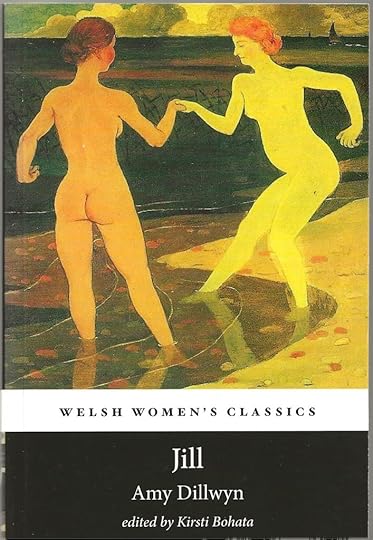
The story of unrequited love for another woman echoes Amy Dillwyn’s life; it’s well done, and it balances the more eventful side of the story. And I must and that it’s more subtly done than the cover image might suggest. Unless I blinked that didn’t happen; nothing like it happened.

But plenty did happen, and it made a great story!
Profile Image for Han Whiteoak.
Author 8 books7 followers
October 14, 2017
I loved this. It's narrated by Jill, a confident, practical and unsentimental (although not as cold-hearted as she would have you believe) young woman who introduces herself to the reader by saying she believes women can be just as adventurous as men. Stifled by life at home with her governess, Jill throws off the advantages of her wealthy upbringing and goes to London in search of work.

It was highly refreshing to read a nineteenth century novel from the point of view of a young woman getting on with what she wants to do in life, which doesn't include marriage. At its heart a sweet and slightly sad story of unrequited love, there is plenty of adventure along the way. Yes, there are some unbelievable coincidences, but there's also an array of humorously quirky minor characters that make the book a joy to read.
Profile Image for Ellie Butler Church.
66 reviews3 followers
April 7, 2021
This Victorian novel pushed boundaries when it was published in 1884, although the queer suggestions are merely hints to the eyes of the modern reader. It's a retrospective story as Jill recalls the events of her coming of age from some point in the future with clarity and details. Instead of a traditional 'coming out' that the ladies of her station were put through, the adventure of the novel triggers Jill's self-discovery and personal growth. Following both the Bildungsroman and lady-to-maid formats but succumbing to the traditions of neither makes the novel distinctly subversive, although maybe not to the untrained eye. 

Jill, or in her former life, Gilbertina, is the unconventional and rebellious, preferring childhood endeavours on the masculine side of the strict Victorian sex binary, like mud-larking, to anything at all ladylike. She represents the anti-thesis of Victorian femininity in her intelligence and curiosity for learning and travel, perhaps especially in her rationality and her apathy towards others opinions of her. The book begins with rejecting tradition, stating that a traditionally masculine 'adventurous disposition' is 'distributed by nature impartially throughout the human race.' What's made clear is that Jill is both born this way and formed this way, her cold and unaffectionate manner a fault of her distant and selfish parents. After her mother dies, Jill is brought along as her father's travels which further excites her spirit for change, adventure and the unknown. Dillwyn wanted this novel to be adventurous, pacey and full of altercations and shenanigans but the fact that the protagonist is a woman, however traditionally masculine would have been revolutionary at the time. 

I loved this novel for how many surprises there were and plot-driving women with full rounded personalities, as well as for how much it sets itself apart from other novels of the time and genre. 
This entire review has been hidden because of spoilers.
Profile Image for frogromancer.
11 reviews
December 29, 2025
loveeed vol one of this— jill’s narration is super interesting in contrast to other 19th century novels, not like the others are bad but i think jill is unique in the way she’s not only YEARNING to leave the kind of box women fit in but the ways she’s already out of it. and she’s funny much love

vol 2 gets soapboxy in a familiar way that i think 19th bildungsromans seem to get (i’m not a scholar i think i’ve read like four) but seeing jill’s arc through was nice enough where i was like Okay I’ll Deal With It.

i think the summary of the book on here made me think it was gayer than it was gonna be and that was a bit of a letdown! but i think it’s my fault for coming in with modern conventions and projecting that on here— it was fun seeing jill kind of being like this adopted stray dog for random women she’s fallen in love with lmao.

i think you could make some interesting points here about 19th bildungsromans broadly during the times and the ways they try to turn social convention but also have them return to the authority they once hated — like to me jane eyre felt like not an end where everything resolves like in a way ideologically feels coherent for lack of a better word but this one it felt like it had melded better by the end. i’m being too vague here but this is for me. if i said anything that gets me cancelled ignore this

A FUN RIDE . thank u doireann for putting this on ur currently reading and getting me to read it. don’t think you’ll see this but WHATEVER GIRL THANK U
This entire review has been hidden because of spoilers.
Profile Image for Rosamund.
888 reviews67 followers
October 3, 2023
Loved the unconventional heroine and her adventures. The plot requires some suspension of disbelief but there is an enjoyable frankness here about how a Victorian woman might not fit the image of womanhood prescribed by Victorian society.
Profile Image for ⭒☆tiredbee☆⭒.
154 reviews12 followers
December 21, 2021
It is incredible that this book has been first published in 1884, because the main character seems in many aspects too modern and witty to be written so far in the past!! I loved it, I loved the characterization and emotional development of the heroine, I loved her flaws as well as her qualities, I loved the fast paced writing and I loved the story💖
I read this book because I knew (maybe from tiktok I can't remember) that the protagonist was a lesbian, however I didn't expect it to be executed so well! Reading the novel, for the time and the context, I believe it's quite explicit that the protagonist is indeed a lesbian, and (💕) she doesn't feel wrong or sinful about it and it's not the central point of the narrative
(I enjoyed it so much that before finishing the last chapter I had already contacted a professor to see if I can translate it as my three-year thesis)
Profile Image for Sally.
602 reviews22 followers
October 26, 2023

‘I have heard people say that men are more apt to be of an adventurous disposition than women; but that is an opinion.’

‘The Adventures of Jill’ might be a good title for this unusual novel. Jill is the child of wealthy but neglectful parents, a ‘gentlewoman’. After her Mother’s depth and Father’s remarriage she runs away to London. The story follows her attempts to support herself as a maid, encounters with bandits in Corsica, lessons in hairdressing..predatory servants and some unusual requests from employers.

This is Jill’s narrative and she interrogates herself and her story throughout. The lack of love and nurture in her childhood, has encouraged Jill to become self-reliant, enterprising and creative. She is curious about, but detached from, emotions. This might make her an unappealing character but I found her rather refreshing. The story is often humourous. The strength for me in this book is the singularity of this character, the unique perspective of Victorian life and the way that her personality oozes out of these pages. Jill felt so alive to me I think I would pick her out in a line up.

Although I found Jill an interesting character, the narrative felt muted, linear. At times I was bored. It followed an almost predictable path. Jill forges her testimonial to get a job, has an adventure, someone finds out her subterfuge and she is sacked. You think the story is building to something but then it falls away and rushes on…I wondered if the style of the writing is meant to reflect the character of the narrator. As in real life some people really can't make exciting things, exciting.

In the blurb this is described ‘a poignant story of same-sex desire and unrequited love.’ I felt sorry that Jill had experienced so little love in her upbringing, I admired her enterprise and ingenuity, but I didn’t really feel sorry for her. She is not always kind to people and I think rather self-absorbed. And the ‘same-sex desire and unrequited love’? Certainly Jill feels an attraction and connection to Kitty who has after all been her only friend, but for me it didn’t feel like ‘desire’ or ‘love’. I kept waiting for more to happen..and it didn't. I am not sure what I have missed in this novel but it wasn’t the quite the story I anticipated.
Profile Image for Laurie.
1,014 reviews1 follower
October 9, 2022
This was an unexpectedly easy to read Victorian novel. It was published in 1884 and the style I am accustomed to in Dickens, Gaskell, Eliot, Trollope and other titans of the Victorian era of long flowery passages describing scenery and dialogue that is phrased quite differently than we speak today is not found in Jill. This is rather straightforward language much more like an early twentieth century novel.

I won't go over the plot, but Jill is a plucky character who is refreshing in her attitude of being who she is entirely unapologetically. She needs to lie and trick people to get what she wants and it doesn't bother her at all. Having upstanding morals and being a good person are not the message here. I found the voice of Jill as a character to be somewhat juvenile. In the end, she is only twenty-four years old and she comments that she feels older in years than her contemporaries, but I felt her story would appeal to a younger audience. I can imagine myself at 14 enjoying this more than I did now. The element of fooling ones elders because you are more clever than they and an encounter with escaped prisoners felt like I was reading a young adult novel in a way that Dickens has never felt to me. There are certainly lesbian undertones in an unrequited crush of a friend and admiration of an older woman. Dillwyn touches on several serious topics such as poverty, class differences, and healthcare. Jill is most definitely a feminist who understands what she wants and does whatever she needs to fulfill those wants in an era that marriage was every upper-class woman's expectation.

Ultimately my reaction to this was that it was enjoyable and fun, but the quality of writing was slightly less accomplished than the well-known Victorian writers and so I am not surprised this is novel is relatively unknown to today's readers.
Profile Image for Rita Wilbur.
119 reviews
May 18, 2024
I’m giving this four stars not so much because of the story line, but because this is a pretty unique novel in Victorian literature. Published n 1885, it rejects pretty much all aspects of the cult of domesticity typical of that era. The titular character rejects everything about love, children, family ties. Even her infatuation with her female employer she never identifies as romantic attachment but rather as a “curious interest” or fascination - and she doesn’t get the girl. She ends the novel happily unmarried.

A note about the title: Jill is her assumed last name, not her first name. In the Victorian era, a lady should be referred to as Miss Jill. Only men or servants are referred to by their last names alone. So the title itself makes it clear that Jill is no lady.

Jill eschews family ties, and while in many ways she retains a lot of class prejudice, nevertheless she rejects the perks of her class privilege to strike out on her own and seek work “beneath her station,” which she never scorns. She’s perfectly willing to take on subservient jobs as long as the situation interests her. Fascinatingly, she’s kind of a jerk. She lies to get her jobs, she steals, she plots revenge against her stepmother. She’s almost an antihero. She does undergo some moral reform over the course of the novel, due to the influence of two women she is “fascinated” with, but even her religious reform is almost practical in nature rather than cloyingly devout. After all, the religious woman she admires so much is also an independent, working woman.

So - not the most fascinating or well-written story in the world, but definitely readable, and the heroine is intriguing by both Victorian and modern standards.
Profile Image for han⚢.
354 reviews18 followers
July 31, 2021
the inclusion of religion towards the end truly ruined this for me. Jill DESERVED to have that revenge on her step mother tbh, and would've still be able to have her conciousness intact. otherwise, this was amazing, to have lesbian yearning so prominent within a work of fiction well over 130 years ago.... I loved it. I loved jill, she was an engaging narrator, I laughed audibly many times reading this which is not a common occurrence when it comes to classic lit LMAO, her vivacity made me smile, and knowing this was semi-autobiographical?? made me so emotional
This entire review has been hidden because of spoilers.
Profile Image for emilia.
354 reviews9 followers
February 11, 2022
3.5/5

Concept: 5/5
Execution: 3/5

I had high hopes for this Victorian Sapphic novel and it was more subtle and coded than I would have liked, but still an interesting read. To be fair, Jill does seem to genuinely love Kitty, and later, Sister Helena, and I was impressed by the way she was not jealous of Kitty’s love interest, and actually felt sympathy and sadness on Kitty’s behalf when rejected by Captain Norroy, rather than vindictively and selfishly celebrating. On the other hand, Jill can be quite egotistical and manipulative, and instinctively would rather put Kitty at risk than not be with her. What I found unfulfilling about the story was the plot/content and how the relationship played out; yes it is unrequited love, but also Kitty is not developed at all as a character or object of desire, and we don’t see much of a complex relationship (of any kind) between Kitty and Jill, as we are so limited by Jill’s insular perspective.

In her introduction, Kirsti Bohata draws a comparison between ‘Jill’ and Dante’s ‘La Vita Nuova’ (randomly one of my favourites!) and I can see why. In both the cases of Dante/Beatrice and Jill/Kitty, the narrator initially meets the other person from afar and yearns for them despite (or, perhaps, because of) their distance and lack of actual connection in life. So in that sense there is something interesting being done here in the tradition of high romance, but it is just not compelling to read. I like Dante for other reasons than how he writes about Beatrice.

The mistress/maid dynamic interests me; this reminded me of the relationship between Roxana and her maid Amy in Defoe’s ‘Roxana’, and also (a little) the dynamics in ‘Olivia’ by Dorothy Strachey. As in ‘Roxana’, the class dynamic is significant in establishing an imbalance of power, but ultimately Jill is an upper class woman in disguise as a servant, and her privilege remains stable and unthreatened by the end of the novel. There is something unsettling about Jill’s moments of pride in her true family name and heritage, and I could not tell whether Dilwyn wanted us to condemn her for this or not.

'Jill’ also shares with ‘Roxana’ an interest in how identity can be constructed through names. The narrator was named Gilbertina at birth, and this was shortened to Jill, but (upon her mother’s wishes) ‘Jill was condemned and Ina substituted, as a more graceful and aristocratic manner of shortening my name’ (p.5), however ‘Jill was the name to which I afterwards returned’, which hints at her reclaiming a more masculine, un-‘graceful’ identity.

There are a few other things I really liked, such as the iconic moment when Kitty refuses to wear a corset, and says, “one must draw a line somewhere […] and I draw it at having my internal arrangements shoved out of their places. Not even to possess a small waist will I endure that!” (p.218) I was very impressed by this empowered rejection of harmful body ideals, and even more incredible is Kitty’s nuanced self awareness; she confesses, “I am not a whit more deficient in vanity and care for my personal appearance than the rest of my sex” (p.219) and yet manages to resist this one convention.

Also, I really enjoyed the part where Jill is an invalid in hospital, and feels that one Nurse (Mary) is mistreating her, and craves mothering and attention and validation from Sister Helena (once again homoerotic desire is implicit). I think Dilwyn was great at illustrating the psychology of illness and being a patient in what seems to be a hostile and controlling system (the hospital), but is of course only viewed from one privileged perspective. I almost wish that the novel had started with the hospital episode and then been about Jill and Sister Helena, rather than Jill and her mistress Kitty.

The final thing I want to mention is the brief discussion of the voracious and overly-imaginative female reader, which is a trope I am becoming interested in and seeing everywhere. Jill retrospectively describes herself as a child, uncritically reading ‘a large number of juvenile story-books of the exaggerated sentimental and goody kind’ (p.8), which ‘I devoured greedily without perceiving how morbid and exaggerated they were, and without doubting their being faithful representations of human nature’ (p.9) Jill sort of falls into the trope of the girl who reads too much fiction and then expects/constructs fictional narratives within her life, like Arabella in ‘The Female Quixote’ and Catherine in ‘Northanger Abbey’. Jill is not the only reader like this; Kitty also ‘greedily devoured as many [French novels, e.g. Zola] as she could lay hold of’ under the pretence of ‘the laudable object of keeping up her French’ (p.126). Jill immediately makes use of this observation to claim closeness and insight – ‘I knew better than that’ – which reminds us that Jill was also this kind of reader.

So there are many wonderful things about this book. Why do I rate it mediocrely? It just isn’t that fun to read, and the emotional stakes are not high. I do like Dilwyn’s sarcastic, matter-of-fact voice (sometimes it reminded me of George Eliot) but I didn’t find her to be a very good storyteller. I always felt too aware that a story was unfolding and a plot being furthered. Still I would definitely recommend this as there is much interesting stuff to be found in it.
Profile Image for Keith.
942 reviews13 followers
Read
August 25, 2025
“The inevitable Mediterranean roll was in less force than usual when we crossed to Corsica, and as we were all pretty fair sailors we had a pleasant passage, notwithstanding the anticipations to the contrary of our especial waiter at the Cannes hotel. He was a brisk, cheery little fellow, with such a power of sympathising with other people that he always identified himself with those guests who were under his particular care, and took their affairs to heart almost as though they were his own. Going to sea and being sea-sick meant precisely the same thing to him; consequently, from the moment he heard of our contemplated trip he became full of compassion for the sufferings we must undergo, and was good-naturedly eager to think of, and suggest, every possible alleviation for the misery which he confidently predicted for us. As we departed from the hotel his final words were to impress upon my two ladies that, last thing before going to sea, one should always eat a hearty meal, because, "ça-facilite--et sans ça, c'est si fatigante." I am sorry to have to add, however, that this well-intentioned speech was received in by no means as friendly a spirit as that in which it was offered. For it was quite contrary to Mrs. Rollin's notions of propriety that one who was a man, and an inferior, should presume publicly to give her advice as to the management of her interior; so, instead of making the amicable response that was evidently expected, she swept past him with a freezing look and an audible remark to Kitty about the atrocious vulgarity of foreign servants who had never been taught to know their place." (Chapter XIV, At Ajaccio).



[Image: Book Cover]

I listened to this novel via the Sleepy Bookshelf podcast over 24 nights. It made for a pleasant way to fall asleep.


***************************************************************************


[Image: The Sleepy Bookshelf logo]


Title: Jill
Author(s): Elizabeth Amy Dillwyn (1845-1935)
Year: 1884
Genre: Fiction - Novel
Date(s) read: 6/30/25 - 8/24/25
Book 171 in 2025
***************************************************************************
78 reviews
October 23, 2022
This is one of those stories you can't believe that were written in the nineteenth century. A Victorian novel like no other I've ever read (and probably never will).

The opening line itself is worthy to be on the top of best-opening-lines ever: "I have heard people say that men are more apt to be of an adventurous disposition than women; but that is an opinion from which I differ". Jill is unapologetically bold from the very first line of her story, and it really sets the mood for what's about to come.

Half bildungsroman, half adventure novel, Jill recounts the life of an aristocratic young lady who flees her widowed father and gold-digger step-mother and embarks herself on a trip with one sole mission: to travel the world as a lady's maid. Jill is an unconventional heroine that detests all gender norms of her time, shamelessly self-reliant, she acknowledges the class privilege she holds within society and knows how to utilize her intelligence to her own purposes. I really enjoyed the ability Jill has of analyzing herself, it shows that she is self-conscious of who she is and is willing to revise her emotions in order to understand herself better. Nonetheless, at times she comes off as remorselessly selfish and cold-hearted (you just can't lie and worry your governess about her sick sister for your own purposes). In fact, she is a hater of love and is certain that it will never fool her (she's got this 'I'm the best attitude, nothing can affect, feelings eww'), but what she doesn't know is that eventually, indeed, love will bring her down. Yup, she ends up falling in love, and with no other than with her mistress. YES, ONCE AGAIN. A lesbian Victorian novel! Alright, it's quite subtle but we're taking about the Victorian period here. Jill is only awed by the transforming power of love, and not by the gender of her crush. We stan Jill, oh yes we do.

A novel that I wholeheartedly recommend for those who want an unusual Victorian heroine.
Profile Image for Raj.
1,683 reviews42 followers
April 23, 2024
Gilbertina Trecastle has always found herself distant to everyone she knows. When her father remarries after her mother's death, she finds herself hemmed in by her stepmother, so she carefully plans an escape, over the course of several years, and puts it into practice at the age of eighteen. Renaming herself Caroline Jill, she becomes a lady's maid and ends up falling in (unrequited) love with her employer.

I thoroughly enjoyed this bildungsroman in which our heroine leads her best life, without recourse to anyone else. There are a lot of fun, almost Dickensian side characters (the germophobe of whom Jill is suitably contemptuous is probably my favourite) and it's got quite an episodic nature, as she moves from adventure to adventure. There's much made of Jill's unrequited love for her mistress, Kitty, but Jill herself is pretty practical about the whole thing. She sees that her affections would never be returned, so so mentally shrugs her shoulders and gets on with things. A similar thing happens with Sister Helena towards the end of the book. I find that practicality so refreshing, especially in a female character, especially especially in a character written in the 1880s!

Something else to love is how Jill wants to be completely ruthless and believe the worst of everyone. And yet, she engages in so many little (and not so little) acts of kindness throughout the book. Often grumpily, with no belief that others will also do the right thing, and is then surprised when they do (the whole flower girl incident made my heart swell several sizes).

It's a great book, definitely recommended. Don't be put off by the two nuddy women on the front cover and don't read the introduction until you've read the book (unlike many such beasts, the introduction is very readable, but it's still got spoilers, and you'll get more out of it once you've read the book).
Profile Image for Chris.
86 reviews
December 29, 2017
Straying for once out of my comfort zone, I came across this on a library shelf and, having once worked on the Hendrefoelan campus in Swansea and attended adult education courses at the house which Amy Dillwyn donated to the university, I was intrigued.

The novel is presented by its publisher as primarily a feminist work, and while this is clearly at its heart, it is just as much a vehicle for observations on life, class and social issues in the nineteenth century.

From the rubric on the back of the book I was rather expecting a more in-depth exploration of the heroine's sexual and emotional feelings, but I am given to understand that Queen Victoria would not even acknowledge the possibility of such things among her own sex, and given the moral outlook professed by society at that time, this was, with hindsight, rather unlikely. Desire is hinted at, but never quite allowed to take centre stage.

Nevertheless the story unfolds in a series of quite riveting episodes, albeit in some cases stretching credulity to the limit, and Jill herself is engaging both as character and narrator.

It would be interesting to see how this novel would have played out if written with the freedom of expression that writers enjoy today.
Profile Image for Fred.
643 reviews43 followers
August 27, 2024
I didn’t get the point of this book at all. It was very short and quite weird.

It started off so well - it’s like Jane Eyre, but if Jane were less religious, naughtier, and a lesbian. Our central character, Jill, is a naughty feisty heroine who has no qualms with telling a few lies to get her way. She can’t stand her stepmother so she runs away from home and eventually becomes nursemaid to a woman she really fancies.

Such a good premise…and then halfway through, the story completely changes tack. She is forced to leave her job. A few episodic parts ramble by. Then she gets hit by a car, meets a virtuous nurse, and realises the power of goodness and religion after all. She wonders if had she been of a different class, she could have met the woman she fancied as equals instead. The end.

This story didn’t have a beginning, middle or end! Or any clear ideas that ran consistently throughout. Just a thread of weird, disconnected episodes that ended abruptly. The humour and charm of the novel’s opening ran thin pretty swiftly. Was not a fan.

There’s a sneak called Perkins who sabotages her career after she turns down his advances (although to be fair, she DID tell the lies he accused her of!) - so maybe that’s a comment on misogyny? Who knows. This wasn’t very good.
Profile Image for Rosamund Taylor.
Author 2 books201 followers
February 7, 2023
This witty, picaresque novel follows the exploits of Ina, called Jill, who runs away from her awful stepmother and finds work as a lady's maid. She becomes courier maid to Kitty Mervyn, with whom she develops a romantic fascination, though she knows they can never be lovers, or even friends. She travels to Corsica as Kitty's maid, and there undergoes a kidnapping and daring escape. This is a remarkable read because of Jill's determination, independence, and unscrupulousness, making her markedly different from other Victorian women characters. She's also witty, cynical and determined to be in the right. I found her very entertaining. Overall, this book does meander, and many of the characters are not well drawn, but it is enjoyable and gives great insight into class and gender during this period.
Profile Image for Shawnee.
293 reviews
January 29, 2025
I feel like I read a completely different book than everyone else.

A lot of people connected with the rebellious female protagonist of Jill. I thought she was manipulative and very young. She then meets a nurse (and aging in my opinion) which makes her realize that she can be better and she sets to change herself. This is at the 85% point in the book. Why did we need everything else?

There was the discussion of Jill having romantic feelings for Kitty but nothing happened. Jill was a bit of a manic pixie dream girl in this regard. Kitty was only present for Jill’s development.

I really can’t recommend this book to anyone. The writing was fine and the characters were fine. I just wanted more in every way.
This entire review has been hidden because of spoilers.
Profile Image for Lucienne Boyce.
Author 10 books50 followers
February 25, 2023
Amy Dillwyn’s Jill introduces one of the most entertaining heroines I’ve come across in a long time – selfish, ruthless, cynical, and often funny. First published in 1884, and now republished in the Honno Welsh Women’s Classics series, it’s an enjoyable mix of the picaresque, gothic and sensation novel, with breaches of class barriers, gender roles and forbidden love thrown in. The novel draws on Dillwyn’s own experience of falling in love with a woman.

Any Dillwyn (1845-1935), a cigar-smoking industrialist, suffragist, and Liberal, wrote seven novels including The Rebecca Rioter and A Burglary, which have also been published by Honno and are equally enjoyable.
Profile Image for Shaz.
1,029 reviews19 followers
October 5, 2023
Three and a half stars

Jill is a very different Victorian heroine than the usual, she's rather selfish and manipulative actually, but she's rational and practical about what she wants and sets out to live her own free life of adventure by working as a maid rather than putting up with her stepmom. She has romantic feelings for the young lady she starts to work for, not that she does anything about them or the feelings are reciprocated, but it's pretty clear in the text.

An unusual and enjoyable Victorian novel.
Profile Image for Patrick Barry.
113 reviews1 follower
February 23, 2023
Could not quite go to four because of so many highly unlikely but critical coincidental occourances that took place. A story just has to be believeable and this was not. As far as Jill herself is concerned, she was a real woman of contradictions, a lot of bad thinks happed to her but in no way could it be said that she did not contributed to her own misfortune. It moved along at a good pace and I enjoyed it being in the first person. I would recommned it.
Profile Image for Daniel Glover.
360 reviews4 followers
December 22, 2024
Jill by Amy Dillwyn is a Victorian feminist bildungsroman written early in the New Woman Movement. The novel breaks all conventions being the antithesis of Cinderella. Jill replaces the Fairy Godmother with self determination and street smarts and the handsome prince with self reliance and same sex attraction. Based upon my past Victorian reading this is truly a unique book!
Profile Image for Jill.
16 reviews2 followers
November 14, 2024
Jill is a really fun read… she is a spunky and very modern heroine for a late 1800’s publication date. It’s closer to 4.5 stars and would be 5 if not for a few things near the end of the book that make the plot a bit wobbly. The writing is fresh and humorous. Very enjoyable!
Profile Image for Heidi Bakk-Hansen.
222 reviews1 follower
August 26, 2025
A charming book, but the last two chapters annoyed me for reasons that will probably be obvious to readers.
Displaying 1 - 30 of 34 reviews

Can't find what you're looking for?

Get help and learn more about the design.