

What do you think?

The Last Outlaws: The Lives and Legends of Butch Cassidy and the Sundance Kid
The Old West was coming to an end. Two legendary outlaws refused to go with it. As leaders of the Wild Bunch, Butch Cassidy and the Sundance Kid executed the most daring bank and train robberies of their day. For several years at the end of the 1890s, the two friends, along with a revolving band of thieves, eluded law enforcement while stealing from the rich bankers and Eastern railroad corporations who exploited Western land…until they rode headlong into the twentieth century. In The Last Outlaws, Thom Hatch brings these memorable characters to life like never before. From their early holdup attempts to that fateful day in Bolivia, Hatch draws on a wealth of fresh research to go beyond the myth and provide a compelling new look at these legends of the Wild West. Includes Photographs
365 pages, Kindle Edition
First published February 5, 2013
Ratings & Reviews
Friends & Following
Create a free account to discover what your friends think of this book!
Community Reviews
Displaying 1 - 30 of 103 reviews

November 10, 2023
If not for the popular 1969 movie, no one would have ever heard of Butch Cassidy and the Sundance Kid, well except for a few Wild West historians. Though not as notorious, they are now considered in the same breath as Jessie James and Billy the Kid. The film contains quite a few ‘really did happen’ scenes from their lives, of course wrapped in entertainment, but the story and the fun is in there, from their gang, The Wild Bunch, to the end of the trail in South America.
‘The Last Outlaws’ ? They earned that title continuing their robbing ways into the 20th century, 1906, with technology at their heels leading to their demise. There are great photos in the book, which is part of the technology that doomed them; having their photograph taken after yet another successful holdup, the detective agency The Pinkertons, got a hold of it and put it on Wanted posters across the West.
At times Author Hatch provides almost -too much information- with Butch and Sundance both coming from loving, religious families, they all kept in touch through letter writing and visits, so a lot is known about their lives. The West could be covered with ‘Butch slept here’ signs on the local hotels. The Pinkertons pioneered ‘scientific criminology’ so they had dossiers on many of their activities and proclivities. Their families lived on well into the 20th century.
Butch’s sister Lula, visited the set of the movie in 1969 !! I think that’s rather astonishing !
To make it to the Outlaw Hall of Fame, you have to be good at not getting caught, or at least escaping, and the ultimate tribute is that after you die, someone, or many, try to say the are ‘the real’ Butch Cassidy. Then, there is the mysterious disappearance of their girl - Etta Place (Katherine Ross for movie fans).
All a good ride, and read.
‘The Last Outlaws’ ? They earned that title continuing their robbing ways into the 20th century, 1906, with technology at their heels leading to their demise. There are great photos in the book, which is part of the technology that doomed them; having their photograph taken after yet another successful holdup, the detective agency The Pinkertons, got a hold of it and put it on Wanted posters across the West.
At times Author Hatch provides almost -too much information- with Butch and Sundance both coming from loving, religious families, they all kept in touch through letter writing and visits, so a lot is known about their lives. The West could be covered with ‘Butch slept here’ signs on the local hotels. The Pinkertons pioneered ‘scientific criminology’ so they had dossiers on many of their activities and proclivities. Their families lived on well into the 20th century.
Butch’s sister Lula, visited the set of the movie in 1969 !! I think that’s rather astonishing !
To make it to the Outlaw Hall of Fame, you have to be good at not getting caught, or at least escaping, and the ultimate tribute is that after you die, someone, or many, try to say the are ‘the real’ Butch Cassidy. Then, there is the mysterious disappearance of their girl - Etta Place (Katherine Ross for movie fans).
All a good ride, and read.

February 15, 2024
Haven't actually read a biography/history of Butch and The Kid since 1976, when I read 1938's (!) The Outlaw Trail: A History of Butch Cassidy and His Wild Bunch, so thought it would be interesting to read something a little more contemporary or perhaps even revisionist. And while this book did scratch that itch, it did so in a rather workmanlike - if not quite pedestrian - manner.
No real revelations here, although I did enjoy the final chapter where Hatch discusses the various conspiracy theories and recorded "sightings" that argue for Butch's survival into the 1920s-30s, (although Sundance seems to be more thoroughly dead). I also found it interesting that the book included so much about Matt Warner and his long-time connection to Cassidy, as I also read his 1946 autobiography, The Last of the Bandit Riders back in the mid-'70s, and didn't remember them being that intimately linked.
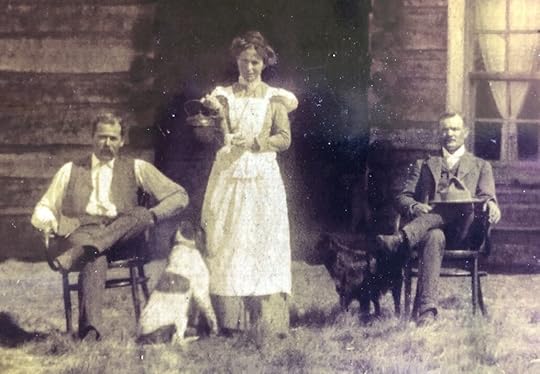
I listened to the audiobook which didn't particularly help, as it had a rather dull narration; but I also own the book (apparently remaindered somewhere) and was hoping there would at least be some new photos. Well, there weren't even all of the famous photos there (including the portraits with Etta shot in New York), much less relatively unknown shots that are mentioned in the text itself, including a group pic shot in Argentina, (shown here, so you don't have to go look for it):
Not really sure why, but I also have a copy of Butch Cassidy: The True Story of an American Outlaw, published seven years after this book came out (probably also remaindered somewhere) - not sure why the world needed yet another one, but I'm sure I'll get to it eventually, if only for comparison's sake.
No real revelations here, although I did enjoy the final chapter where Hatch discusses the various conspiracy theories and recorded "sightings" that argue for Butch's survival into the 1920s-30s, (although Sundance seems to be more thoroughly dead). I also found it interesting that the book included so much about Matt Warner and his long-time connection to Cassidy, as I also read his 1946 autobiography, The Last of the Bandit Riders back in the mid-'70s, and didn't remember them being that intimately linked.
I listened to the audiobook which didn't particularly help, as it had a rather dull narration; but I also own the book (apparently remaindered somewhere) and was hoping there would at least be some new photos. Well, there weren't even all of the famous photos there (including the portraits with Etta shot in New York), much less relatively unknown shots that are mentioned in the text itself, including a group pic shot in Argentina, (shown here, so you don't have to go look for it):
Not really sure why, but I also have a copy of Butch Cassidy: The True Story of an American Outlaw, published seven years after this book came out (probably also remaindered somewhere) - not sure why the world needed yet another one, but I'm sure I'll get to it eventually, if only for comparison's sake.

March 19, 2013
I read this interesting nugget on an e-reader. I found it fascinating, but for some folks it will be considered tmi. It depends how much detail you are up for, and how well you deal with ambiguity.
If you want a real cut-to-the-chase telling, you may do better to look for historical fiction, because the thing about famous outlaws is the whole not-getting-caught part. You can't leave a broad, wide trail for historians to trace while remaining safely anonymous while the law is looking for you. Consequently, Hatch gives us what is believed to have happened at the end, along with a couple of other remote possibilities, and an outright case of fraud, just to cover the bases.
The story does not start with Butch and Sundance, but with their predecessors. Actually, the writer starts clear back in 1866 in order to set context. 50,000 people in the USA die from Typhus, and before the Latter Day Saints, or Mormons, head west, they first send missionaries to Europe to recruit amongst the mill workers. Hatch does a fine job of painting the setting for us: all those dirt-poor city slickers from England come over, desperate, ragged, and ready for a new start, but being city folk, they ignore the seventeen-pound-per-adult and ten-pound-per-child limit, and instead haul all sorts of stuff with them, so they are trying to shove four hundred or five hundred pounds across the plains and up the mountain sides in handcarts. Well, a lot of them die. Of course they do. There's no Medic One. But the reader should be prepared to slog through a lot of detail in order to get to the shooting and the robbing. It's not an action movie, it's good solid history. Be ready.
The 1969 movie reawakened a certain amount of interest in the public, and so there were historians checking journals and anthropologists checking bone and metal fragments in South American graves. In short, the lives of two interesting thieves somehow inspired the expenditure of all sorts of money.
Hatch wants us to understand that neither of these men, nor the Wild Bunch with whom they often associated, was a Robin Hood sort. Whereas it is true that they avoided robbing poor folk (and where's the margin in that anyway?) they mostly robbed from the very rich for their own benefit. They focused on the railroads at first, because stage coaches and railroads were, before technology reached in and touched us all to one another, incredibly easy to rob. Unlike most of the Wild Bunch, neither Butch nor Sundance approved of the use of gratuitous violence. They tipped generously and were kind to children. Who can say whether it was heartfelt sentiment motivating them, or good sense? The neighbors are much less likely to point their finger in your direction when the sheriff comes calling if they remember that you helped put up their fence or paid for your drink.
One way or another, I found myself cheering them on as they boarded a ship with the Pinkertons darting around, one step too many behind them. But guys like this don't settle down and become gentleman ranchers for life. Their whole lives have been adrenaline rushes; they become addicted to being in a perpetual state of emergency.
If you want to know more, you can get the book and read it yourself. Our local library had a digital version available. But roll up your sleeves, and be prepared to dive into an in depth version.
If you want a real cut-to-the-chase telling, you may do better to look for historical fiction, because the thing about famous outlaws is the whole not-getting-caught part. You can't leave a broad, wide trail for historians to trace while remaining safely anonymous while the law is looking for you. Consequently, Hatch gives us what is believed to have happened at the end, along with a couple of other remote possibilities, and an outright case of fraud, just to cover the bases.
The story does not start with Butch and Sundance, but with their predecessors. Actually, the writer starts clear back in 1866 in order to set context. 50,000 people in the USA die from Typhus, and before the Latter Day Saints, or Mormons, head west, they first send missionaries to Europe to recruit amongst the mill workers. Hatch does a fine job of painting the setting for us: all those dirt-poor city slickers from England come over, desperate, ragged, and ready for a new start, but being city folk, they ignore the seventeen-pound-per-adult and ten-pound-per-child limit, and instead haul all sorts of stuff with them, so they are trying to shove four hundred or five hundred pounds across the plains and up the mountain sides in handcarts. Well, a lot of them die. Of course they do. There's no Medic One. But the reader should be prepared to slog through a lot of detail in order to get to the shooting and the robbing. It's not an action movie, it's good solid history. Be ready.
The 1969 movie reawakened a certain amount of interest in the public, and so there were historians checking journals and anthropologists checking bone and metal fragments in South American graves. In short, the lives of two interesting thieves somehow inspired the expenditure of all sorts of money.
Hatch wants us to understand that neither of these men, nor the Wild Bunch with whom they often associated, was a Robin Hood sort. Whereas it is true that they avoided robbing poor folk (and where's the margin in that anyway?) they mostly robbed from the very rich for their own benefit. They focused on the railroads at first, because stage coaches and railroads were, before technology reached in and touched us all to one another, incredibly easy to rob. Unlike most of the Wild Bunch, neither Butch nor Sundance approved of the use of gratuitous violence. They tipped generously and were kind to children. Who can say whether it was heartfelt sentiment motivating them, or good sense? The neighbors are much less likely to point their finger in your direction when the sheriff comes calling if they remember that you helped put up their fence or paid for your drink.
One way or another, I found myself cheering them on as they boarded a ship with the Pinkertons darting around, one step too many behind them. But guys like this don't settle down and become gentleman ranchers for life. Their whole lives have been adrenaline rushes; they become addicted to being in a perpetual state of emergency.
If you want to know more, you can get the book and read it yourself. Our local library had a digital version available. But roll up your sleeves, and be prepared to dive into an in depth version.

January 15, 2013
***Received from Gloodreads first reads giveaway
This was a fantastic book! Very well written and extensively researched. Most of us have seen the movie staring Robert Redford and Paul Newman and/or have basic knowledge of Butch Cassidy and the Sundance Kid. This book is great if you want to learn more, a lot more, about them, their crimes, their escapes, associates and exploits. This book begins by taking us back to their origins, their childhood, their upbrining and their first experience with crime. Their stories are told individually and then together after they met and became members of the "Wild Bunch". Their exploits, robberies, arrests, loves, move to South Americ etc. are well told in this book. I definitely learned a lot about both men and their lives. I would recommend this book to anyone who is interested in history, the wild west, crime or who enjoys a good book.
This was a fantastic book! Very well written and extensively researched. Most of us have seen the movie staring Robert Redford and Paul Newman and/or have basic knowledge of Butch Cassidy and the Sundance Kid. This book is great if you want to learn more, a lot more, about them, their crimes, their escapes, associates and exploits. This book begins by taking us back to their origins, their childhood, their upbrining and their first experience with crime. Their stories are told individually and then together after they met and became members of the "Wild Bunch". Their exploits, robberies, arrests, loves, move to South Americ etc. are well told in this book. I definitely learned a lot about both men and their lives. I would recommend this book to anyone who is interested in history, the wild west, crime or who enjoys a good book.

March 11, 2025
The Last Outlaws by Thom Hatch is a dual-biography of Robert Parker and Harry Longabaugh, known as Butch Cassidy and the Sundance Kid, who were notorious outlaws and cowboys during the heyday of the American West.
This was an interesting book! I loved the theories at the end about the possibilities of Butch and Sundance faking their deaths and continuing to live in the United States- kind of crazy how their bodies were never identified by anyone and they were supposedly just buried in unmarked graves, alone in a different county. Definitely suspect. I love these Old West outlaw books.
This was an interesting book! I loved the theories at the end about the possibilities of Butch and Sundance faking their deaths and continuing to live in the United States- kind of crazy how their bodies were never identified by anyone and they were supposedly just buried in unmarked graves, alone in a different county. Definitely suspect. I love these Old West outlaw books.

December 26, 2019
Having heard so much about them in the lore of local history, it was fascinating to read about the lives of Butch Cassidy and the Sundance Kid. Due to the nature of their lives on the run, there are times when there simply are no sure facts about their actions, and I appreciated that the author acknowledges that and gives us the best assumptions that historians have to fill in the gaps. Butch Cassidy and the Sundance Kid were complex and interesting people, and their story is unlike any other.

June 26, 2019
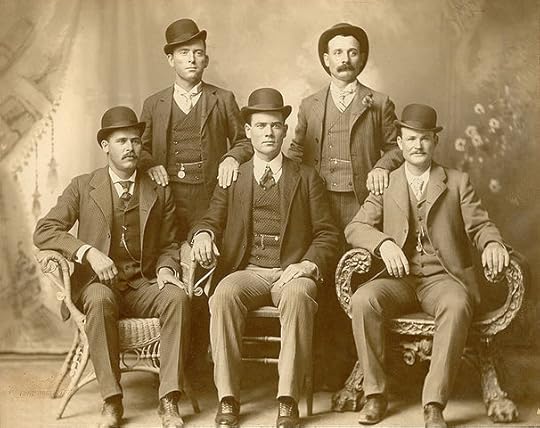
Butch Cassidy (seated, far right)
The Sundance Kid (seated, far left)
Prior to reading The Last Outlaws about the only thing I knew about Butch Cassidy and the Sundance Kid was the romanticized version found in the movie starring Paul Newman and Robert Redford. The reality is somewhat less romantic and also somewhat short on details (since, as you might expect, criminals aren’t in the habit of broadcasting their life and crimes to the public).
The broad facts of their lives are known though. Both Butch and Sundance were born to religious families. They became ranch hands and capable cowboys before turning to horse and cattle rustling and later bank and train robbery. As law enforcement techniques improved, they relocated to South America to start a new life as cattle ranchers. The life of crime proved irresistible, however, and after robbing a courier who was carrying the payroll for a silver mine they were surrounded by Bolivian officials and a gun battle ensued. Neither survived.
Their legacy has endured however, and The Last Outlaws perpetuates (to a certain extent) the image of the fun-loving, quick-witted, rapscallions who thumbed their nose at authority and lived life on their own terms. Not sure if it’s just me, but isn’t that rather a weird legacy for a criminal? Who could you say that about today … O.J. Simpson, Bernie Madoff, Pablo Escobar?
I suspect part of idolization was likely due to the fact that the two were not known to have killed anyone prior to a shootout in Bolivia. Part was due to their Robin Hood aura (stealing from wealthy banks, railroad companies and mines), and part no doubt due to romanticism of the wild west.
Unfortunately, each of these tropes is largely a myth. The life of a western cowboy was far from idyllic and consisted primarily of hard work, drudgery and loneliness. Contrary to their public image as mischievous scalawags, most members of the Wild Bunch were cold-blooded killers and Butch and Sundance weren’t particularly nice people either (they bludgeoned bystanders, threatened lives and dynamited a railcar with someone inside when they wouldn’t open the door … he survived). They stole what amounted to about $10 million in today’s dollars and blew it on fast living. And when cornered, rather than own up to their crimes and turn themselves in, they murdered a Bolivian soldier.
I think it’s safe to say that today’s criminals are no longer romanticized and that a modern-day Butch and Sundance would be far more likely to receive reprobation rather than admiration … and I’d call that a form of progress. Feel free to give your enlightened self a pat on the back.
As to the book, it was an interesting look at a time gone by that was never as glamorous as many choose to remember it.

July 14, 2017
This was a fascinating read about two of the most famous Western outlaws. While I know who Butch Cassidy and the Sundance Kid are in basic terms, strangely enough I have only watched one movie, show, or documentary on them (the Robert Redford one) and that was when I was a child. Because I am in no means an expert on these two outlaws or their gang, I found this book to be a wealth of information.
For instance I had no idea Butch Cassidy was raised as a Mormon. What? REALLY??
I also found it very interesting that the Sundance Kid also had a very religious upbringing as well.
I really enjoyed how the story began with their grandparents and how and why they came to America.
I appreciated the fact that the author told of heists they are known to have committed but many robberies and possible identities that have been attributed to the outlaws but never confirmed. I had never thought of how difficult it must be to historically track down outlaws that made it their business to hide and elude the law.
Also intriguing is the final outcome of the pair. Several different theories were laid out for what happened to Butch and Sundance. It was really left up to the reader to decide what you believe to be true. The main stream belief is they died in Bolivia. Another theory is they survived Bolivia and were able to elude police for the rest of their lives. One if the most trustworthy piece of evidence for that belief is from Butch Cassidy's younger sister who said he came to the home to visit. A less likely one, from a book dealer in Provo, was told about and promptly debunked as well.
PG-13 - This is harder to rate than a novel because it is describing real life but is not actually a story. There is talk of prostitution, saloons, drinking, gambling, murder, robbery, and clouting people on the head with the back of a gun. I don't really believe that being a robber was romanticized though. One time a money belt was rubbing on the men so much it made sores as they tried to escape from a posee. The food on the trail was bland and the ride was hard. The life was a difficult one. And once you became an outlaw it was difficult if not impossible to go back to being an honest citizen.
For instance I had no idea Butch Cassidy was raised as a Mormon. What? REALLY??
I also found it very interesting that the Sundance Kid also had a very religious upbringing as well.
I really enjoyed how the story began with their grandparents and how and why they came to America.
I appreciated the fact that the author told of heists they are known to have committed but many robberies and possible identities that have been attributed to the outlaws but never confirmed. I had never thought of how difficult it must be to historically track down outlaws that made it their business to hide and elude the law.
Also intriguing is the final outcome of the pair. Several different theories were laid out for what happened to Butch and Sundance. It was really left up to the reader to decide what you believe to be true. The main stream belief is they died in Bolivia. Another theory is they survived Bolivia and were able to elude police for the rest of their lives. One if the most trustworthy piece of evidence for that belief is from Butch Cassidy's younger sister who said he came to the home to visit. A less likely one, from a book dealer in Provo, was told about and promptly debunked as well.
PG-13 - This is harder to rate than a novel because it is describing real life but is not actually a story. There is talk of prostitution, saloons, drinking, gambling, murder, robbery, and clouting people on the head with the back of a gun. I don't really believe that being a robber was romanticized though. One time a money belt was rubbing on the men so much it made sores as they tried to escape from a posee. The food on the trail was bland and the ride was hard. The life was a difficult one. And once you became an outlaw it was difficult if not impossible to go back to being an honest citizen.

October 16, 2022
what if you wrote this boo k about johnny cash instwaed

June 4, 2017
Review title: Seeking the trail of Butch and Sundance
Hatch has written a history of this famous outlaw pair, and when he is done separating the verifiably true, the probable, the possible, the improbable, and the impossible, there isn't much left to make a riveting story. Or perhaps the shimmering images of Redford and Newman from the 1969 classic movie would overpower any true story Hatch had to tell. Or perhaps Hatch has just done a pedestrian job of telling it.
The facts point to the lead feet of the cinematic heroes. "Butch Cassidy" was just one of many aliases by which the man born Robert Leroy Parker, and obviously "Sundance Kid", coined by the newspaper coverage that glamorized the outlaw events they were reporting, was one nickname of many aliases for Harry Longabaugh. Parker was born in Utah to British converts to Mormonism who immigrated to join the faithful in their new desert home. Longabaugh was born in Pennsylvania to devout Baptist parents and moved west in search of that glamorized cowboy lifestyle he read about in the newspapers and dime novels. Both men learned cowboy trades and worked sporadically in legitimate day jobs both before and during their outlaw careers, both were reported to be thoughtful men and dedicated readers. According to tradition, neither ever killed a man in cold blood (possibly due to their religious upbringing), a legend that Hatch says appears to hold up in fact.
What is surprising, because the names are so indelibly linked, is how little documentation there is of the two men as a team, not only during their bank, payroll, or train holdups, but as coworkers at various ranch jobs, co-leaders of the loose-knit "Wild Bunch" gang, and friends on the outlaw trail. While Cassidy is recognized as the charismatic leader and careful planner of the heists (with particular and wise focus on get-away routes), the Kid was considered moody and intense but fiercely loyal to Butch and the team. With Hatch's insistence on fact and not hearsay it is also surprising how few heists can reliably attributed to Butch and Sundance,certainly far fewer than reported by the breathless newspaper coverage. Also sketchy in the historical record is the beautiful Etta Place (Katherine Ross in the movie), who may have been the pair's partner, the Kid's love interest, or his wife. She is documented to have accompanied the men to South America, and may have die there, but Hatch finds that she disappeared from the historical record there.
And of course as we know from the sad and beautiful ending of the movie, Butch and Sundance died in a shootout in South America after one last heist ended badly. Or did they? According to Hatch, even the identification of the perpetrators of that heist, while likely based on circumstantial evidence, isn't proven in the historical record, which has given fertile ground for conspiracy theories about the two men living on for years in both South and North America.
Still, with the facts separated from the rest, I found the story or Hatch's telling of it missing a spark. Perhaps it is the writing style: Hatch writes in short simple sentences, which read like a high school history textbook. The result is a story told truthfully, just not excitingly.
Hatch has written a history of this famous outlaw pair, and when he is done separating the verifiably true, the probable, the possible, the improbable, and the impossible, there isn't much left to make a riveting story. Or perhaps the shimmering images of Redford and Newman from the 1969 classic movie would overpower any true story Hatch had to tell. Or perhaps Hatch has just done a pedestrian job of telling it.
The facts point to the lead feet of the cinematic heroes. "Butch Cassidy" was just one of many aliases by which the man born Robert Leroy Parker, and obviously "Sundance Kid", coined by the newspaper coverage that glamorized the outlaw events they were reporting, was one nickname of many aliases for Harry Longabaugh. Parker was born in Utah to British converts to Mormonism who immigrated to join the faithful in their new desert home. Longabaugh was born in Pennsylvania to devout Baptist parents and moved west in search of that glamorized cowboy lifestyle he read about in the newspapers and dime novels. Both men learned cowboy trades and worked sporadically in legitimate day jobs both before and during their outlaw careers, both were reported to be thoughtful men and dedicated readers. According to tradition, neither ever killed a man in cold blood (possibly due to their religious upbringing), a legend that Hatch says appears to hold up in fact.
What is surprising, because the names are so indelibly linked, is how little documentation there is of the two men as a team, not only during their bank, payroll, or train holdups, but as coworkers at various ranch jobs, co-leaders of the loose-knit "Wild Bunch" gang, and friends on the outlaw trail. While Cassidy is recognized as the charismatic leader and careful planner of the heists (with particular and wise focus on get-away routes), the Kid was considered moody and intense but fiercely loyal to Butch and the team. With Hatch's insistence on fact and not hearsay it is also surprising how few heists can reliably attributed to Butch and Sundance,certainly far fewer than reported by the breathless newspaper coverage. Also sketchy in the historical record is the beautiful Etta Place (Katherine Ross in the movie), who may have been the pair's partner, the Kid's love interest, or his wife. She is documented to have accompanied the men to South America, and may have die there, but Hatch finds that she disappeared from the historical record there.
And of course as we know from the sad and beautiful ending of the movie, Butch and Sundance died in a shootout in South America after one last heist ended badly. Or did they? According to Hatch, even the identification of the perpetrators of that heist, while likely based on circumstantial evidence, isn't proven in the historical record, which has given fertile ground for conspiracy theories about the two men living on for years in both South and North America.
Still, with the facts separated from the rest, I found the story or Hatch's telling of it missing a spark. Perhaps it is the writing style: Hatch writes in short simple sentences, which read like a high school history textbook. The result is a story told truthfully, just not excitingly.

August 30, 2013
. Well researched history of Butch Cassidy and the Sundance Kid by a noted western historian. The book traces the backgrounds of both outlaws, from Cassidy’s (real name Bob Parker) Mormon upbringing in Utah and Sundance’s (real name Harry Longabaugh) Baptist childhood in Ohio. Cassidy gained experience as a cowhand working on relative’s ranches. Sundance, as a child, worked on the Erie Canal leading mules that pulled the towboats. Cassidy who worked for a period as a cowboy slid into minor felonious activities like many cowboys who engaged in rustling a few cows or stealing a horse or two as a sideline. Cassidy also fell under the spell of a cowhand cum outlaw Mike Cassidy whose name he eventually assumed. Sundance was enamoured of the western pulps of the day and yearned for a life of adventure. He too had become an expert wrangler and horse-breaker. The two met, mid-career, in one of the robber hideouts in Utah (Robbers Roost, Hole in the Wall, Brown’s Park). They wavered between honest ranch jobs and train or bank robberies and Cassidy became the head of the Wild Bunch as the migratory drifters who inhabited the outlaw hideouts came to be known. Both Cassidy and Sundance prided themselves on never having killed a man, though certainly many of their compatriots were hardened killers. Any attempt to go straight (both Cassidy and Sundance had served time in the penitentiary) was thwarted by the railroads who employed Pinkerton men to hunt down the criminals. An amnesty parlayed by Cassidy and the Governor of Utah with the railroads fell by the wayside when the railroad group were delayed at the meeting, and Cassidy thinking he’d been sabotaged promptly held up another train. The advance of technology at the turn of the century spelled the death knell for the Wild Bunch as the railroads upgraded their security and townsfolk determined to run down the outlaws. Cassidy and Sundance, along with his common-law wife Etta Place, determined to start over in South America with their savings from various robberies. After a spree in New York, they shipped to Argentina where they bought a ranch and began to prosper. The Pinkertons, however, following the precept of always getting their man traced the pair to their Argentine location. After Etta Place returned to the U.S., Cassidy and Sundance were drawn to the newly developed silver mines in Bolivia where they became mule skinners. The lust for wealth and adventure led them to plan a holdup of a payroll and again they were the subjects of a manhunt. Finally cornered by Bolivian troops, they purportedly died in a shootout. Their fate has been in dispute ever since,though it’ s likely they did perish as neither was ever heard from again. Hatch does a fine job in describing their personalities: Butch the jovial and clever planner, Sundance the moody and hot tempered activist. Since my father was born and raised in Vernal, Utah—and his own father had been killed in a gunfight over a land dispute—his grandfather a rancher in the area, I was most interested in the gang’s history in the adjacent Brown’s Park

June 4, 2014
This was an interesting read. It wasn't the best book I've listened to in a while but it was certainly refreshing after the last two I've listened to (The Case for God and The God Delusion).
While the narrator could have been better, he wasn't that bad.
It was interesting to read a biography of two criminals. Usual biographies are of notable figures, aka people well known for major events or accomplishments, normally positive. It was odd to watch the trajectory of the lives of these two men head straight down, rather than gradually up as is the regular format for a biography.
That being said, a few things bothered me about Hatch's historiography. One, he uses the phrase "for all intents and purposes" far too often. I'm very thankful that he didn't say "for all intensive purposes" as many people mistakenly do. However, that phrase, in proper form, should be used sparingly. Two, Hatch occasionally widens the narrative to pieces of general history that, at first, have no connection to Butch or Sundance. Only towards the end of the mini history lesson does Hatch connect it to his main characters.
I do have to say that Hatch manages the highly hypothetical nature of the events of Butch and Sundance's life fairly well. So much mystery surrounds these men who purposefully left as light a trail of evidence as possible. It's easy to see why their lives and stories fascinate so many people.
I enjoyed this book but can't recommend or advise against it. The most I can say is that it's not a bad read.
While the narrator could have been better, he wasn't that bad.
It was interesting to read a biography of two criminals. Usual biographies are of notable figures, aka people well known for major events or accomplishments, normally positive. It was odd to watch the trajectory of the lives of these two men head straight down, rather than gradually up as is the regular format for a biography.
That being said, a few things bothered me about Hatch's historiography. One, he uses the phrase "for all intents and purposes" far too often. I'm very thankful that he didn't say "for all intensive purposes" as many people mistakenly do. However, that phrase, in proper form, should be used sparingly. Two, Hatch occasionally widens the narrative to pieces of general history that, at first, have no connection to Butch or Sundance. Only towards the end of the mini history lesson does Hatch connect it to his main characters.
I do have to say that Hatch manages the highly hypothetical nature of the events of Butch and Sundance's life fairly well. So much mystery surrounds these men who purposefully left as light a trail of evidence as possible. It's easy to see why their lives and stories fascinate so many people.
I enjoyed this book but can't recommend or advise against it. The most I can say is that it's not a bad read.

February 8, 2014
16 Feb, 2014
It's an okay book, I guess. It reads more like a reference history book than a story or novel, which is what I thought it to be. Unfortunately the author starts all the way back to the persons' grandparents giving a brief rundown as to how and way the family ended up in America, and gives opinions and discussions as to what can be verified as fact and what is speculated. This author also tends to get "bird walked" the what other things are going on in the country at the time, something's as far away as northern east cost. Definitely something I'm having to slosh my way through, even though I started out so interested and wanting to read this book. Now I'm just wanting to be finished with it. Really not much in the entertaining section- like listening to a monotone speaker in a class lecture........
18 Feb, 2014
My over opinion of this book has not changed, but I did find a little more interest in the different stories and claims that Butch and Sundance survived and made it out of South America. But the author remaining on topic and followed-up on the other members of the Wild Bunch as well and what they did AFTER Butch and Sundance were supposedly killed. So there is more to this book then just the pair.
It's an okay book, I guess. It reads more like a reference history book than a story or novel, which is what I thought it to be. Unfortunately the author starts all the way back to the persons' grandparents giving a brief rundown as to how and way the family ended up in America, and gives opinions and discussions as to what can be verified as fact and what is speculated. This author also tends to get "bird walked" the what other things are going on in the country at the time, something's as far away as northern east cost. Definitely something I'm having to slosh my way through, even though I started out so interested and wanting to read this book. Now I'm just wanting to be finished with it. Really not much in the entertaining section- like listening to a monotone speaker in a class lecture........
18 Feb, 2014
My over opinion of this book has not changed, but I did find a little more interest in the different stories and claims that Butch and Sundance survived and made it out of South America. But the author remaining on topic and followed-up on the other members of the Wild Bunch as well and what they did AFTER Butch and Sundance were supposedly killed. So there is more to this book then just the pair.

March 19, 2013
I'm really happy to report that after reading this book, it seems that Paul Newman and Robert Redford were perfectly cast as Butch Cassidy and the Sundance Kid. This book has some good information on these two beloved outlaws but also speculates, a lot, about all sorts of things. I'm sure it's very difficult to research and write a book about two people who spent a lot of time in hiding, on the run, in jail, and in South America. But the speculation became distracting after a while. For example, no one knows what happened to Etta Place. Maybe she returned to the U.S. Maybe she was killed after a bank robbery went bad. Maybe she dumped Sundance or maybe he dumped her. Who knows? Aargh!

February 20, 2013
This is a book with a lot of holes in it. Seriously there are a lot of times in the life's of Butch and Sundance that cannot be accounted for. Yet this is where I commend the author the most. He has done a fantastic job of researching all of the facts and not adding or embellishing those missing areas. What is there makes for a fascinating account of a dying breed, the old western outlaw. Anyone interested in these two characters should look this one up.

April 19, 2015
Excellent, readable history of the two famous outlaws.

January 15, 2013
I am having a difficult time getting into this book...
Just couldn't finish it...
Just couldn't finish it...

January 16, 2024
📚💰🚂NOVEL THOUGHTS🚂💰📚
3.5⭐⭐⭐
When you think of Butch Cassidy and the Sundance Kid, who doesn't think of Paul Newman and Robert Redford in those roles in the movie version of their lives?? The movie takes a bit of liberty as to these two notorious robbers and outlaws so this story was an eye opener in its truth and honesty about how they came to have the reputations the did.... sorta sets the story straight, never mind the Hollywood take! To think that both of these men started out in loving, supportive families with proud standards and good foundations, it does seem strange that they both ended up in this life.
It is a story that is very detailed with their crimes and lives and their well recorded robberies of trains, banks and even some stores as they moved across Wyoming and Utah chasing the money held in all these places and did at times get tedious. They were methodical and had a system which always worked until the law caught up to them in South America. This is where Hollywood kinda diverts from the truth of their demise and to be honest, it was a bit startling to find out exactly they did meet their ends. But that's not Newman and Redford's faults... they were just reading the script!
3.5⭐⭐⭐
When you think of Butch Cassidy and the Sundance Kid, who doesn't think of Paul Newman and Robert Redford in those roles in the movie version of their lives?? The movie takes a bit of liberty as to these two notorious robbers and outlaws so this story was an eye opener in its truth and honesty about how they came to have the reputations the did.... sorta sets the story straight, never mind the Hollywood take! To think that both of these men started out in loving, supportive families with proud standards and good foundations, it does seem strange that they both ended up in this life.
It is a story that is very detailed with their crimes and lives and their well recorded robberies of trains, banks and even some stores as they moved across Wyoming and Utah chasing the money held in all these places and did at times get tedious. They were methodical and had a system which always worked until the law caught up to them in South America. This is where Hollywood kinda diverts from the truth of their demise and to be honest, it was a bit startling to find out exactly they did meet their ends. But that's not Newman and Redford's faults... they were just reading the script!

August 27, 2020
Astonishing, Entertaining and Cultivating
Not only the book provides various comparative details on this 'The Wild Bunch', particularly, its prominent legendary leads; Butch Cassidy, The Sundance Kid, and the other renowned members such as Elzy Lay and Harvey Logan who formed this notorious, sophisticated, yet the last gang of the American old-wild-west history, the book also clearly explains the detailed backdrop history of this notorious 'Last Outlaw of the West' gang, which is exceptionally significant.
The development of the modern industrial society of America, which progressed and paved the way for an influential position of the relatively newly founded state of the United States of America in the international community, on the contrary to the diminishing of these outlaw gangs as the 'Wild' West was finally being tamed.
Both the history of the Wild Bunch along with its prominent figures and the backdrop history of the development of American society lead to a better understanding of American culture nowadays.
If this book was a material in the World or America's Civilization class, such lesson would be a lot more entertaining.
Not only the book provides various comparative details on this 'The Wild Bunch', particularly, its prominent legendary leads; Butch Cassidy, The Sundance Kid, and the other renowned members such as Elzy Lay and Harvey Logan who formed this notorious, sophisticated, yet the last gang of the American old-wild-west history, the book also clearly explains the detailed backdrop history of this notorious 'Last Outlaw of the West' gang, which is exceptionally significant.
The development of the modern industrial society of America, which progressed and paved the way for an influential position of the relatively newly founded state of the United States of America in the international community, on the contrary to the diminishing of these outlaw gangs as the 'Wild' West was finally being tamed.
Both the history of the Wild Bunch along with its prominent figures and the backdrop history of the development of American society lead to a better understanding of American culture nowadays.
If this book was a material in the World or America's Civilization class, such lesson would be a lot more entertaining.
February 7, 2022
This book overall was a disappointment. Unfortunately, the author at times got bogged down in shit I could not care less about as a reader looking to learn about Butch Cassidy and the Sundance Kid. Moroni the angel and the golden tablets related to the morman "religion?" Yeah, don't give two shits about that and it dominated the first seventy pages or so of this book, the back story. Also, how do you write a book about Butch and Sundance and the tracker Lord Baltimore does not even get a mention? In fact, the Pinkerton section was a total disappointment. The iconic detective agency and it's quest to hunt down Butch and Sundance is primarily what drove those two South America and it gets glossed over without the i. depth analysis the rest of the book gave say The Morman "religion." Also, long stretches of this book were just speculation. Well Butch and Sundance may have done this, or they may have done that. I thought it was the Beastie Boys and they did it with a wiffle ball bat. If you are looking for a definitive book on Butch Cassidy and the Sundance Kid look elsewhere this is not that book.
July 27, 2025
honestly LOVE these two guys. like idk, if I'd been alive back then I'd def want them to be like my regular house guests. very likeable.
anyway, this was a very fun read for me. I haven't read other books about either of them prior so I have no basis for comparison. I felt like I learned a lot though. my interest in them is ofc the result of the 1969 movie but that's not that surprising. I was curious how accurate the characterization was more than the story itself. I understand that the plot would have many inconsistencies with the truth.
the real ending of these two was more depressing than I had expected. I mean tbh I actually find the movie's ending to be quite sad anyway, BUT their actual deaths saddened me more. I can see why so many of the fantastical alternate stories about them surviving in secret are so appealing. like yah, I kinda really wish they had lived too, but alas. As the author acknowledges, they have survived. in fact, they've gained a sort of immortality and that's worth something I suppose.
anyway, this was a very fun read for me. I haven't read other books about either of them prior so I have no basis for comparison. I felt like I learned a lot though. my interest in them is ofc the result of the 1969 movie but that's not that surprising. I was curious how accurate the characterization was more than the story itself. I understand that the plot would have many inconsistencies with the truth.
the real ending of these two was more depressing than I had expected. I mean tbh I actually find the movie's ending to be quite sad anyway, BUT their actual deaths saddened me more. I can see why so many of the fantastical alternate stories about them surviving in secret are so appealing. like yah, I kinda really wish they had lived too, but alas. As the author acknowledges, they have survived. in fact, they've gained a sort of immortality and that's worth something I suppose.

September 12, 2019
I am very impressed by the attention to detail that is in this book while at the same time being annoyed by how many times it says something like “we can’t know for sure” or “likely.” I know it is the job of the historian to gather as many facts as possible and then do their best to fill in the gaps but I may have liked it better as historical fiction. That being said I really learned a lot from this book about a time in American history that I am less familiar with. I enjoyed reading so much about my home state. I was fascinated with the explanation of why the era of robbers in the Wild West ended and all of the theories and conflicting evidence of how Butch Cassidy “ended” as well. It’s a little frustrating to read a book with no solid conclusion but that’s how real life is!

September 29, 2024
I really got into this one. A nonfiction must-read for anyone who likes westerns. The narrative was well-executed, but perhaps a bit misleading at first. The author begins the book by stating that train robberies and bank robberies were not at all like how they're depicted in Hollywood... then goes on to tell in great detail the lives of Butch Cassidy and the Sundance kid complete with train robberies and bank heists with all the drama of a Hollywood blockbuster.
This read kept me interested - and I'm not usually one for westerns. I especially enjoyed the author's treatment of the mystery surrounding their deaths and the appearance and subsequent disappearance of "Etta Place" from their story.
This read kept me interested - and I'm not usually one for westerns. I especially enjoyed the author's treatment of the mystery surrounding their deaths and the appearance and subsequent disappearance of "Etta Place" from their story.

June 9, 2018
Not only is this a biography of the notorious Wild West outlaws, but also a very good account of American history in the post-Civil War period regarding the rise & fall of the cowboy and ultimately the outlaw. It gives a reasonably accurate explanation of why two men from well brought up family life developed into the most famous bank robbers of all-time.
I strongly recommend this book to anyone interested in this period of US history, but beware, the true story is not quite how it’s depicted in the 1969 film, Butch Cassidy and the Sundance Kid. This is only a spoiler if you believe everything you see in the movies!!
I strongly recommend this book to anyone interested in this period of US history, but beware, the true story is not quite how it’s depicted in the 1969 film, Butch Cassidy and the Sundance Kid. This is only a spoiler if you believe everything you see in the movies!!
December 23, 2020
I don't have room for more books,as I live in a tiny place. Google listed The Last Outlaws as the best biography of Butch Cassidy and the Sundance Kid. This is very well researched,very readable,and highly recommended. Mr. Hatch even includes unseen photographs from South America. What intrigues me about Butch and Sundance is that they entered the game when the the romance of the west was already past. Sundance read books romanticizi g the west. This book has important information,and needs to be applauded.
August 3, 2017
A very interesting book about one of the legends of the American Old West. However, Hatch is quite inaccurate in some of his reporting and depiction of early Mormon history, which means you have to take the rest of the book with a grain of salt. Nonetheless it provides a fascinating account of Cassidy and Sundance's lives and the role they played in the last days of the cowboys and in the lore of the Old West.
July 26, 2021
The plot sort of dragged on, with side stories and characters not pertinent to the main plot. The author was very honest about the conjectures and possibilities of the facts versus fantasy. The back story of the characters was well researched and detailed for entertainment value. The book overall was well written and kept my interest thru-out. Even if it was just to see how the book ended versus the myth of Butch and Sundance.
April 21, 2024
Enjoyable read about a subject I wasn’t super familiar with. I found myself rooting for the outlaws despite their crimes. It fun to read about places they hid out in and committed crimes in as I knew lots of the locations in rural Utah, Upstate NY, and the west in general. The background on Butch Cassidy and his Mormon upbringing wasn’t very neutral, author should have used more balanced sources. But overall a fun listen!
June 26, 2018
A fun read even with the gun fire and violence in some passages. Hatch provides some of the history of the Wild West. Anyone who has seen the Butch Cassidy movie from 1969 will enjoy retelling of the story, especially when the movie is inaccurate. At times the reader has to plow thru lots of details, especially the family trees of Butch and Sundance.
Displaying 1 - 30 of 103 reviews