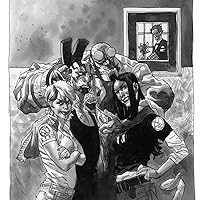
Griots: Sisters of the Spear picks up where the ground breaking Griots Anthology leaves off. Charles R. Saunders and Milton J. Davis present seventeen original and exciting Sword and Soul tales focusing on black women. Just as the Griots Anthology broke ground as the first Sword and Soul Anthology, Griots: Sisters of the Spear pays homage to the spirit, bravery and compassion of women of color. The griots have returned to sing new songs, and what wonderful songs they are!
Milton Davis is owner of MVmedia, LLC , a small publishing company specializing in Science Fiction, Fantasy and Sword and Soul. MVmedia’s mission is to provide speculative fiction books that represent people of color in a positive manner. Milton is the author of eight novels; his most recent The Woman of the Woods and Amber and the Hidden City. He is co-editor of four anthologies; Griots: A Sword and Soul Anthology and Griot: Sisters of the Spear, with Charles R. Saunders; The Ki Khanga Anthology with Balogun Ojetade and the Steamfunk! Anthology, also with Balogun Ojetade. MVmedia has also published Once Upon A Time in Afrika by Balogun Ojetade. Milton resides in Metro Atlanta with his wife Vickie and his children Brandon and Alana.
She laid there, with her face pressed to the earth, watching her captor approach cautiously, the way one would a frightened calf that might bolt at first touch. One of his eyes was ruined, a useless bit of white flesh covered by a flap of skin. But the other, dark and trained on her, glittered with excitement. She imagined that beneath his crimson face wrappings he grinned just as fiercely. Reaching her he quickly pressed her down, ignoring her cries of struggle as his knee dug into her back and his hand palmed her bare scalp. In one fluid movement he loosed the rope about her neck, replacing the scratchy fibers with something cold and heavy but no less constricting. Finishing, he moved from atop her and stepped back, exclaiming in satisfaction.
Ayen struggled to sit, keeping her eyes on him. Her hands went up, feeling the metal clasped about her neck and the length of linked chain extending to her captor. Her heart fell in despair. Janjawa slavers. Who else but they would be out here, on the scorched lands beneath this merciless sun, where only the banished and forsaken--like her--were forced to walk alone. She cursed her carelessness. All knew Janjawa roamed here, hunting for slaves for their coffles to be driven to faraway markets and sold beyond the known world--at least the world as her people, the Djeng, knew it to be.
A fierce tug came on the chain as the Janjawa called to her in his tongue, a mashing of incoherent sounds no more known to her than the bleating of goats. She gazed at him coolly, but did nothing. She had watched many a stubborn cow do the same—become a rock, refusing to be moved when they did not wish. You could learn a lot from cows and rocks, if you paid attention.
The Janjawa’s good eye creased. She imagined now beneath his wrappings he scowled. Another strong yank of the chain pitched her forward, sending her flat to the ground. Still she lay unmoving, refusing even to sit up. From atop their horses his companions laughed, calling out what sounded like jeers. This only annoyed her captor further. He stalked towards her, a long stick now held high, readied to lash her obstinacy. She laughed and cursed as he came, damning him and any children that passed from his shriveled loins to the hottest, most barren and scorched lands beneath Nhialic’s gaze. She was Ayen of the Akok! A Djeng! One of the First People and Lords of Men! And she would die here today than live as a slave! She gritted her teeth, waiting for the blow.
And then, he disappeared.
It was quick. One moment the Janjawa stood there, the next his body caved in and burst apart--clothing, flesh and bone, all violently rendered to pulp as if crushed in the grip of an unseen hand. Blood spurted in every direction, and she gasped as it washed over her, sickeningly warm and unnaturally wet.
Malith. So he was here after all. But then, when did he ever leave?
Ayen blinked, wiping the gore from her eyes. One half of her face was covered in dusty earth; the other in blood. Rising to her knees, she gazed about. Her Janjawa captor was spread out in every direction, like soft aror porridge. His companions fared little better. One lay flat on his back, eyes open and staring to the sky, his glistening entrails torn out and entangled like fleshy roots with those of his horse. The third Janjawa lay crumpled awkwardly beside his bloodied steed, outstretched arms holding his decapitated head as if trying to retrieve it. One among them, however, had lived. Ayen turned to see a lone horse, a blur of black with speckled flints of gray, speeding away in the distance.
“Run,” she whispered. “Flee from me, for I walk with the dead.”
Faint laughter echoed in her ears. It was not a good laugh, the kind that brought feelings of mirth. Instead it was filled with a coldness that cut like a dulled blade.
“Malith. When did you come to so enjoy slaughter?”
Her ghost husband only laughed harder.
I've been reading a lot of diverse fiction - where men and women of color are either the leads or the storytellers, where it's a world built and populated by people of color - this year. Which is strange, because this wasn't a conscious decision on my part. It's not like I set out with a quota to read X amount of books by or about POC when I made my 2017 reading challenge (though, now that I think about it, that wouldn't be a bad idea going forward). With the exception of Black History Month some months back and Hispanic Heritage Month now I didn't even make it a deliberate choice to seek out diverse stories. They've just been catching my interest and excitement a lot more.
Now, as to why they've been catching my interest and excitement a lot more frequently this year, the reasons are many.
Now that I've fully embraced e-books they are now a lot of diverse books and authors of color accessible to me (and very easily at that) since the significant hurdle that is the book publication industry's race problems (especially in regards to speculative fiction) are no longer a significant obstacle. The prospect of reading the adventures, struggles, and heroics of white people has admittedly lost some of it's luster since the majority of white Americans voted in a narcissist who grabs women by the pussy, who believes in white supremacy and nationalism enough that he brought other white supremacists and nationalists into the White House and is trying to reverse every decision his black predecessor made, and the most transparent crook and conman ever. And because, even though that sexist, racist, unqualified, crooked narcissist grows more and more unpopular every week, racism, sexism, homophobia, transphobia, xenophobia, anti-intellectualism, authoritarianism, whataboutism, and blatant lying have never been more popular and normalised in decades in my country all thanks to this wannabe facist. For example, any internet thread these shitheads explode in whenever they catch a whiff of "SJWs" and "Political Correctness" from a celebrity, or a show, or a movie, or a video game, or a comic book, or a book. Or the tidal wave of defenses, excuses, and just unapologetic racism, sexism, homophobia, transphobia, xenophobia, and anti-intellectualism that flood in whenever such acts and thoughts get rightfully condemned and mocked.
Reading about the adventures, struggles, and heroics of people of color has become a lot more cathartic since nearly every day of this year I've spent hours scrolling and reading about what new cruel, corrupt, backwards, or unethical decision this wannabe facist and his cruel, corrupt, backwards, unethical administration have made. And knowing that the adventures, struggles, and heroics of people of color would set the racist, hypocritical snowflakes of my country into a frothing rage at the existence of something explicitly made not to pander to them makes them so much more appealing. Which is why I urge any other fantasy reader who shares my dissatisfaction with the landscape of 2017 to consider taking a dip into a sub-genre of fantasy called Sword and Soul.
As the name implies, Sword and Soul is a counterpoint for anyone who wants or needs a reprieve from the pasty-faced heroes, male and female, and crowds that populate the European-derived villages, towns, cities, forests, and countryside; a remedy for the far too often short shaft black people get in the fantasy genre, especially in the pulpy, sword and sorcery side. Though he was writing about pulp fiction in general, in Walter Mosley's forward for Black Pulp he eloquently explains the appeal of Sword and Soul better than I ever could:
"The beauty of reading is not a college course on existentialism or a psychology seminar on the disaffection brought about by suburban living. Reading can also allow us to imagine a different world, a different self. This vision is the first, or maybe the second, step in the liberation of the human spirit.
"I am more than happy to read about the history and psychology of oppression, the disenfranchisement of our culture and the overwhelming power of capital – but these revelations are poor fare if I cannot also imagine a different world and a different life where the chains of the modern world can be shrugged."
With that said, though they contain enough thrilling, spectacular stories that I would also recommend them, a significant number of the tales in the Black Pulp anthology and the first Griots: A Sword and Soul Anthology do end up indulging in the other sins of pulp fiction: numerous distressed damsels, a heavily skewed male focus, and the uneven quality in work and prose that comes with most anthologies.
Imagine my relief with Sisters of the Spear! It seems like every writer was inspired by the mission goal to make amends for the especially short, especially sharp shaft black women have gotten from all of fantasy because the 17 short stories and novellas collected here are at a much higher consistent quality in prose and a higher variety in tone, protagonists, and adventures than the two previous black anthologies I read.
There were only two or three I would call duds, and all three are mercifully short. If I had to make a list of my five favorite stories here it'd be incomplete. "Ghost Marriage" by P. Djeli Clark is the shining star of Sisters of the Spear, on one hand an exploration of the grief and numbness of a young widow, on the other a masterclass in horror and dark fantasy. Coming in at a close second is "The Night Wife" by Carole McDonnell (who wrote "Changeling", which if for no other reason check out the first Griots anthology just so you can read that) a grim fairy tale about an old queen, her envious daughter, and a succubus-like entity and their love for the queen's new young husband that could give the Brothers Grimm a run for their money. Beyond those two stellar tales there are too many good ones to single out. Which makes the meager 21 ratingsGriots: Sisters of the Spear has on Goodreads such a damn shame. Too many people are missing out on this bundle of African-inspired thrills and chills.
It’s time now to allow the woman on the cover serve as your guide through the anthology. The light she carries will illuminate the truth that is always inherent in the best of fiction. And her spear will slay the stereotypes.
This review is taken from my blog artsandyouthlove:
One of the best things about this anthology is the black women characters in the stories. They are warriors, magic users, goddesses, queens, and more. They are positive representations that show black women can just as good as black men or surpass black men in certain ways.
In addition, almost all of the characters juggle multiple roles that add complexity to who they are. Furthermore, personality traits such as kindness, bravery, and resilience make certain characters very admirable.
Another great aspect of these stories is the magic featured in some of them. Many of the stories are really brought to life because of certain magical creatures or events. For example, one story involves a warrior girl who has a brother who can shape shift into a lion.
Besides the black women and the magic, the pacing of most of these stories is really good. There is action and adventure in many of these stories, so the pacing becomes fast enough that the reader wants to know how the story will end. If they find themselves craving for more, they will find themselves moving on to the next story until they reach the end of the book.
Overall, this is a fantastic anthology. I recommend this book to black women who want to see good representations of themselves in fantasy fiction.
"Sisters of the Spear" brings together tales of heroic Black Women as leaders, warriors, rulers, users of magic and more. Each story is unique in it's own way and I'm sure readers will find their favourites among the collection. This work demonstrates just how creative writers in this genre continue to be and nicely complements "Griots: A Sword and Soul Anthology". Overall an excellent read and I would recommend this book not just to readers of Sword and Soul, but anyone interested in a different take on heroic fantasy.
I only read P. Djeli Clark's story, Ghost Marriage, and wow, was it good. My head was spinning the entire time and the ending left me with a million questions - but in a good way.