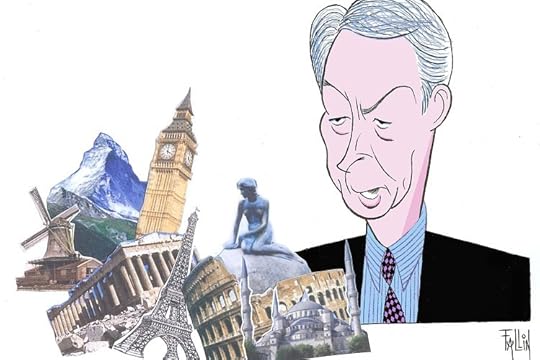
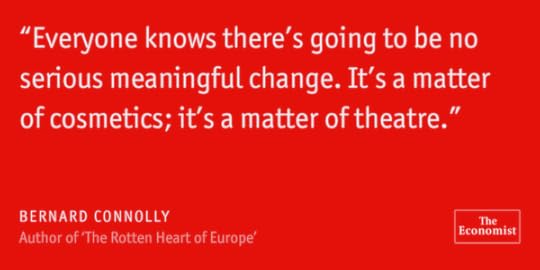
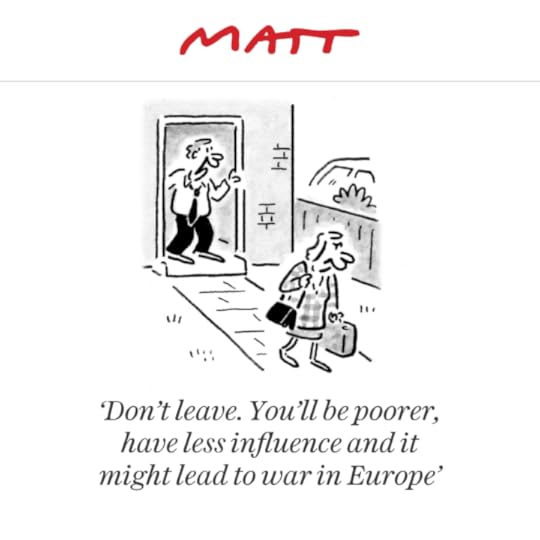
'The Brussels Commission has just suspended its senior economist, Bernard Connolly, for writing a book savaging the prospects for a common currency. There are many who now believe he should be lauded as a prophet.' Observer, Editorial, 1 October 1995
'Mr. Connolly's longstanding proposition that the foisting of a common currency upon so many disparate nations would end in ruin is getting a much wider hearing...' New York Times, 17 November 2011
When first published in 1995, The Rotten Heart of Europe caused outrage and delight - here was a Brussels insider, a senior EU economist, daring to talk openly about the likely pitfalls of European monetary union.
Bernard Connolly lost his job at the Commission, but his book was greeted as a profound and persuasive expose of the would-be 'monetary masters of the world.' His brave act of defiance became headline news - and his book a major international bestseller.
In a substantial new introduction, Connolly returns to his prophetic account of the double-talk surrounding the efforts of politicians, bankers and bureaucrats to force Europe into a crippling monetary straitjacket. Hidden agendas are laid bare, skulduggery exposed and economic fallacies are skewered, producing a horrifying conclusion. No one who wants to understand the workings of the EU, past, present and future can afford to miss this enthralling and deeply disturbing book.
Today’s elections in Holland make this book mandatory; so attention on the affirmations of the head of Turkey: "Erdogan reportedly said during a press conference on Tuesday: ‘We know the Dutch from the Srebrenica blood bath. We know how their perverse their character has become through the mass murder of 8,000 Bosnians there.’"
"Uma vitória de Wilders seria equivalente ao terramoto de 1755 em Lisboa" ["A Wilders victory would be the equivalent to the 1755, Lisbon quake"]. Writer Rentes de Carvalho, 86 years old, living in Holland it's been 60 years. I'LL BE BACK. 15th March 2017
As for the results, Wilders is up, yet not shaking Holland, 16th March 2017
I have struggled to assign a 'rating' to this book. On one side, you can see the book is really well written and researched. The author clearly has 'insider' knowledge, not surprising as he worked for the EC until he was dismissed allegedly when his ideas where clearly too radically in opposition to the main current converging towards monetary union. A dismissal which if you believe the author was clearly unfair and disgraceful in the way it was handled. Apart from this, given when the book was written (mid 90's) it is clear the author knows what he is talking about - the proof is in how many of his forecasts where spot on, and clearly recognizable way after the book was published in 1995. The author portrays very well how non-sensical was to enter into fixed exchange currency rates and how economics and national interests were always second role against the political ambitions of the different players, mainly the German Government, the Bundesbank, the French Government and the 'Enarques' (the most senior French technocrats). He illustrates the idea very well:
"In understanding the collapse of the ERM, however, what is important is that to subordinate domestic (that is, national) economic considerations to national foreign policy goals almost always corresponds to subordinating the preferences of the population at large to those of a political élite, and can never be unconditional, except – possibly – in the most ruthlessly efficient totalitarian state."
The text is in some points hilarious as he illustrates very vividly the main shortcomings of the different characters. But here is when one becomes a bit skeptical. One things the author maybe is too biased, he is a devoted fan of the late Lady Thatcher by the way, and one is never sure if his illustrations and the narration of the facts are too influenced by his political values. The demonisation of the French socialists (even if one would like to believe) and the ridiculisation of others detracts a bit of credibility. The characters seem too flat in these instances. He does however paint more nuanced pictures of others. All this, even if the author's values and political leanings resonate with my own ideas, make me hesitant about how much truth the narrative contains.
I will still recommend the book to anyone interested in the developments leading to the monetary union and in the tensions leading into it, but as I'm saying always keeping a critical eye. Another criticism is that the author doesn't succeed in addressing the lay reader - you will need some economics / finance / monetary basis to understand a big part of the book. And one might argue that the author never portrayed to address the book to everyone but I would say that why then does he every now and then go into explaining concepts which are really simple without doing the same for much more complex situations.
I will finish with a golden but ominous nugget situated towards the end of the book:
"In EMU, those market signals (interest rates and exchange rates) would not be able to operate. Instead, the strain would have to be taken by employment, wages, migration, budgetary transfers among member countries and unsustainable fiscal expansion."
A very reasonable explanation as to why I voted for BREXIT and why the rest of the country should do the same. The deep state in the US is one thing far removed, the machinations of the deep state in Europe is too close for anyone to be comfortable with. The bare fact that Europe has had a civil war every 50-100 years since the Romans ditched us says it all (thanks to Mrs. Grant, my O'level history teacher for that info). That Connolly was sacked for his whistle blowing on its own makes this a "must read" Adam. Love the front cover pic...literally "pissing on Europe".
An essential account of European political and monetary history
For anyone too young to have lived through the formation of the ERM personally (those under the age of 50), this is a thrilling first-hand account of how the European Union as we know it came to be. The author’s identification of the system’s disregard for economic logic and the problems that it would ultimately create have been proven stunningly accurate by the march of history. This should be required reading for all in public office in the United Kingdom.
A very interesting analysis of the real story that is the EU. Far from being a cushy little club, it is in fact a mechanism for the French and Germans to manipulate and gain advantage from the faux institution they have designed for their own benefit.
Sadly the ideal in the long run, is not a bad one, but the means to get there is corrupt and deceitful. Well worth a read whether you agree or disagree with the author's perspective
two take aways: 1) if a sovereign wants to manipulate or alter the value of its currency relative to another sovereign, it does so by adjusting short term interest rates. the world economy is based on (fake) paper money, which is essentially the issuance of debt and the market value of debt. JP Morgan went to Congress and said “gold is money, everything else is credit” true. recommend next to read David Graeber’s book about debt. 2) “Europe is France and Germany, the rest is just trimmings.” true as it has been since the founding of the Holy Roman Empire in the 9th century. contemporary control of the EU and ECB are shared between german and french aristocracy; despite the fact they advertise to the plebs that they’re socialist. a continual hypocritical joke to maintain inherited and/or earned control of the region.
ordering it now. Anyone who gets fired after telling the truth on the inner workings is worth the read. Ordering it now and looking forward to the read.