This historical novel of the American frontier is “a completely engaging tale following a handful of remarkable settlers” (Entertainment Weekly). When cholera strikes San Antonio in 1843, Aurelia Ruiz discovers that she might have the power to heal—and also to curse. Meanwhile, Joseph Kimmel, a schoolteacher in Missouri and the son of a Polish Jew, learns of his brother’s death in San Antonio—and sets off for Texas. Along the way, a runaway slave steals Joseph’s horse. He is rescued by Henry Castro, a man who is importing immigrants to populate his planned city, Castroville—and then Joseph finds himself agreeing to marry a girl to save her from a Comanche chief who has demanded her hand. Together they will establish a unique ranch, one that welcomes members of the Tonkaway tribe, Mexicans, escaped slaves, free African-Americans, and others in distress—and that will incur the wrath of some of its neighbors. But Joseph has not yet encountered Aurelia Ruiz, who will set him on an unexpected path, in this “compelling” adventure that “brings so much fresh energy to the timeworn Western genre” (Austin American-Statesman).
Reason for Reading: I love reading about the time period and the subject matter.
This is an epic drama of settlers struggling to settle in Texas during the years 1840 to 1854. What makes this book stand out from the rest is the characters. Rather than the usual group of white European settlers Vida has cast her tale with peoples who make an unusual yet enthralling story. Each having their own story, until they come together as a group of settlers, are a Polish Jew, an Alsace German, a runaway slave, a paid for slave family, a Mexican woman who may be a witch and her half white daughter. This group of people join and grow together in an emotionally strong bond and face the brutality of the Comanches, Rangers, weather and racism.
I was truly hooked with this book from the first chapter. Each character is introduced separately before becoming part of the group and while the story is told in the third person we are shown the story from various character's perceptions along the way. This is one of the most amazing group of settlers I have read about and I appreciate the insight into the story of the peoples often overlooked in telling of the settling of Texas. Character was everything for me in this book. I felt as if I knew them and certain events were emotionally disturbing because of that.
The plot itself is tremendous. What starts out as one man's journey, and a selfish man at that, turns into an almost Christian allegory of the downtrodden following the Jew believing he will save them and lead them home. He does ... partially, but he is *not* the Saviour. Instead it becomes a voyage of many souls and it is the weak and downtrodden that bring the selfishness out of the man, though unbeknownst to him, and very slowly, by the end of the book, he has been changed, just enough, by the events of his journey and by the people who love him, those whom he met along that journey. I could not put this book down! I even read at the table! Ultimately, a fierce new version of the Western with a bittersweet ending.
This book was just sort of depressing, yup a real downer. No one was made really likable either, yes yes it is good that people have flaws, but can't just one person be happy for like a minute?!
The story was, well it could have been good, but it really did not live up to its potential. It did not flow, it just came out in short bits.
I did sort of like Aurelia, but she is never really there, and you never get under her skin. You never get under anyone's skin.
Why did I keep on reading, eh, I wished for more, it was hot and I was too lazy to move from the lawn.
Cholera descended on the Rio Grande Valley toward the end of summer, when the air was still sticky with heat and the green sweep of hills had not yet turned gold. It hovered in the Texas air like a hungry bird, swopping down and squeezing life away wherever it could. In San Antonio, and even as far away as El Paso, someone milking a cow or tending a baby or loading a wagon would suddenly sicken. The illness killed so swiftly that people rose healthy at dawn and died before supper.
The newspapers in San Antonio printed recipes for keeping cholera away. Fumigate your house with gunpowder smoke. Hang a copper amulet around your neck. Take a daily dose of laudanum. Filter drinking water through burnt bread. Purify your blood with one tablespoon of pepper stirred in a glass of equal parts opium and brandy. The sick died, poisoned and drunk, but they still died.
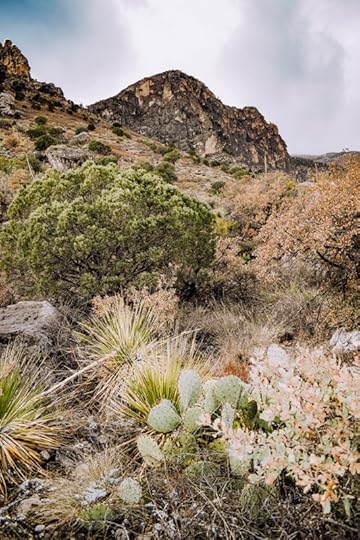
~~One of many beautiful photographs of the Guadalupe mountains in Texas. Joseph starts with a small claim in the upcountry, and slowly buys up the surrounding land until he manages a ranch that reaches as far as the eye can see. Vida's descriptive storytelling follows her characters from San Antonio across Texas. While the landscape is breathtaking, the human struggles taking place in this setting are heartbreaking. This is not a glossy Western. There is violence depicted in all its gory detail. But there are triumphs to be found here too.
First two sentences: Oscar Ruiz, born in Mexico, came to Texas when he was fourteen. He had once raised cattle and sheep on a ranch in a fertile valley along the Rio Grande, before Texicans began eating up the land and pushing the Mexicans out.
Joseph Kimmel, son of a Polish-Jew immigrant, is quite happy with his life teaching math at a boy's school in Missouri. When his shop-keeper brother dies, his brother's partner writes him and says that he is welcome to recover what little possessions his brother has, if he is willing to make the trek to San Antonio. Joseph is no stranger to the back-country. He trapped beaver up and down the Mississippi for years before settling down as a teacher. However, none of his experience prepares him for the desolate wilderness of 1843 Texas.
Along the way he runs into a ragged assortment of Texicans--a diverse group that makes up the ethnic fabric of Texan culture. There's Luck, a runaway slave who is well-spoken, assertive, and has a solid grasp of medicine. Henry Castro is of German ancestry, and persuades his countrymen to immigrate to Texas to stake their claim in the "town" he founded. One Alsatian (a region passed back and forth between France and Germany) girl named Katrin is married off to Joseph in an attempt to save her from the Comanches. Then there's Aurelia, a girl of Mexican descent who practices herbalism, and may have supernatural powers to heal. Mix in Tonkaways, degenerate Texas Rangers, immigrant farmers, and the volatile Comanches. The result is an interesting historical novel that spans 1843-1854.
My two cents: Vida writes with historical accuracy, and creates a compelling setting with her prose. Her descriptions make scenes come to life. However, for me at least, her characters were not as compelling. The violence is intense at times, and includes torture, so fair warning there. My favorite character by far was Katrin. She preservers against all odds, and makes the best of a tough life. I admire her grit. Given 3 stars or a rating of "Good." Recommended as a library checkout if you like western-flavored historical novels.
Joseph Kimmel is a loner. He is a cold man with a streak of kindness. In 1845 he leaves Missouri and heads for Texas hill country. Along the way he reluctantly latches onto some folks (or rather, they latch onto him) who will figure in his life for years to come. He meets Luck and later, Nathan, black men who will become his partners and neighbors in the their new Texas settlement. There is Katrin, a German immigrant who he will marry to save her from the reach of the Commanche, Ten Elk. And there is the lovely Mexican Aurelia, who Joseph openly desires for years. It’s a terrific book loaded with history and exciting scenes of action and violence. But the heart of this novel is in the details of life on the hostile frontier. In Katrin’s frustration being married to an indifferent man who barely acknowledges her existence. In Joseph’s struggle between the lone existence he wants and the community he gathers around him and coldness towards everyone. In the animosity the Comanche feel toward the whites and Mexicans crowding onto their lands. In The Texicans, nobody is safe
I still don't know what I think of this book as it ended so abruptly. I was swiping my Kindle screen for the next page but there wasn't one! This tale of early Texas when the Comanches were still raiding ranches lurched along following Joseph and the strays he picks up along the way. It takes him 4 years to actually collect his dead brother's belongings in San Antonio and discover he's a rich man. What he does with the money comes about as haphazardly as the rest of his life. Throw in a bit of an unrequited love story and the mix just rolls along.
This is a good book about the early life on the Plains of Texas. It has a strange ending which begs for another book to continue the story. The Civil War is only a few years away now and the impact on families in Texas.
A bit of a slow start, but once I reached the one-third mark, the story picked up and became mildly interesting. An easy read with some interesting history.
"1. A person living in Texas during the time of the Republic of Texas. A person modern who advocates that Texas secede from the United States. 2. A native Texan of Mexican descent, a Texan of Mexican ancestry, a Mexican born in Texas. 5. A Texican is also a person of European descent in Texas. A Tejano is a person of Hispanic descent in Texas. 6. A Mexican living in Texas."
The novel includes all the above, the various people that make up the residents of Texas in the 1840s. This would also include the Comanches and other native Indian tribes.
The novel's main character is Joseph, a Polish-Jewish former school teacher who heads from Missouri to Texas after his brother's death there. Joseph meets a European girl in Texas who becomes his wife, and later meets a Mexican woman Aurelia, with whom he becomes obsessed.
Comments: The author is a skilled storyteller, giving excellent descriptions that evoke the time, the surroundings, and the people.
"The braves came home from the hunt with forty bison. They crossed the Colorado and rode into camp. Ten Elk riding ahead, the women laden down with supplies and dragging the butchered bison along behind them until the ground turned bloody and the bison meat was studded with gravel and dirt." (ch. 6)
I think of this as an historical novel telling the story of the Texicans who settled in and made up the new Republic of Texas. Thanks to Nina Vida for a copy of the book for review.
THE TEXICANS tells the story of people trying to make it in Texas not long after it becomes a state. Aurelia, a Mexican with healing powers and Joseph, a Jew who comes to settle his brother's estate after his death are the main focus of the story but their are many more interesting characters that make appearances in this book. Their are runaway slaves, the Texas Rangers and settlers, and of course the Comanches and Tonkaways whose lands are being taken over by the settlers.
Nina Vida presents the stories very well and the lives they must have led in mid 19th century Texas. Joseph's journey is the most interesting and best portrayed. I think if the story was more about him only it would have been an even better read. Aurelia's story was okay, but in the end I didn't see a reason for its inclusion. I kept expecting more of a connection between the two, a romance that never occurred. I felt sorry for the two's hard life, which I am sure was more realistic to the time, but I would have liked another ending.
It was an enjoyable tale, well written and set in an interesting time.
It's a long mood piece about the hardships and sacrifices made during the settlement of Texas.
Characters: Aurelia, Yolanda, Joseph, Katrina, Henry Castro, Tómas.
The Texicans by Nina Vida is set in a time when Texas in a tug of war between Mexican control, U.S. control and independence. Joseph Kimmel has come from Missouri to settle his dead brother's affairs. Meanwhile Aurelia Ruiz is honing her powers to heal and to curse.
The book includes the mixture of people who were part of the Texas Republic. What they share is a desire to improve themselves and make a living. Kimmel grows out of his naivety into becoming a powerful rancher. Aurelia makes tough decisions to stay alive, making her an interesting but not necessarily sympathetic character.
Although The Texicans has the set up of a romance: a historical setting, a man with a good heart and a woman facing a rough life, it isn't a romance. It's historical fiction with the emphasis being more on the fate of the Texas Republic than on any of the main characters.
Set in frontier Texas just after it became a state, this novel features a former Western trapper-turned-schoolteacher as the complicated character at the center of this clash of cultures. He's a man who perceives himself (as most of us perceive most real frontiersmen) as totally independent, not tied to or bound by anyone, but, as it turns out, time after time his life is shaped by his compassionate response to the needs of others--Mexicans, runaway slaves, Indians, utopians--that he comes into contact with.
The story was sometimes choppy (but that may have been because the copy my dad somehow came across while visiting here in Texas was actually a pre-release.) The overall narration was interesting enough to keep going but really, it was like reading a historical soap opera with a little interracial lovin' thrown in for good measure.
I really enjoyed reading this book. What an interesting character study of those who went out west to Texas to find a better life. I also enjoyed learning about their interactions with the Native Americans who continued to fight to keep their land....
Nina Vida is a real delight. I often find male characters written by female authors to lack depth. Not so with Vida her story telling is first rate as is the depth of her characters. Read this one and become a Nina Vida fan.
This book surprised me. Honestly, I chose it because there was a horse on the cover. I ended up liking the way the author wrote and, as usual with historical fiction, I learned quite a bit. The diverse characters were interesting to me but the ending seemed a bit disjointed.
Not bad. Great concept for a Texas-epic (being more inclusive of marginalized/vulnerable character types) but its windup is better than its delivery. Jerky narrative structure, lazy editing, a few too many genre convention pitfalls.
After a slightly bumpy start, this short, compelling novel swings into high gear, detailing the lives of numerous characters with intersecting lives. It's fun.