Jump to ratings and reviews
Rate this book

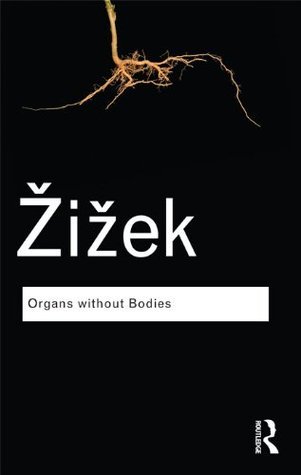
Organs without Bodies: On Deleuze and Consequences

Rate this book

With a new introduction by the author


In this deliciously polemical work, a giant of cultural theory immerses himself in the ideas of a giant of French thought. In his inimical style, Zizek links Deleuze's work with both Oedipus and Hegel, figures from whom the French philosopher distanced himself. Zizek turns some Deleuzian concepts around in order to explore the 'organs without bodies' in such films as Fight Club and the works of Hitchcock. Finally, he attacks what he sees as the 'radical chic' Deleuzians, arguing that such projects turn Deleuze into an ideologist of today's 'digital capitalism'. With his brilliant energy and fearless argumentation, Zizek sets out to restore a truer, more radical Deleuze than the one we thought we knew.

234 pages, Kindle Edition

First published October 24, 2003

47 people are currently reading
1531 people want to read

About the author

Slavoj Žižek

634 books7,512 followers
Slavoj Žižek is a Slovene sociologist, philosopher, and cultural critic.

He was born in Ljubljana, Slovenia (then part of SFR Yugoslavia). He received a Doctor of Arts in Philosophy from the University of Ljubljana and studied psychoanalysis at the University of Paris VIII with Jacques-Alain Miller and François Regnault. In 1990 he was a candidate with the party Liberal Democracy of Slovenia for Presidency of the Republic of Slovenia (an auxiliary institution, abolished in 1992).

Since 2005, Žižek has been a member of the Slovenian Academy of Sciences and Arts.

Žižek is well known for his use of the works of 20th century French psychoanalyst Jacques Lacan in a new reading of popular culture. He writes on many topics including the Iraq War, fundamentalism, capitalism, tolerance, political correctness, globalization, subjectivity, human rights, Lenin, myth, cyberspace, postmodernism, multiculturalism, post-marxism, David Lynch, and Alfred Hitchcock.

In an interview with the Spanish newspaper El País he jokingly described himself as an "orthodox Lacanian Stalinist". In an interview with Amy Goodman on Democracy Now! he described himself as a "Marxist" and a "Communist."

Ratings & Reviews

What do you think?
Rate this book

Friends & Following

Create a free account to discover what your friends think of this book!

Community Reviews

5 stars
162 (28%)
4 stars
149 (25%)
3 stars
162 (28%)
2 stars
58 (10%)
1 star
45 (7%)
Displaying 1 - 26 of 26 reviews
Profile Image for ArturoBelano.
100 reviews360 followers
July 2, 2019
Zizek okumanın kendisi başlı başına bir emek istiyor ve ama sizin o emeği ortaya serişinizin sonucunda her zaman bir anlam, kavrama ile nihayete ermiyor süreç. Hele ki gevezeliklerinin merkezi Felsefeye kaydığında sayfaları döne döne okumak da yetmiyor bazen. Belki de dilimiz, kavramlarımız bu hususta sınıfta kalıyordur, bilmiyorum. Bir de Bedensiz Organlar’ın Deleuze hakkında Hegel’ci bir kitap olduğunu düşününce zorluk ikiye üçe katlanıyor.

Kitaba başlarken bütün bu handikapları bilmekle birlikte, Zizek külliyatında temel bir kavram olan Büyük Öteki’nin Büyük Başka ile karşılandığını görünce şevkim kırılmadı değil. Dahası politik jargona geçtiği biçimiyle neyi imlediği çok açık olan reel sosyalizm kavramının Gerçekte Var olmayan sosyalizme dönüşmesi umutlarımı iyice suya düşürdü. E hal böyle olunca metnin geri kalanını “acaba
burası doğru mu çevrilmiş?” kaygılarıyla okumaktan kurtulamadım. Kavram kargaşaları bir yana metnin genelinde okumayı zorlaştıran, adını koyamadığım bir rahatsızlık hissettim. Umarım bunun yaz sıcakları ve benim yoğunlaşamamamla bir ilgisi vardır.

Böyle kapsamlı bir metne yorum yazacak değilim ancak Zizek’e başlayacak okura bu kitabı Hiçten Az’ın ardına koymalarını ve İdeolojinin Yüce Nesnesi, Gıdıklanan Özne, Kırılgan Temas ve Olumsuzla Oyalanma hatmedilmeden bu sulara girmemelerini tavsiye ederim.

Felsefenin akademik salonlarında bir pop ikona dönüştürülen Deleuze’ün ya da Deleuzcülüğün günümüz kapitalist ideolojinin tam da aradığı ideoloğa dönüşünün hikayesini Zizek’in Hegel’e, Hegel’in Deleuze ‘yaslanarak’ anlatıldığı bu metni tüm zorluklarıyla beraber meselenin meraklılarına öneririm. Felsefi magazin meraklıları ise Hegel 1: Deleuze’ü Arkadan Yapmak bölümüyle yetinebilirler.
Profile Image for Tom Downing.
1 review
October 8, 2013
'Organs Without Bodies' was an interesting and even entertaining read. However, if one expects this to be an in-depth commentary or critique on Deleuzian thought, prepare to be disappointed. The book rather seems to be a collection of essays that sometimes 'encounter' the thought of Deleuze, but other thinkers as well (such as Alain Badiou).

Nonetheless, some of the ideas that Žižek develops in 'Organs Without Bodies' are quite inspiring and stimulating. Moreover, I found Žižek's reading of Deleuze to be very fruitful. He punctures and transforms Deleuzian lingo to his own advantage - something which Deleuze enjoys doing to other authors as well. Although this is probably very upsetting for a Deleuze-scholar ("This is all wrong!"), I found it daring and sometimes illuminating.

In short, 'Organs Wihtout Bodies' is an interesting read. Although I would not deem this book to be of much use for academic purposes, I did find it inspiring and stimulating for the development of my own ideas. Take the book for what it is; don't burn it for what it's not.
Profile Image for Alex Lee.
953 reviews141 followers
January 11, 2016
Its certain that Zizek is "biased" but he writes that he intends to read Deleuze askew.

In many ways, his introduction to Deleuze is quite good. His summary of Deleuze's work and understanding is profound (in the first twenty to fifty pages). And his attempt to match concepts from Lacan and Hegel to aspects of Deleuze's work is pretty admirable. But Zizek does falter with Deleuze, especially towards the end, when it becomes clear that some fundamental aspects of Deleuze's conceptualization is misunderstood by Zizek.

The main difference can be understood in that for Zizek there is one central idea that should be understood as having consistency between the One and the many. For Deleuze this is antithetical, as the meta-position of One can be understood in terms of each multiplicity or it can be understood in terms of the top-down in which each idea has many species. While Zizek would not disagree with Deleuze on this, Deleuze would disagree with the "image of the idea" that the One and the many should be surjected to one another. Lacan for example, is able to bridge the One and the many by twisting the doubling onto a moebius strip in which there is a kind of "Hegelian twist" in which the singular instance becomes a model for itself in what Laruelle would call "in-the-last-instance". Deleuze would not agree with this maneuver as being a maneuver which must occur each time. One could extract from the many a repetition of difference, but that differenciation is a choice that one makes, it is not a maneuver that should be imposed absolutely unless one wanted to jump off into the transcendental cloud and stop thinking and start dominating.

One example of this difference in reading is what Zizek states often that the virtual is the Real, and that this virtual is populated by "organs without bodies". To some degree this is an accurate reading of Deleuze, but it misses the radical choice that one has with Deleuze, in which the sense of the organs is more important than the organs themselves. For Zizek the justification is always with partial pieces, organs which must pre-exist and give rise to a particular body. For Deleuze the arrangement is not important because the body only comes to a particularity only after an extraction of the virtual is made, and the virtual through its many variety of organs can give rise to any number of bodies with latent content from the origin of that organ. For Zizek the idea of the organ in its position is the latent content, so there is no radical variation in the idea.

In this way, Zizek seems to feel it appropriate to slip into being Zizek and writing the book that he normally writes. He seems to see no difference in the variety that can give rise to difference for-itself than the position in which a difference can be central to the event. By adopting this formalism, Zizek maps all events to the same Event, which is the image of the idea ruling his philosophy.

Beyond this, Zizek is insightful, interesting and of course, philosophically sophisticated in his deployment of conceptual rhetoric. But in his attempt to "out do Deleuze" by writing a book on Deleuze, Zizek miss reads certain key concepts. It is apparent that Zizek is unable to explain why Deleuze invented concepts over and over again; as Zizek misses the aesthetic of difference because for Zizek it is not-a-difference at all.
Profile Image for Ellie.
64 reviews10 followers
September 11, 2015
Some interesting/useful ideas submerged in the usual sea of Žižekian navel-gazing.

EDIT: rating it 4 stars now, because Žižek is so wrong in this book that its actually a really rich text to read for academic writing if you want to defend Deleuze's honour.
Profile Image for Mary Tsiara.
99 reviews9 followers
May 18, 2021
Žižek jerking off on philosophy he barely addresses or underdresses as Hegelian, what else is new? TYN.
Profile Image for Elliot.
169 reviews5 followers
August 10, 2023
Finding myself shocked to say this was actually a quite enjoyable and coherent read, a rarity for Zizek (perhaps a result of it being one of his earlier works). In this work Zizek sees himself as facilitating a rapprochement of sorts between Deleuze and Hegel/Lacan. This is possible, in part, because Zizek believes that the Deleuze of Logic of Sense and Difference and Repetition is much closer to Hegel/Lacan than Deleuze himself is able to admit after being "Guattarized" by Guattari in Anti-Oedipus. I'm certainly not an expert enough on any of these thinkers to say whether Zizek is successful but there's no doubt his argument is an interesting and fun read and a novel critique of Deleuze through a Hegelian/Lacanian lens.

Top Quote: Riffing on Deleuze's own conception of philosophy as "buggery," or taking a previous philosopher from behind, Zizek writes, "So, in short, why should we not risk the act of taking from behind Deleuze himself and engage in the practice of the Hegelian buggery of Deleuze? Therein resides the ultimate aim of the present booklet. What monster would have emerged if we were to stage the ghastly scene of the spectre of Hegel taking Deleuze from behind? How would the offspring of this immaculate conception look? Is Hegel really the one philosopher who is “unbuggerable,” who
cannot be taken from behind? What if, on the contrary, Hegel is the greatest and unique self-buggerer in the history of philosophy? What if the “dialectical method” is the one of permanent self-buggering?"
Profile Image for Enzo.
60 reviews5 followers
March 20, 2012
Beim besten Willen nicht, was ich mir erhofft hatte, zudem würde ich oftmals bei den Einschätzungen zu Lacan und zu Deleuze widersprechen. Dennoch ein geistreiches Buch, und letztendlich eine Deleuze'sche Lektüre von Deleuze und Lacan. Leider macht das Buch nichts der üblichen Dinge, die man von einer akademischen Arbeit erwarten würde, um sich dem Thema zu nähern (oder zumindest nicht viel davon), so unterlässt es Zizek, auf die Beziehung zwischen Deleuze und Lacan einzugehen, er systematisiert nicht die Überschneidungspunkte der beiden Theoretiker, und zu guter Letzt, vielleicht typisch für den Autor, landet man auch wieder bei Hitchcock. Mich persönlich langweilt das mittlerweile, aber ich leugne nicht, dass die Filmanalysen Zizeks und vor allem seine Verbindung von Film und Philosophie wie seine Anschaulichkeit allgemein und dabei, fasziniert.

Also, nicht zum systematischen Wissensgewinn geeignet, aber trotzdem oder vielleicht deswegen, zu empfehlen.
15 reviews4 followers
Read
February 16, 2013
Barely mentions Deleuze, so you are really really going to have to read between the lines here to get at any points addressing him. Some people don't realize that Deleuze's idea of the BwO started appearing at least as early as Logic of Sense, so Zizek is probably making most of his points not in reference to the collaborations Deleuze did with Guattari, which Zizek takes less seriously than his early work. You're going to get no direct references to Anti-Oedipus here. Badiou's 'Deleuze: The Clamor of Being' is much more of a concise and focused examination of Deleuze's philosophy, particularly Difference and Repetition and Logic of Sense.
Profile Image for Arsh.
15 reviews16 followers
April 4, 2020
Organs without Bodies by Slavoj Zizek - Book Review; variations on a Concept, and an Anecdote

In reviewing a book by Zizek, only the most painstaking accounting of notations, examples and arguments would enable an effort to be comprehensive. My effort here is not to present a synopsis of the journey that Slavoj takes us through (a task I believe is best left to himself alone). Also, this being a work of philosophy, or at least - theory, what I may analyze isn’t exactly a narrative as with fiction, journalistic accounts, or histories. As a young student of literature I was excited by the prospect of approaching the genre of philosophy as the historiography of ideas. My task, I believed then, was to unearth the living contradictions within which the concepts developed by thinkers gained the unique valency and potency they did. In this sense, I saw myself as an archeologist of philosophy - much in the same vein as Foucault, whose thought in literature departments in the early 2010’s was still very much in vogue.

That is a trajectory that I followed with some sincerity, and I confess that trying to historicize thought, in trying to place it within a context that makes it understandable, that presents it as merely reasonable - is effectively to nullify it’s potency to the point where what would be left of such a work would be nothing more than an excavation of a tomb, from whose stones the spirit has long since left and gone.

f there is a vital impulse in conceptual works, it is precisely in their capacity to serve ends for which they may not have been originally designed, not that a concept is necessarily created with a telos in mind - sometimes the conditions prevalent do not even permit the declaration of a purpose, in which case a concept can do no more than a shine a light onto the darkness of the lived moment.
I would hence like to honor the rigor of thought that, in Deleuze’s words ‘a pickup artist’ would deploy - in appropriating a language to serve his or her own ends, this in fact is precisely what makes it common - and I can think of no trajectory more direct to communism.

The concept of an organ without a body is a mutation. An aberration of a kind made at least in good natured mockery at Deleuze’s conception of a body without an organ. What does an organ do? It facilitates a function which is necessary for the reproduction of the body which it is a part of. The word organ, does not necessarily have to be read in the biological register. We speak of ‘organs of government’ for example - being the judiciary, legislature and the executive, which in turn carry out their respective duties to permit for the well functioning of the state. Instituted bodies, from school clubs to the United Nations can have organs designed to accomplish certain tasks. But before we get any further - a word on how Deleuze originally uses the concept.

A body without organs is principally, for Deleuze a mode of thought. A mode which isn’t locked onto a pre-established, track, function, or is not directed by a telos - understood as end goal or destination. In his diction we encounter utterances such as ‘becoming-machine’, or ‘becoming-woman’ referring to affective tendencies that that are sensed by bodies, or perhaps better yet - expressed by them in their creative negotiation with a field they find themselves in. This has been a useful metaphor as it provides a vocabulary to describe practices which do not rely explicitly on the enunciated word as their medium, such as dance for example. This mode of thought, does bear strong impressions of Deleuze’s commitment to vitalism - a strain distinctly discernible throughout his corpus.
What then would an organ without a body be? There are moments when the necessity of a function, or act presents itself yet the body which may reap the result has yet to be formalized. To draw a historical example - the First War of Independence in 1857 in India was an attempted insurrection without even an idea of the modern nation state that may replace the crown. It was an anti-imperialist struggle to be sure, but it still required the legitimacy of a titular Mughal monarch to galvanize it into a unit.

The first act of rebellion that a student demonstrates in school, maybe as basic as a refusal to comply with a certain definition or interpretation advocated by a teacher - prior to the formation of any student-teacher council, or perhaps better yet - the labour pains of bringing such a body into existence. These are moments, photographs if you will which frame in my mind the political content of the concept ‘organ without body’.

Yet this is not merely a vitalistic snapshot of a fiery moment, a ‘becoming-rebel’ as it were in Deluzean lingo. Remember Fight Club (1999) the Hollywood blockbuster directed by David Fincher based on the novel of the same name by Palahniuk. What is fight club but a group of young men who seek to escape the nihilism of their white collared existence in a ritualized form of underground combat sport which effectively functions beyond the prescribed norms of the society they serve? Or in other words, a form of organization which is formally outside and perhaps beneath the social body. This is an example Zizek plays on quite nicely, and with far greater acuteness.

Analogous to the way the stimulation of genital organs produce orgasms in humans. The input of labour into the means of production, lets say you work at an office computer, produces surplus value for the company. This is the ‘libidinal economy’ that French theorists along the lines of Baudrillard and his ilk describe, the phenomenon that capitalism draws on to incessantly revolutionise itself. The human hand here, is the partial object (in psychoanalytic terms) par excellence. It’s efforts work on and stimulate the substance that constitutes the product of one’s labour, a product which is appropriated only so long as its task is disciplined within the coordinates set by capitalism.
The aspect of the partial object as an organ without a body, I shall leave to Zizek and your curiosity to discover. I would want to focus on another instantiation of this idea which I believe is pertinent to a milieu often created with the collapse of militant organizations.

I sadly would not be able to sufficiently cover the full range of interventions this book (first published in 2004) attempts to make in contemporary discourse. Suffice to say, that like almost all other books by Zizek, it includes interludes on Kant, Hegel, history, Hitchcock, and politics.

What I would like to do however is pitch the central concept of this tome against the site at which it encounters its prime intellectual adversary. Deleuze’s account of fascism. An extract which I believe sufficiently represents this is -
“Deleuze’s account of fascism is that, although subjects as individuals can rationally perceive that it is against their interests to follow it, it seizes them precisely at the impersonal level of pure intensities: “abstract” bodily motions, libidinally invested collective rhythmic movements, affects of hatred and passion that cannot be attributed to any determinate individual. It is thus the impersonal level of pure affects that sustains fascism, not the level of represented and constituted reality.”- “Organs without Bodies.”

I remember watching the Pakistan vs India T20 Cricket World Cup semi-finals in 2011 in Delhi. We were huddled in front of the television in the common room of Hans Raj hostel in the north campus of the University of Delhi. Games of machismo to demonstrate solidarity with the national sporting team aside, the aftermath which constituted the ‘celebrations’ of the victory of the Indian cricket team are etched in my memory. A mob assembled in front of Kamala Nagar crossroad outside the gate constituting students from various colleges, and the form of celebration that was resorted to was violence. Shops were looted, as young bucks were joy riding drunk on motorcycles, and a gang thought it would be fun to light the fern on the walls of the Faculty of Management Studies on fire. Crackers were burst to ensure that the spectacle did not escape anyone’s notice. Similar scenes were witnessed in other parts of Delhi and in other cities as well - none of this was obviously planned.

It is in moments such as these where I feel it is most important to soberly reflect on the enthusiasm with which the unorganized left advocates ‘spontaneous’ organizations and protests. For the danger that Deleuze speaks of is very apparent here. Behind the ‘joy’ of celebratory triumph lurks a brooding communal hatred against Pakistan (and by default - the muslim) that is invariably expressed in forms of violence either personal or public.

The point of organs without bodies in a political sense as I read it is that the left still has the opportunity to engage at a relatively autonomous level of organization where we can express repressed affects. The form of this engagement will necessarily vary - be it via groups on social media, small clubs, hobbyists getting together or maybe just bloggers. But we still have the ability to articulate what it is that we enjoy about cultural products, food, music, cinema, and each other is a space which is not entirely regulated by the logic of capital. More importantly perhaps, to share what we do not appreciate about them. The point of this is not to valorize ‘communication’ which is surely already subsumed in the logic of the commodity. The purest kind of activity that I would cherish is being able to work together while joining in threads of our struggles elsewhere into the fabric of the product we create. Perhaps this may be a conversation, an archive, a photograph, a love letter, a drama - I don’t know; the form varies but it requires to be free of immediate re-inscription into hegemonic norms of thought, be it a national allegory, a graded meritocracy, or a clannish protectionism. It is up to us to create such opportunities - and organs without bodies provides us with a way of imagining them.
Profile Image for bram ieven.
9 reviews1 follower
April 30, 2018
Reading Žižek is usually entertaining because you can expect to be entertained, provoked and wowed. In this case, however, Žižek completely misses the mark. His analysis shows little understanding of the problems that Deleuze and Guattari were trying to grapple with and repeatedly misinterprets the key concepts.

One of the more rewarding ideas offered by Žižek in this book is that there can exist no such thing as microfascism (a core concept in Deleuze and Guattari's Anti-Oedipus). But even then the reader will need to revise this intuition, given that it is based on a misreading of the concept.
Profile Image for Karl Hallbjörnsson.
669 reviews72 followers
April 1, 2018
Kind of torn on this one — I find it hard to judge since I haven't read Deleuze's Logic of Sense or his Difference & Repetition, nor do I have as solid a grasp of the conceptual machinery in Capitalism & Schizophrenia as I'd like — but as always Zizek is very entertaining and stimulating. Of especial interest to me were the comparisons of Deleuze and Hegel — the two thinkers I find most intriguing — although I'm starting to feel somewhat dissatisfied with Zizek's Hegelio-Lacanistic hybrid version of Hegel. I might revisit this one later when I've gotten a better grasp of Deleuze.
Profile Image for Paweł.
14 reviews3 followers
February 18, 2012
Zizek's biased and ambiguous attitude to Deleuze gets on mu goat. He criticizes on of the most excellent books ever written (Anti-Oedipus) as Deleuze's worst. Then he misreads the book as an attack on Lacan, while the Anti-Oedipus's focus is first and foremost on Freud's anthropomorphic dualism and psychoanalytic reductionism.
Profile Image for Cybermilitia.
127 reviews31 followers
December 7, 2015
Bu kitap konusunda kafamdan gecenleri bu platformda yazamam. Ama Deleuze-Guattari'ye dalarken, gecerken Badiou'nun icabina bakmasi azimsanacak sey degil, belirtmeden gecemeyecegim. Hayat degistirici kitaplardan biri.
Profile Image for Ivan Labayne.
375 reviews21 followers
Read
May 29, 2016
Nagkakamot ng bayag si Zizek at tinatanong nya tayo, Is this not precisely the point?
Profile Image for Knecht René.
33 reviews
August 9, 2025
I usually skip the sections on Deleuze in Žižek’s books, because they often remain abstract and impenetrable. That is precisely why I wanted to read Organs Without Bodies, Žižek’s specific confrontation with Deleuze, more thoroughly this time. To my surprise, this book opens up profound and clarifying connections with Fichte, Schelling, Hegel, and, of course, Lacan.

In Organs Without Bodies, Žižek rereads Deleuze through the lens of the Lacan & Hegel, not to simply refute Deleuze, but to think his project through to the extreme, with the aim of uncovering new paradoxes and insights. Just as we can only fully understand Kant by “betraying” him: either by taking him literally and drawing out his ideas to their furthest consequences, or by isolating the creative impulse in Kant that he himself was unaware of! (this was also the approach of Deleuze!)

In the same way, Žižek rediscovers the death drive in Freud, a concept Freud himself never entirely grasped. Žižek is more Lacanian than Lacan, more Hegelian than Hegel, and in that gesture lies his added value: he also enables us to reread thinkers like Fichte and Schelling with renewed clarity. 'The spark of eternity, 'a truly new work stays new forever' (quote)

What begins with Deleuze as the body without organs (BWO) - a pure flux of immaterial becoming - Žižek reconfigures in this book as the organ without body (OWB): a virtuality of pure effects, a paradoxical object that, like the scepter or crown of a king, grants the symbolic order its force, without being substantial itself (the void).

Deleuze starts from a field of intensities, a transcendental empiricism, in which reality emerges from a stream of consciousness without a self (a notion reminiscent of quantum mechanical probability and indeterminacy). Žižek shows how, within that field, the Real, in the form of the death drive, inevitably imposes itself. The fundamental question he (with Deleuze) raises is: Can we fully separate the virtual (becoming) from the actual (being)? And what are the consequences?

The death drive functions here as both excess and lack: an excess that retroactively becomes the cause of its own emergence. As Žižek notes in a footnote (p. 193, note 16): “Death drive is the fidelity to the void itself.”

Crucial to this is the concept of quasi-causality (= transcendental causality, 'effect become cause'): a virtual, immaterial event (the sense-event) that does not originate from bodily causes, but retroactively organizes them. This surplus = the effect that becomes the cause of its cause is precisely the site where freedom arises. Not freedom as autonomous origin, but as a remainder that does not disappear. At this point, the organ-without-body appears: not as pure flux of being, as with Deleuze’s BWO, but as a symbolic excess that traverses and structures the Real body.

Žižek identifies in Deleuze’s dark precursor or field of virtualities the necessity of a void, a non-localized cause, a rupture or crack that is also fundamental in Kant and Hegel. In doing so, he returns to dialectical materialism: not a naive materialism-realism, but a mode of thinking in which sense emerges from the break (Spirit is Bone/Genome). The immaterial/virtual here is not a supernatural force, but the very split within being that makes subjectivation possible.

==> Where idealism tends to close this gap and reduces the effect to a linear cause, i.e. fill in the gap or substantialize the void, dialectical materialism keeps the GAP open and active.

This corresponds with Lacanian notions such as the empty phallic signifier, the quilting point, and the vanishing mediator: structures that organize meaning only retroactively, by adding an excess to the chain of signifiers.

There is also a deep breakthrough - analogy with Kant/Fichte/Schelling. We can only perceive reality by first adding a virtual element to the pre-ontological Real — without this virtual supplement, we are left only with chaos. This is the fundamental paradox of the symbolic: meaning is not a loss/erasing of Reality, but precisely the condition of Perception/Being/Actuality.

==> What comes first: the virtual or the actual? ==> Žižek’s implicit answer: the virtual comes first as intensity, difference, event, and is only afterward subtracted again (in the form of the objet a or the trace of the Real): the vanishing mediator. Because of the Symbolic/Virtual we are able to perceive Reality.

As Žižek summarizes:

“The excess of the virtual sustains actualisation.”

In this sense, the organ without body is not a mystical entity, but a paradoxical structure that makes reality possible, both: a gap and a surplus. This is why Žižek’s project is not an abstract conceptual game, but a philosophy that allows us to take the contingency of the new seriously, against all forms of reductionist materialism or covert idealism as lot of today's science.

By truly thinking Deleuze through to the end, I not only understand Žižek better, but also Fichte, Hegel, Schelling, Freud, and Lacan. In that sense, Organs Without Bodies is one of Žižek’s richest works. though certainly not easy to read. (I skipped the last 50 pages because I’m less interested in the application of all this to cinema, and it took too much time to work through, as it's quite detailed.)
It's definitely best approached after having read several of his other books.

The repetition is always new — and that’s why I love reading Žižek so much.
2 reviews1 follower
December 1, 2024
It’s very thought provoking, and the provocative ideas helped push me in my understanding of both Deleuze, Hegel, and Zizek. However I have my nit-picky disagreements:

Super thoughtful and complex analysis of Deleuze but I think it assumes a Hegelian negativity at the center of his work (Organs without Bodies pg. 58) when Deleuze specifically states: “[A life] is a haecceity no longer of individualization but of singularization: a life of pure immanence, neutral, beyond good and evil, for it was only the subject that incarnated it in the midst of things that made it good or bad” (Immanence: A Life pg. 29).

How can Absolute Knowing be Deleuzian, or, as Zizek puts it, “the virtuality of the eternal process of its own actualization”, if Hegel believes virtuality exists within contradiction and Deleuze believes virtuality is beyond contradiction?

This then lays the grounds for Zizek’s misinterpretation of freedom: “the only way to save freedom is through this short circuit between epistemology and ontology— the moment we reduce our process of knowledge to a process external to the thing itself, to an endless approximation to the thing, freedom is lost, because "reality" is conceived of as a completed, positive order of Being, as a full and exhaustive ontological domain… The only solution here is a Heglo-Deleuzian one: to transpose the incompleteness and openness (the surplus of the virtual over the actual, of the problem over its solution) into the thing itself,” (Zizek pg. 58). Zizek’s problem of epistemology vs ontology doesn’t even exist in Deleuzian metaphysics because the epistemological subject and ontological object are only an empirical actualization of a life’s singularized haecceity. So freedom is not to solve the problem by putting an actual, independent Being into Becoming, but disregards the problem by putting Becoming onto an immanent, relational Being.


To say without the mumbo jumbo— Zizek notices a problem: if things hold knowledge and I learn from those things, then I don’t have the freedom to change the knowledge that things hold. This results in a deterministic line of thinking. To avoid this, Hegel says that knowledge is not pure and unified but has internal contradictions which cause the nature of things to change over time. Zizek misinterprets Deleuze by claiming Deleuze says this too— Deleuze reinterprets where knowledge exists, not what knowledge is. Deleuze believes that an object can exist in all possible configurations, and knowledge exists in my encounter with an objects current configuration. Knowledge exists in my encounter with an object, not within the object. This distinction highlights the key difference between Hegel and Deleuze: for Hegel the self-negation of an objects knowledge cause different encounters, while Deleuze thinks different encounters implies a change from the neutral existence of different configurations. Hegel analyzes the difference in encounters required for a self-negating process, while Deleuze analyzes the neutral, realizing process required for different encounters.

Zizek’s thinks Deleuze is not Hegelian enough, but I actually think Hegel is not Hegelian enough for Deleuze.
829 reviews49 followers
February 12, 2025
Tras haber leído mucho a Zizek y haber realizado ya varias reviews al respecto de su obra, sólo puedo volver a recordar que su filosofía, pese a que muchos les parezca críptica o compleja, supone un capítulo fundamental del pensamiento contemporáneo. Hegel o Lacan son filósofos muy malcomprendidos, puesto que no son intuitivos de primeras, pero quien hace el esfuerzo por entenderlos sin duda que experimenta un crecimiento súbito a la hora de acercarse a los pliegues más íntimamente humanos de la vida y la existencia.

Dicho esto, creo que la obra de Zizek se divide en dos vetas. Una veta es más periodística y artículística, performativa y ligera, cómica, provocativa y divulgativa: los que no comprenden el bagaje cultural del esloveno suelen leerse un par de estos libros y así consiguen reafirmarse en que es un autor menor. La otra veta es de gran monumentalidad, pese a que entrecruce cultura pop con chistes, caso de "Menos que nada", "El espinoso subjeto", "El sinthome", "Sex and the failed absolute", etcétera. "Órganos sin cuerpo" está más bien en este segundo grupo (aunque tiene artículos más directos y provocativos desde un punto de vista político).

Cierto es que se le puede criticar el que, en puridad, no es una revisión o crítica profunda a Deleuze (y Guattari). Más bien Deleuze le sirve como pretexto y, aunque a veces sí que dilucida o problematiza sobre el pensamiento de tal autor, lo que pretende es más bien hacer pensar sobre nociones típicas zizekianas. De hecho, todo el pensamiento de Zizek no es sino un ejercicio de zarandeo psicoanalítico (psicoanálisis moderno, por cierto) y político.

En conclusión, lo considero un opúsculo Zizekiano muy notable, aunque poco compacto (lo que, en este caso, lo considero incluso positivo). Zizek es pura estimulación y sugerencia. ¿Con que fin? Con el fin de que el lector desee sumergirse en Hegel, en Marx y en Lacan. ¿Por qué? Suponen una alternativa existencial y un pespunte cultural y psicológico (artístico, musical, íntimo, sexual, vital...) de una riqueza infinitas. Quizás sean las únicas armas contundentes contra el cientifismo, el nihilismo y los cognitivismos positivistas psicométricos y cuantitativos sobre lo humano.

54 reviews3 followers
April 29, 2023
This is very much not a book about Deleuze. There are sections dedicated to Deleuze, yes, but that’s not the focus. This is a book by Zizek about Zizek’s theory, which just so happens to incorporate more concepts from Deleuze into the analysis than usual, both as concepts to be incorporated into the Zizekian framework or as targets for polemic. If you read this book in that way, it’s good.
Profile Image for Mara.
44 reviews11 followers
February 8, 2023
It’s almost all about Hegel and how Deleuze is actually Hegelian, which in all fairness is really interesting.

But… Ugh… for 3/4ths of the books he’s going on weird tangents that don’t seem at all related and were probably best left in his own weird brain.
Profile Image for Monokl Kitap.
141 reviews26 followers
November 30, 2020
Bedensiz organlar yaşama dair her konuya değinerek aklımızdaki sorulara yenilerini ekleyerek bizi düşündürüyor.
Profile Image for Sigurður Ingvarsson.
12 reviews
December 15, 2020
Seinni hlutinn er einstaklega áhugaverður. Þar eru margar af pælingunum sem Zizek fjallaði síðar um í myndinni the Pervert's Guide to Cinema.
19 reviews
July 22, 2025
This is a thought-provoking work, but more in line with a typical Zizek work rather than a critical engagement with Deleuze.
Profile Image for Roberto Yoed.
804 reviews
July 29, 2021
The Slovenian giant tries to make an apology of Deleuze.

This take on “Difference and Repetition” is the best in my opinion.
Displaying 1 - 26 of 26 reviews

Can't find what you're looking for?

Get help and learn more about the design.