Jump to ratings and reviews
Rate this book

In a Rocket Made of Ice: Among the Children of Wat Opot

Rate this book
A beautifully told, inspiring true story of one woman’s volunteer experiences at an orphanage in rural Cambodia—a book that embodies the belief that love, compassion, and generosity of spirit can overcome even the most fearsome of obstacles.

Gail Gutradt was at a crossroads in her life when she learned of the Wat Opot Children’s Community. Begun with just fifty dollars in the pocket of Wayne Dale Matthysse, a former Marine Corps medic in Vietnam, Wat Opot, a temple complex nestled among Cambodia’s verdant rice paddies, was once a haunted scrubland that became a place of healing and respite where children with or orphaned by HIV/AIDS could live outside of fear or judgment, and find a new family—a place that Gutradt calls “a workshop for souls.”

Disarming, funny, deeply moving, In a Rocket Made of Ice gathers the stories of children saved and changed by this very special place, and of one woman’s transformation in trying to help them. With wry perceptiveness and stunning humanity and humor, this courageous, surprising, and evocative memoir etches the people of Wat Opot forever on your heart.

352 pages, Hardcover

First published January 1, 2014

Loading...
Loading...

About the author

Gail Gutradt

3 books4 followers

Ratings & Reviews

What do you think?
Rate this book

Friends & Following

Create a free account to discover what your friends think of this book!

Community Reviews

5 stars
87 (27%)
4 stars
104 (33%)
3 stars
92 (29%)
2 stars
25 (7%)
1 star
6 (1%)
Displaying 1 - 30 of 55 reviews
1 review
July 15, 2014
The reader is put down in the midst of a community in Cambodia, part of which is the created family of Wat Opot, initially an orphanage for HIV-AIDS children whose parents have passed on the disease and then succumbed to it. "Family" is the important word here, since a loving and supportive atmosphere reigns. Children entering alone quickly find themselves with devoted siblings. The family becomes multi-generational, with older residents serving as mothers to newly-admitted babies.
This author skillfully brings us through the life at Wat Opot. We become accustomed to the routines, the personality and dedication of the man who founded and still leads the community. We share Gutradt's joy as she puts in 4 long visits over a 7-year period.
We are made privy to the occasional thorny problem, as well: There is, for instance, a "sex episode." And not all of the children happily soak up the education offered in the community. But such honesty on Gutradt's part makes the startling success of Wat Opot all the more graphic--and believable.
Gutradt's writing is clear yet artful. She organizes the immense amount of detail that we need in order to share her experience, with magically invisible structure. And we exit the book as full-flown participants, ourselves.
161 reviews2 followers
Read
June 9, 2022
So in terms of books written by Americans about SE Asia, this one ALMOST gets it right in terms of acknowledging one's position of power and impermanence while also being respectful of local culture and letting local voices speak.

I say almost bc there's a few places where an editor should have cut some of the stuff out. The author explains Cambodia's landmines only to go on, in the next paragraph, to say that working with another volunteer is like being in a MINEFIELD. Goodness, it's wild to me to trivialize this expression in any context but especially a Cambodian one.

Anyway, it's still a really good read and very interesting and moving. Also interesting for me as a gay American where HIV/AIDS narratives tend to center on gay men and this one doesn't, which seems important too.
Profile Image for Sharon Huether.
1,851 reviews42 followers
July 11, 2014
I WON THIS FREE BOOK THROUGH GOODREADS FIRST-READS. Gail Gutradt, the author was at the crossrads of her life, when she decided to go to Cambodia and volunteer at a place caled Wat Opot, where people and children, many orphaned went for Hiv treatment. She tells of the good times, funny happenings and the oh so sad times. In that part of the world men would go out partying and come home infected with the HIV virus. Children were often orphaned, by fault of their fathers. The children were brought to Wat Opot where they were cared for and taught their lessons. The story is true, only the names have been changed. As time went on they received more financial help enlarging their space and helping the children. A very touching story.
Profile Image for Donna.
4,764 reviews206 followers
February 10, 2015
This book was a disappointment. I'm glad that the story is being told and that there are dedicated people out there who are truly striving to make a difference. The children stories were sweet as well. But this was not well written and it wasn't a humble account by any means. It jumped around, it was repetitive, and it felt anti-christian. Any time someone did something deemed 'wrong' and they were Christian, it was pointed out that they were in fact a Christian, leading you to believe they were poor Christians. And whenever others did something deemed as 'wrong' and they were a different religion, no religion was mentioned. It felt totally slanted and I have no patience for that. If you are going to paint a religious picture, than be consistent. I recommend this to no one.
Profile Image for Marissa.
144 reviews9 followers
November 29, 2014
I'm sure like most readers, I had no idea that this place even existed. It is both both a heartwarming story and a sad one. No one likes hearing about kids that are ill at any point. However, while reading, you realize that these kids are very well taken care of by the staff and volunteers. I liked the stories about some of the individual children. It made them more real to me since, in a sense, I could bond with them through Gutradt's words.

It's a very inspiring book. Not in the "run off to Cambodia and volunteer way", but more in the "how can I help others" kind of way. For someone who is admittedly not a writer, I thought she did a great job.
90 reviews
June 19, 2022
The world is filled with people quietly going about doing good. People we never hear about but who, nonetheless, change others' lives by their selfless acts of mercy. This book describes the work of a few of these angels of mercy. What I love about the book is that we do see the transcendent good done by those who work at Wat Opot but we also get a very realistic look at the every day gains and losses of working for a grassroots charity with a bare bones budget. There are philosophical and spiritual differences to be wrangled with. Personality clashes among volunteers. A continuing gaping need for funds. These and other real life issues affecting Wat Opat are honestly explored.

Reading about the children was tremendously moving. Just as moving, however, was the overall vision of Wat Opat as a group of mothers, fathers and children coming together as a village. Tending the sick, cheering the successes of young and old, laughing over musical kites dancing in the skies, tenderly grieving the lost - there is everything in this gentle book.
Profile Image for Susan.
413 reviews18 followers
August 22, 2022
Upon finishing reading "In a Rocket Made of Ice" by Gail Gutradt, I did an internet search for Wat Opot.  While reading through the website I saw an "In memory of Gail Gutrandt" link.  Further searches revealed that she died of cancer on February 22, 2016 and that the proceeds of the sale of this book were donated to Wat Opot.
I found this book to be very interesting.   It is made up of a compilation of stories of the people at Wat Opot as well as her own insights and growth during her time volunteering there.
Profile Image for Nicole Means.
457 reviews18 followers
March 6, 2017
This book is a refreshing reminder that just because people have different ways of living does not mean it's necessarily wrong. It is with arrogance that we, in the West, often dismiss other traditions and culture. Wayne Matthysse, whose story is told in this book, rejects efforts of conversion because he believes being good is more about living a moral life than spouting off verses in the name of religion. His life is a true testament of what it means to put others before oneself. "Good leadership is not about being the boss. It is about getting people you love to work alongside you."

I am glad this story has been told. I enjoyed learning about Wayne and all his efforts to help Cambodia's children. However, the writing was a bit repetitive and I found myself skimming certain parts of the story as my mind lost interest.
1 review
August 25, 2014
Gail Gutradt's sensitive and thought-provoking work took me to another world and back again. I felt as if I knew each child she spoke of as well as Wayne Matthys, the man who has given everything to make their lives better. I was especially moved by the author's honesty and humility. While this book is uplifting and heart-warming, it is not a fairy tale story. It tackles the tough issues of volunteering and what it means to love. If you're looking for a book that will touch you deeply and make you question your own motivations and decisions, In a Rocket Made of Ice is for you.
Profile Image for Clay.
Author 12 books116 followers
Read
June 26, 2015
Lovely reading by Lorna Raver of Gail Gutradt's book about her time volunteering at the Wat Opot orphanage in Cambodia. The moving, true, inspiring story transcends a few abrupt time shifts and repetitions in the narrative and came at exactly the right time for me to receive and appreciate it. Recommended.
Profile Image for Jennifer.
58 reviews
February 9, 2015
Within two hours of starting this book i had checked on volunteer opportunities at Wat Opot and air fare to Cambodia.
Profile Image for Paula.
429 reviews34 followers
October 22, 2020
Starts out beautifully; people in service to those in need. My heart swells, my eyes tear, I got my bags half packed, checked home vales so I can sell my worldly possessions, looking up flights and I'm about to empty my bank accounts in a lump sum transfer...

...then chapter 18 hits and she breaks my heart with the inevitable rant of any radical religious zealot cult member... follow me or you suck!

She starts bashing and she doesn't stop- until I choke to death on the hypocrisy and ignorance of her calling people hypocrites and ignorant. Its a 1960s hippie cliché- Organized religion and government both suck- but they're both responsible for fixing world ills, and anyone who lives in any of their geographical confines is complicit-
They can only be good if they do what she wants according to her own piecemeal quilted spirituality and politics- she picks what she likes best about all religions and political factions, cultural foundations and creates a mélange- thn you live in her world or you suck!
how about this:
"god will bless us in his own time in his own way... the USA will not pay its dues because it is too busy fighting an 3 billion dollar a week war fighting an enemy that spends far far less with far better results because the people you [Americans?] war against are not fools"...

Also Direct quote from the book to a well-to-do American visitor " he wrote he has so many blessings that 'sometimes I think they are just siting around in heaven thinking lets just see how much good stuff we can pile on this guy and see how he reacts' Wayne replied he hopes the man will take a closer look at what he considered a blessing because the life you are living can only be made possible by your countries continuance of its present course- are your blessings from heaven or are they really only the spoils of war that are causing death and destruction to millions of people... If ignorance was an illness I think I would have to preform last rights to a majority of the American people"
That's so many pronoun changes, its so much blame. You don't want righ people money? "our AIDS children dont need your shit..." As a reader Im like What? Im sorry? Tell me again why these kids don't need his money? Because you're too proud? And he's the bad guy? You just bitched the US govt wouldn't pull their weight-and when an individual offered to pick up the slack- you won't take his money because why- he didn't overthrow the government?


That is all word- for- word quote from the book. Its hard to listen to as a member of the maligned "American people" and it keeps getting worse- uglier, angrier-

Do you want to do good- or be right? This author performs the former in order to demand the latter in her specific terms- political, religious, functional, financial procedural ...

Claiming to be a tolerant loving spiritual person, she is a total fraud and I can't believe no one has ever made that clear to her. There is a super simple proof- you are part of the problem or solution and to be part of the solution has to depend on need+ willingness to provide. It has nothing to do with her spirituality or the federal governmental decision of donors.

its inconceivable that a woman who claims to be tolerant can be this fanatical about her made up pick/choose personal spirituality and spew this much vitriol against anyone who doesn't agree. A suicide vest might have been a nice option for her.
1 review
August 5, 2019
An American veteran in Vietnam is saved in a medevac escape from the battlefield, while the rest of the troop don't make it at all. He wonders how and where he can repay the Universe as a token of gratitude for sparing his life.

He works in Honduras and New Mexico before learning about HIV positive kids -- many of them orphans -- in Cambodia. He goes there and starts an orphan/HIV AIDS community and NGO.

The book is an extremely well-written account by an American woman who becomes endeared to the expanding community of mostly children whose stay is often cut short due to lack of AntiRetroViral medication. But ARV medications do eventually become available there. More kids survive and their lives acquire a semblance of normalcy: they go to school and start to dream of and steer themselves towards a future of their own choosing.

The orphanage, Wat Opot, is located in rural Cambodia 70 or so kilometers south of Phnom Penh. It has the basic amenities of Buddhist temple, clinic, crematorium, rice fields, pagoda, school, and garden. Author Gail Gutradt documents her visits made during the dry season over eight years. She phrases well, for example-a three-day moon smiles through a froth of stars.

The day to day trials of kids and staff at Wat Opot are described in glowing and compassionate prose. We learn of some crematorium practices, singing kites, interfaith experience, meditation, a boy who has to remove a rice grain from his ear, spiritual orbs in photos, staffing and funding concerns, and how kids learn to overcome showing ill-will towards any who are HIV-positive.

A generous serving of photos and a village map supplement the text.

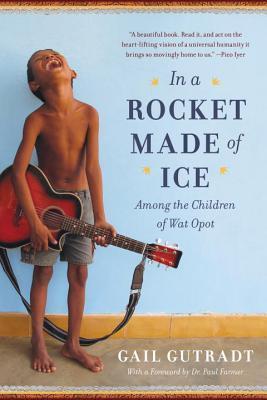
One puzzling observation: nowhere in the book does it mention anything about a music program or chance to learn an instrument. Thus, the cover photo, with the boy holding a guitar as he laughs at something totally hilarious, seems disconnected (despite how excellent it is by itself!). Perhaps such a program started after the publication of the book.


Their website: http://www.watopot.org
Profile Image for Chris.
520 reviews1 follower
January 30, 2019
7/10

I really enjoyed learning about the children of Wat Opot. It was great to learn about a whole community doing good that I had never heard of. There are some incredible people doing lots of good, and it's nice to read their stories rather than all the negative we get today.

My biggest takeaway was that we can't shield ourselves from things because they will make us sad or uncomfortable, but we need to learn and be part of the solution. One of the major challenges that faces Wat Opot is trying to get the community to accept kids that are HIV positive.

I wasn't a big fan of the writing style, it seemed like there was a lot that didn't need to be in there (which is hard to say because the little stories are what bring this book to life). I thought this could have been 100 pages shorter and just as impactful - if not more so.
Profile Image for Jo.
641 reviews
August 1, 2017
I knew nothing about Cambodia, nor their horrible AIDS epidemic. The gentle tenacity of Wayne to simply serve is inspiring. I finished to book feeling a desire to reach outside my comfortable circle of service. Not sure where life will lead me next but I can say for sure that this book has given me a lot to think about.
145 reviews
April 27, 2018
Would like to give this a 3.5....really interesting insight into the evolution of the stigma around Aids in Cambodia. Love reading about these types of volunteer experiences and how impactful working with children and in the field of sexual education can be in developing communities for the residents as well as the volunteers.
Profile Image for Fayette.
368 reviews2 followers
May 18, 2017
I am giving this book 5 stars because I loved it.

"With all the plans we make about what we will do as volunteers, it is what we offer each other as human beings that endures; it is the simple and mutual acts of kindness that remain." --Gail Gutradt
70 reviews
December 17, 2018
5-stars for the story more than the writing. An important, emotional, and worthwhile read.
Profile Image for Adam.
9 reviews
September 20, 2020
Found it very inspiring.
I want to read more about Wayne! He's so intriguing.
143 reviews1 follower
Read
January 3, 2021
Amazing!! Such a touching, heartbreaking story. If only we all could have such a volunteering experience on our lives!! The world would be a better place.
Profile Image for Lorna.
228 reviews
September 9, 2023
A bit of ramble through the others thoughts and memories of her time at Wat Opot. A sweet, inspiring example of the impact of simple, selfless love shown to those less fortunate.
Profile Image for Liralen.
3,608 reviews325 followers
June 26, 2014
People ask me, 'How did you get to Cambodia?'

How do we wind up anywhere? Do we really know? One corner is turned instead of another in a life left open to possibilities. (95)

This is the book Little Princes wishes it were. Gutradt first went to Cambodia with twin desires to travel and do service; she returned because she kept feeling the pull of Wat Opot. But -- although she sees herself as at least a semipermanent part of Wat Opot; she uses 'we' and has enough understanding of how it is run to worry about funding and policies -- she is also aware that this is not her story; this is the story of Wayne (who runs the orphanage) and of course Wat Opot's residents.

As perhaps some combination of a stylistic choice and a practical one, this is more an interconnected, loosely chronological set of stories than it is a cohesive narrative with plotline. I suspect that the practical end of this is that, while Gutradt has spent extended periods of time in Cambodia, she knows how much she is not there for; things can shift significantly between one visit and the next. On the stylistic end...well, this:
Before many weeks had passed at Wat Opot, I would find that the problems were different and the joys more profound than I could have imagined. I will tell you about both in this book, and to that extent I could not help but write a book within a book, one about une femme d'une certain âge who goes off to find her soul by volunteering in the so-called Third World. It's a familiar theme in this isolating age, and although some of my own story inevitably crept in, the book I hoped to write is not about that. It is the lives of the children I want you to know about. (10)

This is their story, not hers.

That's one of the things that I loved so much about this book: that she kept the focus right where it should be. It's a very compassionate, thoughtful read; although she writes about the good and the bad, she's always mindful of Wat Opot's residents and their basic humanity.

Gutradt constantly questions everything -- not in the sense of trying to find something wrong with a situation, but in the sense of trying to understand why people react in certain ways, make certain choices, and how it all connects. The part of the story that is hers is largely a chronicle of learning, of loosening. She's interested in (and mindful of) the impact that volunteering can have on not only the children but also the volunteers...and aware that, in many ways, the impact feels far more significant to the volunteers (herself included); they will eventually leave, but they are just a rotating cast of adults to the children, most of whom will be there much longer.
What is our real work here? We say we hope the children will bond with us, but what are we actually offering them, we who come and go between worlds? More than anything I have done, or tried to teach them, or carried from America to give them, it is the mere act of returning here that has made a difference, that has let them know that I care enough about them to come back. (165-166)

She's interested in Khmer culture, and the children's roots; in what being and AIDS orphan means in the context of this orphanage, this community, this country; in religion, both the ways that the children practice it and the ways that visitors bring it in; in the ways the children adjust and adapt; in what she brings to the table as a volunteer and how that shifts too. She's constantly evaluating and re-evaluating, and I loved it.
I didn't recognize it yet, but in those days Cambodia was consistently portrayed in the media as a terrifying place moving backward from an ancient glorious past to a hopeless future. Every story I read, every image I saw, perpetuated the stereotype of Cambodians as impoverished, emaciated or mutilated by land mines. Moreover, as an American living in a relatively safe community, I was afraid to expose myself to the risks I was convinced were rampant there. I longed to travel, to offer service to the poorest of the poor. But in Cambodia? (143)

My s.o. has been after me for ages to read more about Cambodia (the implication being, I think, that then maybe I will read less about Botswana and Ghana and so on and maybe change my pipe dreams...), but gosh, it's been hard to find Cambodia books that aren't about the Khmer Rouge and the killing fields. I'll read about that, sure; it's a huge (and hugely important) part of the country's history; but how much nicer to have a more positive (if in many places still terribly sad) narrative.

And it's really, really quotable.
Profile Image for Kayrene.
288 reviews20 followers
June 15, 2022
This book affected me so much! I didn't really know what it was about, had just seen it in a reading group online. I am kind of knocked off balance, and very very sad to be reminded just how much injustice there is in the world... how much the children suffer. It's a beautiful, tragic read, and I want to go back and read it again. <3
Profile Image for Nancy Kennedy.
Author 13 books57 followers
September 6, 2014
Gail Gutradt has volunteered extensively at Wat Opot, a community begun on the unused land of a Buddhist temple complex in Cambodia for children with HIV/AIDS or who have been orphaned because of it. In this endearing book, the author writes of the children themselves, showing the reader why she has come to love them and the place she comes to feel alive in.

Ms. Gutradt is encouraged by a friend to volunteer after she makes known her desire for "seva," the Hindu word for selfless service. Even so, she has some adjustments to make when she first encounters the sprawling chaotic community of happy, energetic children. She writes: "Sometimes the energy of the children overwhelms and exhausts me, but what better time to appreciate their life force than when overcome by its passion? The great miracle of Wat Opot is how it heals the spirits of these children so that they can manifest that vibrant, living energy."

Ms. Gutradt's writing is evocative and lyrical without being sentimental or mawkish. The children all emerge with their own personalities, as do the founders and supporters of Wat Opot. Begun by Wayne Matthysse, a former Marine Corps medic who served in Vietnam, the community grows exponentially as the surrounding areas learn of the medical care, education, housing, love and friendship offered there.

I would have given the book five stars, but for one glaring section in which Ms. Gutradt savages the woman who helped Mr. Matthysse found Wat Opot, whom she calls Rebecca. An entirely different side of the author emerges as she damns the woman with uncharitable vengeance. She sounds like a jealous lover. The community veers from its evangelical Christian roots as Wayne's spirituality grows to encompass Buddhist traditions and thought, and his discipline and educational methods begin to diverge from Rebecca's until eventually she resigns. Rebecca notifies the church that supports her and Wat Opot about the change in its underpinnings -- an act that Ms. Gutradt excoriates -- causing the church to withdraw its financial support. But a church has every right to support only those efforts that align with its beliefs. The same goes for Rebecca. Ms. Gutradt has the freedom to come and go as she pleases, believe what she wants, and to comply or not comply with community rules (which she frequently disregards). Rebecca does not have that freedom -- a person who commits to long-term service has fewer freedoms and more responsibility than that of short-term volunteers. Walk a few years in her shoes before you judge.
14 reviews1 follower
May 1, 2015
I feel compelled to qualify my star-rating on this book. I should say that I think, overall, it's quite charming. The philosophy around the organization and the community seems to be culturally appropriate (or at least culturally sensitive) and what they've been able to accomplish with the best of intentions and limited resources is remarkable. That being said, there is just something about the stories, or perhaps about the way the stories are told, that just sort of doesn't sit right. I can't quite articulate it - it could just be my general feelings around the idea of white-Western-privileged "voluntourism." Ultimately, it is clear that they have done a lot of good and that they don't seem to be corrupt or proselytizing, but there is still a sense in how some of the stories are told that the telling of these stories is exploitative somehow.

Ultimately, these children are just like children anywhere else - some of them have a chronic illness, some of them are orphaned, some of them have borne witness to things well beyond their years. What makes their particular circumstances unique (or sadly, not unique in many parts of the world) are the social, economic, and cultural realities that inform them. Maybe my issue is that, though mentioned at times, the full context of the AIDS epidemic in Cambodia isn't really addressed--to say that AIDS entered families because fathers had sex with prostitutes and HIV+ family members were then cast out by their communities is reductive of the larger issues at play in the spread, impact, and treatment of the disease.

All of this being said, I think Gail Gutradt has the best of intentions--her passion for the project and love of the children is obvious throughout. I think the challenge of this book is that it can't decide what it wants to be--a series of short stories/vignettes, a memoir, a collection of essays, a history--and so seems to veer from genre to genre, ricocheting from engrossing to informative to redundant as it goes. All this to say, I think I would feel differently about this book had it been blessed with a better editor.

If, however, you are interested in travel or voluntourism or considering what life might be like for kids somewhere else in the world (I almost wrote "underprivileged kids," but if you read the book and consider the larger reality of life in rural Cambodia you quickly realize that many of the Wat Opot kids are actually very privileged), this is a worthwhile read. Just prepare yourself for a meandering journey and mixed emotions.


Profile Image for Gry.
93 reviews
June 29, 2014
Oh, goodness, I loved this book! As other reviewers have mentioned, the text does repeat itself from time to time, but there is just so much that's done right in this book that I'm willing to forgive this little quirk. A friend once told me that after a traumatic event in her life, time no longer felt linear to her. I get the impression that this author, too, sees the events of her life as a non-linear progression, which could explain the quirky organization and repetitions in this book.

The author, Gail Gutradt, volunteered for several months at a time in the Wat Opat community in Cambodia, over the course of several years. Wat Opat was founded originally as a hospice for people dying of HIV/AIDS, but as better medicines have become available in Cambodia, it has been transformed into a thriving community, where people can receive medical care, become educated, and care for one another. Many of the children living at Wat Opat are orphans, but over time, the community has become a family itself.

I love how Gutradt gives such vivid descriptions of the place and people. Although she is not Cambodian and does not speak much Khmer, she has great respect for their culture and has done her best to learn about it and understand it. She also introduces us to Wayne (the director/co-founder), the other volunteers, the adult residents, and of course the children, in a way that makes readers feel as if these people are dear friends. I also liked how she did not sugar-coat or gloss over the difficulties of working in a place such as this. Sometimes there are unintended consequences when people are trying to be helpful. Sometimes there is frustration and heartbreak. And it takes a lot of inner strength to fully give the love in your heart to those who are sick and dying. Gutradt lets readers in on all the ups and downs of volunteering, and in doing so allows readers to open their own hearts to this special place.
Profile Image for Susan.
4 reviews
July 20, 2014
In a Rocket Made of Ice: Among the Children of Wat Opot (Hardcover)
An Aids community is an unusual place to find pure joy, but Gail Gutradt has taken us to a place where love and caring have transcended tragedy. This writer's voice is so utterly honest that the reader might well be astonished at her bravery. It surely takes courage to leave a comfortable and safe home to journey to a place as far and as different as Aids ravaged Cambodia, but the book displays a second kind of courage as well. In interweaving her own battles - loss, breast cancer, lonliness -with the story of the Wat Opot community, we see the fortitude of one who is willing to seek change and share her failures as well as her success. The melding of the two tales brings us closer this exceptional tale teller and to the extraordinary man who has created this haven for the unwanted out of his own demons.
The story tells of an orphanage, begun as a project of compassion to comfort the dying that has morphed over time to a large and loving community where children are growing up, being educated as well as medicated, and going off to college. There is a deftness and clarity as well as a tenderness and wry humor to Gutradt's prose. Her phrases and metaphors are often like small jewels to savor as the narrative proceeds. The children's trash-made-kites; "But they dance and dip and brush the sky in a glorious calligraphy." The view from nearby mountain top temple ruins; "The fields are separated by narrow paths of sun-baked clay that run like mullions trough a stained glass window". There are more jewels, but when you read the book you will discover them
The photography that is part of the book is just amazing. In particular, the simple portraits of the children seem to reveal their very souls. This book is truly food for the soul.
148 reviews1 follower
July 2, 2015
This is a book that touches both the sympathetic heart and cold reality. (It is written by a lady who spent much time in Wat Opot as a volunteer.) As I read it, I marveled at Wayne, who founded Wat Opot for those in Cambodia who were so in need of a place of refuge and solidarity. The people he helps, the majority of whom are children and many are HIV-positive, are treated with respect and sincere compassion. He's not a "savior on Mount Zion" preacher and converter, but rather a truly good man who wants to make life better for those who often have no other hope. The deaths that are a regular part of Wat Opot become quiet celebrations of respect and love each evening as the children light incense and visit the room where the cremation urns, each with a picture of the person tied to it, are kept. Maybe a mother, maybe a sibling or friend. A peaceful ritual. Most certainly, the part of the book that most frustrated and upset me was reading that the church congregation that initially funded Wayne's efforts decided to pull its funding because he wasn't trying to convert the children to Christianity! For goodness sake - really?!
There are sad stories and success stories. One young man who came to Wot Opot as a child has used the opportunity to get an education for himself and his siblings, and is grateful to Wayne for the chance he gave them. Funds are tight, but Wayne takes no salary and accounts for every penny. His goal is to help the children, and I truly believe that he is doing just that.
Displaying 1 - 30 of 55 reviews