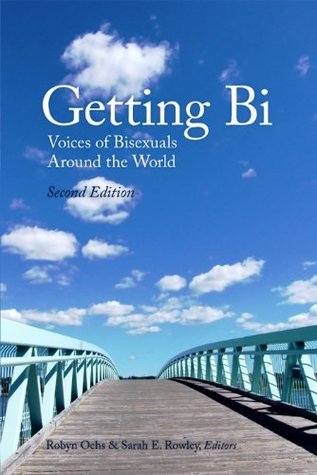
Getting Bi: Voices of Bisexuals Around the World by Robyn Ochs and Sarah E. Rowley was a 4 out of 5 stars for me ✨🩷💜💙✨
I did have to read this book for school, and my review will be a little different than normal because this is being used as an assignment for school (which is really cool, right??), and there are a few specific requirements I need to touch on.
The book is very anti-oppressive as it discusses personal stories covering topics of bisexuality, coming out, life stories, relationship challenges, politics, and so much more, all from people who identify as bi from all around the world. Even though this book was required for school, it was really educational and healing for me, as someone who struggled with internalized biphobia for a long time. I feel like I highlighted and tabbed so much of the book that it’s honestly hard to choose which parts connected with me the most.
I wrote this review while listening to Noah Kahan’s new album 🥺, so that made me a little emotional thinking about it all. Since this book is heavy on personal stories and lived experiences, I wanted to share some of my favorite quotes that really stuck with me:
🩷“I call myself bisexual because I acknowledge in myself the potential to be attracted, romantically and/or sexually, to people of more than one sex, not necessarily at the same time, not necessarily in the same way, and not necessarily to the same degree.”
💜“Being bisexual is nothing other than being able to love, at least potentially, humanity as a whole.”
💙“To me, bisexuality is a matter of loving and accepting everyone equally - seeing the beauty in the human soul, rather than in the shell that houses it.”
🩷“I call myself bisexual because I feel I have the capacity to love both sexes as much as members of a heterosexual couple love each other.”
💜“The girls I loved earliest, before we understood what to call ourselves, or what that meant the world would think of us.”
💙“If you’re in a relationship with a man, why don’t you just call yourself straight?” - I’ve been in a heterosexual-passing relationship for 8 years… this one hit hard
🩷This one is a beautiful poem called confession by Gabriela Granados from Mexico on page 148
“i am one of those women who stares distractedly at the moon until melancholy arrives and begins to notice its contours and colors i am one of those women who asks themselves who am i seeing herself in his fingers in her fingers” 💜
💙“It’s about the potential - the potential to love, to be attracted to, to be intimate with, to share a life with a person because of who they are. I see a person, not a gender.”
I could have shared so many more quotes. I’m not lying when I say I highlighted or tabbed something on practically every page. This book was published originally in 2005 and the version I read is the updated and expanded version from 2009.
Still, I wonder how much has changed since then. One thing I’ve loved about being in my MSW program is the acceptance from instructors, classmates, and the overall vibe. It has truly helped me embrace being bi. Our cohort orientation was one of the first (and maybe only) times that I truly felt comfortable and safe expressing this, especially without judgement since I’ve been in a heterosexual-passing relationship for so long. Like I mentioned, this book connected a lot to the material we’ve covered in this class, which focuses on anti-oppressive social work practice. Intersectionality has been a major focus this semester, and it’s very present in this book. Many of those in the book are from other countries and are part of the BIPOC community, and face even more hardships and scrutiny than I do, as a White, cisgender female. Here are a few more quotes that connect to those themes:
🩷“I think being homosexual is still considered mentally sick by most people in China. It is hard for them to come out.”
💜“Bisexuals face homophobia from the dominant society as gays and lesbians do. But they also face discrimination from the gay and lesbian communities.”
💙“One of the greatest challenges of being bisexual is our (in)visibility.”
🩷“None of us are free until all of us are free.”
I think my closing thoughts are a mix of confusion, hurt, and wonder about the human race when it comes to sexuality. I’ve never understood why it matters who someone is attracted to. It doesn’t impact anyone but yourself and the person you’re in a relationship with. Why do people care SO MUCH? It genuinely doesn’t make sense to me and my heart broke so many times when reading this. I’ve had loved ones say things like “being gay is a sin but we love the sinner, not the sin,” and it’s just like… okay?? Not everyone is religious anyways, and what is the point of even saying that?
Others in the book experienced similar things, including biphobia from within the gay and lesbian communities. It keeps bringing me back to the same question: why can’t people just accept others for who they are and who they love? At the same time, I recognize my own privilege. I didn’t fully realize that in some countries, like Zimbabwe (which is discussed a lot in the book), same-sex relationships are illegal and can result in imprisonment. That perspective really stayed with me…
Anyways, I feel like I’m rambling now, but if you are in social work or related fields, part of the LGBTQIA+ community, have loved ones who are, or just want to educate yourself more on the bi community, I think this is a really important and meaningful read 🫶🏻
Also to my book friends I promise I will read more of my fun books and be more interactive once I am done with the semester 😅😅
____________________________________________________________
Okay friends many of you know I’m working on my Masters in Social Work. One of my projects this semester is reading a book but we can’t write a paper on it and instead have to show we read it by being creative. So what better way for me to do this than to write a Goodreads review?!? I’ll update as I go like always but my instructor will also read my review once I’m done with it! *so def tell her to give me a 10000%