"Laos was never really ours after 1954. South Vietnam is and wants to be." -- McGeorge Bundy, Washington, D.C., 1961 "The Americans thought that Vietnam was a war. We knew that Vietnam was our country." -- Luu Doan Huynh, Hanoi, 1999
Twenty-five years after its end, with many records and archives newly opened and many participants now willing to testify, historian and journalist A. J. Langguth has written an authoritative, news-making account of the Vietnam War from both the American and Vietnamese perspectives.
"Our Vietnam" is a sweeping and evenhanded history of the Vietnam War as it was lived by U.S. presidents in Washington and Communist leaders in Hanoi, by American Marines at Khe Sanh and war protesters at home, by Vietcong guerrillas in the Mekong Delta and South Vietnamese troops in the Central Highlands.
Langguth traveled to Hanoi, Ho Chi Minh City and Beijing to interview scores of ranking Communist officials as well as those who played significant but lesser-known roles. As a correspondent for "The New York Times" in South Vietnam in the 1960s, he observed most of the prominent U.S. officials involved in the war, including Secretary of Defense Robert McNamara, General William Westmoreland, Ambassador Maxwell Taylor and presidential adviser McGeorge Bundy. He has drawn on recently released documents and secret White House tapes to bring the architects of the war and the events of that time into sharp focus.
"Our Vietnam" provides a rare look at the secret maneuvering within Hanoi's Politburo, where an implacable southerner named Le Duan emerges as the man -- even more than the famous General Giap -- who shaped the Communist struggle. Itreveals the palace intrigues of President Ngo Dinh Diem and his sister-in-law Madame Nhu in Saigon. It takes us inside the waffling and self-deceived White Houses of Kennedy, Johnson and Nixon, and shows how those presidents tried to muzzle the press and deceive the American public. It documents the ineptness and corruption of our South Vietnamese allies, recounts the bravery of soldiers on both sides at Ap Bac and Ia Drang, and explores inhuman behavior at My Lai and within the prison walls of the Hanoi Hilton. It makes vivid again the antiwar demonstrations that led to rioting in Chicago and four dead students at Kent State.
As the struggle shifts to the peace talks in Paris, Langguth contrasts Henry Kissinger's version of the negotiations that led to the withdrawal of American troops with other, more objective firsthand accounts. The frantic evacuation of U.S. diplomats and advisers from Saigon during the Communists' final offensive in April 1975 is the poignant climax to this encompassing story of an enemy's unbroken will and America's fatal miscalculations.
With its broad sweep and keen insights, "Our Vietnam" brings together the kaleidoscopic events and personalities of the war -- the assassinations and battles, the strategists and soldiers, the reporters and protesters -- into one engrossing and unforgettable narrative.
A.J. "Jack" Langguth was a Professor at the School of Journalism at the University of Southern California and an American author and journalist. In addition to his non-fiction work, he is the author of several dark, satirical novels. A graduate of Harvard College, Langguth was South East Asian correspondent and Saigon bureau chief for "The New York Times" during the Vietnam war. He was awarded a John Simon Guggenheim Memorial Foundation Fellowship in 1975, and received the The Freedom Forum Award, honoring the nation's top journalism educators, in 2001. A nonfiction study of the Reconstruction Era, is scheduled to be published in 2013.
A.J. Langguth's Our Vietnam is a solid, albeit limited narrative history of the war. This is definitely top-down history: aside from occasionally depicting specific battles and events (the Ia Drang, Tet Offensive and My Lai Massacre), Langguth focuses on American and South Vietnamese policymakers and generals in Washington and Saigon (and, less frequently, in Hanoi, Moscow and Beijing) as they stubbornly tried steering an un-navigable course, bloodily "liberating" South Vietnam from Communism while defending a corrupt, unpopular regime and facing massive dissent at home. Langguth revisits the era's usual statesmen and generals: the indecisive Eisenhower and vigorously ambivalent Kennedy, the mercurial Johnson and devious Nixon, the apparatchiks who carried out their orders with varying degrees of enthusiasm and agony (Bundy, Taylor, McNamara, Kissinger, Lodge, etc.), the wily Ngo Dinh Diem and his pathetic successors, the intractable Ho Chi Minh and his armies of the North. Little of the on-the-ground experiences of American or Vietnamese soldiers, let alone the civilians caught in the crossfire; almost nothing of the antiwar protests or backlash in the US. Yet sometimes old wine poured from new bottles tastes fine: it's always worth revisiting how two generations of American policymakers got their era's major foreign policy crisis so grievously, disastrously wrong. As a worthy, highly readable synthesis of extant literature, then, Langguth's book is worthwhile.
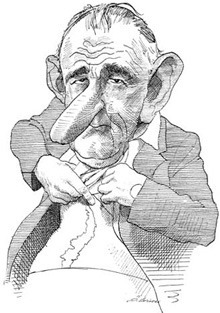
David Levine cartoon of LBJ, note also the long Pinocchio nose - symbolic of all the lies on Vietnam*
With the retrospect of history it is easy now to criticize U.S. involvement in Vietnam, but even so, it is all outlined in this book how all of this could have been avoided. During each year and month of the debacle plenty of warning signs went up time and again.
We are presented with each era of Presidential involvement – Kennedy, Johnson, and Nixon. The first two had advisors who urged restraint, non-involvement – who warned of a quagmire, of a corrupt South Vietnamese government, and of a dangerous slippery slope that would come with escalation.
With the Kennedy years came increasing interference in the South Vietnamese government that ended in the overthrow and then murder of Ngo Dinh Diem in early November 1963. There were 16,000 military personnel in Vietnam by the end of 1963.
It is with the Johnson years that real escalation began with over 500,000 troops by 1968. At this stage the war very sadly became a U.S. war (or as many said LBJ’s war). The U.S. effectively became the major opponent of North Vietnam, and the South Vietnamese government (if it can be called that) became a puppet of the U.S. It became an imperialistic war run from Washington DC. It started to dawn on many in government that this was all wrong.
Page 341 (my book) 1965
George Ball had marveled at the ingenious contortions of logic in his opponents arguments. He regarded McNamara and the Bundy brothers as gifted dialecticians who were arguing that the crumbling of the South Vietnamese government was not a signal to cut U.S. loses and get out but rather as proof that America must bomb the implacable North to strengthen the will of the corrupt South.
Page 449 Senator Fullbright in 1967 “Vietnam is ruining our domestic and our foreign policy. I will not support it any more.”
Page 446 Robert McNamara Defense Secretary 1967 “Corruption is widespread. Real government control is confined to enclaves. There is rot in the fabric.” “The picture of the world’s greatest superpower killing or seriously injuring 1,000 non-combatants a week, while trying to pound a tiny backward nation into submission on an issue whose merits are hotly disputed, is not a pretty one.”
As the author points out there was a disconnect between what was said to the public (all is well, we are winning) and what was said in private by some in government meetings (lets withdraw, the troop escalation is not working).
Nixon did finally pull out, but with all the sordidness and abandonment of allies that this entailed, making empty promises of military aid.
A number of issues stand out. Thankfully in a democratic society people were allowed to demonstrate against (or for) the war. This was done on a massive scale. I knew about the Buddhist monk, Thich Quang Duc, who self immolated himself with petrol in Saigon in 1963. I didn’t know that an American Quaker, Norman Morrison, did likewise in front of the Pentagon in 1965. Robert McNamara, Defense Secretary, saw the smoke from his fifth floor window.
The press, starting in 1965, brought the war to the U.S. and the world (to living room T.V. sets). It raised moral issues which were to be a constant over the next ten years.
Page 385 1965 On the soundtrack Morley Safer (CBS news) described the scene as a microcosm of the Vietnam War...television viewers could watch U.S. marines setting fire to the thatched roofs at Cam Ne. Safer said, “but to a Vietnamese peasant whose house meant a lifetime of back breaking labor, it will take more than Presidential promises to convince him that we are on his side.”
Nixon comes across as far more callous (almost amoral) compared to Johnson. Johnson was generally perturbed about his decisions to escalate the war – cross-questioning himself and his numerous advisors constantly. Why he chose that route remains a historical and psychological mystery – and a tragedy on an enormous scale. Nixon seemed to hardly care about the human toll that he caused by the continued bombing of North Vietnam and expanding into Laos and Cambodia. He called the anti-war demonstrators “bums”. This came back to haunt him; after the shootings by the National Guard at Kent State a father of a nineteen year old daughter, who was killed, said: “My daughter was not a bum”.
My Lai is brought up. We are told of the endurance and suffering of American POW’s in North Vietnam. There are detailed depictions of the personalities involved over the years – American, South and North Vietnamese. There is only a short paragraph about Agent Orange. There is nothing on drug use by American soldiers. I also felt the author painted a too saintly picture of Ho Chi Minh; but I don’t know enough of his history to gauge how accurate that is. Very sadly as the author points out, with the ending of the war in 1975 and re-unification, Vietnam deteriorated into a dictatorship with little in terms of civil liberties.
The author summarizes aptly in the closing paragraph that by 1975 Page 668 North Vietnam’s leaders deserved to win. South Vietnam’s leaders had deserved to lose. And America’s leaders, for thirty years, had failed the people of the North, the people of the South, and the people of the United States.
A lively, informative and very readable history of the war.
Langguth does cover the military aspects, but is mainly concerned with the politics of the war from all sides, and he does a good job putting the war into its global context, and in describing decisions made and how the situation in the South developed. He covers the disconnect between American policymakers’ public statements and their private doubts. He describes how ambivalent the Kennedy administration was, how Johnson announced decisions with a certain bravado but often expressed his doubts in private and questioned himself and his advisors, and how Nixon looked for an out that would leave his credibility intact.
The writing is rich and sober but also a little leisurely and somewhat bland at times. The narrative comes off as poorly organized. There is little analysis, and the book comes off as a bit episodic. The coverage of the war’s origins is a little hazy; there is little on the containment doctrine or on how the US got involved in the French war; the discussion of the Geneva conference could have been better. The coverage of the North and South Vietnamese perspectives is a bit sketchy. For some reason there is little coverage of the Saigon government during the North Vietnamese victory. Langguth also calls the 1973 American aerial bombardment of Cambodia “secret”; he seems to confuse it with Operation Menu, and he also ignores the congressional reaction. At one point Langguth writes that the "National Security Council" was intercepting Bui Diem's cables from Paris to Saigon, when he means the Agency.
A thorough, well-researched and well-written work.
I really give this a 3.5/5, but it's well-written for what it is, so I bumped it up to a 4/5. This book is a narrative history that gives a thorough account of every meeting and decision of major policy-makers for the Vietnam War. It covers the US role from the very beginning, when the Dulles Brothers convinced Eisenhower to hitch the US to Vietnam's wagon, to the fall of Saigon in 1975.
The writing of this book truly is a narrative history. This works both to its advantage and disadvantage. It works to its advantage because the narration is well-done. It's almost like the writers of West Wing writing about the drama of the Vietnam War. The issue, though, is that chapters don't end with a summary of everything we've learned or a reflection of what it all means. I eventually found it hard to get through simply because so much was covered, and no summary or reflection is ever given.
In terms of perspective, I was quite impressed by this book. The author is clearly a liberal, but everyone from conservatives to communists are given relatively fair portrayals with their motives clearly laid out and actions put in context. I came away with this book with a better understanding of many of the key players of the Vietnam War- or at least those whose names I remember, since there are so many people covered in this book.
The amount of information added here is incredibly thorough. If anything, it feels like some things could be trimmed. If I could do anything to change this book, it'd be adding summaries of events at the end of each chapter while also trimming down some of what's covered a bit. Sometimes it feels as if every single meeting about Vietnam ever is covered here, even when it's not particularly important or interesting.
Overall, I learned a lot from this book. Because of how little time for reflection or summary there is I don't think I'll retain a whole lot of specific if I'm being quite honest, but a lot of what I learned in a broader sense will likely stay with me. While this isn't an easy book to tackle, it was certainly informative.
This is an excellent overview of Vietnam before the US actually entered into what Hanoi saw as the third in a series of wars for the country's united independence.
Despite the title, it actually starts in 1960. From there, Langguth has a year-by-year take on the war. Each chapter, in addition to a year, has as its title the name(s) of one or two people key to that year.
I learned a lot about the post-Diem leaders and coups in Vietnam. Learned a fair amount more about the Buddhist monks' resistance. Learned somewhat more about just how much Saigon was infected with Hanoi moles.
In the US, I learned the most about the Bundy brothers, Ball and Rusk, followed by Ed Lansdale.
Rusk comes off as terrible in this book, eventually becoming nothing other than a calcified kidney stone blocking the passage of new ideas that might enhance peace talks. In his last two years in office, he did little other than appeal to LBJ's worst instincts on the war.
Bob McNamara gets fairly sympathetic treatment. Lansdale and Lodge get realistic treatment, as do the others and LBJ. Clark Clifford's heavy lifting on behalf of realism on Vietnam and trying to appeal to LBJ's better angels on peace get good discussion.
I think if you're into this genre, it is quite amazing. As for me, it's one of the best books I've read about the era that my parents and grandparents lived through, and the aftermath that my parents escaped from.
Being able to drop names of key players in this political mess that uprooted so many families globally, and devastated so many countless lives and sparking a huge anti-war/ anti-draft movement in America - allowed me to connect with my parents on a level I absolutely salivated for, in the language they know best and it taught me so much political vernacular in Vietnamese.
My parents have so many opinions on the matter. 'Oh that guy, you know he's your cousins uncle right?' ( as in my 1st cousin's dad's brother) 'Can you believe he was such a ruthless person on the VC side?'
My parents may not be able to articulate their thoughts in English as well as I do, but in Vietnamese, and discussing current events and recent history and political perspectives, they are superstars in my book, and this books helps me learn about their world in the language I know best.
Thoroughly researched probing examination of the origins, growth, and decline and end of the US political and military involvement in Vietnam. Well-rounded, including North Vietnamese perspectives and strategies (and their relations with communist China and the Soviet Union throughout); South Vietnamese politics, though the importance of these diminish over time as Washington and US ambassadors and embassy officers lose patience and faith in the will and capacities of South Vietnam’s government and military; the various embassy and military personnel in Saigon “advising” the South Vietnamese and their Washington counterparts in the White House and state and defense departments; the role of the US press in presenting a different story to the American public from that presented to presidents and relevant government agencies by the defense establishment; tensions between the US political/diplomatic and military perspectives, especially over the questions of bombing North Vietnam and widening the war to Laos and Cambodia and even China; US party politics and election-year politics of 1964, 1968, and 1972; and the growing US domestic discontent and unrest through the Johnson and Nixon years. With some exceptions, these areas are covered in far more depth than actual military operations, and despite the subtitle, the narrative really starts in 1960 with two chapters that introduce the newly elected Kennedy, Ho Chi Minh, and South Vietnamese president Ngo Dinh Diem and then proceeds year by year over 15 chapters through 1975; 520 pages cover the years through 1968, the turning-point year of the Tet offensive and Johnson’s withdrawal from the presidential race, while the remaining 1969-1975 years of “Vietnamization” under Nixon and Ford and the gradual US troop withdrawals and final evacuation of April 1975 are covered in 140 pages.
Starred Review in Booklist --https://www.booklistonline.com/Our-Vi... The Vietnam War was and still is, next to the Civil War, one of the most divisive wars in U.S. history. By looking at the key decision makers on both sides, Langguth chronicles why the outcome was inevitable. In the U.S., there was an outgoing beloved president who warned against a “military-industrial” complex that could influence foreign policy through costly investments in winless conflicts. It was a warning that went unheeded. Into office came a young president elected by the narrowest of margins who found himself deferring to the “wisdom” of elder statesmen, many of whom still retained the view of the U.S. as an invincible power. Finally, there was an old-line former Senate leader swept into the Oval Office because of an assassination’s bullet. On the other side, there was Ho Chi Minh, the quiet revolutionary, and Diem, a corrupt leader backed by the U.S., who handled his opposition by silencing them with such weapons as a resurrected guillotine. This book may be compared somewhat to David Halberstam’s The Best and the Brightest, but it is unique in its perspective of the major players on both sides and is reinforced by newly released documents and the interviews Langguth undertook to sort through detail by detail where everything went so wrong in our war, our Vietnam. — Marlene Chamberlain
Quite good, albeit on its own terms as an incredibly detailed, almost pointillist narrative history of the major phase of American involvement in Vietnam. Given sources, the US side is dealt with more thoroughly although a great deal of attention is given to the players, major and minor, in the north. The detail is almost overwhelming though and there is no attempt at wider analysis or even summary. The detail damns nearly every American policy maker, nearly none of whom performed creditably or honorably. It's hard to say whether delusion or dishonesty was the main motive - probably both.
Bought this book at our local Assistance League store for $2.50 with limited expectations. If I had paid full price I would still feel like it was a steal.
The comprehensive content and quality of writing places this book on my all time favorites list. What an education and valuable experience this read was.
A detailed account of the American involvement in the war (hence "our" war). I read it as we watched the Ken Burns series on Vietnam. Fifty years later we have learned so little.
Covers familiar ground in detail, using self-serving recollections of the politicians and professional government staffers to flesh it out. Done much better by others.
Mr Langguth comes through again with history that reads like fiction. The majority of this book, maybe 90-95%, consists of the politics behind the Vietnam story. The story is told mostly from the US and Vietnamese perspectives, but some Chinese and Russian input is added. There was much more going on than I was led to believe by the so-called "normal" history books.
When I was in Air Force basic training, they harped upon Operations Linebacker and Linebacker II. I was looking forward to reading more about both. But, sadly, the former wasn't even mentioned by name and the latter was only about a short paragraph. Those were defining moments for the Air Force.
My copy of this book, and I'm not sure if others are like this, contained text that was wavy across the page. Since it was such a long book I tried to ignore it. Some pages were fine but when it appeared it was distracting and annoying. Oh well, it is what it is and I'll read it again someday.
As far as a thorough and authoritative contextualization of the most commonly-known historical snapshots of the Vietnam War - Abbie Hoffman, the SDS, the Tet Offensive- Langguth is effective and knowledgeable. For a "graphic narrative", on the whole, his book is a miserable failure. It's bogged down in the knotty logistics of the political side of the war, to the utter omission of the actual experience of those on the battlefield. While that's not necessarily a detriment (especially given the glut of books dealing with that particular subject), it leaves a glaring hole in the narrative that involves a lot of questions unanswered. The bulk of this book is mere chronology, devoid of analysis or ramification. I slogged through a good bit of it without enjoying much of it. Not an essential read, and it certainly won't be my stopping point for Vietnam War history.
An excellent history of our involvement in Vietnam. However, this is not a light read - Langguth does an outstanding job of exploring the politics and policies around American involvement in Southeast Asia, but he is very thorough, so it is, at times, tedious. Nevertheless he explores the full story, beginning with the politics of peace at the end of WWII, continuing with the influence of the Red Scare as it contributed to the policies of American involvement in Vietnam. The sections on Kennedy and Johnson are particularly insightful and his research is both thorough and impeccable. This is not a book for someone who is interested in a leisurely read or a simple overview of Vietnam, but for those who want the complete picture, it does a remarkable job of exploring the "Our Vietnam."
What Langguth did so well in "Patriots" did not fly in this book. Perhaps it was an issue of trying to do too much? I found it incredibly difficult to keep up with the enormous number of personalities and again, while I realize the scope of the Vietnam War is enormous, the American Revolution wasn't exactly small fries and he did a great job with that. I'd rather he'd have focused on a few things and done that well than do a mediocre job attempting to cover everything in little bits. It's thorough and it covers a lot but I didn't exactly race to get through this one.
This is an excellent account of the Vietnam conflict from the time of Eisenhower through the end of US involvement. There are detailed accounts of all US presidents and their policies along with major advisers. Also quite interesting is the view of North Vietnam and the disagreements among the communist nations. The Paris peace talks initiated by Johnson and completed by Nixon/Kissinger. The B52 bombing raids and their futility. This is a good book to read today in order to (hopefully) save the US from making the same mistakes again. Unfortunately it's probably too late for that!
Another good book with details that never made the front page. More concern with the next election then the cost in human lives, wasted resources, personalities, poor judgement.....christ the list just goes on. LBJ was a real work of art talk about a political animal then Nixon and Kissager both fools to the end.
I got what I wanted - comprehensive overview of an atrocity. I learned a lot and feel better equipped to read more detailed, focused accounts of the separate events and personalities. This book reinforces one thing very well: the reality of this conflict is far worse than any of the fictional accounts I have encountered in books and movies.
Balanced, poignant,recommended. I remain fascinated with Viet Nam ,as the defining evnt of my youth and this book shows both sides, something new to me.