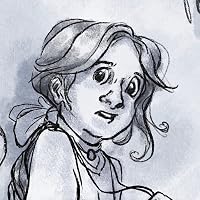
Born into a life of privilege in 1878, Lillian Moller Gilbreth put her pampered life aside for one of adventure and challenge. She and her husband, Frank, became efficiency experts by studying the actions of factory workers. They ran their home efficiently, too. When Frank suddenly died, Lillian was left to her own devices to raise their eleven children. Eventually, she was hired by the Brooklyn Borough Gas Company to improve kitchen design, which was only the beginning. Lillian Gilbreth was the subject of two movies (Cheaper by the Dozen and Belles on Their Toes), the first woman elected to the National Academy of Engineering, and the first female psychologist to have a U.S. postage stamp issued in her honor. A leading efficiency expert, she was also an industrial engineer, a psychologist, an author, a professor, and an inventor.
Monica Kulling was born in Vancouver, British Columbia. She received a BA in creative writing from the University of Victoria. Monica Kulling has published twenty-six fiction and nonfiction books for children, including picture books, poetry, and biographies. She is best known for introducing biography to children just learning to read and has written about Harriet Tubman, Houdini, Eleanor Roosevelt, and Amelia Earhart among others. Monica Kulling lives in Toronto, Canada.
Review for copy of hardcover book. This is an informative juvenile picture book biography celebrating the accomplishments of Lillian Gilbreath, the mother in the true story Cheaper by the Dozen. As a homemaker with 11 children, she applied her learning and creativity as an electrical engineer and psychologist to make home and commercial enterprises function more efficiently. By necessity she became a working mother in the workforce. Some of her innovations we still use today, but I don't want to spoil the discovery. The writing is staighforward and clear. The illustrations make this a beautful book.
It's hard to review this fairly. I've been in love with the Gilbreth family for years, ever since I found copies of Cheaper by the Dozen and Belles on Their Toes at the library's used book sale. The movies were delightful, too, and Myrna Loy is still the face of Lillian Gilbreth for me. So it's hard not to love this abbreviated tale of Lillian Gilbreth, who was a mom of 12 (one child passed away, which isn't addressed here), and a successful businesswoman. As a bonus, the illustrations seem to capture both the worry and the pride that must have made up much of Lillian's life.
In the end, I can't help but like anything that might draw attention to a fascinating woman and family.
Remember Cheaper by the Dozen? Belles on Their Toes? This illustrated story for children tells interesting facts about Lillian Gilbreth's life as the mother of this family after their father dies.
As efficiency experts, the Gilbreths worked together to improve the lives and condition of workers, while at the same time helping them get the most done in the least amount of time. When Frank died suddenly, Lillian discovered that many doors were closed to her as a woman, even though she had twenty years experience in the efficiency field.
At home, without the services of a cook, the Gilbreth children were learning to do the work in the kitchen, but they kept getting in each others' way. So Lillian turned her energies toward making a kitchen an efficient place to work. One of the ways she did it was by talking to 4000 women about what DIDN'T work in their kitchens. Then she worked on a new design. We have her to thank for the work triangle (she called it the circular approach) that arranged work surfaces in such a way that fewer steps were needed and all supplies were near at hand. She also invented an electric mixer and a trash can with a lid that opened when you stepped on the foot pedal. And those shelves in the refrigerator door that hold butter, eggs and milk? She invented those as well.
I had no idea how much we as women and cooks owed to Lillian Gilbreth. And this would be a great book to help children realize that as well.
I am actually grateful that I could not find this book through any inter-library loan and was forced to purchase my own copy. Lillian Gilbreth is such a mentor for a scatterbrain such as myself. I loved this biography of her life using the work she did making kitchens more efficient as the central theme. While this is the theme, the book really is a decent biography, given that it is a children's picture book. I recommend this one highly.
I’ve watched the movie and read the book Cheaper by the Dozen but this focuses more on Lillian’s achievements after her husband’s death. She had creative and innovative ideas which we can expect from a woman with eleven children. 😊
Again, I’m happy to read an interesting picture book biography.
This was a well done, if all too brief, biography of Lillian Gilbreth of Cheaper by the Dozen fame. This focused mostly on her career as an efficiency expert and psychologist which was fascinating. We have the efficient refrigerator door, with crannies for eggs, milk, etc thanks to Gilbreth. We also have the garbage can with a step on pedal thanks to her as well as other inventions. She also pioneered and continued methods of making the workplace more pleasant, with increased lighting, etc as a way of increasing efficiency. One thing in the book drove me to the internet: the author kept talking about ELEVEN children but surely there were twelve?? The most famous book and movie is called cheaper by the dozen after all. It turns out one child, the second oldest, died at age five. Considering the times, to only lose one child was really a bit of a miracle.
This is a nice introduction and hopefully might cause a few curious kids to pick up the novels. Likely more curious adults may pick up the biography if they recognize Gilbreth's name.
One of my childhood favorites was Cheaper by the Dozen. I read it countless times. But for some reason I never read the sequel, Belles on Their Toes. So I really enjoyed reading this and catching up with the Gilbreth family after the events of Cheaper by the Dozen. I had no idea that Lillian Gilbreth was the one who invented or improved so many things in the kitchen that we now take for granted. What a talented lady!
The best sort of non-fiction picture book, is the kind that makes you want to know more about the person or thing that the book is about. This book is one of those. I immediately had to look up Lillian Gilbreth to learn more about her. This book is well written.
A cute children's biography of Lillian Gilbreth. I had read both "Cheaper by the Dozen" and "Belles On Their Toes" but this book gave me a new perspective, however fleeting. I'd be interested in reading an adult-size biography.
A picture book bio of the woman who invented the electric mixer, storage area on refrigerator doors, the efficient kitchen and so much more. The Gilbreth's had 11 children. Mrs. Gilbreth was a master of efficiency and she and her husband established a company that taught other businesses how to be efficient. Their lives were fascinating.
This book however, falls flat. Even though the title, Spic and Span!: Lillian Gilbreth's wonder kitchen, leads readers to believe that the book is mostly about Gilbreth's revamping of American kitchens, it has little to do with that. In a book that is 30 pages reader's aren't introduced to Gilbreth's efficiency ideas until page 18. Less than 1/2 of the book is dedicated to her ideas and inventions. There is also a lack of further information. There's a short work at the end of the book speaking to Gilbreth's education and inventions. It also mentions that she was the topic of two films, Cheaper by the Dozen & Belles on Their Toes. However, the author fails to mention that both of these films were books first, by Mrs. Gilbreth's husband! Such a glaring oversight is inexcusable.
The title does a disservice to the extraordinary subject of Monica Kulling's otherwise inspiring children's picture book biography. A mother of thirteen children and an inventor of tools and processes we now take for granted, Lillian Gilbreth was, as Wikipedia states, "an American psychologist, industrial engineer, consultant, and educator who was an early pioneer in applying psychology to time-and-motion studies. She was described in the 1940s as 'a genius in the art of living.' Gilbreth, one of the first female engineers to earn a Ph.D., is considered to be the first industrial/organizational psychologist." Her family life also happens to be the basis for the film, Cheaper By The Dozen.
Spic and Span: Lillian Gilbreth’s Wonder Kitchen is an impressive condensed version of Lillian Gilbreth’s life and her accomplishments. I knew she did motion-studies for efficient working and shaped the kitchen layout, but I didn’t know that she also invented the foot pedal for bins, shelves for the refrigerator door, and automatic beaters / hand mixer. I liked the illustrations by David Parkins.
Loved that this book highlights Lilian Gilbreth's contributions to the Gilbreth family. I dearly love Cheaper by the Dozen but it is definitely more about Frank than Lillian. I also learned a lot more about Lillian and her inventions which I had not previously known. The illustration style is great and compliments the text wonderfully.
This would be a good book to read to introduce engineering. Everyone at our STEM school knows that engineers build and design, but talking about different kinds of engineering like the ergonomic engineering featured in this book is a more amorphous concept for them. This would be a fabulous way to introduce it.
Great book to read in 15-20 minutes. I am thinking that my grandchildren would enjoy this. It is wonderful that it focuses on the accomplishments of a woman in a world that is predominantly male oriented! It would make a great book to share with girls to show that girls can do hard things and make a difference too!
This is the true story of Lilian Gilbreth who was a very smart woman and the mother of 11 children. She and her husband were efficiency experts and after her husband's sudden death Lillian was faced with financial stress. She decided to continue on the work she and her husband had been doing. Lillian also got into designing and organizing efficient kitchens, and designed some kitchen items that we now take for granted. Very interesting story and beautifully illustrated.
Another solid read from the Great Ideas series (and I believe this is the last of them for me, I'm fairly certain I made it through all the rest). This is a great introduction to the life and works of Lillian Gilbreth, although I do wish at times it had been a bit more filled out. The illustrations were charming.
A thorough and readable biography with captivating illustrations. Lillian Gilbreth, the mother in Cheaper By the Dozen, was a fascinating person, scientific pioneer, and businesswoman. While this picture book has no backmatter, it is full of her highpoints, accomplishments, and inventions. well worth reading and sharing.
A very important living book exploring the extraordinary life of Lillian Gilbreth, her immense challenges and incredible multiple inventions. This is an incredible woman more of people should know about!
Such an inspiring story and this picture book tells it well. I don’t love the title because it’s hard to remember, and this book deserves to be memorable.
WONDERFUL book! I learned many things about Lillian Gilbreth I did not know. The illustrations by David Parkins, a favorite illustrator, are fantastic.
SPIC-AND-SPAN!: LILLIAN GILBERT’S WONDER KITCHEN by Monica Kulling tells the inspiring true story of an ingenious woman who used creativity and perseverance to succeed. From factory assembly lines to kitchen layouts, Lillian Gilbreth spent her life looking for ways to make everyday tasks more efficient. The mother of eleven children, she applied what she learned at home to inventions and ideas that everyone could use.
Monica Kulling’s narrative skillfully weaves useful facts into a fascinating story, while David Parkins’ appealing illustrations match perfectly with the tone of this informational reading experience.
SPIC-AND-SPAN is Monica Kulling’s latest addition to her popular “Great Idea” series featuring the lives of inventors and their inventions. Use the books in a literature circle focusing on informational reading, biography, and inventions.
Unfortunately, children aren’t likely to pick up this book on their own. Teachers librarians will need to think of creative ways to market SPIC-AND-SPAN with children. Consider ways to connect the book with other science and engineering books. Or, focus on the biographical elements and connect them with other books about people. This would be a wonderful book to feature during Women’s History Month. Build a display focusing on woman engineers.
There are some excellent websites focusing on the life of Lillian Gilbreth. Develop an activity that asks students to compare the book to information they find on the web about this exceptional woman. Talk to children about comparing three different sources of information.
Monica Kulling’s Great Idea Series is one of my favorite nonfiction series for young readers. The books showcase inventors, some more known than others, and how they were inspired to create their inventions that, in many ways, changed the course of history. For example, It’s a Snap: George Eastman’s First Photograph tells the story how Eastman invented the photograph, and thus ushered in the new age of documenting history as well as the advent of ‘selfies.’ Going Up: Elisha Otis’s Trip to the Top depicts the founding of the elevator, allowing skyscrapers to literally touch the sky. And one of my favorites, the award-winning In the Bag: Margaret Knight Wraps It Up , about the young inventor of the folded paper bag who eventually owned over twenty patents.
Monica’s newest edition to the series is Spic-And-Span: Lillian Gilbreth’s Wonder Kitchen. This book follows the amazing story of Lillian Gilbreth, the inspiration for the matriarch in the movie and book, Cheaper By The Dozen. Her life is so much more amazing than a movie or a book, however. When her husband dies unexpectedly, Lillian forges ahead to raise her children alone. An efficiency expert, industrial engineer and psychologist, Lillian’s designs and inventions are still considered fundamental to contemporary kitchens eighty years later.
Monica excels at taking a moment in history, oftentimes a forgotten moment, and fashioning a story that is both compelling and informative. Her poetic narrative makes the book the perfect read aloud.
How did I not know about Lillian Gilbreth when the results of her work affect much of my waking hours. From the layout of my kitchen, to a number of appliances that I regularly use, she has made my life easier and undoubtedly safer. Her work on improving the ease and efficiency of assembly lines made the work easier, faster and safer for employees.
Lillian didn't just use her engineering and psychology skills in her job, but she employed them in running her household. With eleven children, she found it the only way to mange.
Author Monica Kulling has brought Lillian Gilbreth to life for me. She has presented a lot of information in bite size pieces that will appeal to the school age readers. I think that this book would most appeal to ages 8 - 12. It will also be of interest to adult readers, though it might leave them wanting to know more detail about Lillian and her works. I also recommend it to all young women considering a career in engineering.
This book, along with the others in the series, would be a great addition to any classroom library. Teachers could use it as a launching point for several discussions including: what do engineers do, types of jobs available, roles of women in the workplace, what in your house would you change to make life better...
The book is fully illustrated by David Parkins. His artwork depicts life in the early 1900's, at the time when Lillian was working.
The title of the book gives the impression that this is a book of efficiency in the kitchen. Spic-And-Span does eventually lead up to this aspect of Lillian Gilbreth’s career later in the book. But, it felt like it took a bit of time to get to the crux of the title. Perhaps, if the title of the book could have been different, then the disappointment I felt trying to connect the title with the story, would have been lessened. Nonetheless, I actually found Lillian Gilbreth’s story more fascinating towards the start of the book, where the writing felt rhythmic, engaging and informative. The latter half of the book felt a bit rushed, albeit, it’s clear that there was a lot to cover in Lillian Gilbreth’s life. A fan of poetic prose, I was expecting more of a rhyming poetic narrative (the way the book started off on the first page)...especially since I was aware that Monica Kulling is a poet. Luckily, illustrations by David Parkins keep the book super engaging and is a great informative read for the younger ones.