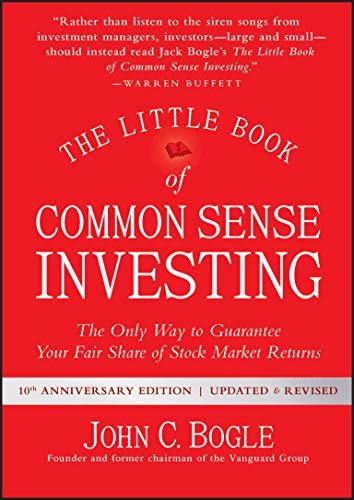
John Clifton "Jack" Bogle (born May 8, 1929) is the founder and retired CEO of The Vanguard Group. He is known for his 1999 book Common Sense on Mutual Funds: New Imperatives for the Intelligent Investor, which became a bestseller and is considered a classic. More on http://en.wikipedia.org/wiki/John_C._...
7/10. Extremely repetitive, both in isolation and considering I had just read “Winning the Loser’s Game”, which talks about the exact same stuff. Emphasizes that 90% of MFs, both active equity and active fixed income funds, underperform their benchmark indexes. Goes on for 300 pages about the superiority of indexing and inferiority of active management
Explains investment return vs speculative return, which comprise market return. Since 1900, market return has been 9.5% per year.
Of the 9.5%… 4.6% has come from earnings growth 4.4% from dividend yield 0.5% from PE expansion
In the long run, speculative return is almost nothing, but it drastically sways the decade to decade returns. Decades most affected by speculative returns:
The ONLY book of common sense investing, as agreed upon by the highest authorities of academia. You can try to fight against the herd, but the herd always wins
Straight and to the point. Logic-oriented steps that break down investing and sum it up into an easy to understand takeaway: use index funds. Specifically, total stock market index funds that track the S&P 500. Bogle breaks down the reasoning for not trying to speculate or use other people's speculation (fund managers) to manage your money. The more managerial/fund fees you incur the more returns you are missing out on. Instead, opt for a traditional index fund, set it and forget it, and watch your money grow.
At the end of the book he also goes over a few asset allocation principles and how people should frame their decision around risk tolerance as well as briefly discussing how social security plays a role in things for retirees.
All-in-all, a great read for anyone new to investing or if you need a concise reminder of how to stay on track.
If you know the four things below, you don’t need to read this book. This is pretty much the only thing it says, over and over and over and over.
1. Long term investing is where it’s at. 2. Index funds are where it’s at. 3. Paying fees to fund managers and financial planners bite into your returns. 4. Broker fees are going to eat into your returns too.
tldr: invest in something that mimics the whole market as closely as possible, like an index fund, and do it without having to pay someone else to manage it. And then don't touch it for 20 years and you will make more money than you would have if you messed around with it.
There, I saved you hours of reading.
You’re welcome.
“But don’t just trust me…” trust this guy from Harvard who is also going to tell you the same thing I just told you for the 12th time.
"Another confession: I have over 3,000 books in my library.
A friend once asked me: “What’s the best investment book you own?”
I walked to a shelf, pulled off this little book, and handed it to him.
Why is this better than the hundreds of other finance books I have?
Because it nails everything you need to know about investing, and you can read it in three beers. And, if you grasp its simple but powerful message, you’ll never get screwed over by the financial industry again.
Warren Buffett called Bogle “a hero to millions of investors”. He was right. I’ve lost count of how many copies I’ve given away over the years. This Christmas, I’ll be giving away more. "
I've read this book multiple times. It is an easy and straightforward read. It's a good read for people who have learned some of the basics of finance but are scared to invest money. It makes investing super straightforward, to the point that there are fewer things easier than investing; it's harder to make coffee than it is to manage your own finances after you read this. You literally cannot lose if you follow this.
Straightforward, easy to read investment advice that stands the test of time. The book provides concrete examples (with data and graphs) of what to do and what not to do with your money to ensure you get the best returns possible. The only thing it lacked which I wish it had was a glossary of all the investment terms and definitions.
Stole my husbands book on this one. This takes the cake for the most I’ve had to research while reading a book. He went down some rabbit holes with detailed terminology that I had to research, but overall really strong sound advice.
Net net - Invest early & stay invested, keep costs as low as possible, and let long term compounding do the work.
This entire review has been hidden because of spoilers.
Short book and easy to read. I am so glad that what i am doing is very similar to what the book suggests. I will recommend the book to my son when he grows up. It is a little hard for people without much financial literacy to read it. But luckily, the main idea is simple and easy to understand: Invest low cost index funds early!
Perfect guide for "DIY investors". Helps to explain index investing and why it is stronger than the alternatives. Its a pretty quick read, so I'd highly recommend if you're unsure about investing strategies.
Everyone is buying ETFs and most probably don't understand why. This book explains the ideas and principles behind steady low-risk investment for long-term rewards.