

What do you think?
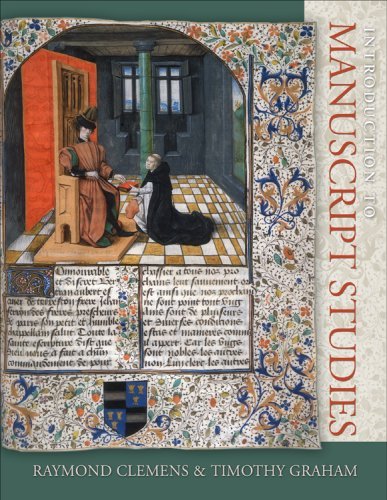
Introduction to Manuscript Studies
This book provides an orientation to the field of medieval manuscript studies. It will be of help to students in history, art history, literature, and religious studies who are encountering medieval manuscripts for the first time, while also appealing to advanced scholars and general readers interested in the history of the book before the age of print. Every chapter in this guidebook features numerous color plates that exemplify each aspect described in the text and are drawn primarily from the collections of the Newberry Library in Chicago and the Parker Library of Corpus Christi College, Cambridge.
301 pages, Hardcover
First published December 1, 2007
Ratings & Reviews
Friends & Following
Create a free account to discover what your friends think of this book!
Community Reviews
Displaying 1 - 22 of 22 reviews
June 28, 2024
Avoided middle section (on reading and working with actual manuscripts) except for the chapter on scripts, but part one and three (on the processes etc. of creating a manuscript; on the most common genres of manuscript) are highly entertaining/informative for a lay person. The relative laxness of in-line citation is notable, but not an issue. A very fun find in the university library!

Read
December 29, 2023Specific to Medieval manuscripts (not my usual expertise). It was easy for me to follow and featured so many invaluable visual references. Assisted my research immensely.

July 19, 2010
Everything you need to know to get started in manuscript studies. Includes lots of beautiful illustrations/photographs.

May 9, 2017
Perhaps this is the best introduction to the study of medieval manuscripts and palaeography......

October 12, 2018
Beautiful book. I'm not a paleographer, just an interested layperson, and I felt I learned a lot. The reproductions are stunning.
But I have no idea how it stands up from an academic standpoint
But I have no idea how it stands up from an academic standpoint

November 23, 2021
I’ve used this volume for reference over the years - mainly to check abbreviations and editorial marks - but as it is on the preparatory reading list for a course I’m attending tomorrow, I thought I had better read it through.
It may seem odd not to have done so before, but my obstacle has been purely physical - I prefer to read on my sofa or in bed, and the size of this book (larger than A4 and a floppy paperback) makes it too big to read in comfort anywhere but at a table.
That really is my only criticism. The content (albeit slightly older now) is excellent and concise, with clear examples and beautiful illustrations. I will continue to recommend it to anyone new to the topic, and will look forward to seeing how our course leader tomorrow expands on its themes.
It may seem odd not to have done so before, but my obstacle has been purely physical - I prefer to read on my sofa or in bed, and the size of this book (larger than A4 and a floppy paperback) makes it too big to read in comfort anywhere but at a table.
That really is my only criticism. The content (albeit slightly older now) is excellent and concise, with clear examples and beautiful illustrations. I will continue to recommend it to anyone new to the topic, and will look forward to seeing how our course leader tomorrow expands on its themes.

August 24, 2022
I’ve used this volume for reference over the years - mainly to check abbreviations and editorial marks - but as it is on the preparatory reading list for a course I’m attending tomorrow, I thought I had better read it through.
It may seem odd not to have done so before, but my obstacle has been purely physical - I prefer to read on my sofa or in bed, and the size of this book (larger than A4 and a floppy paperback) makes it too big to read in comfort anywhere but at a table.
That really is my only criticism. The content (albeit slightly older now) is excellent and concise, with clear examples and beautiful illustrations. I will continue to recommend it to anyone new to the topic, and will look forward to seeing how our course leader tomorrow expands on its themes.
It may seem odd not to have done so before, but my obstacle has been purely physical - I prefer to read on my sofa or in bed, and the size of this book (larger than A4 and a floppy paperback) makes it too big to read in comfort anywhere but at a table.
That really is my only criticism. The content (albeit slightly older now) is excellent and concise, with clear examples and beautiful illustrations. I will continue to recommend it to anyone new to the topic, and will look forward to seeing how our course leader tomorrow expands on its themes.

September 23, 2023
This book offers an in-depth and well illustrated introduction to manuscript studies. It’s written in such a way that interested lay-persons can easily follow along before jumping into the rabbit holes of associated fields of study. It’s a great primer and is well indexed.

August 27, 2024
I read this for Art of the Medieval Book in Fall ‘24.

December 24, 2024
Great writing for a textbook, and incredibly informative. This is probably the best compilation of basic information about manuscripts that you will find.
July 18, 2025
For an introductory book on the subject, it excels. I found it to be very thorough, discussing all relevant aspects of manuscript studies and very well illustrated.

Read
November 12, 2025Textbook like on the topic.
Has lots of nice images, a large number 70+% are from the Newberry library making it a nice reference for some of the books available there.
Has lots of nice images, a large number 70+% are from the Newberry library making it a nice reference for some of the books available there.

July 4, 2019
An academic text which serves as an introduction to the intricacies of Medieval manuscript studies, this book is well worth the read - if that’s something that interests you.
The first part is about the implements of the trade - including the parchment, pens, inks, gold, etc.
The remainder goes into detail on the manuscripts themselves - their provenance, scripts, illuminations, and the interpretation of partially damaged books.
The first part is about the implements of the trade - including the parchment, pens, inks, gold, etc.
The remainder goes into detail on the manuscripts themselves - their provenance, scripts, illuminations, and the interpretation of partially damaged books.

May 7, 2018
It was a joy to read this textbook in which everything was done so splendidly well—ample illustrations all properly laid out on the page and treated in the adjacent text; clear and accessible explanations of everything that needed to be explained; notes, glossaries, bibliographies, lists, and appendices containing all the information one could possibly require; and most of all the delightfully generous tone of the authors, who have sympathy and knowledge of their subject and display no condescension towards medieval ways of thinking and believing. The tone of the text is thorough and matter-of-fact, safe in the assurance that the subject matter, with such personages as the monk Notker the Stammerer and the note-taker known as the Tremulous Hand, could never be dull. One of the most mind-blowing parts of the book for me was the discussion of the medieval systems of reckoning dates—kalends, ides, and nones, oh my! I had never considered the wild evolutions that have preceded our own far-from-perfect, and dare I say far from final, dating system.

February 25, 2008
I'm still working my way through the scripts, but I've seen enough to know that this book should be put into the hands of anyone who wants to work on medieval literature. This books is incredibly learned and accessible.

Read
September 24, 2015An excellent overview about working with primary texts, Clemens and Graham introduce us to codicology, the making of medieval books, punctuation and glosses, selected scripts, and typical medieval genres. Great introduction.

September 16, 2013
A superb introdction to manuscript studies. There is so much I have learned from this. Most definitely worth the read and it shows how this world came to be.

August 22, 2020
Textbook for Rare Books and Manuscripts class (Fall 2020)

February 24, 2021
Saviour of my Masters <3

November 28, 2025
good overview but the title is a little deceptive because it only talks about Latin manuscripts.

April 3, 2018
This is an excellent overview of the methodology behind the scholarly study of medieval Latin manuscripts. It is divided into three parts. Part one focuses on the process of how manuscripts were created. After a brief examination of different possible materials, the text focuses on the production of parchment manuscripts since that was the most common material. The process is masterfully elaborated on from the skinning of the animal to the binding of the book. Along the way, the authors add other details, such as the process of ink production and methods of correction.
Part two shifts to the modern study of manuscripts to give a rundown of the principles for newcomers. Basic principles about how to handle manuscripts and set up appointments are discussed. A brief discussion on the challenging nature of deciphering different punctuations and scripts highlights the complexity of this field. Furthermore, the authors include different ways manuscripts may be damaged throughout the ages and how these and other factors can be utilized to assess the provenance and origin of a document.
The final part gives an insightful and helpful overview of some of the common genres of medieval manuscripts. This covers religious and liturgical texts, Books of Hours, charters, maps, and scrolls. Part three gives much detail in the form of examples, which a reader doesn’t necessarily need to remember, but will certainly be helpful in providing a general idea of each of these genres.
Although this book, with its in-depth explanations and multitude of illustrations, makes for an interesting read, its real value lies in its potential as a reference. The bibliography is particularly extensive and is helpfully divided up thematically so that a scholar can easily find other sources on every topic covered here from parchment production to scholarly articles on specifics scripts. Likewise, the main text would be useful for anyone looking for a quick explanation on any aspect of these manuscripts or the study of them.
Part two shifts to the modern study of manuscripts to give a rundown of the principles for newcomers. Basic principles about how to handle manuscripts and set up appointments are discussed. A brief discussion on the challenging nature of deciphering different punctuations and scripts highlights the complexity of this field. Furthermore, the authors include different ways manuscripts may be damaged throughout the ages and how these and other factors can be utilized to assess the provenance and origin of a document.
The final part gives an insightful and helpful overview of some of the common genres of medieval manuscripts. This covers religious and liturgical texts, Books of Hours, charters, maps, and scrolls. Part three gives much detail in the form of examples, which a reader doesn’t necessarily need to remember, but will certainly be helpful in providing a general idea of each of these genres.
Although this book, with its in-depth explanations and multitude of illustrations, makes for an interesting read, its real value lies in its potential as a reference. The bibliography is particularly extensive and is helpfully divided up thematically so that a scholar can easily find other sources on every topic covered here from parchment production to scholarly articles on specifics scripts. Likewise, the main text would be useful for anyone looking for a quick explanation on any aspect of these manuscripts or the study of them.
Displaying 1 - 22 of 22 reviews