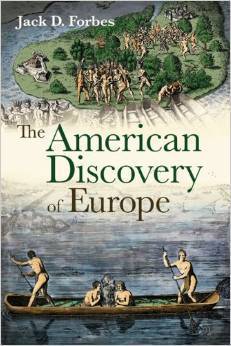
Celebrated American Indian thinker Jack D. Forbes’s Columbus and Other Cannibals was one of the founding texts of the anticivilization movement when it was first published in 1978. His history of terrorism, genocide, and ecocide told from a Native American point of view has inspired America’s most influential activists for decades. Frighteningly, his radical critique of the modern "civilized" lifestyle is more relevant now than ever before.Identifying the Western compulsion to consume the earth as a sickness, Forbes "Brutality knows no boundaries. Greed knows no limits. Perversion knows no borders. . . . These characteristics all push towards an extreme, always moving forward once the initial infection sets in. . . . This is the disease of the consuming of other creatures’ lives and possessions. I call it cannibalism."This updated edition includes a new chapter by the author.
Jack D. Forbes was a Native-American writer, scholar and political activist. He is best known for his book, Columbus and Other Cannibals, which has become a primary text of the Anti-civilization Movement.
UPDATE As I have been listening to speeches by native Americans (a propos the polemic Dakota pipeline) this book is timely. From these speeches I took some clarifying (state-of-things) phrases: "we are the majority" (reds and blacks); "[ongoing] concentration camps for Indians"; and the "Catholic Church" should review the "doctrine of discovery". Inflamed speeches, I would say, with the word "WETIKO". Oh, one of the speakers said Khadafy is "still alive". WOW.
2nd November 2016
(Jack D. Forbes)
A very good psychological/anthropological study of the ways native American Indians saw their different, unique culture being clashed with (and in part destroyed by) a sadistic, materialistic and imperialist European one; white-Christian culture. It's Nature-reverence values versus the white-civilization.
The major thesis of Forbes is that Columbus was a wétiko*. He was mentally ill or insane. He was the carrier of a terribly contagious psychological disease: the 'wétiko' psychosis.
Though I disagree with this view (Columbus had a tough time finding his way to the New World and had to deal with disease and mutiny in his trips; he had previously searched for sponsors and finally found the Spain's monarchs'...and he had to deliver, to show results; even when old, he'd got incarcerated and had his titles and riches withdrawn), I think it's worth the reading.
Those coming next to Columbus surely lacked an ecological approach or an "environmental sensitivity". Voraciousness and lack of respect for Nature was the hallmark of the Civilization that, meanwhile, thrived immensely in America.
Forbes wonders at why celebrating Columbus Day? -no reason for, because Columbus enslaved native Indians (it is said that he participated in shipping thousands to Europe and Africa) for profit reasons.
A well-documented book quoting the rituals and mores of several tribes. All in all, it was a good Native Philosophy: "walking the pollen path"...or "the red road": to live life in a sacred manner. But things turned out to be different.
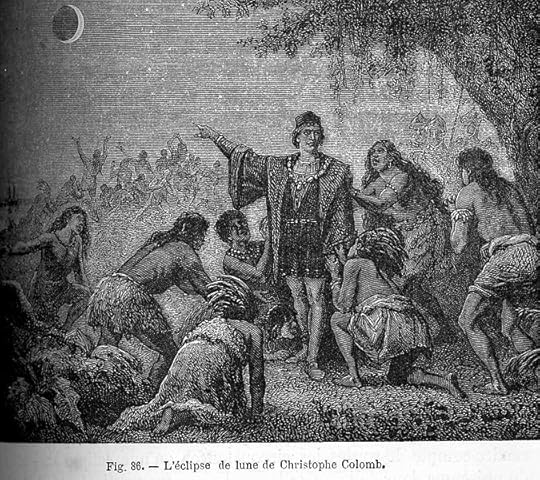
Columbus never reached the United States in "When America was a Brown Woman"
*from Wiki, a Cree word literally meaning cannibal.
Wetiko is a disease of aggression against living things. Killing your future, killing your planet, is the mark of a cannibal. Modern education has little to do with ethics, with stopping the murder of the planet. Natives Americans were taught that all things alive come from the same parent. And so, plants, animals and trees killed are thanked, or asked for permission; respect is behind the relationship. You can’t intentionally be an asshole and then get forgiven fast by a man dressed up in women’s clothing, as with Christianity. What you do to others is who you are. And so, Columbus was a wetiko, mentally ill, insane for enslaving those who were guilty only of generosity and empathy. Fear of the “wild” which provides for you, means fear of something greater than yourself. Wetiko is a Cree term meaning cannibal, one who terrorizes other creatures. Such cannibalism is “raw consumption for profit.” Seeking to become the owners of everything. Before Columbus, “Inuit captives were taken to Norway in ca. 1420 and their watercrafts were on display in a Norwegian cathedral for years.” Native Americans also reached Europe before Columbus. We get taught in school about Hitler while hearing zero about the damage done by the British Empire (India and beyond) during centuries of ruthless domination, and zero that Hitler was openly inspired by US racial laws and its Reservations and extermination of the Native Americans. The point is that we can’t keep letting Wetikos define our history for us. Civilization appears to mean the willingness to use large scale extreme violence to achieve one’s ends against all tribal people, while fantasizing that the world and all nature exists only as our slaves. “Wetiko historians despise those who fought for freedom.” John Smith told the Powatans of Virginia, that “we just need a little land to build a place to trade with you.” And, what was slavery but cannibalism?
Wetiko society is so venal that it must be filled with the military and militant policemen telling everyone what to do. Rather than encourage goodness, such a system literally dares people to step out of line which profits the circular system. John Sutter and Father Juniper Serra were both flaming wetikos. San Francisco’s lovely Sutter Street is named after a pedophile rapist and murderer, while Serra over saw the deaths of more than 40,000 under his charge. Serving as an example for imperialism and exploitation. What a laudable goal. Being both a predator and a cannibal; that’s wetiko. The singer Buffy Sainte-Marie told us that “the whites carry the greed disease.” Might makes right. Wetiko arrogance.
If you think you are just one member of a huge family of living creatures, you will have respect for others. This leads to respect for the hopes and dreams of others. Each rock and plant has a spirit. Lack of respect for things growing, leads to the Wetiko disease which “ultimately involves the de-sanctification of all living things”. “Both Indians and trees must be civilized – that is, turned into stumps.” Tribal reflections: Why are classes of people collectively ever referred to insultingly as kinds of animals or vermin? Why do wetikos use sexual terms as intentional symbols of cheap alienating debasement? Why replace basic ethics with “the profit motive, the will to power, and self-interest”? The wetiko replaces the Sermon on the Mount with profit making, deceiving, being material, saving and hoarding, making food less nutritious, taking from earth and giving back nothing, killing whenever, arrogant whenever, living the life of a sociopath thanks to a Christian God who conveniently forgives all crimes for the asking – a get-out-of-jail-moral-free card. Wetiko can also be seen before capitalism began and can be seen with the famines of Stalin and Mao. Paul Levy writes that wetiko exists within each person and each person must decide whether to feed it or not. US soldiers calmly committing atrocities against Native women and children fed wetiko. Rubber tappers working 500,000 to 1,000,000 men of the Brazilian “sertao” to death in only ten years, also fed their wetiko profit “uber alles” selves.
Recognizing no rules of warfare [besides being the motto of the United States since Jeffrey Amherst, in 1763, intentionally gave Native Americans smallpox ridden blankets] is another obvious wetiko sign. We were taught as kids to recoil at the thought of primitive cultures committing human sacrifice, but never to recoil at the infinitely larger daily sacrifice of innocent people and species going extinct daily to keep the grinding totally non-sustainable wetiko machine alive with its endless wars bent on consuming the entire planet. The wetiko notion of hierarchy is “a form of physical and psychological terrorism”. An 1885 History of California states of the natives, “all were equally stupid and brutish”. All. “Such propaganda kills” by justifying “the genocidal policies of past governments” and well as provide racist fodder for students, to keep wetikos away from non-wetiko “contamination”. Wetiko flourishes in overpopulation. Here are the three kinds of organized crime: State-approved, state-tolerated, and state-prohibited. The Dawes Act was state approved organized crime. So was the taking of slaves by the British, Portuguese, Spanish, and Dutch empires. When you give unfair advantages to the rich, that’s organized crime, as is exempting corporations. Slavery and Indian removal didn’t benefit the working class, it led to exaggerated class differences. Today’s wetiko learns to be a hustler. Get ahead of other people. Such a mentality means great museums today filled with stolen artifacts taken from those considered “the other”. This sickness values a violent society that brings us wealth acquisition by taking it from outsiders and have nots. Such greed means the wetiko beast can and must devour all. In the meantime, Christians keep on killing Jesus; Hiroshima and Nagasaki were calvaries (just like Christ’s Calvary) according to the chaplain of the US bombing crews, Father George Zabelka. Lame Deer said we turned dark skinned Jesus into a “Fuller Brush salesman”.
Native Americans didn’t need fancy churches which shut out the natural world while ignoring the greater cathedral, that is nature itself. Pyramids and temple mounds still bound humans to the earth. “The wetikos want people to box up their religion in buildings where it can be isolated from the rest of life.” Clergy consolidated great power by “controlling the use of the little boxes where that which is ‘sacred’ is stored away”. Beautiful imagery from Jack. Black churches work because it’s not about the preacher – it’s about the preacher and the community. But Jack also wants Black Christians to not be dominated only by “the theology of their European oppressors”. Jack sees Liberation Theology as the way for Christianity to leave Wetiko City and get back to tribal thinking. Paolo Friere in his Pedagogy of the oppressed wanted us to develop a “critical consciousness” and see the dehumanization at the bottom of all oppression. “To adjust to a wetiko society is to become insane.” “Native teachers recognized that men had to be cured of the spiritual sickness before they can build a just society.” We should “emphasize non-possessiveness and humility” and “talk to the plants and to the earth”. Wetiko can’t stand there being a mystery to the real world, while Native People delight in it. Cesar Chavez said, “To be a man is to suffer for others.”
This great book (1979) is known as one of the earliest Anti-Civilization books, written well before Daniel Quinn, Derrick Jensen and James C. Scott. It reminds you that Native Americans have been talking against Western Civilization for centuries while the rest of us have been brought up in the denial zone, unable to see past the wetiko frame which is killing the planet.
The first half felt somewhat repetitive. I saw it referred to as a "manifesto" and I think that is the right word (with a manifesto being "a written statement declaring publicly the intentions, motives, or views of its issuer" according to Merriam-Webster).
For me, this book contained quite a few eye-opening ideas and new thoughts. I have a few questions but, on the whole, I cannot disagree with what he posits. I will be thinking about this one for a long time and hope I become a better human because of it.
I really appreciate the overall direction of the book as an anticolonial critique but it’s endorsement of pacifism really dissuaded me. I believe Forbes is far too hesitant over violent radicalism toward liberation than he should be. His narration almost felt like the opposite of Fanon’s in “Wretched of the Earth” at points. I also felt that the book tried to cover too much - pretty much everything since Ancient Egypt - and that left it feeling really ahistorical at points when he made strong equivalences between individuals, cultures, and states separated by thousands of years. Although I am not well-informed enough in global history to be certain, I also felt that some of Forbes’s accounts of the Middle East and China tangled with orientalist narratives that flatten the regions as culturally uniform.
The occasional gender essentialism, overpopulation fears, and certain aspects of the sexual moralism further struck me as off-putting, and Forbes did not critique the axioms of European liberalism or humanism to the same degree as say, Charles Mills in “The Racial Contract.”
Last, while the idea at the core of the book, wétiko, a symbolic Cree term meaning “cannibal” or one who commits terrible acts, offered fascinating inroads into indigenous philosophy, I am somewhat concerned that Forbes’s application of wétiko as a psychological pathology unintentionally relativizes, for example, “modern” (post-1450 or so) imperialism or settler-colonialism with ancient empires that far pre-dated the economic and social dynamics of the former.
I believe that focusing on the relation between wétiko within a Western imperialist context would had made the book much more focused, as Forbes had less than 200 pages to work with.
I will mark this book as read, but I will return to it and read a portion of the book later on, but why I will not continue reading it for now is the same reason as "Lake like a mirror" it had been far too emotionally draining, to discover all of that terrible terrible reality, which IS sadly a reality and is for thw most part inevitable. For days I were to have the thoughts and ideas sprout in my brain and turn into forests of confusion, irritation and helplessness, but I want to be hopeful. Hopeful for a better reality and a better future. But I am not saying that I will ignore the truth and reality, just I prefer to dowse off for a little bit more, for a few more minutes, until maybe reality changes or I am strong enough to accept it as is. Thanks you Jack Forbes. This has been my most favorite non-fiction book of 2020, as it has shown me so much and has made me fall in love with non-fiction work, which I hope to read more of in 2021.
Five stars because I'm not sure any other book has altered my thinking about so much in the last year. His description of Wetiko Disease -- a disease of greed and exploitation that our society (and most of the world) has been infected with for centuries -- has hooked lots of other new thinking. It's given me language to dive into other aspects of history.
I will not finish this book this time. It reads kind of like a manifesto. But it reads fairly easy, and it's short, so if you want to remind yourself what's wrong with people, go ahead and read it. But I can sum up what I gathered from it:
Western civilization has grown and prospered entirely by exploiting other human beings. That sucks. It's like a disease - it affects people of all levels of wealth. Indigenous people aren't like this.
I would recommend Ishmael by Daniel Quinn if you like this book.
Awesome book. The insanity of ecocide, war, imperialism, colonialism, patriarchy and greed finally makes sense to me. The true gem of this book is the last two chapters.
Makes some compelling points about the prevailing sickness of humankind, and how it is spread and enforced by societies already rife with it. The several chapters near the end are particularly compelling, as they deal with what the author sees as a path forward. Ends with a beautiful poem.
[review originally written for Razorcake magazine]
An early text that inspired the start of the anti-civilization movement, this short book first published in 1978 lays out Jack Forbes' philosophy of what he calls the wétiko, or cannibal, psychosis. Wétiko is a Cree term referring to a cannibal, or 'an evil person or spirit who terrorizes other creatures by means of terrible evil acts, including cannibalism.' Forbes, a professor emeritus and former chair of Native American Studies at University of California-Davis, proposes that many human beings have suffered for several thousand years from this psychosis and its subsequent effects have directly caused countless imperialistic acts, wars, and other violent episodes. Writing from a Native American perspective, Forbes maintains a steady, even-handed and humble tone throughout the text, systematically describing an entire history of atrocities against chiefly innocent people, most of whom were indigenous to their geographical location. Within this historical review, perhaps most insightful are his explorations of terrorism and organized crime (including state-approved, state-tolerated, and state-prohibited varieties).
Having read other writers who have covered similar territory, including Derrick Jensen (who wrote the foreword for this edition) and Howard Zinn, I was familiar with much of Forbes' subject matter. It's the kind of history one doesn't need to read twice to grasp its meaning. Forbes uses the majority of the book, thirteen out of fifteen chapters, to provide examples of wétiko behavior in different contexts at various points in history. I can see how in 1978 the history that Forbes presents could've sparked the beginning of a movement. Frankly, however, revisiting such negative material as I read, with no accompanying answers in sight, left me feeling drained and experiencing difficulty finishing the book. There is only so much much one can read before the brain starts pleading for answers on how to stop this murderous madness. Finally, in the last two chapters, Forbes relents and draws eloquent parallels between Buddhism and Native American philosophy to present a viable alternative to the wétiko lifestyle.
I think it's crucial that people read books like this. I have no idea what percentage of Americans, for example, have never thought about either the genocide that cleared the way for the founding of their country or the continuing violence around the world that sustains our society as it stands today. When I look around me and see the way people live, though, I suspect the percentage is rather high. I like to think that if they were aware, people would make attempts to alter their lifestyles accordingly. As Indian philosopher Jiddu Krishnamurti once stated, 'It is no measure of health to be well adjusted to a profoundly sick society.' Similarly, Jack Forbes tells us that 'to adjust to a wétiko society is to become insane.' The more people who refuse to adjust then, the better chance there is of reversing the damage being done to both the Earth and its inhabitants.
I love the thesis of this book, that modern civilization represents a sick psychosis that infects all of its victims with a greed for power and domination. It's an important point and I agree with it wholeheartedly. An especially poignant aspect of this "illness" is that it infects even the people that it destroys (the poor or otherwise downtrodden), making them into wetiko-wannabes who jump at the first chance to oppress their weaker neighbor, rather than uniting with a common spirit of the exploited to create a better life for everyone.
Unfortunately, that's about all the substance Forbes provides here, and the rest is just examples and slightly different angles of examining the same phenomenon. It comes across as fluff and lost my interest after a while. All of the chapters blend together and I wasn't even sure how Forbes was able to distinguish one from the other in writing it -- the subject seemed exactly the same throughout. A brief survey of the chapter titles corroborates this feeling. Out of 14 chapters, nine of them have the following titles:
Consuming Another's Life: The Wetiko Cannibal Psychosis Columbus: Cannibal and Hero of Genocide Deception Brutality, and Greed: The Spread of the Disease The Structure of the Cannibal's Insanity: Arrogance, Lust, and Materialism Becoming a Predator: The Process of Corruption The Matchi Syndrome: Fascination with Evil Colonialism, Europeanization, and the Destruction of Native Cultures Savages, Free People, and the Loss of Freedom Terrorism: A Frequent Aspect of Wetiko Behavior
All of these talk about the same thing, with slightly different emphasis. As a result, the book started out promising but lost me about halfway through. He does make a good point in the last chapter on the interconnectedness of us all. I particularly like the creativity of the statement that we can live without our bodies, but we can't live without the earth/environment (i.e. air, water and heat). Good stuff, just wish there had been more of it.
This is my second time reading this great book by Indigenous American author Jack Forbes. The book is about "Wetiko." This is a concept that is hard for me to summarize (hence why you read the book), but in a nutshell, it is a disease, in a very real sense of the word, that is the cause of the true evilness in society.
If you assume that humans are born good and if they were to grow up in a "good" society and no one ever mentioned demons or devils or evil things, such as torturing other people, slavery, etc., then they would grow up never conjuring up such images on their own, and thus never live in such an evil way. There is no natural fear of a "hell" and the Devil unless you learn it from good Christians using fear to convert you.
This is how indigenous people, including Native Americans, have lived for ages when Europeans came. But Europeans, along with Christianity, brought the Wetiko disease with them, which justified the slavery, slaughter, and genocide of millions of indigenous people, all for shiny metals. And just like a disease, it spreads. Soon, indigenous and mixed people were doing the evil deeds of their Wetiko-infested masters, becoming soldiers and killing their own people, as continues to be done in places like Central America.
Paiute author Sarah Winnemucca Hopkins in her book Life Among the Paiutes, mentions this also, how her people never feared such things until Christians taught them about it... thus spread the Wetiko disease along with smallpox and genocide.
The list goes on, but this book is one of the most required books I can recommend if you want to understand why the world is the way it is... and it doesn't have to be this way!
Written by Native American thinker Jack Forbes, Columbus and other Cannibals is a short and straightforward expression of the idea, familiar to me from Derrick Jensen's writings, that civilized cultures are inherently mentally ill. Forbes calls this illness the "Wetiko" psychosis and attributes to it all the kinds of "cannibalism" prevalent in our culture. Cannibalism, briefly defined, is any kind of literal or metaphorical consumption of the life of another to gain their energy, etc. This cannibalism is broadly applicable. As Forbes says, "The rape of a woman, the rape of a land, and the rape of a people, they are all the same. And they are the same as the rape of the earth, the rape of the rivers, the rape of the forest, the rape of the air, the rape of the animals." All these "rapes" are attributable to the cannibal psychosis.
He also points out that "wetikos do not eat other humans only in a symbolic sense. The deaths of tens of millions of Jews, Slavs, etc, at the hands of the Nazis, the deaths of tens of millions of blacks in slavery days, the deaths of up to 30 million or more Indians in the 1500s, the terribly short lifespans of Mexican farm workers in Texas and of Indians generally today, the high death rates in the early industrial centers among factory workers, and so on, all clearly attest to the fact that the wealthy and exploitative literally consume the lives of those that they exploit."
"That, I would affirm, is truly and literally cannibalism, and it is cannibalism accompanied by no spiritually meaningful ceremony or ritual. It is simply raw consumption for profit, carried out often in an ugly and brutal manner. There is no respect for a peon whose life is being eaten. No ceremony. No mystical communication. Only self-serving consumption."
Columbus and other Cannibals is a bite-sized version of the idea that our culture is inherently violent, exploitative, and oppression. It is rather simple-minded at times (Forbes asserts that resistors to the dominant culture are not victims of this psychosis despite having been socialized into it), but I think the idea has a lot of truth to it and is extremely interesting. That said, Forbes does very little to "prove" his assertion. Jensen probably does a better job. Forbes states the idea more succinctly, however.
Professor Forbes book just might be the most important book you will ever read. If you want to understand how and why our world is on the brink of destruction, this book is for you.
unexpectedly mixed bag on this one! on the whole there's a lot of great ideas and philosophy to chew on but every so often when applying said ideas to real-world examples, it can almost get weirdly reactionary, especially about sex/sexuality, gender, "overpopulation," etc. (memorably: "bed hopping with alcoholic women," or the "sado-masochistic train [...] sometimes in homosexual and even heterosexual intimate behavior"...ok. what did this add exactly)
i also really struggled with the decision to conceive of wetiko-ness/cannibalism as a mental illness. i'm not sure what use it does to pathologize exploitation of power and disregard for the sanctity of other beings' lives? maybe it's meant to be an implicit critique of how the institution of mental health (tm) is weaponized against people who don't fit in the confines of "wetiko" society--the black student getting hit with a diagnosis of ODD, the young woman taken in for a lobotomy. maybe it's meant to shock or just convey that this is not the healthy state of humanity. i don't know, but my kneejerk reaction here isn't overly into adding further stigma to mental illness. i'd be really interested in forbes having a conversation with someone well-versed in ableism along these lines.
a number of times forbes also refers to the wetiko disease being contagious--which does work in certain contexts he cites, such as colonizers violently disrupting the sociological structure and balance of the indigenous populations. but he remarks at one point that the wetiko disease started in egypt/the middle east and spread from there, and also that it wasn't present in the americas until europe brought it. which like--firstly, pinning the figurative patient zero in the middle east is orientalist as hell and definitely plays into anti-arab racist stereotypes. and secondly, it completely discounts the fact that empires and exploitation did exist in the americas pre-1492. the aztecs, for example, couldn't have "caught" it from spain. people got power, people abused power--couldn't the contagion mutate into the world in multiple places, like the inverse of the different cradles of civilization?
(it's stuff like this that makes me wish this book narrowed its focus--it doesn't have to address every way the wetiko disease manifests in the world, and the extra space could be used to allow for further nuance to close up some of these gaps.)
and this next issue isn't necessarily forbes' fault since the book was last updated in 2008, but it sure is something to be in 2024 reading him propose to palestinians (and also maya activists in central america, among others) to do the equivalent of the great march of return--the thought being that if the oppressors did kill protestors that they'd be so horrified at their own actions that it would effect a change. you can't predict 100% when things won't age well but but sometimes you can make a safe guess.
anyway--outlining some of the issues that've eaten at me over the last few days isn't me saying it's not worth a read. it is! it's just also worth having a critical dialogue with, like anything.
A very coherent and well researched thesis. While I found myself disagreeing with the somewhat rosey representation of nature/anti civilisation I also have to admit that a good 95% of what Forbes puts forward in Columbus and Other Cannibals is worth its weight in gold. Forbes, toward the end of the book, puts forward that there is nothing sinister or evil about nature on our planet, which dismisses by omission human botflies, malaria, jiggers which burrow into the feet of children and grow under the skin crippling them so they can not walk etc. The Great Mystery is more than butterflies and berry bushes, it's horrible things too. As several throw away comments in the novel, Forbes also puts 'prostitutes' in with 'murderers, hustlers, exploiters, cannibals, big oil execs ect'. This rubbed me the wrong way, personally, as I would think that prostitution is a byproduct of the "wetiko disease" that he describes and less a cause of it. It's my understanding that this book was originally published some time ago, with a few new pieces added in for reprinting and freshness, so maybe the author's view of sex in general is outdated. To suggest that a sex worker is just as evil as a multi-billion dollar oil baron is misogynistic. Forbes doesn't differentiate between sex traffickers and the victims unless you count his use of the word 'pimp' in that context, but even then every instance of condemnation of pimps is always followed by prostitutes, in this book.
Either way it was an enrapturing read, I was at a Cree sundance pledge meeting and the sundance chief recommended us a book called "Dispelling Wetiko", when I looked into it I found that it was a response to "Columbus and Other Cannibals." So I opted to read this book before starting that one.
This book speaks about differences between cultures of Native Americans and Wetiko based European predatory greedy materialistic civilization.
Animals do not show unnecessary cruelty or greed. Native Americans considered Earth as our mother and all beings our brothers and sisters. Everything alive is sacred to them. Therefore, they only kill a living being in case of strong need and talk to a plant or animals they are killing, in order to eat them or make clothes out of them, to apologize for hurting them and to thank them. This veneration of all life is quite different life philosophy from the one that modern civilization cultivates. Modern civilization is about greed and gluttony, killing for thrill, and exploiting other’s lives without remorse. Native Americans have no word for religion. Religion is what we are and what we do.
European “civilization” has committed unimaginable atrocities all over Asia, Africa and Americas. Ironically they referred to the natives they exploited and killed as “savages” and “barbarians”. Author uses term Wetiko of Native Americans as an explanation of spirit behind these atrocities.
Wetiko means cannibal. It is evil person or spirit who terrorizes other creatures by means of terrible evil acts. Cannibalism is here seen as consuming other’s life and consuming their land and resources for own private purpose or profit. Slave owner is an example of such cannibalism. Wealthy industrial exploiting his workers is another example. Nazism and conquering of Americas are also examples. The spread of Wetiko disease of exploiting and destroying others corresponds to what Europeans call “civilization”.
Wetikos somehow believe that they have the right to use another person and its resources in ways that are disadvantageous to the victim. Wetiko personality is about arrogance, greed, lust, inordinate ambition, materialism, opportunism, lack of honesty, deceit. They believe that “might makes right”.
In Wetiko societies there is a hierarchy in which each social class seeks to exploit the one bellow it. To be a man, to Wetiko people is to be oppressor. Wetiko disease also spreads by resisting Wetiko oppressors in Wetiko way that is by violence.
Humility in Wetiko society is fake as it is based on fear from more powerful and not of knowing own place in the Universe and respect for all beings as his relatives. Wetiko people think they can cheat God the way they cheat other people. After sinful life they repent and believe all is well.
Before doing anything one must be aware why is he doing that. Being good is in intention not just in deeds. It is also in the way one feels about other beings. Native Americans have a sense of kinship with all living beings. This respect is humanizing and gives them love for all beings. They know that man’s heart cut from nature becomes hard and that lack of respect for living growing beings leads to losing respect for humans as well.
European civilization based on Judeo-Christian roots de-sanctifies nature and people and spiritual world and everything that was considered holy and sacred by natives and projects evil on non-Christians. It considers all people sinful and guilty by birth and makes evil view of Creator as angry being who punishes souls forever in afterlife. It makes sexuality something sinful and establishes a link between sexuality and aggression. It sees the forest and nature as pagan and evil. There is also unhealthy fascination with imagined horror stories about negative spiritual beings and practices. Another derivative of installing guilt for inherited sin and for demonizing other forms of spirituality is obsession with punishment and thus also with sadomasochistic behavior.
Wetiko is a culture obsessed with materialism. Even when it proclaims faith it is materialistic by striving to build monumental churches and forgetting to establish highest importance of love for all beings. Wetiko notion of religion is that it should be boxed in church buildings and unrelated to the rest of life.
I would say that Wetiko is a culture that hates life, so it destroys it and in that way cuts the branch on which it is sitting. In my opinion Wetiko is not just opportunistic materialistic greedy life philosophy. It is backed by a spiritual force known to Christians as demonic presence. Christianity, that was supposed to be resistance to Wetiko, was from its very start overtaken, assimilated and misused by Wetiko forces. Christianity is turned into formalized set of rituals, and separated from its main idea of being love and spreading love as an antidote to Wetiko possesion. Sadly, love is just a word used by Christians and not lived in everyday life. It has turned into being obedient and formally good in order to get to heaven and avoid hell. In reality one is only as good as he has love for other beings inside him.
Colonialist systems seek to create Wetikos in oppressed population in order to create hierarchy of opposed groups so that their state is managed without bringing much external force. Oppressed masses feel inferior to ruling invader class and those of mixed origin and de-nativized go to great lengths to become closer to ruling class. When conquered people are reduced to state of poverty and despair some of them start to believe that their survival depends on cooperation with exploiters. They start doing small steps like becoming Christian, stopping with native way of living, becoming part of local police forces. Later they become obsessed with greed and wish to have high status, to be a part of European civilization and they become dishonest and corrupt and start to despise the natives from whom they origin. They become Wetikos.
Europeanization of natives typically introduces concepts of male dominance and authoritarian family structure. Subjugation of woman and treating them like objects and slaves is part of Wetiko culture. That is not strange because in Wetiko culture everyone who lacks physical or material power is abused and exploited. The law of Wetiko civilized is the law of stronger. The rise of patriarchal societies corresponds to the rise of Wetiko civilization. Wetiko disease of spirit takes us down the path of no heart.
“It is not the concrete, material results of one’s life that are important, for all such things can be destroyed, lost, or dissipated rapidly. It is rather the quality of our acts, of our struggle, of our motives, of our love, of our perseverance which are truly significant”
This is eye opening book about the egoistic and materialistic disease of our western civilization. Highly recommended reading.
Too preachy! I tried to get through this as the subject is fascinating, but the author spends most of this time standing on a soapbox and complaining instead of proving information about the Native American beliefs.
I read this back in 2017 and it was part of my introduction to the term Wetiko. This is a crucial book in helping to gain knowledge on the criminal side of humans and how the Americas were developed.
Forbes’ work has been noted in many of the books on Native American history and culture which I have read in recent years. When I found that Columbus and Other Cannibals was readily available via the Internet Archive, I decided to read it because access to public libraries is more limited and somewhat risky in today's world of the corona virus pandemic.
The author explained that ‘wetiko’ is a term from the Cree language denoting a person who terrorizes other people by engaging in terrible or evil actions, including cannibalism. By cannibalism he meant that the EuroAmericans consumed (exploited and/or killed) the lives of Native Americans, as well as African Americans, for their own personal purposes and/or profit. Over the course of slightly more than 200 pages of narrative text he demonstrated where, how, and why this took place in the Americas from the time of the first arrivals of the Europeans in the late 16th century up through the 20th century.
Quotes from such primary sources as Columbus and other so called explorers, Catholic missionaries, Native American folklore and mythology, and well known Native American spiritual leaders like Luther Standing Bear and Black Elk were integrated into the narrative in a manner which provided an organized and textured argument. For those readers who like to check on an author’s sources these are carefully delineated in the text along with 8 pages of notes at the end of the book. There is also a bibliography that is 8 pages long.
Despite these strengths CaOC has some flaws. First, if anything the number and length of the quotations made it slow going at times. Second, the later chapters in the 2008 edition of the book which I read discussed how wetiko has still operated in late 20th and early 21st century more generally in American foreign and economic policies. I found this to be unrelated to Native American issues and also redundant.....so much so that I skimmed much of the last 30 pages or so of the book. Third, Forbes made only the briefest allusions to the impact that wetiko had on the natural environment of the Native American world of the 17th, 18th, and 19th centuries. By the time of CaOC’s last revision in 2008 climate change, etc was not a novel idea any longer. It would have been more effective if he had noted this more clearly in the book.
IMHO, CaOC would make an informative introductory text for those who have not done much reading in Native American Studies. I would also recommend it for someone wanting to read what became a foundational set of arguments that subsequent scholars in the field have relied and elaborated on. For example, I can see how CaOC influenced the arguments put forward by Roxanne Dunbar-Ortiz in An Indigenous Peoples History of the United States.
This a bit of a whirlwind of a book, so here are some thoughts in list form.
Before reading know, -Forbes doesn't care about being palatable. If you are palm colored, it's quite likely at least one thing in here will offend you. Try to work past that and see the bigger picture. -There's a lot of frank discussion of some terrible topics, and a few quotes shared from truly disturbing works. TW's for sexual assault, general violence, torture, genocide, racism, et. all that comes with colonialism. It kicks off really early in the book, so make sure you're ready to be uncomfortable from the getgo.
General thoughts, -A lot of Forbes' general point very much resonates with me. I think it's very reasonable to call a people who commit genocide proverbially for breakfast "insane" and unwell. I think Forbes is really quick to throw out his personal opinion about the specifics, though, and I wish there was more supporting material to go with it. Not because I necessarily thing he's wrong, but I'd like to know what helped him see it the way that he does. But, also, I suppose to an extent it's because I don't 100% agree with him and want to know more. -There's a pretty big implied emphasis on the power of language, demonstrated by Forbes using Indigenous terms where possible instead of the ones colonizers use - except when it comes to the Romani people? I'm super confused on that oversight. I also think he throws around some terms in general that mean something to him that I'm not really sure are common usages, like the word "pimp." In general there was a lowkey consistent theme of calling something out as problematic/harmful, but doing it kind of sloppily, such that it frequently came off more as his personal musings rather than a well thought out argument. (Maybe that's his goal, though, I don't know.) -I think this is really really good material for white folks and particularly Christians to grapple with. The legacy of harm that exists in our communities needs to be faced, and even if you disagree with Forbes on a lot, reading this and grappling with his statements would be a good exercise in self evaluation.
Wetiko- a cannabalistic, parasitic and ultimately self destructive mindset
Historically, it referred to a person who becomes spiritually diseased by consuming the lives of others, driven bt an insatiable hunger that overrides empathy, reason or balance. This becomes expanded into a metaphor for societies and institutions that systematically exploit people and the land. In his view, when culture elevates greed, conquest and personal domination into virtues, it creates collective pathology. It doesn't just inflict individuals, but becomes embedded into political systems, economic structures and ideologies.
Columbus is presented not as a heroic explorer but an example for wetiko behavior. The voyages of conquest uneased a pattern of enslavement, genocide and exploitation that became a foundation of European colonialism in the Americas. He symbolizes a mindset shaped by entitlement, religious zealotry and willingness to rationalize terror for wealth. It manifested slave trade, destruction of Indigenous cultures, military interventions and industrial capitalism. It is a worldview that sees living beings as objects to be consumed. Much of what has been taught as civilization or progress is built on patterns of violence, deceit and domination.
Forbes contrasts this with Indigenous worldviews centered on balance, stewardship and interdependence. The crisis of modernity is not politicak or economic, but spiritual. Healing requires rejecting the wetiko mindset and recovering ethical frameworks rooted in responsibility, humility and respect for all forms of life. Recognizing the nature of the problem is the beginning of transformation. Having awareness, compassion and integrity, to challenge systems that normalize exploitation and reclaim ways of living that honor interconnection rather than consumption.
One of the most important books you can read. Jack fluidly and brilliantly describes the structure, the spread, the behavior of the cannibal class, the consumers of human souls and lives.
I'm reminded of a ruling from the Council of Vienne in 1311 on the topic: " By their statutes, sometimes confirmed by oath, they not only grant that usury may be demanded and paid, but deliberately compel debtors to pay it. By these statutes they impose heavy burdens on those claiming the return of usurious payments, employing also various pretexts and ingenious frauds to hinder the return." ... "Furthermore, since money-lenders for the most part enter into usurious contracts so frequently with secrecy and guile that they can be convicted only with difficulty, we decree that they be compelled by ecclesiastical censure to open their account books, when there is question of usury."
The wealthy and powerful in our society stick to their false and manipulative narratives as if we can't see through their lies. If you consider your soul to be the you behind your eyes, then a corporation that takes almost all of what you produce and pays you just enough to keep coming back (if you're one of the lucky ones), taking your entire life from you, is consuming a large fraction of your time and energy on this planet, it is eating your soul. I find Jack's straightforward statement of what is to be incredibly refreshing.
The one area I would disagree is that he asserts that the wetiko illness originates in materialist perspectives, but I have seen powerful wetiko deploying idealist worldviews and behaviors. I think the causes, origins, and true nature of the wetiko disease are more complex than any of us have a complete story for.
I happened to be reading this at the same time as We Will Be Jaguars: A Memoir of My People, which provided a lot of evidence for the argument this book makes. (I liked that one more although this is better at showing the pattern across history and location.) This book is a manifesto - short but still often repetitive and strident. The detailed history of Columbus and other examples of exploitation was helpful for me as someone whose public school education glossed over many of those topics. I found some of the arguments wanting, however, like some of the gender essentialism and the unexplored implications of defining the exploitation of others as a communicable disease. I think it is worth reading because it does force a privileged reader such as myself to confront hard truths; it's a good start but a little incomplete on its own.
Absolutely worth buying and reading slowly for its lessons to sink in. The gist of wetiko disease is the rampant, callous exploitation of people and nature for personal gain, excessive materialism, gluttony, greed, and lack of concern for the rights of others. It is so prevalent in all aspects of modern society that we can hardly comprehend it is an insane way to live. The thirst and hunger for more of everything that can never truly satisfy us, because wetikos are insatiable, can never get enough, but never stop trying.
Is there a way to stop this from completely destroying the planet? I suppose we must try, one person at a time seeing the light...
I read this book based mostly on Derick Jensen's endorsement. Was thoroughly disappointed. Though I sympathize greatly with Forbes basic premise, the delivery of his argument leaves much to be desired. Not a well written book. And, I think Forbe's comes dangerously close to embracing a lot of classic "noble savage" tropes throughout.
Favorite part about this book was the ample excerpts from Black Hawk and other Native Americans historical figures.
Sadly, this is one of those books I couldn't wait to finish only because I really wanted to read something else.
Forbes provides a thought provoking critique of the civilized worldview as the root of imperialism, exploitation and the patriarchy. In the last two chapters, the weakness of his critique becomes evident: because the author addresses civilization as a spiritual illness, his proposal is to fight it by searching spiritual enlightment. The propositive chapters do not engage with native and non-native movements fighting against modern civilization.