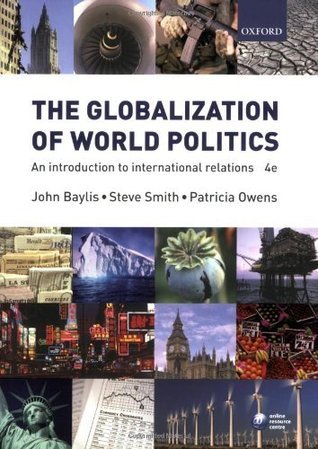
Now in its fourth edition, this internationally successful text has been fully revised and updated in light of recent developments in world politics, with new chapters on the changing nature of war, human security, and international ethics. A comprehensive introduction to international relations, it is ideally suited to students coming to the subject for the first time. It provides a coherent, accessible, and lively account of the globalization of world politics.
FEATURES * Contains work from an impressive line-up of international contributors who are experts in their fields; the chapters have been carefully edited in order to ensure an integrated and coherent style throughout the book * Covers history, theory, structures and processes, and international issues * Offers a visually stunning 4-color interior * Enhanced by a comprehensive Companion Website (www.oup.com/uk/orc/bin/9780199297771/) that includes a test bank, PowerPoint slides, case studies, multiple-choice questions, links to journal articles, a flashcard glossary, and--new to this edition--video clips, video pod-casts of contributors, and a news feed
NEW TO THIS EDITION * Three new chapters on the changing nature of war, human security, and international ethics * Each chapter includes a 400-word case study * More examples from the developing world
Everybody knows what an important book this is for the student of International Relations and it is considered one of the basic texts for all the right reasons. Giving one a glimpse of the evolution of the international system over the ages to explaining nearly all the relevant phenomenon through the lens of different theoretical paradigms, it keeps the much celebrated "globalization" central to its discussions. Specific chapters have been written by well known authors of the field and ever since my first meeting with this book last year, I've enjoyed reading it every time I've picked it up.
I bought the fifth edition for myself and was overwhelmed by the beauty of its colourful and glazed paper and attractive design. However, my only complain is that in the course of widening its scope, the new edition seems to have cut down on the depth of the analysis previous editions offered ( an example is the chapter on World history from 1900-1990). This compromise of depth in favour of breadth means that the book remains only a starting point, albeit, a thoroughly engaging, up-to-date and relevant one! This also enables it to be a book that would be accessible to both students of I.R. along with a person who may not belong to the academic field but may be intrigued by International Relations nevertheless.
Note : The sheer beauty of the book along with the ease of reading it makes it one of my most prized possessions :)
This textbook is a must for any International Relations student. As a newbie, it gives us the basic structure that we can use to comprehend the basics of IR, as well as the contemporary issues at hand.
One of my professors said that the book was so good, as each chapter was written by a renowned scholar of that field, that he fears students might just use that textbook for references and ideas.
The book has a useful glossary, questions at the end of chapters, further readings, colourful texts and photos, and for each sub-chapter, a review. I have been writing notes and underlining texts on this book.
My only concern that as a 2nd year student, while it has proved very useful for qualifying year, now it seems that what they talk about - to depth and width - is lacking. Say if I was to write about the issue of nationalism, this textbook will quickly give me the basics, but nothing more. I would have to go to JSTOR and other journals to get the more specific information which our paper requires. The textbook is great for beginners, and as the title of the book mentions, it is an introduction merely. I am happy to have read most of the book from cover to cover.
Year 1 done: Even if some people disappeared from my life after freshers week, the Globalisation of World Politics remained loyal throughout the year, let’s go IR year two!!!🤝
This book is highly dense; it covers everything and then some. It is also, I would say, a successful attempt to explain its topics from the more relevant perspectives. The editors' definition of relevance in this case made sure that we got a measured diversity. I find this reference similar to this one, but I found the former to be more digestible. Again, I take into account that I used this book for coursework rather than purely for reading. There were significant updates in the edition, notably mentions of the Trump administration.
I managed a PDF copy of the 2020 edition, which was technically perfect for my purposes. Compared to another dense main course reference this semester, I didn't notice any spelling- or grammar-related discrepancies in this one, if there were any at all.
está regular bastante más pesado que el de goldstein porque no tiene ejemplos ni vainas aunque los primeros capítulos sobre las tradiciones de pensamiento son mejores y más teóricos que el manual de goldstein no lo volvería a leer
4.5/5. A nice and gripping starter to theories of Internstional Relations. The books is divided into three sections. The first section traces the evolution of current international orders glancing through the prevailing systems in world history. It is supplemented by the theoretical tools used to understand the approaches towards the subject. The second sections deals with various actors and their roles in the larger game of international politics. I specially enjoyed the chapter on war and feminist approaches. The final section comprises of prevalent global challenges and issues faced by the international community. Ranging from poverty, security, environment, nuclear proliferation and terrorism, the authors provides interesting insights into the problems with many perspective.
Additional case studies and boxes help to test and track the understanding of concepts. Every chapter concludes with analyzing the theme with respect of globalization. The content of book is sheer justice to the title and reputation of the book. I deducted 0.5 because I still have a few chapters to finish (as the ones on international regime and private actors are too dry, factual and boring...)
This is the textbook I chose for my upcoming intro to IR course, which I'm teaching for the first time. So it'll be listed as "reading" for at least the next three months...
First, let's talk about what John Baylis' "The Globalization of World Politics" is: a sweeping, relatively comprehensive overview of the field of International Relations. With five chapters on world history, another 7 on the major theoretical schools of IR, and then another 15+ chapters on various topics of importance such as international ethics, modern warfare, peacekeeping and diplomacy, international political economy, and others. Suffice to say, GWP is a massive, sprawling look at just about all the major topics in contemporary IR.
That being said, the depth of each topic necessarily can't be more than an overview, and while this may suffice for an "Intro to IR" course, it won't leave you with much beyond that. In addition to that, the strength of each chapter varies wildly; while I found his chapters on realism, constructivism, and Marxism pretty descriptive, sections like those about the impact of post-colonialism or feminism were largely lacking. However, Baylis wins points for having 5-15 "Further Reading" suggestions at the end of each chapter and topic, which serve as a basic jumping-off point for motivated students. He also includes a rather excellent Glossary at the end of the text, which prepares readers with precisely the kind of vocabulary needed to navigate a field as academic as international relations.
Baylis also takes an approach largely agnostic from bias; while you can tell based on his attention to detail about certain topics where his expertise lies, he also largely avoids the very common trap of completely neglecting heterodox schools of thought or uncomfortable facts about popular perspectives. Perhaps this is due to his European academic heritage. All I know is, I was genuinely surprised to find an entire section about Antonio Gramsci's contributions to IR written without bias-- this is something you'd never find from a professor at, say, the University of Texas, and I found it incredibly refreshing. Ditto for Baylis' asides on the spread and growth of economic inequality as a side effect of globalization and interdependence, for another example. Really one of the strongest aspects of the book.
"The Globalization of World Politics" suffers from the misfortune of trying to introduce students to a gigantic and relevant field of study, and while it mostly accomplishes the goal, it can't possibly get all the way. I don't hold it against Baylis, because this effort is sure the best one I've come across so far, but it is what it is. If you're looking for an exhaustive, 2000-page tome that covers every aspect of IR in depth, I'm not sure it exists. But for an educating and interesting introduction? GWP has you covered in spades.
I rarely read text books cover-to-cover, but I did so with this one. I appreciated the natural progression of the work--from discussing theories of international politics and questioning the very existence of globalization, to addressing factual matters such as the functioning of the UN and other international actors and discussing world problems seen daily in periodicals.
I found that the authors presented a fair-minded analysis of each subject in an intelligent, comprehensible way and almost always struck a great balance between educating and informing the reader about the issues, viewpoints, etc. while letting the reader comes to his/her own conclusions where points of view may differ among the experts.
Finally, I like this book as it provides a wealth of additional information to guide the student. From a detailed glossary and index at the back of the book to multiple summaries of chapter subsections and carefully-crafted annotated bibliographies for further exploration at the end of each chapter, this book left me with a wealth of further reading suggestions and easy ways to come back to it for reference.
It is a very academic book, and I do not mean that in a good way. It is very focused on semantics, interpretation, representation and the study of the study of IR. It does not give much practical information. A lot of the information given is very general, basic and simple. Sometimes outright false. It could be useful for someone who is young and does not even follow the news, but personally it did not bring me any information. I only read half of it before I stopped.
I finished The Globalization of World Politics, and it was a solid introductory read.
It gives a clear overview of the basics; what’s what in international relation; without going too deep or overwhelming the reader. I appreciated that it also points you toward more in-depth readings, which makes it useful as a starting point rather than an endpoint.
Not the most exciting read, but that’s expected from a textbook. It does its job well.
Should be 3.5 to be honest. Finished this textbook in 1 month! Such a laborious journey. The book did a good job as a textbook! But it is also a testimonial for why noone wants to read textbook. Sentences are like 10 line long, which makes readers go through the same passage again and again. I wonder is there any way to make international relations an interesting topic?!!
Read many of its chapters over the last couple of years. It helped me a lot in my concept making related to the subject, especially the theories of world politics. I will recommend it to those who have interest in the subject of world politics and world politics.
This is - and deserves to be - one of the most popular textbooks on international relations in the globalised era. It has good historical context and thorough accounts of the various theoretical approaches, both of which are genuinely enjoyable to read.
So many subjects, loved the linkage and the way of going from the general to the specific to representing all that is happening in world politics till 21 chap.