Jump to ratings and reviews
Rate this book

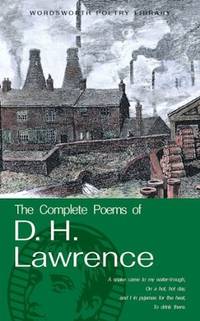
The Wordsworth Poetry Library

The Poetry of D.H. Lawrence

Rate this book

DH Lawrence – An Introduction. For many of us DH Lawrence was a schoolboy hero. Who can forget sniggering in class at the mention of Women In Love or Lady Chatterley’s Lover? Lawrence was a talented if nomadic writer whose novels were passionately received, suppressed at times and generally at odds with Establishment values. This of course did not deter him. At his death in 1930 at the young age of 44 he was more often thought of as a pornographer but in the ensuing years he has come to be more rightly regarded as one of the most imaginative writers these shores have produced. As well as his novels and plays he was also a masterful poet and wrote over 800 of them. In this collection we discover and nourish ourselves on a small part of that legacy that reveals much about the man and his views on life. Many of those poems are also available on our audiobook verson at iTunes, Amazon and other digital stores.

80 pages, Kindle Edition

First published January 1, 1964

126 people are currently reading
3244 people want to read

About the author

D.H. Lawrence

2,084 books4,176 followers
David Herbert Richards Lawrence was an English writer of the 20th century, whose prolific and diverse output included novels, short stories, poems, plays, essays, travel books, paintings, translations, literary criticism, and personal letters. His collected works represent an extended reflection upon the dehumanizing effects of modernity and industrialisation. In them, Lawrence confronts issues relating to emotional health and vitality, spontaneity, human sexuality and instinct.

Lawrence's opinions earned him many enemies and he endured official persecution, censorship, and misrepresentation of his creative work throughout the second half of his life, much of which he spent in a voluntary exile he called his "savage pilgrimage." At the time of his death, his public reputation was that of a pornographer who had wasted his considerable talents. E. M. Forster, in an obituary notice, challenged this widely held view, describing him as "the greatest imaginative novelist of our generation." Later, the influential Cambridge critic F. R. Leavis championed both his artistic integrity and his moral seriousness, placing much of Lawrence's fiction within the canonical "great tradition" of the English novel. He is now generally valued as a visionary thinker and a significant representative of modernism in English literature.
http://en.wikipedia.org/wiki/D.H._Law...

Ratings & Reviews

What do you think?
Rate this book

Friends & Following

Create a free account to discover what your friends think of this book!

Community Reviews

5 stars
700 (36%)
4 stars
652 (34%)
3 stars
427 (22%)
2 stars
81 (4%)
1 star
36 (1%)
Displaying 1 - 30 of 53 reviews
Profile Image for Georgia Scott.
Author 3 books325 followers
July 7, 2023
Love this book as you would love someone. The imperfections only make it more human. Quarrel with it if that's to your liking. There are politics for sparks. But for me, desire is what pulls me to its pages and keeps me coming back.

"Song of a Man Who is Loved" begins with these enticing words: "Between her breasts is my home, between her breasts." I can see the man. I can see the woman. She is a harbor from the storms of life for him.

The poem "You" stirs my blood though it's only five lines long.
"You, you don't know me.
When have your knees nipped me
like fire-tongs a live coal
for a minute?"

"Kisses in the Train" uses rhymes to imitate the rhythm of the track and rising pulse of its passionate passenger. It opens with these stanzas:
"I saw the midlands
Revolve through her hair
The fields of autumn
Stretching bare,
And sheep on the pasture
Tossed back in a scare.

And still as ever
The world went round,
My mouth on her pulsing
Throat was found,
And my breast to her beating
Breast was bound."

Then, there is the melodic and invitational "Leda" (here in its entirety):
"Come not with kisses
not with caresses
of hands and lips and murmurings;
come with a hiss of wings
and sea-touch tip of a beak
and treading wet, webbed, wave-working feet
into the marsh-soft belly."

Those four poems alone are worth four stars to me. Find yours by opening up this book.
10 reviews5 followers
December 3, 2008
My favorite poem from my favorite poet:

"Self Pity

I never saw a wild thing
sorry for itself.
A small bird will drop frozen dead from a bough
without ever having felt sorry for itself."
-D. H. Lawrence, 1929
Profile Image for Patric.
10 reviews
March 25, 2012
The Great American Sage Don Jones introduced me to D,H. Lawrence poetry in 2000 and D.H. is one of the greatest gifts I have received in understanding the depth and breath of the sacred masculine's longing for wholeness in our world ~ true love, natural beauty and authenticity in interactions with others. This is a complete digest of D.H.'s poetic angst, insights and blessings in modernity that reveals a new wonderful landscape of wholeness in humanity and horizons in the human heart for all of us to explore within. I keep this book on my classic top shelf and ready at hand everyday for inspiration.
Profile Image for Alok Mishra.
Author 9 books1,249 followers
April 27, 2019
Reading the works by Lawrence in prose is certainly a pleasure well-extracted. However, once you read the poems written by him, you come to know him closely, better and in vivid perspectives of his personality. Reading poems by Lawrence taught me that he was close to the truth - the truth that everything is there either eternal or ephemeral in totality. Nothing is aloof. This might be my personal interpretation but I am sure many readers might have come close to it as well. This collection is complete.
Profile Image for Christine.
7,223 reviews569 followers
July 29, 2013
What is it about Lawrence and sex? Even the tortoises are having intercourse in this collection of poetry.

And let me just say, Lawrence, the bunny poem, dude, really?

That aside, or maybe because of it, many of the poems in the collection are good. Even if Lawrence had never written any of his novels, many of these poems might have earned a place in literature as well. He covers more than sex, but politics and the hope and contradiction that is America. There is much about gender roles and relationships here as well.
He mediates on a mountain lion he saw killed and carried by someone, and the mediation turns into which is worth more – humankind or the power and beauty of the cat. If you have ever had a dog or cat that met a blue jay, you will love the poem of the same name.
There is something more honest about these poems than about his novels, a nakedness that doesn’t quite appear in the long works. In some ways, though the poetry, Lawrence shows himself as a follower of Wordsworth, a descendent of all those romantics.
Profile Image for Iulia.
803 reviews18 followers
April 27, 2022
Deeply carnal, firmly rooted in the physical world, sensuous & voluptuous - often to excess.

These are highly personal & self-revelatory poems - you learn, amongst others, that D.H. Lawrence's outlook on women is dubious: he either idealizes them, or blames them for his lack of sexual fulfilment, or he’s being downright hateful towards them. Poems such as "Last Words to Miriam", "Manifesto" or "Figs" are very telling in that regard. At times, Lawrence uses his poetry to air his grievances with the world, be it women, money, capitalism etc. Some poems are striking, some are raw rants only, less accomplished. There’s a fair amount of debris in here, in all honesty, but there’s also great stuff.

Some favourite titles:

"Love on the Farm"
"Coldness in Love"
"Piano"
"Seven Seals"
"Two Wives"
"Craving for Spring"
"Snake"
"Bavarian Gentians"
“Elemental”
"Dreams Old and Nascent: Nascent"
"Song of a Man who Has Come Through"
"Trust"

**********************************

“Since you are confined in the orbit of me
do you not loathe the confinement?
Is not even the beauty and peace of an orbit
an intolerable prison to you,
as it is to everybody?”
(from Both Sides of the Medal)

“I wish that spring
would start the thundering traffic of feet
new feet on the earth, beating with impatience.”
(from Craving for Spring)

“For my part, I prefer my heart to be broken,
It is so lovely, dawn-kaleidoscopic within the crack.”
(from Pomegranate)
Profile Image for Nathan Nearpass.
5 reviews4 followers
Currently reading
December 19, 2009
love
'One thing is certain, we've got to take hands off love.
the moment i swear to love a woman all my life that very moment i begin to hate her.
In the same way, if i swore to hate a woman all my life, I should instantly feel a pang of compunction
Amounting almost to love.' D. H. Lawrence
Profile Image for Ryan.
111 reviews6 followers
June 27, 2025
Lawrence has long been one of my favorite writers as a novelist, poet, and an essayist, but I'd never actually sat down and read the entirety of his poetic output until recently, when my wonderful partner Amanda and I decided spur of the moment to start at a random point and read 10 or 12 poems out loud per night. And I must say that reading his work out loud really suits Lawrence-- better than most poets, even-- because of how well they lend themselves to impassioned, even enraged, recital/performance: so many of these, especially from the seminal collection Pansies, give rich, vibrant, full-throated voice to Lawrence's many qualms, theories, pet obsessions, et cetera, such that reading them silently to oneself just doesn't compare with the visceral enjoyment of having them performed as rants. Great fun, and sometimes surprisingly funny ("he looks like baby!"), given Lawrence's (undeserved) reputation as a misanthropic pornographer, with many beautiful poems about nature/natural beauty to go with anti-industrialization tirades and broadsides against stuffy British intellectuals, etc.
Profile Image for Frank Oswald.
8 reviews3 followers
September 2, 2025
After 7 years of reading this on the toilet I am finally finished. Whose oeuvre should I read next in that regular way?
Profile Image for Mark.
695 reviews17 followers
May 31, 2023
Lawrence is a strange poet, because so many of his poems read as "unpoetic;" at first glance, this seems to betray a lack of skill, but upon deeper study, I think it is helpful to run across writers who push the boundaries of a genre because they come from outside of it. Lawrence's "Pansies" are perhaps the most controversial and least-well-recieved of his poetry, and on first blush, many of them are just bad (by poetic standards). Those few which stand out as better than the others still feel a bit too forceful in their message, a bit too straightforward and lacking in re-reading value. But that's the funny thing: this totally contradicts his preface to the "Pansies", wherein he bemoans most "original" (philosophical?) thoughts because "immediately it irritates by its assertiveness;" this seems to be the very thing he does with these "poems," many of which are barely more than one opinion or observation. In that preface, Lawrence seemed to both dismiss the poems as "casual thoughts," but he also thought them important enough to fight for their printing when threatened by censorship, and for him to spend the time editing manuscripts and ordering them in an intentional sequence. But, as I wrote in one of my close readings, I think it's actually superficial to dismiss these Pansies, and that they actually make an important point about tone of voice and poetry:

Pensées, oui, mais dont? Like Friedrich Nietzsche before him, who wrote much of his philosophy in poetry, and much of that poetry in the voice of his enemies, D. H. Lawrence uses varying levels of nuance and irony in his Pansies, which invites the tantalizing question of how “serious” these thoughts are, and which “voice” uttered them. Mostly, they remain in a conversational register, which seems important; if you have ever attempted transcribing a conversation, you will notice immediately how “un-prose-like” it is, with repetitions, Freudian slips, and its own natural cadences. Likewise, rather than these “Pansies” being only internal thoughts, they seem to be utterances, or thoughts “out loud.” Thus in contrast to the Russian Formalists who posited a “literary” register which deviates from “ordinary language,” this collection implies the opposite, that thoughts, in their natural state, are more akin to poetry. Rather, it is only prose which artificially orders thoughts into neat, complete sentences. These “Pansies” are thoughts in their natural state: confrontational, overconfident, and yes, poetic.

But are these “Pansies” barely-formed thoughts that Lawrence “blurted out” on the page (as many critics insinuate), or do they interrogate the genre of poetry by their tone and subject matter? If the latter, then their literal content matters less than their effect upon the reader. As Roger Simmonds points out, the primary effect these poems have is not a literal changing of the reader’s mind on any specific topics, but rather a spurring of impassioned debate (142). This debate initially revolves around a reevaluation of the poems’ “literary worth,” which, if continued, broadens to an interrogation of what we even mean by “literary,” “poetry,” and “thoughts.” If this is the case, Lawrence’s flippancy when talking about these poems is less a matter of preemptively defending himself against potential criticisms, but rather is his way of helping us look at the bigger picture. One could even argue that the less traditionally “poetic” the poems, the better, because it forces readers away from overly-close readings which otherwise threaten to maintain an aesthetic orthodoxy. Lawrence seems to be implicitly arguing that no ars poetica poem can fully challenge formal presuppositions so long as it maintains those suppositions itself. In this way, Lawrence’s Pansies function similarly to a senatorial filibuster, where to expect rhetorical flourishes or convincing arguments would miss the point.

This is not to say that the “Pansies” contain only filler content, but their oftentimes “slightly bullying…assertiveness” is exactly what Lawrence was complaining about in his Foreword. If these seemingly straightforward “thoughts” cannot be taken at face value, what other everyday messages we receive must be interrogated? Once again, Lawrence paradoxically forces the reader away from surface-level engagement with these poems by their apparent superficiality. Readers who get hung up on “buds” that “are a bit shrivelled-looking” both miss the point and prove his point, especially about censors. The censors of his time illustrated the point perfectly, threatening banning his work for a few out-of-context profanities. Likewise, critics displayed their own puritanism by censuring Lawrence’s “profanity” against poetic expectations. Both “missed the field for the flowers” if you will, which, if you can excuse the idiom’s cliched roots, is an especially pertinent metaphor for Pansies.


Like with Pansies, much of Lawrence's poetry misses a certain tone of voice which we just assume is necessary for poetry (in lieu of formal constraints such as rhyming and artsy topics). In other of Lawrence's poetry he approaches topics such as tortoises orgasming (yes, you read that right), and dammit, I actually am intrigued. Once again, on first reading it's repulsive and seems to sully the entire endeavor of poetry, but as I re-read that tortoise poem sequence, I found a strange evolutionary mythology linking us and all of pulsating life into one big family, one long lineage. Another in the "Reptiles" section, "Snake," is probably one of his more-anthologized poems, and that one helpfully interrogated socialization and fear, and, though it has a straightforward enough narrative, highly rewards the reader upon re-reading.

I'm not sure if it's a flaw in Lawrence's poetry or in ourselves that these poems repulse so much on first glance, but I'm glad I was forced to look longer than I would have of my own free will. Especially because his Late Poems are really amazing. It seems his jokey, strange sense of humor sobered up, and he wrote some truly beautiful theological poems. Echoing his earlier bemoaning against gnosticism, his later poems tightened up his earlier thoughts and created their own strange concept of a radically embodied God. Lawrence rightfully points out how terrifying it would be to fall out of the hands of a loving God, and how it is "self-knowledge" which separates us from Him. Lawrence's anti-gnosticism goes so far that he rejects all striving after that which unnecessarily abstracts, because that breeds pride and distances us from physical reality. It's difficult to parse precisely how he conceptualizes God, because he uses the same terminology but means different things. Thankfully, Lawrence consistently orders his poems so that there is often considerable overlap between them, allowing you as the reader to both follow threads between them, and, if you're lazy, not have to read all of them. His last long poem, "The Ship of Death," is a beautiful work which echoes Neruda's "Nothing but Death" (albeit much more hopeful) and the Gilgamesh epic. Lawrence's movement in the poem from enclosing darkness to a light emerging on the horizon is poignant and I think justifies the book of poetry. Though his work requires a bit more labor and patience than it perhaps SHOULD need, I'm still thankful I read this collection, especially because it showed transitions from his early, orgiastic animal poetry, to his more ironic middle poetry (Pansies), to his sober, moving thanatopsis.
Profile Image for Gavin.
Author 3 books617 followers
March 27, 2019
Far better than his far more famous novels. Bitter and randy but often sensational, bringing flowers

Reach me a gentian, give me a torch!
Let me guide myself with the blue, forked torch of a flower
down the darker and darker stairs, where blue is darkened on blueness
down the way Persephone goes, just now, in first-frosted September
to the sightless realm where darkness is married to dark
and Persephone herself is but a voice, as a bride
a gloom invisible enfolded in the deeper dark
of the arms of Pluto as he ravishes her once again
and pierces her once more with his passion of the utter dark
among the splendour of black-blue torches, shedding
fathomless darkness on the nuptials.



There's about 6 duds for every one of those - as always, a Collected is never judged by its hit rate but by its best. His philosophy is rank nonsense ("Sexless people transmit nothing."; "The machine shall be abolished from the earth again; / it is a mistake that mankind has made;") - as always, this has no bearing on the poems. What do I care that he is the most unsound voice in the great unsound choir of English literature?

See here, here, here, here, here.

The dirt-cheap holly-green Wordsworth paperbacks are where I got my first education. (I think this is what older generations got via Dover Thrifts or Pelicans.)
2 reviews
April 25, 2013
Bat
I had to read some of D.H. Lawrence's poems for an English class my favorite one was Bat. Lawrence begins this poem by describing a beautiful scene of bats flying in the sunset in Florence Italy. He believes these bats to be swallows, but asks himself why are they flying so late. He begins to study the way they fly and how they look in the sky. When he realized that they are bats he changes, and begins to describe this animal with certain disgust, he calls them "creatures that hang themselves up like an old rag." It's as if bats represented something bad for him, darkness, perhaps something scary with a grin they have on their faces. He says "in China bats are a symbol of happiness," however not for him.
The human race is funny that way, we can like something a first glance but when we realize what we are really looking at we change our minds and decide we no longer feel the same way. The scene of the bats reminds me of the national park in New Mexico where you can see the bats fly by the thousands on summer nights. Lawrence traveled a lot and New Mexico was one of the places he visited. His ashes are in New Mexico although he died in France. So a little theory that I have that I was not able to confirm in my research was that when he wrote this poem maybe he was in New Mexico but missed Italy, which is where the initial scene takes place. I liked this poem because the scene he describes is easy to visualize and I think bats are cute.
Profile Image for Ata A.
25 reviews
August 16, 2013
D.H. Lawrence's poems are intensely expressive. My personal favorite of his poems in this large collection is the very last, "Phoenix". For those interested in Metaphysics - especially Sufism or even Buddhism - they will appreciate the words of the poem "dipped into oblivion" [fanaa' in sufic nomenclature].

Overall I adore the work! It also includes poems regarding politics, love, morality, religion, justice, etiquette and even subtle satire :)

Here are some short selections:

Souls to Save

You tell me every man has a soul to save?
I tell you, not one man in a thousand has even a soul to lose.
The automat has no soul to lose
so it can't have one to save.

Change:

Do you think it is easy to change?
Ah, it is very hard to change and be different.
It means passing through the waters of oblivion.

Sleep:

Sleep is the shadow of death, but not only that.
Sleep is a hint of lovely oblivion.
When I am gone, completely lapsed and gone
and healed from all this ache of being.


Profile Image for Margo Montes de Oca.
69 reviews2 followers
March 3, 2022
SCRUMPTIOUS. love it. j'adore. top five best poets. favourites include 'fidelity', 'hummingbird', 'snap-dragon', 'red geranium and godly mignonette', and 'lizard'.

'I can imagine, in some otherworld
Primeval dumb, far back
In that most awful stillness, that only gasped and hummed,
Hummingbirds raced down the avenues.

Before anything had a soul,
While life was a heave of matter, half inanimate,
This little bit chipped off in brilliance
And went whizzing through the slow, vast, succulent stems.

I believe there were no flowers then,
In the world where the humming-bird flashed ahead of eternity.
I believe he pierced the slow vegetable veins with his long beak.

Probably he was big
As mosses, and little lizards, they say were once big.
Probably he was a jabbing, terrifying monster.

We look at him through the wrong end of the long
telescope of Time,
Luckily for us.'

Profile Image for Bob.
101 reviews11 followers
July 30, 2008
This is one I've picked up off and on over many years. My favorite is the little poem

Self-Pity

I never saw a wild thing
sorry for itself.
A small bird will drop frozen dead from a bough
without ever having felt sorry for itself.

- - - - - - - - - - - - - - - - - - - - - - - - -

Now, I could say that it is not a poem, but just a piece of observation which sticks in my memory. Which, I suppose, could be a definition of poetry after all.
Profile Image for Daniel Klawitter.
Author 14 books36 followers
May 17, 2015
Sorrow

Why does the thin grey strand
Floating up from the forgotten
Cigarette between my fingers,
Why does it trouble me?

Ah, you will understand;
When I carried my mother downstairs,
A few times only, at the beginning
Of her soft-foot malady,

I should find, for a reprimand
To my gaiety, a few long grey hairs
On the breast of my coat; and one by one
I watched them float up the dark chimney.
Profile Image for Cooper Renner.
Author 24 books57 followers
October 27, 2020
Did I read every poem? Of course not. A lot of foolishness is in here. Many of Lawrence’s poems are more like rhymed prose (not necessarily a bad thing) than poems because the rhymes occur so irregularly and the lines are so metrically flat. His most famous poems—Snake, Bavarian Gentians, Ship of Death—are free verse, but I find many of the short rhyming lyrics quite delightful.
Profile Image for Markéta Kimi.
75 reviews
October 4, 2016
"And I think in this empty world
there was room for me and a mountain lion.
And I think in the world beyond,
how easily we might spare a million or two humans
And never miss them."
Profile Image for Cheryl.
1,086 reviews2 followers
July 8, 2014
I'm not entirely sure that every poem in here needed to be published, but it was a complete collection and read over the course of many, many months, worth the effort in my opinion.
Profile Image for Jen.
55 reviews17 followers
December 16, 2012
"The Piano" is my absolute favorite poem. I treasure this collection and keep it on my nightstand.
Profile Image for Rena Sherwood.
Author 2 books49 followers
Read
July 18, 2024
When I was in community college, I had an English prof who was a total fangirl over DHL. Quick tip, kids -- you want an easy A in class, just find out what Teacher's favorite thing is and write about it. So, I had to go all-in on DHL to score that A. Don't know how many times I managed to score As just for knowing "The Rocking-Horse Winner" backwards.

I didn't get my hands on a copy of the complete poems until I was homeless in England. It featured in one of the worst nights of my life.

Three days before my birthday, my makeshift home in the woods got flooded out. When the waters rose, my crazy, abusive boyfriend vanished, leaving me and my elderly dog to face the flood. The waters receded, I cleaned out, managed to get a fire going to dry out. Had food for the dog, but not for me. Took three days to get one cup of tea.

That night, my damn boyfriend came back, drunk. He found this book in my rucksack and read poems to me all night.

Meanwhile, back in America, unbeknownst to me, my favorite singer Peter Gabriel was playing Philadelphia (close to where I used to live).

On my birthday.

Just something I had been wishing for ... since I was sixteen.

So, that ruined DHL's poems for me.

No, this isn't a proper book review, but many things can make you hate a book or author, and this is what happened to me.
39 reviews1 follower
May 6, 2021
I have loved his poems for all of my adult life. i bought this copy as I couldn't find my original copy and needed it for a writing for well-being workshop i was running. I think baby Tortoise is probably my favourite poem of all time.
Profile Image for Janée Baugher.
Author 3 books5 followers
August 18, 2020
Truthfully, I only read volume #2. Diatribes, complaints, polemics, rants, moments of tongue-and-cheek. Satirical. Where's the depth, the craft, the attention to lyricism?
19 reviews
January 1, 2021
Although his poems are not extraordinary poetry, I would recommend this book as it offers a rare insight to another side of D.H. Lawrence’s literary work and - may I say - his uttermost feelings.
Profile Image for ana.
12 reviews1 follower
January 24, 2021
In all honesty, his poetry is okay-ish. I think there are far better modernist poets to choose from. He has some good essays, though! I recommend Studies is Classic American Literature. :)
Profile Image for Mark L.
107 reviews
January 29, 2022
Admittedly a fair few of these are quite raw, but there's plenty of wisdom and interest particularly for the Lawrence aficionado.
Profile Image for Blueeeeme.
12 reviews
October 21, 2022
He was fine as a young romantic poet, then he turned rude and misogynistic.
War, machinery, failed ideas and relationships appear in his poems later, and Lawrence turns against himself.
Displaying 1 - 30 of 53 reviews

Can't find what you're looking for?

Get help and learn more about the design.