Jump to ratings and reviews
Rate this book

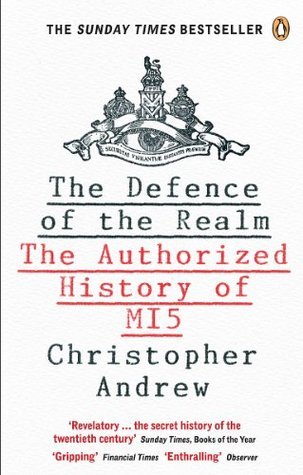
The Defence of the Realm

Rate this book

To mark the centenary of its foundation, the British Security Service, MI5, has opened its archives for the first time to an independent historian. In The Defence of the Realm, Christopher Andrew reveals the precise role of the Security Service in 20th-century British history, from its founding by Captain Kell of the British Army in October 1909 through two world wars and up to and including its present roles in counter-espionage and counter-terrorism. Full of dry humour, this fascinating and thoroughly engaging book describes how MI5 has been managed, its relationship with the government, and where it has triumphed and where it has failed. Readers will also discover the identities of previously unknown enemies of Britain and the West, whose activities the Service has brought to light. Above all, they'll understand the distinctive ethos and place of this hitherto extremely secretive organization within the U.K.

1544 pages, Kindle Edition

First published January 1, 2009

398 people are currently reading
3003 people want to read

About the author

Christopher Andrew

50 books171 followers
Christopher Maurice Andrew, FRHistS is an Emeritus Professor of Modern and Contemporary History at the University of Cambridge with an interest in international relations and in particular the history of intelligence services. (military.wikia.org)

Ratings & Reviews

What do you think?
Rate this book

Friends & Following

Create a free account to discover what your friends think of this book!

Community Reviews

5 stars
323 (28%)
4 stars
456 (39%)
3 stars
298 (25%)
2 stars
59 (5%)
1 star
13 (1%)
Displaying 1 - 30 of 109 reviews
145 reviews9 followers
December 19, 2019
I BEAT YOU YOU BASTARD. 950 pages of small type. YES.

Anyway, it is a great book, loads of great details, lots of humour. You do respect the chaps of MI5 a lot afterwards, and it is further proof that conspiracies are bloody hard to pull off, which is why there aren't that many of them.
Profile Image for Joe.
194 reviews21 followers
March 18, 2010
The main problem with this book is that you don’t really know what’s been left out. The early history including the campaign against Germany up to 1945 is probably largely complete and it is an impressive story. The early Cold War is also very informative and the author convincingly undermines the Peter Wright conspiracy theories.

Perhaps not surprisingly the detail starts to fall away as the book approaches recent decades. I strongly suspect a lot of bad things went on vis-à-vis Northern Ireland and surveillance of those considered subversives on the UK mainland. However, given that it is an authorized history and touches on contemporary issues you shouldn’t really expect any great revelations or exposure of wrong doing.

This is probably not a book for the casual reader. It is well written, but it couldn’t be described as racy and is enormously detailed. For those with a serious interest in UK politics it should be of far greater interest. I enjoyed revisiting the Cold War politics I grew up with; it now seems a world away.

Read with your critical faculties switched on.
340 reviews15 followers
November 30, 2020
If you are a fan of spy movies and books, you probably recognize the names George Smiley, James Bond and/or Ian Fleming. They were primarily employees of MI6, British Intelligence dealing with spying on foreign countries. If you are an American, think Central Intelligence Agency (C.I.A.). There is a counterpart to that in both countries. MI5 in England is counterintelligence and in the U.S. it is the Federal Bureau of Investigation (F.B.I.) investigates spies.

DEFEND THE REALM by CHRISTOPHER ANDREW details the history of MI5 over its first one hundred years 1909 to 2009. MI6 and MI5 shared a common origin in 1909 in that they were created at the same time in 1909 and shared o small office. They each had one employee – MI5 army Captain Vernon Kell and MI6 Royal Navy Commander Mansfield Cumming. The book was written to commemorate the 100th Anniversary of the two services. The author had unprecedented access to the files of MI5 except highly classified items.

Kell served as head of MI5 until 1940. No other leader up to the book’s publication served more than 9 years. Early on, MI5 depended on local police superintendents for most of its information. In the last 17 years that the book covers, there were two female leaders – Dame Stella Rimington (1992-96) Baroness Manningham-Buller (2002-07).

At the outbreak of WWI, MI5 had 17 employees. By1922, they had a double agent known as A-14 who was a paymaster in German Intelligence who gave MI5 the names of 83 fulltime and 188 part-time German operatives in England.

Some of its early successes involved William Le Queux (pronounced “Q”) a writer of spy novels. During WWII, all of Germany’s spies in England were either arrested, turned into double agents or were eliminated.

This book is RECOMMENDED if the reader wants to know more about how spies are created and caught. It is spell binding and a page-turner.

GO! BUY! READ!
Profile Image for Tom Nixon.
Author 22 books10 followers
April 7, 2019
I tend to take a somewhat skeptical view of histories of the various intelligence agencies around the world. How much can one author really have access to? How much of it is really true? There's good reason to approach a lot of these books with a certain amount of trepidation- but Defend The Realm is different. MI-5 was founded in 1909 and for the occasion of their centenary in 2009, they actually commissioned a history of their first one hundred years- which means that this book is probably one of the few authorized histories of an espionage agency that I can recall coming across.


Christopher Andrew was probably the most obvious choice to tackle the work. The jacket cover describes him as being 'Britain's leading historian of Intelligence' and he's been on the history faculty of Cambridge University- but he's also actually the author of another book I own, The Mitrokhin Archive (which goes over the files smuggled out of KGB Headquarters and turned over to the British by Vasili Mitrokhin.) In other words, Andrew has tackled this kind of source material before and you can immediately tell that he brings a ton of expertise on the subject to his narrative about MI-5. There might have been another person out there who could have taken better advantage of the unprecedented access that Andrew was given to MI-5's files, but I doubt it.


Right off the bat, it's important to note that MI-5 isn't MI-6. No James Bond shenanigans here- in fact, the amount of historical detail about the camaraderie and the work culture actually makes it seem like a better place to work. SIS is described as being more centered around individual agents doing the work of intelligence, while MI-5 seems to have settled into a tradition of working as a team to tackle whatever the problem of the day was. (I also like how Andrew takes time to note the role of women in the workplace and how they advanced over the decades in the organization into officer ranks and eventually, in 1992 with the appointment of Dame Stella Rimington as Director General, to the top of MI-5 itself)


It's origins begin in the First World War where there was a preoccupation and worry about possible German subversion and catching spies. If there's one trend that continues throughout the decades it's that MI-5 operates in peaks and valleys-- German intelligence is at the forefront at first, but then the concern drops in between the wars and comes right back up again for the Second World War. After the war, MI-5 sort of shrank back down again, but soon found itself growing once more to face the Soviet threat. That preoccupation lasted until Operation Foot in the early 70s, before MI-5 pivoted to deal with the Troubles in Northern Ireland. There was another 'valley' at the end of the Cold War, which saw MI-5 briefly move toward tackling organized crime before pivoting again to face the rising threat of Islamist terrorism.


What surprised me about this book? Well, how much of an overseas service MI-5 had before decolonization amped up and the Empire retreated. Their involvement in tracking and countering the widespread industrial subversion of the 1970s was also surprising. The book naturally touches on the infamous Wilson Plot, which turned out to be less sinister than I thought- there was some concern about some trips that Wilson took to the Soviet Union that MI-5 checked out, but he had moved away from any Soviet sympathies he may or may not have had by the time became Prime Minister. The unmasking of the Cambridge Five spy ring also takes up a significant chunk of the book, for obvious reasons-- but I didn't know about the Czech SVB and other Communist satellite intelligence agencies being so active in the spy game either.


Overall: It's a doorstop of a book, but the level of access is unprecedented and the author has the expertise to maximize it. It's everything you've ever wanted to know about MI-5 but were afraid to ask- and normally that might be a little bit of a daunting prospect, but what it turns out to be is a portrait of the 20th century history of the United Kingdom from an unique perspective: the people who saw more than you thought and did more than you knew. My Grade: **** out of ****.
550 reviews7 followers
August 29, 2023
Let's put the obvious criticism out there first: all authorised histories are going to be about whatever the organisation in question wants them to be about, and that goes double for an organisation with the Official Secrets Act at its disposal. But don't read official histories if that bothers you. This one is MASSIVE, it's a real herculean achievement of research, narrative, analysis and selection. Feel like I've been reading it forever. There's some stodgy bits in there, and the first half of the book is definitely the best, benefiting from a greatest hits of WW2 spy successes and, doubtless, a greater amount of source material that has been declassified.
Profile Image for Larry Loftis.
Author 8 books376 followers
November 29, 2015
Enjoyed both of his books on British Intelligence (this one and his book on MI6 ("Secret Service"). He has a glaring error in this book, however, in an unfounded and uncited assertion that Dusko Popov was codenamed TRICYCLE for his "fondness for three-in-a-bed sex." [p. 253]. I'm still baffled how an Oxford scholar would make such a charge without a reference.

Contrary to Andrew's suggestion, Popov was given the code name TRICYCLE when he acquired two sub-agents, forming a net of three.
Profile Image for Martin Rogers.
77 reviews
December 14, 2024
1,000 pages of non-fiction, but I just could not put it down. Magnificent and do easy to read with no knowledge before starting
Profile Image for Alex Daniel.
10 reviews
November 1, 2023
Very interesting but at 40 hours for the audio book, it was a bit of a slog to get to the end.

Was it well written? Yes.
Did I enjoy it? Yes.
Did I enjoy it more than four other books I could have finished in that amount of time? Probably not.
Profile Image for Michal Paszkiewicz.
Author 2 books8 followers
December 21, 2017
A very interesting book. I found it particularly surprising how the culture has changed since the time that MI5 was first created. At the beginning of the book, the service was investigating pacifists (as well as those pesky Germans). Next, about half of the book was about Communist spying and subversion (with a few breaks for the Nazis, Zionists and other factions). It almost feels like the book is about the final loss of MI5 - with the eventual removal of political vetting (especially in the light of the current rise of modern left-wing agendas) and eventual transition into a fully counter-terrorist agency instead of being a counter-espionage agency.

I was slightly surprised by the lack of information in certain areas - e.g. not much was mentioned of Enigma at all (I guess I need to find an authorised history of GCHQ), and even though the book talked about the lack of Chamberlain's actions on information received by intelligence services, it doesn't mention the fact that Polish codebreakers had already broken enigma and shown Britain that Germany was planning an attack.

The greatest part of this book is in the detail though. Every spy story is almost a few paragraphs in the book, but contains much in the way of heroics, adventure and hard work. MI5 is a very impressive agency and it is very interesting to have a glimpse into the way it has worked in the past.
Profile Image for GT.
86 reviews4 followers
August 8, 2013
A comprehensive history covering 100 years of Britain's famed MI5, responsible for counter-espionage, counter subversion, and counter-terrorism. I found myself swinging back and forth from enjoying the detailed material to slogging through certain sections. Everything thing is here from WWII triumphs to mistakes and details on failed investigations and poor Directors (DGs).

I go with 3 Stars - ★★★

mfgavin's rating criteria:

★ = Horrid waste of time
★★ = May be enjoyable to some, but not me
★★★ = I am glad I read it
★★★★ = Very enjoyable and something I'd recommend
★★★★★ = A rare find, simply incredible
Profile Image for Heikki.
Author 6 books27 followers
March 2, 2011
This book shows us that not only is life in MI5 interesting, it is also fraught with danger to the individuals and to society as a whole.

The early part of the book is in my view more interesting than the final part, say, after the Cambridge Five have been discussed. This is not to say the IRA and post-9/11 times weren't interesting, it's just that the space allotted to narrating what happened is not sufficient and there's a cramped feeling to it.

But the First WOrld War and the 'German spies for Kaiser' stories are fabulous reading, especially the man who was hanged and almost mourned for by the British agents who sent him to the gallows.
Profile Image for Erik Graff.
5,165 reviews1,449 followers
October 26, 2020
I have been reading the official histories of both MI6 (espionage) and MI5 (counter-espionage/terrorism) simultaneously. Of the two, this is the better study, both because it is more inclusively open and because it is better written. A sympathetic study, it still notes many of the failures and controversies which have marked the history of the service during the years covered, 1909-2009. (N.B. Also published as 'Defend the Realm')
Profile Image for Brent.
12 reviews
February 2, 2010
I was hooked from the first page. Christopher Andrew writes an engaging history of the British Security Service that helps you understand the intelligence community: its function and how its very presence enables us to go about our daily business. Even people who don't like James Bond are going to enjoy this book, because it's real and not full of cheesy spy bally-hoo.
Profile Image for John.
137 reviews38 followers
January 4, 2021
It's a long haul. The pages are now covered in highlights and I took notes. Detailed and informative. A stark tale of how such a vital service has remained so under funded and under resourced. When all else fails, maintain a sense of humour.
Profile Image for Davide Moraschi.
Author 1 book1 follower
April 20, 2022
Very well documented, probably too much of a mouthful. A couple hundred pages less would have been probably easier. It seems to me kind of watered down and too much "official" and "authorized".
Profile Image for David Baer.
1,070 reviews6 followers
February 23, 2025
Somewhere in this immense tome, the author relates how the MI5 leadership believes that telling their institutional story is an important part of preserving it. Or something like that. That remark, and the nature of the content, makes me believe that the target audience for this book is, in fact, MI5’s own members. As a “general audience” member, I found it pretty heavy going.

Don’t blink! If you miss the definition of an acronym, of which the text is positively INFESTED, you will be constantly distracted by the task of filling in “Her Majesty’s Government” for HMG, say, or (worse) be perpetually fuzzy on exactly who is the SIS. I had blinked, see, sometime between the WWI origin days involving Sir Vernon Kell, who was chosen by the War Office to lead the Secret Service Bureau (SSB). At that primordial time, SSB was a meager thing, and at the end of the war the SIS positioned itself to absorb the SSB. Anyway, I blinked, and for the rest of the book, SIS kept popping up in practically every other sentence, to the point where I was asking myself if SIS was actually a synonym for MI5 or what.

No. SIS is MI6, an appellation I swear is found nowhere in the book.

I blinked, and I missed where the term MI5 originated from. Always with the SSB acronym. Google AI tells me they are the same thing. Every so often the text throws in MI5, but most frequently uses SSB. This is a point I was hazy on for the entire book, and I’m happy now to know they are the same, but I had to Google it.

More fundamentally, the book betrays its insider orientation by focusing on the bureaucratic dynamics of SSB and SIS. Vast historical episodes like WWI and II occur, and yes the book mentions the very successful deception campaigns like Patton’s fictitious First US Army Group, and Operation Mincemeat. Look elsewhere for satisfying stories about those, because in this book you get some meager references but they are buried in less interesting stuff like who the DG was, who wanted to be DG, what was the relationship between HMG and the DG, and so on. Notice the acronyms.

Even when it is telling stories, it tends to launch in the middle and cut out before the end: so I remember a little vignette of some guy in a car surveilling a house, but I have very foggy understanding of what led up to him being there, why it was important, and what came next. Because it is an authorized story, “sources and methods” are punctiliously protected, and it turns out you need those things to tell a good story.

Oh, and MI5 would like you to know very clearly that Peter Wright and his book "Spycatcher" is not credible. Interesting how the book links famous CIA paranoiac James Angleton with Wright. Also, the whole Kim Philby thing would have been so much worse for Western interests if the Soviets had handled him more competently. But that was an SIS thing, I think. These are mind-boggling stories of world-changing import, but this is a book from which one grasps little of the end-to-end storylines.
79 reviews2 followers
November 3, 2024
In this great beast of a book, Chris Andrew practices pure narrative history at its highest form - original archival work and comprehensive narrative detail, packaged in a well-written text. His use of humour, suspense, and mastery of writing make finishing this 1000-page book easier than books half its size.

However, even the highest form of narrative history remains unable to overcome the problems associated with the genre itself. Without a clear argument, it becomes difficult to analyse and dialogue with his precise claims throughout each chapter. Without a clear identification of his subjectivities (at one point he refers to himself in third-person in the text), the text does not seem sufficiently reflexive about its limitations and potential biases. Both of these make it more difficult to critically credit Andrew's largest contribution - his use of MI5 archives, which perhaps is why it remains a point of controversy.

I further note that Andrew's political leanings do sometimes glow through the text quite clearly. He is visibly much more fascinated with analysing the impact of Soviet disinformation and subversion than the Tsarist counterparts. He seems quite fond of Thatcher, and willing to hand-wave away her attempt to use MI5 against organised labour as an isolated incident unrelated to previous or later controversies about the politicization of the agency.
Profile Image for Charlie Richardson.
39 reviews1 follower
March 24, 2020
If like me your wanted to know more about the origins of MI5, then this book will be of interest but be warned you will need to do some weight lifting training before buying this book as it's a pretty lofty tome.
It's insightful and really does answer any question you may have of this incredible organisation that has until recently be confined to the shadow.
To points I will add that the book is very acronym heavy and as it doesn't have a glossary of terms at the back of the book , sometimes it treats you as someone who should know that SIS is in fact MI6 so reading it in parts can be a challenge , I will also point out that the historian Christopher Andrew makes no secret of his loathing of Peter Wright ( the writer of Spycatcher) which may be understandable but shows this is not an impartially written book but if you can forgive the writer his personal feelings along with his belief that if you don't know that VSSE is the Belgian secret service then he's just not going to tell you , you will enjoy this book.
Secretly ( no pun intended ) I think it just wasn't meant for people like me , I think it was written for the people who work in the shadows.
Profile Image for Roger Woods.
315 reviews5 followers
May 18, 2022
This massive tome presents the history of the Security Service from its beginnings in 1909 to 2009 i.e. for the centenary. Christopher Andrew is a well respected historian and an expert on the impact of secret intelligence with a deep understanding. Apparently no restriction was placed on the judgements he makes although it is obvious that certain information must remain classified. The history of certain well known events is very interesting when the record is set straight but the author does not cover up security failures whilst celebrating successes. Intelligence work particularly in counter terrorism will continue to play a crucial role as this century progresses and new challenges will continue to arise as economic, social and technological factors add to the mix.
22 reviews
March 11, 2019
It is one of these books where I can find only three reasons for them to be read:
1 - if you seriously have nothing better on the subject to read at hand
2 - if you want to have the official story, completely cleaned of anything not agreed by the government.
3 - at a deeper analysis level, if you want to know what they want you to know.

It is the official story of the MI-5. Nothing juicy to read about here or any plot that might be still questioned. For a factual approach it helps to know what the governement wants you to believe and what is the current official policy regarding certain matters such as Ireland/the Troubles, Israel and terrorism post 1945, etc.
Profile Image for Victor.
171 reviews
May 22, 2017
Comprehensive and authoritative review of MI5 from its origins to the modern day. Worth reading for the many fascinating stories of internal security and counter-espionage. Learned quite a bit about human nature and the factors and foibles in various high-profile operations, such as the double-cross system and operations Fortitude and Mincemeat in WWII, the Cambridge Five and the efforts to uncover them. Didn't care too much for the coverage of "the troubles" in Northern Ireland and in the colonies, but the part on modern (un)holy terrorism was fascinating and instructive.
Profile Image for Gary Donnelly.
Author 5 books30 followers
October 10, 2017
Wide ranging and as ambitious as always, Christopher Andrew nonetheless manages to keep you reading as though engaged in a page turning thriller. The complexities of the Government's most secret inner workings and the multitude of characters who cross the stage are directed with a cool hand but the narration never lapses into dry recounting or distanced inventory taking. Professor Andrew's work retains humour and humanity and in doing so he does what others can only aspire to; he brings history to life.
225 reviews1 follower
May 2, 2020
This is an impressively researched, and comprehensive book by Christopher Andrew, who brings his expertise of intelligence to the analysis in this book. This is a must-read book for anyone who is seriously interested in the study of intelligence and particularly the Security Service. Understandably much of the book focuses on the early years of the Service, but there is still much to enlighten the reader on the more contemporary years. This is not a piece of propaganda for the Security Service, but rather an open, objective account and analysis of their first 100 years.
8 reviews1 follower
September 7, 2020
Dr Christopher Andrew has done very well to best conclude the history behind the security service, however partial he attempt to win over the audience. I read something early on which made me rethink his own analysis of everything, and had I better thought what actually gone on between the lines or that anyone doing intelligent gathering initially must be cautious of conscientious. Ultimately the stronger belief whether had secret service saw from good eye there probably be friends with Germany. This mind might take a whole life time to understand and better think of ones conscious.
106 reviews
April 18, 2021
It took me about half a year to read this book. Some sections were interesting reads, but other sections (such as on personnel) led me putting the book away for awhile, and revisiting it later on. The book focuses on MI5, not surprisingly, but I would have liked a bit more background on several conflicts the Service had to deal with. What struck me most is that pivotal points in history were not foreseen by the Service, despite its effort to collect intelligence on it. It makes me wonder what the future has in store for us..
Profile Image for Keith Johnstone.
261 reviews7 followers
December 23, 2019
This should be used more as a reference book than reading from cover to cover as I have tried to do. There is so much information in here, some of it very interesting, that could be its own book (and indeed there are now some). With Christopher Andrew being given this kind of access it was always going to be difficult to émérite something wholly readable and engaging although he did a far better job than his counterpart who wrote the MI6 equivalent book.
Profile Image for Joe.
280 reviews1 follower
April 12, 2020
A good read but heavy going. At times it reads like a history of a civil service department the exception being that it had extraordinary responsibilities. The operational details are excellent and the research is amazing. Yet, at least in the early years it is a wonder that the secret service survived. Too much details into the day to day working of the department make for a slow but informative read. If you have the time worth a read.
Profile Image for R.S. Rowland.
Author 1 book
July 25, 2018
I wish I could give this book more than 5 stars for the invaluable aid it gave me while writing my book. Unbelievably detailed with rare illustrations and pictures, fascinating stories direct from the files of MI5, and incredible research. While this is certainly more of a reference book, it would also make a great read for anyone interested in hard core espionage.
Profile Image for David Burgess.
17 reviews
January 10, 2019
Disappointing that Christopher Andrew doesn't really address the accusations against Roger Hollis (questioning the mental faculties of his accusers does not address their accusations, and undermines the other conclusions he draws), this is nevertheless a dense and rich history, if you have the patience for it.
Profile Image for Logan Horsford.
577 reviews21 followers
April 30, 2019
It might have gotten a higher rating if I was reading a paper copy instead of listening to it. After numerous attempts to fast forward through the very skippable intro, I gave up (it kept droning on and on) and moved on.

Audio - needs a different sort of formatting; just chapter 1 and go. All of the tedious stuff can be tacked on at the end.
Displaying 1 - 30 of 109 reviews

Can't find what you're looking for?

Get help and learn more about the design.