On the fiftieth anniversary of Watson and Crick receiving the Nobel Prize, a freshly annotated and illustrated edition of The Double Helix provides new insights into a scientific revolution.
Published to mark the fiftieth anniversary of the Nobel Prize for Watson and Crick’s discovery of the structure of DNA, an annotated and illustrated edition of this classic book gives new insights into the personal relationships between James Watson, Frances Crick, Maurice Wilkins, and Rosalind Franklin, and the making of a scientific revolution.
In 1928, James D. Watson was born in Chicago. Watson, who co-discovered the double helix structure of DNA (deoxyribonucleic acid) at age 25, was awarded the Nobel Prize in Physiology or Medicine in 1962, along with Francis Crick and Maurice Wilkins. His bird-watching hobby prompted his interest in genetics. He earned his B.Sc. degree in zoology from the University of Chicago in 1947, and his Ph.D. from Indiana University in Bloomington in 1950. He worked with Wilkins and Francis Crick at Cavendish Laboratory in England in 1951-1953, when they discovered the structure of DNA. Watson became a member of the Harvard Biology Department in 1956, then a full professor in 1961. His book The Double Helix, which was published in 1968, became a bestseller. Watson was appointed director of Cold Spring Harbor Laboratory on Long Island in 1968, and became its president in 1994. As director of the National Center for Human Genome Research at the NIH in 1989, Watson launched the worldwide campaign to map and sequence the human genome. Watson was an outspoken unbeliever who considered that human progress had been shackled by the idea of divine fate, and that human beings should do their utmost to improve the future. In a Youngstown State University speech, Watson said, "The biggest advantage to believing in God is you don't have to understand anything, no physics, no biology. I wanted to understand" (The Vindicator, Dec. 2, 2003).
I ended up skimming this. I really hope his more recent book DNA: The Secret of Life is considerably more interesting and considerably less sexist. It should be a fascinating story, but really it's mostly about James D. Watson bouncing around between different supervisors and making sexist comments about Rosalind Franklin -- sorry, "Rosy", who would've been much better in his eyes if she'd done something with her hair. [ETA: in total fairness to those who have difficulty recognising hyperbole, it's worth noting that it probably isn't mostly about these things... but it sure felt like it to me. His later book is much, much better and more to the point.]
I can understand his fascination with DNA, but that's just about all I could get on board with. And his writing style was just completely flat. I do not honestly think all the details like how cold he was in Italy are at all relevant to the history of the discovery of the double helix.
Gossip, backstabbing, petty squabbles, arrogance, snobbishness, and misogyny take a front row seat in this personal account of how the double helix structure of DNA was discovered.
I expected more from Watson's book.
And then there is the question about Rosalind Franklin's contribution to the discovery. While Watson does spend some time in the epilogue to credit Franklin for her work on the subject, it seems too little, too late. He spends the entire book painting her as an uncooperative, dour, argumentative, bossy, frump with an "acid smile" in a career mostly reserved for unattractive women who have little chance of catching a husband. (He actually introduces her in the book in almost exactly those terms.)
Oh, and there is little explanation of the structure of DNA itself. It really is more of an account of his thoughts on girls, stomach pains, and on the personal lives of people Watson encountered when working on the project.
The Double Helix (1968) is written by Dr. James Watson (b.1928) an American molecular biologist that only had moderate knowledge of mathematics, genetics, and chemistry when he began his research to uncover the structure of the DNA.
These autobiographical accounts for the most part take place between the years 1951 and 1953, during which, Watson, takes the reader though the events, roadblocks, and uncertainties he faced until discovering the secret to life. The sacrifices, Watson, made were mostly fueled by his desire to become a renowned scientists and his dream of winning the Nobel Prize. As a result, Watson, together with his colleague, Francis Crick (1916-2004), from the University of Cambridge and Maurice Wilkins (1916-2004), from King's College London, were awarded a Nobel Prize in 1962 for discovering the molecular structure of the DNA.
But it was Wilkins' colleague, Rosalind Franklin (1920-1958), who was marginalized, hence being a woman scientists, as the double helical structure was significantly based on her X-ray diffraction (crystallography image) patterns that were shown to Watson and Crick without her knowledge and consent. Franklin's excessive exposure to radiation was in all likelihood the cause of her cancer that resulted in her untimely death. Nevertheless, their work and discovery was a quantum leap in the field of genetics.
But as far as the book is concerned, this first-person narrative was somewhat colorless with only skin-deep descriptions and illustrations of the science behind the discovery. There was also a subtle trace of a discriminatory tone, Watson, employs when referring to women in his stories. I mostly recall the women either portrayed as snobbish or sex objects. To be fair, he does speak very highly and sincerely of Franklin in his epilogue, but she was no longer alive at the time it was written.
Also, the only semi-eventful development of the story was the competition between the laboratories in England (underdogs) and the laboratory in Pasadena (favorite) headed by the renowned scientists, Linus Pauling. Where the underdogs beat the heavyweight to the punch and first discovered the two intertwined chains structure that ended up becoming one of the greatest scientific achievements of all time.
Watson turned out to be a jackass and I went into the book expecting to have that general opinion confirmed. Not just racist but sexist and white male privilegist. Some of his remembrances were pretty juvenile and petty, but the core story of the science was pretty engaging.
In what was obviously an afterward posted many years after the original publishing date, he made a somewhat gracious gesture of acknowledgement to Rosalind Franklin after dissin' her all the way through the book. It didn't redeem him.
“In the end, though, science is what matters; scientists not a bit.” ― Steve Jones in, James D. Watson's The Double Helix
I gave it three stars last night (DNA night, thanks Riku), but that just didn't seem right. The structure wasn't stable, and I felt it probably deserved four stars (one for A, one for T, one for G, one for C; also one for Watson, one for Crick, one for Wilkins, and yes one for Franklin).
Short, interesting, personal and important but also sexist, biased, & according to Crick "a violation of friendship". Watson's attitudes towards Rosalind Franklin today seem so maligned that Watson eventually had to clarify that these were attitudes and view at the time of the discovery and not when he wrote the book. Still, despite this major and very real issue, the book (along with Watson, Crick & Wilkins contributions) cannot be undersold. The discovery of DNA's structure changed biology and the book catapulted Watson & Crick into that pantheon of fame that is seldom reached by even Nobel-level scientists.
Shows how arrogant, misogynistic, and plain stupid the "discoverers" of DNA's double helix were.
Pros: Emphasizes the importance of being able to access a free, open, creative, in some ways childish state of mind in order to allow for truly creative and "defocalized" states of mind that allow for scientific discovery. Tunnel vision can be a scientist's worst nightmare.
Cons: Shows how childish, pretentious and socially inept the scientific establishment can be. Also shows how a great scientist who suffered in silence due to being surrounded by sexist men in positions of authority was robbed of credit for providing the critical evidence necessary for finding and verifying the structure of DNA. Rosalind Franklin, you will not be forgotten.
I made the mistake of reading this over a long period of time. I see now that it really needs to be read in just a few sittings. Also, a basic background in chemistry and physics (none of which I have) would be beneficial. Thank goodness for Wikipedia.
This is the riveting story of the discovery of the secret of life, the helical structure of DNA. Even though the Nobel award was given to both James D. Watson and Francis Crick, the pendulum of recognition swings to Watson for this well-known account of how it all came to be.
The path to discovering the structure of DNA is of course fascinating, but Watson’s charming prose and thrilling narrative adds drama to the history.
Watson’s writing style has that English charm, which is unique for an American. I did, however, sense a bit of false humility in his account. He often refers to his ignorance on certain scientific principles and his physical unattractiveness to perhaps gain sympathy for appropriating other’s work.
“Sometimes I daydreamed about discovering the secret of the gene, but not once did I have the faintest trace of a respectable idea.”
I find that hard to believe. Now, I, Douglas Feil, could honestly say, “not once did I have the faintest trace of a respectable idea”, but not Watson. After all, he had several traces of ideas, and he strategically and sometimes underhandedly put himself in the middle of those on the verge of scientific discovery. His theories were just wrong at first.
Thanks to the work of Rosalind Franklin, Linus Pauling, Maurice Wilkins, and a host of others, he used their “faintest traces” to build upon his own theory. Discovering the structure of DNA was hard work, but much of it was timing. Kudos to Watson and Crick for that, and I do believe they deserved the Nobel for their work.
I was disappointed in his treatment of Rosalind Franklin. He almost unapologetically skewers Rosalind Franklin and her contributions to the discovery of DNA. I say almost because he reserves the ending epilogue for a sort of apology. “Since my initial impressions of her, both scientific and personal were often wrong, I want to say something about her achievements.” He apologizes after her death and the apology was after the prior vilification. If Watson really respected Franklin and appreciated her contributions, why not leave out the dirt? Here’s a book that more properly defends Franklin: Rosalind Franklin: The Dark Lady of DNA.
Overall, I found this account thrilling and vital. Few scientific discoveries get a story like this. Watson's writing is sure-footed and perfect for describing his accomplishments.
James D. Watson became a controversial figure later in life, but this story recounts the seminal event in his life: the 1953 discovery of the structure of DNA for which he received the 1962 Nobel Prize in Physiology with his collaborator Francis Crick and another, Maurice Wilkins.
Watson is an excellent storyteller, something which cannot be said of most scientists. He successfully ensnares the reader into the drama of the moment, describing the personalities involved and making the science attainable to any reader. The discovery of the double helix as the structure of DNA is perhaps the most remarkable event in biology after Darwin's grand theory of Evolution. Watson and Crick devised the structure using tinker-toy-like models and corroborating their findings with x-ray crystallographs which were surreptitiously taken from the laboratory of Rosalind Franklin.
Watson was a wunderkind American who acquired his PhD in zoology at the age of 23; Crick was a 35 year-old boisterous gad-about who was struggling for direction, having earned his BS in physics and unable to get the proper motivation for a PhD. The unlikely duo hit it off and agreed that DNA biochemistry was the ticket to recognition. At this time Linus Pauling at CalTech was transitioning his emphasis from proteins to DNA, setting the stage for a race to find the secret of the genetic code.
Watson spins the yarn in dramatic fashion, writing in 1968, fifteen years after the discovery and 6 years after the Nobel. He offers an apologia of sorts to Dr. Franklin, who was taken aback by the use of her xrays without permission. Watson admits that her gender had much to do with the raw treatment she received in the male-dominated world of science. Franklin did not receive a Nobel because she tragically died in 1958 from ovarian cancer at the age of 37, and the Prize is only awarded to living scientists.
I cannot believe that I've never read this book before. It's relatively short and remarkably easy to read. I highly recommend this to anyone who has any interest in science, medicine or the history of the 20th century.
I have no doubt that James Watson was a (pretty) competent scientist - although the way he writes it, every thing seemed to favor him up to the discovery of the double helix structure. He chose the field by a mix of chance and cunning, having eliminated other fields which would require more effort, by his own words (I suppose some people call it self-disparaging, but somehow to me it reads like a humble brag) and less likely to yield the chance to make a huge discovery. If that's not cheating science, I don't know what is. I have more respect to great men and women who did science because they really loved digging up more and more facts about something they truly love, something that they can't stop thinking about. Such as Feynmann and Einstein and Curie and yes, Rosalind Franklin, the brilliant and dedicated molecular biologist upon whose work Watson and Crick built theirs.
I hate the way Watson portrays Franklin, the way he demonizes her into someone difficult to work with, when in fact he and Crick did not really respect her as an equal. In some scenes that he recollects in the book it seems as if they resented her for getting the double helix images before them, because it means they needed the results of her research.
Watson's writing is friendly and easy enough to read. But the vibe of the whole book seems to be: "Oh the Nobel prize thing? I didn't really put that much effort into it, I just happen to be a scientific genius and a visionary."
After reading Bill Bryson’s wonderful A Short History of Nearly Everything, I’ve been effectively disabused of the notion that scientists are purely logical, rational, and reasonable folk, and that science progresses through mild-mannered and careful thinking. I bet it does, sometimes. But, like any dynamic human activity, science is populated by a diverse group of people. Some, I’m sure, are the workaday, tame people we like to imagine in white lab coats. But we also have half-deranged incorrigible bachelors who stick needles in their own eyes (Newton), adventurous world-travelers with exotic diseases (Darwin), and fun-loving, impetuous youngsters who enjoy chatting about foreign girls and wine as much as tinkering with organic chemistry (Watson).
This book was great. We are all taught in school that DNA was discovered in 1953 by Watson and Crick. What we are not told about is the high school-type drama that was involved. Backstabbing, gossip, love, wine, vicious arguments, a race against time (and Linus Pauling)—after reading this, you’d be amazed that us humans ever get anything done.
The elephant in the room here is, of course, Watson’s description of Rosalind Franklin. It’s very sexist. She comes across as a know-nothing bulldog. I’m sure many readers will be put off by it. Personally, I think it’s valuable to read about anyway. It’s a bird’s eye view into what institutional sexism was like. Moreover, I think that Watson’s honesty is preferable to a retrospective cover-up. I have no doubt that this was actually how Watson experienced the events he describes. Also, even Watson dedicates the last two paragraphs to an apology for his treatment of Rosalind, as well as an encomium to her scientific work. It’s a shame she died young, or she might have seen more of the credit in her lifetime.
And (if you will pardon me for saying this) the sexism on display is a part of the charm of this book. Not that sexism is charming, of course, but that Watson gives us a singularly candid portrait of how scientists really operate. For The Double Helix has no pretense of objectivity or authority. It is a first-person account of one of the greatest scientific discoveries of the 20th century, with all of the peripheral thoughts, activities, interests, and proclivities that were part of Watson’s life while he struggled with the problem. So read this book, to see how a 24-year-old American with stomach pains from English food managed to uncover the secret of life by tinkering with a model in a cramped Cambridge office. And he didn't even need a lab coat.
"For a long time, the world believed that Rosalind Franklin had nothing to do with James Watson’s and Francis Crick’s discovery of DNA’s structure. In no small part, that’s because Watson said she didn’t, and we believed him. His 1968 autobiography Double Helix was the first full-length account of the discovery story. He refers to Franklin as “Rosy” throughout the book, and describes her physical appearance in blatantly sexist ways. He also omits the part of the story in which he and Crick used Franklin’s Photograph 51 without her permission or knowledge; Photograph 51 was the key evidence to unlocking the structure of DNA. He couldn’t completely erase Franklin, since too many people knew who she was, but he diminished her enough with a whimsical nickname and assessments of her attractiveness that her part in the story could easily be missed."
I read this quite a long time ago but I remember it being an interesting account of what science looks like from the trenches. The struggles, uncertainty, the thrill of the race with other labs. It also paints a realistic picture of discoveries: it's not one sudden eureka moment that changes everything but a process of gradual narrowing down of the truth with a sequence of smaller eureka moments in between.
I was expecting a lot from this book and it surely didn't meet my expectations. I picked this book because genetics always have been fascinating to me. When I was in college I did a course on molecular biology and DNA was really interesting and important topic. My professor mentioned this book but I couldn't find time to read it that time.
Everything is wrong with this book from Watson's writing to his remarks on Rosalind Franklin. The only thing accurate here is the science which can't be overlooked. But I am also unable to digest the misogynist remarks of Watson, a well educated and renowned scientist. It felt like I was reading an article on a magazine rather than a very popular book.
Battle of egos, blind ambition, tensions, quarrels, conflicts of interests... Sadly or not, science goes hand in hand with the little defects of human nature. The race having led to the discovery of the structure of DNA is obviously no exception, and James Watson, the young lad (he was only 24!!) who was among whose hitting such jackpot, reminds us so here with his own version of the events.
As every personal account such version is, of course, far from being objective! His arrogance is annoying. His egocentrism irritating. Some of his comments about Rosalind Franklin off the mark. He also was often accused of too much putting himself and Crick under the spotlights at the expense of other people's works. None-the-less, if the guy is a bore (gosh!) and his writing style full of difficult jargon, he delivers a fascinating testimony about, not only that great scientific triumph that was the discovery of the structure of DNA, but, also and beyond, how science is at times practiced.
It is, at least, a powerfull insight no one interested in such topics should ignore.
بدت مقدمة الكتاب شيقة ومغرية في التقديم الذي عرضه المترجمان، ولكن مع الأسف الكتاب كان ممل جدا، وتتخلله كثير من التفاصيل العلمية صعبة الفهم بالنسبة لغير الدارسين لعلوم الأحياء الدقيقة (الميكروبيولوجي) والكيمياء الحيوية (البايوكيمستري). كنت قد تخيلت أن أخوض مغامرة شيقة مليئة بالأحداث المتشابكة والمتسلسلة، يتناثر عليها ذرات من ملح الأحداث الدرامية من الحين إلى الآخر، كما قرأت في السيرة الذاتية الرائعة لماري كوري (هوس العبقرية)، أو على الأقل أخوض تجربة علمية بلغة دراجة بسيطة وجذابة لا تصيبك بالملل كما في كتابات ستيفن هوكينج ونيل ديجراس تايسون. لكن مع الأسف الكتاب كان أشبه بمذكرات شخصية رديئة، تتناول سردا يوميا للأحداث بطريقة مملة وغير جذابة، والتفاصيل العلمية بها أشبه بقراءتي لأحد كتب المايكرو أو البايوكيمستري الأكاديمية الخاصة بالجامعات، بأسلوبها العلمي الجاف، دون وجود أي تعبيرات أدبية تحد من جفاف المادة العلمية أو تُبسط فهمها. نجمتان فقط هما كل ما أستطيع إعطائه لهذا الكتاب.
I had the great good fortune to meet Dr. James Watson, many times actually, and to have his kind assistance when I, a scientific novice, set out to save the venerable Public Health Research Institute in New York. Watson's major accomplishment, his role in determining the structure of DNA, is a fascinating tale well told in a form the lay reader can easily appreciate. For those who wonder how scientific discoveries are made, and indeed on the nature of scientific research itself, this is a great source.
الأن فترة استعداد لي إمتحان القادم في بايو كمستري ، كان نصيب الأمس في دراسة شيت "شابتر"الأحماض النووية ، وبالطبع الدكتور شرح مقدمة علي مكتشف الدنا ، وطبعا فضولي النابع من الحسد للمكتشفين
واصحاب جائزة نوبل خلاني نبحث عليه لعند ماوصلت لتحفة ورواية شخصية لي اكتشاف أهم اكتشاف علمي لحد الأن ،..!
المهم في بداية كانت صدمة أنه جمس واطسون دخل الجامعة شيكاغو وعمره 14 السنة ..! عبقرية ياسي ..!
لكن علي حسب السرد في الكتاب ، وحسب مقولة واطسون ..ان كل العلماء أغبياء ..أعتقد أيضا أن أصحاب جوائز نوبل كلهم ، كان سبب الأول ، هو الحظ في دراسة في الجامعات مرموقة ، ، الجهد ووقت لدراسة ، وللعمل في بحوث العلمية ...!
هناك سبب مهم ايضا شاب كان مثل أغلب الشباب الجامعي مكلف بي بحث وانجاز بحوث علمية ، مقارنة في جامعات العربية وكليات الطب لايوجد شي اسمه بحث علمي لطالب طب ، وسبب انه (انت شنو فهمك في طب قاعد طالب وصغير )
واطسون نافس علماء كبار في السن اصحاب جوائز نوبل قبله ، الغريب احترام الكبار لشغف الشباب وتعليهم ، احني مثلا هنا في بلادي مستحيل شخص دكتور كبير يعلم طالب صغير سر المهنة بسبب المثل الي يقول ( صاحب صنعتك عدوك )
المهم كتاب كان صدمة ، وممتع لأنك تعرف اكثر من شخصية حاصلة ع جائزة نوبل .وليس هناك شي صعب ، لانه مكتشف اهم بحث علمي الي هوا الحمض نووي لما يكتشفه وهو يشرب في قهوة لكن اكتشاف
كان علي سنوات وعلي بحوث وجهد وعمل لناس ثانية ، يعني الإبداع والإكتشاف مرهون بقواعد لشخص قبلك وهكذا ، يعني العلم مش محصور لشخص واحد ، العلم للجميع ومجد الإكتشاف للبشرية أجمع ...!
المهم لاعزاء للعرب ، والمهم عندنا بترول وهما لا ...قصدي المهم احني مسلمين وهما كفار ..!
This book was probably ten times as fun to read as I suspected it would be. The very idea of it, and its drab wrappings, led me to believe it would be dull, full of scientific mumbo-jumbo, slow, and poorly written. It was none of these. It's one of the few books that I have had a hard time putting down. The race between team Watson and Crick vs Linus was riveting, and even though I knew how it would generally work out, I was worried and on edge until their paper was published. I was especially interested in who would make that final leap (Watson or Crick) and break the problem open. I'm also certain that the importance of the discovery played a big part in the book's ability to keep me enthralled.
The book is also especially eye-opening in regard to how some science is done. It's astounding how such an important and apparently hard problem could be solved by someone with a nature as lackadaisical as Watson. I suspect this nature in some way made him a perfect compliment to the much more driven and, by Watson's own account, intelligent Crick. A perfect combination of squishy and solid. It could be argued that Watson's great talent was his ability to work with Crick, which very few people seemed capable of.
I wonder how "obvious" the solution is these days. I never took a biology class (not even in high school) and as soon as they mentioned the fact that certain base pairs were always equally represented I somehow knew that it was because they always connect together as pairs. So I assume it's knowledge that floats out their in the ether that is hard not to pick up these days, but it was still surprising to me that that was the key point that was holding them up for such a long time, and once it was understood it practically solved the problem.
Of course there was a fair amount of science in the book that was beyond me, but I don't think it got in the way of the basic understanding of the story. Plus the reader doesn't feel terrible about their own ignorance because half of the book seemed to be Watson confessing to his own ignorance in most every encounter he had with any other scientist of any significance.
I think it is clear that Watson is not the most reliable narrator, which makes for an interesting non-fiction read (about science no less). I'm certain he does a very poor job of accurately describing Rosy (which is confirmed in the epilogue when he admits to as much). And I'm not certain that his modesty is feigned or not. I suppose it's easy (as in it doesn't hurt one bit) to claim yourself to be an inferior intellect when you have the discovery of the structure under your belt and uncontested. But anyway, this unreliability, if accepted as a flaw (especially the mischaracterizations) I think only makes the story more interesting, as opposed to harming the story. It makes the journey that much more human.
I've been debating the four or five star. In a perfect world/website it would be 4.5. Today I shall error on the side of too many stars.
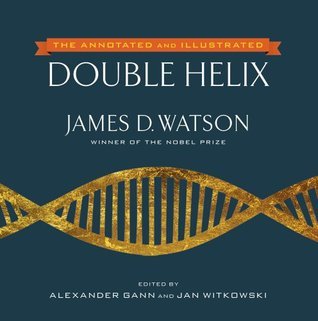
To be clear, the five star rating is for the annotations and illustrations this edition offers - not the original text of The Double Helix. Alexander Gann and Jan Witkowski did a superb job incorporating all the photographs, correspondence, and interview materials. It gives so much context to the story I had previously only knew snippets of. If I had to pick a favorite part, it would definitely be Appendix 4. I had no idea of the backstory into writing and publishing the book! If you're considering reading one man's very subjective account on the discovery DNA, I highly recommend you read this edition. While you're at it, pick up Rosalind Franklin: The Dark Lady of DNA by Brenda Maddox.
I loved this book because it showed me another side of science, literally some parts of this book and some comments of the Nobel laureate James D. Watson left me with an open jaw. This book is full of gossip, backstabbing, deep unappreciation, and yeah misogyny.
"It was all too clear that the presence of popsies does not inevitably lead to a scientific future."
When Watson started his book with "Thus many of the comments may seem one-sided and unfair" you know you are getting yourself in some kind of juicy gossip!
I cannot write the review without mentioning how much I was disappointed by the way Rosalind Franklin was mentioned in this book, in my opinion, it was simply disrespectful.
"By choice she did not emphasize her feminine qualities. Though her features were strong, she was not unattractive and might have been quite stunning had she taken even a mild interest in clothes"
"Also, there was no denying she had a good brain. If she could only keep her emotions under control, there would be a good chance that she could really help him"
"But at least Pauling was six thousand miles away, and even Francis was separated by a two-hour rail journey. The real problem, then, was Rosy. The thought could not be avoided that the best home for a feminist was in another person’s lab."
"There was not a trace of warmth or frivolity in her words. And yet I could not regard her as totally uninteresting. Momentarily I wondered how she would look if she took off her glasses and did something novel with her hair."
"Her past uncompromising statements on this matter thus reflected first-rate science, not the outpourings of a misguided feminist."
I was also shocked by his unprofessionalism and how he broke the rules of some scholarships he was offered and I felt that he was kind of disrespectful to everyone around him, even to his close friends and family:
-- Talking about his friends "John and Elizabeth Kendrew rescued me with the offer, at almost no rent, of a tiny room in their house on Tennis Court Road. It was unbelievably damp and heated only by an aged electric heater. Nonetheless, I eagerly accepted the offer. Though it looked like an open invitation to tuberculosis, living with friends was infinitely preferable to any other digs I might find at this late moment."
--Talking about his sister " Furthermore, if Maurice really liked my sister, it was inevitable that I would become closely associated with his X-ray work on DNA."
"Though my sister was upset when she saw me, I knew that months, if not years, might be required to replace her superficial values with those of the English intellectual. Carradale thus was the perfect environment to go one step further and acquire a beard. Admittedly I did not like its reddish color, but shaving with cold water was agony."
--Talking about Crick "One day, in a moment of despair, he revealed that Crick made his ears buzz. Moreover, he remained unconvinced that Crick was needed. Already for thirty-five years, he had not stopped talking and almost nothing of fundamental value had emerged."
"Though a few dissidents still thought he was a laughing talking-machine, he nonetheless saw problems through to the finish line."
--Talking about Crick and Odile's relationship "At no moment did Francis see any point in trying to simplify the matter for Odile’s benefit. Ever since she had told him that gravity went only three miles into the sky, this aspect of their relationship was set. Not only did she not know any science, but any attempt to put some in her head would be a losing fight against the years of her convent upbringing. The most to hope for was an appreciation of the linear way in which money was measured."
I think I should end this review, I think what annoyed me the most is the fact that Watson admitted that he used Rosalind's data without her knowledge and that she never got the Nobel prize for her contribution "Rosy, of course, did not directly give us her data. For that matter, no one at King’s realized they were in our hands. We came upon them because of Max’s membership on a committee appointed by the Medical Research Council to look into the research activities of Randall’s lab. Since Randall wished to convince the outside committee that he had a productive"
I'm going to talk about this in class in a few days, and I know we're going to spend the majority of the seminar on how the Old Boys of British science treated Rosalind Franklin. With good reason: her contributions to the discovery of the double helix structure of DNA are now well-known, and they were all pretty big dicks to her. Watson's misogynist jabs are deeply frustrating to read, often detracting from the narrative itself -- which is structured as a fun academic mystery (AND Y'ALL KNOW HOW MUCH I LOVE MY ACADEMIC MYSTERIEEEES). It is profoundly important that we talk about how women are treated in science, in the 50s and today.
That said, here are some other things I would like to talk about: - why Watson remembers every meal he eats - what Crick's laugh really sounded like - Watson and Odile's gossip dates cause they sounded like fun - how can Watson be such an obvious asshole yet so endearing? - dry humour in the sciences and why it is so very effective - is there fan fiction about this competitive circle of DNA-seeking dudes, cause like, there's gotta be, I feel like ya could cut the tension with a knife - or maybe we could do a movie? That Turing movie went over well, MOAR SCIENCE BIOGRAPHY MOVEEZ PLS - DNA is so, so, so fucking cool - biology wtf - I love when all the sciences get along <3 physics, chemistry, and biology all had to help on this one!! beebees! - how emotional I got when Watson finally figured out the base pairs and why did I cry when reading the appendixed Nobel presentation speech
Hopefully we do not have time to talk about most of those as I will sound ridiculous but whatever, Goodreads friends, you signed up for the real deal here.
Anyway: totally worth the read. I tend to read more physics than biology pop-science; that's maybe gonna have to change.
"من الممكن حتى لهاوي طيور سابق أن يحل الحمض النووي ! " ~ جيمس واطسون .
العلم ليس كما كنا نظن .. ليس لمجموعة أشخاص بمعاطف بيضاء.. معزولين عن العالم ويعيشون في المختبرات مع فئران التجارب ! العلم في الحقيقة تجربة إنسانية من الدرجة الأولى .. تحوي بين طياتها مشاعر إنسانية مختلطة .. من حقد وكراهية وتنافس وخوف وتحدي وهزيمة وانتصار .. أكثر ما أعجبني في الكتاب هو تركيز واطسون - في أثناء بحثه عن التركيب المثالي للـ دنا - أنه لابد أن يكون جميلًا وبسيطًا .. و عندما اكتشف النموذج، كان على يقين تام بأن شيئًا بهذا الجمال وبهذه البساطة لا يمكن أن يكون خطأً .. هذا الإعتقاد الراسخ بضرورة بساطة وجمال الحقيقة أعطاني نظرة مختلفة للحياة والعالم ..
احترامي الشديد لواطسون وزملائه كريك ، و موريس ، و روزاليند ، و أخيرًا بولنج .
A first-rate account of the discovery of DNA by one of the Nobelists who did it -- the other being Francis Crick. They were both pretty young at the time. . . For a real review, look for Tony61's in the 5-stars. For fun, see my GR friend Tadiana's 2-star!
Good book. And very short! 143 pp in the mmpb I read, and might still have -- I recognize the cover art! Not sure I would still give it a 5-star. I've never re-read it.
How to review The Double Helix? As a scientist who also happens to be a woman, I'm already biased against James Watson and Francis Crick, the two scientists credited with the discovery of DNA, because I'm aware of Rosalind Franklin. It's not very many pages into the book before Franklin appears and Watson's description of her makes me cross, but he's already failed to endear himself to me long before I get even that far.
I'm not sure how tongue in cheek he's being, but he comes across as lazy and ruthless. He doesn't want to do the hard work; he avoids understanding x-ray crystallography, anything about biology, difficult mathematics and anything too far removed from what he already knows. He even acknowledges that during his PhD he was dangerous enough to be kept from the lab, meaning he got an easy ride on the way to collecting his degree. He avoids following the rules that are set for his fellowships and the funding that comes with them because he doesn't want to work on the difficult tasks he has been set. Even so, he wants to work with brilliant people enough to claim the prizes for their hard work. Doesn't he just sound like a joy?
So when we get to Franklin and she's criticised for wanting credit for her own work and for not wearing lipstick, I'm already out of patience. Fine, so the book was first published in 1968, at time when a lot of people held ideas that now feel very backwards, but science had always tried (and almost always failed) to be a meritocracy - to so openly criticise a scientist for their appearance over their work is infuriating. No wonder Franklin didn't like them.
In some later editions, including the beautiful Folio Society copy that I hold, Watson has added a note, admitting that he was unfair to Franklin and that she didn't deserve the treatment she received. This goes some way to fixing the problems, but not far enough.
In terms of the science, it's fascinating. The x-ray crystallography field was still pretty new at the time and the work needed to find the structure of DNA was extensive. The importance of the results cannot be understated and, even if it's hard to like the scientists who did the work, the results are beautiful and elegant. Interestingly, this book is presented like something between a diary and a piece of pop-sci, except the science is pitched at someone who already has a decent background in chemistry. Very little is introduced at a layperson's level and someone who really wanted to understand, without a science background, would probably need to read it with a couple of Wikipedia tabs open.
So it's a strange book. The science is cool, the characters are mostly awful and the pitch is all over the place. If you're going to read books about science then this is an obvious one to choose, but that doesn't have to mean that it's a good one.
Just finished this book. What can i say? It is totally worth reading, but if you are not afraid of some scientific words and descriptions. For me it is one of the best books ever, and i will explain why. First of all this short book tells about how really big discoveries are being made: surprisingly the regular people are making them. But those people are keen to make something new. They don't bother about the money, or sex, or new car - the biggest passion possessing them is the science. Such books are moving the science forward because they are making the young mind to think that he can move the science himself like watson and crick and to decide to master biochemistry or physics etc. Secondly this book is real story about the collaboration and opposition between the scientists, something that is not well-known to regular people. It is really interesting to learn about. As for me - i never suspected that so hard competition existed between american and britain scientists, moreover, that the cultures are so different: conspicuous adversary between US scientists, and, in contrast, unquestionable confession of the first right to make investigations for those who decided to investigate first, in britain. Thirdly this book is making you to think: surely you always can dismiss all chemical details, but what a pleasure to get into them! I saw negative opinions about the Double Helix counting 200 words or more, but i believe that the people wrote them have to keep their fervor for the whole bunch of other junk books, but not for the stories of the greatest scientific discoveries of the modern history.
Watson is unironically comically evil. If I believed anything about my colleagues and associates like Watson does, you couldn't get me in a million years to ever admit it. Truly an incel before his time. As another reviewer said, "Gossip, backstabbing, petty squabbles, arrogance, snobbishness, and misogyny..."
A reminder that scientists aren't some alternate species. That they are competitive and lazy and insecure. That they are arrogant. That they make stupid mistakes and worry about their careers and money. That they feel lonely and lustful and like to party.