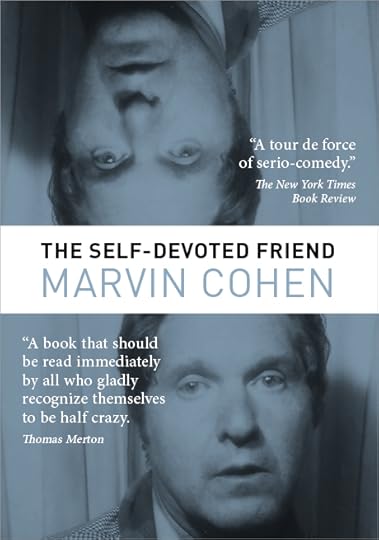
50th-anniversary edition of critically acclaimed writer Marvin Cohen's debut fiction. Not quite a novel, the book is best described as a series of humorous philosophical dialogues between the narrator and his "other" self, touching on a vast array of subjects such as birth, love, art, nature, religion, death, and everything in between.
A mere 1,500 hardcover copies of The Self-Devoted Friend were printed in London by publisher Rapp & Carroll Limited in 1967, 750 of which were imported by New Directions Publishing for distribution in the United States. According to Cohen, New Directions publisher James Laughlin explained his decision behind the very limited edition by saying it was "only for the happy few." Despite its overwhelmingly positive critical reception, no further copies of the book were ever produced. Completely reformatted, this new paperback edition contains the full text of the original and the author has also written a new brief introduction.
"When I was an unpublished writer 55 years ago, I lived in the same crummy tenement as Marvin Cohen in New York, and got to know him and his extraordinary writing. To me he was the Beckett of Avenue B -- funnier, more accessible, but just as determined to show us the world in a new way. Cohen is the chronicler of frustration, and The Self-Devoted Friend is just one of his masterpieces." Paul Theroux
"It is rare these days -- perhaps, any days -- to come across a work that not only reveals a striking, fresh talent, but stands outside current literary preoccupations. What Mr. Cohen has is his own: a joy in language, and an eye, at once innocent and shrewd, for the paradoxes inherent in the human condition. He puts both language and people through their paces, stands them on their heads, and hugs them to his heart in what amounts as a tour de force of serio-comedy, a sort of superb clowning in which pathos and absurdity intertwine as they do in a Charlie Chaplin film." The New York Times Book Review
"Cohen surrealistically juxtaposes ideas, seeks irrational and fantastic links, but for the high purposes of verbal comedy and linguistic entertainment."The New Statesman (London)
"Marvin Cohen's wacky humor has something of Thurber, something of Steinberg, Buster Keaton, the surrealists, the pataphysicians. The Self-Devoted Friend is a book that should be read immediately by all who gladly recognize themselves to be half crazy." Thomas Merton
"Such discontinuous fictions as Finnegans Wake or Naked Lunch or Marvin Cohen's The Self-Devoted Friend would store more suitably than nineteenth-century novels." Richard Kostelanetz
“‘If you’re myself,’ I bewildered, ‘then who am I?’”
One of the most fascinating experiments in modern psychology/neuroscience happened when a seizure patient’s corpus callosum was cut. Not only did this ameliorate the seizures by severing communication between the brain’s hemispheres, but it also created, in effect, two consciousnesses. For example, when the recovered patient went to pick an outfit from her closet, she had one in mind while, unbeknownst to her, the other half of her brain had another one in mind, until she realized she was holding something completely different. This split-brain condition can affect other aspects of one’s life, especially because, although right-brain-left-brain theories are generally the stuff of myth, the left hemisphere does have a lingual leaning.
Marvin Cohen is not a neuroscientist, but his 1967 novel The Self-Devoted Friend (brought back into the light by Tough Poets Press) explores the mental schism we all experience to one degree or another, whether it’s the id duplexing the superego or instinct stinking up the intellect. The novel is essentially sceneless and placeless, rather exploring the brainscape in a way that’s both solipsistic and not, if for no other reason than that the narrator has a friend devoted to himself, which is his self. On page 51, I noticed that Cohen included a “Prose Poem,” or what might be labeled flash fiction today, which happened to be his first published piece, in an anthology titled The Beat Scene from 1960, which also included work by Lawrence Ferlinghetti, Jack Kerouac, Allen Ginsberg, and Gregory Corso, the piece ending with: “We loved each other to extinction. Even our graves are invisible.” Patchworking past work into a larger work is definitely common among writers, but it did make me aware of other moments that appeared to be set up to include what might be other originally stand-alone pieces.
Like any writer worth their weight in pages, Cohen has a fairly strong knack for obliterating and subverting clichés in both clever and humorous ways: “He justifies his inactivity under the motto, ‘Better latent than never.’” “…extreme laughter, which split their sides and scattered their ribs.” The eyes of the lascivious if not predatory: “‘She knew which side she’s bred to be buttocked on….’” And perhaps less obvious, depending on the attention of the reader, this last sentence after a wild passage on surreal sneezing: “Ring out the nose, and drench in the dew.” Cohen’s penchant for puns is employed during a funny sex scene in which, among other things, their music was “like a beast with two Bachs.”
There are plenty of times when Marvin Cohen channels his inner Marvin Koan, giving us riddles that are either philosophically weighty or comedic or both, such as: “Closing the mind down on his eyes, my friend puts power into his sight, and thoughts do all his seeing. Being blind, they produce ignorance. My friend ignores this, and concentrates on his handicap.” Or: “A woman was born abstract. To be cured, she was sent to pose for a realist. As more of her appeared on the canvas, less of her remained in life. As the painting took final shape, she narrowly disappeared. The artist, it had appeared, captured her totally.”
Perhaps due to his lifelong hearing issues, Cohen’s prose can at times be so idiosyncratic that it’s extra-delightful to read, similes and metaphors being hyperbolic or poetic if not both, such as “…his pseudo-cultural superstructure is so elegantly poised, like a flea ballerina on the windy top of a coarse pyramid’s monumentality,” or “Paste may preserve my teeth and lotion train my hair, but when a skeleton draws free of every civilized label, emptying the wedding ring of a well-fed finger, the stars teach bones a new dance.”
Although the prose is not written in a stream-of-consciousness style, page by page, the novel reads like a free-association romp delineating the tug-and-pull paradoxes of the man and his ‘friend’ and life in general, which includes love, work, death, sex, religion, achievement, and more. Although it seems to lose some power at the halfway point, this brief “misery-tear-swept journal […] of his poignant, methodical debauchery of his doomed life’s time in his poetically heroic struggle to fill his soul with a sufficiency of body” is worth checking out, and I definitely plan on reading more of Cohen’s corpus.
It's a bit like if Rabelais got together with Beckett and the next day found themselves with a small litter of bunnies and there was MJ Nicholls cos=playing the Godfather. Funny=funny stuff. But you may need to be an Hegelian to truly appreciate it.
Excellent spadewerk here by Tough Poets Press ; and an author even yet breathing and poet'ing :: http://marvincohen.net/
Over the holidays I decided to give the copy I brought to California with me to my stepson who was happy as a clam to have it. He knew the blurbists pasted on the book and was excited to read this highly-respected book. For my part I was a bit overwhelmed with the text and no amount of medication ingested helped my understanding or enjoyment of it. It is my belief the book is above my pay grade. The three stars is more out of respect than my honest feelings about how much I "liked" it.