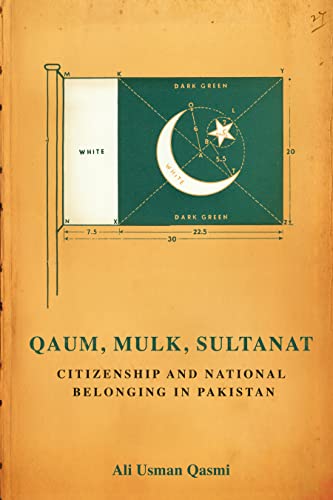
After the trauma of mass violence and massive population movements around the partition of India and Pakistan in 1947, both new nation states faced the enormous challenge of creating new national narratives, symbols, and histories, as well as a new framework for their political life. While leadership in India claimed the anti-colonial movement, Gandhi, and a civilizational legacy in the subcontinent, the new political elite in Pakistan were faced with a more complex to carve out a separate and distinct Muslim history and political tradition from a millennium long history of cultural and religious interaction, mixing, and coexistence.
Drawing on a rich archive of diverse sources, Ali Qasmi traces the complex development of ideas of citizenship and national belonging in the postcolonial Muslim state, offering a nuanced and sweeping history of the country's formative period. Qasmi paints a rich picture of the long, arduous, and often conflict-ridden process of writing a democratic constitution of Pakistan, while simultaneously narrating the invention of a range of new rituals of state—such as the exact color of the flag, the precise date of birth of the national poet of Pakistan, and the observation of Eid as a "national festival"—providing an illuminating analysis of the practices of being Pakistani, and a new portrait of Muslim history in the subcontinent.
of this period in pakistan, i think it is only some of the essays from muhammad asad that as a young teenager gave me some sense of what early pakistani nation-making looked like. while his contribution to this project is ultimately marginal, his appearance in this book was one among many surprising, fascinating and -- more than occasionally -- very funny elements of this past that made this book such a great read.
On the first few years of Pak. and how the postcolonial state inscribes the legibility of its power on bodies made legible, and conjures a preferred notion of qaum via commemorative acts, archival practices, museum designs, etc. Really delves into the post-partition calculus and ideological reasons for being pragmatic & pragmatic reasons for being ideological through things like descriptivist vs. non-descriptivist names, national anthem, waxing vs. waning moon on flag. The postscript was a fun read too.
Ali Usman Qasmi offers a deeply researched and thought provoking exploration of Pakistan’s formative years as a post colonial state. The book carefully unpacks how, from day 1, the state was engaged in defining not just constitutional structures but the very meaning of belonging, citizenship, & Islamic identity. One of the most striking themes in the book is how the early Pakistani state attempted to regulate and standardize matters that ranged from moon sighting to dress and public expressions of religiosity. In its effort to construct a cohesive post-colonial Islamic identity, the state selectively endorsed certain interpretations of religion while sidelining others. This created a constant tension between Ulema and the state. While segments of the clergy sought a stronger role in shaping the constitution according to their own vision of an Islamic polity, the state allowed only those elements that aligned with its political objectives. The resistance to these centralizing and Islamizing impulses particularly from representatives of East Pakistan and non Muslim members of the Constituent Assembly. Through detailed anecdotes and debates from the Constituent Assembly the author tells how things were moving forward in initial days with regards to how State wanted to define everything in the name of their own interpretation of Islam & Statehood. The book stands out for grounding ideological debates in archival material and assembly proceedings, making it both analytically rigorous and narratively engaging. It does go a bit academic and challenging to read but the anecdotes keep it afloat. It challenges simplified narratives about Pakistan’s origins and instead presents the state as a site of ongoing struggle over identity, sovereignty, and citizenship. Overall, this book is an essential read for anyone interested in Pakistan’s constitutional history and post colonial state formation.
This is a genuinely informative book that offers a valuable and often overlooked perspective on Pakistan's formative years, making it a great resource for students of the subject. My only reservation is that the writing style felt more complex than necessary at times, which made it a little difficult to get through. With some tightening, this could have been a much more enjoyable read, but the insights it contains are certainly worth the effort.
This was a dense read, and it took me quite a while to go through the entire book. Qasmi is an amazing historian, utilizing archives to carry out a deep analysis into the construction of Pakistani nationality, nationhood, citizenship and identity.