

What do you think?

Miracleman #1
Miracleman Prem Hardcover Book 01 Dream Of Flying Direct Market Quesada Variant Edition
KIMOTA! With one magic word, a long-forgotten legend lives again! Freelance reporter Michael Moran always knew he was meant for something more -- now, a strange series of events leads him to reclaim his destiny! • Relive the ground-breaking eighties adventures that captured lightning in a bottle -- or experience them for the first time -- in these digitally restored, fully relettered editions! • Issue 1 includes material originally presented in WARRIOR #1 and MIRACLEMAN #1, plus the MARVELMAN PRIMER. Issue #2 includes material originally presented in WARRIOR #1-5, plus bonus material
128 pages, Hardcover
First published June 7, 1990
About the author
Alan Moore
1,633 books22.3k followersAlan Moore is an English writer most famous for his influential work in comics, including the acclaimed graphic novels Watchmen, V for Vendetta and From Hell. He has also written a novel, Voice of the Fire, and performs "workings" (one-off performance art/spoken word pieces) with The Moon and Serpent Grand Egyptian Theatre of Marvels, some of which have been released on CD.
As a comics writer, Moore is notable for being one of the first writers to apply literary and formalist sensibilities to the mainstream of the medium. As well as including challenging subject matter and adult themes, he brings a wide range of influences to his work, from the literary–authors such as William S. Burroughs, Thomas Pynchon, Robert Anton Wilson and Iain Sinclair; New Wave science fiction writers such as Michael Moorcock; horror writers such as Clive Barker; to the cinematic–filmmakers such as Nicolas Roeg. Influences within comics include Will Eisner, Harvey Kurtzman, Jack Kirby and Bryan Talbot.
As a comics writer, Moore is notable for being one of the first writers to apply literary and formalist sensibilities to the mainstream of the medium. As well as including challenging subject matter and adult themes, he brings a wide range of influences to his work, from the literary–authors such as William S. Burroughs, Thomas Pynchon, Robert Anton Wilson and Iain Sinclair; New Wave science fiction writers such as Michael Moorcock; horror writers such as Clive Barker; to the cinematic–filmmakers such as Nicolas Roeg. Influences within comics include Will Eisner, Harvey Kurtzman, Jack Kirby and Bryan Talbot.
Ratings & Reviews
Friends & Following
Create a free account to discover what your friends think of this book!
Community Reviews
Displaying 1 - 30 of 371 reviews

June 1, 2020
Turn everything off (including your phone), put up your feet and enter the world of Miracleman a masterclass Alan Moore jam! This is an absolutely genius reinterpretation and reimagining of the 1950's comic book and superheroes, starting off with a great origin story (one of the best ever) and Project Zarathustra! Words cannot even begin to explain how different this is to every other superhero book ever written, just go and get it and read it! 9 out of 12, very strong Four Stars and the same again for 2015 re-read. Collects Miracleman #1 to 5.
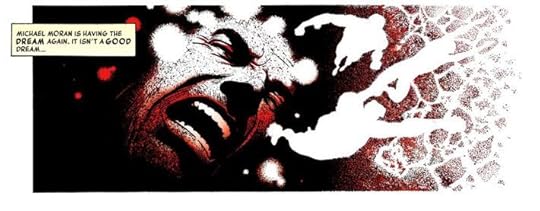
2015 and 2013 read
2015 and 2013 read

January 23, 2013
Miraculous reading!!!
This TPB edition collects the first storyarc known as “A Dream of Flying” featuring issues #1-4 of “Miracleman” (originally published in chapters in the comic book “Warrior” #1-11), plus additional stories “The Yesterday Gambit”, “Cold War, Cold Warrior”, “Ghost-Dance”, along with a “Behind-of-Scenes” section with sketches, pin-ups, cover variants, etc…
Creative Team:
Writer: Alan Moore (despicted as “The Original Writer”, based on characters created by Mick Anglo)
Illustrators: Garry Leach, Alan Davis, Steve Dillon, Don Lawrence & Paul Neary
LIFE AND TIMES OF MIRACLEMAN
Damn you, Liz, you’re laughing at my life!!
Miracleman has a long, polemic, and messy history.
Way back in the good ol’ 50s, L. Miller & Son, Ltd., a British Publisher house, had a license to reprint issues of Shazam!, and it was a thunderous (pun intended) success in England. However, Fawcett Comics didn’t have enough money anymore to keep its legal battle against DC Comics about the claim that the character of Captain Marvel was a pastiche of Superman (Now both characters are property of DC Comics). So, back then, with the trouble of no more new issues of Shazam! meant that L. Miller & Son didn’t have anymore something to reprint, so to avoid going out of business, it hired Mick Anglo to create a character to replace Captain Marvel.
To be blunt, Mick Anglo didn’t burn many neurons, since Marvelman is indeed a real pastiche of Captain Marvel, along with support characters clearly copied from Captain Marvel, Jr., Dr. Sivana and Black Adam.
Mick Moran was a kid working as copy boy at the Daily Bugle (No, not that one! Yep, ol’ Mick Anglo didn’t waste neurons at all, and he was like a walking lawsuit) and after meeting an alien “Astro-Physicist” named Guntag Borghelm, Mick Moran got superpowers (flight, super-strenght, invulnerability, all the good stuff!) and he only had to say the magic word: Kimota (Atomic, phonetically backwards).
Soon enough he got allies: Young Marvelman and Kid Miracleman, with similar powers but they have to say the magic word: “Marvelman” (Yes, as well as with Captain Marvel, Jr, it’s way dumb that their magic word is part of their battlenames!). And their main villains were Young Nastyman, Dr. Gargunza and Young Gargunza. And believe it or not, this was able to sell quite good, in the UK, for 10 years (1953-1963).
THE PEOPLE VS TODD MCFARLANE
It’s coming this way, and it’s a monster…
But, don’t be so harsh on good ol’ Mick Anglo, since thanks to his “creation”, Alan Moore was able to work on it…
…It’s clear that Alan Moore should read Marvelman when he was a kid and I’m sure that he loved it, since Alan Moore’s love for comic books is as big as the world (and more). No wonder that he wanted to do something to bring back Marvelman to the pages of comics, but he knew that what works in the sunny and campy 50s and 60s wouldn’t work in the dark and cynical 80s. Moore loved the original Marvelman as a kid, but he wasn’t a kid anymore, so, his angle was how to make to work a children’s book to appeal to those adults that loved it too, but they aren’t kids anymore neither, along with any other new adult reader who want to try the comic book.
But, it wasn’t about just a simple reboot, making everything dark and violent, while dismissing any trace of its original campy origins. No, Moore doesn’t like the easy path. Moore’s genius was finding a way to keep all that campy stuff as part of the past life of the characters in the comic book, while presenting a believable and logical development of them, now living in the 80s.
Miracleman’s take by Moore, was originally published as “Marvelman”, but Marvel Comics treated to sue for the use of the word “Marvel” in the name of the characters (Now, it’s part of Marvel Comics, yet another irony in the wonderful world of comics). So, the character and the title went for “Miracleman”. The title was able to tell its story, the main run by Alan Moore and later was taken by Neil Gaiman (close friend of Alan Moore). However, Quality Communications, the British publishing house of Miracleman, went out of business, and the copyrights of Miracleman went to a messy hell.
Todd McFarlane (you know, that guy who created Spawn) bought the copyrights of Eclipse Comics, an American “deceased” publishing house, which supposedly possessed the right to publish material related to Miracleman, and based on that, McFarlane inserted the character in one of his comics, Hellspawn, along with stopping any attempt to re-print Moore’s Miracleman in trade paperbacks by Marvel Comics (since Moore gave away for free his own rights over the character in the hope that readers would be able to read Miracleman (since the printing of Quality Communications were already too rare to find)).
Thankfully, Neil Gaiman was working with Marvel by then (maybe you heard… Marvel: 1602) and Gaiman engaged into a legal battle against McFarlane, which was eventually won by the good guys after demonstrate that Eclipse Comics never was owner of the copyrights of Miracleman. The coast was clear again and Marvel Comics was able to re-print again in TPBs the iconical run by Alan Moore of Miracleman, and thanks to that, I was able to buy them finally to add them to my collection (Since I am a huge fan of Alan Moore, I was sad at some moment, thinking that I wouldn’t be able to have Miracleman, a vital work of Moore’s creative career).
Michael Moran is an adult now, he is married, living in London and working as freelance reporter. He is not hero, he doesn’t have any powers. However, he has an odd dream…
…a dream of flying.
Michael Moran’s life soon will be an epic maelstrom of magic words, impossible powers, campy childhoods, broken families, government secrets, mad scientists, professional assassins, superpowered psychos and more… much more!!!
Miracleman is an essential reading piece for Alan Moore’s fans, but also is a smart study of the super-hero genre, how it can work in the real world, and how material of the comics’ golden age can be adapted into modern era without losing its legacy’s charm.
If Watchmen was Alan Moore’s answer of how a team of superheroes would really interact, and you can know how unmerciful interacting can be and how hard is to reach an effective teamwork…
…well,…
In Miracleman is about how a family of superheroes would really grow up, and you can know how painful growing up can be and how easy is to reach a family feud…
Team? It’s about work. Work is business. Family? It’s about… blood. Blood is personal.
This TPB edition collects the first storyarc known as “A Dream of Flying” featuring issues #1-4 of “Miracleman” (originally published in chapters in the comic book “Warrior” #1-11), plus additional stories “The Yesterday Gambit”, “Cold War, Cold Warrior”, “Ghost-Dance”, along with a “Behind-of-Scenes” section with sketches, pin-ups, cover variants, etc…
Creative Team:
Writer: Alan Moore (despicted as “The Original Writer”, based on characters created by Mick Anglo)
Illustrators: Garry Leach, Alan Davis, Steve Dillon, Don Lawrence & Paul Neary
LIFE AND TIMES OF MIRACLEMAN
Damn you, Liz, you’re laughing at my life!!
Miracleman has a long, polemic, and messy history.
Way back in the good ol’ 50s, L. Miller & Son, Ltd., a British Publisher house, had a license to reprint issues of Shazam!, and it was a thunderous (pun intended) success in England. However, Fawcett Comics didn’t have enough money anymore to keep its legal battle against DC Comics about the claim that the character of Captain Marvel was a pastiche of Superman (Now both characters are property of DC Comics). So, back then, with the trouble of no more new issues of Shazam! meant that L. Miller & Son didn’t have anymore something to reprint, so to avoid going out of business, it hired Mick Anglo to create a character to replace Captain Marvel.
To be blunt, Mick Anglo didn’t burn many neurons, since Marvelman is indeed a real pastiche of Captain Marvel, along with support characters clearly copied from Captain Marvel, Jr., Dr. Sivana and Black Adam.
Mick Moran was a kid working as copy boy at the Daily Bugle (No, not that one! Yep, ol’ Mick Anglo didn’t waste neurons at all, and he was like a walking lawsuit) and after meeting an alien “Astro-Physicist” named Guntag Borghelm, Mick Moran got superpowers (flight, super-strenght, invulnerability, all the good stuff!) and he only had to say the magic word: Kimota (Atomic, phonetically backwards).
Soon enough he got allies: Young Marvelman and Kid Miracleman, with similar powers but they have to say the magic word: “Marvelman” (Yes, as well as with Captain Marvel, Jr, it’s way dumb that their magic word is part of their battlenames!). And their main villains were Young Nastyman, Dr. Gargunza and Young Gargunza. And believe it or not, this was able to sell quite good, in the UK, for 10 years (1953-1963).
THE PEOPLE VS TODD MCFARLANE
It’s coming this way, and it’s a monster…
But, don’t be so harsh on good ol’ Mick Anglo, since thanks to his “creation”, Alan Moore was able to work on it…
…It’s clear that Alan Moore should read Marvelman when he was a kid and I’m sure that he loved it, since Alan Moore’s love for comic books is as big as the world (and more). No wonder that he wanted to do something to bring back Marvelman to the pages of comics, but he knew that what works in the sunny and campy 50s and 60s wouldn’t work in the dark and cynical 80s. Moore loved the original Marvelman as a kid, but he wasn’t a kid anymore, so, his angle was how to make to work a children’s book to appeal to those adults that loved it too, but they aren’t kids anymore neither, along with any other new adult reader who want to try the comic book.
But, it wasn’t about just a simple reboot, making everything dark and violent, while dismissing any trace of its original campy origins. No, Moore doesn’t like the easy path. Moore’s genius was finding a way to keep all that campy stuff as part of the past life of the characters in the comic book, while presenting a believable and logical development of them, now living in the 80s.
Miracleman’s take by Moore, was originally published as “Marvelman”, but Marvel Comics treated to sue for the use of the word “Marvel” in the name of the characters (Now, it’s part of Marvel Comics, yet another irony in the wonderful world of comics). So, the character and the title went for “Miracleman”. The title was able to tell its story, the main run by Alan Moore and later was taken by Neil Gaiman (close friend of Alan Moore). However, Quality Communications, the British publishing house of Miracleman, went out of business, and the copyrights of Miracleman went to a messy hell.
Todd McFarlane (you know, that guy who created Spawn) bought the copyrights of Eclipse Comics, an American “deceased” publishing house, which supposedly possessed the right to publish material related to Miracleman, and based on that, McFarlane inserted the character in one of his comics, Hellspawn, along with stopping any attempt to re-print Moore’s Miracleman in trade paperbacks by Marvel Comics (since Moore gave away for free his own rights over the character in the hope that readers would be able to read Miracleman (since the printing of Quality Communications were already too rare to find)).
Thankfully, Neil Gaiman was working with Marvel by then (maybe you heard… Marvel: 1602) and Gaiman engaged into a legal battle against McFarlane, which was eventually won by the good guys after demonstrate that Eclipse Comics never was owner of the copyrights of Miracleman. The coast was clear again and Marvel Comics was able to re-print again in TPBs the iconical run by Alan Moore of Miracleman, and thanks to that, I was able to buy them finally to add them to my collection (Since I am a huge fan of Alan Moore, I was sad at some moment, thinking that I wouldn’t be able to have Miracleman, a vital work of Moore’s creative career).
Michael Moran is an adult now, he is married, living in London and working as freelance reporter. He is not hero, he doesn’t have any powers. However, he has an odd dream…
…a dream of flying.
Michael Moran’s life soon will be an epic maelstrom of magic words, impossible powers, campy childhoods, broken families, government secrets, mad scientists, professional assassins, superpowered psychos and more… much more!!!
Miracleman is an essential reading piece for Alan Moore’s fans, but also is a smart study of the super-hero genre, how it can work in the real world, and how material of the comics’ golden age can be adapted into modern era without losing its legacy’s charm.
If Watchmen was Alan Moore’s answer of how a team of superheroes would really interact, and you can know how unmerciful interacting can be and how hard is to reach an effective teamwork…
…well,…
In Miracleman is about how a family of superheroes would really grow up, and you can know how painful growing up can be and how easy is to reach a family feud…
Team? It’s about work. Work is business. Family? It’s about… blood. Blood is personal.

January 7, 2016
After an almost 20 year absence, Miracleman reappears, throwing his alter ego Mike Moran's life into chaos...
Back in the day, before he was Alan Moore: Supreme Curmudgeon and Master of Beards, Alan Moore was simply a cutting edge comic book writer. Miracleman was his ticket to the big time, before Swamp Thing, before Watchmen, before whatever it is he's doing these days besides seemingly being pissed off all the time.
Miracleman started life as Marvelman, a 1950s British Captain Marvel homage/ripoff. Moore, Alan Davis, and some others brought him back in the pages of Warrior, a UK comic magazine. How does one revive a ripoff character from the 50s and make him relevant?
Spectacularly! That's how. Moore takes essentially a kid's comic, breaks it down, and shows what superheroes might be like in real life. I love how he deconstructs the Captain Marvel-like hero and actually makes it believable. Also, this volume nicely illustrates the carnage super heroes would create in the real world.
I do have a couple gripes, though. This volume is super thin for what it costs. Also, I'd much rather have a couple more issues included instead of the Warpsmith material and the sketches, especially considering I still have a couple issues of Warrior and Miracleman lying in some dark corner of the Dan Cave.
All things considered, Miracleman is still pretty damn good and a cool piece of 1980s comic book history. Four out of five stars.
2024 Upon a reread, my feelings haven't changed much in the last eight years. It's still good and I amended the review in places. I think this book's time has passed. It was so influential at the time that it doesn't seem remarkable anymore. Its influence is felt everywhere. Kind of like the way John Carter of Mars doesn't seem that imaginative since Star Wars has been pillaging it for the last 40 years or so.
Back in the day, before he was Alan Moore: Supreme Curmudgeon and Master of Beards, Alan Moore was simply a cutting edge comic book writer. Miracleman was his ticket to the big time, before Swamp Thing, before Watchmen, before whatever it is he's doing these days besides seemingly being pissed off all the time.
Miracleman started life as Marvelman, a 1950s British Captain Marvel homage/ripoff. Moore, Alan Davis, and some others brought him back in the pages of Warrior, a UK comic magazine. How does one revive a ripoff character from the 50s and make him relevant?
Spectacularly! That's how. Moore takes essentially a kid's comic, breaks it down, and shows what superheroes might be like in real life. I love how he deconstructs the Captain Marvel-like hero and actually makes it believable. Also, this volume nicely illustrates the carnage super heroes would create in the real world.
I do have a couple gripes, though. This volume is super thin for what it costs. Also, I'd much rather have a couple more issues included instead of the Warpsmith material and the sketches, especially considering I still have a couple issues of Warrior and Miracleman lying in some dark corner of the Dan Cave.
All things considered, Miracleman is still pretty damn good and a cool piece of 1980s comic book history. Four out of five stars.
2024 Upon a reread, my feelings haven't changed much in the last eight years. It's still good and I amended the review in places. I think this book's time has passed. It was so influential at the time that it doesn't seem remarkable anymore. Its influence is felt everywhere. Kind of like the way John Carter of Mars doesn't seem that imaginative since Star Wars has been pillaging it for the last 40 years or so.

February 18, 2015
This is proto Alan Moore, in which he takes 1950’s comic conventions and tries to turn them on their ear in a smarty-pants, overambitious, BIG ideas kind of way. It’s a matryoshka doll type of story, where ideas are nestled within ideas. You keep opening the egg after egg until your left with a big, empty, dissatisfied feeling of weariness.
I’m not just about throwing two proverbial pigs in a gunny sack kind of comics reader; I’m all for smart writing in comics, but I don’t need to read florid, grandiose captions written above a panel where someone just got blown to bits in an explosion. It’s a comic book – show me, not have me read your pretentious, over-cooked word play.
The supplementary stories included within this package left me with the same type of headache I got after I watched Ang Lee’s Hulk.
I’m not just about throwing two proverbial pigs in a gunny sack kind of comics reader; I’m all for smart writing in comics, but I don’t need to read florid, grandiose captions written above a panel where someone just got blown to bits in an explosion. It’s a comic book – show me, not have me read your pretentious, over-cooked word play.
The supplementary stories included within this package left me with the same type of headache I got after I watched Ang Lee’s Hulk.

April 10, 2014
Miracleman is a legendary comic that’s been off bookshelves and in legal limbo for many, many years.
Miracleman’s complicated history goes back to the Golden Age when he was created as a British knockoff of the popular DC Comics Captain Marvel character (who today is called Shazam), an origin which would see the character dragged through the courts for decades. When arguably the most famous comics writer there’s ever been, Alan Moore, came to write Miracleman at the start of his career, he managed to rejuvenate him with a fresh, bold new vision before finishing his run and passing it on to a young writer who’d just started out – Neil Gaiman.
Gaiman would never finish his run and went on to popularise another forgotten series, Sandman (which he’d begun the year previous to Miracleman), while the Marvelman/Miracleman books would go out of print due to copyright claims (though recently Marvel and Gaiman announced that Gaiman would be finally completing his Miracleman story – expect it sometime in 2016!). The Miracleman books have been out of print for years and have been touted as one of the greatest superhero comics ever created, from those who were lucky enough to read it.
Things changed a couple of years ago when the numerous legal cases were settled and Marvel emerged as the sole owner of the Miracleman comics. Marvel head honcho, Joe Quesada, began to lay the groundwork for a reissuing of all of the comics by touching up the art – re-colouring, re-inking all of the pages –and, in January 2014, more than 30 years after it first launched in the pages of long-defunct British magazine Warrior, Alan Moore and Garry Leach’s Miracleman was back in print!
Besides the newly restored (and gorgeous!) artwork, Marvel agreed to Moore’s request to remove his name from the new editions – he would be credited only as The Original Writer. So now that the first book in the series has been released, does Miracleman, Book 1: A Dream of Flying live up to the hype – is it really as good as older comics readers claimed it to be? In a word, yes – and I say this as not much of an Alan Moore fan!
Taking its cue from a Silver Age comic where, in a devastating event, Miracleman is so hurt that his memory is wiped, Young Miracleman is killed and Kid Miracleman goes missing, the book opens decades later with a middle-aged Michael Moran having traumatic dreams of flying through space - he’s forgotten that he was once Miracleman. Moran is now a married freelance reporter who can’t conceive a child with his wife, but, one day, while covering a nuclear power protest, he sees the word “atomic” backwards, says it, and transforms into Miracleman: KIMOTA (which is actually atomik but whatever)!
The most striking thing when reading this 30+ year old comic is how fresh it reads. Check out other superhero comics from the early 80s and a great many haven’t aged well (Chris Claremont’s clunky X-Men comics are a good example). But Moore’s (I refuse to refer to him as the pretentious Original Writer) work has endured so well that it feels like it’s a contemporary comic. I’d even say it’s much better written than his recent League of Extraordinary Gentlemen books. It’s also amazing how he’s able to cram so much story into so few pages – the Miracleman “issues” were part of an anthology magazine so were limited to 6-8 pages and yet read like full length comics!
But it’s the ideas and the execution that make Miracleman stand out. Moore explores the fascinating duality of superheroes through Miracleman managing to impregnate his wife while his real self, Mike Moran, couldn’t, and what that means to Mike, while Kid Miracleman’s story is creepy beyond belief as his superhero self takes over his original identity and becomes an enormously powerful supervillain. Little details like Mike and his wife discovering the extent of Miracleman’s powers by purchasing comics and running through the list of other superheroes’ powers to see what he can and can’t do make this that much more of a brilliant read.
I wouldn’t say every aspect of Moore’s Miracleman works perfectly. There are some bizarre side characters from the future called the Warpsmiths who talk in this hideous-to-read Clockwork Orange facsimile style and whose stories were so abstract that I could not follow – or really care about - what was happening. And towards the end of the book, Moore begins to over-write so the pacing of the stories drops and drops until the pages are filled with characters’ standing about tiresomely soliloquising.
The art is another aspect of the book that’s amazing. The credits in this book are a murderer’s row of legendary comics artists: Garry Leach, Alan Davis, Paul Neary and Steve Dillon. Despite the varying artists, they try to maintain a consistent look to the comic though you can see bits and pieces here and there of the kind of art styles they would develop in later years. Dillon’s artwork though is unrecognisable from the kind he drew when he was a kid starting out on Miracleman to the artist he is today, working for Marvel.
Miracleman, Book 1: A Dream of Flying is definitely worth reading if you’re a superhero comics fan - it’s smart and full of great ideas, it’s entertaining and highly readable with stunning artwork and is easily one of the best Alan Moore books I’ve ever read. More importantly for those of us who’ve been wanting to read the book for years but didn’t want to pay hundreds on eBay for a copy, we now have affordable versions of the legendary classic available for the first time in decades – check it out for yourself and find out why it has the reputation it does!
Miracleman’s complicated history goes back to the Golden Age when he was created as a British knockoff of the popular DC Comics Captain Marvel character (who today is called Shazam), an origin which would see the character dragged through the courts for decades. When arguably the most famous comics writer there’s ever been, Alan Moore, came to write Miracleman at the start of his career, he managed to rejuvenate him with a fresh, bold new vision before finishing his run and passing it on to a young writer who’d just started out – Neil Gaiman.
Gaiman would never finish his run and went on to popularise another forgotten series, Sandman (which he’d begun the year previous to Miracleman), while the Marvelman/Miracleman books would go out of print due to copyright claims (though recently Marvel and Gaiman announced that Gaiman would be finally completing his Miracleman story – expect it sometime in 2016!). The Miracleman books have been out of print for years and have been touted as one of the greatest superhero comics ever created, from those who were lucky enough to read it.
Things changed a couple of years ago when the numerous legal cases were settled and Marvel emerged as the sole owner of the Miracleman comics. Marvel head honcho, Joe Quesada, began to lay the groundwork for a reissuing of all of the comics by touching up the art – re-colouring, re-inking all of the pages –and, in January 2014, more than 30 years after it first launched in the pages of long-defunct British magazine Warrior, Alan Moore and Garry Leach’s Miracleman was back in print!
Besides the newly restored (and gorgeous!) artwork, Marvel agreed to Moore’s request to remove his name from the new editions – he would be credited only as The Original Writer. So now that the first book in the series has been released, does Miracleman, Book 1: A Dream of Flying live up to the hype – is it really as good as older comics readers claimed it to be? In a word, yes – and I say this as not much of an Alan Moore fan!
Taking its cue from a Silver Age comic where, in a devastating event, Miracleman is so hurt that his memory is wiped, Young Miracleman is killed and Kid Miracleman goes missing, the book opens decades later with a middle-aged Michael Moran having traumatic dreams of flying through space - he’s forgotten that he was once Miracleman. Moran is now a married freelance reporter who can’t conceive a child with his wife, but, one day, while covering a nuclear power protest, he sees the word “atomic” backwards, says it, and transforms into Miracleman: KIMOTA (which is actually atomik but whatever)!
The most striking thing when reading this 30+ year old comic is how fresh it reads. Check out other superhero comics from the early 80s and a great many haven’t aged well (Chris Claremont’s clunky X-Men comics are a good example). But Moore’s (I refuse to refer to him as the pretentious Original Writer) work has endured so well that it feels like it’s a contemporary comic. I’d even say it’s much better written than his recent League of Extraordinary Gentlemen books. It’s also amazing how he’s able to cram so much story into so few pages – the Miracleman “issues” were part of an anthology magazine so were limited to 6-8 pages and yet read like full length comics!
But it’s the ideas and the execution that make Miracleman stand out. Moore explores the fascinating duality of superheroes through Miracleman managing to impregnate his wife while his real self, Mike Moran, couldn’t, and what that means to Mike, while Kid Miracleman’s story is creepy beyond belief as his superhero self takes over his original identity and becomes an enormously powerful supervillain. Little details like Mike and his wife discovering the extent of Miracleman’s powers by purchasing comics and running through the list of other superheroes’ powers to see what he can and can’t do make this that much more of a brilliant read.
I wouldn’t say every aspect of Moore’s Miracleman works perfectly. There are some bizarre side characters from the future called the Warpsmiths who talk in this hideous-to-read Clockwork Orange facsimile style and whose stories were so abstract that I could not follow – or really care about - what was happening. And towards the end of the book, Moore begins to over-write so the pacing of the stories drops and drops until the pages are filled with characters’ standing about tiresomely soliloquising.
The art is another aspect of the book that’s amazing. The credits in this book are a murderer’s row of legendary comics artists: Garry Leach, Alan Davis, Paul Neary and Steve Dillon. Despite the varying artists, they try to maintain a consistent look to the comic though you can see bits and pieces here and there of the kind of art styles they would develop in later years. Dillon’s artwork though is unrecognisable from the kind he drew when he was a kid starting out on Miracleman to the artist he is today, working for Marvel.
Miracleman, Book 1: A Dream of Flying is definitely worth reading if you’re a superhero comics fan - it’s smart and full of great ideas, it’s entertaining and highly readable with stunning artwork and is easily one of the best Alan Moore books I’ve ever read. More importantly for those of us who’ve been wanting to read the book for years but didn’t want to pay hundreds on eBay for a copy, we now have affordable versions of the legendary classic available for the first time in decades – check it out for yourself and find out why it has the reputation it does!

September 19, 2014
A god shall walk among men, thus spake Zarathustra; this one walks from the technicolor innocence of the comic book 1950s into the dark and grime of the real world 1980s. A meta commentary on that ridiculous, wonderful innocence, an homage and a critique as well. A boy-hero transforms into a bloodthirsty villain; a teen-hero transforms into a schlubby everyman. A schlubby everyman becomes a living god; a happy dream of flying is suddenly remembered!
But is this truly so? Here be dragons, and unexplored territories – at least in 1985, before Watchmen. Alan Moore had his ideas and themes already perfectly formed, his darker directions already mapped out. His smart deconstruction and reconstruction of comic tropes and hero archetypes never blunt his story’s visceral shocks or disguise its messily emotional foundation. The dialogue and narration move from angst-filled realism to surreal poetry. His Miracleman moves from knowable to unknowable. Garry Leach’s superb art moves from ambiguous waking dream to throbbing nightmare.
The answer to all the questions, the actual origin story... amazing. Out of the darkness, into more darkness. The dreamer dreams a dream; the scientists conduct an experiment.


But is this truly so? Here be dragons, and unexplored territories – at least in 1985, before Watchmen. Alan Moore had his ideas and themes already perfectly formed, his darker directions already mapped out. His smart deconstruction and reconstruction of comic tropes and hero archetypes never blunt his story’s visceral shocks or disguise its messily emotional foundation. The dialogue and narration move from angst-filled realism to surreal poetry. His Miracleman moves from knowable to unknowable. Garry Leach’s superb art moves from ambiguous waking dream to throbbing nightmare.

The answer to all the questions, the actual origin story... amazing. Out of the darkness, into more darkness. The dreamer dreams a dream; the scientists conduct an experiment.


August 12, 2016
There Are Men, and the Men Mean Nothing to Him...
Originally published under the title “Marvelman” from 1982 to 1984 in the pages of a British black-and-white comic-book anthology called Warrior, Alan Moore’s Miracleman re-imagines a lighthearted, rather juvenile Captain Marvel knockoff from the 1950s for the much darker, much more cynical 1980s. It marks the end of the innocence for the superhero, and the beginning of the so-called “British Invasion” of American mainstream comics: From 1985 on, “Marvelman” would be reprinted as Miracleman (in order to stave off threats of legal action from Marvel Comics) for the American market.
Until Moore’s “Marvelman” came along, superhero comics had been targeted almost exclusively at children (despite Marvel’s promotional claims of the 1960s to be producing “pop art” for college hipsters). They had been designed to deliver, rather than undermine, power fantasies, and the inevitable clashes between heroes and villains had always abode by the unwritten yet pleasantly familiar rules of the genre: “It was almost as if we were all playing a game, a game which neither side took entirely seriously.” In Moore’s fictional world, however, there is nothing playful or pleasantly familiar or reassuring about a superhero fight:
“There is a passion here, but not human passion. There is fierce and desperate emotion, but not an emotion that we would recognize... They are titans, and we will never understand the alien inferno that blazes in the furnace of their souls. We will never grasp their hopes, their despair, never comprehend the blistering rage that informs each devastating blow... We will never know the destiny that howls in their hearts, never know their pain, their love, their almost sexual hatred... And perhaps we will be the less for that.”
Moore’s superhero has lost touch with humanity. We learn that his semi-mystical, Captain Marvel-inspired origin is merely a computer program the military secretly installed along with the super-powers. The idea was to create the ultimate weapon, and to keep this weapon in check with the help of an artificial consciousness created along the lines of simplistic superhero tropes. As it turns out, though, Marvelman is far too powerful to follow man-made rules of any kind:
“Out of the dark, he is coming... There are walls, and he does not care about the walls. There are men, and the men mean nothing to him. There are snares... and the snares are not worthy of his contempt.”
Casting the superhero as a dangerously naive power fantasy we should have outgrown a long time ago, “Marvelman” is an early expression of Alan Moore’s frustration with the comic-book industry as well as with the rise of neoliberal politics. To Moore’s mind, the continued dominance of the superhero genre not only stifles the medium’s evolution but also promotes faith in redeemers from above--the kind of faith that appeared increasingly problematic at a time when Thatcherism and Reaganomics were starting to dismantle the welfare state for the sake of corporate profits.
In terms of storytelling, “Marvelman” is still a bit of a bumpy ride: it jumps around rather wildly in places, gets unnecessarily difficult here and overtly wordy there, and is generally not yet as convincingly conceived and elegantly executed as Moore’s later anti-superhero masterpiece Watchmen. That being said, “Marvelman” features some of the most stunning scenes Moore has ever created, and it certainly stands head and shoulders above your typical comic book from the early 1980s.
What bothers me about this book is something else: Couldn’t Marvel Comics, the very publisher that enforced the name change from “Marvelman” to “Miracleman” in the mid-1980s, have returned to the original title and character name now that they own the rights? Couldn’t they have reprinted the story in its original British format instead of forcing it into the American one? Couldn’t they have put a few more than 113 pages of actual story into a hardcover book priced at US$30? And last but not least, did they really have to digitally color the beautiful original black-and-white artwork by Garry Leach and Alan Davis? Oh well, at least “Marvelman” is finally back in print...
Originally published under the title “Marvelman” from 1982 to 1984 in the pages of a British black-and-white comic-book anthology called Warrior, Alan Moore’s Miracleman re-imagines a lighthearted, rather juvenile Captain Marvel knockoff from the 1950s for the much darker, much more cynical 1980s. It marks the end of the innocence for the superhero, and the beginning of the so-called “British Invasion” of American mainstream comics: From 1985 on, “Marvelman” would be reprinted as Miracleman (in order to stave off threats of legal action from Marvel Comics) for the American market.
Until Moore’s “Marvelman” came along, superhero comics had been targeted almost exclusively at children (despite Marvel’s promotional claims of the 1960s to be producing “pop art” for college hipsters). They had been designed to deliver, rather than undermine, power fantasies, and the inevitable clashes between heroes and villains had always abode by the unwritten yet pleasantly familiar rules of the genre: “It was almost as if we were all playing a game, a game which neither side took entirely seriously.” In Moore’s fictional world, however, there is nothing playful or pleasantly familiar or reassuring about a superhero fight:
“There is a passion here, but not human passion. There is fierce and desperate emotion, but not an emotion that we would recognize... They are titans, and we will never understand the alien inferno that blazes in the furnace of their souls. We will never grasp their hopes, their despair, never comprehend the blistering rage that informs each devastating blow... We will never know the destiny that howls in their hearts, never know their pain, their love, their almost sexual hatred... And perhaps we will be the less for that.”
Moore’s superhero has lost touch with humanity. We learn that his semi-mystical, Captain Marvel-inspired origin is merely a computer program the military secretly installed along with the super-powers. The idea was to create the ultimate weapon, and to keep this weapon in check with the help of an artificial consciousness created along the lines of simplistic superhero tropes. As it turns out, though, Marvelman is far too powerful to follow man-made rules of any kind:
“Out of the dark, he is coming... There are walls, and he does not care about the walls. There are men, and the men mean nothing to him. There are snares... and the snares are not worthy of his contempt.”
Casting the superhero as a dangerously naive power fantasy we should have outgrown a long time ago, “Marvelman” is an early expression of Alan Moore’s frustration with the comic-book industry as well as with the rise of neoliberal politics. To Moore’s mind, the continued dominance of the superhero genre not only stifles the medium’s evolution but also promotes faith in redeemers from above--the kind of faith that appeared increasingly problematic at a time when Thatcherism and Reaganomics were starting to dismantle the welfare state for the sake of corporate profits.
In terms of storytelling, “Marvelman” is still a bit of a bumpy ride: it jumps around rather wildly in places, gets unnecessarily difficult here and overtly wordy there, and is generally not yet as convincingly conceived and elegantly executed as Moore’s later anti-superhero masterpiece Watchmen. That being said, “Marvelman” features some of the most stunning scenes Moore has ever created, and it certainly stands head and shoulders above your typical comic book from the early 1980s.
What bothers me about this book is something else: Couldn’t Marvel Comics, the very publisher that enforced the name change from “Marvelman” to “Miracleman” in the mid-1980s, have returned to the original title and character name now that they own the rights? Couldn’t they have reprinted the story in its original British format instead of forcing it into the American one? Couldn’t they have put a few more than 113 pages of actual story into a hardcover book priced at US$30? And last but not least, did they really have to digitally color the beautiful original black-and-white artwork by Garry Leach and Alan Davis? Oh well, at least “Marvelman” is finally back in print...
December 27, 2018
So it's insane I never even heard of this series. I've been reading comics for a LONG time but some I just never heard of. Buddy of mine told me this is Alan Moore's top 3 most talked about series next to V and Watchmen. Well damn, I had to jump on and read it.
So this starts off with a very goofy 50's superhero issue. Super cheesy and what you'd expect from comics written then. We then flip to the 80's and learn our hero is reborn! Michael Moran thought he was just a regular dude living his life with his wife. Then one day he mutters the words and becomes Miracleman! Very similar to Shazam, but with this story we take some dark turns. Very very dark and twisted turns.
Good: Really dug the feel of this comic. The look into superheroes and how screwed up it can become when it's all "a facade" for someone and he's actually an experiment of sorts. The villain here is really screwed up and loved how Miracleman, the hero of the story, gets his shit wrecked so quick. The lengthy dialogue for the most part actually has great moments and it's well written.
Bad: It is long-winded though. Heavy on exposition and dialogue boxes might turn some away. Also, the added on warpath or whatever issue is dull and stupid, skip it if you ask me. Adds nothing to the main story.
Overall, this is a really screwed up comic in a lot of ways but I was intrigued the whole time. Time to check out volume 2 and onward! A 4 out of 5.
So this starts off with a very goofy 50's superhero issue. Super cheesy and what you'd expect from comics written then. We then flip to the 80's and learn our hero is reborn! Michael Moran thought he was just a regular dude living his life with his wife. Then one day he mutters the words and becomes Miracleman! Very similar to Shazam, but with this story we take some dark turns. Very very dark and twisted turns.
Good: Really dug the feel of this comic. The look into superheroes and how screwed up it can become when it's all "a facade" for someone and he's actually an experiment of sorts. The villain here is really screwed up and loved how Miracleman, the hero of the story, gets his shit wrecked so quick. The lengthy dialogue for the most part actually has great moments and it's well written.
Bad: It is long-winded though. Heavy on exposition and dialogue boxes might turn some away. Also, the added on warpath or whatever issue is dull and stupid, skip it if you ask me. Adds nothing to the main story.
Overall, this is a really screwed up comic in a lot of ways but I was intrigued the whole time. Time to check out volume 2 and onward! A 4 out of 5.

January 17, 2021
The story, or history, of this series, is a bit of a mess. So let's get it out of the way. In 1953 some guy named Mike Anglo did a knock off of the Captain Marvel (DC) comics, lawsuits caused a name change but not really much else. Thus the character was named Marvelman - a young reporter named Micky Moran encounters an astrophysicist, instead of a wizard, who gives him superpowers based on atomic energy instead of magic. To transform into Marvelman, he speaks the word "Kimota", which is phonetically "atomic" backward, rather than "Shazam". Instead of Captain Marvel Jr. and Mary Marvel, Marvelman was joined by Dicky Dauntless, a teenage messenger boy who became Young Marvelman, and young Johnny Bates, who became Kid Marvelman; both of their magic words were "Marvelman".
In 1959 he went out of business. In 1982, in a British Anthology called "Warriror", Alan Moore recreated the character as "Miracleman". This is where the book starts. Now I am not known for much love for the older style of comics, so what gives?
Well, Alan Moore did something amazing. I truly did not know what to expect and I get the feeling many will not like it right off the bat. Moore's retelling is far darker and that appealed to me. It's a truly twisted tale, once you figure things out.
Michael Moran is presented as married, plagued by migraines, having dreams of flying, and unable to remember a word that had such significance in his dreams. Covering a terrorist attack his memory comes back and viola! Miracleman is back!
But all is not well-there has been a great deal of manipulation of Miracleman. Once he realizes that the explosion that killed his family was not what it seemed and the fact that Kid Miracleman (Johnny Bates) had survived and never stopped being the Kid Miracleman, as well as other revelations brought on by Mr. Cream, who worked for the Government that caused the entire mess, that changes his reality. The book ends with the conflict with Dr. Gargunza (Doctor Sivania anyone?), a former Nazi doctor.
What makes this book so good? The dark nature of the story replete with lies, betrayal, and sheer violence is a different take on the "Superman" story. In fact, in modern times, all those "What if Superman went rogue?" or "Hey Superman is an alien in mindset" stories? Yeah, they derive from this. On top of a truly dark story, that unfolds over several individual issues and tales, there seems to be more going on-I am still trying to ascertain the relationship with the Warpsmiths.
On top of a stellar and dark story, there is the prose. I realize modern day comic writers rarely take time to work on prose, but it is especially telling when compared to this series. Lines like :
"For to be human is not enough when Gods cry war amidst the thunder." or "See him frozen in victory. See the portrait of a monster."
That is what makes a truly great story. Plot+ prose combines to make a joy to read. The art? It works well for the story and it has survived the times well. Miracleman is one of the more interesting, and strange to say, considering the character's origins, one of the more original stories out there. Alan Moore has written a unique story and it is one that all readers will appreciate.
Highly Recommended.
In 1959 he went out of business. In 1982, in a British Anthology called "Warriror", Alan Moore recreated the character as "Miracleman". This is where the book starts. Now I am not known for much love for the older style of comics, so what gives?
Well, Alan Moore did something amazing. I truly did not know what to expect and I get the feeling many will not like it right off the bat. Moore's retelling is far darker and that appealed to me. It's a truly twisted tale, once you figure things out.
Michael Moran is presented as married, plagued by migraines, having dreams of flying, and unable to remember a word that had such significance in his dreams. Covering a terrorist attack his memory comes back and viola! Miracleman is back!
But all is not well-there has been a great deal of manipulation of Miracleman. Once he realizes that the explosion that killed his family was not what it seemed and the fact that Kid Miracleman (Johnny Bates) had survived and never stopped being the Kid Miracleman, as well as other revelations brought on by Mr. Cream, who worked for the Government that caused the entire mess, that changes his reality. The book ends with the conflict with Dr. Gargunza (Doctor Sivania anyone?), a former Nazi doctor.
What makes this book so good? The dark nature of the story replete with lies, betrayal, and sheer violence is a different take on the "Superman" story. In fact, in modern times, all those "What if Superman went rogue?" or "Hey Superman is an alien in mindset" stories? Yeah, they derive from this. On top of a truly dark story, that unfolds over several individual issues and tales, there seems to be more going on-I am still trying to ascertain the relationship with the Warpsmiths.
On top of a stellar and dark story, there is the prose. I realize modern day comic writers rarely take time to work on prose, but it is especially telling when compared to this series. Lines like :
"For to be human is not enough when Gods cry war amidst the thunder." or "See him frozen in victory. See the portrait of a monster."
That is what makes a truly great story. Plot+ prose combines to make a joy to read. The art? It works well for the story and it has survived the times well. Miracleman is one of the more interesting, and strange to say, considering the character's origins, one of the more original stories out there. Alan Moore has written a unique story and it is one that all readers will appreciate.
Highly Recommended.

February 9, 2015
I hate Alan Moore for leaving his name off the credit box. I respect his stand on never to work for Marvel or DC; in fact, Miracleman was the reason Moore never worked for Marvel ever again after his stint with the publisher's UK office; I just find it foolish and eccentric and exasperating.
This new edition of the original collected edition now comes enhanced with the latest coloring technology and new computer lettering. It also included a lot of back-matter that fans would love to peruse over. I love the new Marvel hardcover, forgoing the book jacket and leather and going for a design that is easier to read without worrying about creasing or damaging the jacket.
The only fault that I could see, aside from entirely omitting Moore's name and crediting him as the nameless "The Original Writer", was that the aspect ratio is all wrong. Miracleman or as it was known in the United Kingdom as Marvelman, was originally published in a magazine format. As a result, there is a lot of gaps in the top and bottom margins.
Marvel deserves a lot of credit in unifying all the Marvelman/Miracleman claims and rescuing it from near obscurity. I am going to support them by buying the rest of these Miracleman hardcovers.
Reading it, it becomes so apparent that this is the direct ancestor of all modern superhero books. Moore had a great love for superhero books and his first attempt to bring legitimacy and acclaim to the genre began with this.
This new edition of the original collected edition now comes enhanced with the latest coloring technology and new computer lettering. It also included a lot of back-matter that fans would love to peruse over. I love the new Marvel hardcover, forgoing the book jacket and leather and going for a design that is easier to read without worrying about creasing or damaging the jacket.
The only fault that I could see, aside from entirely omitting Moore's name and crediting him as the nameless "The Original Writer", was that the aspect ratio is all wrong. Miracleman or as it was known in the United Kingdom as Marvelman, was originally published in a magazine format. As a result, there is a lot of gaps in the top and bottom margins.
Marvel deserves a lot of credit in unifying all the Marvelman/Miracleman claims and rescuing it from near obscurity. I am going to support them by buying the rest of these Miracleman hardcovers.
Reading it, it becomes so apparent that this is the direct ancestor of all modern superhero books. Moore had a great love for superhero books and his first attempt to bring legitimacy and acclaim to the genre began with this.

April 29, 2014
It's probably safe to call this the most anticipated reprint in the history of comics. It took many years and many lawyers to get here, but the fabled Alan Moore (and, later, Neil Gaiman) take on British hero Marvelman/Miracleman (ah, lawsuits!) is finally available outside the collector's market. Like so many other long-time comics readers, I've been hearing about this book for over a decade, without any opportunity to read it. Now I have.
In some ways, this sort of feels like a dry run for Watchmen, a deconstruction of a classic hero. It isn't as polished or nuanced as Watchmen, but I never expected it to be. But it is good, very good, as good as I'd heard. Knowing when it was published, it's obvious what a jolt this must have been at the time. And it's to Moore's credit that the writing hasn't dated at all.
Nor, for that matter, has the art. Yes, it's the writing that's earned these stories a place in comics history, but the art is also truly outstanding. And is there anything better than a comic that looks as good as it reads?
In some ways, this sort of feels like a dry run for Watchmen, a deconstruction of a classic hero. It isn't as polished or nuanced as Watchmen, but I never expected it to be. But it is good, very good, as good as I'd heard. Knowing when it was published, it's obvious what a jolt this must have been at the time. And it's to Moore's credit that the writing hasn't dated at all.
Nor, for that matter, has the art. Yes, it's the writing that's earned these stories a place in comics history, but the art is also truly outstanding. And is there anything better than a comic that looks as good as it reads?

May 12, 2013
Man, was I excited to read this. "Miracleman" is an out of print title written by Alan Moore back in the 80's. It has been caught up in bureaucratic red tape for almost 20 years. It was hugely influential on a group of writers and artists when it first came out but then faded into the mists of nerdom because it simply couldn't be read.
I had resigned myself to never being able to read this when I found out Marvel acquired the rights and were going to print all the "Miracleman" stories and let Neil Gaiman (the author who eventually took over the series from Moore) finish his long unfinished storyline. So yeah, to reiterate, Joey B was excited.
My first impression was that "Miracleman" was a natural progression for Moore following "Watchman." It was a meta-commentary on the comics that Moore grew up with and the inherent silliness that comics had back then. Much like "Watchman," this was Moore forcing those comics to grow up and deal with the reality of what would happen if someone really had God-like powers.
I was shocked how much the comic "Irredeemable" 'borrowed' from "Miracleman", although I'm sure many people have wondered what would happen if Superman went crazy before. I can't wait until they release the rest of the comic so that I can see what Gaiman does with the story.
This comic is very much the missing link between the 'soft' comics of yesteryear and the 'gritty' comics of today. A great read.
I had resigned myself to never being able to read this when I found out Marvel acquired the rights and were going to print all the "Miracleman" stories and let Neil Gaiman (the author who eventually took over the series from Moore) finish his long unfinished storyline. So yeah, to reiterate, Joey B was excited.
My first impression was that "Miracleman" was a natural progression for Moore following "Watchman." It was a meta-commentary on the comics that Moore grew up with and the inherent silliness that comics had back then. Much like "Watchman," this was Moore forcing those comics to grow up and deal with the reality of what would happen if someone really had God-like powers.
I was shocked how much the comic "Irredeemable" 'borrowed' from "Miracleman", although I'm sure many people have wondered what would happen if Superman went crazy before. I can't wait until they release the rest of the comic so that I can see what Gaiman does with the story.
This comic is very much the missing link between the 'soft' comics of yesteryear and the 'gritty' comics of today. A great read.

August 11, 2012
This, for me, was where I began to follow Alan Moore's writing: as originally serialized in the pages of Warrior magazine, in B&W, together with features by others, including Moore's own V for Vendetta.
These stories retain their freshness. I'd like to reread all the Marvelman/Miracleman stories, and, amazingly, that is becoming possible in these re-released editions from Marvel.
Highest recommendation.
These stories retain their freshness. I'd like to reread all the Marvelman/Miracleman stories, and, amazingly, that is becoming possible in these re-released editions from Marvel.
Highest recommendation.

September 10, 2013
It took me at least three attempts to get into this more than just scanning it....
It had interesting bits, but read a lot like a tweaked version of Captain DC Marvel. Not Carol Danvers....
Power words? Kids and separate heroes? Hmm...
The bad guy was pure Black Adam. Now I get volume 2 a bit more, Which I mistakenly read first, but meh, not amazing.
At the time I'm sure it was amazing, but whatever, Alan Moore isn't God.
It had interesting bits, but read a lot like a tweaked version of Captain DC Marvel. Not Carol Danvers....
Power words? Kids and separate heroes? Hmm...
The bad guy was pure Black Adam. Now I get volume 2 a bit more, Which I mistakenly read first, but meh, not amazing.
At the time I'm sure it was amazing, but whatever, Alan Moore isn't God.

June 11, 2020
I am very glad DC reprinted this old run on Miracleman, otherwise I probably would've overlooked it as some of Alan Moore's earliest works. Previously I felt Swampthing was his best run, now I am not so sure anymore, as this comes very close of dethroning it for me. The beginning starts like any old superhero comic would but don't be fooled as that changes very quickly, I won't spoiler anything here. What happens in those first two issues ... Lets just say many many creators and writers took inspiration from what Moore did here (they just copied it), and I was shocked to see that in his books from the early 80s.
The second half of the book is weaker but I feel thats just because alot of what he wrote is now in the normal "superhero-tropes" category and a bit overused, but for back then it was a very refreshing take on it. Very easy to recommend!
For me a straight 5.0 out of 5.0 stars.
(I just hate that in the newly released HC they put an Issue of "warpsmith" at the end, it left quite a sour aftertaste in my brain but that has nothing to do with MiracleMan itself.)
The second half of the book is weaker but I feel thats just because alot of what he wrote is now in the normal "superhero-tropes" category and a bit overused, but for back then it was a very refreshing take on it. Very easy to recommend!
For me a straight 5.0 out of 5.0 stars.
(I just hate that in the newly released HC they put an Issue of "warpsmith" at the end, it left quite a sour aftertaste in my brain but that has nothing to do with MiracleMan itself.)

June 5, 2014
This Vulture article made me very excited to read this recently re-released comic, and now that I have, I don't even know where to begin with a review. So here is a brief history of the comic, taken from the Vulture article (click the link above for the full article):
When the U.S. stopped importing then-popular Captain Marvel to Britain in 1954, British publishers created their own knock-off, Marvelman, who was popular until U.S. comics import restrictions eased in the early 60s, causing Marvelman do disappear in 1963. In 1982, Dez Skinn launched the anthology Warrior and brought back Marvelman, giving it to writer Alan Moore. This series continued until 1984, when it came to a stop amidst rumors Marvel Comics pressured Warrior to drop it because of the Marvelman name. In the early 90s, American publisher Eclipse bought the character rights and started reprinting the Warrior comics with the character renamed as Miracleman. They also continued the story with writer Neil Gaiman. This lasted until Eclipse went out of business in 1994. Then, in 2009, Marvel bought the rights to the character, and announced they were reprinting all the stories... and letting Gaiman write and publish the end of the saga.
So this first volume, collecting Miracleman issues 1-4, is a bit dated and distinctly British, but it is also the early work of graphic novel legends Moore and later, Gaiman, and it shows. The opening gambit, a Golden Age interpretation of Miracleman and his sidekicks had me quickly flipping through the book to make certain the entire run wasn't like that, but fear not, it isn't. It is just a brilliant way to contrast the way Miracleman is about to be handled going forward -- by turning everything the reader, and he himself, knows end over end. In a word, this comic is an early archetype of the subversive work Moore would later be known for.
This is not on the level of Watchmen or The Sandman -- at least not this first volume -- but it is unmistakably brilliant in its own right, so much so that The New Avengers, Vol. 2: Sentry basically stole Miracleman's origin for their Sentry character.
I do have one issue with this collection that does not relate to the comic run, and that is that this 176 page hardcover book is about a third filler material, some of which is the type of obligatory sketches almost always found at the end of most trade paperbacks, but there are also multiple comics at the end that do not feature Miracleman at all. So just be aware going in that this collection is a bit slimmer than you might initially expect. I guess Marvel has to make as many trade paperbacks as it can out of a 24-issue initial run. And, of course, I will run out and buy them all. Sigh.
When the U.S. stopped importing then-popular Captain Marvel to Britain in 1954, British publishers created their own knock-off, Marvelman, who was popular until U.S. comics import restrictions eased in the early 60s, causing Marvelman do disappear in 1963. In 1982, Dez Skinn launched the anthology Warrior and brought back Marvelman, giving it to writer Alan Moore. This series continued until 1984, when it came to a stop amidst rumors Marvel Comics pressured Warrior to drop it because of the Marvelman name. In the early 90s, American publisher Eclipse bought the character rights and started reprinting the Warrior comics with the character renamed as Miracleman. They also continued the story with writer Neil Gaiman. This lasted until Eclipse went out of business in 1994. Then, in 2009, Marvel bought the rights to the character, and announced they were reprinting all the stories... and letting Gaiman write and publish the end of the saga.
So this first volume, collecting Miracleman issues 1-4, is a bit dated and distinctly British, but it is also the early work of graphic novel legends Moore and later, Gaiman, and it shows. The opening gambit, a Golden Age interpretation of Miracleman and his sidekicks had me quickly flipping through the book to make certain the entire run wasn't like that, but fear not, it isn't. It is just a brilliant way to contrast the way Miracleman is about to be handled going forward -- by turning everything the reader, and he himself, knows end over end. In a word, this comic is an early archetype of the subversive work Moore would later be known for.
This is not on the level of Watchmen or The Sandman -- at least not this first volume -- but it is unmistakably brilliant in its own right, so much so that The New Avengers, Vol. 2: Sentry basically stole Miracleman's origin for their Sentry character.
I do have one issue with this collection that does not relate to the comic run, and that is that this 176 page hardcover book is about a third filler material, some of which is the type of obligatory sketches almost always found at the end of most trade paperbacks, but there are also multiple comics at the end that do not feature Miracleman at all. So just be aware going in that this collection is a bit slimmer than you might initially expect. I guess Marvel has to make as many trade paperbacks as it can out of a 24-issue initial run. And, of course, I will run out and buy them all. Sigh.

February 8, 2013
This short trade paperback collects together the first few issues of Eclipse's Miracleman series in the US - which were themselves reprints of black and white material originally published in the Warrior magazine in the UK.
Marvelman was a British version of Fawcett's Captain “Shazam!” Marvel. First printed in 1954, Marvelman lasted until the early 60s before interest in the character faded. Then, Alan Moore took the idea and decided to reinvent and deconstruct the character. In the 1980s, a new, darker Marvelman was born in the pages of Warrior magazine to much critical acclaim.
The story in this TPB goes something like this. Mike Moran is a reporter in his 40s who suffers from strange and terrible nightmares. One day, he's covering a story about the opening of a nuclear power station when the place is attacked by terrorists. By pure chance, Mike Moran happens to see the word "Atomic" reversed through the glass in a door and upon uttering the 'magic' word Kimota, is transferred in a boom of thunder into Marvelman/Miracleman. For twenty years he's been unaware of his powers - ever since that fateful, deadly, snowy day in 1963 which still haunts Mike's dreams. Since the 60s, the Miracleman family were all thought to be have been destroyed - but Mike Moran isn't the only powerful superman who survived...
This was Alan Moore's first deconstruction of the modern day superhero. It came before Watchmen but covers similar territory to that fantastic story. Like Watchmen, it takes a person with all-too-human thoughts and emotions in the real, modern world, gives him unearthly superpowers and then examines the effect on the world and on the superhuman himself. It's an interesting story that rather cleverly manages to merge the bizarre, old-fashioned stories from the 50s by Mick Anglo into this modern day interpretation. And this *is* modern, in the sense that it's dark and brutal. Characters are beaten to a pulp or killed with little effort, whilst we're shown again that absolute power can corrupt absolutely.
The art by Gary Leach and, later, the wonderful Alan Davis matches the gruesome story and is dark and realistic. The complex emotions of characters are well depicted during the quiet periods whilst furious action scenes are stunningly shown in murky colours. And that's my only criticism of the art on this book - it's perhaps a little too dark to make out the details at times. Alan Davis' work is perhaps a little easier to follow than Gary Leach's although this is some early art from Davis so is not as polished as his later stuff.
Overall, this is a marvellous (or should that be miraculous?) story. Of course, by now, this sort of dark examination of superhumans has been done many times, but in the early 80s this was very new and exciting. Highly recommended.
Marvelman was a British version of Fawcett's Captain “Shazam!” Marvel. First printed in 1954, Marvelman lasted until the early 60s before interest in the character faded. Then, Alan Moore took the idea and decided to reinvent and deconstruct the character. In the 1980s, a new, darker Marvelman was born in the pages of Warrior magazine to much critical acclaim.
The story in this TPB goes something like this. Mike Moran is a reporter in his 40s who suffers from strange and terrible nightmares. One day, he's covering a story about the opening of a nuclear power station when the place is attacked by terrorists. By pure chance, Mike Moran happens to see the word "Atomic" reversed through the glass in a door and upon uttering the 'magic' word Kimota, is transferred in a boom of thunder into Marvelman/Miracleman. For twenty years he's been unaware of his powers - ever since that fateful, deadly, snowy day in 1963 which still haunts Mike's dreams. Since the 60s, the Miracleman family were all thought to be have been destroyed - but Mike Moran isn't the only powerful superman who survived...
This was Alan Moore's first deconstruction of the modern day superhero. It came before Watchmen but covers similar territory to that fantastic story. Like Watchmen, it takes a person with all-too-human thoughts and emotions in the real, modern world, gives him unearthly superpowers and then examines the effect on the world and on the superhuman himself. It's an interesting story that rather cleverly manages to merge the bizarre, old-fashioned stories from the 50s by Mick Anglo into this modern day interpretation. And this *is* modern, in the sense that it's dark and brutal. Characters are beaten to a pulp or killed with little effort, whilst we're shown again that absolute power can corrupt absolutely.
The art by Gary Leach and, later, the wonderful Alan Davis matches the gruesome story and is dark and realistic. The complex emotions of characters are well depicted during the quiet periods whilst furious action scenes are stunningly shown in murky colours. And that's my only criticism of the art on this book - it's perhaps a little too dark to make out the details at times. Alan Davis' work is perhaps a little easier to follow than Gary Leach's although this is some early art from Davis so is not as polished as his later stuff.
Overall, this is a marvellous (or should that be miraculous?) story. Of course, by now, this sort of dark examination of superhumans has been done many times, but in the early 80s this was very new and exciting. Highly recommended.

June 27, 2019
Before The League of Extraordinary Gentlemen, before Watchmen, there was Miracleman. And by that I don't mean the original British knockoff of Shazam from the 1950's. That's not to degrade Mick Anglo's work by the by. That's actually what happened, albeit with a whole bloody mess of legal issues/copyright claims/naming & ownership disputes that followed.
No, I'm talking about Alan Moore's run on Miracleman back in the 1980's, one of the first comic series - at least to my tiny tiny brain - to openly pick apart superheroes and look at what would happen to them in a realistic setting. And Moore doesn't disappoint. There's a reason he's considered one of the best, if not the best writer in graphic novels in British history.
The plot of Book one is pretty simplistic but does a lot to set the groundwork for what will come. Mick Moran is 40-something bloke with a pot belly and a freelance journalist job, living in 1980's Britain....
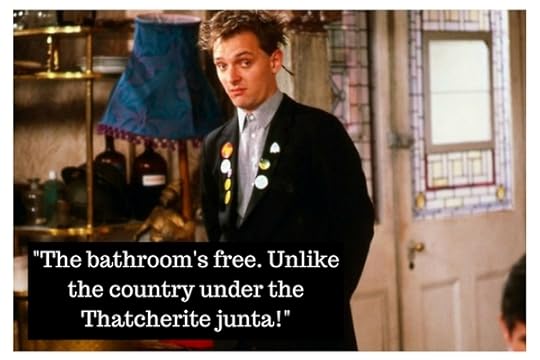
You said it (P)Rick....
....who's struggling with a shaky job and marital problems. His wife Liz, wants a baby but they've had no luck getting pregnant. He's also been struck down with a bad case of recurring nightmares, dreams of flying and explosions and burning. One day when doing a gig on a protest at a nuclear power facility, a group of terrorists take over the plant with plans to sell the radioactive material to foreign powers. Michael in the midst of this sees a word reflected across the steel of a warhead.
KIMOTA
Upon saying the word, there's a bright flash, an explosion of energy and Mick becomes/remembers that he's Miracleman. He beats the terrorists and flies off into the sky, happily crying out:

For the record, the left scene is from the 1980's edition, the right is from the recent reprint. Make of that what you will.
Meanwhile however, other parties have taken notice of Miracleman's return. In particular, a government agency who had something to do with a "Project Zarathustra", Evelyn Cream, a big bulking bloke working for the agency with sapphire teeth and Johnny Bates AKA Kid Miracleman whose reaction to Miracleman's return will set off a firestorm of chaos and madness.
Let's get this out right off; I'm looking at the original colour prints from the 1980's, not the recent Marvel reprints which changed up a lot of the colours. For starters, each issue in the story is well-written with a good sense of pacing and space. At the time of its initial print run, it was printed in Warrior Magazine which meant a limited page space so Moore makes a point of using every panel to tell part of the story and not faff around. There are some handy little design quirks to work around the limitations, like one-sided phone conversations and no needless fluff to complicate the main story.
The artwork by Gary Leach is gorgeous with a good use of lighting and shadows to accentuate facial features and scenery. The colouring is bright and vibrant, although at times a little flat. Each character is drawn in a distinctive style which makes them easy to recognise and there's a good range of facial expressions to clearly convey emotion.
Right from the outset there's something vaguely wrong with Miracleman's design, not due to bad art but a deliberate choice. Mick Moran looks normal for his age, but Miracleman looks perfect, flawless, like he's sculpted from marble. He doesn't look human because of a slight uncanny valley effect. Even his own wife comments on this as she meets Miracleman for the first time.
Speaking on Liz, the supporting cast are all decently designed and fleshed out. Liz Moran is a struggling housewife who nevertheless loves her husband, but the arrival of Miracleman throws a spanner in the works. Archer, the head spook behind Project Zarathustra looks worn down and terrified, suddenly aware that the ghosts of the past have come back to haunt him. And then there's Johnny Bates who.....
Well at this point I'm going to have to get into the meat of this comic, which means both spoilers and me donning my poncy hat and poncing about the poncing parlour. So if that's not your thing, here's my quick capsule judgment.
Really good, great art, compelling story, interesting characters, would read again.
As for the rest of you.....
5
4
3
2
1
.5
.25
Okay so let's talk how being a superhero would suck.
So right off the bat with Miracleman we get a sense of something being off. The story doesn't start with Mick. It starts with a short Miracleman comic that looks like something out of the 1950's:
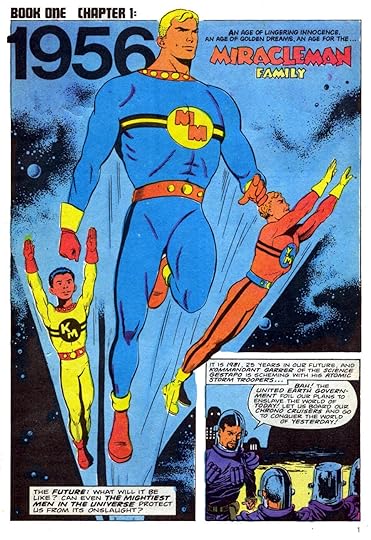
The fucking Science Gestapo! WTF?!
Cut to the end of the story and we have a group shot of the Miracle family with a slow panning closeup on Miracleman's eye followed by the quote from Nietzche:
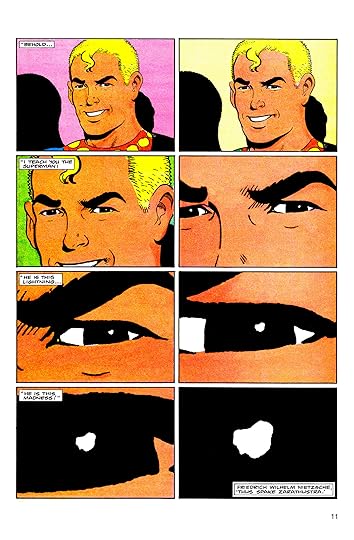
Ominous.....
If this doesn't give you an idea that this isn't going to be your typical superhero romp, prepare for a surprise. Moore has stated that he wrote Miracleman in the mind of a cosmic horror story and it shows. Even from that beginning, Moore goes out of his way to reinforce the idea that Miracleman is not human. That he is something not of this world, beyond this world. And it's that alien power that Moore explores.
Even in these early issues of Miracleman, Moore takes a long heavy look at what being a superhero like Superman or Shazam would realistically be like, by exploring things like:
- What would the dynamic be like between a superhero and their wife?
Pretty shitty, seeing as how it was Miracleman who knocked up Mick's wife.
- What would happen to people around a superhero when they transform?
Third degree burns, blindness and burst eardrums
- How would the rest of the world actually react to the appearance of an all-powerful superhero?
The government gets involved, mass property damage and people die
And then there's Johnny Bates, AKA Kid Miracleman who is a literally a walking question.
What would happen to someone like Billy Batson if one day he just decided to stay as SHAZAM forever?
The answer.....
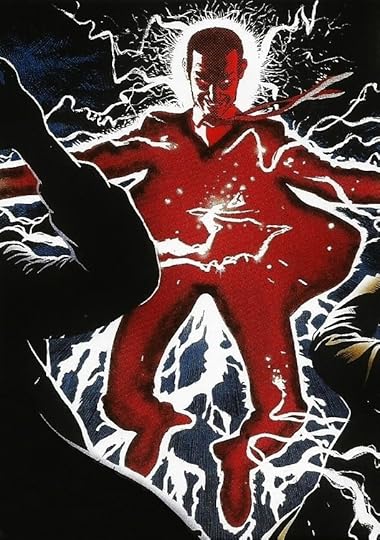
Absolutely.....

....fucking.....
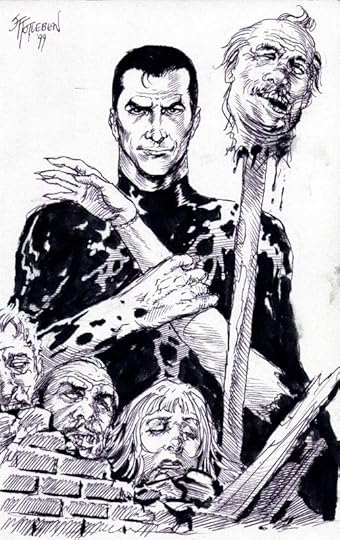
....terrifying.
Kid Miracleman is the end result of what happens when a super-powered alter ego never stops existing. He's the World of Cardboard argument wrapped up in a single psychotic lunatic who has long since stopped giving a fuck. The first thing KM does when he's outed is burn the eyes out of his secretary just because she spilled the coffee. He sends a kid flying into the sky - breaking some of his ribs due to the G-force - just because it fucks with Miracleman. Everything he does, he does because he's completely let himself go from all moral boundaries. He doesn't give a rat's arse because why should he? He's stronger, faster, more skilled and more powerful than anything on the planet.
Ultimately though KM is defeated - in part because he forgets his own transformation phrase and says it, turning back into Johnny, who is still a kid, albeit now with PTSD - but this arc ends on an ominous note, with Evelyn Cream capturing Mick Moran and Johnny Bates being condemned to a psychiatric hospital. Miracleman: A Dream of Flying is a solid opener to Moore's run on the character. It's compelling, unsettling, with great art, interesting, engaging characters and a solid story that doesn't overstay its welcome.
After this, we have Book 2: The Red King Syndrome.
No, I'm talking about Alan Moore's run on Miracleman back in the 1980's, one of the first comic series - at least to my tiny tiny brain - to openly pick apart superheroes and look at what would happen to them in a realistic setting. And Moore doesn't disappoint. There's a reason he's considered one of the best, if not the best writer in graphic novels in British history.
The plot of Book one is pretty simplistic but does a lot to set the groundwork for what will come. Mick Moran is 40-something bloke with a pot belly and a freelance journalist job, living in 1980's Britain....
You said it (P)Rick....
....who's struggling with a shaky job and marital problems. His wife Liz, wants a baby but they've had no luck getting pregnant. He's also been struck down with a bad case of recurring nightmares, dreams of flying and explosions and burning. One day when doing a gig on a protest at a nuclear power facility, a group of terrorists take over the plant with plans to sell the radioactive material to foreign powers. Michael in the midst of this sees a word reflected across the steel of a warhead.
KIMOTA
Upon saying the word, there's a bright flash, an explosion of energy and Mick becomes/remembers that he's Miracleman. He beats the terrorists and flies off into the sky, happily crying out:
For the record, the left scene is from the 1980's edition, the right is from the recent reprint. Make of that what you will.
Meanwhile however, other parties have taken notice of Miracleman's return. In particular, a government agency who had something to do with a "Project Zarathustra", Evelyn Cream, a big bulking bloke working for the agency with sapphire teeth and Johnny Bates AKA Kid Miracleman whose reaction to Miracleman's return will set off a firestorm of chaos and madness.
Let's get this out right off; I'm looking at the original colour prints from the 1980's, not the recent Marvel reprints which changed up a lot of the colours. For starters, each issue in the story is well-written with a good sense of pacing and space. At the time of its initial print run, it was printed in Warrior Magazine which meant a limited page space so Moore makes a point of using every panel to tell part of the story and not faff around. There are some handy little design quirks to work around the limitations, like one-sided phone conversations and no needless fluff to complicate the main story.
The artwork by Gary Leach is gorgeous with a good use of lighting and shadows to accentuate facial features and scenery. The colouring is bright and vibrant, although at times a little flat. Each character is drawn in a distinctive style which makes them easy to recognise and there's a good range of facial expressions to clearly convey emotion.
Right from the outset there's something vaguely wrong with Miracleman's design, not due to bad art but a deliberate choice. Mick Moran looks normal for his age, but Miracleman looks perfect, flawless, like he's sculpted from marble. He doesn't look human because of a slight uncanny valley effect. Even his own wife comments on this as she meets Miracleman for the first time.
Speaking on Liz, the supporting cast are all decently designed and fleshed out. Liz Moran is a struggling housewife who nevertheless loves her husband, but the arrival of Miracleman throws a spanner in the works. Archer, the head spook behind Project Zarathustra looks worn down and terrified, suddenly aware that the ghosts of the past have come back to haunt him. And then there's Johnny Bates who.....
Well at this point I'm going to have to get into the meat of this comic, which means both spoilers and me donning my poncy hat and poncing about the poncing parlour. So if that's not your thing, here's my quick capsule judgment.
Really good, great art, compelling story, interesting characters, would read again.
As for the rest of you.....
5
4
3
2
1
.5
.25
Okay so let's talk how being a superhero would suck.
So right off the bat with Miracleman we get a sense of something being off. The story doesn't start with Mick. It starts with a short Miracleman comic that looks like something out of the 1950's:
The fucking Science Gestapo! WTF?!
Cut to the end of the story and we have a group shot of the Miracle family with a slow panning closeup on Miracleman's eye followed by the quote from Nietzche:
Ominous.....
If this doesn't give you an idea that this isn't going to be your typical superhero romp, prepare for a surprise. Moore has stated that he wrote Miracleman in the mind of a cosmic horror story and it shows. Even from that beginning, Moore goes out of his way to reinforce the idea that Miracleman is not human. That he is something not of this world, beyond this world. And it's that alien power that Moore explores.
Even in these early issues of Miracleman, Moore takes a long heavy look at what being a superhero like Superman or Shazam would realistically be like, by exploring things like:
- What would the dynamic be like between a superhero and their wife?
Pretty shitty, seeing as how it was Miracleman who knocked up Mick's wife.
- What would happen to people around a superhero when they transform?
Third degree burns, blindness and burst eardrums
- How would the rest of the world actually react to the appearance of an all-powerful superhero?
The government gets involved, mass property damage and people die
And then there's Johnny Bates, AKA Kid Miracleman who is a literally a walking question.
What would happen to someone like Billy Batson if one day he just decided to stay as SHAZAM forever?
The answer.....
Absolutely.....
....fucking.....
....terrifying.
Kid Miracleman is the end result of what happens when a super-powered alter ego never stops existing. He's the World of Cardboard argument wrapped up in a single psychotic lunatic who has long since stopped giving a fuck. The first thing KM does when he's outed is burn the eyes out of his secretary just because she spilled the coffee. He sends a kid flying into the sky - breaking some of his ribs due to the G-force - just because it fucks with Miracleman. Everything he does, he does because he's completely let himself go from all moral boundaries. He doesn't give a rat's arse because why should he? He's stronger, faster, more skilled and more powerful than anything on the planet.
Ultimately though KM is defeated - in part because he forgets his own transformation phrase and says it, turning back into Johnny, who is still a kid, albeit now with PTSD - but this arc ends on an ominous note, with Evelyn Cream capturing Mick Moran and Johnny Bates being condemned to a psychiatric hospital. Miracleman: A Dream of Flying is a solid opener to Moore's run on the character. It's compelling, unsettling, with great art, interesting, engaging characters and a solid story that doesn't overstay its welcome.
After this, we have Book 2: The Red King Syndrome.

August 4, 2014
No os voy a engañar a estas alturas si os digo que no conocía yo este tebeo, por mucho de Alan Moore que fuera y que se publicara en mi tierna infancia de descubrimiento comiquero. Pero cuando se corrió la voz de que Marvel lo iba a republicar, las reacciones de los entendidos me llamaron la atención enseguida, así que estuve ojo avizor. Mas aun cuando la versión de Marvel salió censurada, a pesar del aviso de que es para adultos y que Panini confirmo que ellos publicarían la versión sin censura, ni en textos ni en imágenes.
Y es que esto que parece un tebeo ochentero inglés de superhéroes, es algo bastante mas de lo que pudiera parecer. Nos encontramos con una de las primeras reinvenciones del genero por parte de Alan Moore, que no se muerde la lengua a la hora de dar una vuelta al tema y ponerlo en ridículo para llevarlo a unas cotas mas realistas respecto a como sería realmente la vida de alguien como Michael Moran que se encuentra con el marrón de que también es, y hasta ahora no lo sabía, un superhéroe de nivel dios.
Alan Moore, al que no se puede mencionar en el tomo por problemas de derechos y que aparece tan solo nombrado como "el guionista original", recupera en 1982 un personaje de décadas anteriores del cómic británico, cancelado años atrás y lo lleva una reinvención del genero desdibujando las fronteras con la ciencia ficción y con el propio realismo, para presentarnos a un Michael Moran y a su alter ego Miracleman. Con problemas y circunstancias que no son las de esperar. Con lenguaje adulto, despelote y temas intensos, al menos para los implicados, como puede ser la mujer del propio Moran que se ve de repente que tiene un marido doble, uno de ellos casi divino, mas guapo, mas alto, mas listo, mas enamorado y de paso un portento en el catre.
Este primer tomo es una pequeña maravilla de cómic y aunque a veces parece que Alan Moore se "regala" un poco con su superioridad moral respecto al resto de tebeos, no deja de ser su primera obra maestra. Colección que también escribirá Neil Gaiman, ya que estamos comentando el tema y que ha estado 20 años desaparecida sin publicarse por problemas de derechos, batallas legales y asuntos por el estilo.
Pero ahora que ha podido publicarse lo ha hecho remasterizada, recoloreada y el tomo de Panini, costando lo mismo que el americano, viene con muchos extras y por tanto mas paginas y sin la censura americana que es tan mojigata como para dibujarle bragas a la mujer del protagonista si esta se pasea en pelotas por la casa, amen de escenas mas escabrosas que saldrán en tomos posteriores. Vamos que aunque barato no resulta, es totalmente recomendable .
Y es que esto que parece un tebeo ochentero inglés de superhéroes, es algo bastante mas de lo que pudiera parecer. Nos encontramos con una de las primeras reinvenciones del genero por parte de Alan Moore, que no se muerde la lengua a la hora de dar una vuelta al tema y ponerlo en ridículo para llevarlo a unas cotas mas realistas respecto a como sería realmente la vida de alguien como Michael Moran que se encuentra con el marrón de que también es, y hasta ahora no lo sabía, un superhéroe de nivel dios.
Alan Moore, al que no se puede mencionar en el tomo por problemas de derechos y que aparece tan solo nombrado como "el guionista original", recupera en 1982 un personaje de décadas anteriores del cómic británico, cancelado años atrás y lo lleva una reinvención del genero desdibujando las fronteras con la ciencia ficción y con el propio realismo, para presentarnos a un Michael Moran y a su alter ego Miracleman. Con problemas y circunstancias que no son las de esperar. Con lenguaje adulto, despelote y temas intensos, al menos para los implicados, como puede ser la mujer del propio Moran que se ve de repente que tiene un marido doble, uno de ellos casi divino, mas guapo, mas alto, mas listo, mas enamorado y de paso un portento en el catre.
Este primer tomo es una pequeña maravilla de cómic y aunque a veces parece que Alan Moore se "regala" un poco con su superioridad moral respecto al resto de tebeos, no deja de ser su primera obra maestra. Colección que también escribirá Neil Gaiman, ya que estamos comentando el tema y que ha estado 20 años desaparecida sin publicarse por problemas de derechos, batallas legales y asuntos por el estilo.
Pero ahora que ha podido publicarse lo ha hecho remasterizada, recoloreada y el tomo de Panini, costando lo mismo que el americano, viene con muchos extras y por tanto mas paginas y sin la censura americana que es tan mojigata como para dibujarle bragas a la mujer del protagonista si esta se pasea en pelotas por la casa, amen de escenas mas escabrosas que saldrán en tomos posteriores. Vamos que aunque barato no resulta, es totalmente recomendable .
July 22, 2008
One of the best stories done dealing with the idea of putting super heroes in the real world.
Moore takes some fairly lame british heroes ( a pretty obvious rip off of Captain Marvel) and puts him smack dab in the middle of Thatcher's England.
Brilliant stuff where the mix of the real world and the larger than life are perfectly balanced.
You root for the heroes, rather than being amazed at how messed up their are, you can sympathsize with their problems, but their are still lots of big comic book moments.
Moore takes some fairly lame british heroes ( a pretty obvious rip off of Captain Marvel) and puts him smack dab in the middle of Thatcher's England.
Brilliant stuff where the mix of the real world and the larger than life are perfectly balanced.
You root for the heroes, rather than being amazed at how messed up their are, you can sympathsize with their problems, but their are still lots of big comic book moments.

November 2, 2014
I was really enjoying this book and was thinking all the hype was justified then 3/4 of the way through the reader is introduced to the Warpsmiths and it become so confusing I didn't know which way was up anymore.
I'm undecided if I'll pursue reading the next book, maybe if it just falls into my lap I'll give it a go.
I'm undecided if I'll pursue reading the next book, maybe if it just falls into my lap I'll give it a go.

January 7, 2015
UPDATE:
Came back to this one about 2 years later with the intent of reading parts 2 and 3. It's pretty solid. Last time, I think I got sidetracked by the Warpsmith bullshit at the end. What the hell even was that? A bunch of time-hopping, dimesion-surfing alien people with names that look like someone was trying to cash in a bunch of useless consonants on their turn at Scrabble? It was WAY too much, way too confusing, and I rarely say it, but I think the book is stronger without this additional material.
Old Review:
Pretty good stuff. Although I think this suffers from the fact that, although it came first, I only just now got my hands on it.
There was a big legal battle over the character and the rights to reproduce these issues, it seems. Between Neil Gaiman and Todd McFarlane, no less. There was some back and forth, a trade was made where Gaiman surrendered claims to characters Angela and Cogliostro, and then McFarlane violated the deal, Gaiman sued, and in the end justice won out. You know, after a few decades or so.
Interestingly enough, while I was finding THAT out, I also found that there's a guy named Al Simmons, which is the name shared by McFarlane character Spawn, and apparently Simmons wrote a book about his experience sharing the character's name and dressing in costume for promotional appearances. Aaaaand McFarlane sued the guy. The defense for Simmons mounted a good argument in saying that Simmons has never been mistaken for Spaen. Let me remind you, Spawn is a character who was a special forces dude who got double-crossed, died, went to hell, and then made some kind of deal with the devil and came back as this sort of demon creature thing with mystical powers and a rad outfit, including lots of chains and capes.
I tried for about 3 minutes to see if this book, The Art of Being Spawn, was available, and it's not. So my guess is that one way or another, Simmons' book was squashed.
The point here, I really hate it when these stupid disagreements keep comics and books off the shelves. Everyone wants a piece of everything, and as a result, nobody gets to have it. And that's bullshit.
I know for a fact that McFarlane had plenty of cash. I know for a fact that Gaiman is also doing just fine at this point. So when do we stop talking about who is right and start talking about whether or not I get to read goddamn Miracleman already!? Not to mention that the issues contained here were written by ALAN MOORE, not Gaiman or McFarlane, so what the fuck? Buncha jerks.
And the reason I'm all steamed up, it would have been great to read this prior to reading a lot of the other stuff I read in the DECADES since this got all tangled up. It would have made me feel different about a series like Mark Waid's...shit, what was that one I liked? Indescribable? No, that's not it.
Untouchable? No, that's the baby carriage movie.
Unstoppable? No, that's the movie where Denzel fights a train.
Inconsolable? No, that's how I felt after I hit a duck with my car once.
Incontinent? No. Definitely no.
Inconceivable? No. And don't say "ma-widge", okay?
Unconditional? No. That's my love.
Incredible? Hulk.
Unassailable? That's probably the next Spider-Man adjective.
Inappropriate? Closer. Warmer.
Unintentional?
Uninspired?
Irredeemable! That's it! Goddamn! I liked IRREDEEMABLE, and I can see why some other people might not have. It's a bit of a re-tread of stuff in here. But I have to come at it with what I know.
It's a little like watching a heist movie and someone says, "They did all this crap in the first Taking of Pelham 123." I'm sure they did. But I didn't see it first, and now I can't UNsee all the stuff from Ocean's 12.
By the way, what the holy fuck was Ocean's 12? I saw a portion of that, and it appeared that Bruce Willis was himself and Julia Roberts was a Julia Roberts impersonator? I'm to believe that in this Oceans world, there's Julia Roberts the movie star and then this lady who looks EXACTLY FUCKING LIKE Julia Roberts because she is Julia Roberts?
Anyway. This has gotten all out of whack.
Came back to this one about 2 years later with the intent of reading parts 2 and 3. It's pretty solid. Last time, I think I got sidetracked by the Warpsmith bullshit at the end. What the hell even was that? A bunch of time-hopping, dimesion-surfing alien people with names that look like someone was trying to cash in a bunch of useless consonants on their turn at Scrabble? It was WAY too much, way too confusing, and I rarely say it, but I think the book is stronger without this additional material.
Old Review:
Pretty good stuff. Although I think this suffers from the fact that, although it came first, I only just now got my hands on it.
There was a big legal battle over the character and the rights to reproduce these issues, it seems. Between Neil Gaiman and Todd McFarlane, no less. There was some back and forth, a trade was made where Gaiman surrendered claims to characters Angela and Cogliostro, and then McFarlane violated the deal, Gaiman sued, and in the end justice won out. You know, after a few decades or so.
Interestingly enough, while I was finding THAT out, I also found that there's a guy named Al Simmons, which is the name shared by McFarlane character Spawn, and apparently Simmons wrote a book about his experience sharing the character's name and dressing in costume for promotional appearances. Aaaaand McFarlane sued the guy. The defense for Simmons mounted a good argument in saying that Simmons has never been mistaken for Spaen. Let me remind you, Spawn is a character who was a special forces dude who got double-crossed, died, went to hell, and then made some kind of deal with the devil and came back as this sort of demon creature thing with mystical powers and a rad outfit, including lots of chains and capes.
I tried for about 3 minutes to see if this book, The Art of Being Spawn, was available, and it's not. So my guess is that one way or another, Simmons' book was squashed.
The point here, I really hate it when these stupid disagreements keep comics and books off the shelves. Everyone wants a piece of everything, and as a result, nobody gets to have it. And that's bullshit.
I know for a fact that McFarlane had plenty of cash. I know for a fact that Gaiman is also doing just fine at this point. So when do we stop talking about who is right and start talking about whether or not I get to read goddamn Miracleman already!? Not to mention that the issues contained here were written by ALAN MOORE, not Gaiman or McFarlane, so what the fuck? Buncha jerks.
And the reason I'm all steamed up, it would have been great to read this prior to reading a lot of the other stuff I read in the DECADES since this got all tangled up. It would have made me feel different about a series like Mark Waid's...shit, what was that one I liked? Indescribable? No, that's not it.
Untouchable? No, that's the baby carriage movie.
Unstoppable? No, that's the movie where Denzel fights a train.
Inconsolable? No, that's how I felt after I hit a duck with my car once.
Incontinent? No. Definitely no.
Inconceivable? No. And don't say "ma-widge", okay?
Unconditional? No. That's my love.
Incredible? Hulk.
Unassailable? That's probably the next Spider-Man adjective.
Inappropriate? Closer. Warmer.
Unintentional?
Uninspired?
Irredeemable! That's it! Goddamn! I liked IRREDEEMABLE, and I can see why some other people might not have. It's a bit of a re-tread of stuff in here. But I have to come at it with what I know.
It's a little like watching a heist movie and someone says, "They did all this crap in the first Taking of Pelham 123." I'm sure they did. But I didn't see it first, and now I can't UNsee all the stuff from Ocean's 12.
By the way, what the holy fuck was Ocean's 12? I saw a portion of that, and it appeared that Bruce Willis was himself and Julia Roberts was a Julia Roberts impersonator? I'm to believe that in this Oceans world, there's Julia Roberts the movie star and then this lady who looks EXACTLY FUCKING LIKE Julia Roberts because she is Julia Roberts?
Anyway. This has gotten all out of whack.

November 15, 2018
The history of Miracleman is a long, complicated, and weird one. It is also one that most Americans who don’t read comic books will neither be familiar with nor care about. If you’re British, however, you may know a bit about it. If you are an Alan Moore fan, you’ll definitely know about it.
Moore should be a familiar name to anyone who loves comic books. Best known for his revolutionary titles such as “Swamp Thing”, “Watchmen”, and “V for Vendetta”, Moore’s works are perhaps best known for a dark pessimism and scathing social commentary.
“Miracleman: Book One: A Dream of Flying” is a compilation of 14 issues of the original Miracleman comics published by Eclipse during the mid-1980s. Moore is credited as “The Original Writer”, which is kind of a winking nod to the strange controversy surrounding the title.
In truth, Miracleman has his origins dating back to 1954, when writer-artist Mick Anglo created a British comic book series named Marvelman, a thinly-veiled rip-off of the American superhero Captain Marvel (also called Shazam). It had a good run in the United Kingdom for almost a decade.
It was resurrected by Moore in the early ‘80s, although to avoid lawsuits brought by Marvel Comics, the name was changed from Marvelman to Miracleman. Thankfully, the familiar red double-M emblazoned on his costume didn’t have to change. When Moore left the series to do others, Neil Gaiman (another well-known name among comic book lovers) took over the series in the late-‘80s.
In the mid-1990s, Todd McFarlane bought the rights (or so he thought) to Miracleman when he bought Eclipse Comics. Gaiman sued McFarlane for ownership rights in what amounted to a very long legal battle. In 2009, however, it was discovered that Anglo had never lost ownership rights, making McFarlane’s and Gaiman’s claims illegitimate. Anglo eventually sold the rights (the actual ones) to Marvel Comics, which then republished the original series by Moore.
So, that’s a lot of unnecessary but interesting back-story about Miracleman.
The actual origin story starts with Miracleman, along with sidekicks Kid Miracleman and Young Miracleman, fighting evil villains and saving the world in 1956.
Flash forward to 1982, where Michael Moran is having migraine-inducing nightmares in which he is a superhero. In the recurring dreams, he is investigating what appears to be a crashed spaceship in an Arctic wasteland. There is an explosion, pain, and then---
Real life: Moran, middle-aged, journalist, married. And those damned migraines. Always, with the migraines, is the thought that he is missing something important, that with one simple word, his life will drastically change.
See, in 1956, all he had to do to become Miracleman was say the word “Kimota!” aloud, and he would transform into Miracleman. But he has forgotten the word. He has forgotten who he really is.
Then, one day, during an investigative reporting of a nuclear power plant, terrorists storm the building. Moran’s migraine sucker-punches him. Memories flood in. He sees a word flash in front of him. He says it aloud.
The end!
Just kidding. As one would expect from the visionary Moore, there are a plethora of plot twists and tangential storylines you won’t see coming in “Miracleman: Book One”. Hint: they don’t always go well for the hero.
Powerful storytelling, great artwork, and a believable superhero make this graphic novel an important one for any comic book lover’s collection.
Moore should be a familiar name to anyone who loves comic books. Best known for his revolutionary titles such as “Swamp Thing”, “Watchmen”, and “V for Vendetta”, Moore’s works are perhaps best known for a dark pessimism and scathing social commentary.
“Miracleman: Book One: A Dream of Flying” is a compilation of 14 issues of the original Miracleman comics published by Eclipse during the mid-1980s. Moore is credited as “The Original Writer”, which is kind of a winking nod to the strange controversy surrounding the title.
In truth, Miracleman has his origins dating back to 1954, when writer-artist Mick Anglo created a British comic book series named Marvelman, a thinly-veiled rip-off of the American superhero Captain Marvel (also called Shazam). It had a good run in the United Kingdom for almost a decade.
It was resurrected by Moore in the early ‘80s, although to avoid lawsuits brought by Marvel Comics, the name was changed from Marvelman to Miracleman. Thankfully, the familiar red double-M emblazoned on his costume didn’t have to change. When Moore left the series to do others, Neil Gaiman (another well-known name among comic book lovers) took over the series in the late-‘80s.
In the mid-1990s, Todd McFarlane bought the rights (or so he thought) to Miracleman when he bought Eclipse Comics. Gaiman sued McFarlane for ownership rights in what amounted to a very long legal battle. In 2009, however, it was discovered that Anglo had never lost ownership rights, making McFarlane’s and Gaiman’s claims illegitimate. Anglo eventually sold the rights (the actual ones) to Marvel Comics, which then republished the original series by Moore.
So, that’s a lot of unnecessary but interesting back-story about Miracleman.
The actual origin story starts with Miracleman, along with sidekicks Kid Miracleman and Young Miracleman, fighting evil villains and saving the world in 1956.
Flash forward to 1982, where Michael Moran is having migraine-inducing nightmares in which he is a superhero. In the recurring dreams, he is investigating what appears to be a crashed spaceship in an Arctic wasteland. There is an explosion, pain, and then---
Real life: Moran, middle-aged, journalist, married. And those damned migraines. Always, with the migraines, is the thought that he is missing something important, that with one simple word, his life will drastically change.
See, in 1956, all he had to do to become Miracleman was say the word “Kimota!” aloud, and he would transform into Miracleman. But he has forgotten the word. He has forgotten who he really is.
Then, one day, during an investigative reporting of a nuclear power plant, terrorists storm the building. Moran’s migraine sucker-punches him. Memories flood in. He sees a word flash in front of him. He says it aloud.
The end!
Just kidding. As one would expect from the visionary Moore, there are a plethora of plot twists and tangential storylines you won’t see coming in “Miracleman: Book One”. Hint: they don’t always go well for the hero.
Powerful storytelling, great artwork, and a believable superhero make this graphic novel an important one for any comic book lover’s collection.

August 15, 2019
Miracleman is what you get when you treat potentially goofy superhero comics as if they were serious works of literature. This is Alan Moore's revisionist take on Marvelman, a superhero from the 1950s created by Mick Anglo, and it's a key work in helping comics to break free from their restrictive code. The artwork is painterly, the prose are florid though not overly so by this point, and the characters are treated as ordinary human beings having to come to terms with the fact that they have extraordinary powers.
The real physical consequences of being able to fly in super-speed is even touched upon at one point, along with the thanklessness of being heroic, where Miracleman rescues a child from his nemesis Kid Miracleman, thus accidentally breaking a few ribs before returning him to his aggrieved mother, who says "Give him to me, you bloody monster!!" as she angrily walks away holding her child.
Given all the explosions and action set-pieces though, what I found most engaging about the story were the more personal aspects, such as Mike Moran's relationship with his spouse Liz, having to explain to her that he's Miracleman despite her laughing at the absurdity of his story, and his frustration at having impregnated her as Miracleman, meaning his baby won't be his, and John's inner-torment at the hands of his split-identity, his complete lack of control over what Kid Miracleman does.
When it gets into the scientific explanations of how the Miraclemen were created in the final issue and the one on one battles, that's when it becomes less interesting, and the extra content of this edition which is confusingly placed in continuum with the main story, I didn't even bother to read. Though since those are a part of this particular edition, I won't count it as part of the Miracleman story I'm reviewing. In total, it just about scrapes in at 4 stars.
The real physical consequences of being able to fly in super-speed is even touched upon at one point, along with the thanklessness of being heroic, where Miracleman rescues a child from his nemesis Kid Miracleman, thus accidentally breaking a few ribs before returning him to his aggrieved mother, who says "Give him to me, you bloody monster!!" as she angrily walks away holding her child.
Given all the explosions and action set-pieces though, what I found most engaging about the story were the more personal aspects, such as Mike Moran's relationship with his spouse Liz, having to explain to her that he's Miracleman despite her laughing at the absurdity of his story, and his frustration at having impregnated her as Miracleman, meaning his baby won't be his, and John's inner-torment at the hands of his split-identity, his complete lack of control over what Kid Miracleman does.
When it gets into the scientific explanations of how the Miraclemen were created in the final issue and the one on one battles, that's when it becomes less interesting, and the extra content of this edition which is confusingly placed in continuum with the main story, I didn't even bother to read. Though since those are a part of this particular edition, I won't count it as part of the Miracleman story I'm reviewing. In total, it just about scrapes in at 4 stars.

June 20, 2015
This is early Alan Moore, and is an excellent example of the superhero/horror cross overs that Gaiman, Morrison and other British comics authors did so well a few years later. As per usual, Moore brings so much more than an average comic perspective to this series, starting small and expanding the universe until the entire world is changed. The artwork was stunning, from both artists to work on the book, and the colours are gorgeous. Horrifying, breath taking and captivating.
Highly Recommended.
Highly Recommended.

June 18, 2014
Now, see, this is why we all fell in love with Alan Moore in the first place. I've been waiting for most of my comic-collecting career for this series to climb out of legal limbo and be reissued, and I'm overjoyed that it finally has.
Young Alan Moore was so much more fun than the modern Artist Formerly Known As Alan Moore. The stories are still dense, but they're accessible, readable, and don't presuppose that the audience has an encyclopedic knowledge of every obscure, forgotten novel written in the last 500 years. (End LXG rant.)
Moore doesn't even suppose that you know who Marvelman was. (Utterly crap 50's British Captain Marvel rip-off.) He just gives you the basic facts, then he and the great Alan Davis dive into a story about how horrific it would be if superheroes really existed. I was reminded of the carnage in Man of Steel (which I loved, btw) - but in that film, the audience was still expected to view Superman as a hero despite the sheer destruction, and that I think was what made audiences so uncomfortable. Miracleman puts the idea right on the table: if these beings existed in our world, whatever their intentions, they would be monsters.
That this idea came forth in an early 80's weekly super-hero strip was nothing short of revolutionary.
Young Alan Moore was so much more fun than the modern Artist Formerly Known As Alan Moore. The stories are still dense, but they're accessible, readable, and don't presuppose that the audience has an encyclopedic knowledge of every obscure, forgotten novel written in the last 500 years. (End LXG rant.)
Moore doesn't even suppose that you know who Marvelman was. (Utterly crap 50's British Captain Marvel rip-off.) He just gives you the basic facts, then he and the great Alan Davis dive into a story about how horrific it would be if superheroes really existed. I was reminded of the carnage in Man of Steel (which I loved, btw) - but in that film, the audience was still expected to view Superman as a hero despite the sheer destruction, and that I think was what made audiences so uncomfortable. Miracleman puts the idea right on the table: if these beings existed in our world, whatever their intentions, they would be monsters.
That this idea came forth in an early 80's weekly super-hero strip was nothing short of revolutionary.
June 13, 2020
A true classic. Alan Moore is the best at trying to make superheroes "real" and this was his take on things years before Watchmen. This was particular heavy stuff in 1982 I'm sure. Moore took the campy 1950s Marvelman Family (think Captain Marvel family) and turned the silliness into dead seriousness. I don't want to go too deep into the plot here as it's complex, but I will say it's brilliant and the art fits the story perfectly. Somehow Alan Moore manages to pull this off without sounding pretentious, which would almost seem impossible, yet he does it. Just great stuff, some of the best superhero comics I've ever read.
In this particular collection I thought the two "back up" stories included took away from the main storyline rather than enhanced it, but I suppose it was included for completists. There's also several rare piece of artand things like that.
This series was held up in legal limbo for years and therefore only a small percentage of comic readers to got to read it, which was a shame because it's so good. I have to give Marvel credit for finally getting this to the masses in a nice format.
In this particular collection I thought the two "back up" stories included took away from the main storyline rather than enhanced it, but I suppose it was included for completists. There's also several rare piece of artand things like that.
This series was held up in legal limbo for years and therefore only a small percentage of comic readers to got to read it, which was a shame because it's so good. I have to give Marvel credit for finally getting this to the masses in a nice format.

June 30, 2020
La obra oculta tantos años, esa historia que pocos habían leído y la situaban entre lo mejor del gran Alan Moore.
Demasiada expectativa suele jugar en contra y si bien es muy buena el final al menos de este primer libro me desconcertó bastante.
Sí vemos al escritor jugar con tópicos en aquel momento novedosos, que se volvieron frecuentes en su galería de recursos.
Buena edición de Ovni.
Anotación de la segunda lectura. De nuevo el final me deja descolocado. Ahora sí voy por el siguiente tomo a ver si ese cierre cobra sentido.
Demasiada expectativa suele jugar en contra y si bien es muy buena el final al menos de este primer libro me desconcertó bastante.
Sí vemos al escritor jugar con tópicos en aquel momento novedosos, que se volvieron frecuentes en su galería de recursos.
Buena edición de Ovni.
Anotación de la segunda lectura. De nuevo el final me deja descolocado. Ahora sí voy por el siguiente tomo a ver si ese cierre cobra sentido.

December 24, 2018
Originally published in the UK in 1982, re-released by Marvel in 1990, this absolutely holds up.
It was way ahead of its time, anticipating (and no doubt shaping) the type of comics Grant Morrison and Warren Ellis made such a splash with decades later.
It was way ahead of its time, anticipating (and no doubt shaping) the type of comics Grant Morrison and Warren Ellis made such a splash with decades later.

December 6, 2007
Alan Moore's run of Miracleman is really, really good, perhaps even better than Watchmen. This comic is incredibly well-structured. The panels are brilliant, and the story is told with an economy I've rarely seen; so much happens in so few pages. And the book is emotionally resonant, too. The characters are as believable as they can be, being super-powered babies and sociopathic ubermenschen, and there's a lovely tone of tragedy to even the most optimistic segments.
In general, this book starts off asking, "What would it be like to be a superhero in the real world?", and ends up asking, "What would the real world be like with superheroes?" The answers might surprise you!
Also, a super-powered jerk devestates London in some pretty terrible ways. Chessboards made out of human breasts? Buildings swathed in intestines? Rains of eyeballs? Yikes.
Sample quote, from #15:
"These charnel pastures serve as a reminder, a memento mori, never letting us forget that though Olympus pierce the very skies, in all the history of Earth, there's never been a Heaven, never been a house of gods, that was not built on human bones."
In general, this book starts off asking, "What would it be like to be a superhero in the real world?", and ends up asking, "What would the real world be like with superheroes?" The answers might surprise you!
Also, a super-powered jerk devestates London in some pretty terrible ways. Chessboards made out of human breasts? Buildings swathed in intestines? Rains of eyeballs? Yikes.
Sample quote, from #15:
"These charnel pastures serve as a reminder, a memento mori, never letting us forget that though Olympus pierce the very skies, in all the history of Earth, there's never been a Heaven, never been a house of gods, that was not built on human bones."
Displaying 1 - 30 of 371 reviews