Jump to ratings and reviews
Rate this book

The Art of Subtext: Beyond Plot

Rate this book
Charles Baxter inaugurates The Art of, a new series on the craft of writing, with the wit and intelligence he brought to his celebrated book Burning Down the House: Essays on Fiction.

Fiction writer and essayist Charles Baxter's The Art of Subtext: Beyond Plot discusses and illustrates the hidden subtextual overtones and undertones in fictional works haunted by the unspoken, the suppressed, and the secreted. Using an array of examples from Melville and Dostoyevsky to contemporary writers Paula Fox, Edward P. Jones, and Lorrie Moore, Baxter explains how fiction writers create those visible and invisible details, how what is displayed evokes what is not displayed.

The Art of Subtext is part of The Art of series, a new line of books by important authors on the craft of writing, edited by Charles Baxter. Each book examines a singular, but often assumed or neglected, issue facing the contemporary writer of fiction, nonfiction, or poetry. The Art of series means to restore the art of criticism while illuminating the art of writing.

196 pages, Kindle Edition

First published January 1, 2007

137 people are currently reading
1955 people want to read

About the author

Charles Baxter

94 books429 followers
Charles Baxter was born in Minneapolis and graduated from Macalester College, in Saint Paul. After completing graduate work in English at the State University of New York at Buffalo, he taught for several years at Wayne State University in Detroit. In 1989, he moved to the Department of English at the University of Michigan--Ann Arbor and its MFA program. He now teaches at the University of Minnesota.

Baxter is the author of 4 novels, 4 collections of short stories, 3 collections of poems, a collection of essays on fiction and is the editor of other works. His works of fiction include Believers , The Feast of Love (nominated for the National Book Award), Saul and Patsy , and Through the Safety Net . He lives in Minneapolis.

Ratings & Reviews

What do you think?
Rate this book

Friends & Following

Create a free account to discover what your friends think of this book!

Community Reviews

5 stars
453 (34%)
4 stars
512 (38%)
3 stars
289 (21%)
2 stars
43 (3%)
1 star
18 (1%)
Displaying 1 - 30 of 184 reviews
Profile Image for Kathy Davie.
4,876 reviews736 followers
July 23, 2013
Nonfiction for the writer and intended to help develop a deeper, more interesting plot.

My Take
This was too subtle for me. I picked up a few useful bits here and there, but for the most part, I was just confused.

The first chapter was good, and I got all excited with the promise of what I thought was ahead.

"...create an interior space, using details of location and objects that mirror a psychological condition."


I love this idea and had never consciously considered it even as I subconsciously appreciated its use in the books I read.

But then Baxter goes on to muddle it up. Or perhaps it wasn't a muddle so much as he never connected the dots with his subsequent meanderings---it read more like a random series of thoughts that connected in Baxter's mind.

Further in, there is a dissection of motivations which Baxter explains as possible plot starting points. A bit obvious, but it was a chunk I could grasp.

Oh, another interesting bit is his analysis of Freud's "wrecked by success" phrase. It's a truism that people can be just as crippled by a fear of success as they can by a fear of failure, and Baxter notes that the trauma of achieving success can also lead to useful plot conflicts.

Baxter also notes those novels which are almost all subtext including Cheever's "The Swimmer" and Franz Kafka's The Castle .

He does confuse me with his discussion of psychic deafness and referential denial as it sounds as if he's applying them in two different areas. He bounces back and forth between explaining and a silly story that makes no sense. I have to wonder if he was late getting this story written for some deadline. Although he does go on to explain "the unheard" as a denial of what we don't want to hear and a selective filtering.

I did enjoy his discussion on how, and he had some good examples. Consider the many different ways you can say a phrase depending upon how you're feeling: scared, happy, bored…

He also explains the necessity of a scene in your scenes. And by that I mean, embarrassment. You know you need conflict in every scene, and one way to achieve this is in having your characters act outrageously. Well, more outrageous than someone raised to be polite, anyway. Instead of conflict-avoidance, you need to seek out creating conflict. "Create scenes that in real life we would typically avoid." And, of course, this level of conflict would be different for each character, each scene. --Look on this necessity as an opportunity to project your own wish to behave outrageously or to fulfill a desire, but on paper. It seems that just about any of Dostoyevsky's stories can provide excellent examples of this.

"Creating a scene is thus the staging of a desire."


John Cheever's "The Five Forty Eight" has a scene which rings true when Miss Dent explains to Blake why she needs that gun...gave me the shivers it was so true.

Baxter does caution against being melodramatic, however. --In my opinion, melodrama is not drama that makes the reader uneasy. Instead it's going over the top in emotion or reaction.

His chapter on "Loss of Face" is, interesting to read, but again, confusing. I'm not sure if it's my own projections, desires, or what, but I don't (or hope I don't!) judge a book by its cover or a face by its beauty or lack of. Are we truly suspicious of beautiful people? And as for contemporary use of clothing and body language as a way to characterize someone. Yeah?? So?? Isn't this more accurate than using the way a person's face looks?

I do agree with Baxter that in our current society we've all learned to put on a face, that people are on guard against others. Look at the Ted Bundys of the world!! I do wish, however, that someone would explain to me how the "history of racism and the history of disability studies have invalidated reading someone's character based on the appearance of their face". How does this even relate? Is it intended to provide validation to Baxter's comments?

Ooh, I did like his use of Paula Fox's characterization of Laura's smile. How he explained her description of its transformation into something of malice! Eeek!

One of the pluses is a list of the books to which Baxter refers throughout the text. I just wish he'd included either the page number upon which the book appeared or a hint as to its purpose in being included as an example.

I gotta say, for all in all, this book simply gave me a headache trying to understand it. It wasn't worth the few gems.

The Cover
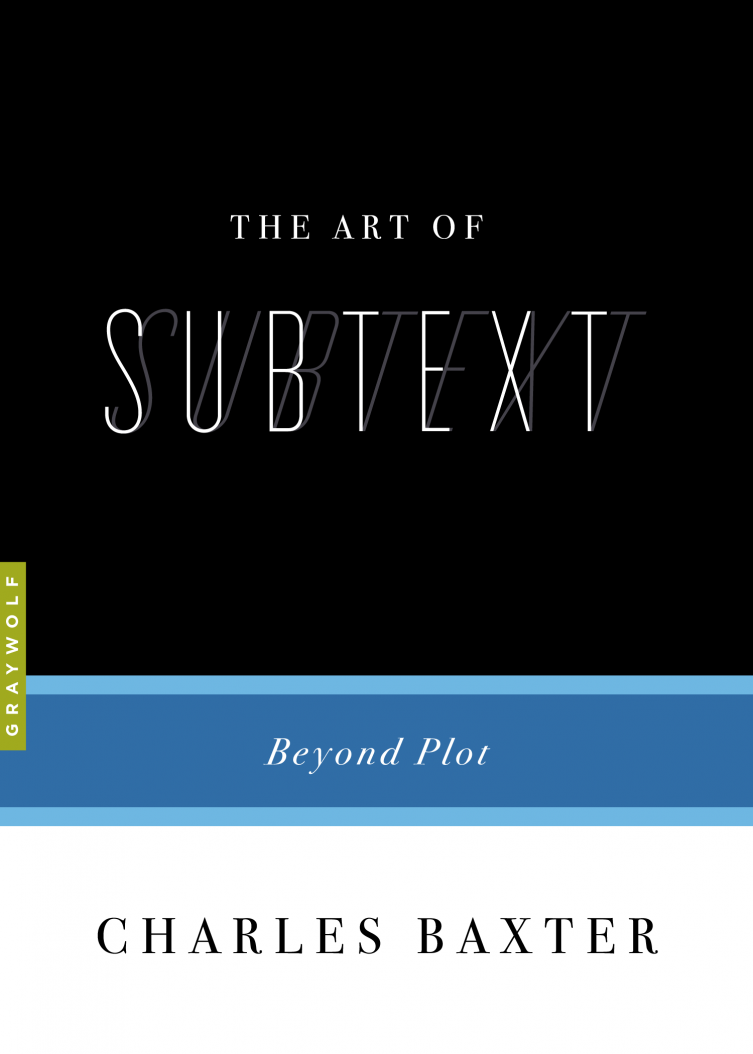
The cover is split by five horizontal bands: the largest, the black, focuses your attention on the title; two "pinstripe" bands of colonial blue separate the royal blue band with its subtitle, and the remaining band at the bottom reverses the top color choices with the author's name in black against a white background.

The title indicates a depth, an exploration that goes inside the plot, The Art of Subtext: Beyond Plot.
Profile Image for Glenn Mitchell.
55 reviews8 followers
December 29, 2014
Self-Consciously Literate

This book is the opposite of Linda Seger's book on subtext. Where Seger's book is practical in focus and useful writers who want to enhance their skill at weaving subtext into their stories, Baxter's book is theoretical and more an exercise in analyzing subtext in literary fiction.

Writers who are looking for practical advice they can use to elevate their stories will almost certainly be disappointed. This is a book aimed almost exclusively at reading well well and not on writing well.
Profile Image for Steven.
Author 1 book114 followers
April 13, 2008
I read this one eagerly because Baxter's Burning Down the House is one of my favorite books on the craft of fiction. Have to say, though, that after the first read I was disappointed. Perhaps it was just the high expectations, but it may also be that this book is more a "why you should" as opposed to a "how you create." I'm already sold on the value of subtext so I was hoping for more discussion of how to do it; you know, more "the art of." On subsequent reads, however, I'm finding more of Baxter's subtle suggestions: his subtext on how to create subtext.
Profile Image for Edan.
Author 8 books33.1k followers
September 7, 2010
I read this book in two sittings, and found it absorbing and thoughtful. I had hoped it would make me gasp with recognition a little more, that it would give me some new ways of thinking about fiction, but instead it articulated nicely my own thoughts on fiction writing. I'm teaching excerpts to my next class of short story writing students, and I look forward to re-reading, discussing and expanding on Baxter's ideas with the group.

Onto Joan Silber's book in this "Art of" series. Can't wait!
Profile Image for M0rningstar.
136 reviews5 followers
February 10, 2017
Some very good insights; especially appreciated illuminating conceptualization of relationship between plot and subtext. Would be four-stars if not so scattered at times. Agree with other reviewer that this is more of a reader's guide than a writer's how-to.
Profile Image for Sandhya.
39 reviews2 followers
July 23, 2017
I've read this three or four times in its entirety. A brief, highly concentrated, and extremely helpful book that reveals the techniques great literary writers use to imply rather than state outright the deeper meanings of a narrative.
Profile Image for Aatif Rashid.
Author 4 books18 followers
August 25, 2018
It’s one of the best books on fiction writing because Baxter clearly has something to say—he’s not just close reading a bunch of novels, but using those novels to make points about craft, about details, about describing faces, etc.
Profile Image for Gabriel.
Author 16 books154 followers
July 21, 2008
A great book for both reading and writing in the realist tradition. A stifling and tangential book (on some topics) for all others. Baxter's interests here should help portraitists ("realists") to understand their art much, much better, by focusing on some basic but subtle (and typically infuriating) problems of portraying emotion without melodrama, and of "bringing characters to life."

"Young writers tend to hate the whole idea of plot." This sentence bothered me, as a young writer who hates the whole idea of plot, as it implies that my hatred of the whole idea of plot is something that I will perhaps grow out of, rather than a considered stance on the possibilities and potential strengths of creative writing. Baxter may or may not have meant writers such as myself, but the implication belies the whole conceit behind this book: that this is "the" aesthetic, that there are no others, or that this one ("realism") is much closer to the conditions of "real life" than others. All of which I reject.

I am, however, able to appreciate the subtleties of Baxter's clever readings and evocations of these problems, and his ability to focus on the problem, and get the reader to focus on the problem, without giving pat/prescriptive "solutions." A worthy companion to "Burning Down the House."
Profile Image for Thomas.
Author 4 books151 followers
August 6, 2016
Baxter's slender, ruminative book explores how writers can use staging and "micro-detailing" to shed light on the inner-lives of characters and create scenes that will resonate in a reader's imagination.

"What if wishes and fantasies turn out in some cases to be more powerful than their real life satisfactions?" Such questions, illuminated by cogent examples, will make any writer think about their own stories.

The Art of Subtext includes an extended, poignant scene from Minnesotan J.F. Powers and now I'm searching for one of his collections.

This is an instructive book for the serious writer.
Profile Image for Selina.
629 reviews9 followers
April 29, 2015
This book is definitely longer than 120 pages...

I found this book easy to read, but sometimes difficult to understand. The point that Baxter makes in the beginning is that it is difficult to explain subtext. Sometimes I think he spent a lot of time showing examples, but not enough time explaining the subtext behind them and how he deconstructed the way the subtext was revealed. Usually I am fine with just examples, but I found it hard to follow some of his thoughts from time to time.

Overall, I think this book was helpful, both in writing, and perhaps in better understanding people and the subtext they present every day!
Profile Image for Tim Weed.
Author 6 books195 followers
May 25, 2015
Well worth the read. The final chapter on faces was frustratingly illogical, as Baxter basically makes the broad and unsupported claim that faces are no longer portrayed in fiction, and then proceeds to undermine that claim by providing numerous contrary examples. Still, the book as a whole is a useful and provocative addition to the fiction writer's craft library.
Profile Image for Bekah.
15 reviews
June 21, 2021
It was. Fine?

If you're expecting a book that simply gives you writing advice regarding subtext, like I did, you're going to have to wade through a lot of essayistic meandering to find it. However, if digging through something and putting in the work in order to parse out out what it's teaching you is a rewarding experience for you, you'll probably love this book!
Profile Image for Pippa.
Author 2 books31 followers
November 6, 2017
This is a really fascinating little book. As a writer I was glad I stumbled on it. It's one thing to know that you need to put subtext in your plays, but it's more difficult to actually do it. I love his big questions and wandering, philosophical mind too.
Author 16 books30 followers
December 2, 2016
Read for a class. This book explored the use of subtext of various types in writing fiction. Mostly successful.
Profile Image for Steve Ellerhoff.
Author 12 books58 followers
February 26, 2022
Baxter's essays here explore aspects of subtext in fiction in ways that are already sharpening both my reading and writing. If you're tired of buzzword plot approaches to stories, if your delight in stories arises in their subtleties, this little book will likely arrive as a relief. So many great ideas are brought out and entertained: Staging that amps up the unspoken thoughts and feelings of characters, the necessity of making scenes (or what the Irish call "making a holy show") in fiction when you're too shy to do it in life, making sure characters aren't always listening to each other because real people often don't listen to each other, and what different authors do with characters' faces in their stories. My good friend Gabe put me on to this book and I'm so thankful he did. Great fertilizer here.
Profile Image for Josie.
169 reviews1 follower
November 6, 2022
Probably the best writing help/insight/guidance book I've ever read!! Picked it up for some inspiration for my Prod 200 silent film and even though it's obviously aimed at writing literary fiction, many of its suggestions for staging and facial expressions were completely applicable to my project as well. Subtlety is missing in so much current media (I definitely struggle with it a lot) so getting some advice on how to embrace it was very very very helpful; cannot recommend enough for anyone who does any kind of creative writing
Profile Image for Ann Douglas.
Author 54 books172 followers
February 6, 2022
A brilliant and thought-provoking guide to the invisible currents at work in great fiction: "those elements that propel readers beyond the plot of a novel or short story into the realm of what haunts the imagination: the implied, the half-visible, and the unspoken." I know I'll be thinking about, and returning to, this book again and again.
Profile Image for Terri.
308 reviews2 followers
September 6, 2019
I love Charles Baxter's essays on writing, and I know I'm not alone. This whole book is excellent. I'm especially fond of the chapters "Digging the Subterranean," "Unheard Melodies," and "Creating a Scene." I will refer to this often.
Author 7 books34 followers
August 20, 2025
Loved this book's discussion of "portraiture" and the role that facial descriptions and their subtext plays in fiction.
Profile Image for Demetri.
120 reviews1 follower
December 4, 2025
Charles Baxter’s “The Art of Subtext” announces its subject in a quiet way, but the ambitions of the book are anything but small. Within the modest frame of six essays, Baxter is trying to describe a whole mode of reading and writing: how stories mean more than they say, how feelings find their way into gesture, staging, silence, and the parts of life we decline to look at directly. It is, on its surface, a craft book. Underneath, it is a book about attention and about the costs of looking away.

Baxter writes as a practitioner and as a critic. He is not interested in offering a set of rules that might replace imagination; he is interested in giving names to phenomena that working writers and serious readers already sense. The title promises “subtext,” but what he really delivers is a series of lenses – staging, subterranean desire, the unheard, inflection, scene-making, the human face – through which the familiar territory of the short story and the novel suddenly reveals a second topography.

The opening essay, “The Art of Staging,” is outwardly the most straightforward. Baxter borrows a term from the theater and insists that fiction, too, depends on where bodies are placed in space, what objects are in the room, and what those arrangements quietly declare. Staging, in his sense, is not mere background. It is a way of sending signals about power, vulnerability, longing. A child on a threshold, a couple in separate chairs, a glass that keeps being mentioned but never drunk from – these are not neutral decor. They are, in Baxter’s hands, the first layer of subtext, the way the visible world starts to lean toward what cannot be spoken.

A second essay, “Digging the Subterranean,” moves from the outer arrangement of a scene into the inner pressure that moves it along. Here the key word is desire. Baxter’s example of the board game where you secretly assign yourself a life goal – some combination of love, fame, and money – turns into an analogue for plot itself. Characters, like players, declare one thing and want another; the story happens in the gap between what they think they are aiming at and what their choices reveal. The most interesting desires, he suggests, are the ones that are only half acknowledged. Ahab says he wants the whale; Gatsby says he wants Daisy. What drives the narrative, in Baxter’s reading, is not the surface ambition but the subterranean need – an argument with the universe in one case, a wish to revise the past in the other. Subtext is simply what happens when the reader is allowed to feel the strain between those levels.

If desire creates the pressure, “Unheard Melodies” reminds us that pressure often meets resistance in the form of deafness. Baxter is acute on the ways in which contemporary life teaches us not to listen: the drone of announcements, the screens in every public space, the small rituals of dismissal that allow people to keep talking without taking anything in. From denial in family dramas to the more ordinary filtering of overtaxed minds, he traces different kinds of unhearing and shows how they can animate dialogue. The best conversations on the page, he argues, are rarely tidy exchanges of question and answer. They are parallel monologues, non sequiturs, jokes dropped into the path of confessions. People talk past one another, and in that failure to connect the reader hears the story’s true emotional key.

“Inflection and the Breath of Life” is, among these, perhaps the most immediately practical essay even as it refuses to become a simple how–to. The idea is deceptively simple: it is not only what is said that matters, but how it is said. A line like “I’m glad you came” is worthless on the page until the writer finds a way to fix its tone – grudging, relieved, brittle, or teasing. Baxter turns his attention to narrative voice as well as character speech, worrying about language that has been flattened by bureaucracy on one side and inflated by advertising on the other. Too little inflection and the prose dies; too much and it becomes a species of sales pitch. In the narrow passage between those extremes, he suggests, lies a form of writing that can still feel fully human.

In “Creating a Scene,” Baxter returns to social behavior and the norms that constrain it. Most people are trained, from childhood, not to make scenes. Nobody likes the guest who weeps at dinner, the commuter who starts shouting on the train. Yet fiction, he argues, depends on just that sort of shamelessness. A character who has been polite and patient for too long must finally insist, must stage a desire in some public way. The scene in which someone behaves badly – begs, rants, humiliates themselves, forces others to look – is precisely the scene that stories have been preparing us for. Baxter is good on the difference between earned confrontation and cheap melodrama, and his examples from Cheever and others show how carefully the ground must be laid. If the eruption feels inevitable, it can reveal everything. If it feels merely noisy, it reveals a failure of the writer’s nerve somewhere upstream.

The final essay, “Loss of Face,” is both the most explicitly ethical and the most speculative. Baxter begins from a painting, a self–portrait that shows a sick man propped up in bed, attended by his doctor while shadowy demons brood in the background. The face in the foreground is the part of a person we can see; the demons represent private terror and history. Every character, he suggests, is some combination of these, the visible and the hidden. But what happens when, for cultural and political reasons, writers turn away from faces altogether? The long physiognomic tradition that linked character to looks is properly suspect, tainted by racism and a worship of beauty. Plastic surgery and mass media have made the face a commercial object as well as a moral trap. It is easy to understand why a contemporary writer might hesitate to describe a face in detail or to draw conclusions from its features.

Baxter does not recommend a return to the crudities of judging souls by bone structure. What he does propose is that fiction cannot do without some form of attention to faces, to the particularity of how a person looks, frowns, flinches. If we refuse to look at faces, if we confine ourselves to clothes, cars, weapons, and décor, we risk losing the sense that a story is about people at all. Whose faces appear, and whose do not, is not just a technical matter; it is a moral one. The unregarded and the marginal, he reminds us, already suffer a kind of social invisibility. To write novels and stories that never quite bring those faces into focus is to cooperate, however quietly, with that erasure.

Throughout the book, Baxter’s habit is to move between example and abstraction. A passage from “Moby–Dick,” a scene from a play, a short story by Cheever or O’Connor, an anecdote from his own classroom – these become occasions for small arguments about how fiction works. He is at his best when he pauses over a detail that a hurried reader might have skimmed past and turns it until its facets catch the light. An offhand description of a room starts to look like a map of a marriage; an odd repetition of an object becomes a kind of gravitational field around which feeling collects. It is criticism with the air of a conversation, not a verdict.

This conversational quality is one of the book’s strengths and, occasionally, one of its irritants. Baxter is not a strict architect; he circles his topics, doubles back, allows himself digressions. Readers who arrive expecting a neatly bulleted manual on “how to write subtext” may find themselves impatient with the time he spends defining terms, qualifying claims, or lingering over favorite authors. The insights are real and often sharp, but they come in the mode of essays rather than prescriptions. The book is more likely to change how you read than to tell you where to put your next plot twist.

There is also a certain partiality baked into the examples. Baxter’s canon is largely the familiar one: nineteenth– and twentieth–century American and European fiction, with a strong leaning toward white, male writers from the center of the tradition. The arguments he makes do not depend on that particular group, and an attentive reader can easily transpose them onto other bodies of work. Still, a reader alert to questions of representation may wish that a book about what remains unsaid in fiction had made more room for writers whose positions in literary culture have themselves been marginal or contested. When he does invoke questions of power and visibility, especially in the last essay, one senses other lines of inquiry that the short format does not allow him to follow.

Yet it would be unfair to mistake the book’s preferences for a lack of self–awareness. Baxter is quite conscious of the historical weight behind some of his topics. His discussion of faces is shadowed by the history of physiognomy and by modern anxieties about the gaze; his account of unhearing is tied to the noise of contemporary life, to the way media and commerce have colonized attention. The essays are attempts to think through those conditions rather than to deny them. If there is a mild conservatism in his attachment to certain kinds of realist narrative, it is counterbalanced by a sense that realism itself needs to be refreshed from time to time – made strange again by noticing what has become invisible from overuse.

For working writers, the book’s usefulness lies less in explicit advice than in the questions it plants. Before staging a confrontation, one might ask: where are these people actually standing or sitting, and what does that say about the history between them? When a character declares a wish, what contradictory wishes are stirring beneath the surface? In a scene of revelation, who fails to hear, and why? On the level of line and paragraph, what tone is the language taking – not only in dialogue but in the story’s own narrative stance – and does that tone truly match the material? Finally, whose faces are being described, and with what kind of care or reluctance?

Because Baxter writes with the double perspective of novelist and teacher, he tends to trust the reader to apply these questions in their own way. He will trace a pattern in a story, suggest that something similar might be done in one’s own work, and then move on. The effect can be liberating: instead of being told what not to do, the reader is invited into a more alert mode of noticing. At the same time, the absence of explicit exercises or concrete “try this” prompts may leave some readers – especially those early in their practice – feeling that they have been given a set of elegant diagnoses without quite being handed the remedies.

What stays with you, after the last essay, is less any single technique than a posture. Baxter is advocating a kind of imaginative ethics: a willingness to look at what is difficult without rushing to explain it away, to let the half–hidden elements of a scene do their strange work. Subtext, in his view, is not a gimmick hiding under dialogue but the natural result of putting complex people into plausible situations and refusing to flatten them into slogans. The book is compact, but it assumes that its readers are willing to reread, to follow trains of thought across chapters, to let an idea about “unheard melodies” ricochet against one about “creating a scene” or “loss of face.”

Measured against the flood of writing manuals that promise to unlock bestsellerdom through the right beat sheet or formula, “The Art of Subtext” offers a quieter, more demanding kind of companionship. It asks for patience and careful attention, and it rewards both. If one were to translate that response into a number, it would land, for me, at about 84 out of 100 – a strong, lasting contribution to the literature of craft, marked by occasional limitations but animated throughout by a serious and humane curiosity about how stories reach beyond their words.
Profile Image for Joel.
40 reviews2 followers
August 2, 2023
helpful to reflect on the subtext of good storytelling and the dynamics at play beneath the surface, but a bit uninterested and underwhelmed with the final chapter
Profile Image for Larry Michael.
Author 5 books
September 21, 2017
The Art Of Subtext: Beyond plot
In Charles Baxtor’s book The Art Of Subtext: Beyond Plot how does the technique of staging and subtext allows the unspoken and unseen to be revealed.

Baxtors unveils the techniques necessary for a writer to see the process of subtext as a set of details that allow the reader to form an idea that there is more to the characters actions than what he first sees. First the author uses examples of novels that reveal characters through dramatic placement called (the art of staging). Baxtor uses Bernardo Atxago’s Obabakoak as an example of staging:

[A window through which, while he wrote, Esteban Werfell could see the sky, the Willows, the Lake in the little house built there for the swans in the city's main park. Without really impinging on the solitude, the window maid an inroad into the darkness of the books and mitigated the other darkness which often created phantoms in the hearts of men who have never quite learned how to live alone.] (Atxago 3)

In the paragraph above I not only learn of the character but of the book which surround his personal space. Esteban is a literary type that sits alone like his solitary room. It parallels the complementary darkness’s. They form a combination of the mental and physical enclosure of the typical writer:

[The literal window makes an “inroad” on the literal darkness, and its view of willows and lakes and swan houses constitutes the prisoners portion, his meager diet of the real. (A recent Nobel Prize-winner in literature Orhan Pamuk, claimed in his Nobel speech that such rooms are shared by all writers everywhere.] (Baxter 9)

Then Baxter shows what subtexts are made of and how they are brought to the surface. He recounts a game he used to play called Careers in which you could choose money fame or love, or a combination of thereof. But what he reveals in the writing of Subtext is that often in reality the yearning of the character might be hidden. He or she might have all three or one of the three but their true yearning never occurs. Or they might want the wrong thing and when it occurs all hell breaks loose. A good example is the character captain Ahab of Herman Melville’s Moby Dick:

[Obsessions-ill-defined though they may be –breed collaborators, and they turn personal subjects into collective cultural subjects. Under the burden of obsession, plots enlarge in significance. Ensnaring all bystanders, they acquire sociopolitical meanings and counter meanings. Every fixated leader that resists rational discourse, from Ahab down to our current legislators, has contempt for those who are “reality-based.”] (Baxter 40)

In my writing this technique of using subtext to go beyond the extrinsic to the intrinsic will work well for developing deeper plots and more well-rounded characters. My own thesis has characters that will need the reader to see beyond the surface to mythical meanings that are richer than society’s extrinsic façade:

[The writing strategy here is complex but not complicated. You put in the foreground the staging area, the story that is going on now. This story gradually reveals what has happened in the past, where the chronic tensions are and whose echoes are still audible.] (Baxter 26)


Baxter, Charles. The Art of Subtext: beyond plot
Atxaga, Bernardo. Obabakoak (Vintage, 1992; Editorial Erein, 1988)
Profile Image for Scheherazade.
50 reviews6 followers
December 26, 2018
Informative. Well written. Interesting.

I recommend this book to anyone studying literature and\or writing. Easy to follow and read and hardly ‘academic’ as some reviewers have described its style but that doesn’t take away from its intellectual fruit. Highly recommended.
Profile Image for William Adams.
Author 12 books22 followers
May 6, 2017
Subtext is hard to write because you don’t write it. You set it up and let it show, but it remains unstated. When done effectively, the reader has a sense of discovery far more clear than if the message were stated starkly.

Subtext is mainly found in literary writing. Genre writing tends to state and describe everything, even the obvious. A lot of people like that, and there’s nothing wrong with it. I used to enjoy it, before I started reading literary fiction. I am now incapable of going back to my formerly beloved mysteries and thrillers.

Married couples are masters of subtext:
“Honey, have you seen my cufflinks?” “I’m not the keeper of your damn cufflinks!”

What’s that about? It’s not about cufflinks.

Baxter’s book is not exactly an instructional on how to write subtext, but if you think about his examples, you can extract plenty of lessons. The book is more like a set of meditations on subtext, divided into six chapters.

To write good subtext, characters must already be well-known to the reader so that a line of dialog, or a gesture, can carry double meaning. That’s the secret. One way to do that is to set a scene in a place that defines a mood which can then be used as subtext. Baxter gives plentiful examples from literature to illustrate his points. For example, a woman leaves the room, visibly upset. The man goes to the window she was looking out of and sees the cemetery she saw. He knows then what she was feeling. A meaningful communication has occurred without a word. That technique depends on the characters having a prior history, known to the reader. The past is always a good subtext to the present.

The difference between what a character wants and what they get is rich ground for subtext. The ten-year-old opens his gift and says, “Socks. Thank, you grandma.”

Baxter describes dozens of techniques for developing subtext, illustrated with examples. The book is a revelation. If only doing it was as easy as understanding how.
474 reviews11 followers
January 24, 2008
This is one book in a series about the art of writing (some of the others include commentary on poetry). Charles Baxter's book is a collection of essays all dealing with the same subject. Although I understood the point of each essay, it would be difficult to summarize them as a whole, hence I'll provide a brief summary of each.
The Art of Staging is more than simply about setting but how setting and positioning of characters leads to the what is going on underneath the action. Although there may be little action in a piece (example Frost's poem Home Burial), given the right staging the simpliest gesture can convey worlds of inner feelings.
Digging the Subterranean: Baxter uses the game of Careers to illustrate his point in this chapter in which he discusses the conflicts between getting a lot of something you didn't necessary want (e.g. love when you wanted fame) or conversely getting what you want but finding it burdensome (Edith Warton's My Mortal Enemy. As in life, action also often contradicts intention (thus presenting a conflicted character).
Unheard Melodies is a meditation upon how much we are forced to filter out of our noise-filled world a necessity that often leads to not hearing what is important and necessary.
Inflection and the Breath of Life essentially deals with "It's not what you say, but how you say it."
Creating a Scene points out that the characters we like to read about are NOT the characters we would either want to live with in real life or to be.
Loss of Face observes the lack of description of facial expressions in many modern works and writing students' apparent misunderstanding that this is no longer done. Face, after all, Baxter argues, is what infants first attend to. Worlds of information can be conveyed by an author in describing faces.
Profile Image for London.
34 reviews3 followers
May 6, 2012
This is a book full of passion for art and language. As someone who hasn't formally studied literature, The Art of Subtext gave me a wonderful new way to think about my reading and writing.

While as far from a how-to guide or writing manual as possible and still be a book on writing, I suspect that this book will impact my writing more than most of the writing manuals I've read. Baxter's prose is engaging and his opinions are unflinching (if occasionally stodgy or nostalgic). I find it difficult that many readers will agree with him completely, but it's equally incredulous that readers will find him unengaging or lacking insight. His critique on the disembodied and disconnected nature of modern relationships, where we talk at each other instead of with somebody is contradicted by his examples from 19th century literature, but remains intriguing and worth thinking about.

English majors may find this ground they've covered, but for those who haven't studied literature on a collegiate level and want to get more out of their reading (or film/tv viewing), I'm tempted to call this a must-read. Even for those who have covered this ground before, Baxter's style and willingness to speak his mind give the reader much to deliciate over.

This is the first book in a series on The Art of…, all edited by Baxter. I'm excited read the rest of them.

On a design note, the entire The Art of… series are all unusually sized books. They're about as wide as an iPhone is tall, and around 50% taller than wide. Combined with the slender page counts, these are fantastic books to slip into a coat pocket or small bag.
Profile Image for Karen.
Author 1 book14 followers
May 31, 2017
What a complicated topic to take on. Writing about the art of subtext is probably a little like trying to catch the tail of a passing cloud: hard to grasp and just when you think you’ve got it, something as slight as a gentle breeze pushes it out of reach.

Subtext, to me, is the river of meaning running beneath a scene. It’s when two characters do something or say one thing, but they actually mean something much deeper and often much weightier. Baxter’s book is not a manual and I found my concentration drifted many times while reading. Like I say, it’s tough to write about what’s not there.

He begins by looking at scene staging. It’s a great place to start – where characters are, what they’re doing, how they interact can say so much. He goes on to talk about when characters can’t or won’t hear what’s happening around them – a technique that I can’t say I’ve encountered too often, or at least not in a way that would have suggested subtext. He also talks about inflection, which is advice that might work well for stage or screen, but becomes difficult to denote on the page, other than through italics or unlining or, worse in my opinion, tagging that includes adjectives like “softly,” “brashly,” “stubbornly.”

The final bit of the book is about literal loss of face – the way authors don’t take the time much anymore to let readers know what their characters actually look like. It was a strange note to end on, given that it doesn’t happen much anymore and there didn’t seem to be great examples of where a physical description would qualify as subtext.
Profile Image for Jim.
Author 23 books347 followers
December 2, 2008
Some unusual circumstances surrounding my reading this book. After a few false starts I started reading in the middle and was hooked right away and then looped around to the beginning again. Since the chapters are freestanding essays are various aspects of subplot, this worked fine. But it made me look at the introduction a bit suspiciously as I think it overpromises (as do many books about writing).

Also, I happened to read this book while reading Chris Baty's No Plot, No Problem which I kept with me during NaNoWriMo. The two books couldn't be more different and it was fun to read a bit of one, a bit of the other. Baxter presents complicated, for me anyway, ideas about the rhetorical underpinnings of the ineffable in a manner that's easy to grasp. I agree with some of the other reviewers in that I'd like the close reading examples to be a bit more sustained. Some books are briefly mentioned and then never brought up again. Nevertheless, a compelling read on a fascinating subject.
Displaying 1 - 30 of 184 reviews

Can't find what you're looking for?

Get help and learn more about the design.