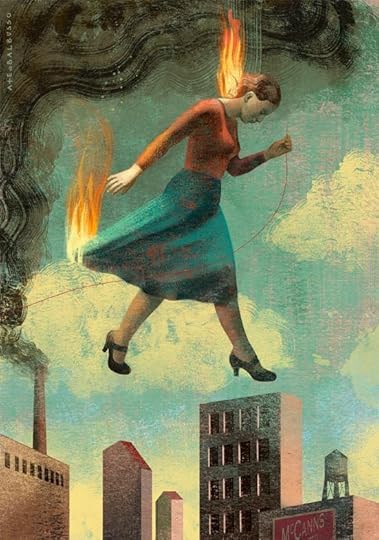
Burning Girls, by Veronica Schanoes, is a fascinating dark fantasy novella about a Jewish girl educated by her grandmother as a healer and witch growing up in an increasingly hostile environment in Poland in the late nineteenth century. In addition to the natural danger of destruction by Cossacks, she must deal with a demon plaguing her family.
My Nebula Novella Nominees reading continues. Burning Girls by Veronica Schanoes was a 4.8-star experience for me, and I wouldn't hesitate to recommend it.
There is some wonderful writing going on in the SF/F genre these days, and I couldn't be more excited by discovering some high-quality new-to-me storytellers.
Starting with this publication, permaybehaps she will be the author of a whole collection. Until now, she's been in anthologies like Queen Victoria's Spells and the 2008 edition of the year's best fantasy and horror.
''Deborah - the judge." ''She is sharp enough, but there is no heart in her chest, only a steel gear.''
So she thought to herself "if I cannot be pretty and if I cannot be kind, I can be powerful, I would be powerful, and make everybody see it.''
Deborah a Jewish girl has been trained by her witch grandmother, and try to save her family in the late nineteenth century in Poland and NEW WORLD. I find myself heartbreaking as reading this short, fantasy, historical, fairy retelling, wonderful, fascinating, impressive, and terribly sad story.
"In America, they don’t let you burn. My mother told me that.'' BUT I wept while burning there.
3.5 stars. A chilling and dark take on a classic fairy tale brought into an entirely new context of Jewish mysticism and turn of the century immigrant culture that I found quite compelling.
Learning and skill are things to be proud of; they are the stars that light the sky of one's lifetime.
Growing up in Poland, Deborah has been trained by her bubbe in ancient arts that many consider to be witchcraft. She becomes a godsend to her village through her skills that involve treating illness and all manner of womanly woes. But, will her training be enough to help her keep her baby brother safe from a powerful demon? And years later, after she and her sister have arrived in America, will she be able to do it again?
This is a beautifully written novella that echoes the story of a familiar fairy tale. The author skillfully combines Jewish folklore and an old-world charm with the horrors of the early 20th century.
Intricately woven tale of religion, superstition and fable. The reimagining of the elements used are impressive in this turn of the twentieth century novella.
But I had the power. I knew already that I could be useful.
I find myself speechless in trying to describe how good this novella is. I'm tempted to just write READ IT NOW and leave it at that, but as a review that would hardly be convincing enough. Part historical fantasy, part horror tale, BURNING GIRLS takes Jewish folklore out of the shtetl, brings it to the New World, and applies it to one of New York City's most notorious and lasting tragedies. To say it blew me away would be an understatement. In only a short number of pages, Schanoes creates characters that feel as real to you as your own family, and a world that lives and breathes as much as the one around you. It's no surprise that BURNING GIRLS won the Shirley Jackson Award for best novella of the year, or that it continues to receive such well deserved accolades. This is something special. Read it now.
I'm typing sentences, deleting them, and attempting to write more. I don't know what to really say except that Burning Girls left me speechless. I started reading the story without reading any reviews or the words italicized at the start. It was on Tor.Com - what else did I need to know?
What I found in Burning Girls was a striking mixture of witchcraft, Judaic mythology, fairy tale, history, and feminism. The more I read, the more I was sucked in by the writing of Veronica Schanoes. She weaved the above-mentioned elements into her world flawlessly and held me helplessly ensnared in it. By the time I reached the end, my skin crawled and was covered with chill bumps.
Veronica Schanoes' Burning Girls is a story you should put aside an hour for, and she is definitely a writer whose future works I will be impatiently waiting to read.
Heartbreaking. I thought I knew what was coming, because I identified the story upon which it was based. I missed the biggest clues of all. Gorgeous writing.
Burning Girls by author Veronica Schanoes is a dark fantasy novella you could read for free on the Tor.com site, but at some point the author published the anthology Burning Girl and Other Stories which features this one (and others) and took it offline.
''She is sharp enough, but there is no heart in her chest, only a steel gear.''
A Jewish girl named Deborah learns all about healing and witchcraft from her grandmother. When it becomes too dangerous to stay in Poland, Deborah and her younger sister Shayna go to America.
"In America, they don’t let you burn. My mother told me that.'' But I wept while burning there.
A great re-imagining of Grimm’s Rumpelstiltskin al be it dark and heartbreakingly sad. Great story telling. I will read Veronica Schanoes’ anthology soon.
Themes: Bialystock, Poland, a contract with the lilith, coming the new World, the old demons are still around.
When I was looking for my next tor shorty, I decided on this one because I really enjoyed Veronica Schanoes other story, Among the Thorns which I thought was a much more successful story than this one.
This one is pretty much teetering on 2.5 stars, and I rounded up because I do enjoy this author's writing style immensely and I think I would have liked it more had I not read Among the Thorns first. The plot for this one just felt forced and cliche for me, and was too much like the other story I had read, that I am wondering whether Veronica Schanoes is pretty much a one-trick pony. Both stories dealt with the concept of cultural and social identity, both read like folktales, and both had a historical backdrop containing small eastern European Jewish villages, revenge, and folklore. I enjoyed Itte from Among the Thorns much more than I enjoyed Deborah from Burning Girls and found her character much more genuine. Itte becomes thirsty for revenge when her father is murdered, and that thirst permeates into every single living cell of her body and it then radiates out from her. Those emotions are raw and chilling, and made her a much more interesting character. Deborah is smart but ugly and I found her much less sympathetic. Even when her loyalties to her family override her tendency to be cruel, punishing, and self-righteous, her moments of virtue kind of came of as false. The story itself surrounds Deborah and her training to become a healer and a witch like her grandmother. She, like her grandmother before her, battles with an ancient demon, a lillit, who torments women into giving up their children, using her newfound powers to do so, even as they weaken her.
Both Itte and Deborah are Jewish girls growing up in a Gentile world. The themes of cultural identity run through both, though it is more central in Among the Thorns. Deborah and her sister Shayna eventually end up in America, working in factories, and learning to adapt to their new surroundings. When they find that the lillit has followed them there, Deborah must work hard to protect her family and their futures.
The problem I had with this story is that I just didn't find enough creativity or anything new. Honestly, much of the story read like a retelling of the Rumplestiltskin story (and really, do we need any more updates of that one?) and it even appears that the demon's real name is Rumfeilstilizkahan. (Coincidence? I think not.) And like I said earlier, I may have liked this one a lot more if I hadn't already read a far superior and similar story.
One thing I will say about it is that the writing is gorgeous. Veronica Schanoes is really adept at capturing imagery and painting scenes with words. A turn of a phrase here, or a beautiful line there really added up to make something beautiful. I just wish I was reading something just a bit different.
I came across this novella almost by accident. Not the ones that involve tripping or any other misfortune, instead I prefer to point my finger at Fate. In what I guess are 31 pages, the author weaves _ and in this I'm afraid I'll have to resort to the same old tropes _ a heartbreaking story with roots in the historical fiction, magical realism, fairy tale retellings and horror domains.
"In America, they don’t let you burn. My mother told me that. When we came to America, we brought anger and socialism and hunger. We also brought our demons. They stowed away on the ships with us, curled up in the small sacks we slung over our shoulders, crept under our skirts. When we passed the medical examinations and stepped for the first time out onto the streets of granite we would call home, they were waiting for us, as though they’d been there the whole time."
Told with a crisp efficiency, the Burning Girls takes us to Nineteenth century Poland, to a land and time fraught with the potential for racial problems. In a place where legends of Old are still very much present in the characters lives, what follows is a rich and dark tale of superstitions and dangerous beings, that don't take kindly at being thwarted.
I had read some comments on how a certain event _ that I only heard about for the first time, in the most recent Alice Hoffman book _ , lets call it that (to avoid spoilers), was also a part of this story... ...even so, I kept waiting until the last moment for a different thing to happen. For a moment i held on to the fairy tale part, forgetting that this is mostly an horror story.
Also I can't help pointing out, how refreshing it was, to have in such a short novella, a relationship the sorts of Deborah and Ruthie. I'm afraid that the first time Deborah says that she doesn't care about boys, I got myself prepared for some insta love idiocy, as it's normally the case. But unlike what today has become a trend, that didn't happen here, and I loved the small insights we are given into their relationship.
Poignant and unforgettable, this is much more than a family's plight from the supernatural element. It's a realistic portrait of Jewish families who trying to escape persecution in their countries, ended up finding another different type of horror, in the countries who received them. You can read this novella Here
Also on the Tor's site, and according to Ellen Datlow:
A new story by Veronica, a novelette called "Among the Thorns," will be posted on Tor.com April 30th. Suffice to say, that I'm really looking forward in reading it.
Author's Official Site
You can also get the Burning Girls free ebook here: Kobo
Every now and then, in the midst of all the dross, you read something that moves you. Veronica Schanoes's Burning Girls is just one such story.
Set in the late 19th century, Burning Girls is about Deborah, the daughter of Polish Jews in the years after Cossacks stopped burning villages but while the threat of pogroms against Jews was still very real. While her sister is raised to follow her mother as a seamstress, Deborah is trained by her grandmother to be a witch. She uses a white magic that draws on arcane and mythical Kabbalah-like Jewish writings and beliefs. As her power grows, she learns of a demon stalking their little family. Then, one day, the long feared pogroms come for them, and they set their sights on America, to start over, to escape the violence, and to escape the demon.
Part of what I enjoyed about this fantasy (a period fantasy, maybe?) was how it felt authentic, while at the same time avoiding cliches. Sure, there's a bit of handwaivium going on, but the magic is not without a cost. Based on language and the calling on power from certain angels and names of God, Deborah uses the magic to help women, and it lends a certain sense of sympathetic feminism to it.
And yet, it's Schanoes use of pathos, rather than magic, that makes the story worth the read. They struggle, grow, hurt, and are hurt. They grow together and apart, are tossed and turned in the trends and politics of the day. With each obstacle overcome, sympathy builds until a final denouement that both surprises and moves.
Burning Girls was nominated for the 2013 Nebula in the novella category, and while it didn't win, it was a worthy nominee.
It doesn’t happen often that a novella has the ability to hold such a complete and rich story within the span of a few dozen pages.
The story follows Debora, a slightly obnoxious but gifted girl, as she is trained by her grandmother to be a healer and witch. In an attempt to escape the Cossacks, Debora and her sister leave Poland for America only to find out that you cannot outrun your demons.
This is a beautifully written novella that echoes the story of a familiar fairy tale. The author skillfully combines Jewish folklore, old-world charm and magic with the horrors of the early 20th century.
In America, they don't let you burn. My mother told me that.
I thoroughly enjoyed this book - loved the writing and the story. I am a big fan of magical realism and for 1 cent on Amazon this is definitely worth the read.
This collection was like many collections- some great stories, some that were okay, and some that left me cold. Common themes in the stories: GLBTQ+, feminism, Jewishness, folk and fairy tale retellings, labor movement, mental illness.
I always like a good retelling/reframing of a classic story, and the final story "Burning Girls" managed to put together pretty much all of the themes I've listed above, wrapping the tale of Rumplestiltskin with immigration and the Triangle Shirtwaist Factory Fire. It was one of the strongest stories in the book. I also liked "How to Bring Someone Back from the Dead" with its allusions to many such heroic efforts and "Ballroom Blitz" with its echoes of The Red Shoes and the Shapeshifted Swan Brothers combined with a rockabilly style and unexpected notes of the desperation of the chronically mentally ill.
"Phosphorus" was good but just plain depressing as it described the life and death of a match girl, one who worked in a phosphorus match factory. "The Revenant" was also an interesting a creepy meditation on vengeance.
I didn't so much enjoy "Tea with Baba Yaga", "Lost in the Supermarket" which just felt pointless, or "Alice: a fantasia " which was a little too trippy and disjointed from reality for me.
It took me a bit longer than I wanted to finish this book because I stalled on some of the weaker stories, but if you skim past them there are rewards worth reading.
A short novella touching on the Cossacks invading Poland, surviving young Jewish women coming to America where they thought they'd be safe, and learning otherwise the hard way. It takes place around the time of the Triangle Shirtwaist fire, and the story has women working in the factories being treated horribly. Part of the story has the girls fighting off demons with witchcraft, which I skimmed. Too short to become very invested in it, but not bad.
A fresh take on the historical witches folk tale. Full of dark atmosphere, Jewish culture, and oppressive atrocities. Well written with a well voiced protagonist easy to invest in. I enjoyed how this really brought to life how the righteous men of the New World manipulated the naivety and desperation of those seeking a safer life, and how it doesn't follow the expected path.
It's a pity it was so short. And I would have loved some notes at the end about the historical events that inspired the story. But the weaving together of a fantastical narrative and true events was excellent and poignant.
There is a lot of history and a lot of life packed into this one story. It really is one of the best stories I've read this year among all of the many award nomination processes, smart, clever and still enjoyable to read, but still important to remember. The whole package. It was nominated for the Nebula Award for Best Novella in 2013 against a strong field.
It was interesting that two other Nebula nominated novellas were also historical fiction. I strongly preferred this to Wakulla Springs, though I'm in the minority going by the number of nominations and wins it received. The history in that story was strong but the speculative fiction elements were weak, as was the pace and tension, both of which were strong here. Vylar Kaftan's The Weight of the Sunrise from Asimov's Science Fiction, February 2013 or possibly available online depending on your timing, was an alternate history of the Incan Empire that was also quite interesting and enjoyable to read. What if they'd found a way to isolate people with smallpox and quarantine them? How would it have changed the history of that nation, that region? And what sort of a relationship would the revolting American colonies want with the power to their south? I wasn't able to read Nancy Kress's or Catherynne M. Valente's stories that were also in the Nebula category, but Laurence M. Schoen's was a lot of fun, not what I normally see in award nominated stories, just a regular fun story well-told and a series that I want to add to my to-read list.
Anyway, The Burning Girls was a very powerful story in a field of strong, interesting and entertaining stories. The history happens to be some that I'm quite familiar with and I appreciate the way the more horrifying parts were told with deep emotion without going too sensational. It felt true, like the reader was witnessing a family tragedy. Usually short fiction has to focus in on one event or a short time frame to make the impact work within the physical size of the assignment, but this story attempted to show this family's triumphs and all to many tragedies over time and across cities and nations, and the author made it work, focusing in on a narrow enough tale that the slightly longer or wider scope worked very well. It's a story of America, just as Wakulla Springs was, with or without the demons and witches or sea monsters. It's always the monsters who wear human skin who are the scariest after all. All three of the historical fiction based stories show that element pretty clearly.
And once again I'm going on and on because I'm writing too late at night while I'm too tired. But The Burning Girls is available for free still from the Tor.com website and I think it may also be available from Amazon as well for the same low price, I encourage you to check it out. it's not a spot of light reading, but it's a worthwhile story that you'll remember.
Born in Bialystok, Poland at the turn of the century, Deborah is possessed of the power like her bubbe. Deborah is a witch, and spends her summers in training with grandmother Hannah: learning to assist in childbirth, cure common ailments, terminate unwanted pregnancies, craft blessings and talismans, and drive away demons. But Deborah's magic is little help against the growing tide of antisemitism sweeping through Europe; and when the Cossacks lay waste to Hannah's village, killing Deborah's beloved grandmother and mentor, it becomes clear to her family that they must escape to America. America, where "they don't let you burn."
While the family - mother, father, and sister Shayna - work overtime to save enough money for the trip, Deborah discovers a horrifying secret. There, among grandmother's sparse belongings, is a mysterious contract: "The ink seemed to be made of blood and vomit. A stench like cowshit rose off the page. My stomach churned every time I unfolded the paper." When a demon tries to steal her newborn brother Yeshua, Deborah realizes that her grandmother did the unthinkable: traded her daughter's next child in exchange for the family's safe passage to America. Though Deborah succeeds in destroying the contract, it's at great personal cost; and while Deborah and Shayna eventually make it to the New World, they're ultimately unable to escape the lilit's clutches.
Burning Girls is a beautiful and captivating story from start to finish. Schanoes draws from multiple genres - dark fantasy, magical realism, fairy tales, historical fiction - seamlessly weaving these threads together to create a bewitching tapestry filled with horror and heartbreak. (The Białystok pogrom, during which between 81 and 88 people were murdered and another 80 injured, occurred in June 1906; and the Asch building was the site of the infamous Triangle Shirtwaist Factory fire.) This could easily be a full-length novel (frankly, I'd love to see it on the big screen!) but works beautifully as a novella.
The story's title, which is referenced throughout the plot and in myriad ways (is Deborah not a girl on fire when she uses the power of the evil eye to set bubbe's contract aflame?), sets the stage for a rather shocking climax. Schanoes also plays with language in interesting ways; take, for example, Deborah's abrupt transition from spending her days in friend Yetta's sweetshop to slaving away in a NYC sweatshop.
Whether you're interested in fantasy or feminism, worker's rights or the persecution of Jews throughout history, you owe it to yourself to check out Burning Girls. I cannot recommend it highly enough.
Kindle freebies can go either way, but this one was very good. Marketed as dark fantasy, but to me it read as fiction with a mythical aspect. This novella tells a story of an Eastern European Jewish female experience both in the old country and the new one. It's a fine piece of historical fiction ending with an all too real all too tragic fire, putting a fine point to the fact that there were many ways to get burned for the oppressed minorities on either side of the world. Excellent writing and well developed characters. This was an excellent short read. Recommended.
"Learning and skill are things to be proud of; they are the stars that light the sky of one’s lifetime."
The story really give goosebumps. It's a long time I never read a good novella with witty and well written. Burning Girls that I found by accident when I was looking for light reading.
The story are combined of Jewish folktore, a fairytale adaptation, historical accident, science fiction in horror and feminist.
I will look forward for Veronica work's in future. I love her writing style and how she building up the story and plot with ending that i never expected.
Schanoes was a very deserving winner of the Shirley Jackson Award for best novella for this fine entry in a field of excellent work. She blends myth and folklore, history and horror into a compelling narrative about characters who act and feel real. Her use of the real tragedies of the Russian persecution of Jews and the Triangle Shirtwaist Factory fire are heartfelt and powerful, never exploitative, raising the narrative to a transcendent and devastating level.
BRILLIANT. Even though it's based on a quite well-known story, it is fresh, bold, feminist, full of witchcraft and a political background and references to religion that are actually relevant. Pure gold. It's so colorful the real world looks pale after reading it.