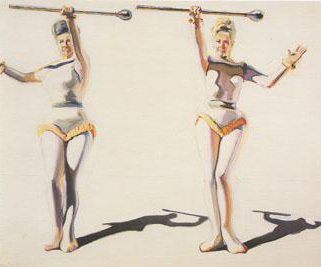
One of the giants of American art, Wayne Thiebaud was at first unappreciated because of the everyday subject matter of his paintings. His tasty hot dogs, delectable cakes, dizzy streets, and sleepy deltas have since become icons of twentieth century art. Now young readers have the chance to explore the development of a fascinating artist while delighting in the very child-friendly art that has made him so acclaimed. With her deft touch, critically-acclaimed non-fiction author Susan Rubin tells the story of the man behind the masterpieces.
Susan Goldman Rubin is the author of more than forty-five books for young people, including Andy Warhol: Pop Art Painter; The Yellow House: Vincent van Gogh and Paul Gauguin Side by Side; and Edward Hopper: Painter of Light and Shadow. A long-time instructor in the UCLA Extension Writers Program, Susan Goldman Rubin lives in Malibu, California.
A solid brief biography and introduction to the art of Wayne Thiebaud, suitable for children or adults. Alternates pages of text with art reproductions.
Outstanding book! It’s a terrific story of the man and the artist., and the teacher. It’s beautifully done. Included is little seen work by Wayne Thiebaud. I love his landscapes, desserts, people, etc. A wonderful painting that I’ve never seen before that appears is his “Self Portrait with Suspenders.” He looks so approachable, and I think this book shows that he is. For this book, he very generously provided information about his life and artistic education and experience and outlook. The layout of the book is so creative and attractive. Each page’s background is in a different color, and even the text color often changes. I had no idea he knew Willem De Kooning, another artist whose work I appreciate. I didn’t know he had a second house in San Francisco either. This book works as a biography, an art book, a book that teaches art, an art history book, even a philosophy book; it’s just terrific. Kudos to Susan Goldman Rubin because she let the artist speak for himself and his work is displayed so well, it’s hard to remember everything isn’t coming just from him, that she in fact put this book together. I’m wild about this book, and I think kids will be too; Thiebaud’s art is often very appealing to children.
Middle-grade well-designed chapter book biography that "feels good" in the hand, told in an easy conversational style. Author Susan Goldman Rubin reveals Thiebaud's different art stages showing his sense of humor, use of color in different media (35 color images!) as he struggled to find his own way of painting--well organized and clear writing.
This book is one of my earliest art memories... My art teacher always had a copy lying around. She showed me Thiebaud's beautiful brushstrokes, his iconic blue shadows... I'm still in love with his work.
This compilation is delightful in its charm and simplicity. A great introduction to Thiebaud and his art, especially for kids.
Lovely children's non-fiction work on Wayne Thiebaud! Surprisingly there aren't a lot of extensive artist bios on him online so this was a great help in preparing for my Art Club lesson for kids!
Wayne Thiebaud is a well known artist because of his delicious and beautiful paintings. Most of his drawings are from his childhood memories. He started painting when he broke his back while playing football. He used it as a distraction but gradually started to like it more and more. He usually painted food in different perspectives and added shadows to make the drawings look more realistic. When he was sixteen, he got a job as an in-betweener for Walt Disney Studios. He went to an art school in Los Angeles where he learned many useful tricks that he would later use in his painting as a professional artist. During WWII he entered the army for he wanted to become a pilot, but instead he became an army artist. There he met Patricia Patterson, who he married and had a daughter named Twinka. He went to New York to find a job as a cartoonist and a commercial artist. He didn’t get many opportunities and he missed his family, so he went back to Los Angeles. He started to work as an art director and cartoonist in a company's employee magazine. Wayne started to become interested in fine art and studied the art of great painters who captured the human figure on canvas and paper. Wayne and Robert Mallary became good friends, and Mallary would critique his artwork to make him better. In 1949, Wayne went to college to get a degree so he could teach art. When he graduated, he got a job teaching at Sacramento Junior College. The first thing that Wayne taught his students was drawing. He wanted them to capture the object they wanted to draw. In 1951, Wayne went back to school to earn his master’s. There were no art galleries in Sacramento, so Wayne published his art where he could. Wayne was tired of not having his art displayed in a real art gallery, so he moved to New York City. He always made a thumbnail sketch before drawing the real painting. He outlined the shapes in his drawings with vivid colors such as blue and green. Wayne wanted his own style of learning, and he acquired that by sketching the drawing with a yellow color and the filling in with the actual color, making borders in his painting. Wayne and Patricia divorced, and he married Betty Jean Carr. When Wayne started to show his work to the public, no one wanted to buy his art. He went to many different galleries, but had no luck. When he was about to give up, Allan Stone took his artwork and kept it in his house to see what he liked best. Realizing Wayne had talent, he offered him a one-man show where all of his artwork was sold. Wayne started to draw people in 1963, for he was always interested in painting people. At first he tried drawing from memory, but realizing that it was a disaster, he drew life models instead. Wayne usually tried many shadows before finding the right one for his drawings, which were always filled with color. He would sketch a portrait of himself every morning, and sometimes, he would turn them into painting. Wayne started to draw landscapes, but it took him tie until he mastered this style of painting. He played with perspective to trick the viewer. He used ideas from sketches he made in the past to create a composition. He made small drawings into bigger formats to see how the drawing changes. He changed compositions to create new ones or created different compositions with the same object. His signature was a small heart before his last name. To give himself challenges, he would increase to number of desserts in his compositions. He even 34 treats in one of his drawings. His son, Paul asked him for lessons and he would tell him to keep a sketchbook. He would correct his drawings and show him techniques. He retired and started working part-time as a studio art and art history teacher. Wayne won dozens of medals, awards, and honorary degrees for both his paintings and teaching. Wayne is still modest, although he has lots of success. His pictures show his sense of fun, joy of painting, and his love of color.
Wayne Thiebaud followed his dreams and passion, even though he knew that he could lose what he already had. This is what I like about Wayne. He isn’t arrogant and will help others. He’s modest and appreciates the simple things of life, such as food and a simple day at the beach. Wayne became famous because of his paintings of food. He increased his popularity with a variety of different compositions such as portraits and drawings of dancers, his wife, his children, and many more. He learned many techniques and styles from different artists, such as de Kooning. He adopted his style of lines and drawing. De Kooning’s drawing technique included many different brushes and was like a rhythm or pattern.
I would recommend this book to Middle and High School students who are interested in art and famous artist. To those who like art history and want to learn more of how some artists are well know now. I would recommend this book for, it’s really interesting and teaches you about many great achievements in Mayne’s life and how simple doesn’t have to be bad. Art is found in many places, and even in the most unexpected.
This entire review has been hidden because of spoilers.
Artist Wayne Thiebaud doesn't fit into a neat little descriptive adjective. He doesn't consider himself to be a "pop" artist, but he paints everyday objects. He isn't a landscape artist, but his landscapes intrigue the eye and involve the viewer. He isn't a portrait painter, but his portraits and paintings of people tell us a great deal about the subject and the artist as well. In this "deliciously" designed book, the author not only informs us about his life, but we learn a great deal about art at the same time. Filled with some of his best known works as well as works that are from private collections and are seldom seen, this yummy looking book may entice a young reader to learn more about art. Or just look at the world in a different way.
So much delight in one slim book! In Delicious author Susan Goldman Rubin introduces the work of contemporary artist Wayne Thiebaud, best known for his large canvases filled with desserts. Thiebaud's bright paintings are a reflection of his personality: "I was a spoiled child. I had a great life, so about the only thing I can do is to paint happy pictures." As Rubin unfolds the story, we learn that Thiebaud worked hard, practiced his art, and shared his wisdom freely. Rubin also brings out the depth of thinking and creativity behind these seemingly simple canvases. Finally, the gorgeous bright book design is just a joy to read, hold, look at. Delicious is truly a sumptuous treat!
How can you not love an artist who focuses on desserts? Rubin's artist biographies are always a delight and this one is no exception. It celebrates an artist who had a happy childhood and wants to create joyful art. That's a rare combo with artists! I've always loved his food paintings, but I now am fascinated by his farm geometric landscapes and would like to see more of his work. And, I'd love to see him draw Popeye with both hands simultaneously like Rubin reports he can do.
Beautiful design work and an engaging, conversational voice make this a wonderful introduction to the art of art. I'm deeply impressed with Thiebaud's range - not having much exposure to his work outside of his foods, I found his landscape and portrait work very interesting. Kudos to the author for getting permission to reprint so many privately-owned pieces of the artist's work.
This is an outstanding summary of the man and the evolution of his art. I had the good fortune to meet Mr. Theibaud twice. He is a true gentleman with a great sense of humor. The author neglected to put a warning label on the cover: "Please do not read this if you are hungry. You may take a bite out of it." Enjoy this delightful book!
Another great bio by Susan Goldman Rubin. The book design is fantastic - yummy colors, easy-to-read layout, felt way more fun than the typical biography for kids. The art is gorgeous, and the colors Thiebaud chooses truly are delicious.
I love Thiebaud's work, and this is a fab intro to the ideas and life experiences that made him into such a fabulous artist. Reproductions are wonderful, too, and show the variety of his work (not just the paintings for which he is so well known). Really enjoyed this one!
A beautiful book with full color examples of the artist's work on nearly every other page. A substantial bibliography and index make this a nice choice for biography research projects. A wonderful addition to library collections, or home collections for budding artists.
This was a terrific biography of Wayne Thiebaud and his somewhat difficult- to-categorize painting style. I only wish every J-Biography book was this beautifully designed and interesting to read—my memories of reading biographies as a young reader certainly don't include books like this one.
Wonderful little book. Lots of beautiful prints of Wayne Thiebaud's paintings and many pieces of interviews with him. Sure, it's short on analysis of his paintings, but as a shallow person, I'm ok with that!
An absolutely "delicious" study of a contemporary painter, how he makes art, and what art does, packaged in a wonderfully designed book that young people (and pretty much anyone else) will enjoy.
Rubin does her usual outstanding job of capturing her subjuct. In this book, she doesn an exceptional job of bringing the artist and his work to the young audience.
This is a fast read, and I love the colorful format and pictures. I was interested to learn about Thiebaud's journey to become a professional artist. It made me want to do art!