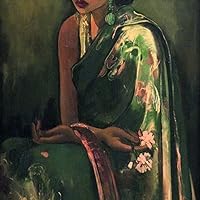
"But as we are to see a great deal of Amelia, there is no harm in saying, at the outset of our acquaintance, that she was a dear little creature. And a great mercy it is, both in life and in novels, which (and the latter especially) abound in villains of the most sombre sort that we are to have for a companion so guileless and good natured a person. As she is not a heroine, there is no need to describe her person; indeed I am afraid that her nose was rather too short than otherwise and her cheeks a good deal too round and red for a heroine..."
I just chose this passage randomly out of the first few pages of the novel to illustrate how much I love Thackeray's voice. He himself is the best character in the novel. To use theatre terminology, he definitely breaks the 4th wall into the story quite frequently. Reading it is rather like watching the play, but with periodic pauses for the playwright to jump up on stage and offer his commentary upon the action, and also upon his perceptions of the feelings of those watching his creation. (Thackeray himself terms the "Vanity Fair"- his comment on society in general- a sort of play.) This might sound annoying to some, but, really, it isn't. If you're already reading the book critically... I suppose it could also be compared to reading a chunk of a book for class and then stopping to discuss your reactions with a professor determined to make you see things beyond the surface and expose whatever prejudices you might have against the book. I loved debating with Thackeray in interpreting scenes and actions. The margins are filled with my disagreements or indulgence of his point of view. And I almost never write in books. It was irresistable in this case.
It is as interesting trying to draw a portrait of Thackeray's character as it is the rest of them. He is sometimes defensive, sometimes judgemental of his audience, at times quietly insightful, at times ironic, at times as gleeful as a child at some trick he believes he's played upon us. You can just see him cackling over his writing, clapping his hands when he thinks of something good and scribbling away furiously into the night. He makes the tale seem brightly, urgently alive just in the sheer immediacy of his feeling and force of personality.
Right. As to the story itself? Very solid, old fashioned tale of love, war, betrayal, money, family. All the standards for an epic. But in the way it is executed, it is anything but standard. Particularly for its time. It was subtitled, "the novel without a hero," by Thackeray. It is a book filled with, as the best are, very grey characters with motivations and actions sometimes very hard to fathom. The epitome of this is of course Becky Sharp, the main character if not the "heroine," of the piece. Capable of both acts of great kindness and selflessness, and sheer, naked cruelty when it suits her, it is hard to either condemn or praise the woman in the end. I grew to root for her anyway, though. She's awful, she really is, but she does seem to learn by the end of the book. She changes, progresses, and all while getting everything she's ever really seemed to want. She's ambitious and cutthroat, but manages to do well in a world that tries to slap her down at every turn. (Not that she doesn't deserve it sometimes, I will admit.) There is also a more standard, sweeping love story for those of you in it for the more conventional aspects. The above described Amelia is involved in that plotline.
Also? This book has the best, the longest, the most throughly researched and detailed description of the battle of Waterloo that you are likely to find. A huge chunk of the book is devoted to that day and the reaction to that day, and it is as epic a war novel as one could hope to find for that space of time.
In some ways, I feel like Thackeray was trying to encompass his century as a whole, not just the very specific time of the Napoleonic wars. He deals with class, money, ambition, war, roles and rights of women, questions of morality, and times that inevitably change and change again, pushing the old world and the old ways into ever faster irrelevance. Just as the 19th century did. I think Becky Sharp might well be a fitting symbol of the whole century: she wants to rise high in society, she wants as much money as she can get her hands on, she wants the appearance of morality (but doesn't much care for the actuality), she is from the lower class and spends the book working her way up the ladder tooth and nail through representatives of the "old guard," at any cost to herself or others. And yet, she still holds sentimental feelings for Amelia, for her husband, she does what she thinks is best for her son (however controversial that might be and at whatever cost in pride), and she cannot quite bear to be completely alone.... I don't know. I'm really just remembering things I wrote down when I read this over two years ago, re-piecing together theories, so I hope you'll forgive me if they're a wee incoherent.
There is more to it than that, but I do not think that any review of reasonable length can encompass everything in this book, particularly when I've already rambled about my favorite things for so long, and things are already this disorganized. Fitting, I suppose, in such a merrily chaotic book. So I'll just leave you with the quote that I think explains and drives much of the action and is one of the major points of the novel:
"Vanitas Vanitatium! Which of us is happy in this world? Which of us has his desire? Or having it, is satisfied?"